
What happens when spoken word poetry and the museum meet?
Maria Giulia Pinheiro takes stock of two years of SLAM at CAM
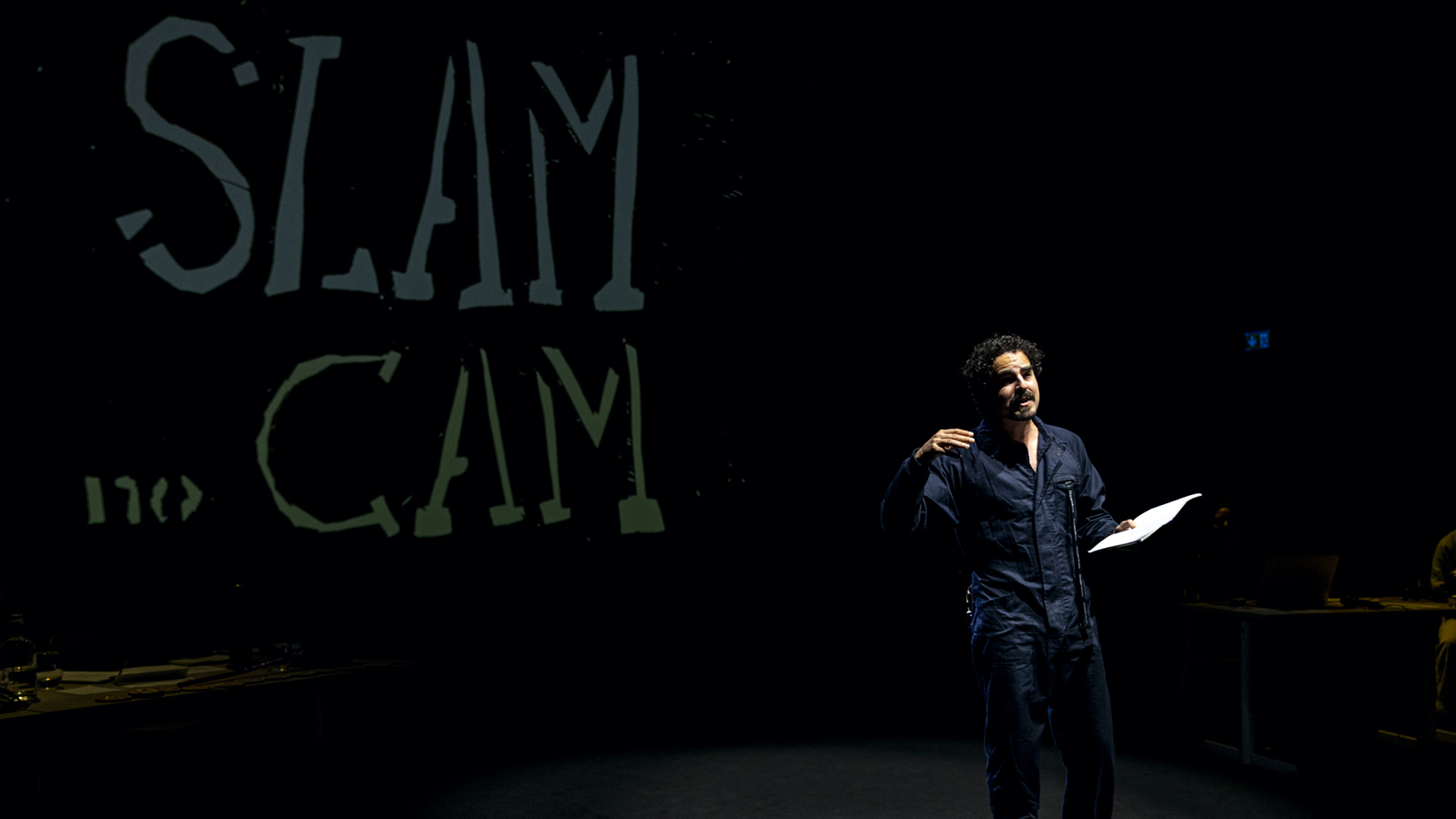
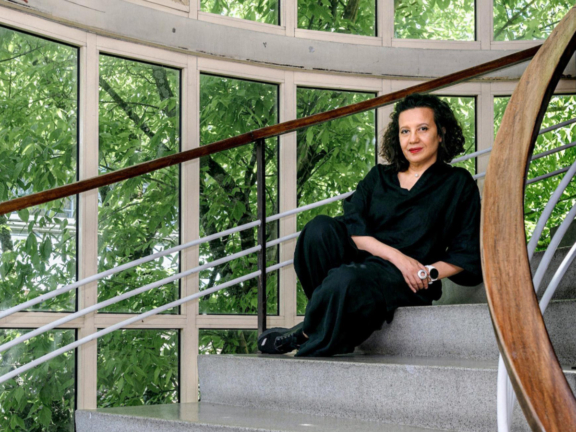
Maria Giulia Pinheiro has a particular image in mind to explain what sustained SLAM at CAM for two years: two people locking eyes, in a space where anything can happen. It was this trust in the encounter, more than any formula or spectacle, that enabled Associação Fala to organise, within CAM, ten editions of spoken poetry over the course of a cycle that the institution itself kept renewing along the way, as the confirmed quality of the project won over an ever-growing audience. September saw the last edition take place, a grand finale that closed a journey begun in January 2025
She describes the project as one of the most successful she has led, with a loyal audience of all ages and more than seventy-five poets taking to the stage, many of them several times. Laughing, she asks me not to write that SLAM at CAM was a ‘success’ before going on to admit that that’s more or less what it was. ‘We were able to enhance what CAM already gives to poetry’, she concludes, without hiding the pride behind her modesty.
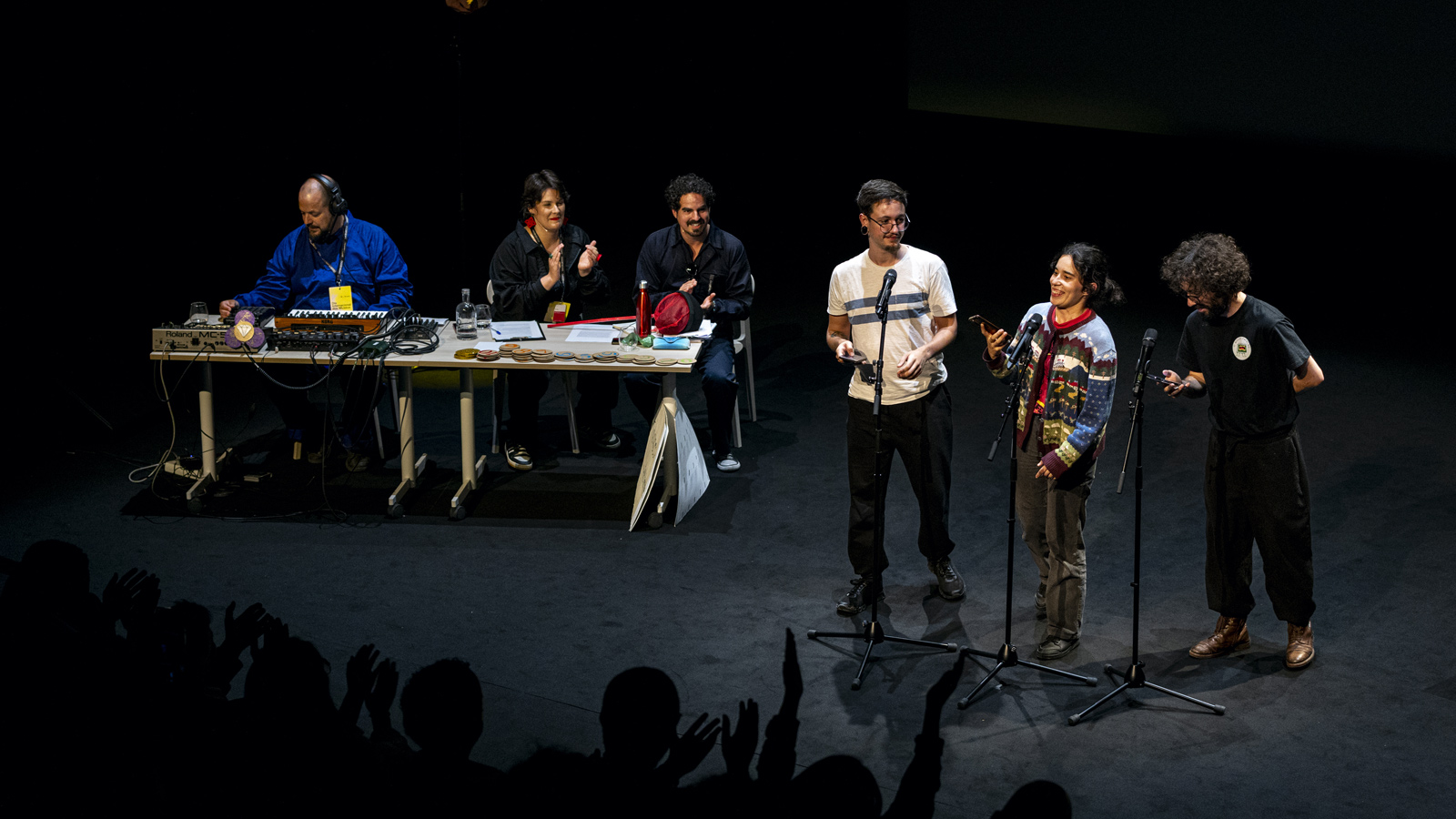
To understand SLAM at CAM and the work of Maria Giulia Pinheiro, we need to go back a decade and cross the Atlantic to Brazil. A poet and playwright, it was in São Paulo in 2016 that she competed in the national finals of FLUP, the Literary Festival of the Urban Peripheries, curated by Roberta Estrela d’Alva, and helped organise large-scale slams in the city.
She arrived in Portugal in May 2019 and, three months later, founded the Todo Mundo Slam [Whole World Slam], now in its seventh year. She found that there was already a history of a spoken word movement in the country, but that it had fallen into hiatus since Raquel Lima left Porto. ‘There has long been a strong movement in Portugal. It is a movement that needs to be nourished a little more, but it has existed for a long time,’ she says.
What she felt was missing was the playful component, the idea of fun, of a space where migrants can also feel welcome among the Portuguese languages, in the plural, a concept she attributes to the linguist Caetano Galindo, professor at the Federal University of Paraná, for whom the Portuguese language has never been a single entity. ‘What we’re looking for is precisely that difference. We aren’t looking for unity,’ she explains.
Todo Mundo Slam grew quickly and gained partners over those seven years, including Gonçalo Antunes, who now has shared responsibility for the project, and found a permanent home in Alcântara Library, where it has a regular audience. It also allowed other creations by Maria Giulia to flourish, for example the poetic ginjinha [cherry liqueur], a poetry circle around a glass of ginjinha, and her game Ciranda.
It was that series of ‘little seeds’, as she calls them, that, in November 2024, were formalised with the foundation of Associação Fala, a moment when, as she describes it, the laborious ‘ant’ work finally started to ‘sprout wings’.
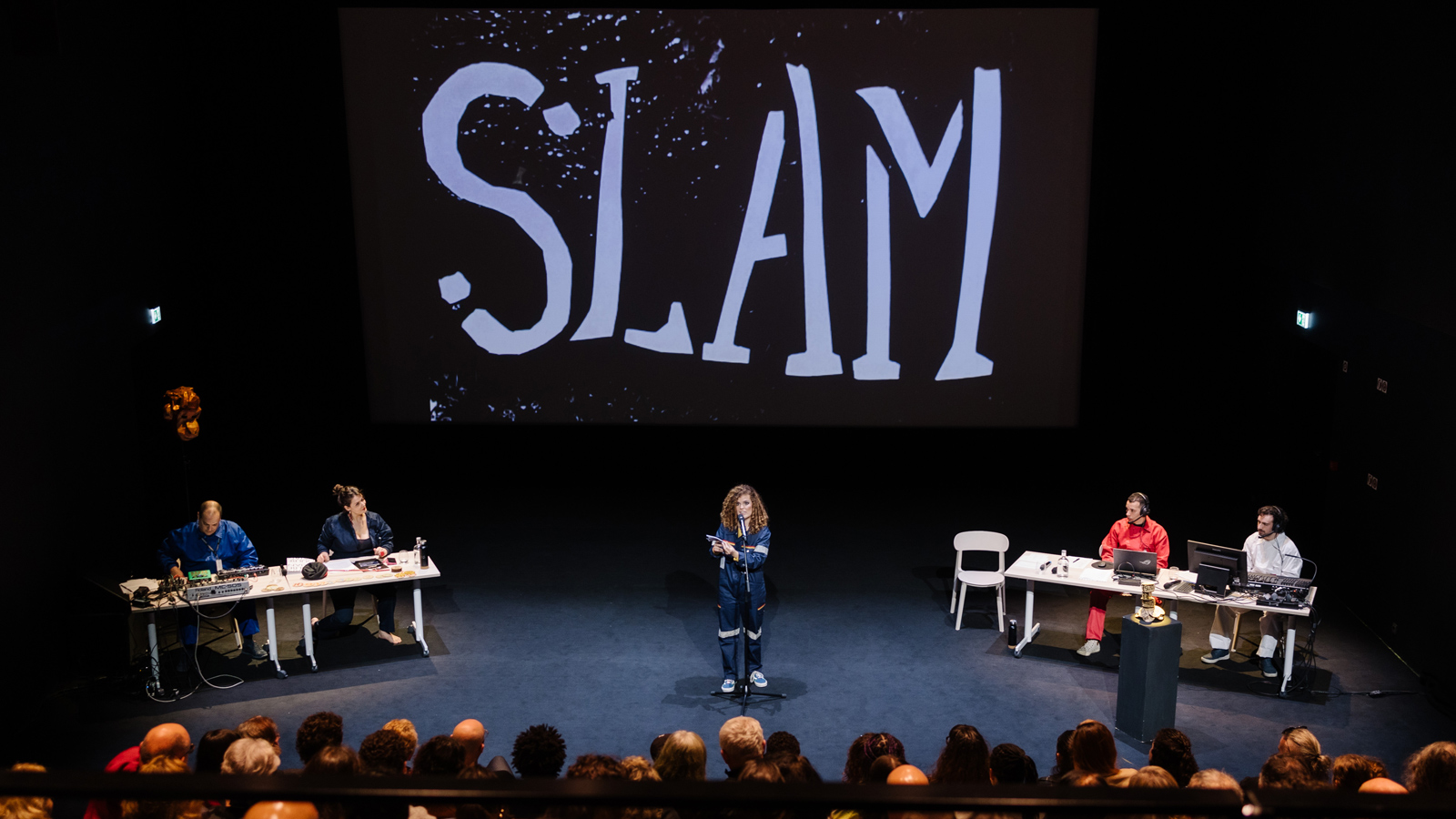
The invitation from the Gulbenkian to take the slam to CAM constituted one of the first big challenges for this new association, at the same time as Fala was taking on other partnerships, such as the Zona Ler Dramaturgia [Drama Reading Zone] at the Teatro do Bairro Alto (TBA), proposed by Melissa Rodrigues, then discourse programmer at the TBA, and the collaboration with Anna Zêpa, who brings a connection between poetry and the audiovisual to the project.
In the context of the CAM, Maria Giulia’s main concern was preventing the slam from transforming into what she feared most: a serious poetry competition. ‘When we bring a poet to the Gulbenkian, we have a responsibility not to let things get too serious, because it might seem like a poetry contest. And it isn’t. A slam a is spoken word game’, she explains. This cautious attitude stems from a very specific reading of the origin of the format.
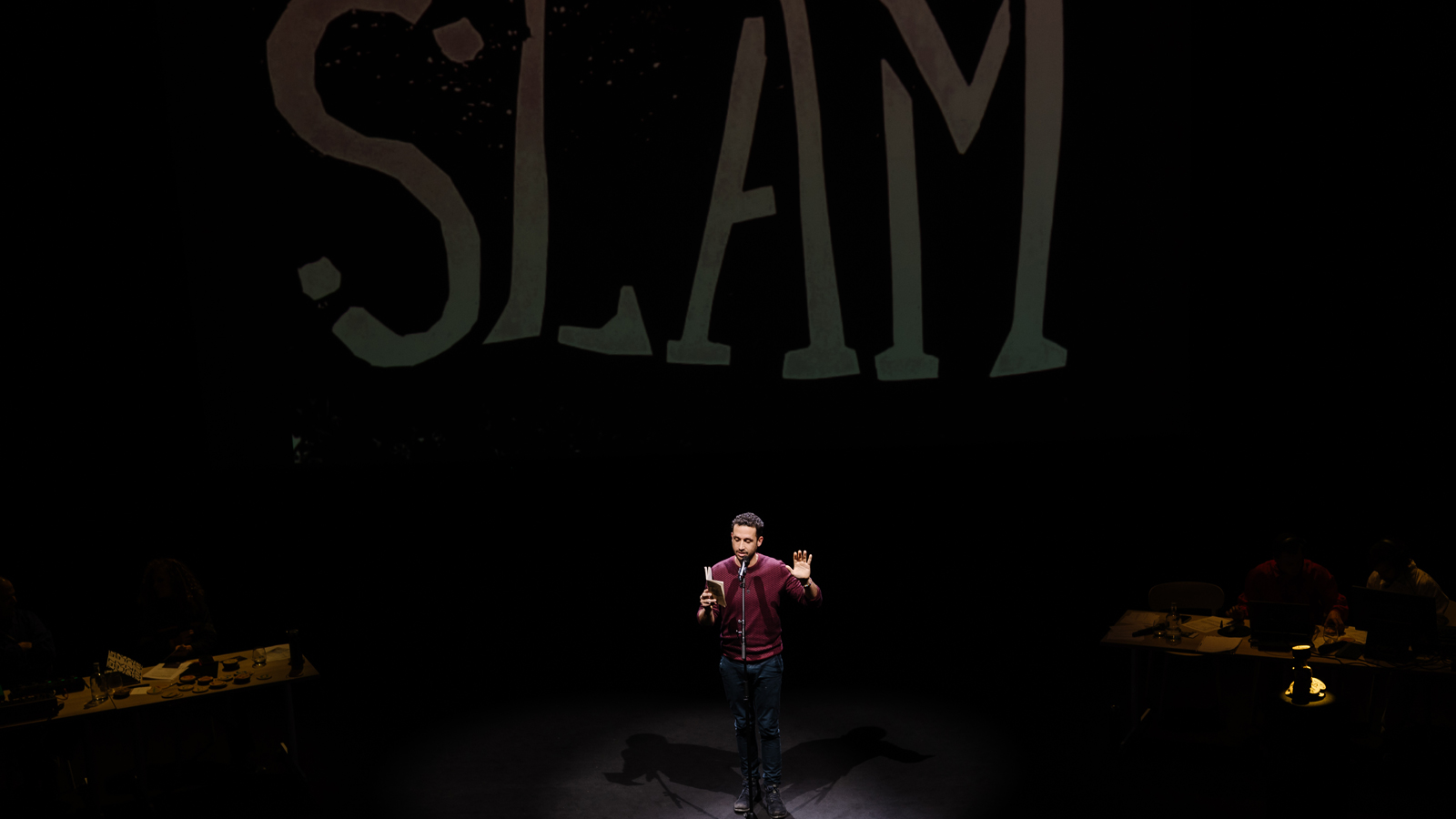
The poetry slam was born in the United States, created by Marc Smith, a construction worker from Chicago who didn’t see himself reflected in the seriousness of the poetry soirées in the city. But for Maria Giulia, that American genealogy relates only to competitions; the spoken word itself, she clarifies, is much older, present in the oral tradition of peoples from Latin America, the griots of the African continent, the European troubadours.
‘The beauty of Portuguese is that the technology doesn’t belong to anyone,’ she says, explaining that each slam adapts to the place where it happens. It is from that very concern that she avoids competitive vocabulary. ‘The moment we get too competitive, we start to think with a neoliberal mindset,’ she says, before explaining the aims she encouraged among the team: make people laugh, make them excited, and only later, if it comes to it, make them hurt.
Maria Giulia had already taken spoken poetry to the Museu da Língua Portuguesa, in Brazil, but never to a visual arts space. At CAM, poets visit the exhibition before each edition in search of inspiration, and the final poem of the night is always sparked by a work from the collection. The idea was suggested by Daniela Vinhetas, an educator at the museum, based on a similar experience she had led in Angola.
The outcome was the opposite of what she feared: the poets battled for a place in the third round just so that they could write, under pressure and in twenty minutes, a poem based on a work in the exhibition. ‘It’s a lot of fun when people get desperate to be in the third round’, she says, calling it one of the great triumphs of the format and proof that the word and the image feed off one another. ‘I’m a words person, and when they say that a picture is worth a thousand words, I always say: then tell me that with a picture’, she jokes, before arguing that visual stimulus doesn’t replace the power of the word, but instead multiplies it.
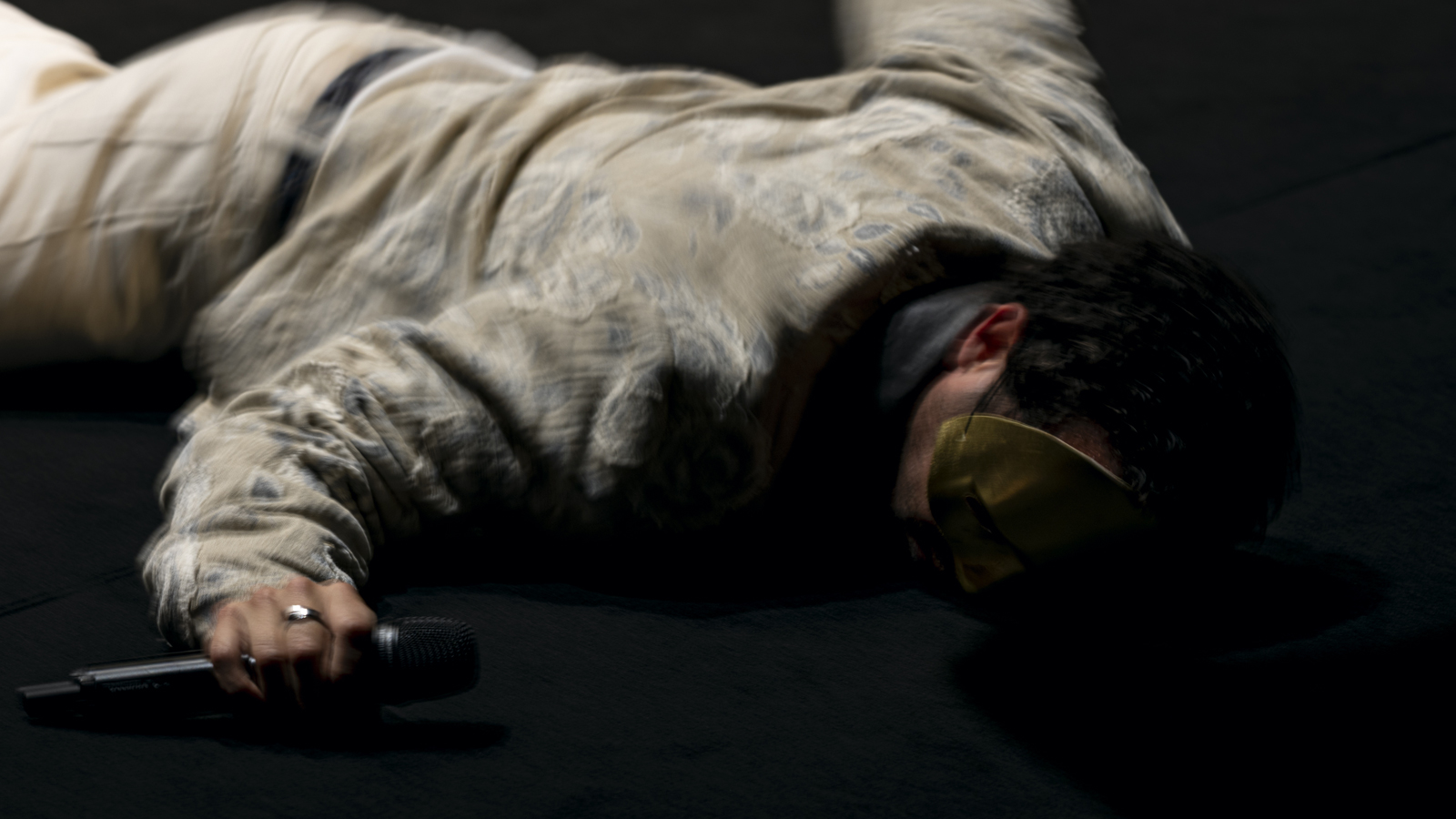
While participants in Todo Mundo Slam dress in sportswear, like athletes of the word, at CAM they become labourers of art, clad in workwear to use, in their own words, the apparatus offered by the institution in the service of poetry. The nighttime setting is specially designed to create tension without taking itself too seriously: wearing overalls, a host character interpreted by Gonçalo Antunes acts as a ‘wildcard’, able to bring back, in an act of last-minute justice, a poet who had a bad night at a previous iteration but who deserves another chance.
Participants can accumulate diamond points, a gold coin, a limited number of points that the scorers can attribute and a trophy that is itself an original work of art signed by Gonçalo Antunes – an object that, Maria Giulia admits she would love to have at home.
She doesn’t deny that the trophy and the desire for a good performance feed a certain competitive spirit among the poets. But what the Fala team does, systematically, is destabilise that logic: it shows poets how the results can be unfair, invites them to arrive before the audience so that they can get to know one another, asks them to talk amongst themselves as much as possible. ‘We want the poets to become friends’, she says, and cites her own friendships born on slam stages, including that with Luísa Romão, who has since won the Jabuti Prize in Brazil, and with Mel Duarte and Luz Ribeiro, who received a dramaturgy prize in Portugal.
At SLAM at CAM, everyone makes poetry, even the poets. ‘Creating is like eating, like going to the toilet, like having a bath. It’s a vital need, like drinking water’, she says, explaining why she refuses to place the artist on a pedestal.
The jury is composed of the audience itself, with a single rule: they mustn’t be personal acquaintances of any of the poets participating. Each participant has three minutes to speak, and over the course of an hour and a half around ten people take the stage. ‘We listen for twenty-seven minutes and speak for three’, she notes, describing the deliberate predominance of listening over speaking as the true democratic exercise of the night.
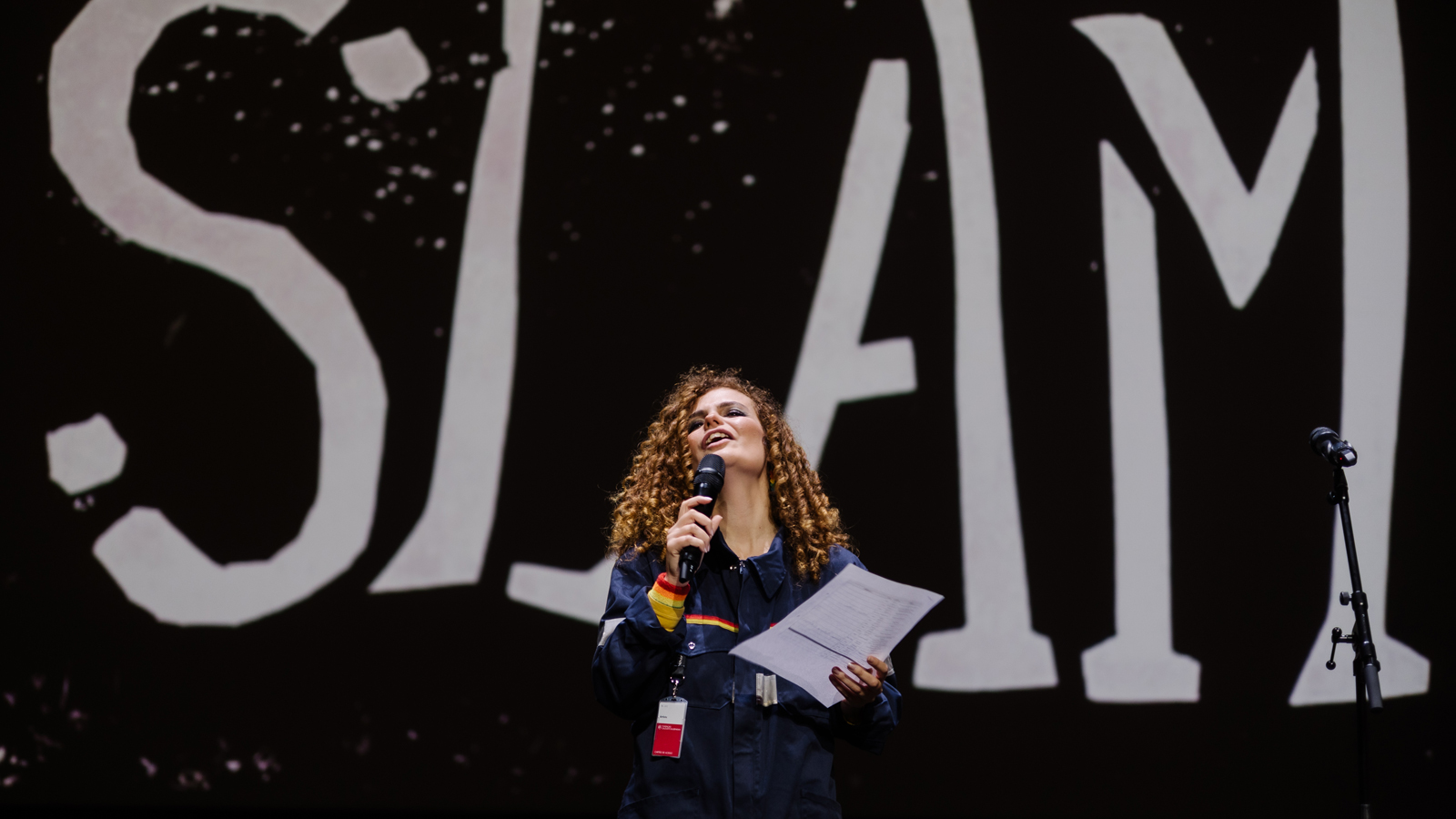
Perhaps that’s why what remains from the ten editions is not a list of champions. ‘Hardly anyone remembers who won a slam, but we remember such and such a performance, not always by the winners’, she says, recalling a poem about Palestine that lingered in the memory of all those in the room long after they had forgotten how it was scored.
It is that emotional archive, more than the applause, that Maria Giulia takes with her as she reflects on the risk she took when entering a large cultural institution. She recognises that a project born as a practice of resistance and occupation of public space can lose its strength when it is hosted by an organisation of this scale, but she is adamant that didn’t happen here.
‘We still resist while being there, in other clothes, under other lights’, she says, arguing that each context demands its own strategy and that none cancels out the other: the same principle that led her to keep running Fala in schools and social housing neighbourhoods, often without any remuneration, at the same time as occupying CAM.
The final edition brought together the fifteen poets selected over the last five rounds, who battled for a place to represent SLAM at CAM at the final of Portugal Slam, the national poetry slam competition. After that, Associação Fala will move on to other venues, just as it did before arriving at the Gulbenkian. Returning to the image with which she started, she reiterates what she still believes after so many years devoted to the spoken word: ‘It happens in a space of risk and vulnerability, which I find very interesting.’ Two people, or one hundred people, staring each other down, something about to happen between them – for Maria Giulia, that is still the most advanced technology that exists.
BANTUMEN at Gulbenkian
Explore the series


No results were found for your criteria.
You may also like
No results were found for your criteria.