
Diogo Pimentão: a ‘drawing of a drawing’
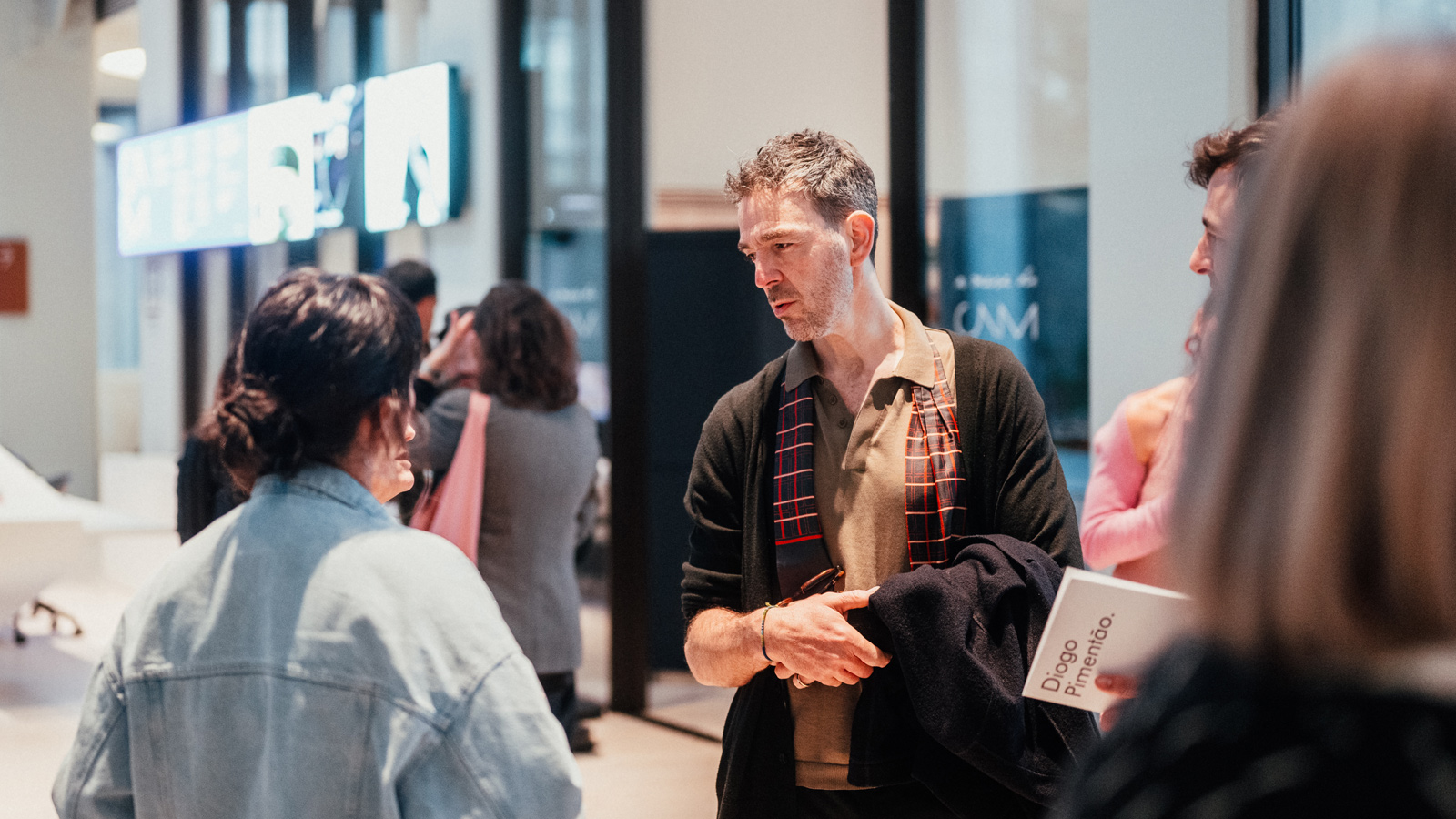
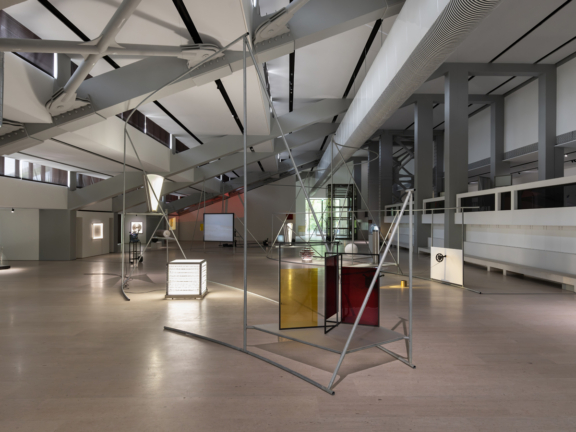
Diogo Pimentão invites those who enter the exhibition room to inhabit a drawing. Made for, and based on, a human scale, the installation interacts with the body, gives instructions through gestures and urges the public to move through the space.
This occupation of the room stems from the artist’s desire to find in drawing an expanded, three-dimensional and multidisciplinary dimension: ‘I see the exhibition as a “drawing of drawing”, a place where the works react to the space and test it, opening up possibilities of connection.’
The meditative suspense in the pieces displayed in ‘Transient Force of Things‘ is evident, almost palpable. As the exhibition notes explain, ‘the moment of tension in which everything is about to transform, the delicate and tangential point at which two forms touch’ is evoked in the space. This liminal configuration clearly manifests in the body of the artist and the observer, as a common language.
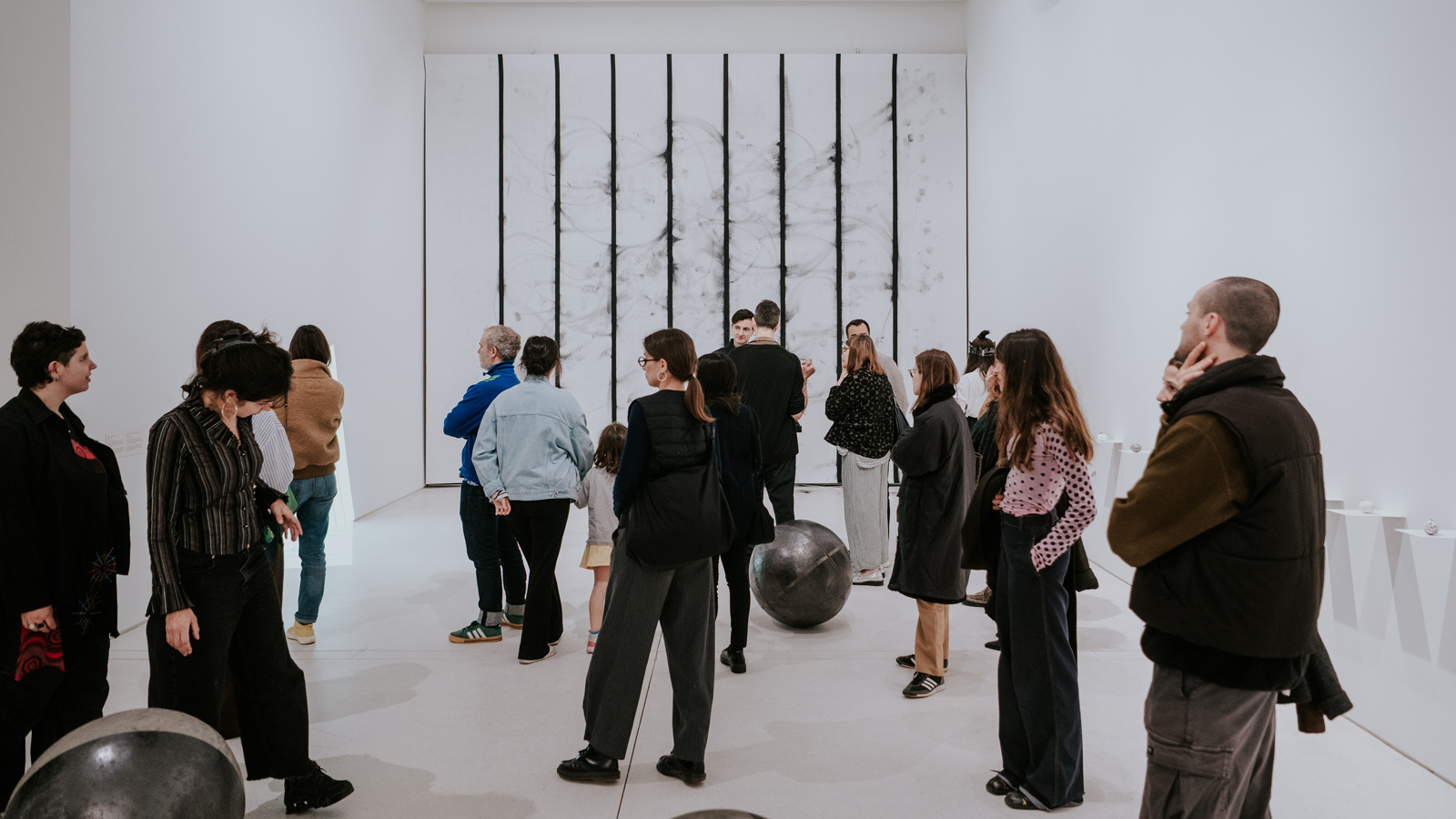
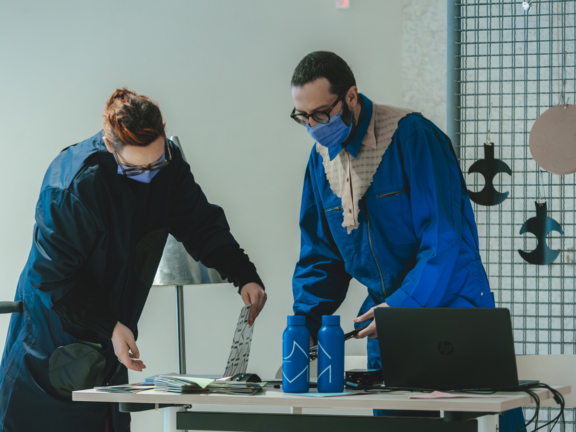
The day before the opening, a group of guests watched the final assembly and the performance that resulted in the production of the work ‘Estrutura (resposta)’ [Structure (Response)]. The artist and the dancer and choreographer Emmanuel Eggermont, his collaborator in this piece, positioned themselves on a white carpet where several straight lines were drawn in pencil, similar to a musical score.
The composition of noise and metallic sounds, created by Julian Lepreux, guided their bodies, which through soft gestures, sweeping steps and exchanges of spatial occupation revealed a new drawing from that initial page.
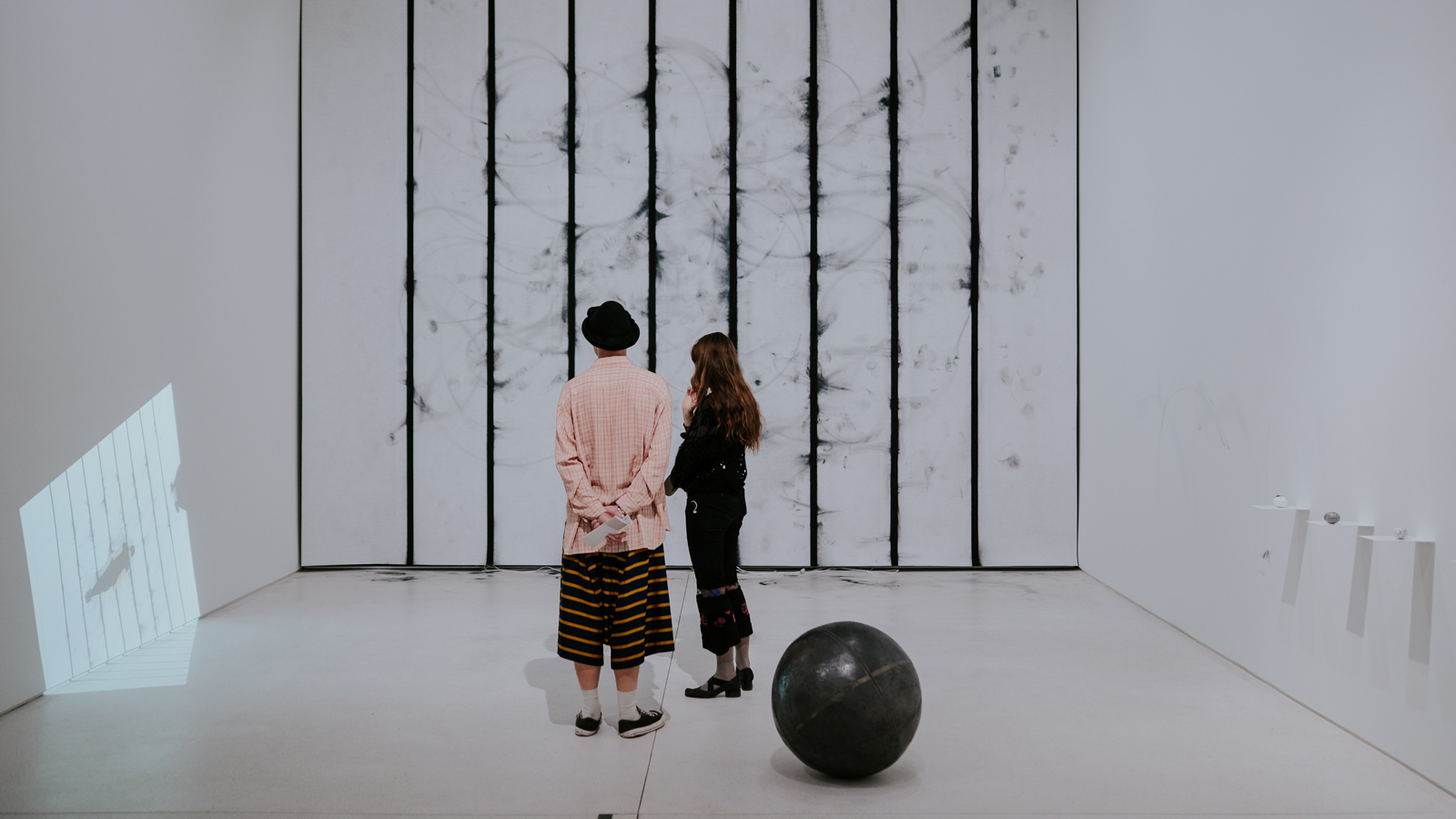
Both danced, alternating between rehearsed gestures and improvised moments that revealed themselves as proof of time and memory. Inevitably, the public also became part of the moment as witness of a presence, which can be seen as both an interference and an extension of the work itself.
Diogo Pimentão confers a sense of activism to this action: the search for balance on the floor as a base, the body as an agent of ‘a field of transformation’ and, fundamentally, liberation from the conditioning of the initial lines.
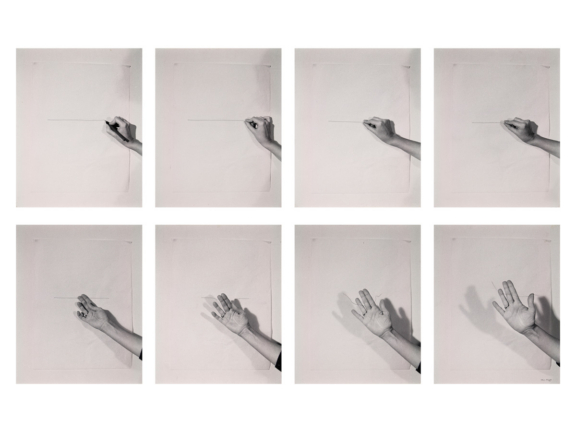
This symbolic juxtaposition, where the dance over the music results in drawing, characterises the artist’s practice: an experimental redefinition of drawing as a process sensitive to rhythm and space. The video recording of this performance, with the title ‘Linha e Movimento’ [Line and Movement], is projected in the space, while its physical result hangs from one of the gallery walls.
While this piece can be seen as the end of the itinerary, by condensing the key elements of the project it also acts as a premise to observe the remaining sculptures. The artist highlights the complexity of the materials, and while the graphite has a nuclear and elementary composition, the concrete evokes a primitive and brutal materialisation.
The symbolism of this apparently contradictory selection seeks an approximation to the poetic, as the artist himself notes: ‘Metaphors ensure bridges between art, ethics and natural laws’. These ideas branch out and create a cohesive atmosphere in the whole of the exhibition space. The appropriation of repetition is also a tool for change, visible both in the components (charcoal, concrete, paper), and the recurrent forms (the egg, the sphere, the line).
The journey through the exhibition begins with the elementary line that, through reiteration, gains the form of a layer of graphite. When these lines overlap, they assume a volumetry that demonstrates the malleability and possibilities of using the materials.
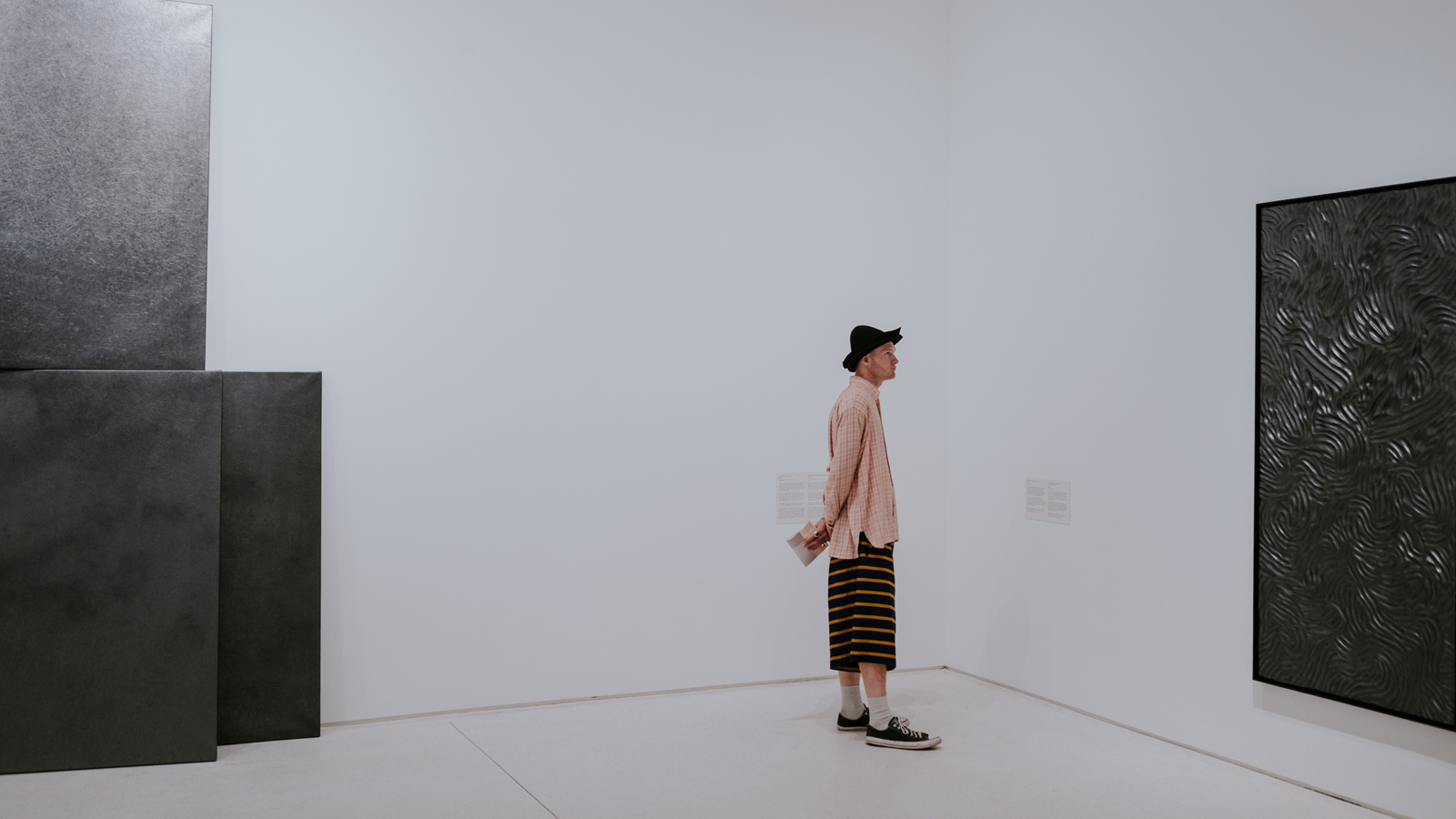
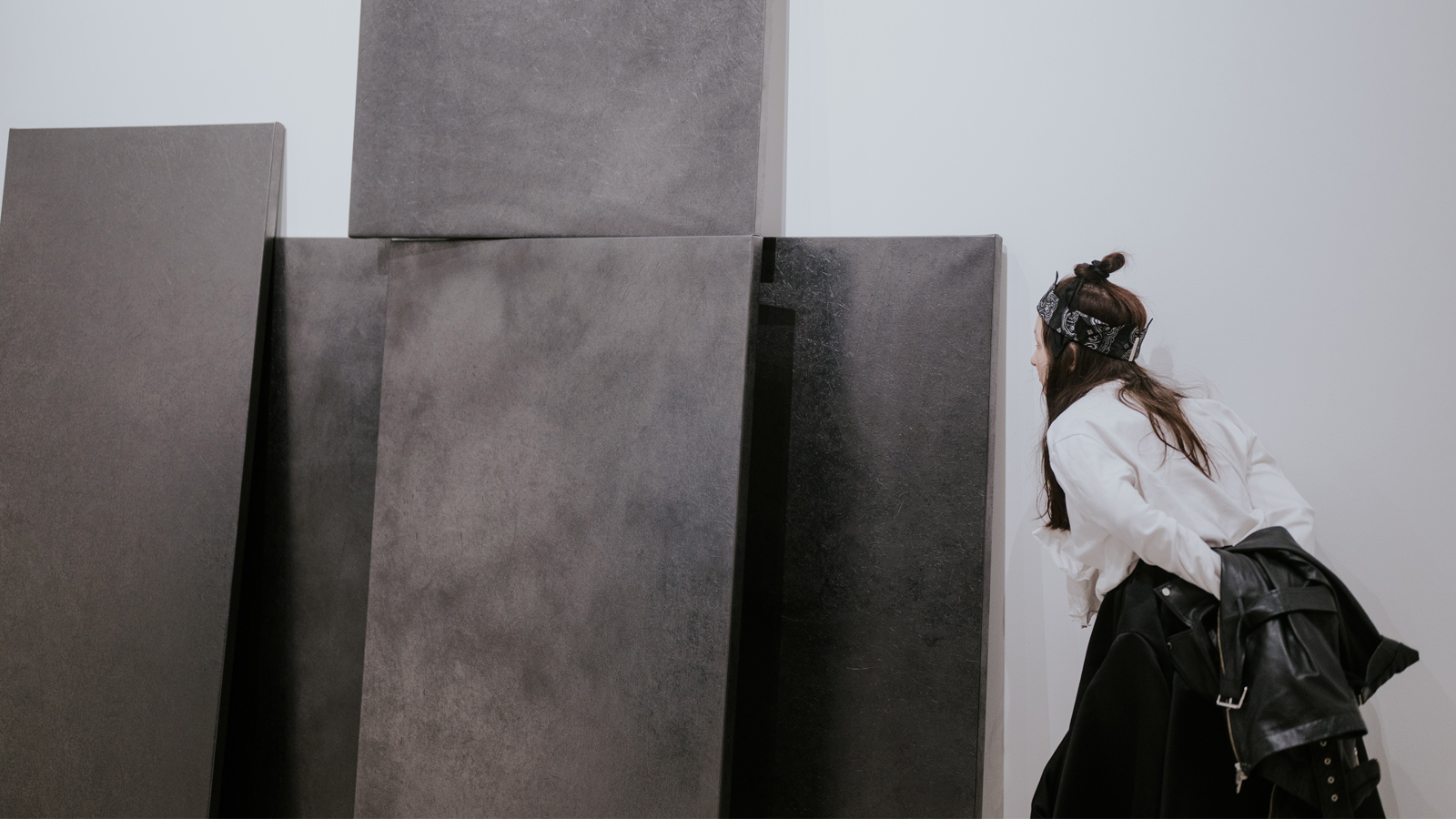
This can be observed in the piece ‘Sublinhadas (ações)’ [Underlined (actions)] which occupies the entrance: three sculptures in paper covered in graphite and folded in the shape of a beam that challenge the natural architecture of the room. The same happens in the piece ‘Entre Lugares (fáscia)’ [Between Places (fascia)], six panels of paper covered in graphite, set on aluminium frames leaning against the wall, at the very limit of the height these elements can reach within the space.
By gaining a visual weight that counters the lightness of the paper, these pieces project a physical force which creates a false perception and seeks, in its fragility, a sensation of stability. It thereby demonstrates the plasticity of a dual matter that manages to be delicate and resistant, light and heavy, poetic and real. This mode of occupation invalidates any scientific or architectural approach because, as shown by the interaction of the pieces during the performance, it is only the result of the artist’s intuition.
Starting now from a curved line, which evokes freer gestures, the remaining pieces in the room, ‘Ponto de Encontro (tangência)’ [Meeting Point (tangency)], are concrete spheres covered in graphite, and are concerned with the density and rootedness of rounded forms.
Shaped to serve as true ‘contexts for thought’, these sculptures-drawings materialise a place of tension between ‘matter and intention’, contained in the precise second that precedes metamorphosis.
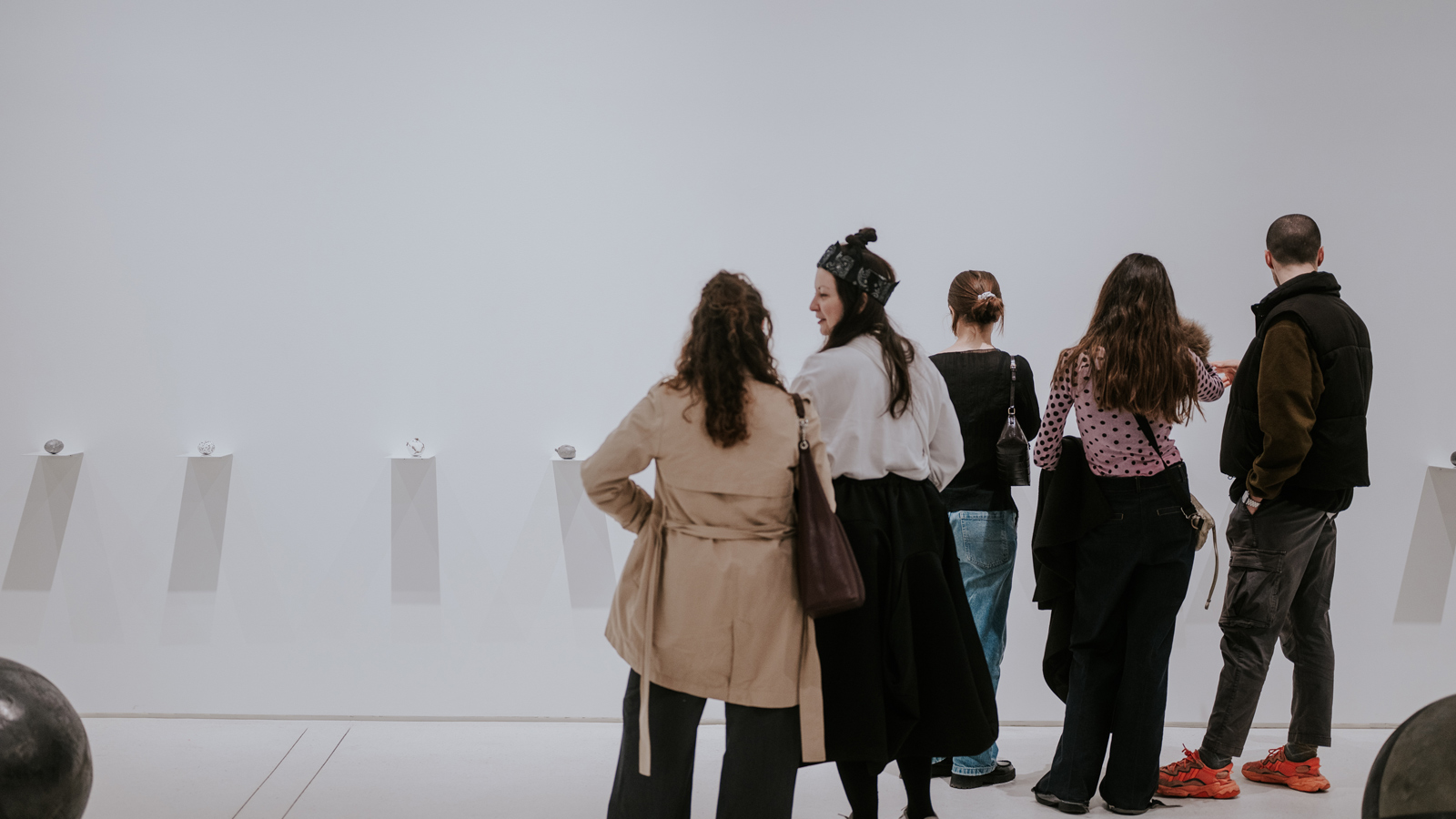
This same threshold of change is extended in ‘Transformação (condição)’ [Transformation (condition)], a set of twelve eggs in different stages of evolution, whose shells exhibit different finishes and some of which are already fragmented. It is the material translation of the artist’s premise: that the old form inevitably has to be broken so that a new one can finally emerge.
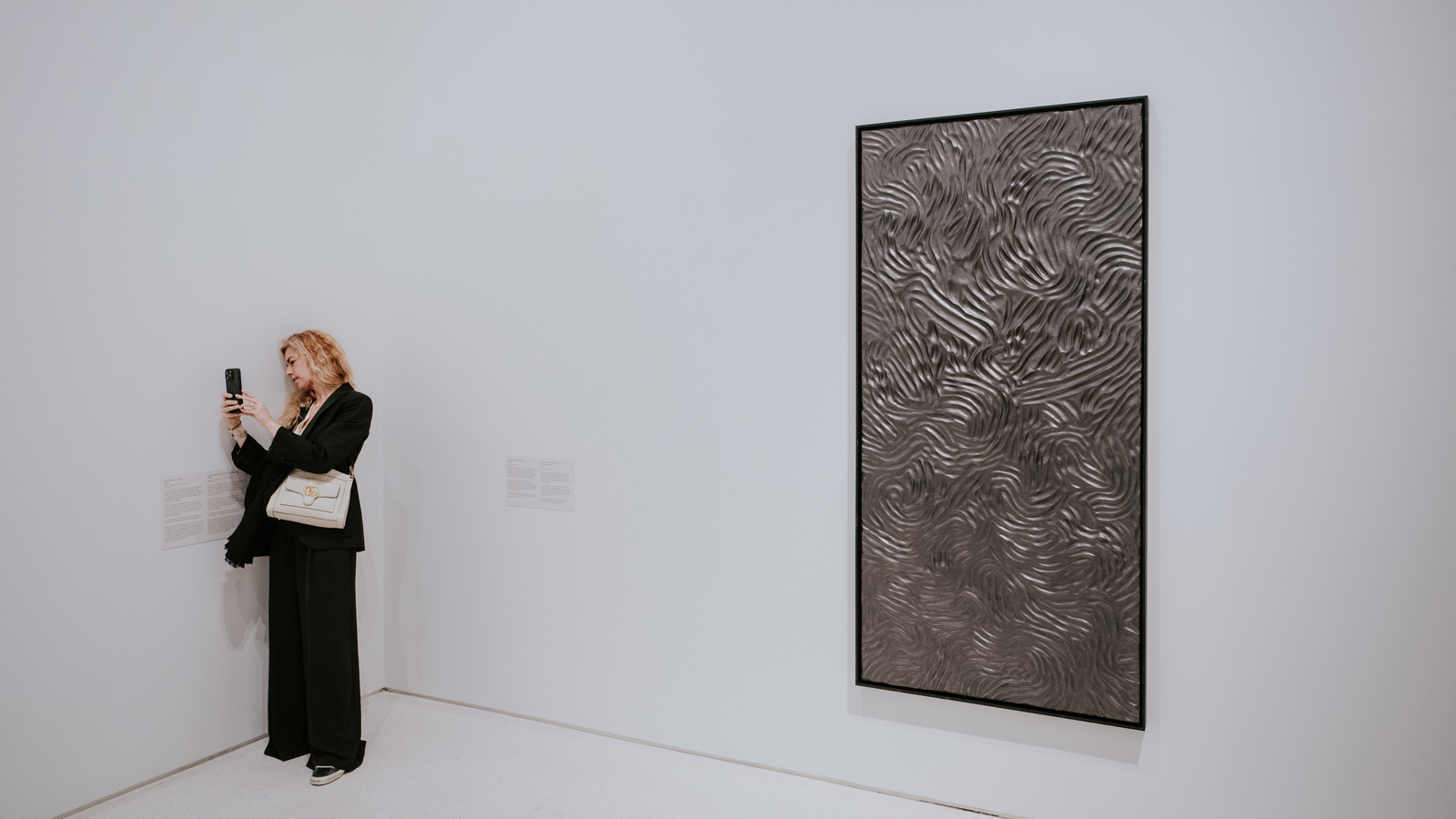
Returning to the theme of traces of human presence, the sculpture ‘Mudança (traço/vestígio #1)’ [Change (trace/remnant #1)] is a self-portrait resulting from the ‘collaboration’ between the drawing and the body itself and materialises the dimensions of the artist lying down in an extended position. Pimentão imprinted, in wet concrete, a series of marks with his fingers until they created an irregular pattern where, once again, the memory of the moment is crystallised.
Ultimately, ‘Transient Force of Things’ is a contemplative and static exhibition, an ecosystem that encapsulates a notion of prolonged time. Diogo Pimentão transforms the act of drawing into a physical and spatial event that demands the visitors’ intervention.
By combining the fragility of paper with the rigidity of metal and concrete, the exhibition leaves us suspended in this same ‘limit point’ that the artist seeks; a place where the void gains weight, movement is fixed on the wall and the spectator discovers themselves as a line inside a drawing.
The quotes included in this text were taken from materials made available in the exhibition, namely the exhibition notes and the zine publication that accompanies it.
You may also like

No results were found for your criteria.