
Coisa-Ponta: ‘How to access the unimaginable?’
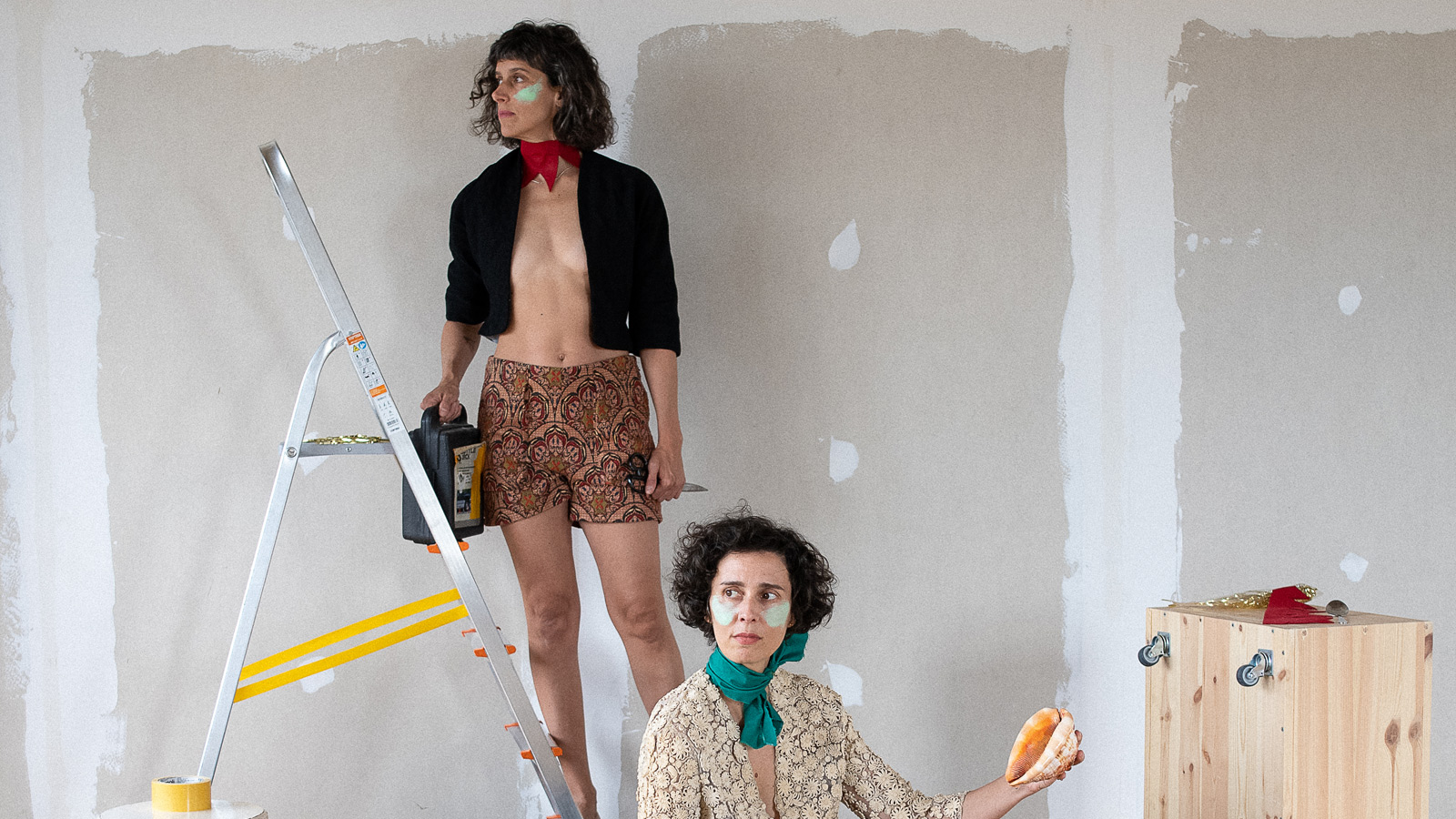
Alexandra Balona (AB) – This interview wishes to be surrealist. However, as we read in the text of Coisa-Ponta, ‘being surrealist is a Serious-Thing’ [Coisa-Séria]. Which leads me, after all, to ask you: how did the idea for this duet come about? And why now?
Márcia Lança (ML) – Ana Rita and I have known each other for almost thirty years. And the feeling is that our relationship has already gone through many things and many different phases: estrangement, distance, closeness, more understanding, less understanding, anger, an inability to understand each other… all sorts of things. And I think this duet comes at a moment of great rapprochement, which is a coming together again of our lives as people, but which is also a way of looking at each other from an artistic point of view. A thinking again: who are you, and what are you up to now? Something like that. As if I also wanted to look at you more closely, I don’t know.
Ana Rita Teodoro (ART) – Yes. I think this duet, which is an artistic duet, is also an ode to friendship. It may be our friendship, but I think that in the present time, friendship is something that should be valued more. And I also feel that having someone who has been by your side for thirty years is a friendship that is a kind of a family I chose. And we have this relationship because we met in an artistic, school context. So our friendship was born with the desire to be artists and with this artistic affinity.
ML – That’s right. It’s been there from the beginning, hasn’t it?
ART – Yes. And for me, this encounter with Márcia, now, is also a way of looking at that girl—at those girls of 17, 18—who fell in love with art, who took classes at the Fine Arts School, went to every exhibition, every museum, went to see every performance, and had a great desire to make things, to get to know things and to enter that universe, the artistic universe.
ML – And that is a serious thing. For us it has always been a very serious thing. Serious doesn’t mean we can’t laugh, or even have a rather caustic sense of humour at times. But it is a serious thing.
ART – It is.
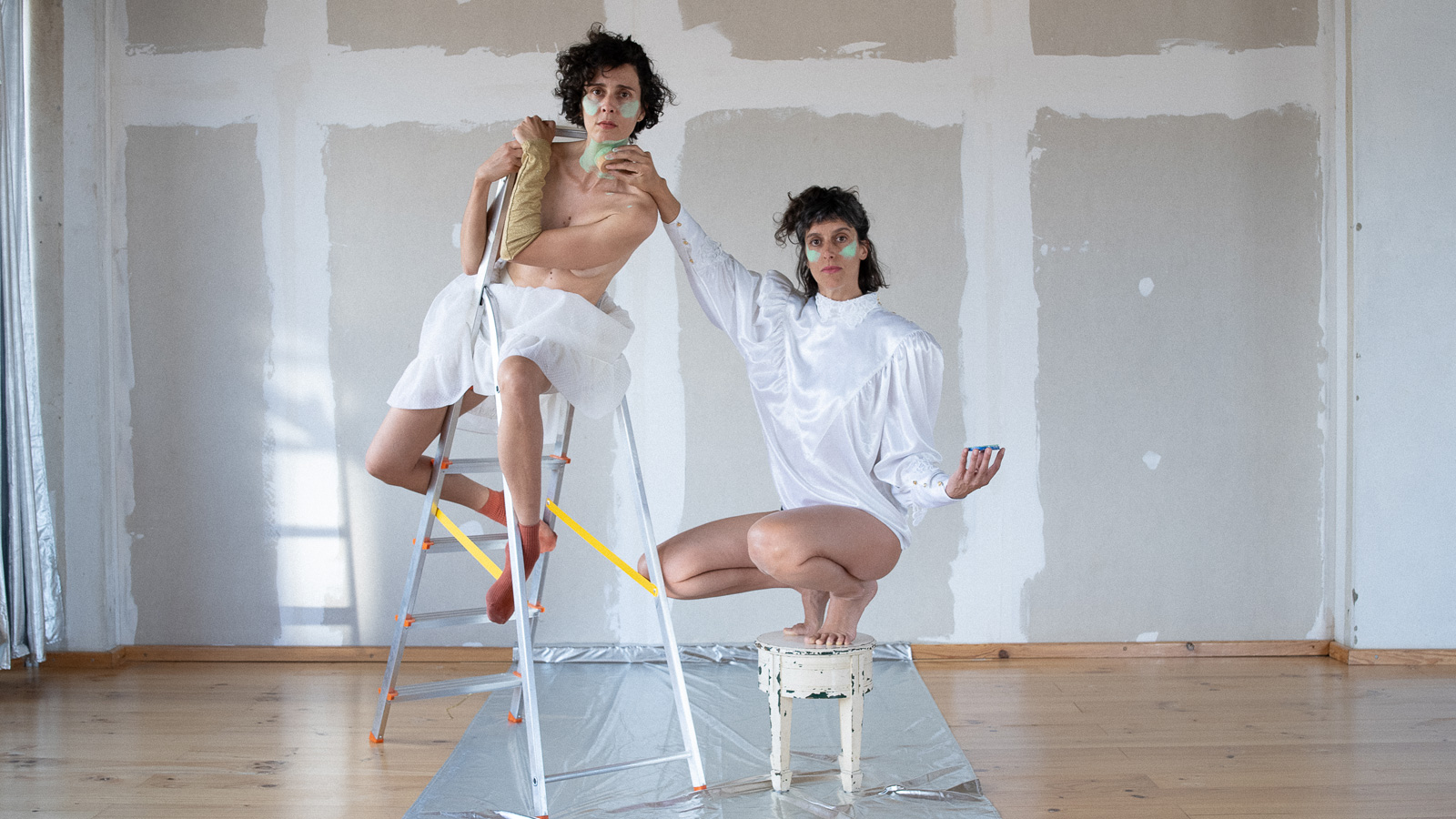
AB – In the libretto of Coisa-Ponta we find various texts, some of them captioned ‘written without looking’ or ‘written to begin or to end’. Some texts break words into syllables, others play with homophones, confusing the meaning. Automatic writing and the exquisite corpse were surrealist strategies for approaching the unconscious. What is the relevance of this libretto, and how does it relate to Coisa-Ponta?
ART – I think we should start by saying that they are not texts, they are poems. At least, when we made them, we said: let’s write poems and let’s write a book of poetry. And I think that, for us, the libretto is a connecting link with the work, a rather unconscious one. When it says ‘to begin or to end’, it’s because in each rehearsal we would either start by writing a poem…
ML – And that worked as a kind of warm-up—to get a sense of the imaginary, or for letting go of that very tightly held consciousness, right?
ART – Yes. Or to end a rehearsal.
ML – As a kind of understanding of what had just happened, but not in a direct way.
ART – And I think that creates a bond between us in an almost telepathic way. Lately, we’ve even been talking about an idea of telepathic courage, which we are putting on stage as a relationship between the two of us, because we don’t know what the other is going to do.
ML – A compositional strategy, right?
ART – Yes. We don’t know what the other is going to write and, at the same time, it’s almost as if we did. It has happened several times—but it’s always an unknown, it may or may not happen—that Márcia writes a word I was about to write, or that I was thinking of. It really is a kind of layer of communication, an invisible and unconscious bond that has been practised over time.
ML – Yes, this writing of poems is a practice. When you say ‘that has been practised’, that’s it: it is a practice, and it has actually accompanied the process from the very beginning. It always comes in relation to a deck of cards that we created before going into the studio and that kept growing throughout the process. Every time we are going to write a poem, we draw a card at random, without looking, and that card dictates the title of the poem. It doesn’t necessarily dictate a theme, because we only write the title and from there we write whatever we want, but somehow things relate to each other.
AB – And which surrealist processes took on new life as choreographic strategies?
ML – To answer this question, it would really help to have the process notebooks, because I write down a lot of things about composition. And Ana Rita said this question was for me to answer, and I panicked a bit.
ART – Sorry, but it’s because, within the process—and I don’t know if this is relevant to the question—I feel that Márcia has a great capacity for analysis and reflection when it comes to this part, which has more to do with choreographic strategy and with the relationship between a textual and visual-arts process and choreography. I think I have a way of throwing myself in a bit more…
ML – Headfirst, right? You go into the thing with your whole body.
ART – Yes. Still, since I had read the questions, I did a bit of homework.
ML – What did you write?
ART – I wrote that this was not very intentional, but that from the moment we worked with the operations of the visual arts and of literature—of poetry, more than anything—this produced certain images. And I was remembering precisely Márcia’s notebooks, where we wrote down a set of strategies related to surrealist techniques.
ML – In fact, we said that the techniques used by Surrealism would be, for us, compositional strategies. Which are superimposition…
ART – concealment..
ML – metamorphosis, frottage, assemblage…
ART – chance..
ML – the ready-made, too.
ART – the exquisite corpse.
ML – Yes.
ART – So we put these surrealist practices into practice, on stage, and that produced certain images.
ML – They were used a lot in the process of improvisation, of creating material—not least because they are all written on the cards of the deck we talked about earlier. I don’t think there is a direct translation between surrealist processes and choreographic strategies, in the sense of one thing being carried over exactly into the other. But there is an unfolding, and in that process of unfolding, things transform a little, as if they had a life of their own. It is no longer us controlling the relationship between one thing and another; instead, multiple relationships are created. And I think it is in that multiplicity that new strategies are also created, ones we perhaps can’t even name yet.
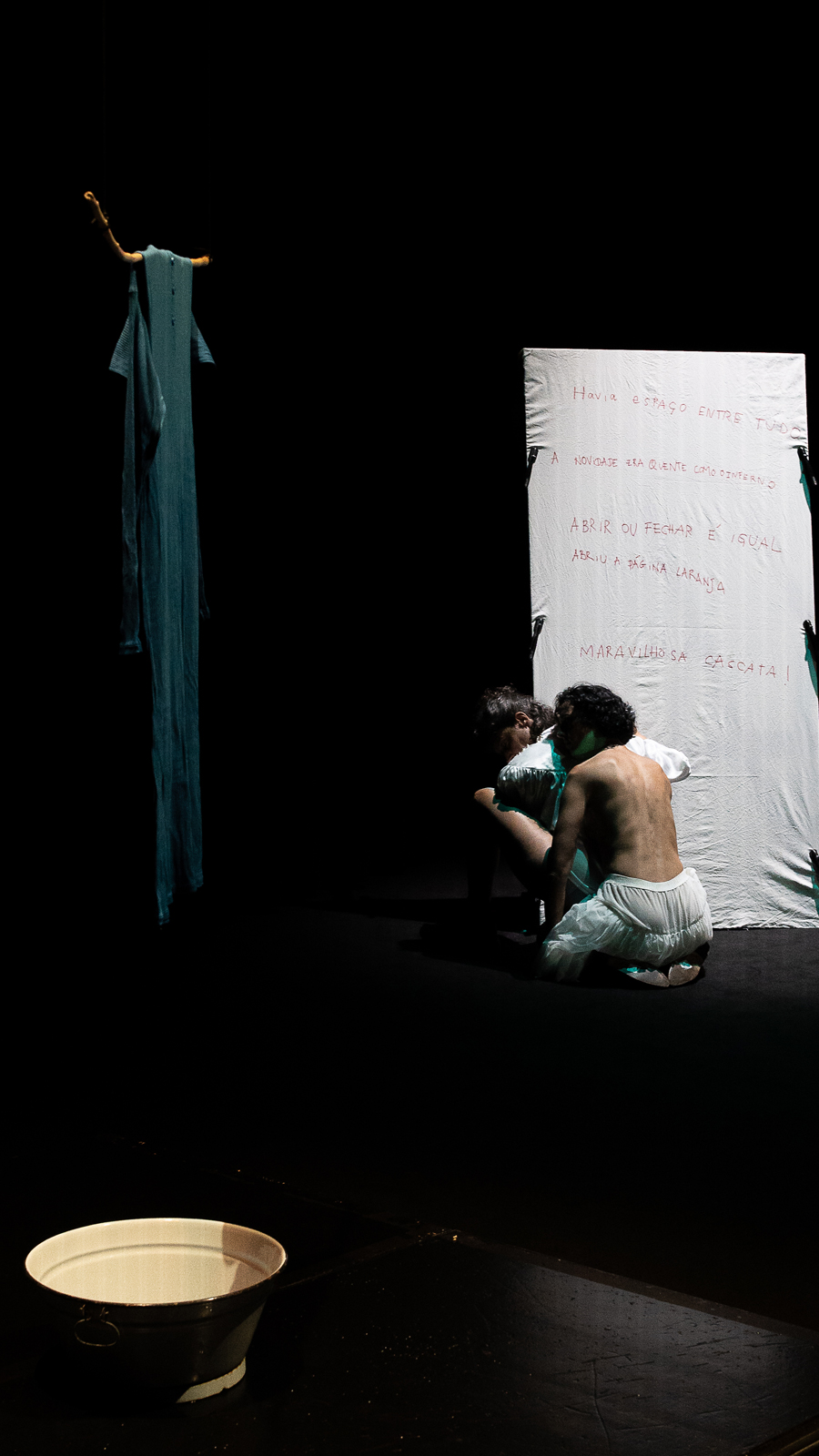
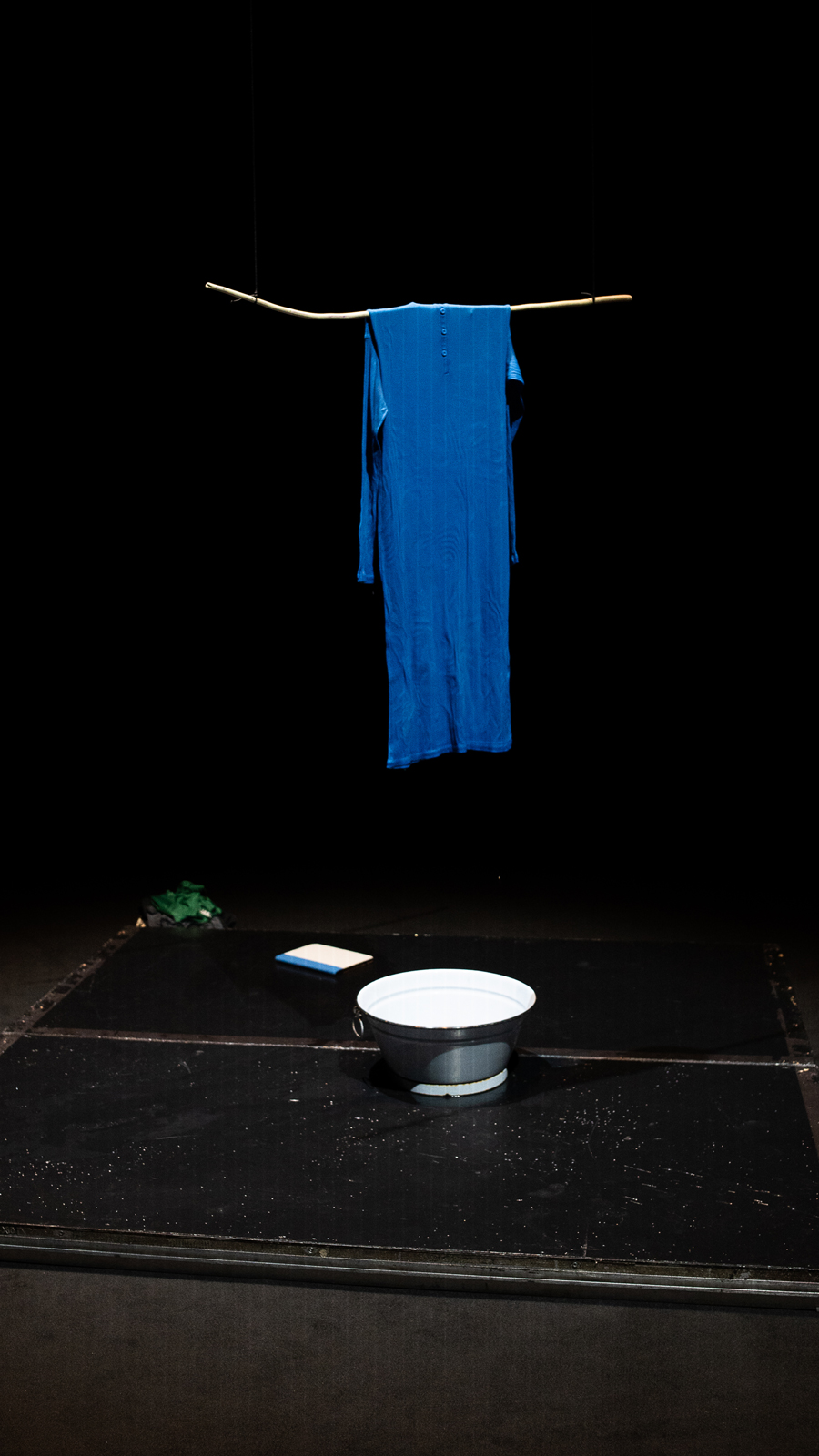
ART – I’d just also like to say that, over the course of the process, and especially towards the end, we had to deal with the contrast between a work for a gallery, which belongs more to the visual arts, and a work for a theatre. I think the choreographic decisions were gradually shaped by the apparatus of the theatre space. Although we would like—and we really do think—the work could also be shown in a gallery. And if it were, it might perhaps take choreographic directions slightly different from the ones we will present at CAM or in Vila do Conde.
ML – Without a doubt. We still intend to do it in a gallery context, to experiment.
ART – Yes, we think it would be great.
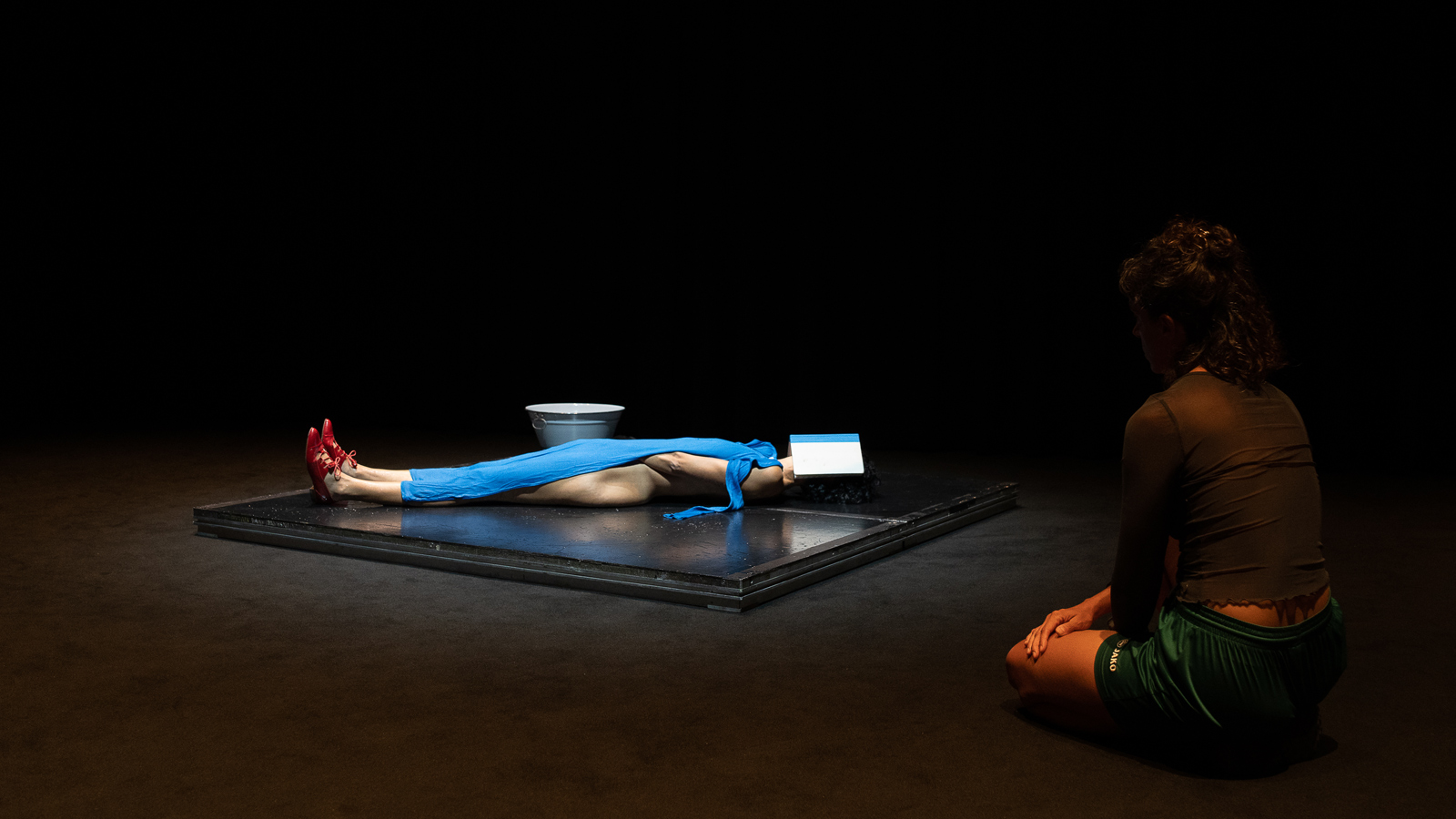
AB – After your encounter with surrealist art, a breach opened up that fostered, as you put it, ‘an artistic practice guided by a of that which, in intention, is deliberate, as a way of accessing the unimaginable’. Was it really possible to switch off the intentional? And how was this unimaginable conveyed?
ML – Do you want to start?
ART – Sure. To begin this work, we invited Sofia Lapa, who was our Art History teacher when we were 17, and it was she who brought us this phrase—’lulling to sleep that which, in intention, is deliberate’—which has guided us all along, for a year now, ever since we started working.
ML – I think the word ‘lulling’ is very important, because lulling to sleep is not switching off, is it? You ask: ‘was it really possible to switch off the intentional?’ I don’t think it is possible to switch off the intentional, but it is possible to lull it to sleep, to place it in a zone that is a little more in the half-light, in an in-between state. And I think that’s interesting; in fact, we try to operate in that place, in that in-between space, in that space of drowsiness.
ART – I have nothing to add to that.
ML – Perhaps just to say that this word, the ‘unimaginable’… we went around this word quite a bit with Sofia, too. How do you reach what you cannot imagine? What is it that you cannot imagine? How do you gain access to it? Can you get there? What is it?
ART – I think these strategies we found, which are those surrealist strategies, I think they manage to reach those places that we had not imagined.
ML – To come closer, right? To bring ourselves closer to the unimaginable.
ART – And then, from the moment they happen, they are concrete.
ML – And the number of things that escape us is always much greater than what we manage to hold on to. Perhaps the unimaginable lies in what escapes us, I don’t know.
AB – Finally, what does it mean, then, to be a surrealist woman in 2026? And what surrealist legacy matters to explore or retain in artistic practices today, and why?
ML – I don’t know what it means to be a surrealist woman, but I can identify some directions along that path. I think we are in a moment of hyper-control, of the exaltation of surveillance, internal and external, of a kind of apogee of guilt—and guilt is always linked to a hyper-consciousness. And I think Surrealism is a delirium of freedom from all these forms of imprisonment. Of course it will have other prisons—a prison always has a reverse side. But the feeling I have is that there is something that opens onto this lulling of consciousness, onto these in-between spaces, onto the breaches… They are very delicate places. It is not this pornography we are living in, where everything is hyper-exposed, without any filter or veil.
ART – One of the first things we watched was an interview with Mário Cesariny in which he said that, before the 25th of April [the 1974 revolution], he always woke up late, and that after the 25th of April he started waking up early. And we reflected on this: the surrealists lived to quite an old age. We have some examples—like Leonora Carrington, who also lived to quite an old age; and, thinking of another woman who never joined the surrealist group, Louise Bourgeois also lived to a very old age. And they were profoundly artists; their art was…
ML – These were ways of life.
ART – Yes, these were ways of life.
ML –And I think we are a bit like that. There’s nothing arrogant about this, but at least when I look at you, that’s how I see you. I wouldn’t know how to see you any other way. For me, you have been an artist—I’m getting goosebumps—since the very first work I saw you make, at Chapitô. I think that’s it. I can’t see you any other way.
ART – Yes, I think we are two surrealist women of 2026.
ML – Somewhat unintentionally.
ART – A little unintentionally (laughs).
ML – I think I’m a bit of a surrealist involuntarily. It always seems strange to me to say that I’m a surrealist, but, to be fairer, a part of me is surrealist.
ART – The other part is ready-made (laughs). Not me, I’m 100% surrealist. No… 90%.
ML – The rest is ready-made.
ART – The rest is something else.
BANTUMEN at Gulbenkian
Explore the series
No results were found for your criteria.
You may also like
No results were found for your criteria.