
Sara Bichão: ‘It’s there to communicate, and its gaze is directed at the viewer.’
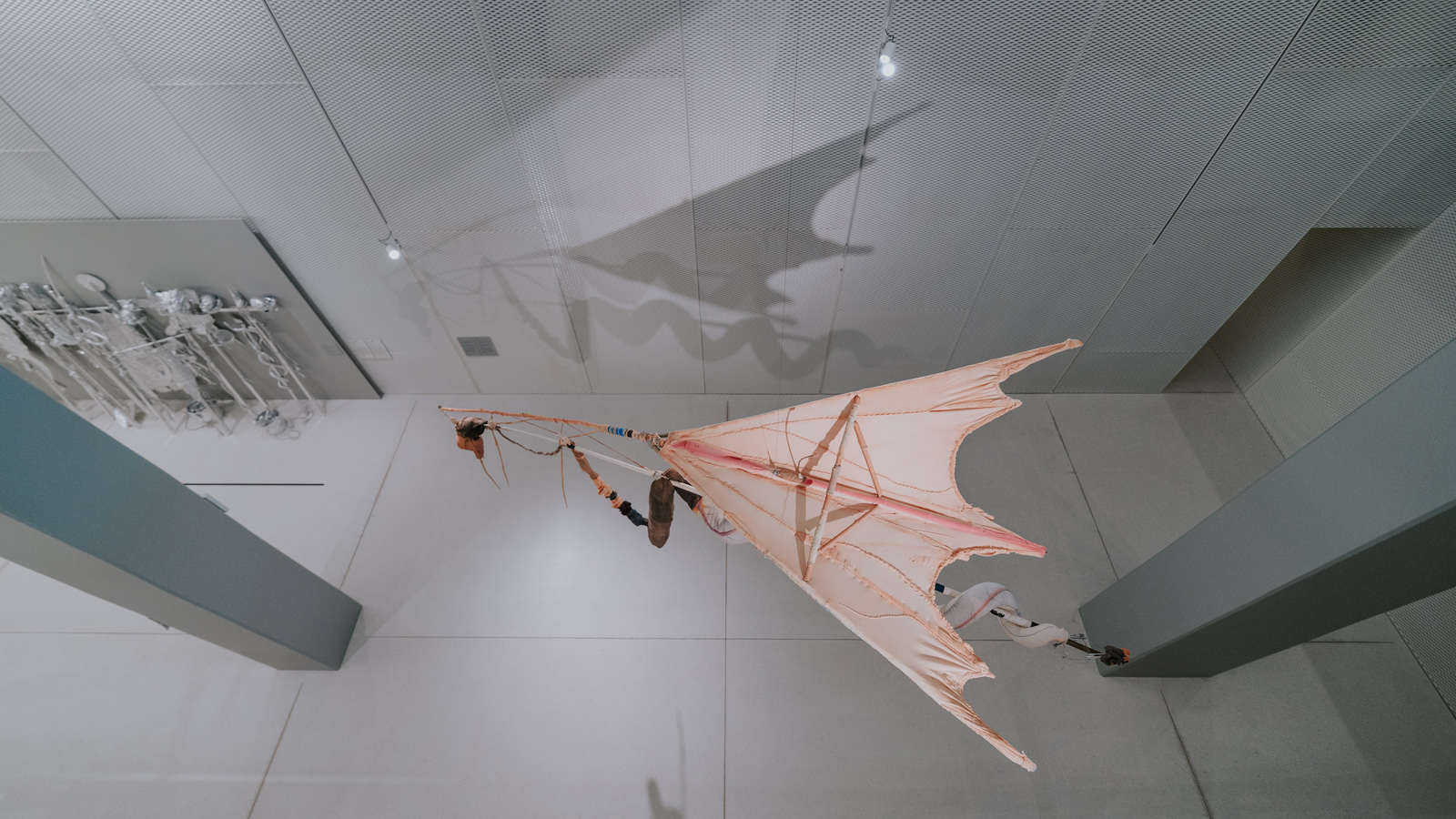
I spoke with Sara Bichão (b. 1986, Lisbon) about her sculpture ‘Longínquo (dur)’, from 2025, and now from the CAM Collection. Conceived to be part of the exhibition ‘Scheherazade, the Never-ending Collection of CAM’, the work stirred curiosity regarding its creation process, especially the circumstances, intuitions, and decisions that guided it.
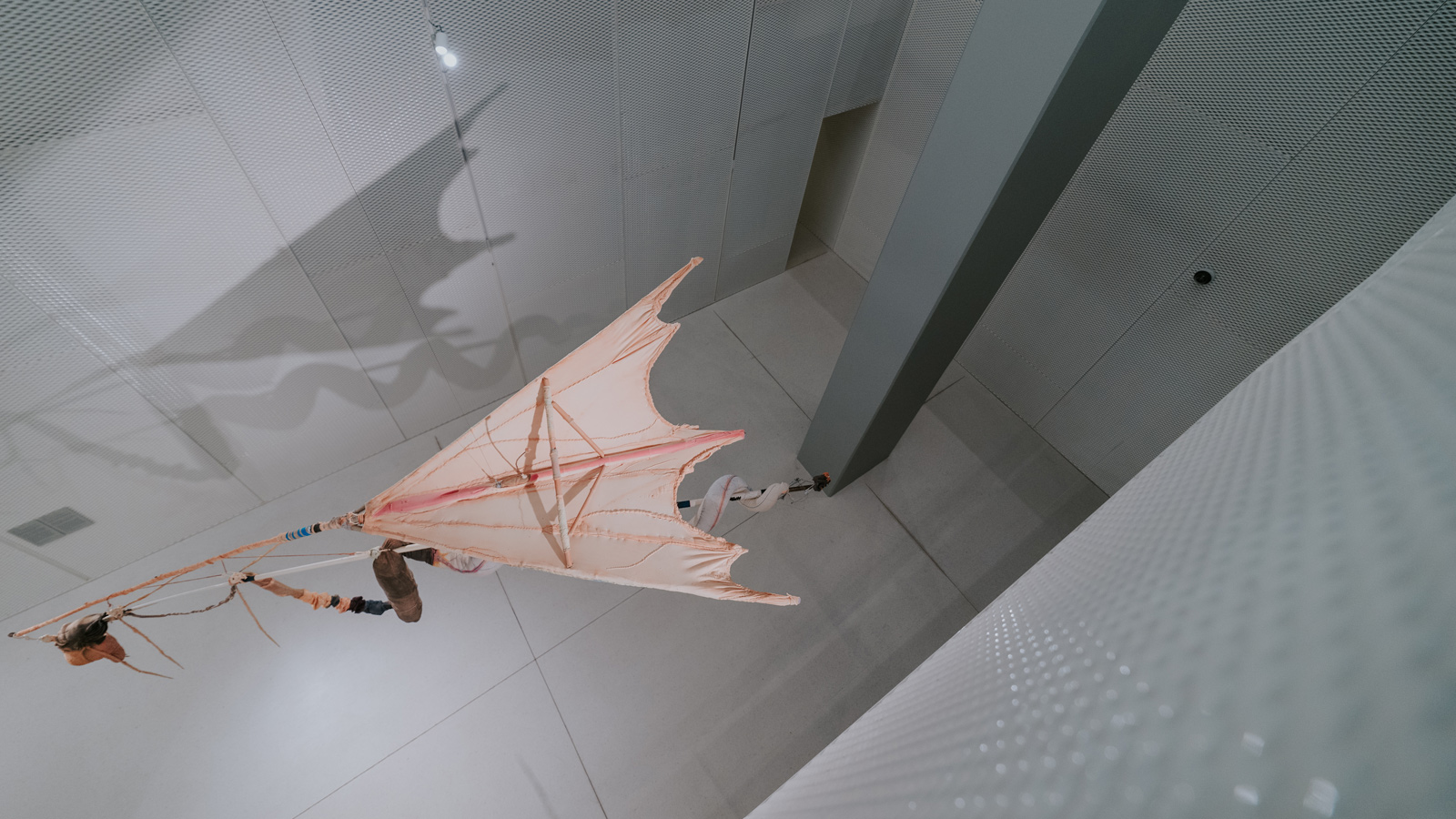
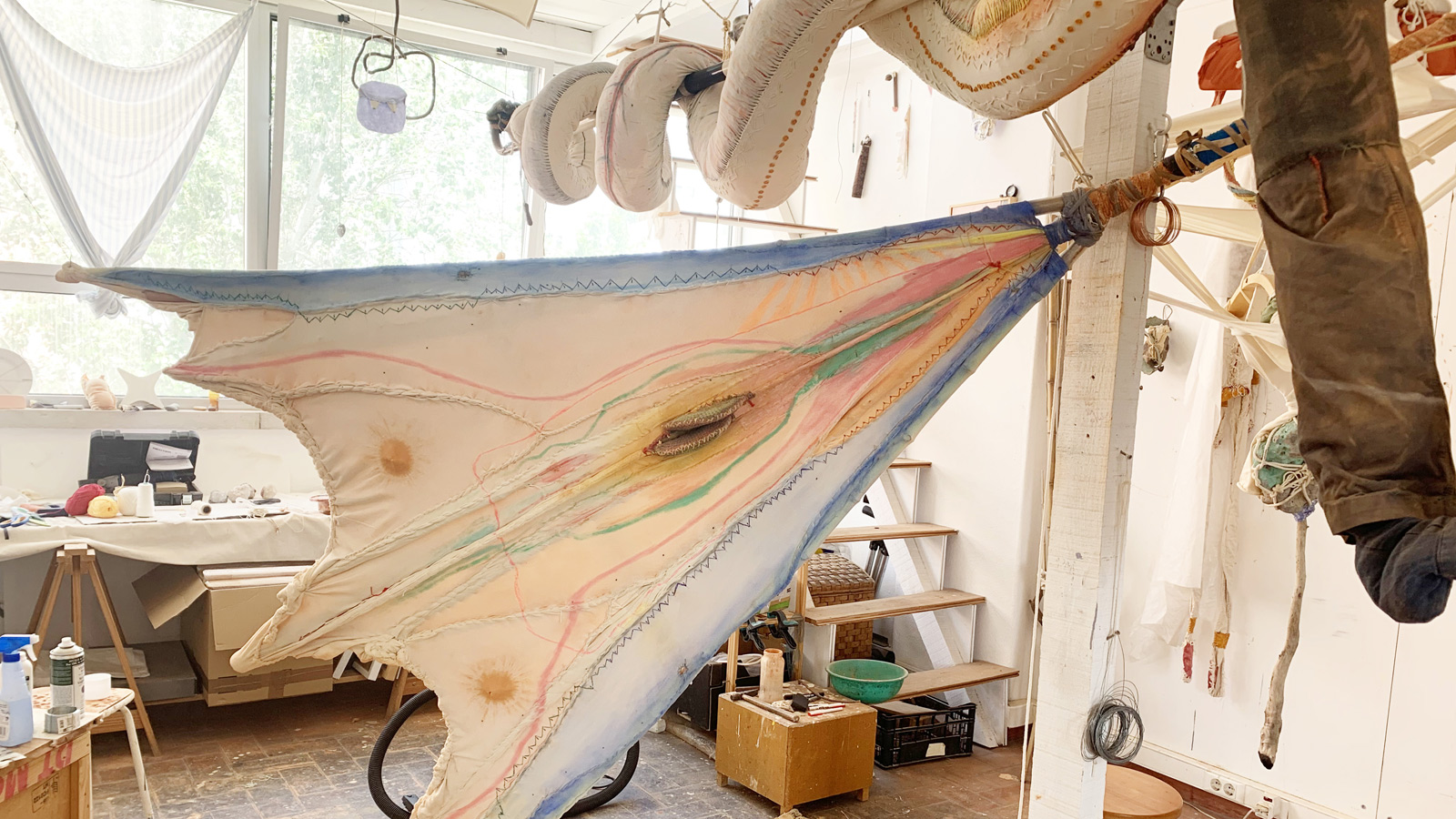
The sculpture marks the start of the exhibition route, set in the entrance atrium and immediately visible as you descend the wide staircase. Within its cross-shaped structure, a suspended, wing-shaped form made of fabric, rope, rubber, metal and wood holds a coiled ‘creature’ whose face emerges in relief.
As the conversation unfolds, the artist reflects, with her characteristic lightness, on the creation of the work and describes each stage of the process. Sara Bichão blends technical detail with poetic language and a genuine fascination for materials and their potential. I began by asking about her relationship with CAM, where she had exhibited in 2018, in the former Project Space, in a show curated by Leonor Nazaré: ‘Sara Bichão. Find Me, I Kill You’.
Francisca Portugal: In this new work, is there any continuity with ‘Find Me, I Kill You’ (2018), or did you want to explore new territory?
Sara Bichão: They’re two very distinct propositions. ‘Find Me, I Kill You’ was born from the fusion of a personal experience and the encounter with the exhibition space. The project was organised as a constellation of works interconnected with one another and with the room itself, forming a closed system that drew the visitor in.
‘Longínquo (dur)’, on the other hand, was created for the new CAM Collection exhibition, ‘Scheherazade, the Never-ending Collection of CAM’, and stands as an autonomous work. It began with an invitation from the exhibition’s curator, Leonor Nazaré, to inhabit a space defined by the museum, while simultaneously creating a dialogue with a flying sculpture I’d shown in the gallery earlier this year.[1] For me, it was important that the piece could traverse multiple dimensions of time, much like the narrative of the legend itself, which is compelling precisely because it echoes urgencies of both the past and the future.
From these initial conditions, I set the coordinates of the piece – its type, scale and form – and stepped into a creative space where I’m completely free. Whereas ‘Find Me, I Kill You’ imposed a closed game upon the viewer, ‘Longínquo (dur)’ inhabits a shared territory, coexisting with the other works and the viewers who engage with it.
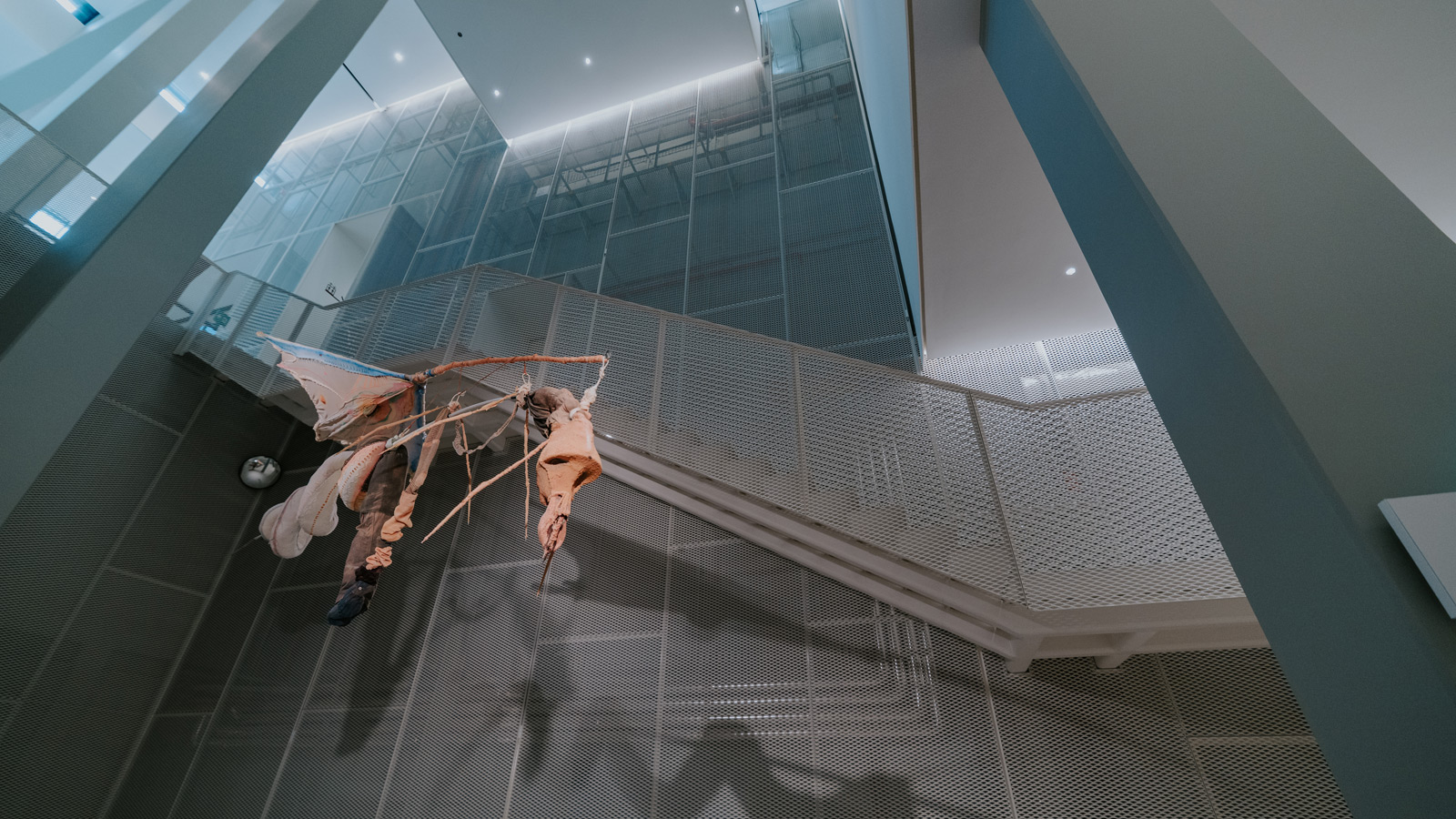
FP: The work is installed on the lower floor, at the bottom of a staircase that leads the visitor into a transitional space. How does that location, that descent and that encounter shape the visitor’s experience and the reading of the piece?
SB: The space certainly interests me, but that doesn’t mean the work is confined to it. It’s a space people pass through, though it can become one of contemplation for those open to it. Although I knew the installation would be temporary in that location, I built it within the constraints imposed by the space. The piece is about five metres long but can extend further, as its structure is expandable. However, in that location it was important to find a scale that ensured the work neither disappeared nor dominated, maintaining harmony with the flow of visitors. What’s particularly interesting is that, along this route, viewers can observe it from above and from below, allowing for an extended period of contemplation.
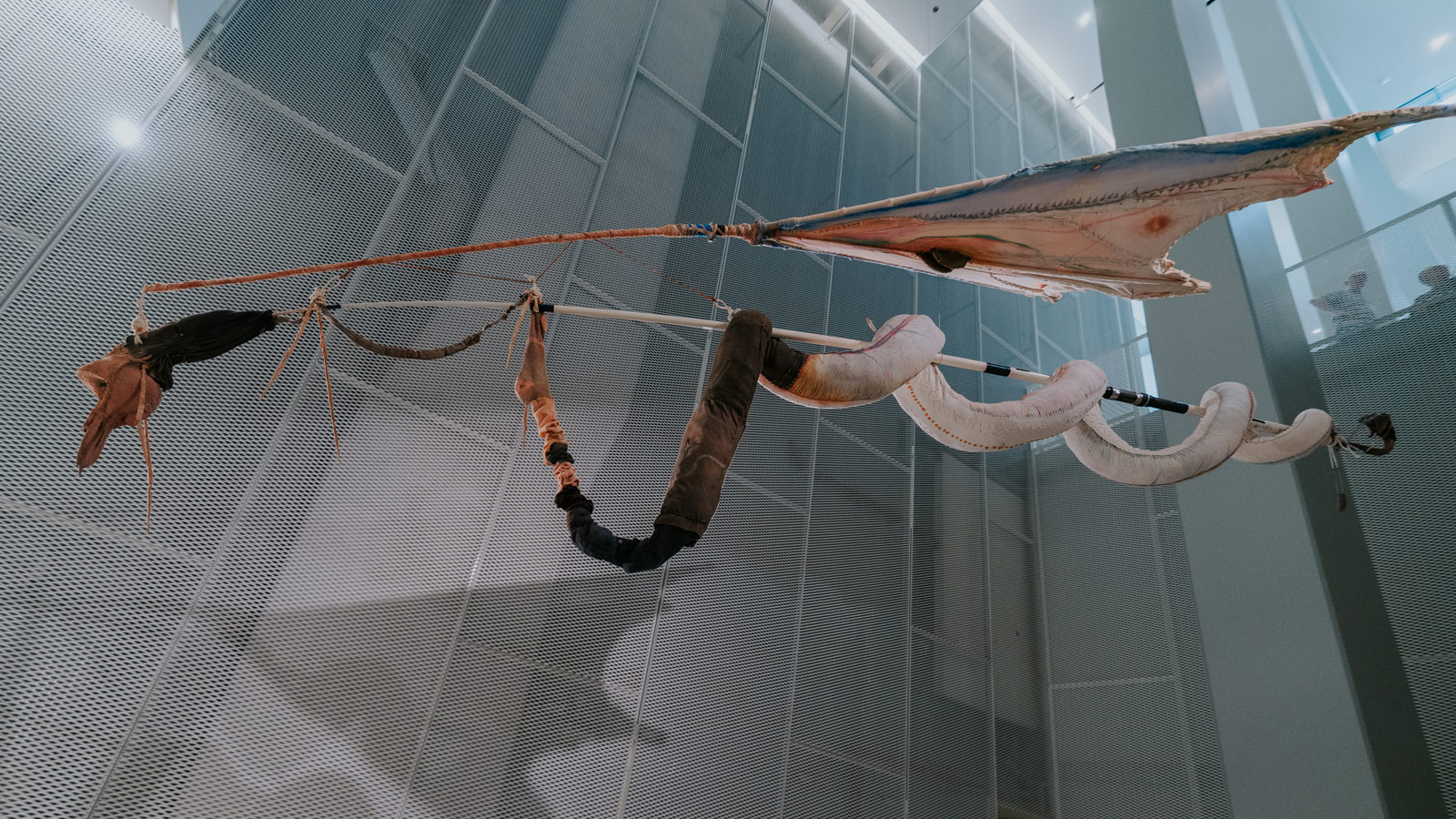
The sculpture can be understood as a whole ‘organism’, from head to foot, and sometimes even from within. Rarely is a sculpture seen so completely, from every angle. Then comes the mystery of the gaze: at a certain point, on the lower floor, it’s possible to meet the sculpture face-to-face. It looks back, as if pausing to land, caught in transit. It’s open, available. It’s there to communicate, and its gaze is directed at the viewer.
FP: In a previous interview you said: ‘I like to work according to the metabolism of nature. I’m also interested in memories. And I make a point of following the attractions I feel towards certain materials I happen to come across.’ When one looks at your work, there’s always a question about what these materials are, where they come from and how they transform. In what way did the choice and provenance of these materials, some reused, others found, shape the form of this new work?
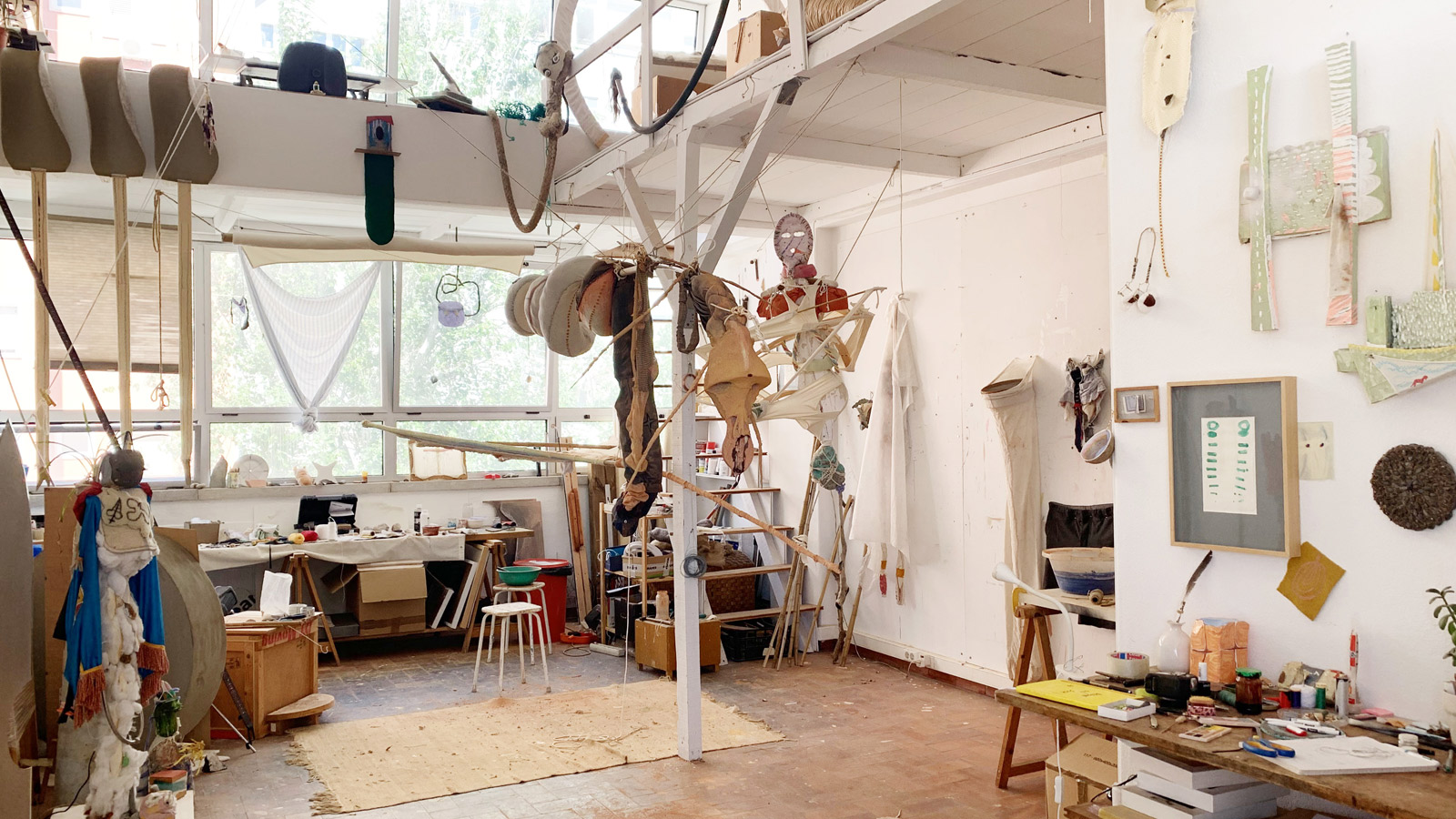
SB: Without a doubt, the materials are everything: they’re the object, the subject and the very stimulus of my work. Many of them have been with me in the studio for years. Sometimes because they came in abundance, other times because they hold a personal story, a family connection or an intimate link with me. Matter is memory, and it carries a vital energy that I like to keep close. When I integrate it into a work, I’m transferring a private event into a collective context, and sculpture, for me, is precisely that: a shared identity.
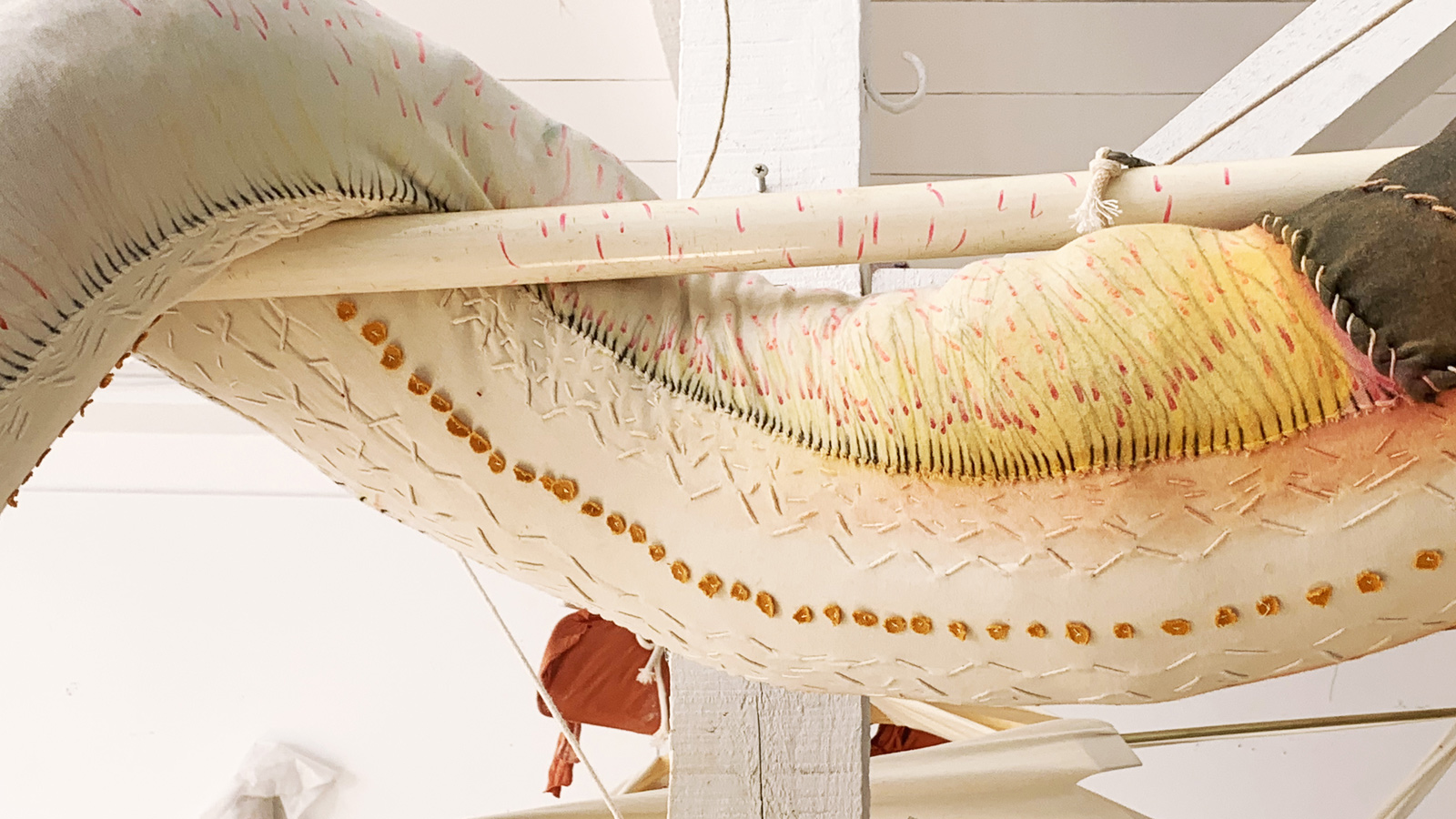
In this work there are four fundamental materials. The main body is made from the ‘skin’ of an earlier piece, shown in ‘Find Me, I Kill You’ (2018). That covering went through a metamorphosis to become part of this new sculpture, yet its origin can still be recognised if you refer to the documentation of the earlier exhibition.
The fishing rod, meanwhile, establishes a direct link with another flying sculpture, the same one I mentioned before. I chose it for its extendable quality, which allows me to work with scale more flexibly. Then there’s the bamboo: I asked the gardeners at the Gulbenkian Foundation for a few canes after noticing one being used as a stake during a walk. One cane became the spine of the piece, and the others the vertebrae. Finally, there’s the clay-sand earth[2], collected at the Serralves Foundation during my last institutional exhibition. It carries a recent memory, and as long as that material resonates, it will continue to appear in my works.
There are still secrets between the sculpture and me, invisible and held within its body, which need not be revealed. Every work has its mystery, and it belongs to us alone. The spirit of the sculpture is profoundly influenced by the traces of these materials. They’re the story of the piece – its force and its character.
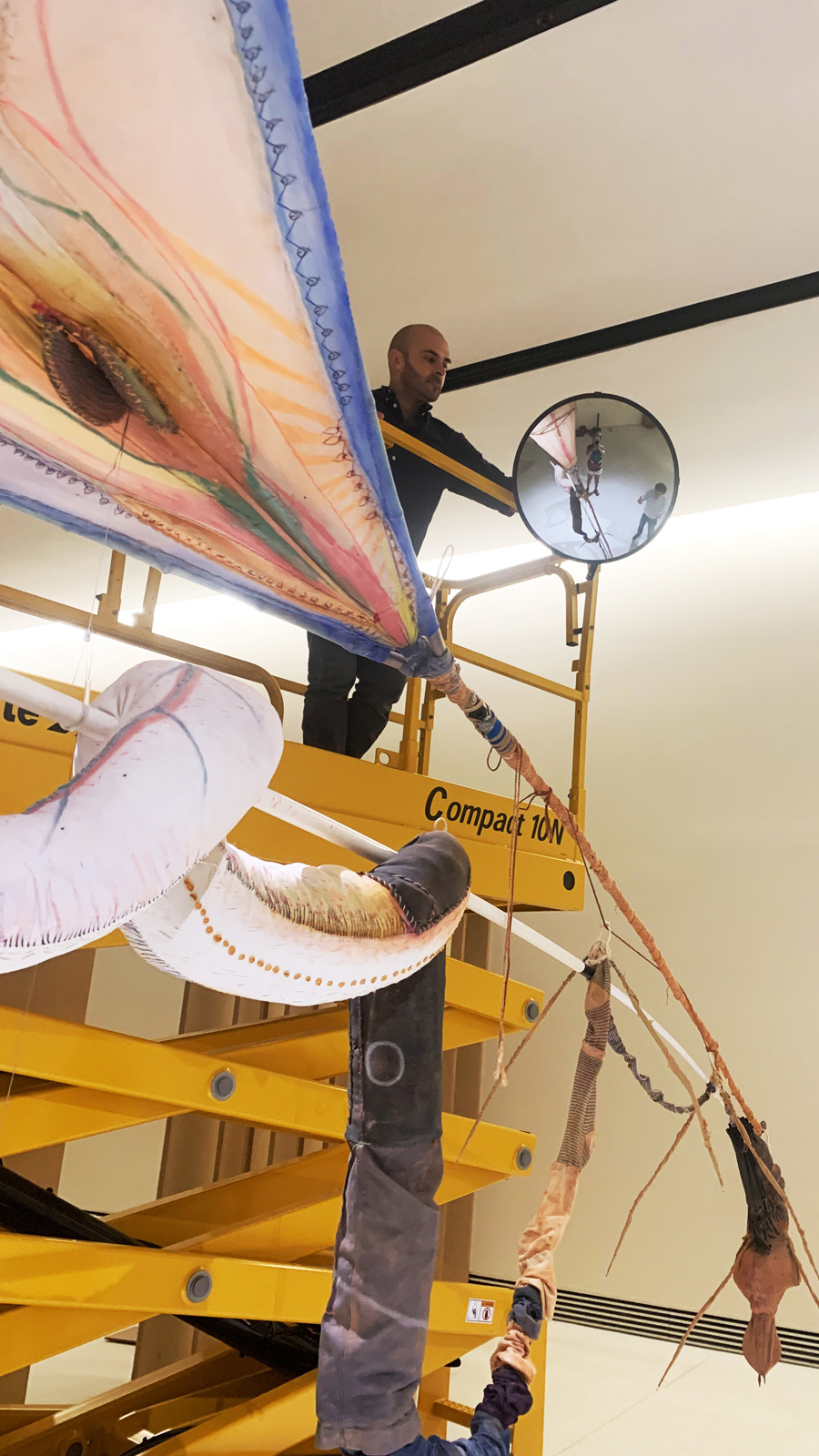
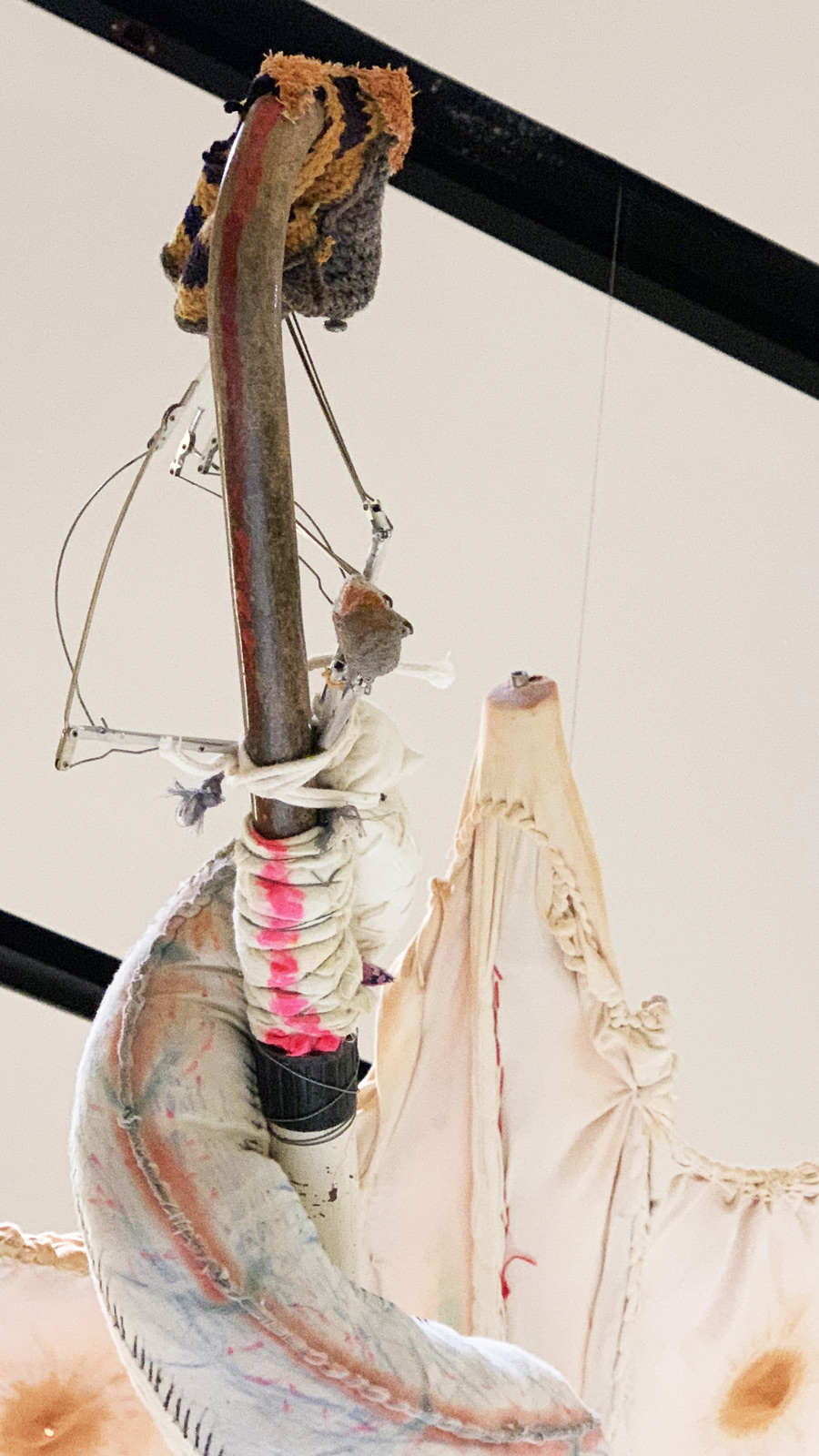
FP: Your sculptures seem to emerge from a dialogue between intention and chance, between what’s planned and what simply happens. How do you achieve that balance? Do you design in advance, or do you start making it and let the design reveal itself along the way?
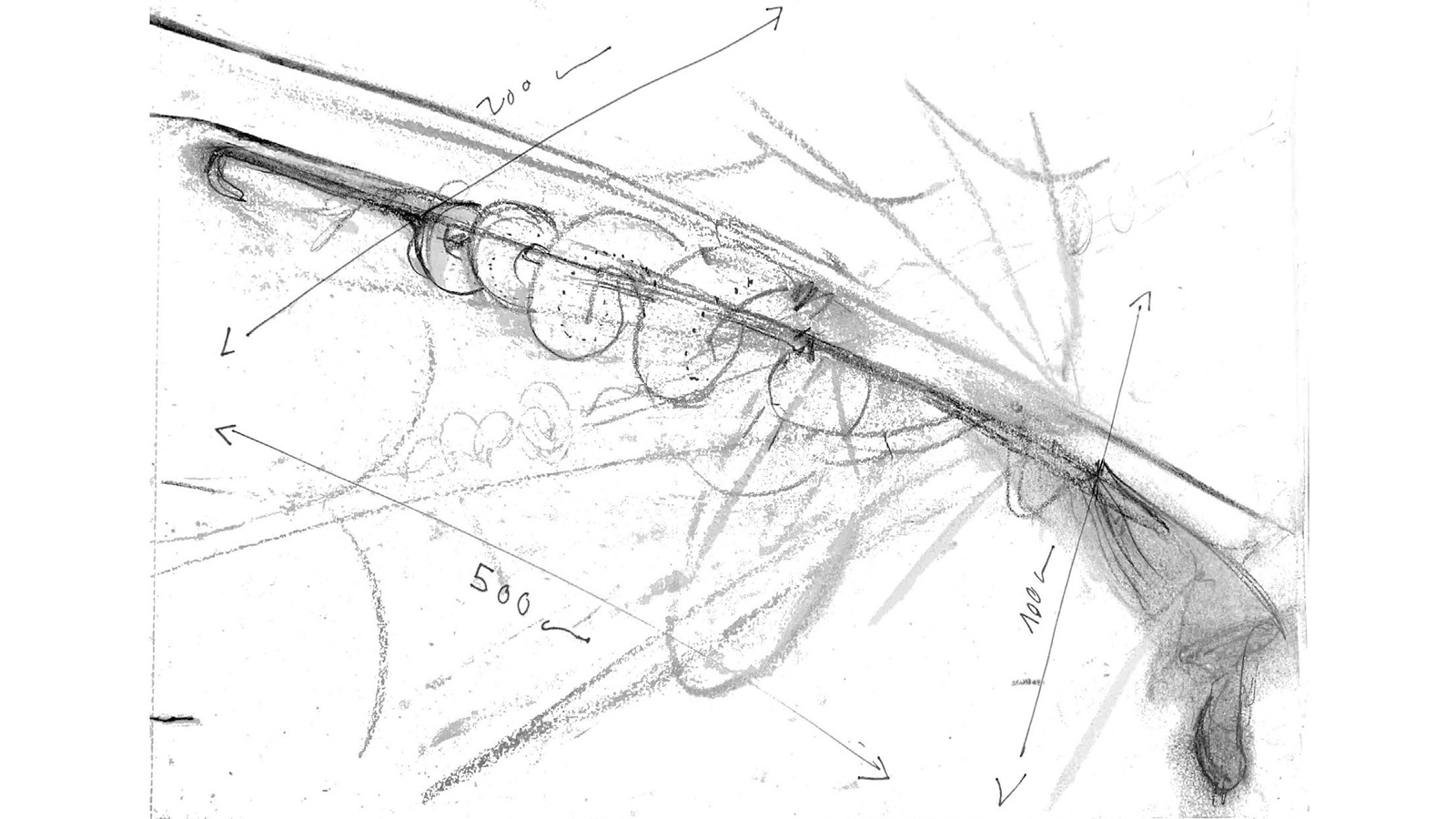
SB: I hardly ever plan a sculpture rigidly before making it. I can’t work that way. What I do is begin by defining a few coordinates: the volume, the type of work, whether it’s suspended or resting on a surface, whether it rises or descends, and how it needs to inhabit the space. It’s like preparing characters for a film: understanding the weight of the place, its tone, its reverberations. From these coordinates, I enter a space of creative freedom. I bring materials together, observe how they interact, and the sculpture gradually takes shape through that encounter. It’s important to stay alert: when the piece begins to develop its own character, its identity mustn’t be lost. But there’s no fixed final design; the work defines itself as it’s made.
In this case, the drawing functions mainly as a technical record, serving to mark out dimensions, proportions and coordinates. It’s a sketch that helps me understand the body of the sculpture from beginning to end, as a whole. It isn’t an improvised construction: if I’m able to draw the work, it’s because there was a strong intention behind it, and the finer details – the position of a knot, a point of tension – are recorded to guide its realisation. It’s a continuous dialogue between what already exists, what’s emerging, and what the space calls for, always with rigour so the piece’s force remains intact.
FP: Since this exhibition is inspired by Scheherazade, is there any narrative, literal or symbolic, that runs through this piece?
(SB) I feel naturally connected to the idea of Scheherazade, as a woman, and to the way stories transform and extend into one another. My sculptures also go through that metamorphosis: they travel, change shape, carry memories of other pieces and other times. I reflected on what Leonor Nazaré said about ‘One Thousand and One Nights’ and allowed myself to be drawn into those tales, though not with the intention of illustrating them. It’s something that remains and operates on almost unconscious level of the creative process; the sculpture never settles into a single narrative. It inhabits that imaginary space, time, and place. It travels, carrying information, emotions and events, and continues to bear all of this as a testimony to the future.
The sculpture is called ‘Longínquo (dur)’. ‘Dur’ is Persian, the original language of ‘One Thousand and One Nights’, and a translation of the Portuguese ‘Longínquo’ (Faraway).
From above, it appears one way; from below, another. Manifesting itself as forceful yet delicate, perhaps feminine, bird‑like or fish‑like – serene.
[1] Referring to the work ‘Voo’ (2024), from the exhibition ‘Diver’s Flight’, held between November 2024 and January 2025 at Galeria Filomena Soares, Lisbon.
[2] An earth-based mixture of sand, clay and stone.
Works from the CAM Collection
Explore the series



No results were found for your criteria.
You may also like

No results were found for your criteria.