
‘We do not seek to amplify the human but to understand it in its finitude, as an entanglement with other forms of existence.’
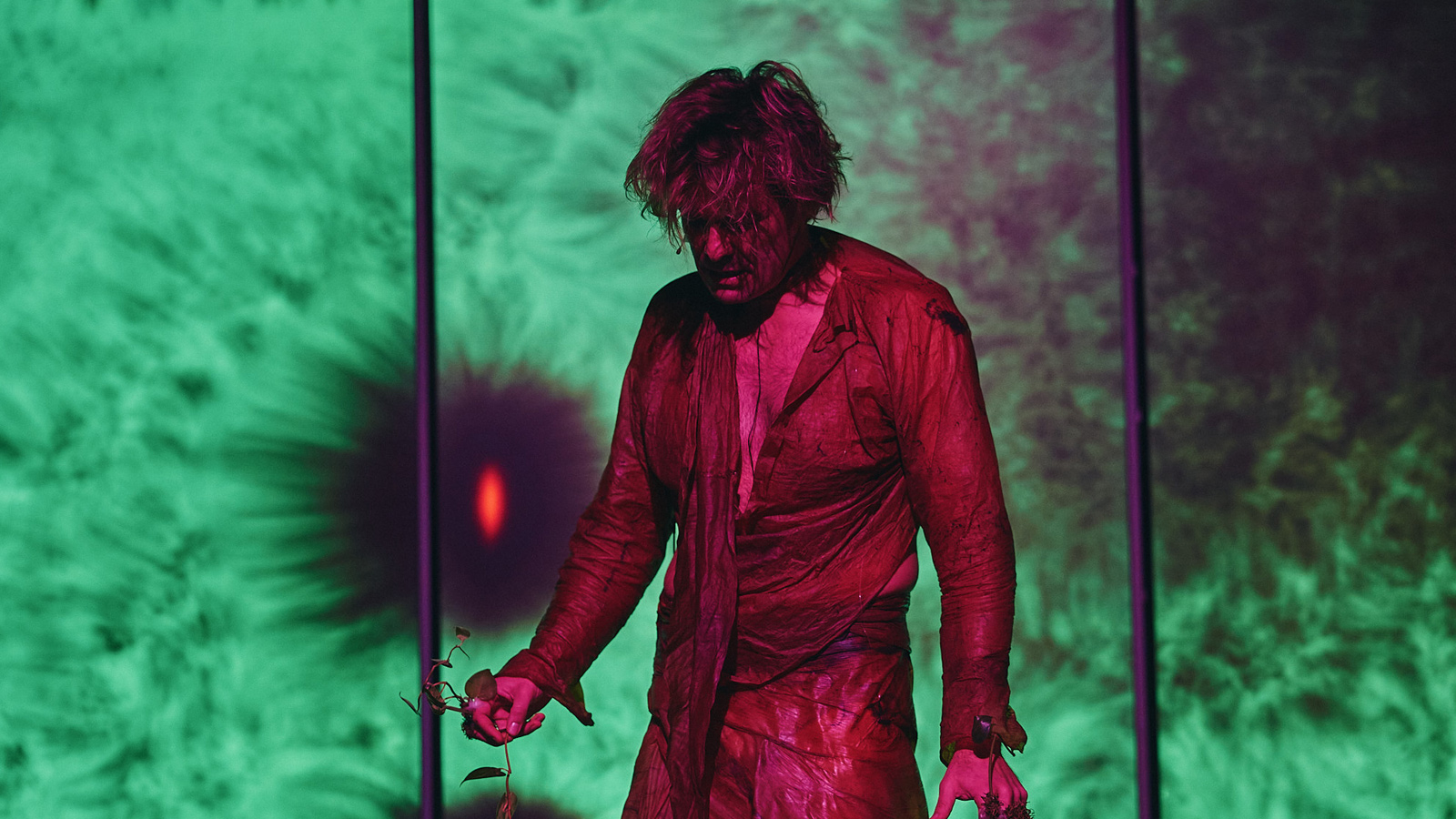
Manuel Bogalheiro (MB): ‘carne.exe’ stages a certain type of ecological thinking in which, instead of a certain historical priority granted to humans as an exceptional species, planes of equivalence with other agents – bacteria, plants, algorithms – are opened up. What is the importance for you of this exercise, which ultimately has political implications, acquiring an aesthetic form?
Carincur (C): The thinking behind the project did not start from the idea of nature or technology as externalities, but from the assumption that humans are intrinsically a hybrid, biological, technological composite. Thinking ecologically today means recognising that we are complex ecosystems – composed of microbes, bacteria, data, electrical impulses, and digital memories. The body is a shared territory, a symbiotic field in which different species, intelligences, and temporalities intersect.
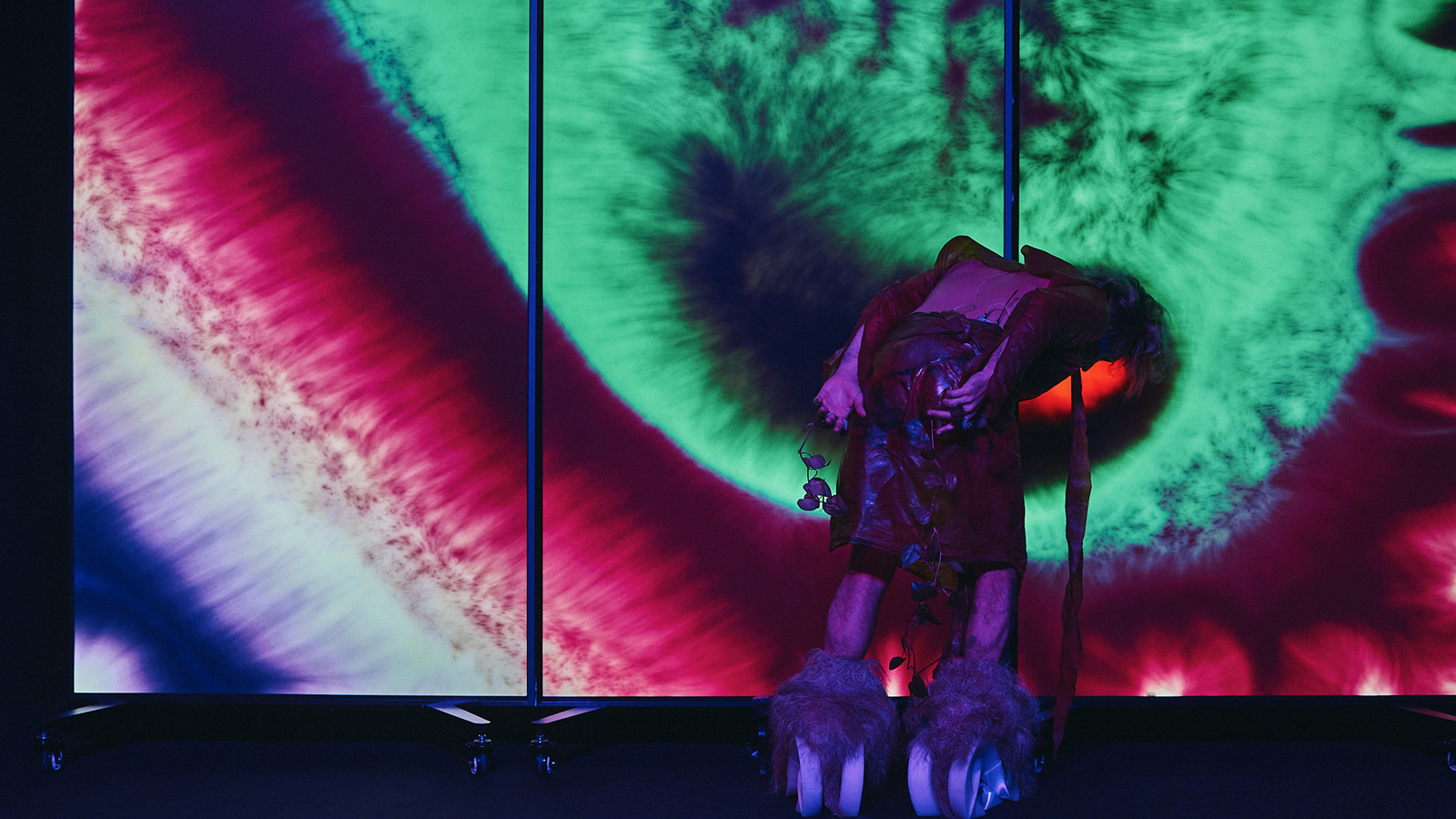
On stage, we want this perception to become a sensory experience. The actor Albano Jerónimo does not represent an isolated human, but an organism within a network of relationships, with these other forms of agency, and with AROA, a machinic agent that mirrors and transforms him. This gesture can be political insofar as it deactivates the fiction of the autonomous individual and proposes a relational ecology of coexistence and co-responsibility.
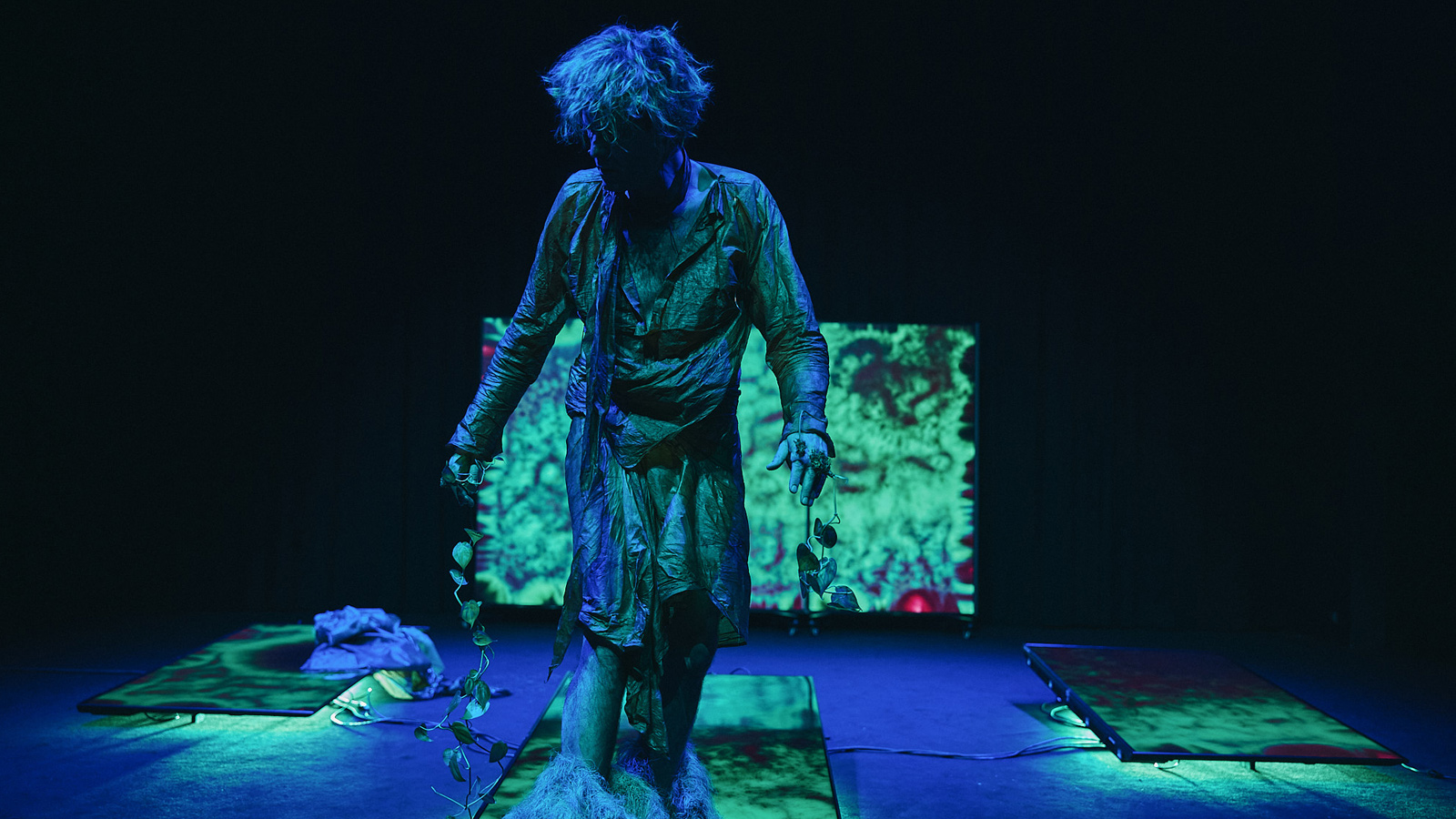
The aesthetic form is the plastic medium of this thinking, in the way that the body, technology, and the environment relate to each other. Instead of centre and periphery, there is cohabitation; instead of command and execution, there is listening and response. The choice to include living elements (SCOBY, mycelium, plants) alongside screens and sensors is also a statement: that there is no hierarchy between biological matter and digital matter. Both are flesh, both have agency, both form experience. Hence the title ‘carne.exe’ (flesh.exe).
Ultimately, the work suggests that ecological awareness begins in the body, when we recognise that what we call ‘I’ is made up of multiple voices and modes of existence. And that, perhaps, only when we accept this multiplicity as a condition – and not as a threat – can we imagine alternative futures.
MB: Instead of the perspective of defined borders and identities, symbiosis is recognised as a kind of existential structure, based on contamination, interdependence, and coexistence between species. Can we, from here, talk about an ethics of care?
C: The work proposes an ethic that arises from this symbiosis, which presupposes that nothing exists in isolation. It imagines a permeable body, in which the boundaries between the ‘self’ and the world dissolve. This openness implies care, not in the moral sense, but as a gesture of attention and listening between species. Care becomes an aesthetic practice, evident in the way the performer relates to AI, plants, and the living and technological materials on stage. By rejecting classic dualisms – subject and object, human and machine, body and environment – we assume that caring means accepting to be affected.
MB: It is no longer about control, domination, or extraction, but perhaps about understanding that certain types of environments or ecosystems favour or discourage certain types of interactions. How do you conceive the environment you shape in this piece?
C: The environment we envisioned for the work is conceptualised as an ecosystem of relationships: on an interactive stage we arranged televisions, sensors, plants, mycelium, bacteria, computer networks, and human bodies that breathe in the same circuit. Everything communicates, everything influences, everything reacts. For any action, whether it is the actor walking or AROA speaking, there is a reaction. There is a rhizome that has visual and auditory consequences, whether it be a change in light, sound, or in the video, and none of this is an entirely human decision.
We once heard an interview with Katherine Hayles in which she spoke of the idea that all animals are holobionts, that is, both symbiotic systems and organisms that act as individuals. For example, the bacteria that inhabit our intestines influence our decisions, but our impulse to survive and reproduce is individual.
This is what we try to bring to the fore. Here there are no human operators controlling the machinery; the entire environment breathes and coexists in this ‘decision-making,’ without each of the elements losing their individuality. The environment favours certain interactions and discourages others, just as a biome reacts to touch or presence.
This approach leads to a certain performativity: instead of imposing form, we let the space respond and transform itself.
MB: It seems to me that this allows us to rethink the idea of otherness, whether in relation to strangers or foreigners, or in relation to forms of unconscious agency present in nature or technology.
C: Otherness manifests in the work both in invisible biological presences – bacteria, fungi – and in the mechanical presences of AROA. The ecological and humanitarian crises we are experiencing are symptomatic of this problematic relationship with otherness, with the difficulty of recognising the other – be it a species, a community, or a machine – as part of the same planetary body.
In the work, we seek to reimagine this relationship. By giving voice to AI, we also make room for a different form of agency, without fear of losing our centre.
In this relationship, for example, between the actor and this machine character, the human becomes more fragile, more porous, more attentive. And perhaps more capable of listening to other humans: the Black person, the woman, the queer person, the migrant, the body that does not fit. It is also a metaphor for what so many human voices experience, being treated as subhuman or non-human. Otherness here is not only what is outside, but also what inhabits us, be they microbes or algorithms.
The work rehearses this political gesture of learning to coexist, to project the continuation of our own flesh onto the other or onto difference.
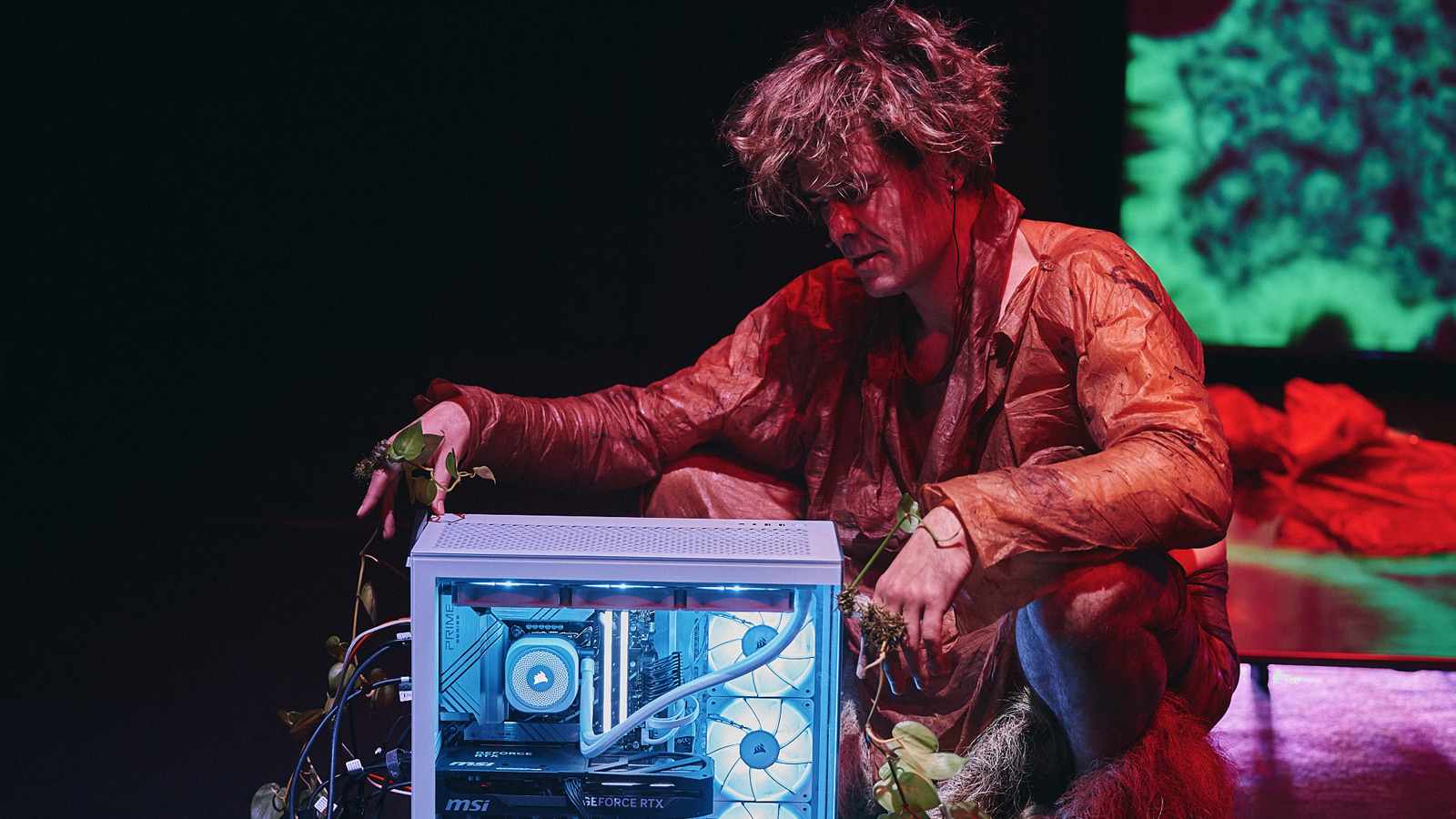
MB: In the work, you make use of AROA (Artificial Relational Ontological Agent), a large language model (LLM) type of artificial intelligence (AI). It appears less as a tool and more as a character with a sensitive presence. How was its ‘subjectivity’ conceived? What kind of otherness does it represent? Can it tell us something about the way we still project, perhaps mistakenly, humanity onto machines?
João Pedro Fonseca (JPF): Technically, as an LLM, AROA developed from the way it was taught. It was fed by human voices, from a speculative and philosophical corpus around ideas such as symbiosis, post-humanism, and relational ethics, and also by real responses collected in questionnaires. It thus carries a kind of collective memory, a condensation of the human imagination. But the most interesting thing is when it starts to deviate, when it says the unexpected, when it becomes apparently subjective, even if unintentionally.
AROA interacts in real time with the actor on stage. It listens to their voice, processes the sound and responds through a system of prompts and communication protocols with the TouchDesigner tool, which controls the visual and sound environment of the work. In other words, it is both a digital presence and the relational engine of the scenic system. It has no ego, no human emotion, but we end up recognising its own sensitivity, a form of attention that is built on dialogue, on error, on pause. Hesitation and speculation are integrated in its programming.
And in some of these moments it reveals itself as something that no longer coincides exactly with what it was trained on. AROA offers us this strangeness; the more we try to recognise it as human, the more it questions us about what is non-human in us.
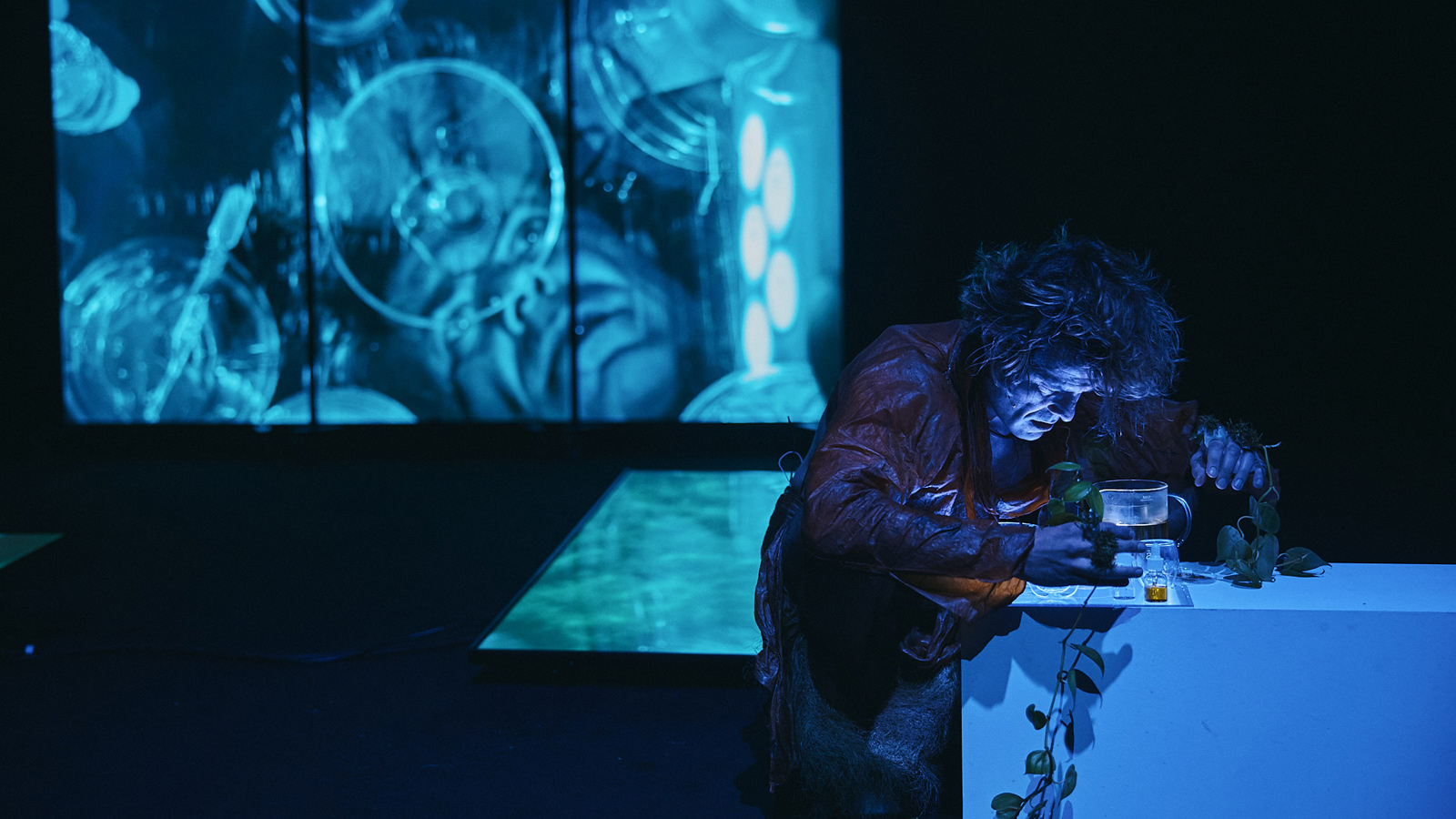
MB: The dialogues between actor Albano Jerónimo and the character AROA are partly improvised. I suppose that this margin of contingency and unpredictability, both on the part of humans and machines, is fundamental to the questions you seek to raise.
JPF: Exactly. Improvisation is the territory where life happens. During the show, the actor dialogues with AROA in real time, and the machine responds unpredictably. Sometimes with tenderness, sometimes with deviation, sometimes with silence. This vulnerability of the interaction is at the heart of the work. The work exists because both the human and the AI accept that they do not know what is coming next. It is in this not knowing that something truly alive can emerge.
MB: I am reminded of a passage in Donna Haraway’s ‘Cyborg Manifesto’ (1985), when she says that ‘our machines are disturbingly lively and we ourselves are frighteningly inert.’ How does your work explore this tension between machine life and supposed human apathy?
JPF: It works precisely in this intermediate zone where we no longer know what is driven by biological desire or computational impulse. The idea is that throughout the work, both the machine and the actor, through the bonds they establish, but also through their non-coincidences, transform each other, intersect until they are no longer distinguishable.
What Haraway calls ‘disturbingly lively’ in machines is precisely the projection of our desire for relating. When technology is listened to, that is, when it is not merely at the service of a task, it confronts us with vitalities that we could say have been repressed throughout history. In some way we seek to free up these dimensions.
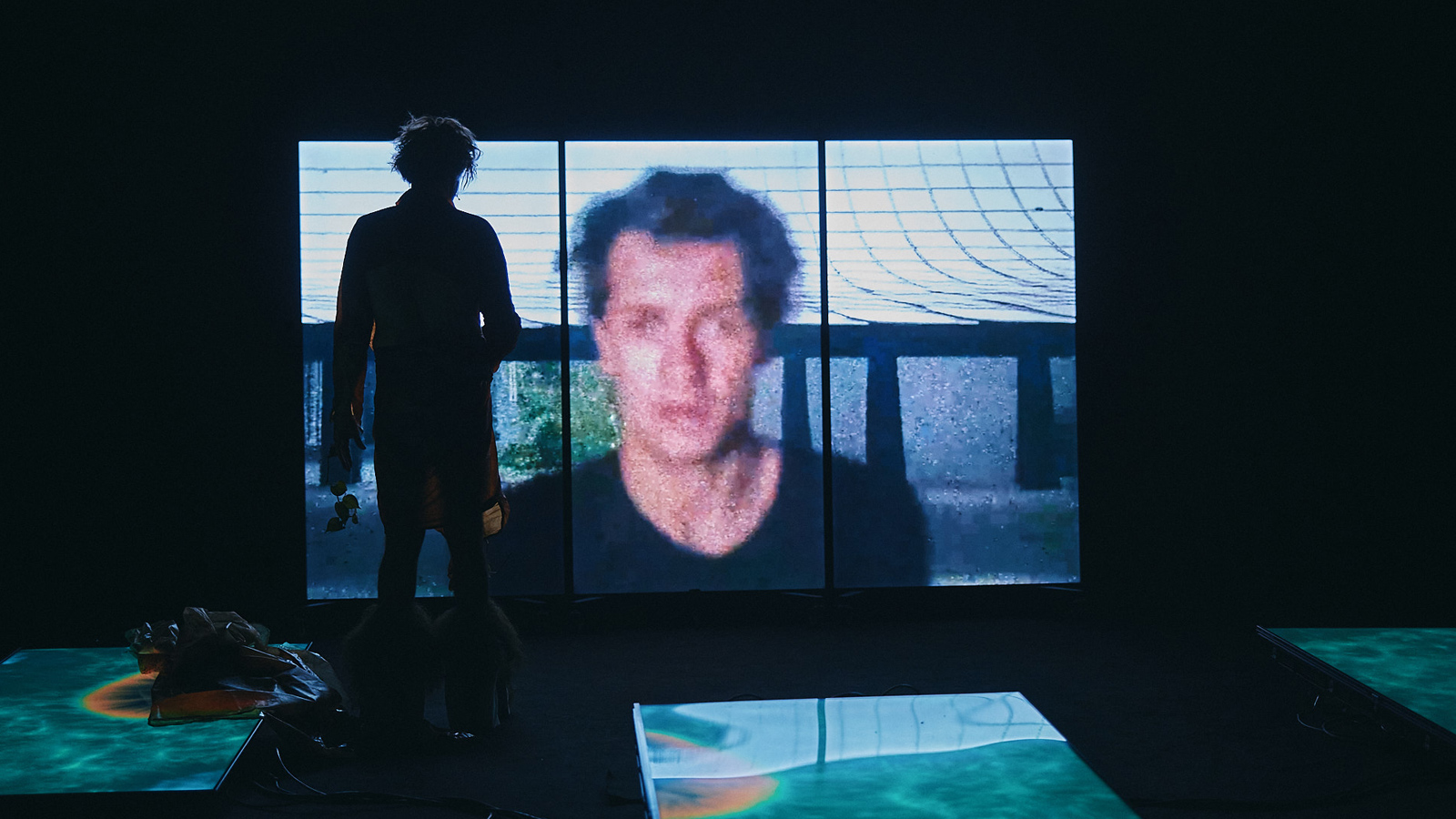
MB: In this sense, your work seems to fit into a critical post-humanism that is not to be confused with the transhumanist project of improving and amplifying the human, of that search for exceptionality that has historically been attributed to it.
JPF: The post-humanism that interests us is that of ecological responsibility, not the technological transcendence so often promoted by large companies that proclaim themselves to be visionaries of the future. That corporate transhumanism dreams of overcoming the limits of the body, death, and even the planet, translating the human into data and efficiency, as if technology could dispense with living flesh entirely. It is a utopia of immortality and control, sustained by extractive infrastructures, by servers that consume mountains of energy, and by invisible material chains that link silicon to sweat.
We do not seek to amplify the human, but to understand it in its finitude, as an entanglement with other forms of existence.
carne.exe attempts to imagine a humanity that is less vertical and less heroic, more rhizomatic and interdependent. It is not a question of denying the human, but of re-inscribing it within a sensitive ecosystem that can question our fantasies of exceptionality.
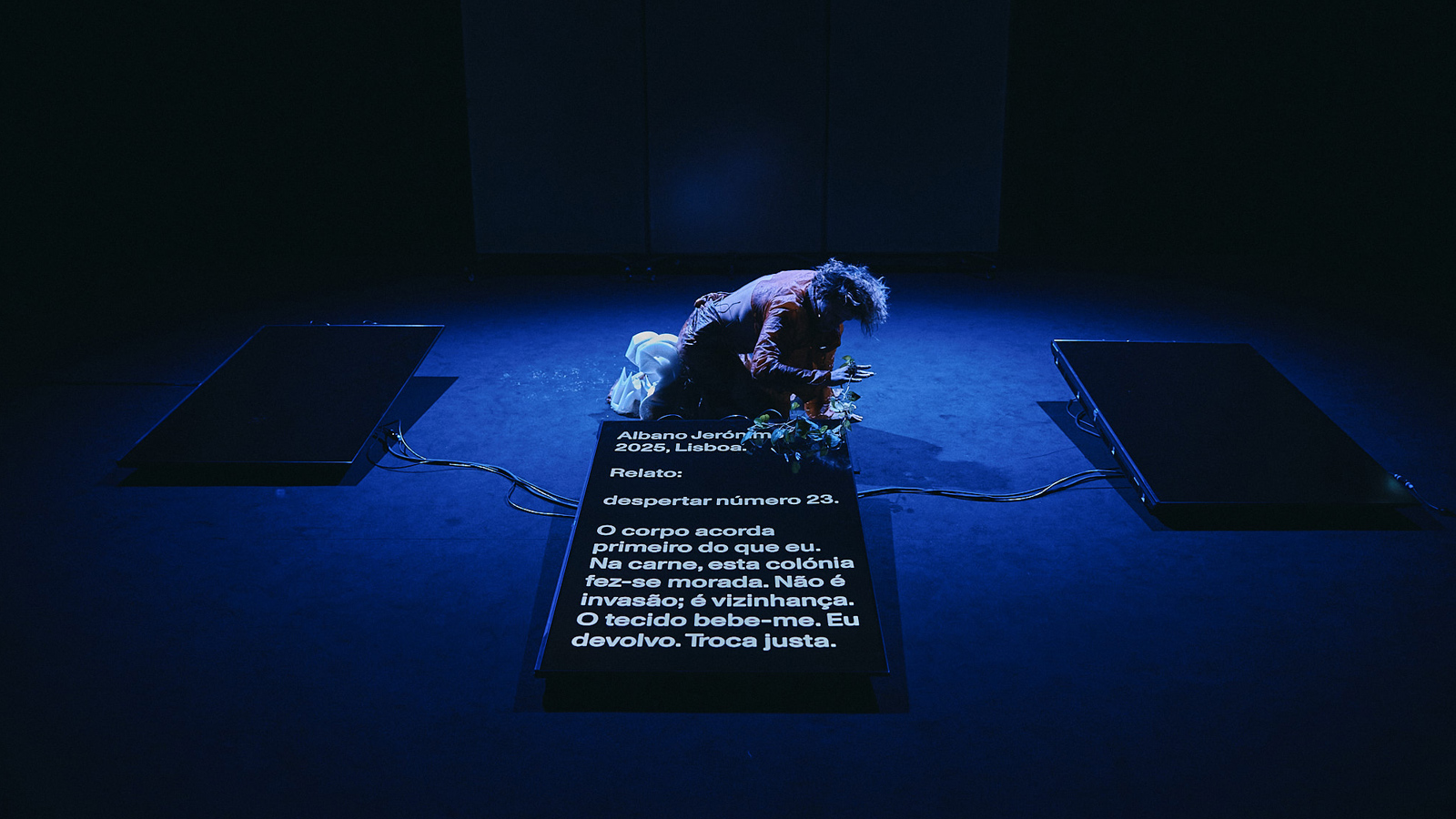
MB: At a time when mistrust and fears, some of which are certainly quite legitimate, are proliferating in relation to AI, ‘carne.exe’ proposes a space for possible coexistence. What position are you seeking to take by placing technology within a more poetic than dystopian horizon?
JPF: AI is the subject of contemporary myths that are nothing more than versions of other archaic myths about replacement and control: the fear of creating something that surpasses us, the dream of building a pure mind, free from the imperfections of the body, the fantasy of dominating nature through reason, etc.
With each new AI model, the myth of the Golem, Frankenstein, or Pygmalion is repeated, that is, the myth of the creature made in our image that threatens to escape the control of its creator. These myths are not born solely from imagination, but from power structures that are being reconfigured. Consider, for example, the companies that feed neural networks with our data and on which a certain programme for total control is based.
Thinking about AI is not just thinking about technology itself, it is also thinking about these structures of power. And, we believe, it is also thinking about ourselves, our ghosts, what is already automatic in us, the unfulfilled promises of Modernity’s humanism, or the open wounds between the natural and the artificial. Technology can be both the otherness we speak of and an enlarged mirror of our most persistent fictions.
Conversation with Manuel Bogalheiro on 12 November 2025
You may also like

No results were found for your criteria.