
Hamadryads, or the wind that speaks to the trees
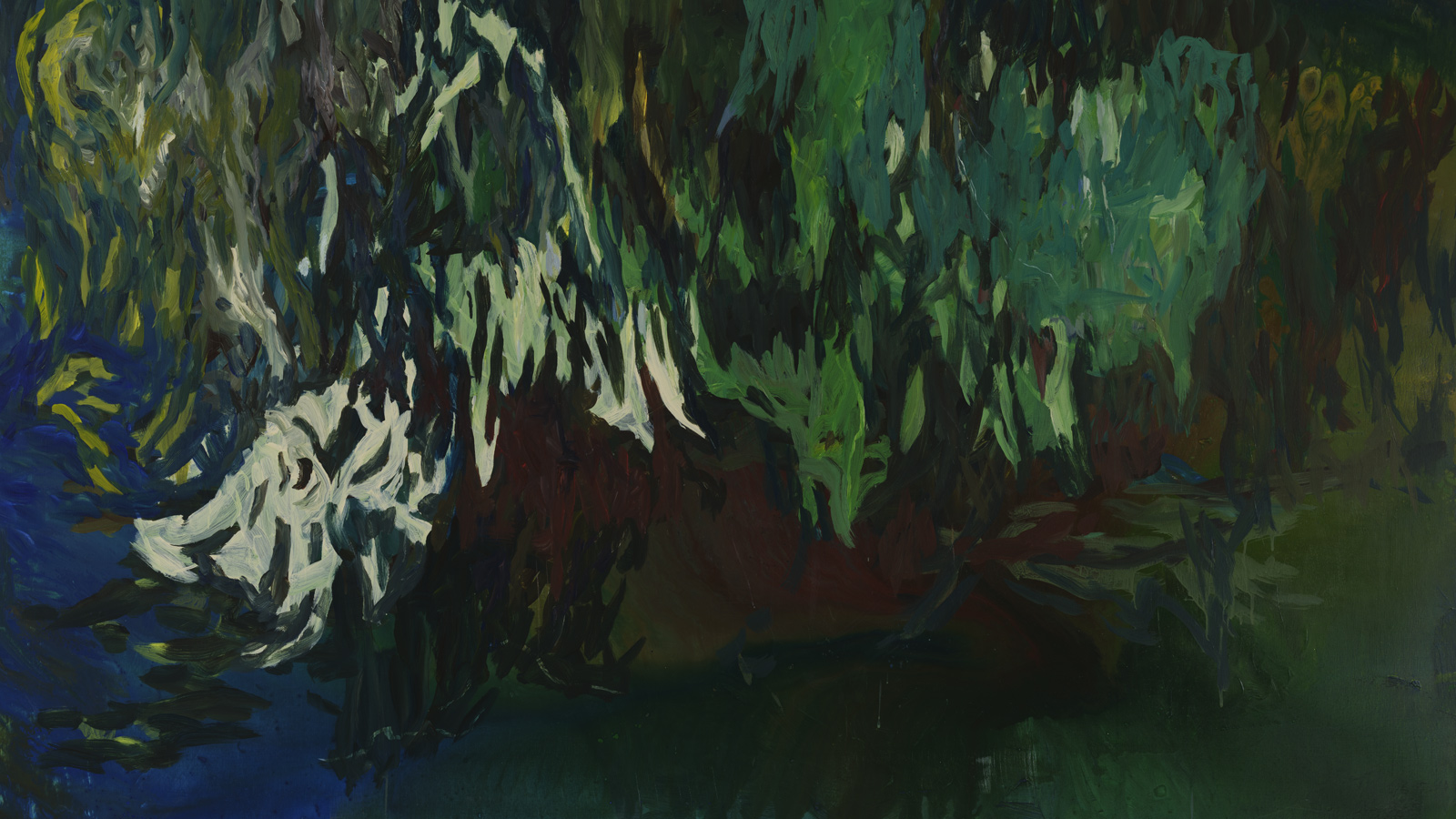
Three works, differing in form, materials and appearance, share the same surname, like a small amulet. Hamadryads – nymphs born bonded to trees, which they protect with their lives, their destinies being interwoven – inhabit legends from Ancient Greece, striking those who cut down, exert violence on or in some way doubt the divine force of their plant companions. The different first names of the works (‘Metamorfoses… Alguns Dias…’ [Metamorphoses… A Few Days]) convey the understanding that the natural is transitory, it is transformative movement, it is the passage between states that elevates the cyclic existence of all things.
In ‘Metamorfoses_Árvores’ [Metamorphoses_Trees], a painting in layers, like the earth, we breathe the nighttime marshland landscape, where the horizon fades into the plenitude of the Ribatejo region to merge ground with sky, the trees marked out only by their silhouetted shadows. In it I see, with the eyes of my memory, the weeping willows bowing over the dirty river, like someone shedding limpid tears that immediately disappear in the muddy riverbed.
The feeling of swampy humidity, an earthy humus, the silhouette of the trees, the multiple tones of the night sky glimpsed between the dense treetops, almost allow us to sense another dimension hidden by the veil of night that falls over the floodplain. In the canvases of Ilda David’, I see poetry and painting holding hands between river and pasture, memory and atmosphere, breathing and immanence – I find that dreamlike place that is home to the desire to merge body with earth.
‘Por alguns dias’ [For a Few Days] is a textile work that unfolds in two objects: one piece of fabric and a jacket, both linen and belonging to the artist or a female family member. The act of embroidering over these anamneses could be a way of inscribing time on the surfaces around her, but I suspect there is more to it than that. An invocation of the ancestral memory of this cyclic movement of the hand holding the needle, so simple, but which, as a superimposed gesture, brings us closer to the past – which might not be idyllic, but always maps out our relationship with the earth. As Maria Gabriela Llansol wrote ‘I sew, and when I stick the needle in and look back at the line of stitches, it seems to me that they form a path of stones through the desert’ (Livro de Horas I, 2009).
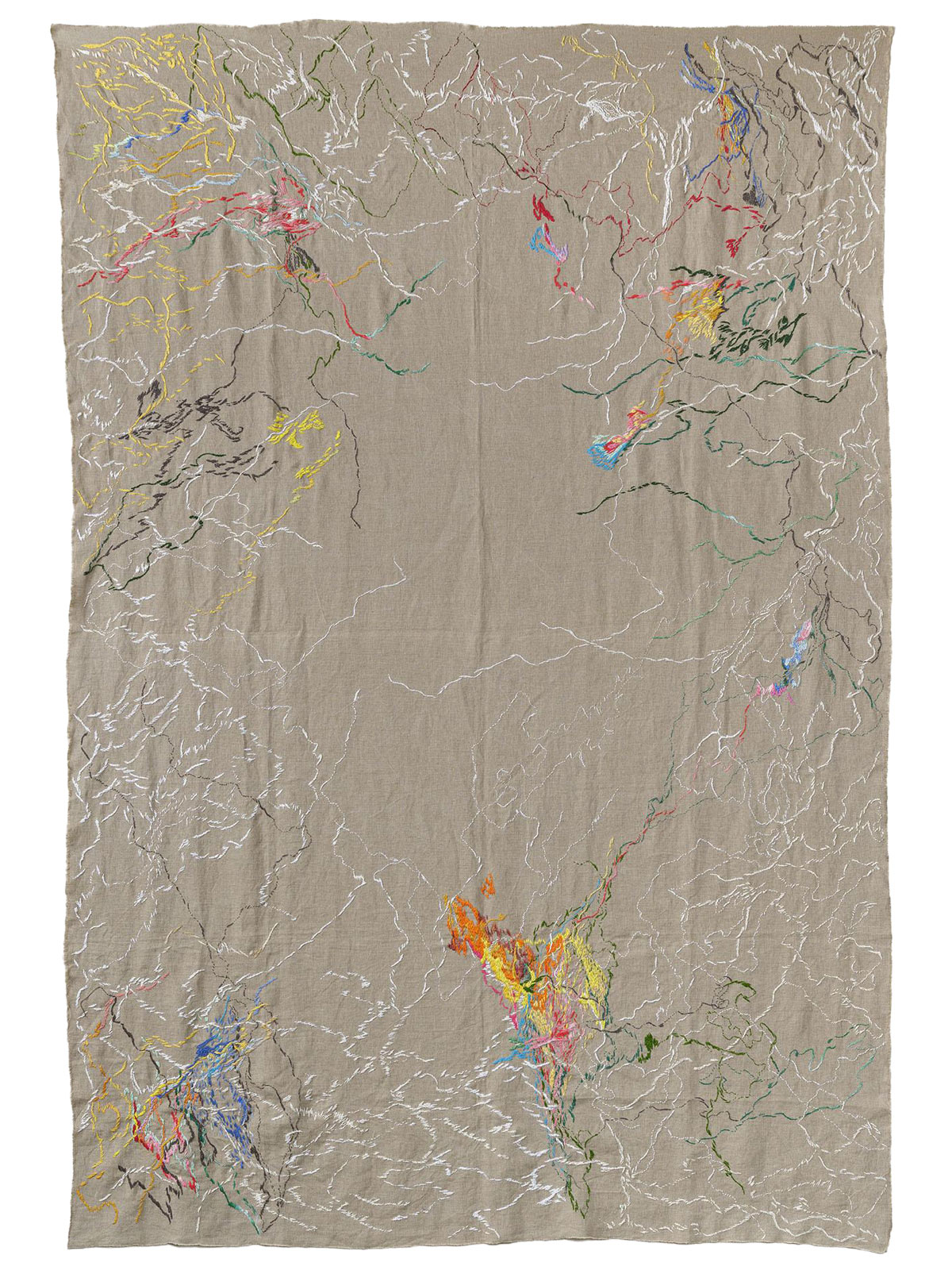
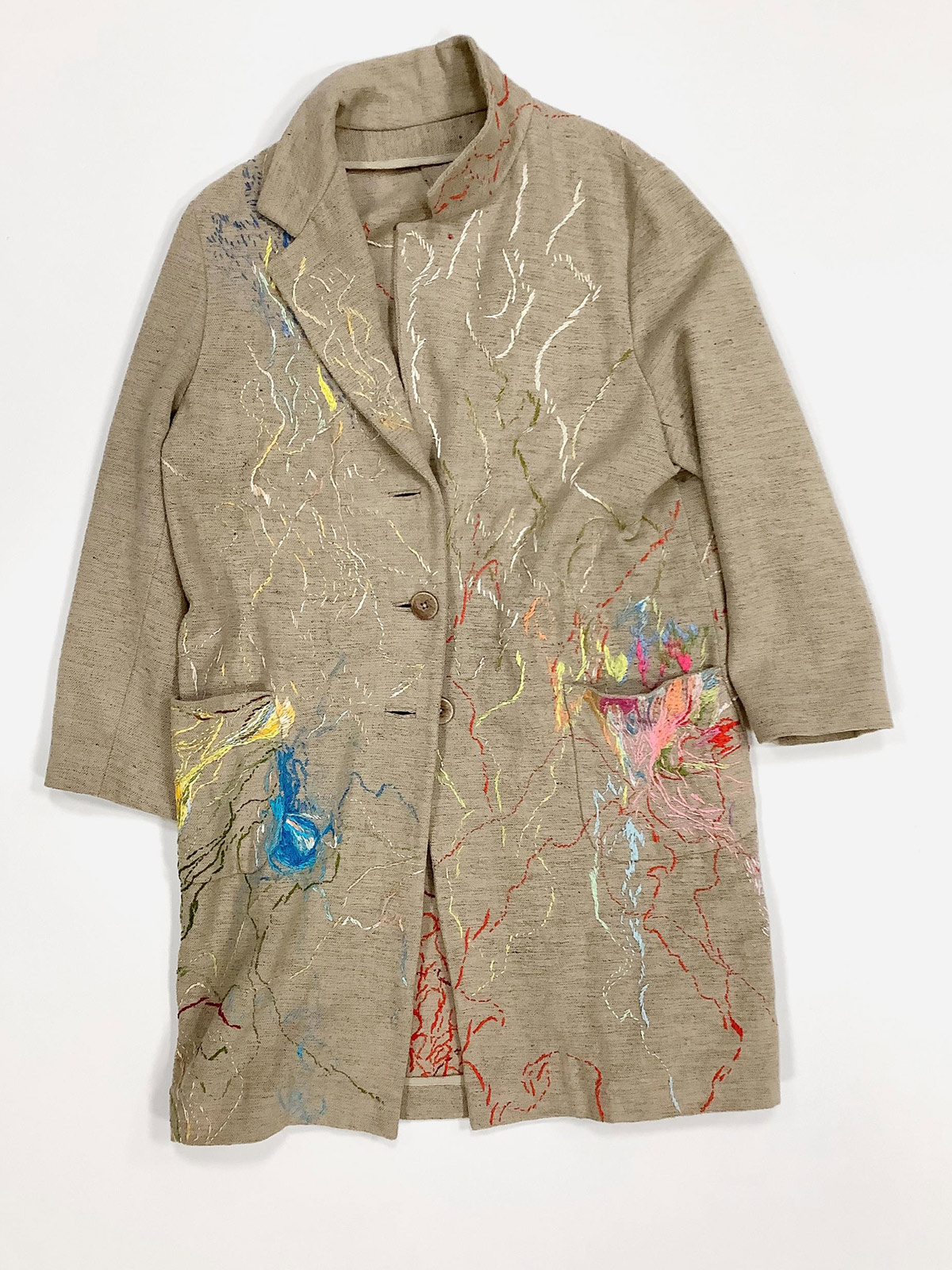
Embroidered by hand, the lines ploughed through the linen recall the wind swelling through the leaves, whispering caresses that descend from sky to earth, as though the air wanted to converse with the tree spirits. Perhaps they are the invisible fingertip movements of those hamadryads, carefully drawing constellations in their trees, whose roots would never allow them to ascend to the heavens.
Ilda David’s cosmology is that of landscapes and readings, of mythologies and tree leaves, of poems and river water. In the Ribatejo region, there is no sea, but always a horizon that extends endlessly across plains that (do not) contain it, and it is on that horizon that we find the poetry within: in the never-ending line that splits earth and sky, we witness the smallness of our insignificance in the face of the magic of Earth. And perhaps we remember that we cannot make it disappear.
Works from the CAM Collection
Explore the series



No results were found for your criteria.
You may also like


No results were found for your criteria.