
When Writing Is Not Enough: the Drawings of Maria Isabel Barreno
Before she drew, Maria Isabel Barreno (1939–2016) wrote. Words were enough for her to give shape to thought, to explore both the world and the inner self. But at a certain point – as sometimes happens to those who create – writing proved insufficient. The gesture demanded space, and the stroke began to emerge. Only later did the awareness come:
‘For a long time, I only wrote. Sounds had colours, sentences stretched out like arms or branches, weaving a lacework of light and shadow with what was named, with what was spoken. Sometimes, almost without me noticing, my hands would move around in intricate patterns as I thought. I believed that writing was enough for me.(…) Until one day, I said, I am – and I drew.’[1]
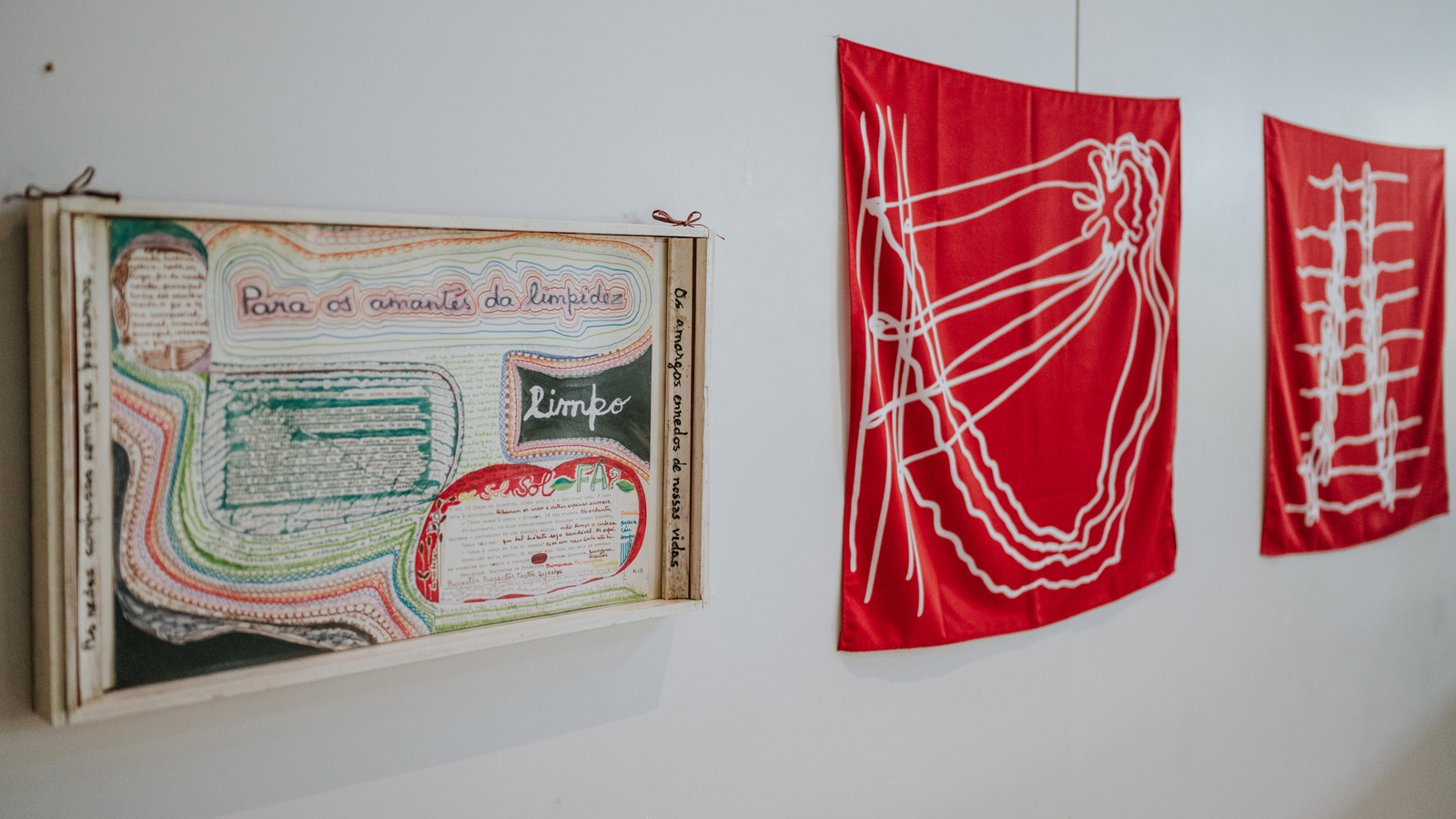
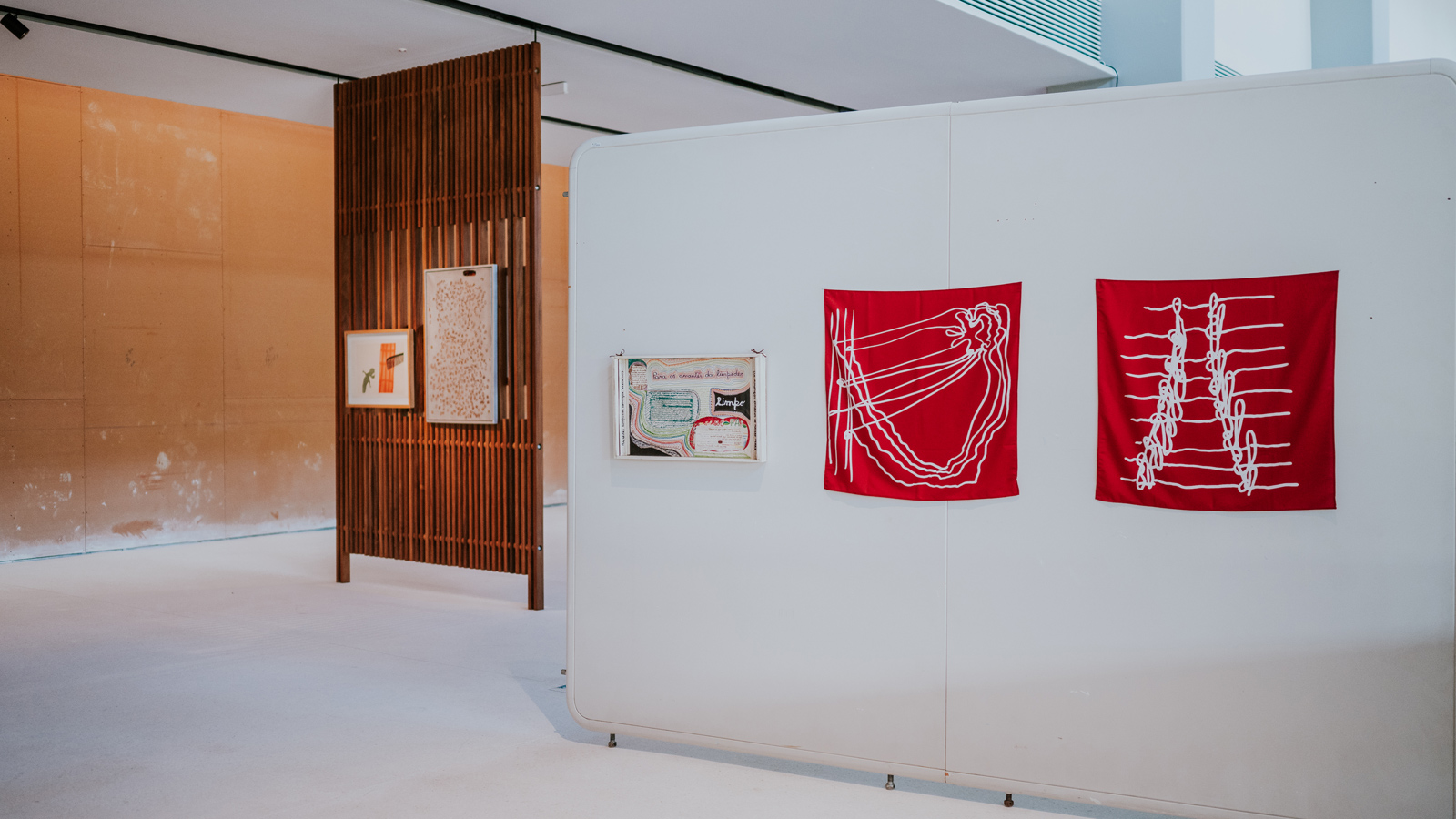
These words by Maria Isabel Barreno appear in the catalogue of her solo exhibition, held at CAM in June 1986. A writer and co-author of ‘New Portuguese Letters’, Barreno also established herself as a visual artist through the exhibition ‘Desenhos, Livros e Tapeçarias de Maria Isabel Barreno’ [Drawings, Books and Tapestries by Maria Isabel Barreno]. CAM holds two drawings from this exhibition in its Collection: ‘Espreitando as folhas’ [Peeking at the Leaves, 1982] and Limpo (1982). The latter was selected by Leonor Antunes for inclusion in the exhibition ‘a selection of works from the collection by leonor antunes’.
‘Limpo’ (1982) explores the idea of words as a form of plastic materiality. Letters, both drawn and typed, and graphic lines emerging between phrases and paragraphs reinforce the idea of thought in flux, where writing and image bleed into one other. It is a play between chaos and order, the entire surface being filled with words, colours, and textures.
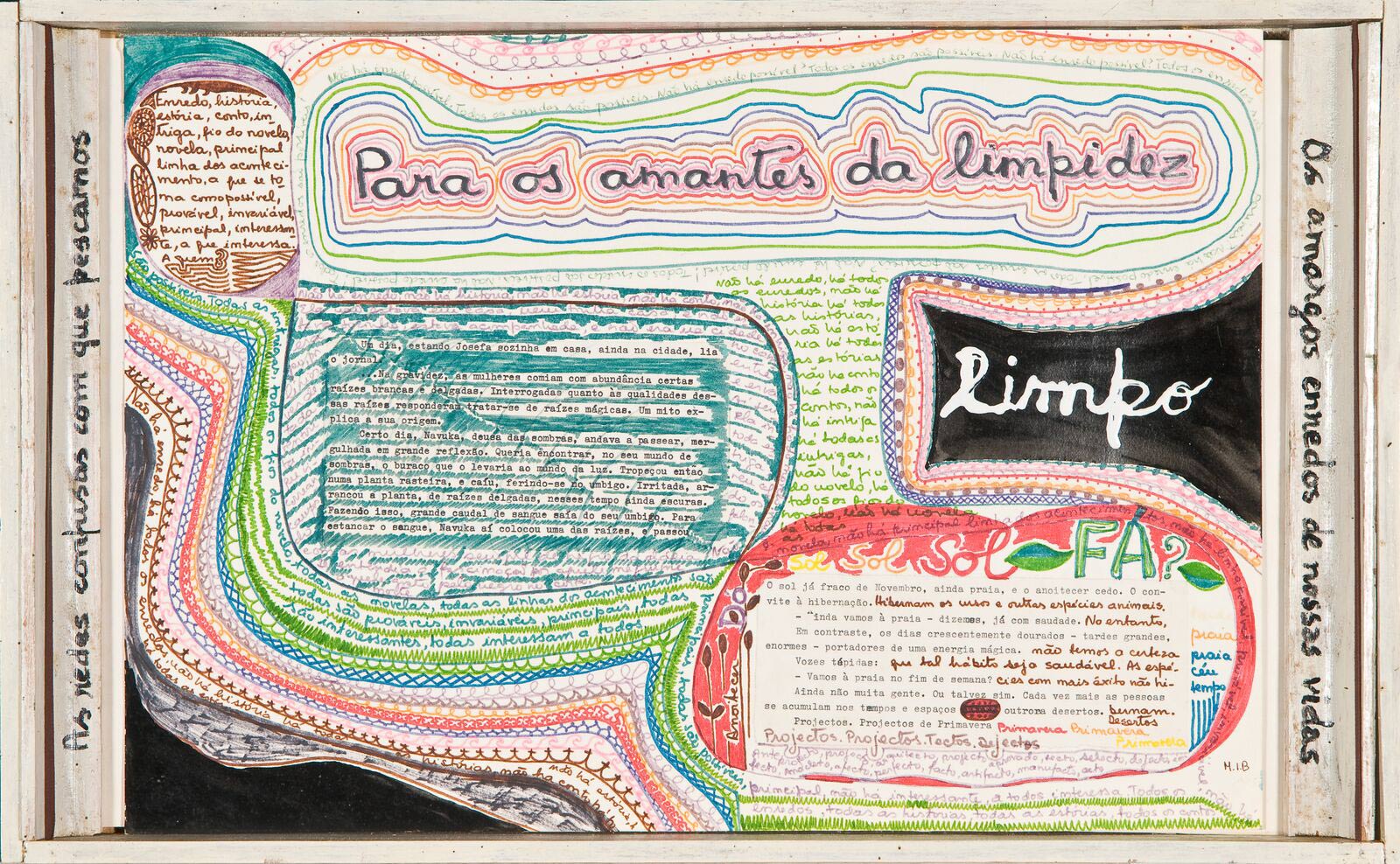
The phrase ‘Para os amantes da limpidez’ [For lovers of cleanliness], which appears to carry a satirical tone, stands out at the top of the composition, surrounded by layers of colour that ripple outward like waves, suggesting an organic movement that draws the eye across the other elements of the drawing. The total saturation of the space immediately contrasts with the title of the work and the notion of ‘cleanliness,’ which is typically associated with clarity and the absence of noise. The text even extends to the very frame of the drawing, where the phrases ‘As redes confusas com que pescamos’ [The tangled nets with which we fish] and ‘Os amargos enredos das nossas vidas’ [The bitter plots of our lives] are inscribed.
One paragraph evokes myths and symbolic imagery weaving a narrative that interlaces mythology and the female condition as it speaks of magical roots, blood, and transformation. The text is absorbed by the graphic explosion of the felt-tip pen and its colours. Handwritten words overlap, forming a marginal commentary that expands the central discourse.
The saturation of visual information demands a slower, more attentive process of decoding. An act of resistance against homogeneous discourse. Rather than a transparent, straightforward reading, the drawing requires interpretative effort – a willingness to engage with the juxtaposition of meanings. There is no economy of means. On the contrary, the work is born from complexity and layering, not absence.
From the artist’s own words, we understand that her experience of writing was so profound and intricate that she perceived language visually. Drawing thus arises as an involuntary, organic extension of writing – its natural prolongation.
From the coexistence of multiple symbols, the interplay between language and image, discourse and materiality, Maria Isabel Barreno’s drawings open up a space of freedom.
[1] Barreno, M. I. (1986). ‘Dezanove Desenhos de Maria Isabel Barreno’. Lisbon: Calouste Gulbenkian Foundation, Centro de Arte Moderna. Provenance: Gulbenkian Art Library.
Works from the CAM Collection
Explore the series



No results were found for your criteria.
You may also like
No results were found for your criteria.