
‘Interior #2’, by Patrícia Garrido
-
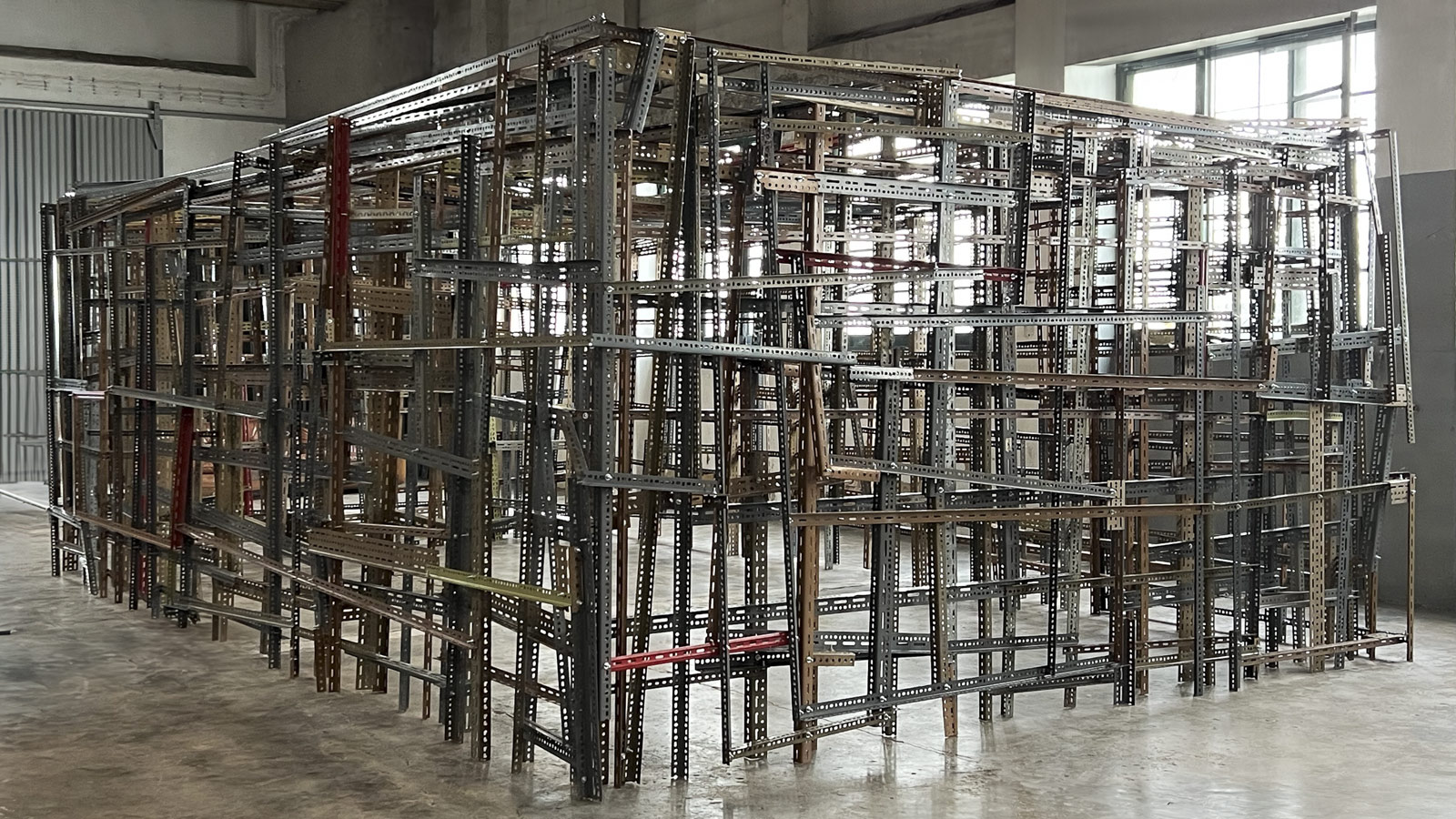
Patrícia Garrido, 'Interior #2', 2021
To write about ‘Interior #2’, it is important to reflect on Patrícia Garrido‘s entire body of work. Not because interpreting or enjoying this particular piece is dependent on its relationship with other works, but because – to use her own words – it is possible that all her pieces are, in fact, the same: continuous reformulations of an identity that is always in flux, in constant dialogue with the flows of the world.
Her sculptures and installations are odes to the persistence of things and memories, built from reused utilitarian elements whose primary purpose is to mediate the relationship between body and space. These relationships are materialised in forms where both the body and the space that contains it are absent, but clearly imprinted: although based on autobiographical referencing (the artist’s body is the universal measure of her works), the limits of subjectivity fade away, as in the indelible mark of this absent body could fit our own.
Between the personal and the universal lies home, the centre of the world and our own centre. By fleshing out these constructed places, Garrido reveals intricate relationships between body, space and life. If, like her, we believe in the affective accumulation on the surfaces that surround us – imagining sedimentary layers of history witnessed and memorised by the structures that support human life – we can also think of objects as houses where we keep or lay down parts of ourselves.
‘Interior #2‘ was built specifically for an exhibition at the Carmona e Costa Foundation. In its relationship with the gallery, its scale meant that one had to circulate through the narrow corridor that separated it from the walls of the space. The constrained body, excluded and relegated to the periphery, was left to project itself through its gaze into this transparent but insurmountable interior, made up of abandoned angle brackets in an old workshop where the artist established her studio. In this piece we find many of the specificities of Garrido’s work – the architecture, the standardised module, the repetition, the construction material – here extrapolated to a brutal scale that inevitably makes us question how spaces shape us so we can in order for us to fit into them.
An imposing installation, ‘Interior #2’ is, in essence, the materialisation of a life-long process: continually constructing, deconstructing and reconstructing our place(s) and identity(ies), never final, never watertight. With no fixed assembly plan, each assemblage results in a work that is both the same and another. A bit like living itself, relearning every day how to inhabit our bodies and the world, always in flux – making and remaking the same piece.
Works from the CAM Collection
Explore the series



No results were found for your criteria.
You may also like


No results were found for your criteria.