
‘I translate human tragedy into poetic images, sometimes chilling and terrifying.’ Grada Kilomba’s subversive and unique art
-
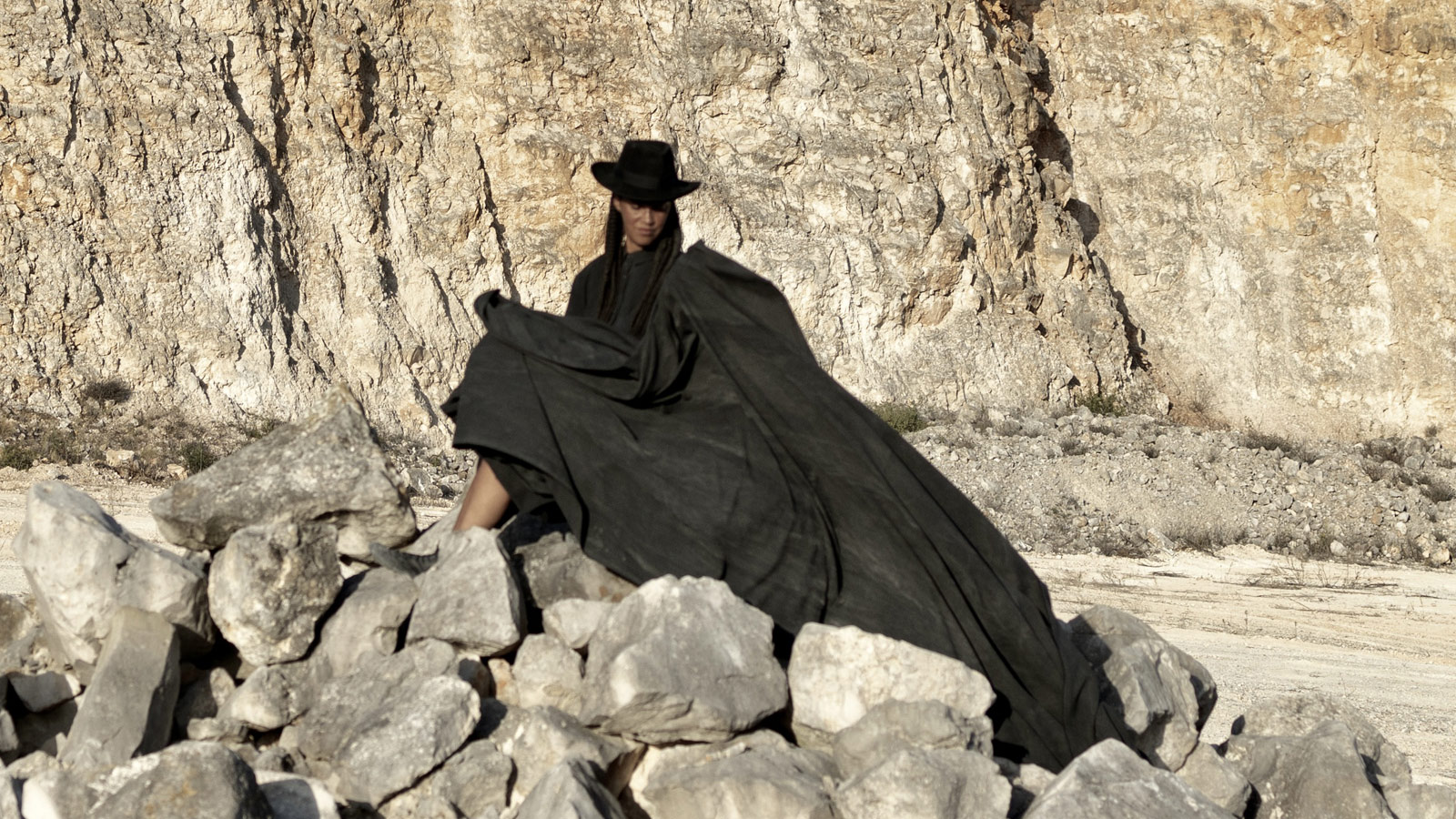
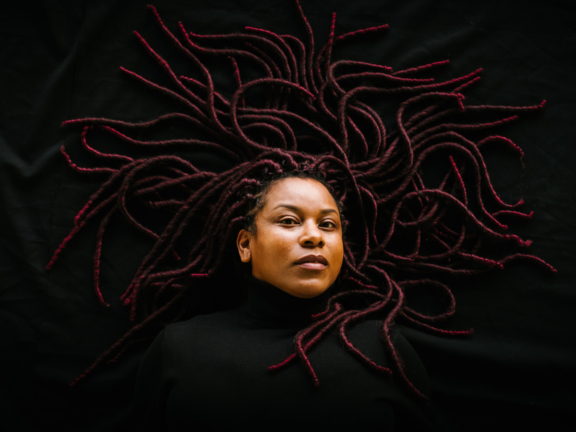
Grada Kilomba, 'Opera to a Black Venus', 2024. Courtesy of Goodman Gallery and the Artist.
Grada Kilomba is one of the most respected voices on the international art scene. The artist was born in Lisbon and grew up in Mercês, near Sintra, and later moved to Berlin, where she now primarily lives and works although, more recently, she has also been spending some time in the town of Sintra. Her acclaimed works have been acquired by some of the world’s most important collections, exhibited in major museums and seen as providing an important contribution to the global discussion of issues related to identity.
Grada Kilomba develops her artistic practice through careful attention to form, image, movement, sound and language. Her work does not start from the idea of representing content, but from the need to find an appropriate form for each underlying narrative, anchored in a sensorial architecture that can generate unique experiences. In her immersive, large-scale video, performance, spatial, sculptural and sound installations, Kilomba tells stories and poses questions as she explores the concepts of memory, trauma, repetition, cyclical violence and post-colonialism.
‘I work with the incomprehensible. Each work is a letter of a new alphabet to try to understand that which has never been understood.’
She moved to Berlin, after securing a scholarship to pursue her PhD and has built a career in the city, distinguished by great aesthetic and intellectual precision, and by her continuous work of active listening to history, the body and space. ‘I’m interested in researching a story and listening to how it wants to be told. Each story almost whispers its appropriate form and sound. This intimate listening exercise always inspires me to work with new formats and materialities,’ she says, adding that more than the theme itself, her main focus is how it manages to cross different disciplines and may be transformed into visual, sound and performative language.
Her creative process is guided by a living relationship with knowledge, in which reading, writing and research and psychoanalysis are not parallel activities to the construction/idealisation of the work, but rather an inherent driving force. The works are the result of a process of prolonged study and careful transposition between different fields.
Her repertoire is traversed by careful attention to language as a subject in its own right. She considers that languages are neither neutral nor interchangeable; but instead constitute systems of power, exclusion and unequal listening.
‘Rather than thinking in semantic languages, I think in visual languages. I translate human tragedy into poetic images, sometimes chilling and terrifying.’
This statement launches a reflection on how ideas can take shape without being limited to the word, or literal translation into a discourse. In her work, this non-semantic language is comprised by gestures, movements, materials and symbols, that simultaneously operate as both matter and metaphor. The absence of a direct verbal statement requires the viewer to activate their repertoires of memory and sensitivity.
Frantz Fanon is one of her key intellectual references, not just because of his ideas, but due to the way that he constructed a way of thinking that moves between various disciplines – from psychoanalysis to literature, from philosophy to political intervention. Reading his works, often via the versions available in foreign languages because the respective texts haven’t been translated into Portuguese, becomes an exercise in critical listening and construction, which is then transformed into powerful images, sculptural dances and living objects.
Kilomba’s works don’t emerge from a prior choice of technique, but from a commitment to narrative. In this context, form is an internal response to the material of memory, wherein each project imposes its own lexicon and a grammar, that cannot be found in established disciplines, but needs to be invented in the act of creation itself.
In order for this language to exist, it is necessary to break with the very foundations of Eurocentric thinking: disobey disciplinary rigidity, challenge the hierarchy between different ways of knowing and refuse the imposition of a hegemonic narrative as the only valid way of naming the world. ‘The language that we’ve been given can’t tell our story. In our inherited language we appear as a problem, a deviation or even a spelling mistake. It’s important to create new languages that give voice to that which has been silenced’, a premise that she adopted as a university lecturer.
This constant practice of questioning and crossing disciplines is an inherent characteristic of Grada Kilomba’s artistic career, leading to invitations to serve as a guest lecturer at various European universities, such as the University of Applied Arts in Vienna or Humboldt University in Berlin, or to produce works in theatres such as the Maxim Gorki Theatre, also in Berlin. In 2024, she was the Angela Davis Guest Professor at the Goethe University Frankfurt, where she developed the programme ‘Grada Kilomba: The Art of Performing Knowledge’.
This creative methodology takes on an inaugural form in Memories of the Plantation, a work presented in multiple forms: book, performance and installation, created as an extension to her doctoral research in Berlin.
Considered a landmark in the approach to racial issues and translated into more than five languages, the text proposes a series of brief psychoanalytical, almost clinical narratives about everyday situations of racism. Its most important dimension concerns how language is affected, as it moves between disciplines: the way that the text moves between essay and fiction, between analysis and poetic rhythm.
When performed on stage, the text is not simply represented, but embodied, making it possible to build a performative space, where the word finds its image, and listening becomes a shared practice. ‘Whereas science tries to give us answers, in contemporary art you have to create questions and interrupt the imagination – that’s the task of an artist,’ she says, emphasising that art can also be seen as an exercise that engages with the audience’s imagination, challenging us to question, reimagine and consider new stories.
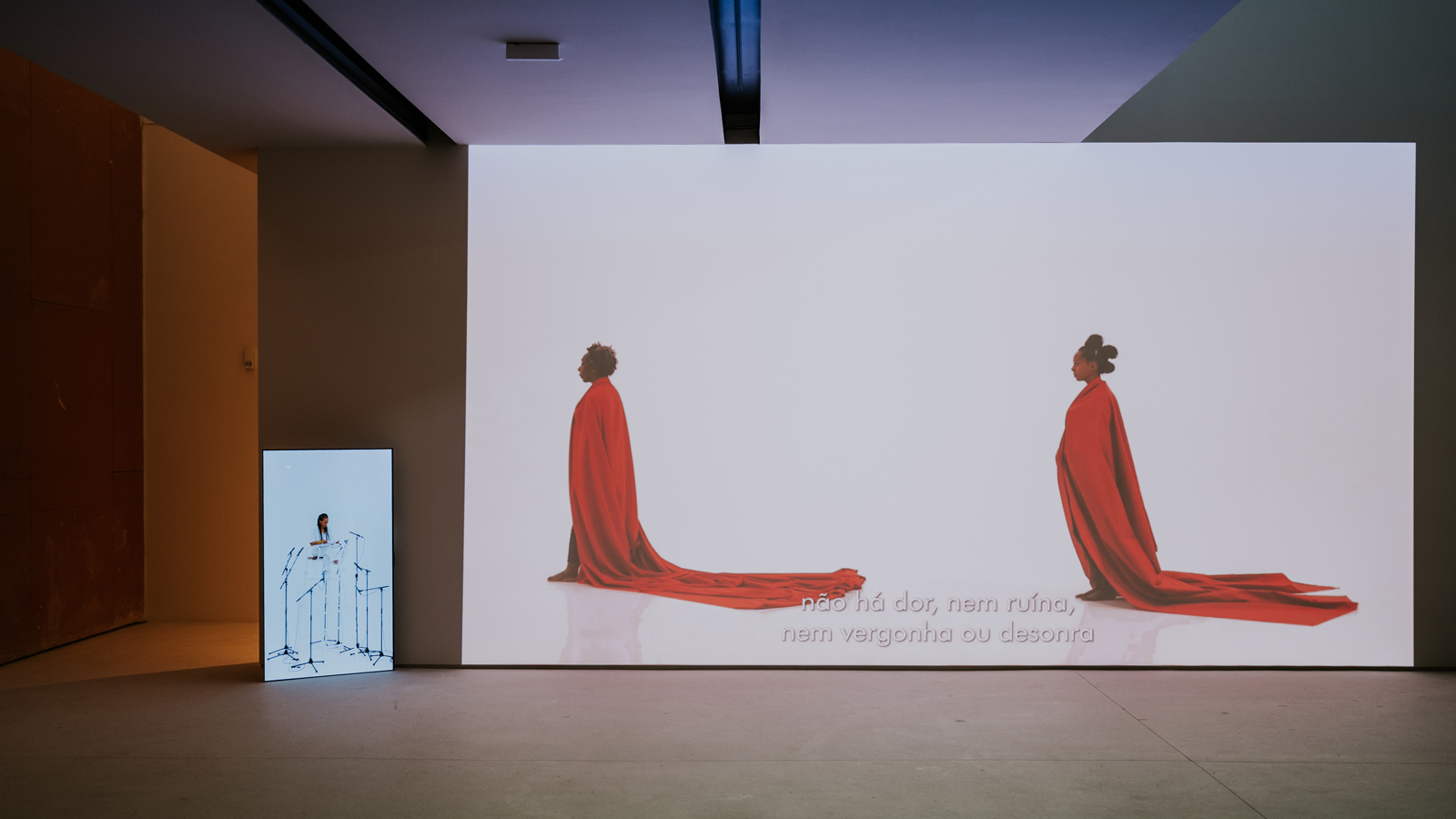
This approach is particularly evident in the acclaimed trilogy of video installations ‘A World of Illusions’ (2016-2019), that was first shown at the Palais de Tokyo in Paris and subsequently acquired in 2021 by the CAM Collection, as well as by the Tate Modern in London.
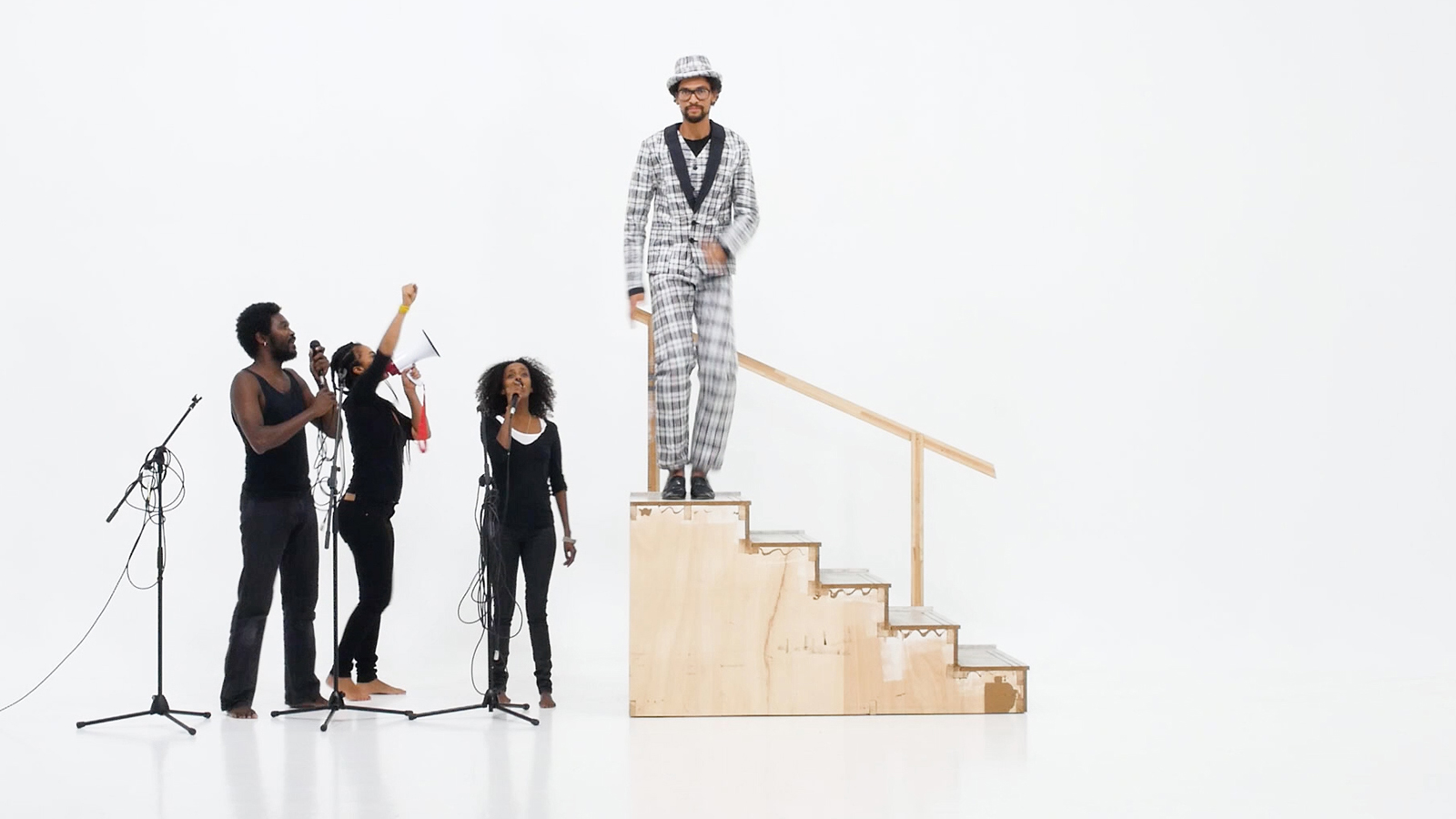
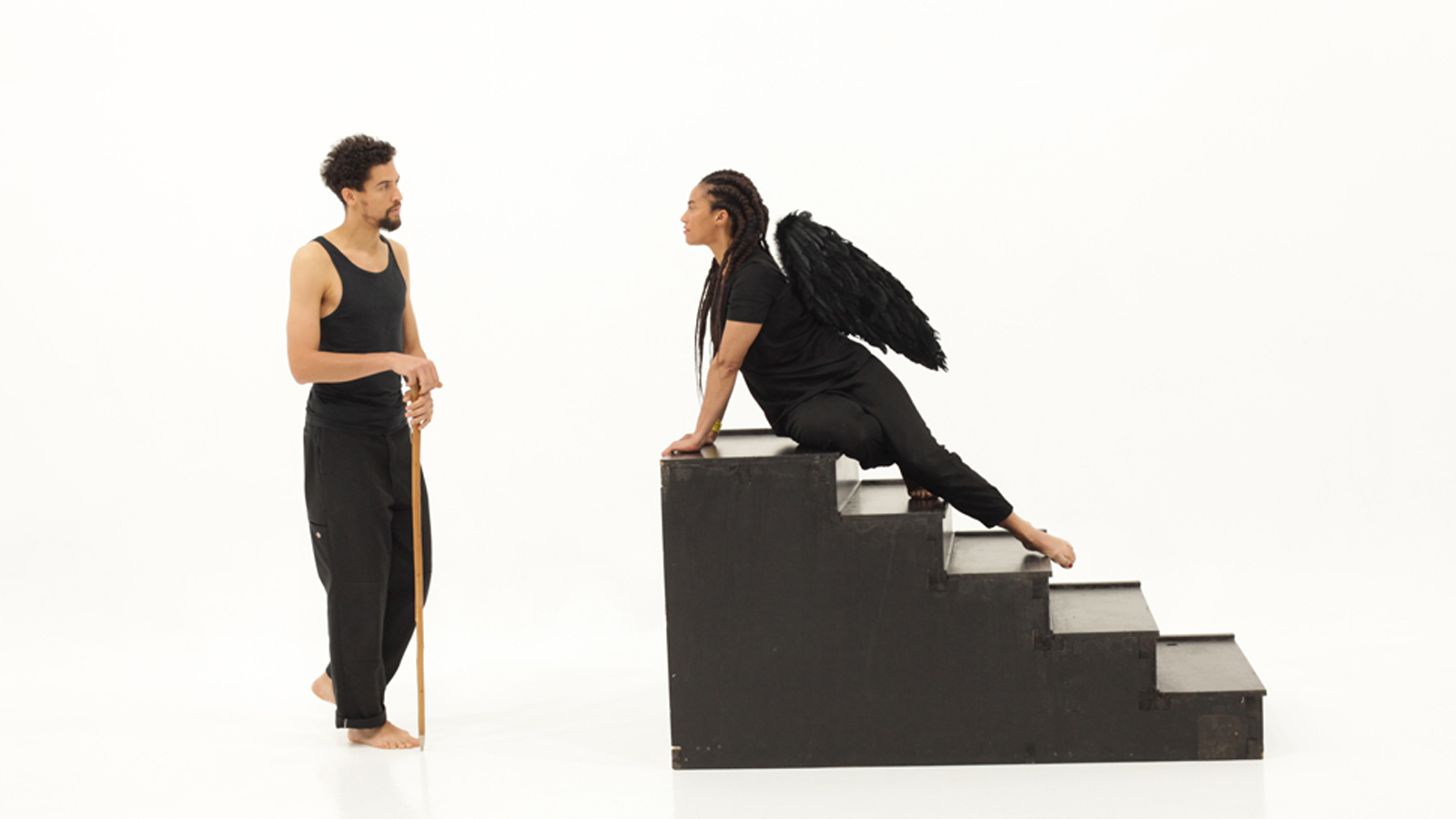
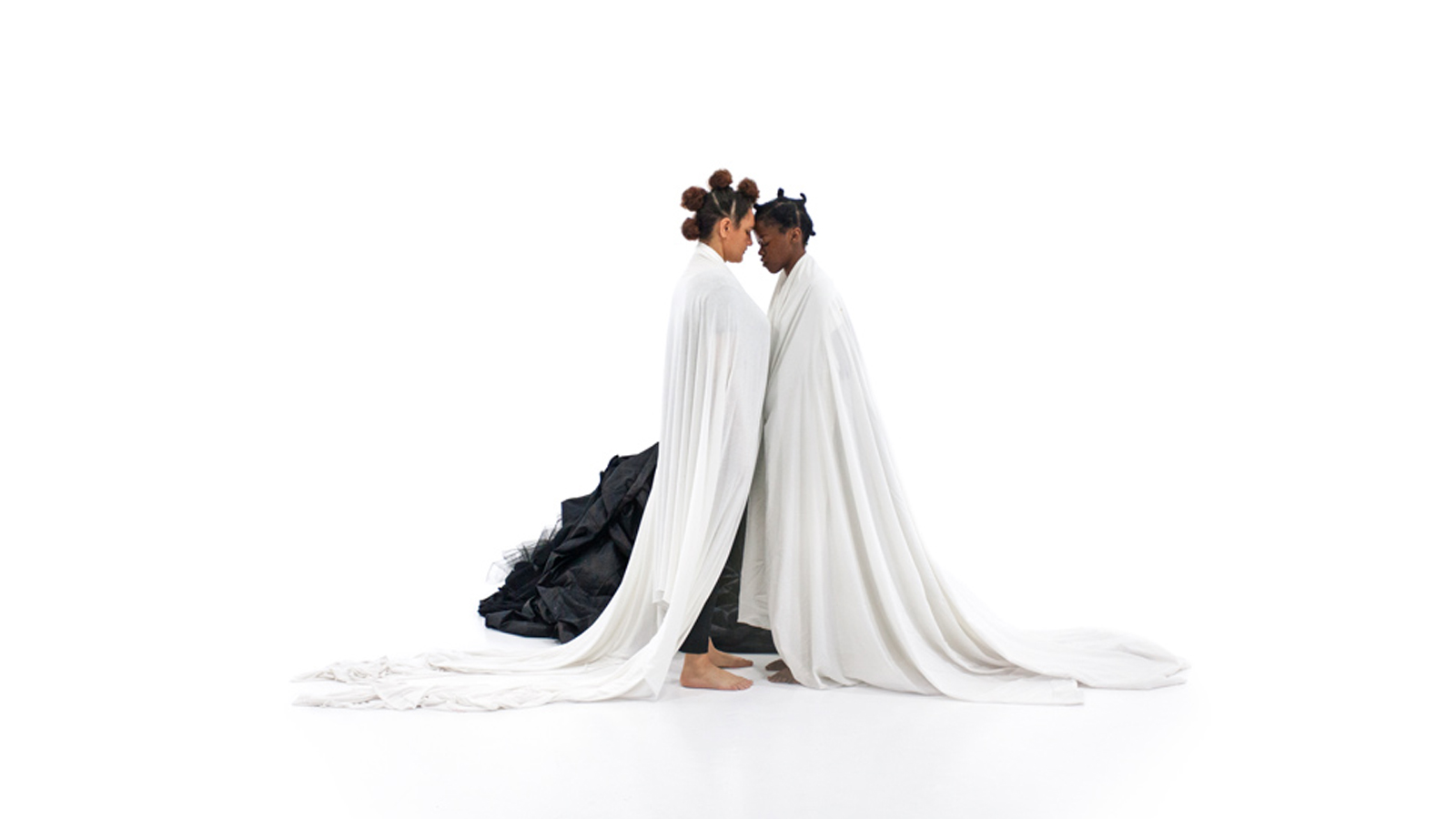
In each video, Grada Kilomba stages a Greek myth – Narcissus, Oedipus and Antigone – in order to construct languages that pose various questions, without verbalising the responses. With an ambitious architectural work, the artist creates a set of white, curved walls to create the illusion of a timeless infinity within the camera. On this timeless stage, that upholds her characteristic visual minimalism, Kilomba works with an ensemble of actors and dancers from Berlin, and with the South African opera composer Neo Muyanga, who interpret each of the stories. Between the sound of words and voice, piano and composition, movements and careful choreography, in which the artist always intervenes as a performer, Grada Kilomba creates an immersive staging, that crosses multiple disciplines to address the most urgent human tragedies: from loss, to violence, exclusion, genocide and mourning, ritual and memory, resilience and freedom.
‘Illusions, Vol. I, Narcissus and Echo’ (2017) presents an image of reflection and repetition, which suggests a difficulty in looking beyond the familiar, and evokes the unresolved marks left by the colonial past. In ‘Illusions, Vol. II, Oedipus’ (2018), the dynamics of violence and repetition are explored in greater depth, revealing the cycles that run through power relations. In ‘Illusions, Vol. III, Antigone’ (2019), a contained sense of resistance emerges, where silence and repeated gestures become a form of refusal to forget, recalling voices and stories that often remain on the margins.
The trilogy is marked by an extremely rigorous visual language, based on long takes, sparse movements and use of choreographed sound. Each element is articulated with millimetric precision, in order to produce an immersive and reflective experience that demands the viewer’s undivided attention. New ‘post-colonial minimalism’ is the term that is often used to describe Grada Kilomba and her artistic practice.
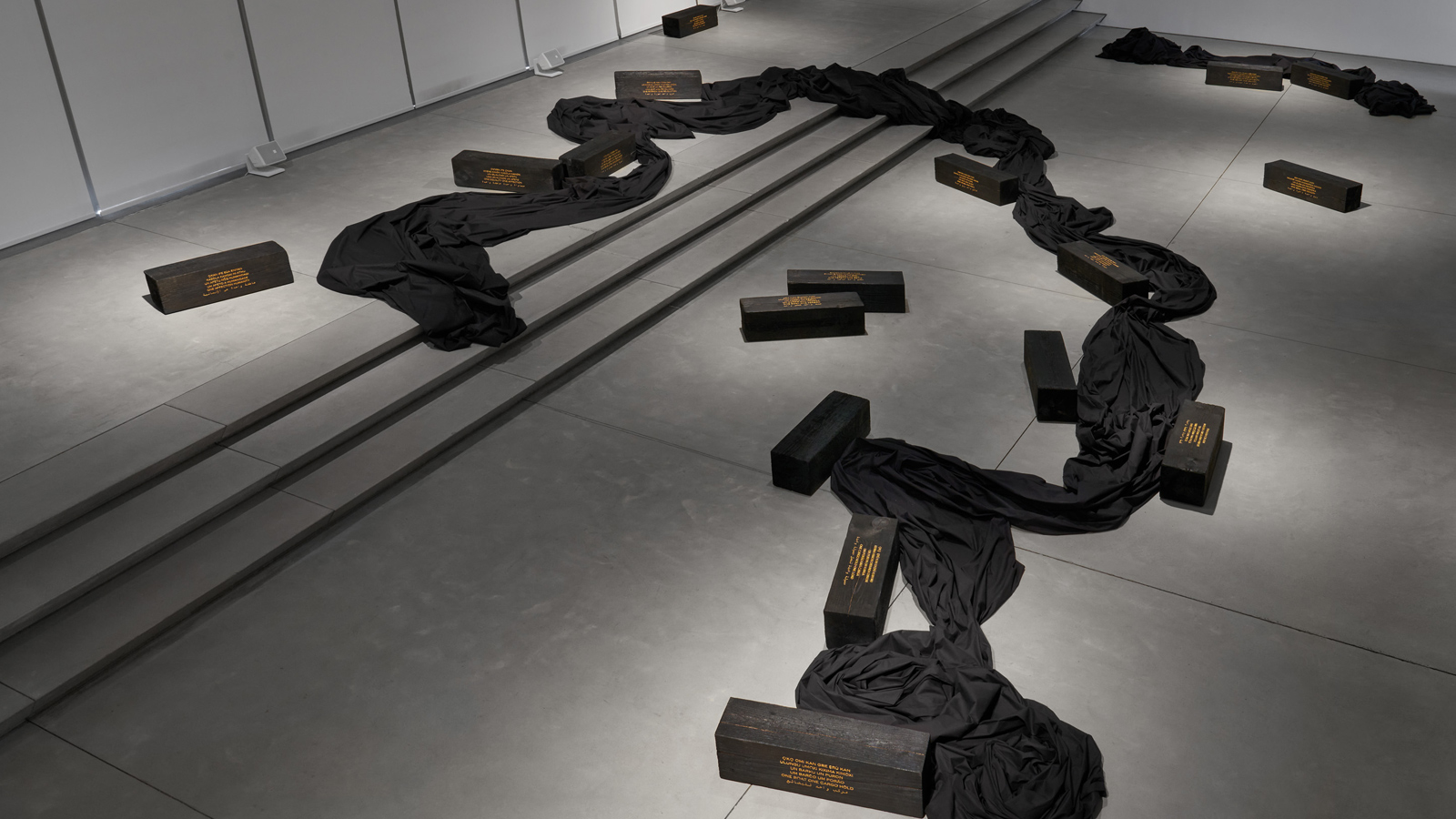
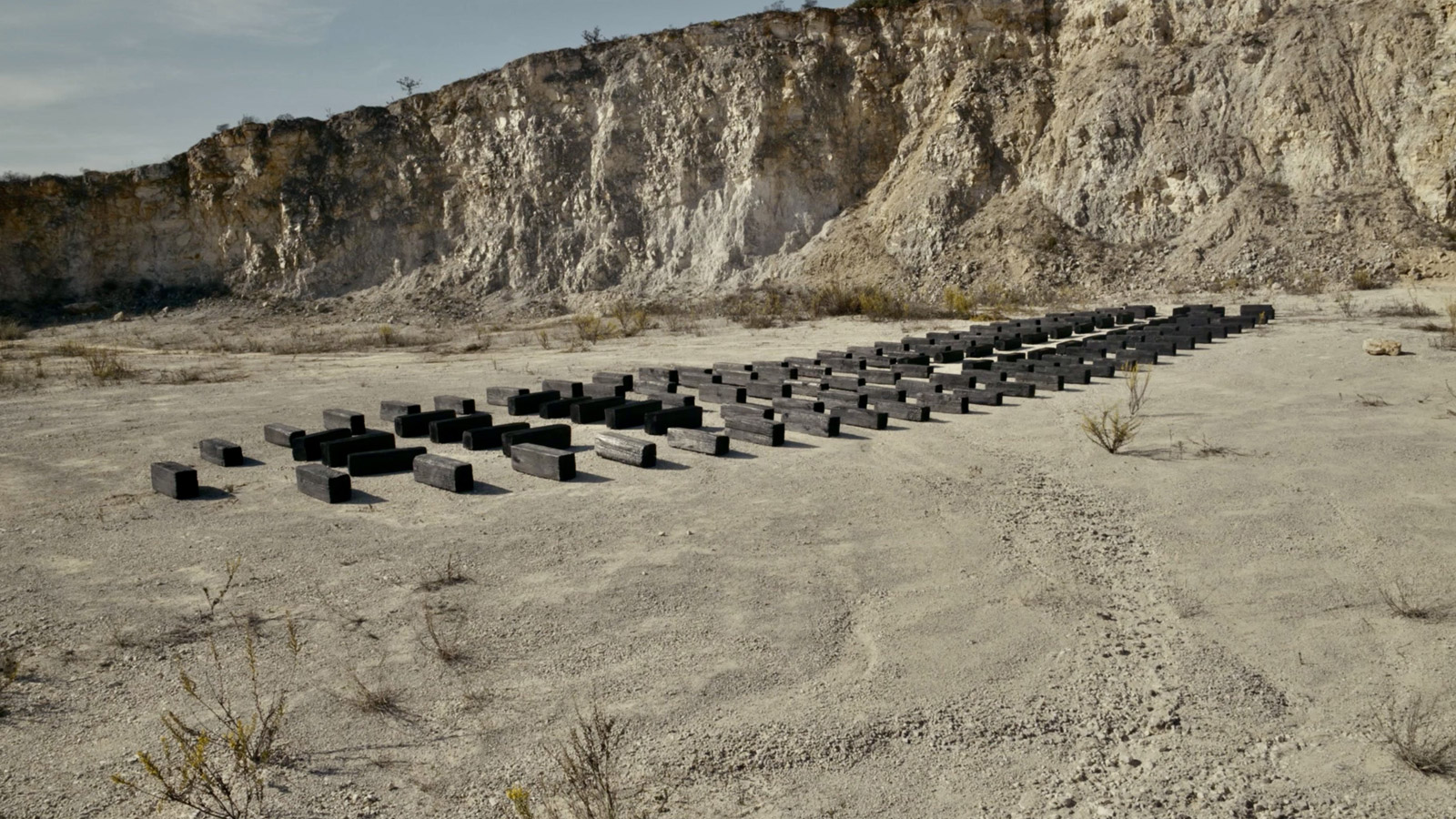
Her work of composition reappears using another material approach in ‘O Barco’ [The Boat] (2021), commissioned by BoCa and Kunsthalle Baden-Baden, which has been presented in spaces such as MAAT in Lisbon, Somerset House in London and the Inhotim Institute in Brazil, where it is part of the Brazilian national collection. The 32-metre-long sculptural installation is built with 140 blocks of charred wood, that meticulously draw on the floor the layout of the hold of a European slave ship. The blocks, geometrically aligned and with poems inscribed in gold and in several languages, create a visual rhythm that directs the body through the space.
‘The Boat’ takes on another dimension through activation of a performance staged and choreographed by the artist. For this piece Kilomba has once again assembled a diverse ‘ensemble’ of artists from the outskirts of Lisbon, where she grew up. From sopranos to tenors and contraltos, dancers and percussionists, the artist worked with artists such as Kalaf Epalanga and Dino D’Santiago for the musical production, David Amado, her principal dancer for years, and Selma Uamusse.
‘For me, involving a large number of people with it is one of the most beautiful parts of my work as an artist. This is a practice of care, responsibility and sharing opportunities – a decolonial practice.’
This installation, its exhibition and its performance led the artist to take more than 20 performers from the outskirts of Lisbon to the other side of the Atlantic, where the work was nominated twice as the best solo exhibition in Brazil in 2024.
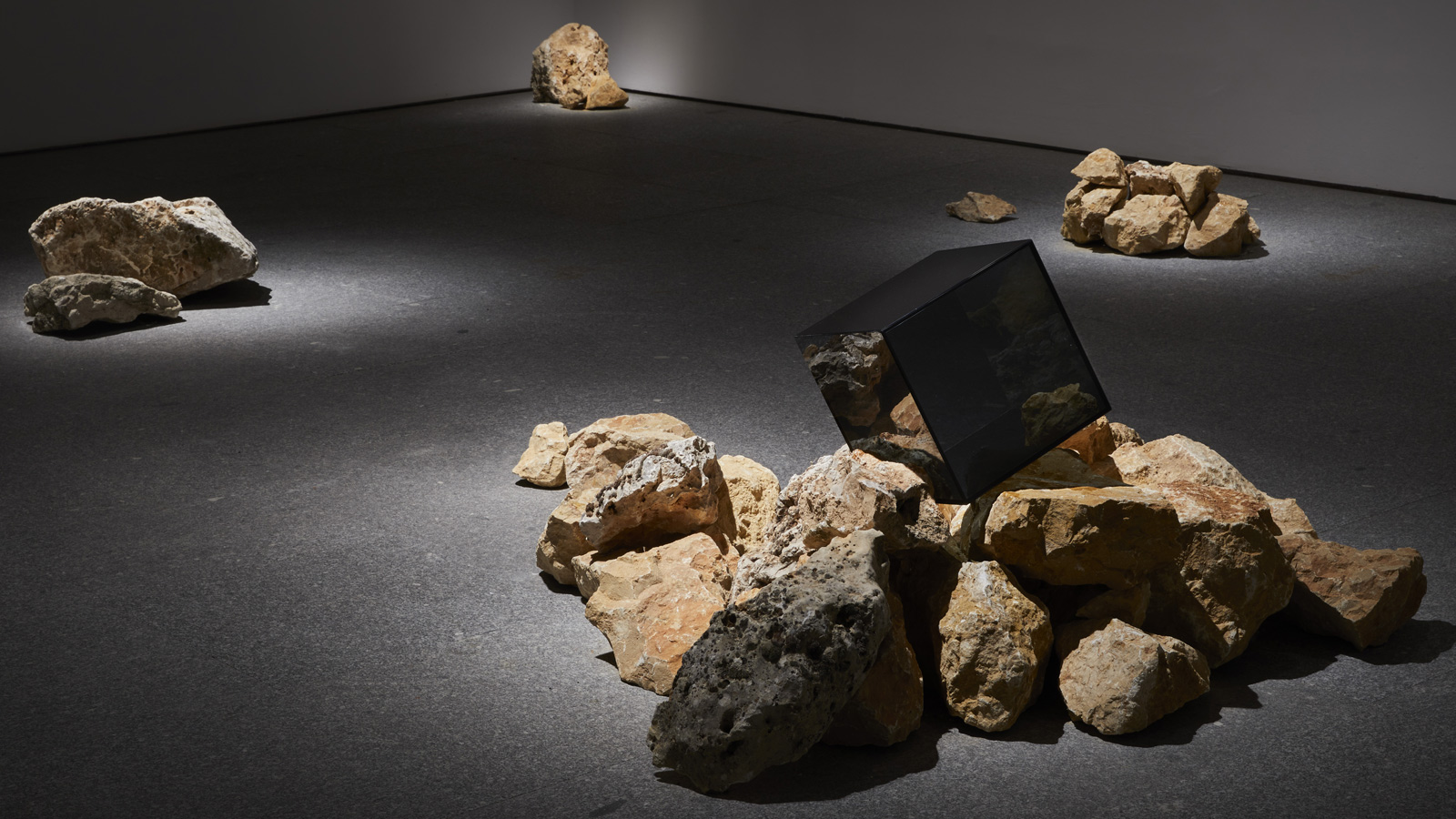
Kilomba continues this investigation into the relationship between body, space and sound in her latest work, ‘Opera to Black Venus’ (2024), commissioned by the Museo Nacional Centro de Arte Reina Sofía in Madrid in the context of her most extensive solo exhibition to date. She poses the question: ‘What would the seabed say tomorrow if it was emptied of water today?’ By imagining the seabed as a historical archive of the human condition, where millions of bodies have been deposited over the centuries: from slavery and the transatlantic crossing, to policies of exclusion and migration, to climate tragedies, wars and genocides, the sea memorialises the violence of human history.
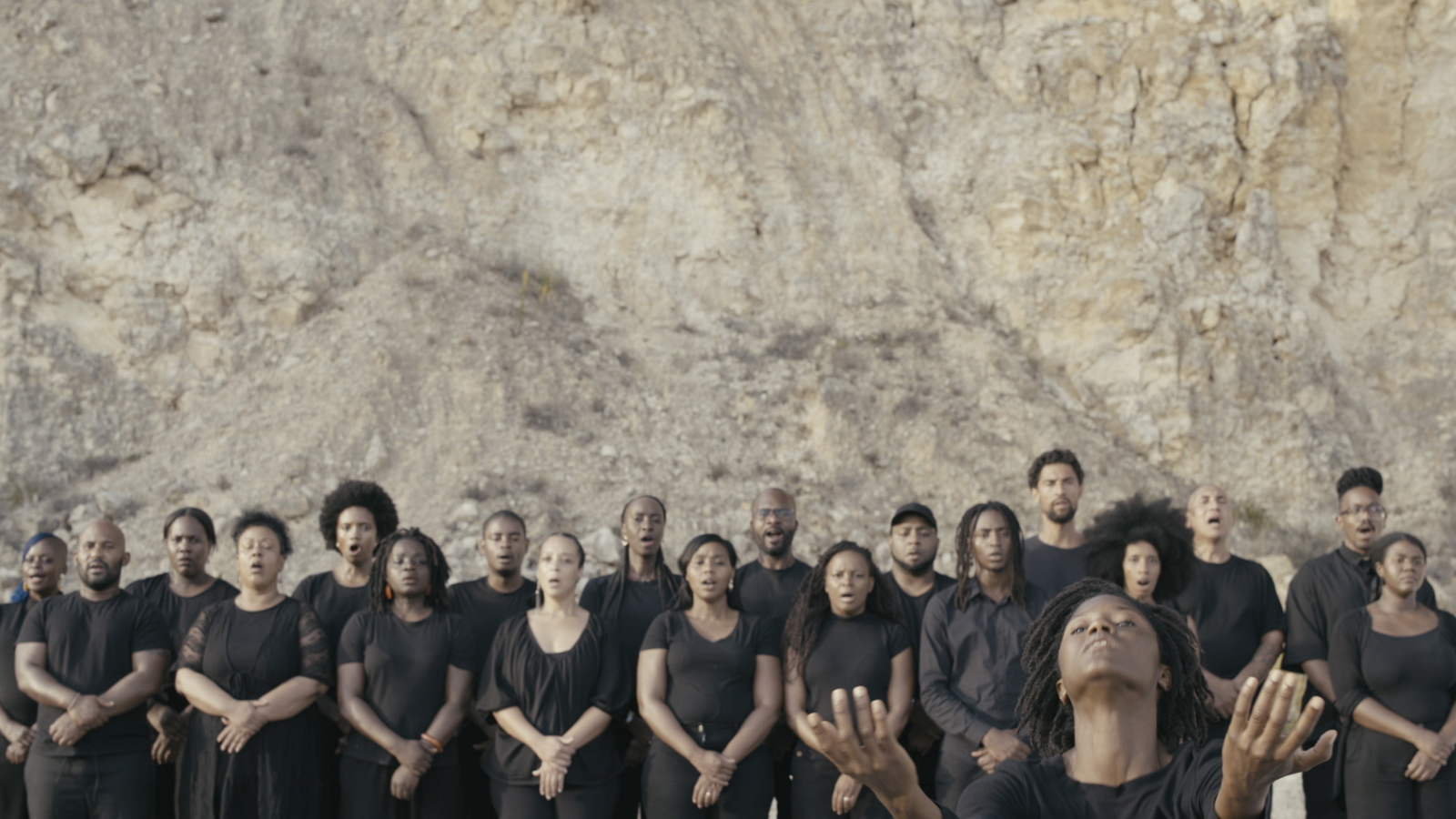
In the inactive Secil quarry, in Almoster, Grada Kilomba, with her Lisbon ‘ensemble’, stages, choreographs and films a set of works that are presented as a requiem or lament to the horrors of the present. Three new monumental works, including video, installation, textiles, earth, stone, sound and glass, transport us to an operatic register, where the performing body does not repeat the original violence, but instead constructs another possibility of enunciation. The staging is precise. The work doesn’t dramatise, but instead structures a space of presence. ‘Opera to a Black Venus’ was listed as one of the best exhibitions in Madrid and is currently on show at the Jinan Biennale in China. Her catalogue of the same name has just been released by Distanz Verlag in Berlin, making it the most extensive publication of her artistic work to date.
Her formal rigour, expressive restraint and attention to detail have been widely recognised by international critics. In addition to Documenta 14 in Kassel and multiple biennials, Kilomba co-curated the 35th São Paulo Biennial ‘Choreographies of the Impossible’ in 2023, together with Diane Lima, Hélio Menezes and Manuel Borja-Villel. That same year, she returned to ISPA in Lisbon, the institution where she graduated, to receive an ‘Honorary Doctorate’.
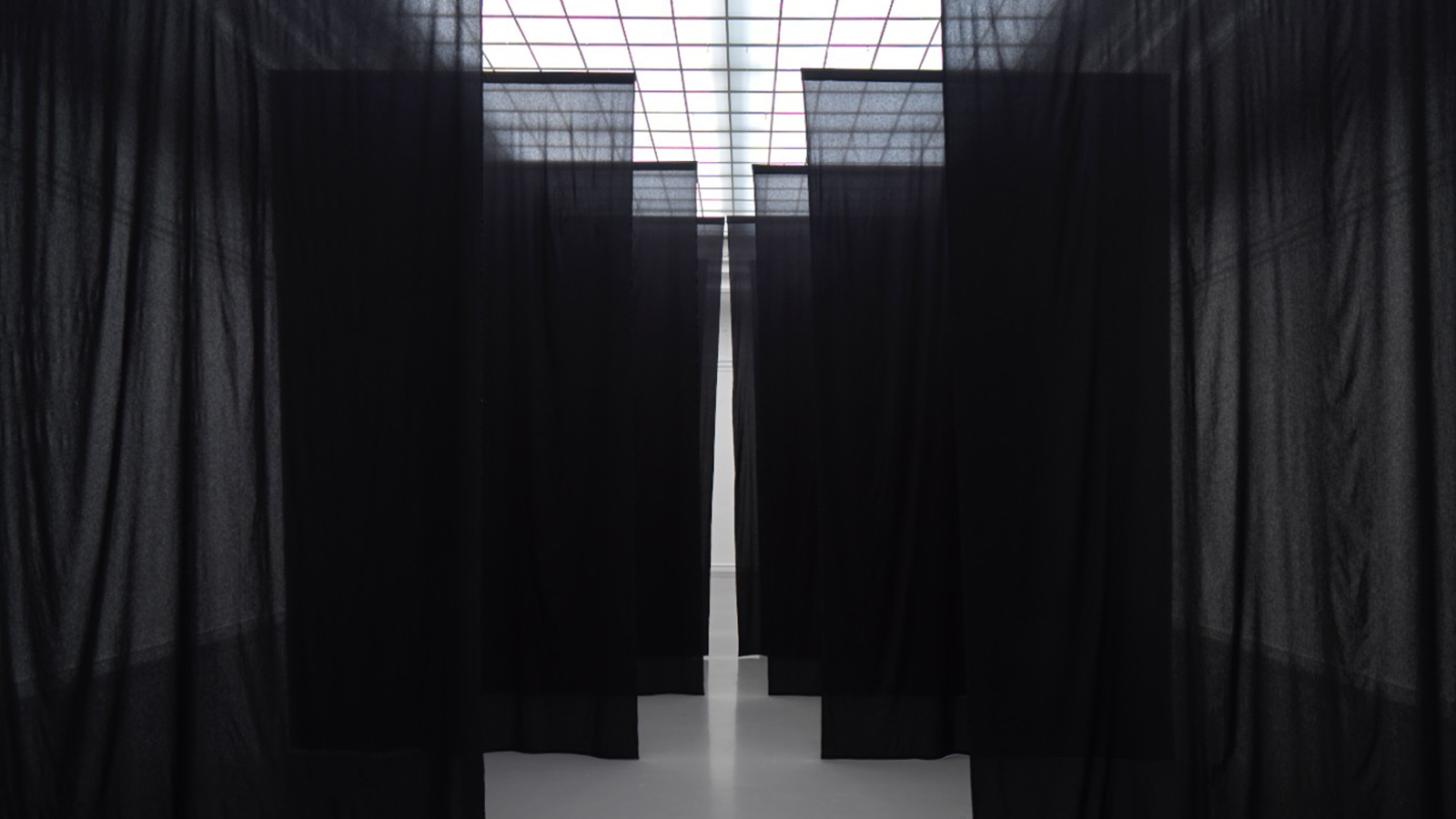
Grada Kilomba is aware that she could only become who she is when she left Lisbon for Berlin years ago, where she found a city that invested heavily in its artists and intellectuals. Her institutional career, between museums, biennials, universities and theatres around the world, reflects not only the scope of her work, but also the recognition of a language that is constructed autonomously, and which demands an openness to silence and complexity from the spaces where it is presented.
‘I'm an artist with many layers, materialities, temporalities and disciplines. My work is extremely complex. It's essential not to be reduced to adjectives that confine us to a single theme and relegate us to a footnote.’
Kilomba has emphasised the importance of only showing her work in contexts that are prepared to fully accept her language.
‘You often have to say: I'm not showing my work now. I'll only come back when the museum is ready to show it centre stage.’
Deliberate refusal is both a gesture of care and a way of protecting the integrity of the work, history and the artist herself, establishing boundaries that preserve the meaning and power of creation. Her practice proposes that the place of art is not the answer, but the question, and the question is not about what the artist represents, but about what the work constructs or what it proposes. In her own words, it’s not ‘what do I represent?’ but rather ‘what do I want to present?’
At the heart of her creative approach is the conviction that art has the power to construct languages that don’t yet exist, not as an imposition, but as a possibility. And it is in this meticulous construction, made up of rhythm, pause, voice and silence, that Grada Kilomba’s work is inscribed, not as a commentary on the world, but as a new structure for inhabiting experience. As part of her subversive act of autonomy, Grada Kilomba is preparing a new work for the city of Paris, which we will soon be able to follow.
BANTUMEN at Gulbenkian
Explore the series








No results were found for your criteria.
You may also like
No results were found for your criteria.