
‘City around the City’, Tristany’s ‘Mundu’ [world] and art as a means of transformation

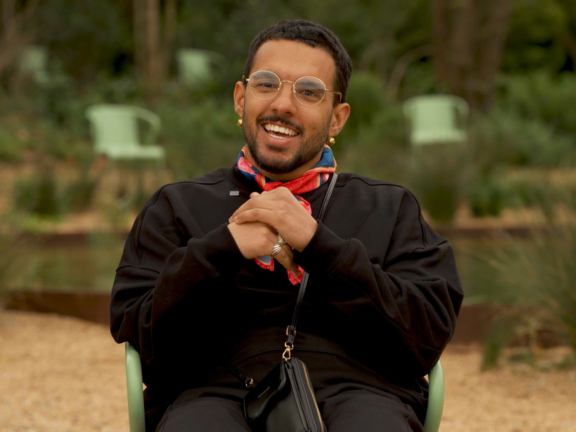
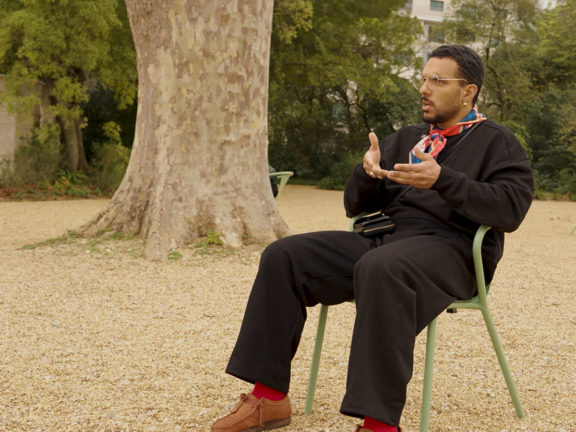
Born and raised in Algueirão-Mem Martins, Tristany Mundu is a multidisciplinary artist who uses music, the visual arts and performance to convey the reality around him. His work stands out for its ability to combine different artistic languages to tell stories that challenge perceptions about identity and urban territory. More than an artistic expression, his work reflects on the role of art as an agent of social transformation and deconstruction of preconceptions.
It is this cross-disciplinary vision of art that lies at the heart of Unidigrazz. Founded in 2018 by Tristany, Onun Trigueiros, Diogo ‘Gazela’ Carvalho, Sepher AWK and Rappepa BeDju Tempu, the collective formed with the aim of giving voice and visibility to emerging talents in the Sintra area. The official Unidigrazz website states: ‘Unidigrazz is a consequence, a continuation of something [that already exists]; of the work of street rappers, writers, poets, of all mothers.’ More than a group, it is a movement that reclaims the outskirts as a space of creation with its own identity.
Over the years, the collective has made its mark at festivals and in cultural spaces, demanding social change in both cultural and social education and the promotion of events, as demonstrated in ‘Meia riba kalxa’, ‘na boka mundu’, on display at Festival Iminente, and ‘Portugal é racista’ [Portugal is racist], exhibited at MAAT.
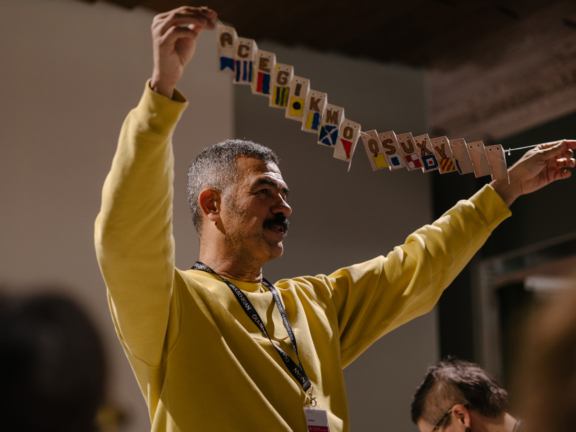
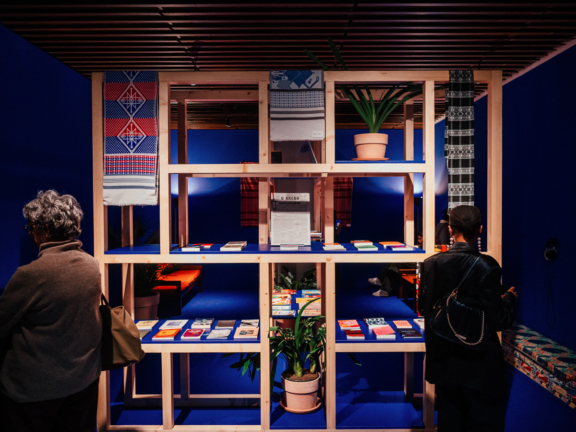
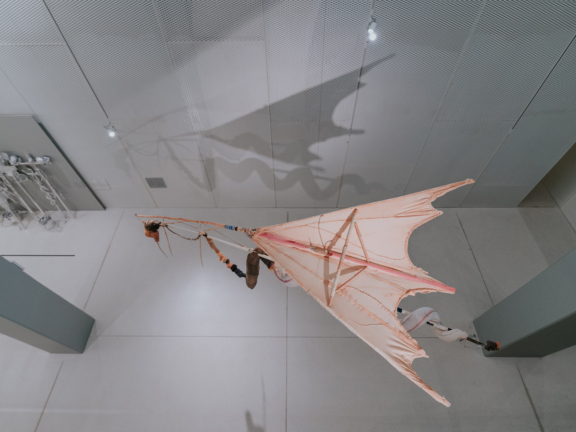
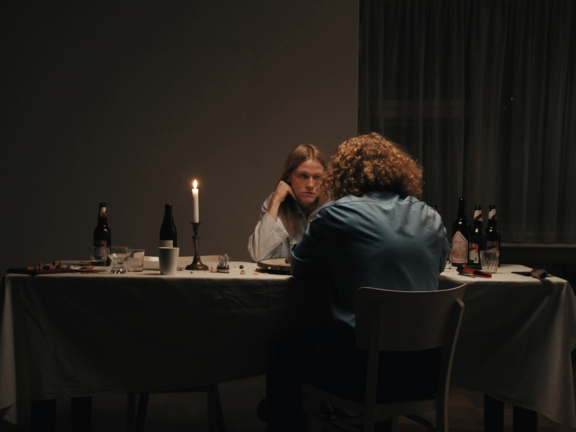
Now, with ‘City around the City’, Tristany is restating the group’s position. The project, which consists of a video installation combining a triple projection and a series of textile pieces he calls ‘flags,’ proposes a fresh gaze on the urban territory. Not only that: it is also the artist’s first solo exhibition, a project that does not limit itself to presenting an alternative vision of the city, but also challenges the way we experience it.
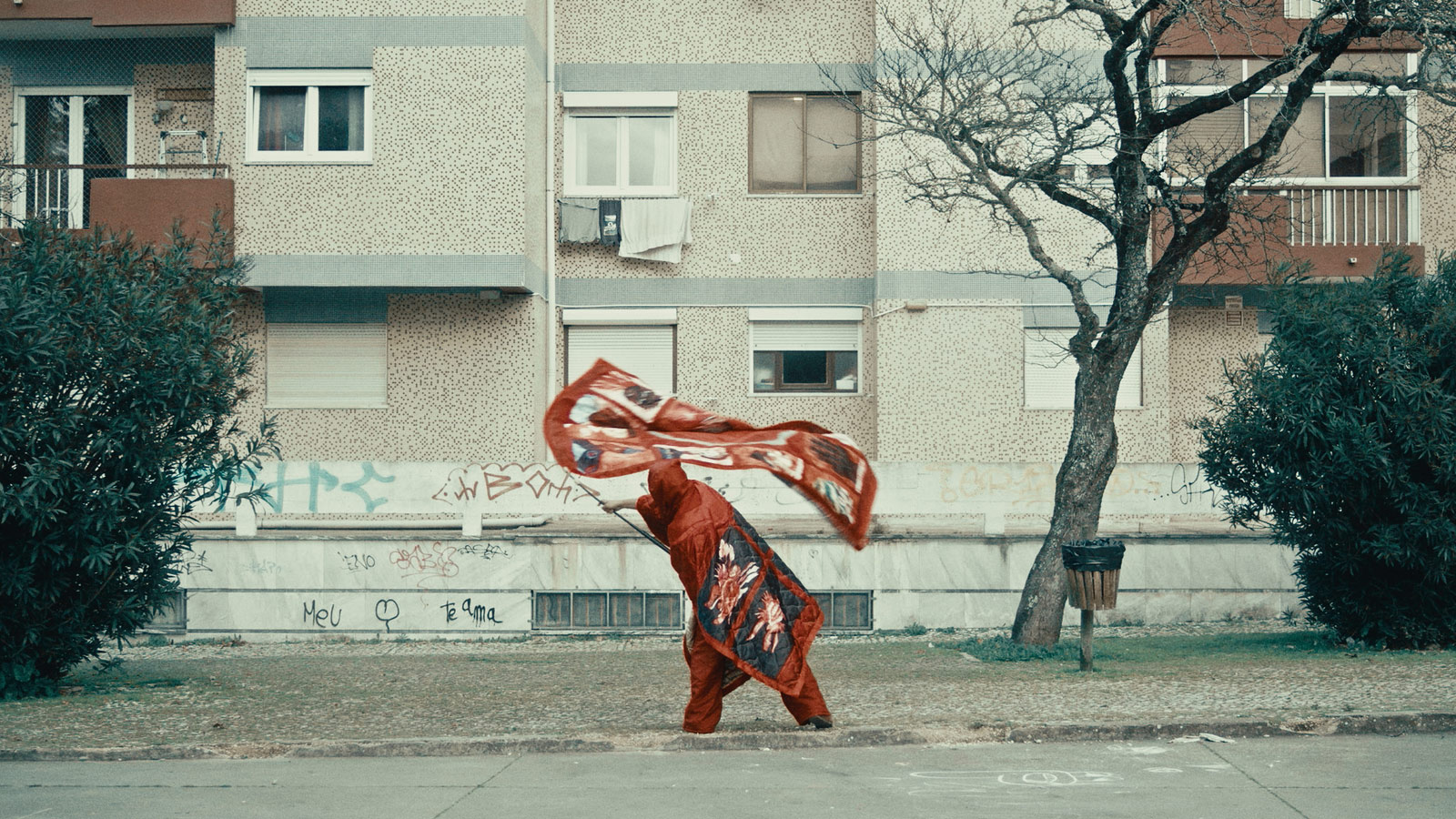
‘Travelling, seeing the same space over and over made me realise that I never knew it the way I thought I did,’ he admits. For him, the city is not merely a static stage, but an emotional landscape, in constant mutation, adapting to the gaze and experience of those who inhabit it.
If ‘City around the City’ had a soundtrack, it would be a mosaic of influences and atmospheres. Tristany weaves that sound landscape with references ranging from Sons of Kemet to Phoenix RDC, in a hybrid that translates the multiplicity of experiences and urban memories.
The artist rejects the idea that the outskirts exist on the margins. ‘I didn’t want to link that kind of narrative to this piece. I wanted to talk about something, in this case a space, a territory that, within its idea of existence, doesn’t need other spaces to exist,’ he states. His city is not an extension of a centre – it is a centre in itself, with its own voice and recognisable identity.
This thought led him to the concept of ‘tourism in our own area’. Tristany suggests that inhabitants should stop to observe and rediscover what has always been around them. ‘By experiencing the present, the everyday life of the places where we live, with this installation, I was able to do something I call ‘tourism in our own area,’ where we stop to contemplate the life unfolding in our space,’ he reveals.
And if the streets could talk? According to Tristany, they already communicate. ‘I think they asked us to speak for them, but they could speak too, and walk and move. So, I think they could speak for themselves, but they end up speaking later, because I too am at their service.’
‘City around the City’ is more than just an artistic installation. It is an invitation to look with new eyes at the territories we inhabit. Because, after all, the city isn’t just what we see. It is also everything we imagine.
BANTUMEN at Gulbenkian
Explore the series



No results were found for your criteria.
You may also like

No results were found for your criteria.