
“The Gulbenkian Scholarship strengthened the idea that it’s worth taking risks”
-
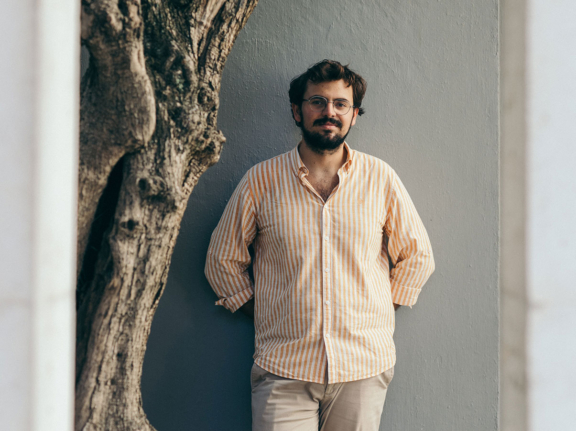
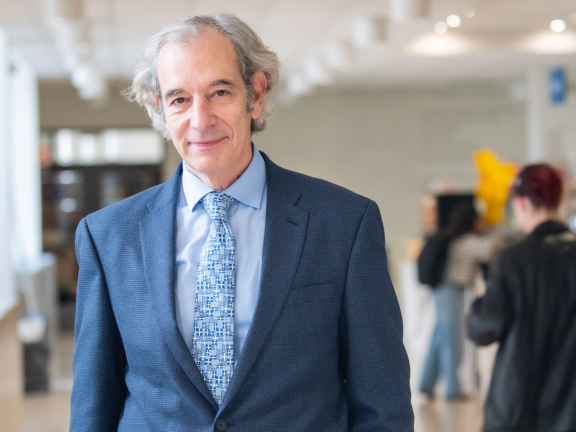
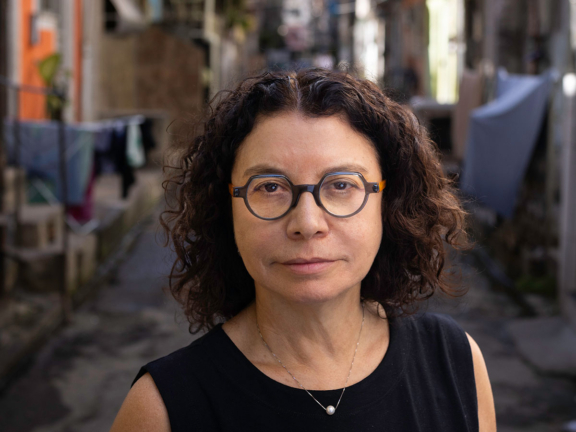
Jorge Almeida © Estelle Valente
He could be anywhere on the planet, but Jorge Almeida decided to settle in Portugal, at the University of Coimbra, where he teaches, directs the ProAction Lab (The Perception and Recognition of Objects and Actions Laboratory), and manages two millionaire scholarships.
Staying in Portugal was a choice. In addition to wanting to stay close to his family, he also wanted to change things—to fight for better working conditions for researchers and to bring psychology education closer to what is being done abroad.
Son of a maths teacher and an electrical engineer, he was born and raised in Lisbon. When he wasn’t pursuing his dream of becoming a scientist, he played football, walked around looking up at stars and constellations, played guitar in a band “of questionable quality ”, was a boy scout and conducted countless experiments… in the kitchen. He chose to study science without hesitation, but when he finished high school, he applied to study psychology almost by chance.
He hadn’t finished his degree yet, but he was already writing to researchers around the world, asking for an internship. He ended up at Harvard, where the cost of living led him to apply for a scholarship. He wrote to various institutions, saying: “I’m at Harvard, working with Alfonso Caramazza on how the brain stores information. I’m not yet doing a PhD, but I’m going to do it very soon. Is there any possibility of receiving a research scholarship?” The Gulbenkian Foundation welcomed his audacity.
The research scholarship was awarded in 2004 and renewed for 2005. Jorge went on to do a PhD. Today, at the age of 44, he has settled in Coimbra, where he teaches and has a research laboratory where he works with around 20 people from different nationalities (only four are Portuguese) and research areas.
In this interview, he talks about his career, his passion for what goes on in the brain, science in general and the importance of the Gulbenkian scholarship in his life.
Let’s start with the Gulbenkian scholarship. Tell us the story behind it. Like any story, it begins before the application.
I graduated in Psychology from the University of Lisbon. During my fourth year, I emailed a number of professors about doing an internship. One of them got back to me. He was working in Birmingham, UK, where I spent a month. The following year I did another internship, at the university, and then it became clear that what I wanted to do was fundamental research, not applied research.
Before I finished my degree (in November 2003), I wrote to several researchers again. One of them was Alfonso Caramazza, from Harvard, to whom I said, “I would like to work with you.” And the Harvard professor replied: “Sure! But it’s very expensive and we don’t have the money to support you”. After about ten more emails, I finally packed my bags and set off—using my own funds—to work in a laboratory studying semantic memory and language.”
Which is what you’re still studying…
Yes. To give you an idea, we’re studying a patient who can say “this is a pen”, but can’t say that it is made of metal; but if I show him a piece of metal, he says “ah, this is metal”. So there’s a problem in understanding the material when the material is associated with an object. These unique cases tell us a lot about the human mind. If it happens like this, it’s because the human mind has an organisation, a structure, and when part of that structure is damaged, it leads to this happening.
Back to the scholarship…
Alfonso was the one who started the field of Cognitive Neuropsychology, or at least one of the people who drove forward the field of patient study in order to understand the human mind – not the study of patients in order to help them. The important thing here was to understand the human mind. And by understanding it, I’m helping whoever wants to apply this knowledge.
What exactly did you do at Harvard? Was it an internship?
I was in the lab as a research assistant, I helped to carry out experiments and I ran my own experiments as well. I was given a visa to work at Harvard, I had my own office, all sorts of things… but it wasn’t exactly cheap, and I couldn’t keep relying on my parents.
And that’s when Gulbenkian comes in.
I emailed Gulbenkian and said, “I’m at Harvard, working with Alfonso Caramazza on how the brain stores information. I’m not yet doing a PhD, but I’m going to do it very soon. Is there any possibility of receiving a research scholarship?” And Gulbenkian honoured me with a two-year scholarship.
It’s not common to start your internship (at Harvard!) before you have your PhD…
Some of my collaborators, in their first year at Harvard, got to a laboratory and immediately realised, “I want to work here.”
When you want to be a scientist, you do it to solve a societal problem, to find a solution. I fell in love with this question about how the brain works.
And why Psychology and not Psychiatry or Neurology?
I had a dear friend who wanted to study psychology. I thought it could be great.
When I started, I began to study cognition, how the mind works, and from that moment on everything else was suddenly not an option any more.
Choosing Psychology was a fluke. Whereas the transition from Psychology to the study of the mind and how it works…
Your eyes are shining.
I tell my students to stop and think about how we do this. When I’m talking, that process is the most complex thing there is. How do I get from the idea of the message to the lexical entry? How do I then take the various lexical entries and organise them into a sentence? Then I have to move on to phonology. And then articulation. It’s completely crazy.
It’s not just language, it’s everything else really – writing, recognising, making breakfast. How do I know what a glass is? It can be a stemmed glass or just a glass, it can be made of glass or plastic, it can be seen from above or from the sides… but I always know that it’s a glass. How does this happen? These are the questions we work on. We only realise this when we have a patient in front of us.
Can you give us an example?
Patients with visual agnosia, lack of visual awareness. For example, I’m looking at my wife but I can’t recognise her face. I recognise her voice, her hair, the way she walks, her smell. But visually, I don’t recognise her face.
Yet another example: I had a patient who, when he looked at people’s faces, saw the whole right side melting – the nose, the eye and the mouth melting. The right part was melting, but the left part was normal. We helped him understand how and where this happens, in which part of the process.
What drives you in such cases?
Understanding the brain.
Let’s go back to 2006…
I did my PhD at Harvard and, when I finished, I sent an email to all the heads of the psychology faculties in Portugal saying that I wanted to come back. Having left Harvard, I could easily have done a post-doc at one of the best universities in the world, but I wanted to do something here. I only got one reply, from a professor who had been a PhD student in the United States, and was at the School of Psychology at the University of Minho. I got a position at Minho, which I combined with a Marie Curie cofund project called Welcome to Portugal.
A while later, I applied for a position at the University of Coimbra. I didn’t come first, I came third, but the people ahead of me fortunately didn’t want the job. Before accepting, I met with the board to negotiate, which is common in the US. I wanted to have a research laboratory and the conditions to win an ERC scholarship [a scholarship from the European Research Council] in five years’ time.
And you got both.
Yes, but it took me 3 times to win the ERC scholarship. It was the first ever ERC for the University of Coimbra and the first in Psychology in Portugal. We had to break new ground… How do you manage 1.8 million euros? How do you spend the money?
Wasn’t it 2.5 million?
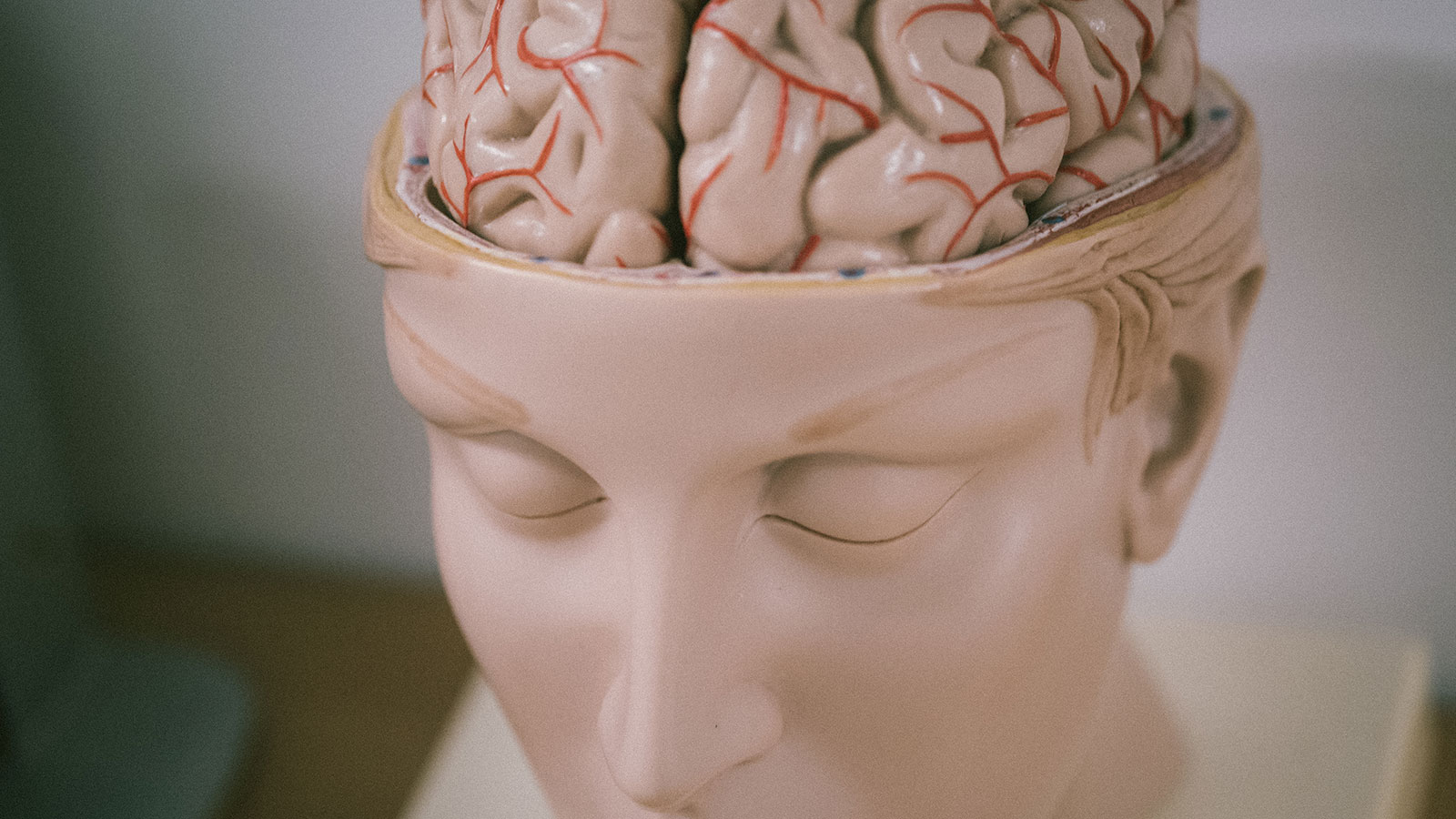
I have two European projects that I’m working on at the same time. The central aim of the ERC scholarship, which involves €1.8 million in funding, is to map the brain: understand how it works, how information is stored and represented in the brain, what the strategy for organisation is and why it’s important.
There is actually a map of what we see, and this map is reflected in the brain. The auditory cortex also has a topographical map, but it doesn’t follow location, it follows tone. As for the motor part, we have the muscles: if I stimulate it here, it will move its arm like this. There’s a reason for this happening. This is the study of our Content Map, and the findings are already being published.
And the 2.5 million scholarship?
While I was developing this project, I was struggling with another issue: in Portugal, when you think of psychology, you think of mental health, of treatment, and that’s it. But this is not the case throughout the rest of the world. Here we have 50 psychology professors and 35 to 40 of them are clinicians. At Harvard, we had maybe 20 professors, of which only two were clinicians.
If you think about the etymology of the word, Psychology is the study of Psyche, of the mind. It’s not the study of the sick mind or mental health.
For instance, we don’t think much about Development. What do children know? How do they learn? How does a child’s mind evolve? What exactly is core, central? Not many people are studying this in Portugal. Almost nobody, unfortunately.
Is this what the other project focuses on?
The other project is called Cog Booster – it’s a cognition booster. This project involves 2.5 million from a European programme called Widening, which is trying to close the gap between widening countries (developing countries – Portugal, Bulgaria, Poland, Estonia) and non-widening countries (developed countries – Spain, France, Germany, England).
In Portugal, Bulgaria and Estonia, 70 per cent of psychology departments are clinical or educational psychology departments.
But there are people involved in the field of cognition in Portugal.
In Portugal we have about 5% of people working with cognition. In France it’s 50 % and in the United States it’s about 70 %.
Here, what I do, studying the mind, is considered esoteric, but elsewhere it’s absolutely normal.
But you insist on staying in Portugal.
Precisely. This has to change. And it is changing.
This project aims to hire people, teachers, and close the gap.
The 2.5 million scholarship will fund five teachers for x number of years. Is that the logic?
The 2.5 million will be used to provide people with a team, laboratory space, hours of scanning, which are very expensive, and other facilities so that they can carry out research.
It’s a scientific project. It’s an action of coordination, of organisational change. This is the change I want to bring about. And this change means, first and foremost, showing that psychology isn’t just about mental health, there’s this other part that’s important.
How important was Gulbenkian in this journey?
It was mainly the realisation that if you don’t do anything to get what you want, it won’t happen; if you do, it might. It was by departing from the canon that I found my way to Harvard. And that then led me to apply to the ERC three times (and not just once), and to go after this European scholarship of 2.5 million. Risk pays off.
And now?
Now it’s time to keep pushing forward.
Application is important, but it is not the only important thing. Is fundamental science important? Yes. How much can it achieve? A lot! But we are living under the imperative of the applicable. And that means killing fundamental science today and all science tomorrow. We can’t support Alzheimer’s patients if we don’t know how the brain works. But I’d be very happy if people used my research to solve Alzheimer’s in the future.
Fellows’ Stories
Explore the series
No results were found for your criteria.
You may also like

No results were found for your criteria.