

Começar
The panel of Almada Negreiros
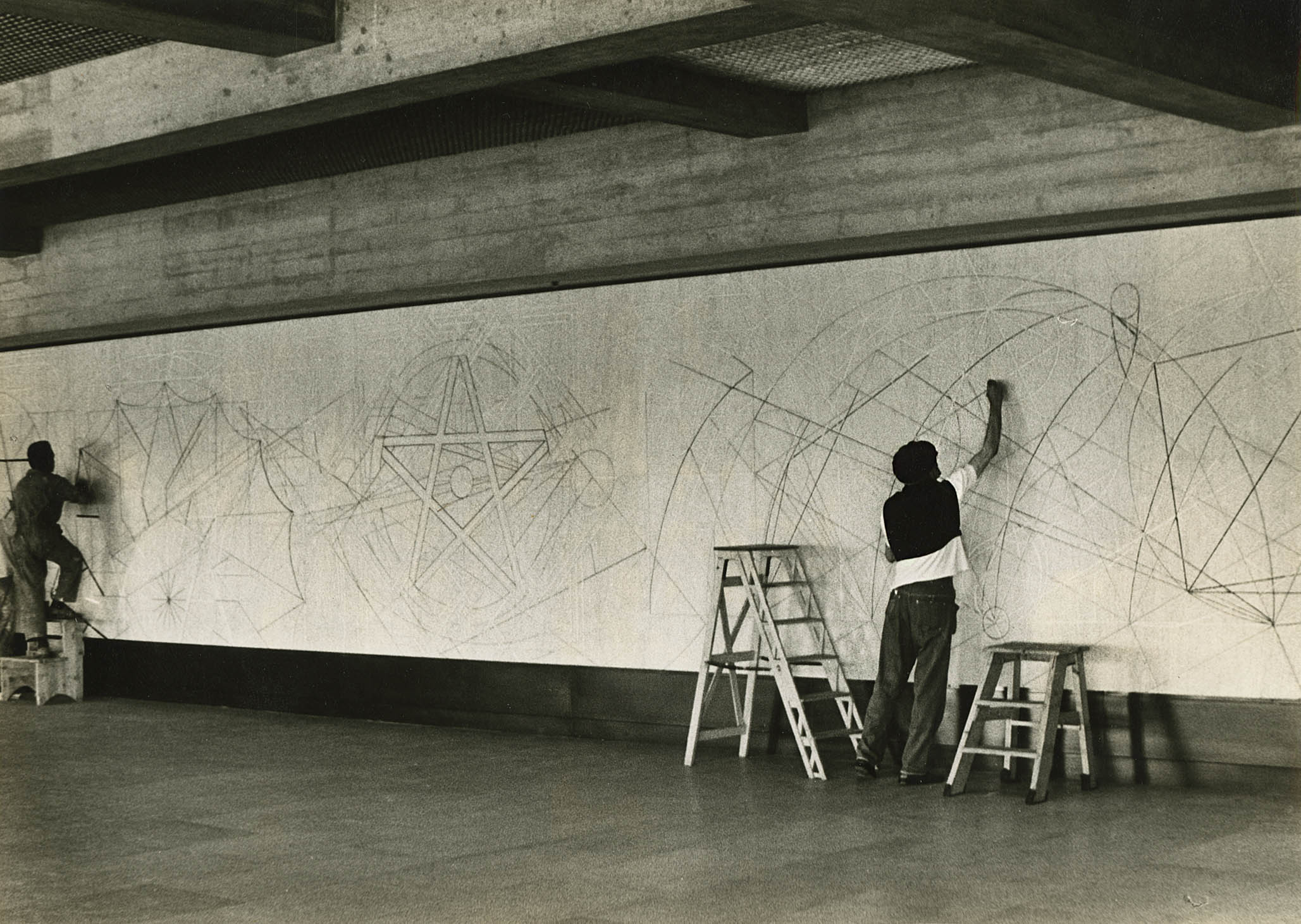
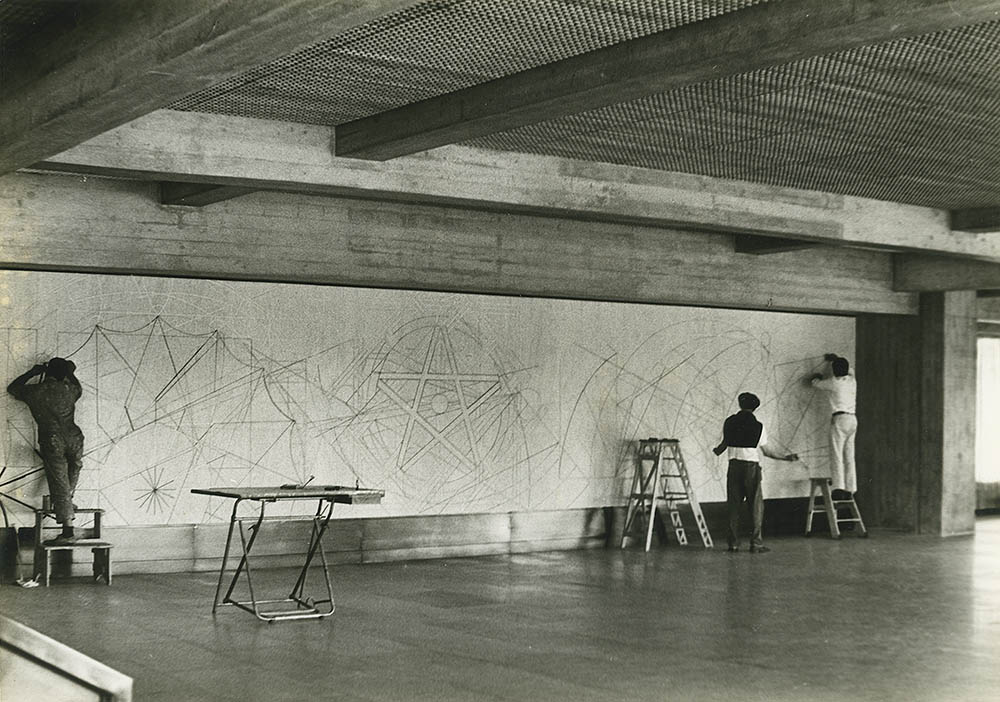
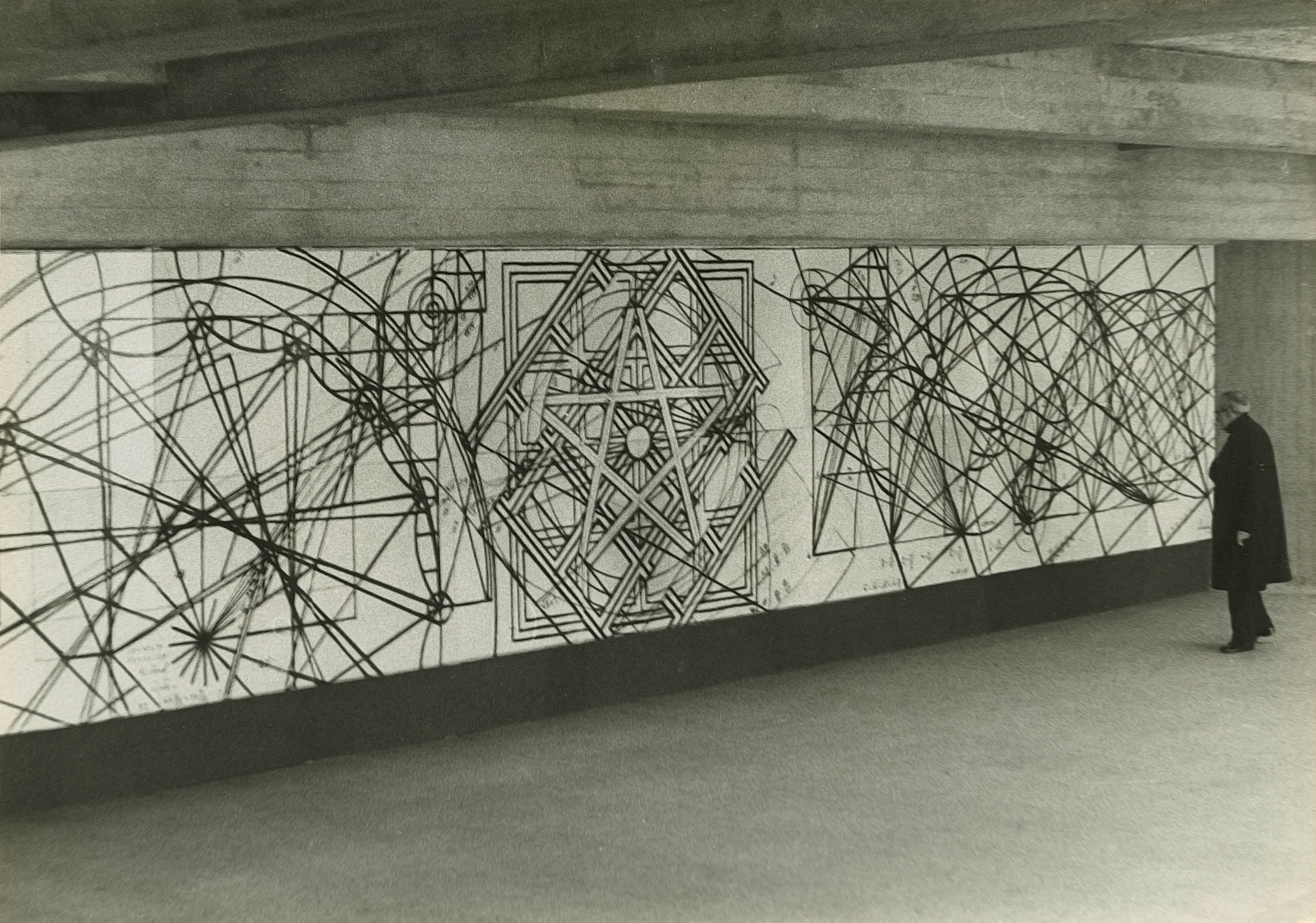
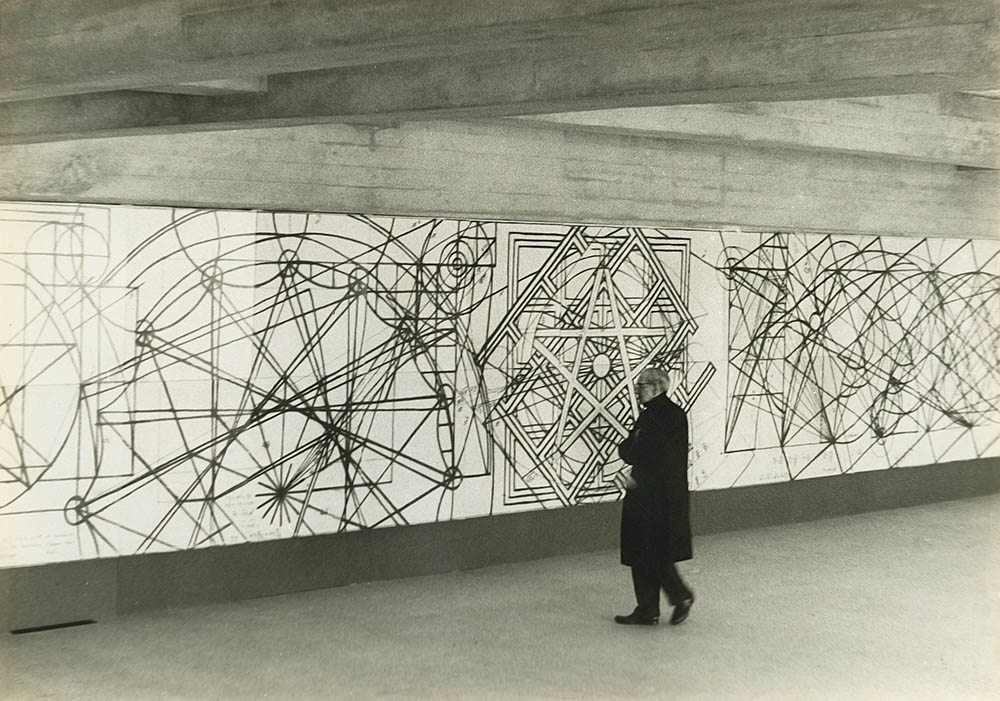
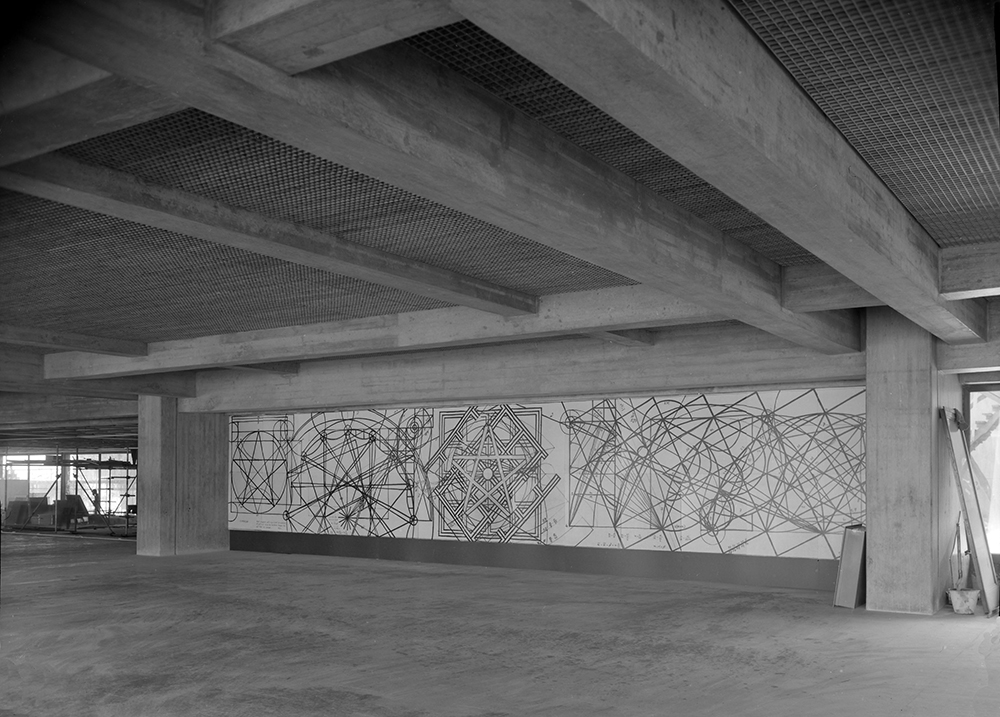
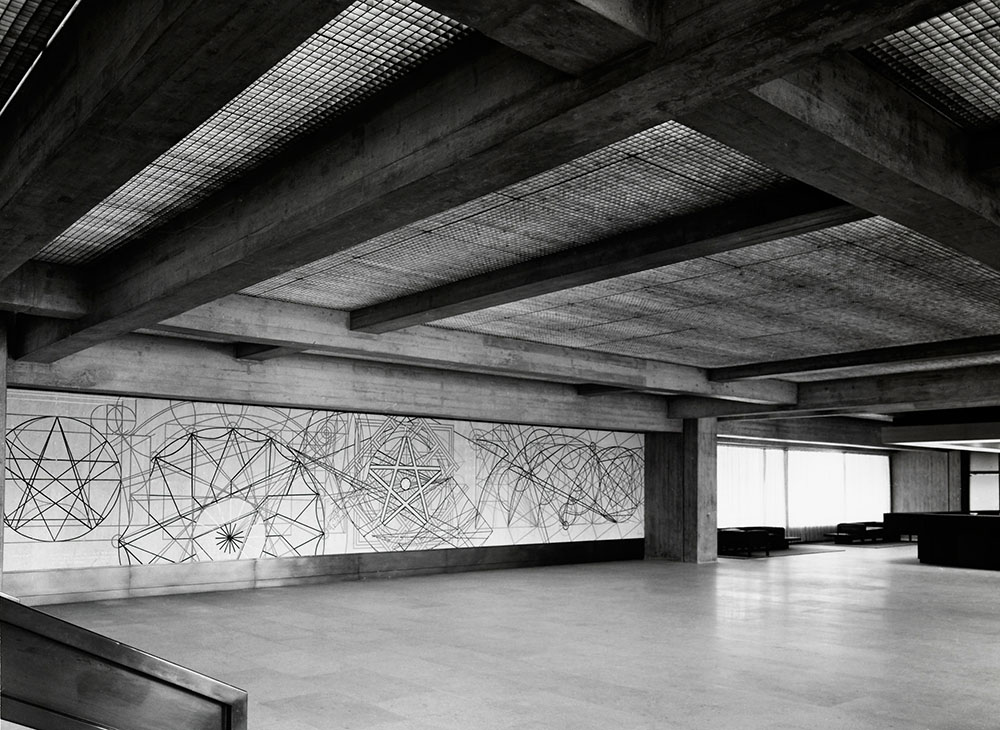
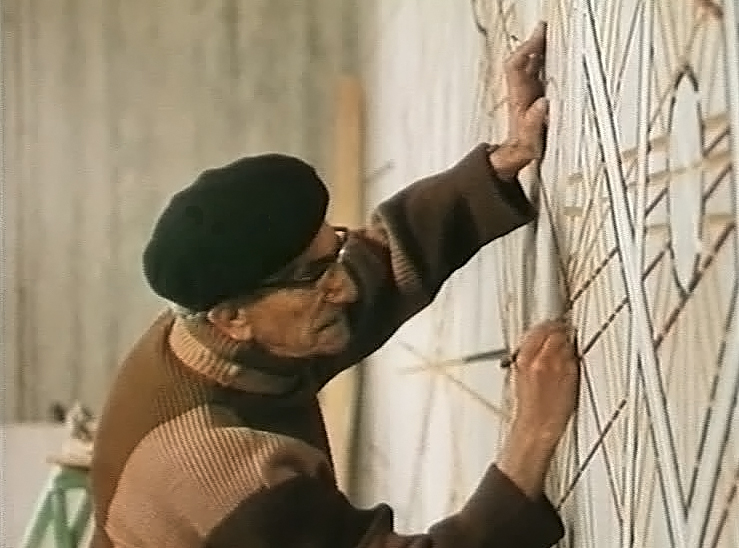
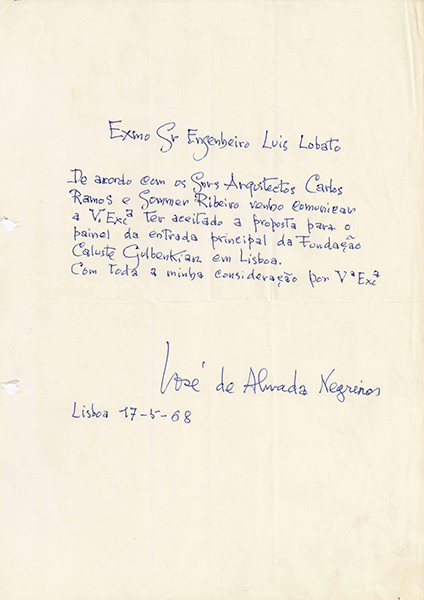
The panel Começar, commissioned by the Calouste Gulbenkian Foundation for the foyer of its headquarters in Lisbon, was José de Almada Negreiros’ last work. The artist was given full thematic freedom and chose to engrave on limestone a synthesis of his self-taught studies on numbers and geometry, which he had passionately pursued since the early 1940s.
Explore the panel
The piece’s geometric complexity may be better understood by tracing its construction step by step, with the aid of the colour demarcation suggested by Almada. The following steps clarify the work’s successive stages by singling out and recombining its geometric elements one by one. The panel has been divided here in five parts, according to the piece’s identifiable visual elements: Pentagonal stars, Figura superflua exerrore, Large central star, Divisions of the circumference and The Bauhütte point.


Almada and geometry
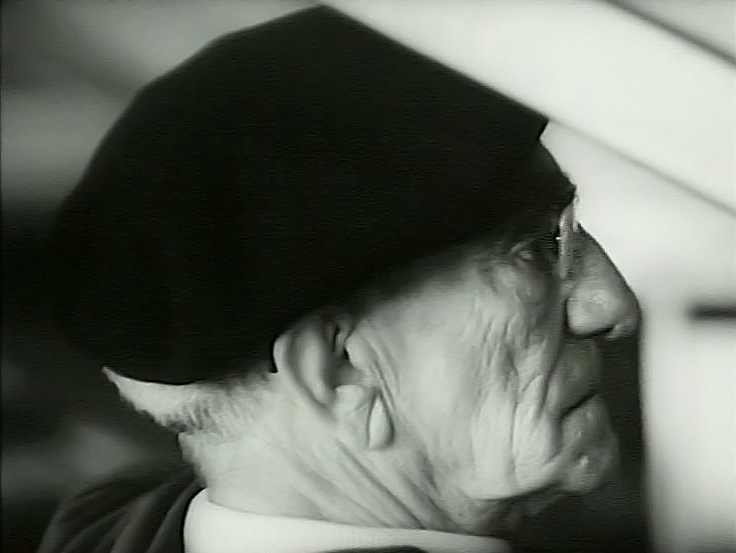
Born in São Tomé and Príncipe in 1893 to a Portuguese father and a Portuguese-Angolan mother, José Sobral de Almada Negreiros was brought up and educated in Lisbon, together with his brother António, at the Jesuítas de Campolide boarding school. After his mother’s death in 1896, his father moves to France. In 1913 Almada holds his first solo exhibition. He joins the group of Orpheu magazine, created in 1915 by Fernando Pessoa and Mário de Sá-Carneiro. He proclaims himself a futurist and writes four avant-garde manifestos, earning a reputation for making scandal in public places, on his own or together with Santa Rita Pintor. Those years are fertile in artistic collaborations, reflecting the avant-garde fervour of the 1910s, and later the 1920s’ liberation of social mores and bohemian life.
In 1919 Almada leaves for Paris, where he will live for one year. He extends the shaft of the “d” in his very recognizable signature, which he will use from then on. In the 1920s he tightened relations with several Spanish artists and intellectuals, and leaves for Madrid in 1927, where he makes a name for himself in the Madrilenian artist milieu, holding a solo exhibition, contributing to several group expositions and collaborating with musicians, writers and architects.

RHe returns to Portugal in 1932, where he witnesses the implementation of Estado Novo’s cultural policies, which establish a new way of working for artists. He takes on several public and private commissions, producing stained-glass pieces, tile panels, fresco paintings, among other works, mainly in collaboration with architect Porfírio Pardal Monteiro. At the same time, he maintains a steady production of drawings and paintings, graphic designs, literary texts, poems, theatre plays and conferences.
In 1934 he marries the painter Sarah Affonso, with whom he will have two children. He founds the Sudoeste magazine in 1935 and, in the following year, takes part in the Independent Modern Artists Exhibition in Lisbon, along with his wife. In 1942 Almada is awarded the Columbano Prize (by the National Secretariat of Propaganda) and, in 1957, he receives a hors concours award at the Calouste Gulbenkian Foundation’s First Visual Arts Exhibition.
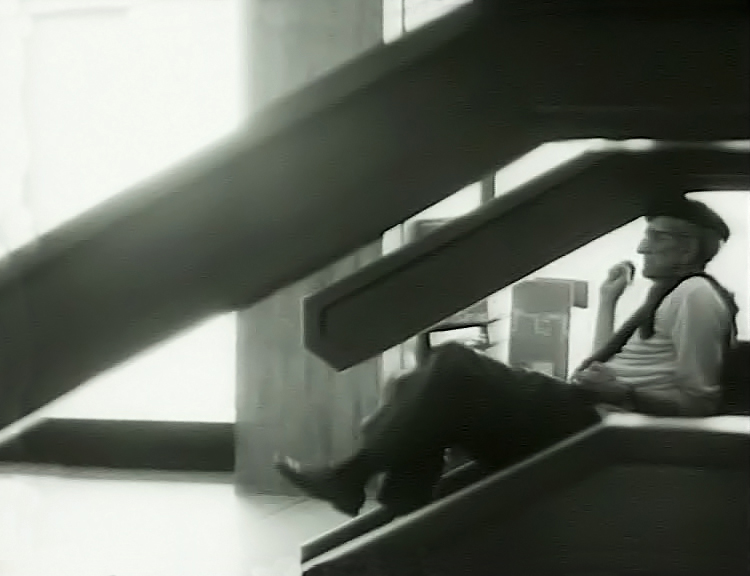
His last commissioned work is the panel Começar [To Begin], for the foyer of the Calouste Gulbenkian Foundation’s headquarters (1968). He dies on June 15th 1970, at the Hospital of São Luís dos Franceses in Lisbon.
By his own accounts in the 1950s and 1960s, it was in 1916 that, together with Santa-Rita Pintor and Amadeo de Souza-Cardoso, Almada visited the National Museum of Ancient Art (MNAA) in Lisbon, where he became fascinated with the painting Ecce Homo, then attributed to the 15th-century royal painter Nuno Gonçalves. Ten years later, in 1926, Almada proposes a new sequential order for the Painéis de São Vicente de Fora (Panels of St. Vincent, MNAA), by the same Old Master. Although highly controversial at the time, Almada’s proposition, based on the perspective of the floor tiles in the six panels, remains undisputed to this day.
Although this discovery implies the acknowledgment of the importance of geometry in painting (due to linear perspective), Almada’s deep fascination with geometry only becomes apparent from the 1940s on. His visual work becomes increasingly geometric in style, as exemplified by his frescoes for the maritime stations of Alcântara and Rocha do Conde de Óbidos (painted in the 1940s), his self-portrait Auto-reminiscência de Paris (Paris Self-Reminescense, 1949), his portraits of the poet Fernando Pessoa (1954 and 1964), or his tapestry Números (Numbers, 1958).
Almada is awarded a hors concours prize for the four black and white paintings he submitted to the First Visual Arts Exhibition held by the Calouste Gulbenkian Foundation in 1957. As emphasized by their titles, these paintings (in the Calouste Gulbenkian Museum – Modern Collection), of a full-fledged geometric abstractionism, clearly attest to the importance of geometry in Almada’s work, both as a theme and as a compositional device.
By his own choice, the content of the panel Começar [To Begin] is entirely geometric, and includes, anthologically, several geometric constructions and various cultural references already present in the work he had produced throughout his decades-long career.
Glossary
ɸ
ɸ (Phi) is the letter of the Greek alphabet that denotes the golden ratio. A Φ rectangle (or golden rectangle) is approximately 1.168 in length to 1 in width.
Bauhütte
A German term that refers to a medieval guild of cathedral builders. Almada owned an edition of Matila Ghyka’s Le nombre d’or, wherein he probably read the quatrain that prompted his geometrical research on the Bauhütte point.
“Dinheiro” from King Afonso Henriques’ period
Up until the mid-14th century, minted coins were also called “dinheiro” (a term derived from denarius, the name of a Roman monetary unit which was still in circulation at the time).
Ecce Homo
Latin expression meaning “Behold the man”, a theme from Christian iconography, and the title of a picture in the Museu Nacional de Arte Antiga [National Museum of Ancient Art], painted by an unknown artist circa 1570, which deeply fascinated Almada Negreiros.Émile-Auguste Chartier
Émile-Auguste Chartier (1868-1951), also known as Alain, was a French philosopher, journalist and pacifist. Among his pupils were Simone Weil, Raymond Aron, and Simone de Beauvoir.
Figura superflua exerrore
The title of a drawing by Leonardo da Vinci included in Luca Pacioli’s treatise De divina proportione. Almada Negreiros had a 1946 edition of this book (published by Editorial Losada).
Golden angle
The golden angle is obtained by dividing the 360º circumference according to the golden ratio, which produces two angles: an angle of 137,5º and a complementary one of 222,5º, approximately.
Golden number
The golden number is (1+√5)/2, which equals approximately 1.618.
Golden ratio
Two lines are in the golden ration if the proportion between their lengths is the golden number, ɸ (approximately 1.618).
Harpedonaptae
An expression from ancient Egypt which literally means “rope stretchers”, and refers to those who specialized in laying out the foundation lines of architectural structures. They would accomplish this task by using knotted ropes, hence the term.
Labrys
A double-headed or double-bladed axe. Originally from Crete, the labrys became widespread in Greek culture, acquiring several symbolic connotations throughout the times.
Marcahuasi
A plateau in the Andes Mountains, with a height of more than 4,000 meters above sea level, and known for its anthropomorphic rock formations. Almada establishes a connection between his square grid and the ancient cultures of this region.
Parts of a circumference
The expression “parts of a circumference” refers to the measure resulting from the division of a circumference into equal parts (a regular pentagon, for instance, divides a circumference into five equal parts).
Pentagram
A pentagram is a five-pointed polygonal star.
Proportions
The proportion of a rectangle is the relationship (the ratio, or the quotient) between its length and its width.
The Gauss-Wantzel Theorem
A mathematical theorem that determines which regular polygons may be accurately constructed with a compass and a straightedge.
The Athenian Treasury
The treasury, located at Delphi, is a Doric marble monument dedicated to Apollo. Almada establishes a connection between his square grid and the geometry of this classical building.
Bibliography
José de Almada Negreiros: Ver, Arcádia, 1982.
João Furtado Coelho: “Os Princípios de Começar”, Colóquio – Artes (n.º 100), 1994.
Luca Pacioli: De divina proportione, Editorial Losada, 1946.
Matila Ghyka: Le Nombre d'or, Librairie Gallimard, 1931.
Pedro J. Freitas and Simão Palmeirim: Livro de problemas de Almada Negreiros, SPM, 2016.
Credits
Conception and scientific content by Pedro J. Freitas (CIUHCT-FCUL) and Simão Palmeirim (CIEBA-FBAUL), as part of the Modernismo Online project.
Thanks to Catarina Almada Negreiros and Rita Almada Negreiros.