
Didier Fiúza Faustino: ‘How can we make a space that sucks us in?’

Maria João Teixeira: The design of H BOX makes some visual references to the world of science fiction. For example, there’s the lines of Discovery 1, the design of the ‘POD’ capsule and even a hint of the monolith from ‘2001: A Space Odyssey’. What’s your relationship with science fiction?
Didier Fiúza Faustino: I have very strong ties to science fiction. It’s one of my major points of reference, both in terms of the concept of those worlds and the stories that feed into them, and in terms of architectural forms. I draw plenty of inspiration from authors like Philip K. Dick and films such as ‘Blade Runner’.
MJT: Do you like Isaac Asimov?
DFF: Asimov, sure! I also like ‘Dune’ – but the book, not the film! And science fiction series like ‘Space: 1999’. I grew up loving them. I always had this hankering for tomorrow’s world, a present vision of what the future might bring. That whole style fascinates me. And then there are the stories. Recently, I’ve been thinking a lot about the whole genre. For instance, Villeneuve directed a film called ’Arrival’ before his adaptation of ‘Dune’.
It’s a fictional tale that connects with the current reality and anticipates what might be possible. The science fiction author has this technological capability. But my primary touchstone is still Philip K. Dick. Or J.G. Ballard! There are whole ranks of authors who allow us to visualise other ways of being. That said, such works are ultimately self-referential in a sense.
This wasn’t something people really considered when I was very young, but when ‘Blade Runner’ came along… it no longer looked ahead to new phenomena, but examined our own world turned on its head. It depicted the gradual transformation or contamination of a contemporary city. ‘Dune’ itself, as conceived by Jodorowsky, also offers this perspective. So to answer your question, of course I have an intense relationship with science fiction.
MJT: I’m a big fan of ‘2001: A Space Odyssey’, both for its visuals and for the philosophical question that the film addresses. Although I had already seen the drawings, the first time I saw the actual H BOX capsule installed in its space, I made the connection immediately.
DFF: Capsule, that’s the word. It’s that idea of a capsule ‘ex nihilo’, an interior object, designed to be mobile and form part of collections, museums and public spaces within institutions. It was conceived as an institutional space. The Hermès Foundation wanted a dedicated space to show films and commissions by young creators and video artists, but without it being just a standard space within another. In other words, they wanted a space that was an artwork in its own right.
MJT: Was the concept of creating a work of art that hosts other works part of the initial brief, or was it something that was integral to the process of translating your artistic vision into a functional physical piece?
DFF: Both. Initially, it came from a brief by Pierre-Alexis Dumas, artistic director of the Hermès Foundation. The idea was to think about how we could create a room, an object, a space that could be moved to different locations and screen films. In that sense, it was more like set design. From there, we moved on to the idea of a pavilion – an autonomous structure that stands freely within space. In fact, it wasn’t designed to be outdoors, because rain would get inside, but it could very well have been. The idea was for it to be an autonomous object, rather than a work of art. We wanted to create a pavilion that could be assembled and disassembled in record time.
In terms of the aesthetics, or the shape and materials, it’s like something from science fiction, with its spaceship vibe and rudder-like appendage. It’s not so much the monolith, but the rudder and the satellite-like design that give it a sci-fi look. I consulted various artists and creators along the way. When I presented my idea, I actually referred to science fiction and the notion of touring, space exploration and having a satellite. And then there was the aesthetic form. I think the materials are extremely redolent of this style, coupled with the suspension of the structure off the ground. It’s like the capsule is touching down, without any solid foundations. For me, that allies it with certain iconic images, or iconographies, from science fiction. The shapes and materials were also informed by acoustic issues, hence the bevelled form.
The initial design was actually a cube floating on a few struts, with a ramp. But when we started working on form and openness, there were two issues at stake. For one thing, we had to create an object that was open in some way, so that what was happening inside could be projected and seen from the outside. Instead of a door that opens, we have the transparent front wall, which allows people to see that something is going on inside. The cut-outs are there for acoustic reasons, to contain the sound within the space. Then there’s the design element of the rudder – the object that is landing on a territory. From there, other details soon emerged, such as the shape of the feet.
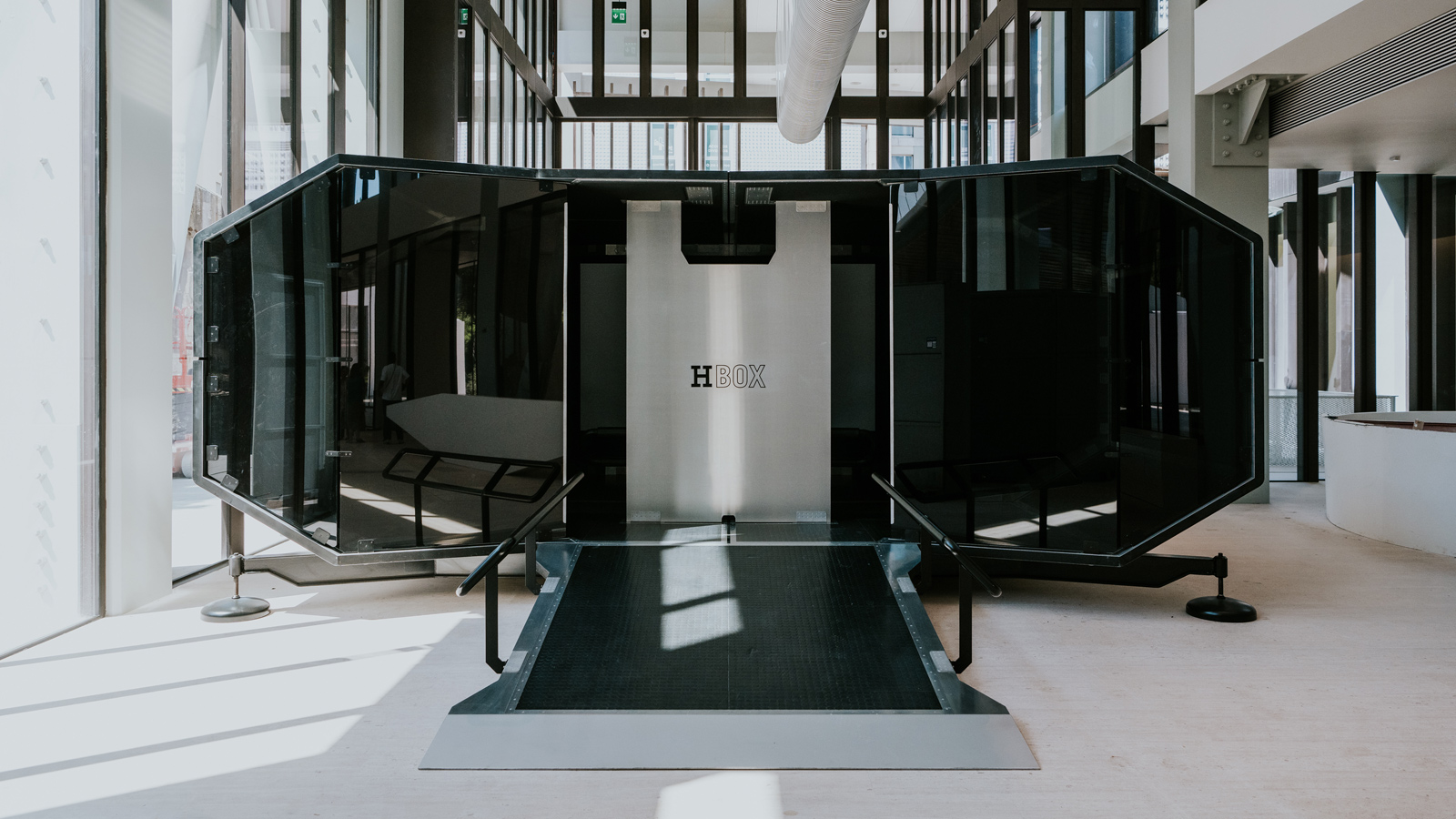
MJT: With its striking geometric shapes, H BOX is clearly the product of meticulous attention to technical detail. Did you draw inspiration from a specific architectural style or design movement when creating the piece?
DFF: The work of Kaplický and his Future Systems studio definitely had an influence. I was very inspired by the machine architecture movement, which is still going today. Future Systems centred around the latest tech in the 1970s and 80s. It was a popular movement that fused technology with architecture, which is something I draw on in my work. In a sense, this tied in with one of the specifications for the piece – easy disassembly and reassembly.
It was a long journey. We spent almost five years on the road, so we had to take a purely technical approach when it came to the lightness, resistance and materials that made up the piece. Even though the material is ultralight and resistant, its components have to withstand being assembled and disassembled 20, 30, 40 times. Having been on a massive tour over its lifetime, from Japan to the United States, passing through other places en route, it has since been restored. It ended up at the FRAC, a French art centre, before being loaned out to the Le Fresnoy film school. When its life cycle finally came to an end, it arrived at my studio in Portugal. One life has ended and another has begun with the new version for CAM.
MJT: H BOX uses high-tech materials, including those normally associated with aerospace engineering. How did you go about selecting these materials and how do you think they contribute to the immersive experience of the work?
DFF: It’s more about the language that these materials speak. We could have made a collapsible Greek temple, but the objective was to find materials that would allow the sort of manipulation we required. In the case of H BOX, the high-tech materials include aluminium, which was chosen for its density and lightness. We used honeycomb aluminium, which usually has aeronautical applications like aircraft fuselage and wing construction.
MJT: So the idea was to combine robustness, portability and durability.
DFF: Exactly. It was all about lightness and safety. The interesting thing is that at the time the work was designed, we weren’t just working with the construction materials, but also had to take the ambient materials into consideration, such as the quality of the video, the projection and the sound. For instance, the speakers and sound system were custom-made by hand. The projector we used was state-of-the-art at the time. It was a huge thing, because we’re talking almost 20 years ago. We developed speakers based on a monocoidal model, which allows the treble and bass to come out at the same point. It all made sense in the context of the time.
MJT: How about today?
DFF: Twenty years later, when we embarked on this new cycle, we looked at all of these issues again, because the power, visual quality and luminosity of the projector – a 40-kg box – no longer made sense. Technology has evolved so much, in terms of both sound and spatial audio, that we had to rethink everything in collaboration with CAM teams. The platonic ideal, as it were, of the H BOX architecture, the hexagon, still makes sense because it’s functional and the story behind it remains relevant, but the high-tech elements – like the sound and visuals – are no longer the same. All of this has been adapted once again: now the projector is a small box and the space that used to be occupied by the former large structure has been pared back.
MJT: How has the role of the artist and the work of art changed? What can technology add in this day and age?
DFF: More than anything else, technology is about opening up new frontiers. It always has been. Generally speaking, each new tool that appears, each update, each new function available, expands the possibilities of the artist or creator, allowing them to explore new territories. It’s like an exoskeleton that offers increased strength and power.
The other day we were reflecting on the impact of the internet when it first appeared. It was a completely new tool, a Eureka moment that opened up a wealth of new possibilities. These days, there’s a lot of talk about artificial intelligence and the question of authorship, but in essence it’s just another tool. I think there’s an interesting shift taking place. Before, the applications of technology were appraised in relation to the body, but now they’re increasingly associated with the idea of collaboration and the amplification of the mind. And that, for me, is a fundamental change.
Perhaps that’s why I find Philip K. Dick so fascinating. The way his writing anticipates and hypothesises about the future makes us think about the real and the sub-real, about how technology can manifest something that was only a concept before. He anticipates this intriguing fusion between the physical and the immaterial. Of course, like any tool, technology can be misused, but that’s not what concerns us here…
In fact, that’s exactly what I’m getting at: the mindful use of technology – how to build and use it without pushing against it. Of course, architecture can also be an instrument of power and domination. It’s important to recognise the line between these two dimensions – protection and amplification versus domination and power.
MJT: Yes, and it can also be a means of mediation, something intelligent and balanced.
DFF: Exactly! That’s the whole game. ‘Voilà’!
MJT: What were the biggest technical or conceptual challenges that you faced in developing H BOX? Did tackling these challenges lead to innovative solutions in terms of architecture, materials or technology?
DFF: I wouldn’t say they led to any specific innovation in that sense. But the interesting thing about the project was that it gave us the opportunity to work with companies that, while not in the aeronautics industry, produced containers, machinery and other equipment for the armed forces. This is a highly advanced industry, so the major challenge was entering that environment, absorbing that knowledge and applying it in a completely new way.
As artists or creators, we often use technologies that weren’t developed for art, but which come to us via other routes. In the case of H BOX, we were collaborating with companies that had never worked on this type of project or grappled with these issues, but which, in essence, weren’t very far removed from our concerns. I’ve always been interested in mobile air traffic control towers and the military and infrastructural technology used in military campaigns – how territory is occupied, how structures are moved, how materials are transported. We were now operating in that space. The big challenge was to convince experts from these industries to work with us in an unfamiliar context.
MJT: How did the creation of H BOX influence the rest of your creative process? In other words, has it had any influence on your other projects, in terms of architecture and design?
DFF: I’m always wondering the same thing. My fascination with technology, science and fiction coincided here. The big challenge was moving beyond the realm of Star Wars-style cardboard figures and cosmic scenery. The fact is that we couldn’t yet do what we wanted in our scenes. You introduce what you’re aiming for little by little, and that’s how you get the result. The challenge was to achieve a level of compatibility between the visual effect and the physical reality.
What did that bring to my work? We’re also talking about a decisive moment in my career, especially in my first decade of work. But the fascination was always there. Perhaps it was my ability to integrate other technologies and knowledge into my projects that led to me being chosen for this one. The satellite concept and the aerospatial aesthetic were what seduced so many people.
MJT: The piece was first shown in 2007, but it started in 2005, is that right?
DFF: Yes. I say that it’s been going 20 years because the initial idea came about in 2005. And the project was completed a year and a half later.
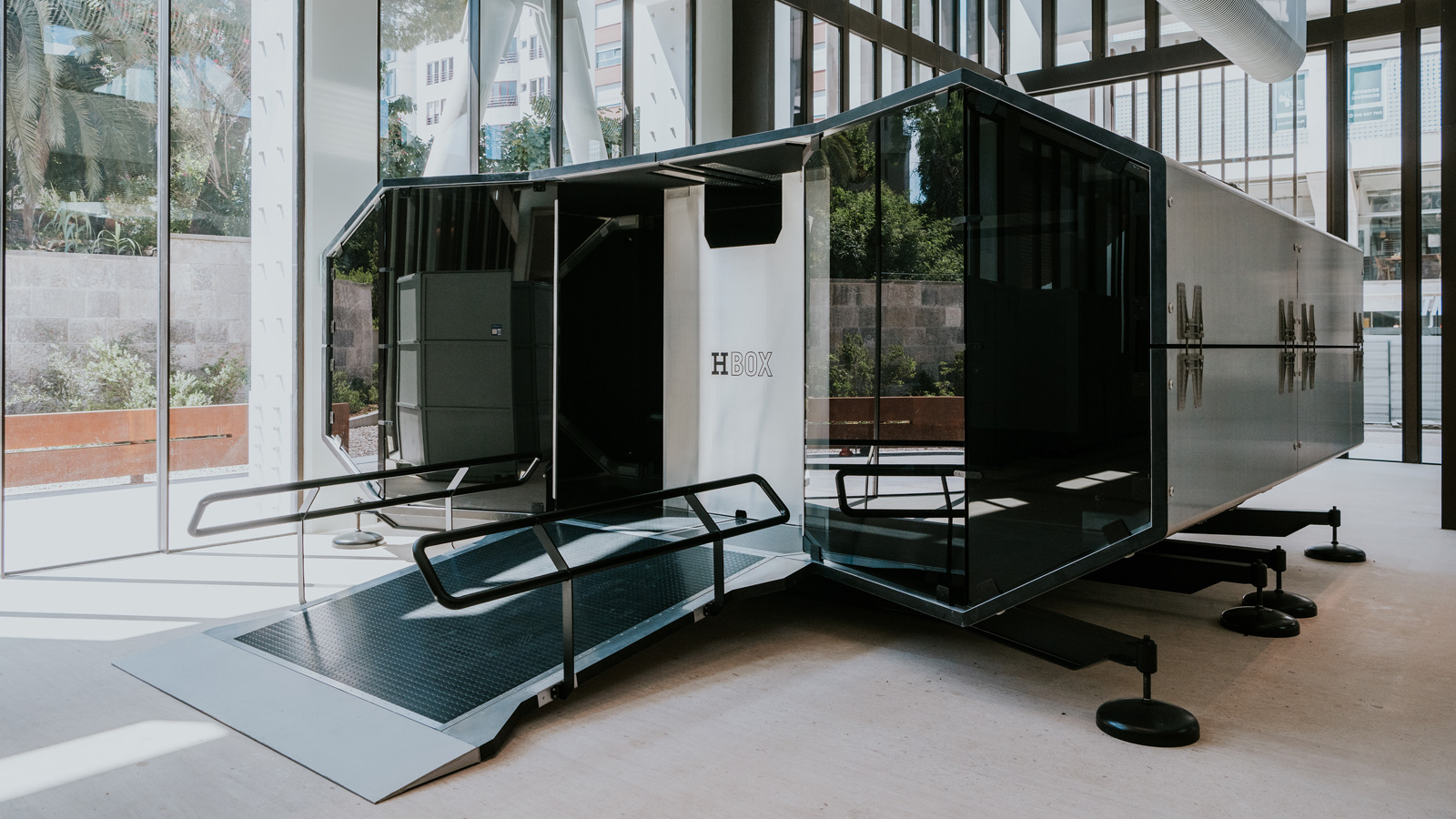
MJT: That’s pretty fast! And it has already toured a few continents over the last few years… With the opening of CAM in September 2024, it has returned for a new lease of life. What’s your view on the exhibition and the reception of the work by the public in this new context, compared to its previous appearance at venues such as the Tate London, the Centre Pompidou in Paris, Art Museum Beijing, MUDAM Luxembourg and Musac León?
DFF: I really liked it in Tokyo, at the Yokohama Triennale. I was at the ferry terminal, which was an incredible place!
MJT: Did you get any feedback from its Portuguese context? How did viewers feel about it? And how has it recently been received, with the return of H BOX and its exhibition at CAM?
DFF: Benjamin Weil has played a part in the most recent iteration. He was part of the project from the start, as the curator, and he commissioned the films. He was very involved in the whole process. The new CAM management team have been instrumental, too. In terms of how it’s been received, everyone tells me it’s fantastic! It’s been amazing! It’s successful because people go up to it without knowing what it is, it’s right at the entrance, and it’s a freely accessible piece, an open space.
MJT: It’s more or less unique in Portugal.
DFF: In a way, I think this has to do with the growing cosmopolitanism of Lisbon. When H BOX was created, Lisbon was hardly on the map. Its a matter of geopolitics and a shifting centre of gravity. Back then, Lisbon didn’t have many projects of this kind, unlike many cities abroad.
It’s a purely urban object. Let’s talk a bit about what the H BOX actually is. Its precise identity is neither here nor there: it’s an object, a booth, a pavilion, a public space concept that’s open to everyone. Is a museum a public space? Yes. At least, it often is. And so it’s an object, a booth, a pavilion, a form of momentum that is installed briefly or for a while in a public space, and is used publicly, without restrictions on who enters. That offers a particular experience, something different. In this case, that experience is access to a shared projection, an open space within a public space, a portable cinema, a mobile screen without any one checking tickets at the door. You don’t pay; you’re free to enter. All of this is bound up in the experience.
MJT: It’s democratic, too.
DFF: Yes, it is. Speaking of the public reception, I think it stems from the way people respond to an object or space like the one we have here, which is open to use. We’re in the garden of CAM. What does this new architectural structure offer here? It’s this in-between place… a protective space open to individual appropriation. It gets at the very question of public space, of collective and personal use. That balance intrigues me, and it’s in the very DNA of H BOX.
The work’s reception in Lisbon is similar to that in other places. When a public space offers something that can be appropriated, people will immediately make use of it, because that’s what public space does: it invites you to experiment, to try out a new experience or situation. Like these chairs scattered around here, what do people do?
MJT: It’s an invitation.
DFF: Exactly – it’s an invitation! It’s not stipulated in writing anywhere, but people make use of them! They find a good position, sit in the sun and shift the chairs around. In the same way, H BOX is like an open door. And not a doorframe, but an open portal! By passing through it, people are crossing a threshold.
MJT: A portal, like the gateway to another dimension.
DFF: Another dimension, exactly. Its power lies precisely in the lack of restrictions. It’s intended for the public space, to be used and shared. From that point of view, I would say that the success of the piece is that it is what it is, and by its very nature it will always work. When placed in a public space, it becomes an object that people who come across it instinctively appropriate.
MJT: Finally, is there anything we haven’t covered that you’d like to talk about?
DFF: One thing I haven’t mentioned is that the object’s contact with the ground is highly circumscribed, giving the impression of something in transit, which lands and then leaves.
MJT: The object almost appears to be levitating.
DFF: And there’s the fact that it’s a shelter, albeit an open structure. Another important thing it the threshold that it represents between the inside and outside. And it offers protection.
MJT: And immersion.
DFF: Yes, it’s an immersive experience. There you have it! And probably, thinking more globally, the references to machine architecture that I mentioned earlier, which have to do with articulations and denote an architecture that is not static but nomadic, consisting in movement.
We talked about the writer behind the film ‘Contact’ and about the Chinese author Liu Cixin, who wrote a fantastic story about languages. In its capacity as a kind of immersion booth, the piece has a language that is so archetypal in terms of design that it eludes any firm sense of identity altogether. The work is defined by technology and has an aesthetic redolent of high tech, science fiction and spaceships. It speaks that kind of language, which is why I’ve been talking about sci-fi and beloved authors like Philip K. Dick and J.G. Ballard, who didn’t write science fiction, but has an affinity with it somehow …
MJT: Well, his work touches upon science, right?
DFF: Yes! Cronenberg’s there too, and even … there was a nice scene in a film by the director of ‘Blue Velvet’, who passed away recently.
MJT: Lynch?
DFF: Yes, David Lynch! There’s a sequence that I think is pure science fiction, or what we might describe as post-natural, body-machine or architecture-machine, but has more to do with initial fears or deep fears. I think it’s in ‘Lost Highway’. There’s a scene where the protagonist starts going down a corridor, and as the seconds go by the darkness encroaches, little by little, as though he’s being sucked back in time. All my design work was along these lines; one of the initial driving forces was this idea: how can we make a space that sucks us in?
You may also like




No results were found for your criteria.