
‘There Is Always a Woman in the Attic’, by Leonor Rosas

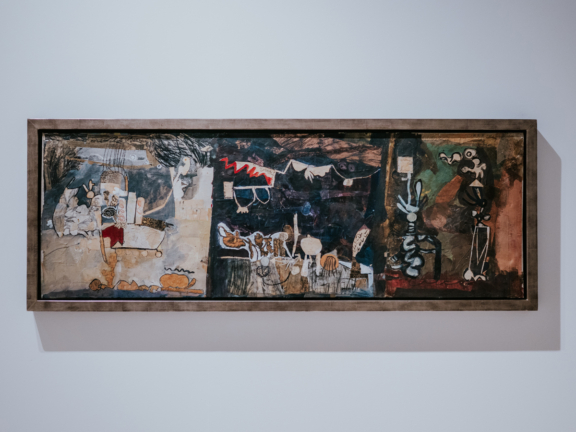
Eagerly, I entered the exhibition in search of this painting. Its title borrows from a novel by Jean Rhys, which tells the story of the sombre woman locked away in the attic of Mr Rochester, the romantic hero of Jane Eyre. Antoinette Mason, who at first reading seems like a mad obstacle standing in the way of the fantastic, improbable union between Jane and Rochester, transcends the role of ghost and becomes a woman of flesh and blood. Antoinette, a Jamaican ‘Creole’ woman and heiress to a vast fortune, was married off to Rochester through a financial arrangement made by her stepfather. ‘Intemperate and impure,’ she becomes the object of her new husband’s rage – a man who cannot bear the sun that shines within her; a woman who enjoys dancing, flirting, and strolling around her island. Once in England, she is shut away in the attic of an old house, her non-conformity pathologised as madness. Such was the fate of the Victorian woman who resisted forced marriage, the loss of independence, and the demands of sexual purity: hysteria and a shackled body.

I do not see Jane Eyre as her opposite. Beneath the heavy mantle of 19th-century patriarchy, I see a Jane who refused a loveless marriage, who rejected the idea of being either bird or angel to a man – a Jane who, within the limits of her time, pursued knowledge and self-determination. Perhaps Antoinette truly is Jane Eyre’s ‘Gothic double’: the literary embodiment of her desires, transgressions and repressed thoughts. Or maybe she is the double of us all. There is always a woman in the attic. Unruly, angry, defiant. Centuries may pass, but we still know that an angry woman is unwelcome – disruptive, untameable. Perhaps the time has come to open the door to the Antoinette in our attic. Let’s set fire to this house as well.

Reflections on ’Paula Rego and Adriana Varejão. Between Your Teeth’
Explore the series






No results were found for your criteria.
You may also like















No results were found for your criteria.