
Climate of Change: Seven Key Insights

This study set out to understand Portuguese citizens’ attitudes towards climate challenges and to profile the organisations working in the environmental field, along with the approaches they use to engage the public. By bringing these two perspectives together, it identifies opportunities to spark individual and community-level change that can support a systemic transition in tackling the climate and biodiversity crises.
Key insights
1. Environmental challenges: awareness doesn’t translate into action
Most Portuguese citizens acknowledge the seriousness of environmental challenges. In response to the question, “Will the economic costs of tackling climate change be higher than the economic costs of its impact?”, 71% believe that the impact of climate change will be more costly.
Will the economic costs of tackling climate change be higher than the economic costs of its impact?
Although many Portuguese believe they could be doing more for the environment, there is a clear gap between intention and action. Environmental concerns are often deprioritised in favour of more immediate issues, such as healthcare, poverty, and social inequality.
What issues do you think are the most pressing in Portugal?
When it comes to environmental issues in Portugal, extreme weather events, resource depletion, and climate change emerge as the top concerns. Air pollution, deforestation, soil degradation, and biodiversity loss, while still recognised, are seen as comparatively less pressing.
Which of the following environmental issues do you consider most concerning in Portugal?
2. The public sphere must lead by example
When observing their surroundings, whether in the street or in the institutions they interact with, most Portuguese citizens say they rarely encounter examples of good environmental practice. Their concern about the accumulation of litter reflects this absence of visible leadership.
“I lived in Switzerland for five years and it’s completely different. There’s no pollution, people aren’t allowed to throw rubbish on the streets, and waste is collected at set times. You can’t just throw things out whenever you like. Or you can, but then you get fined. And people follow the rules, it’s nothing like what we have here in Portugal.”
— Focus group participant
Only a small portion of the population reports seeing sustainable practices implemented in public spaces. Still, more than half believe the public sphere should set the standard in the environmental transition, helping to build trust and credibility around change.
As for individual behaviours, half of respondents chose “sorting waste and recycling” as the most impactful action in combating climate change. More scientifically urgent measures – such as switching to renewable energy or adopting more sustainable mobility habits, including increased use of public transport – are ranked lower.
Which of the following individual behaviours do you believe have the greatest impact in addressing climate change?
3. Different citizen profiles call for tailored engagement
The study identified five distinct segments of the Portuguese population, ranging from the most to the least committed to adopting more sustainable lifestyles. These profiles should inform the way we craft messages and narratives to raise awareness and drive engagement around environmental and climate issues.
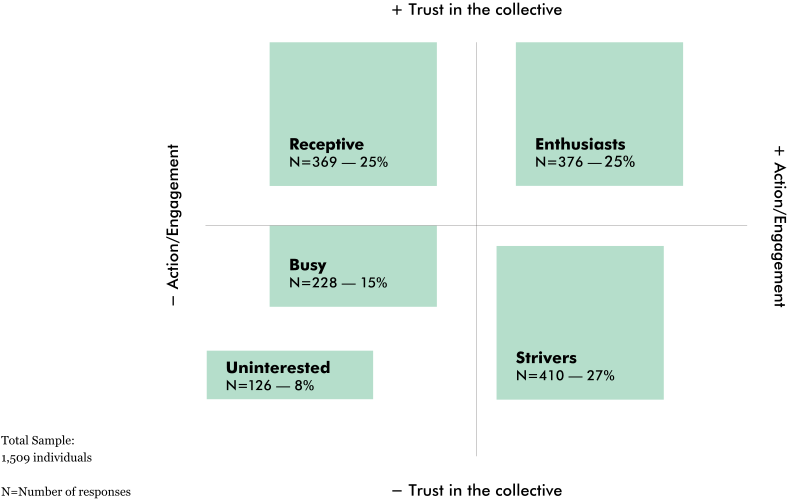
Based on a sample of 1,509 respondents, the following profiles emerged:
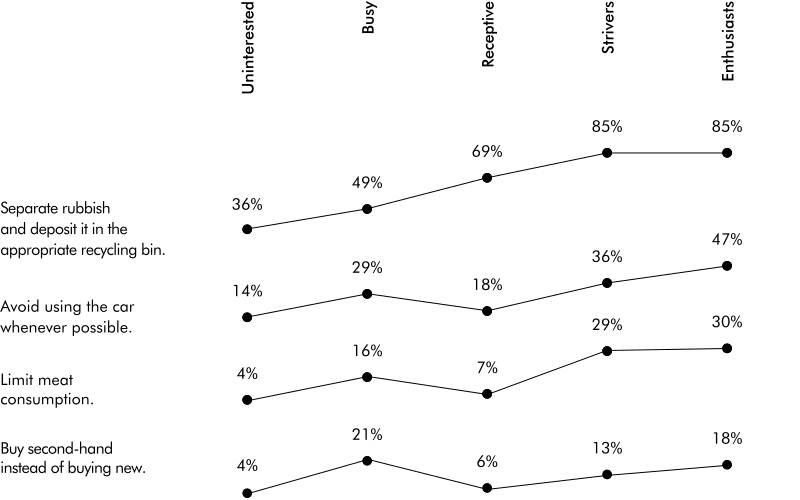
Understanding these profiles is essential. In the most engaged segments, there is a higher proportion of university graduates (43% among Enthusiasts and 50% among Strivers), compared to lower levels in the less engaged groups (32% among the Busy and 33% among the Uninterested).
Gender and age patterns also stand out: Enthusiasts are predominantly women (53%), while the Uninterested group includes the highest percentage of men (56%). In terms of age, 60% of Enthusiasts are between 45 and 60 years old, while just 13% are aged 18–24. Among the Uninterested, younger people are more present—20% are aged 18–24—alongside even splits between those aged 25–44 and 45–60 (40% each).
4. Being young doesn’t guarantee a sustainability mindset
Survey results and focus group discussions reveal that many young people are more preoccupied with rising living costs and job insecurity than with environmental sustainability. They are also less connected to their communities, taking part in fewer associations or collective initiatives, and less inclined to adopt sustainable habits.
More sustainable routines
What most clearly sets this group apart is how they access information. When asked where they get their knowledge about sustainability, 52% of young respondents pointed to social media – almost double the average across the full sample (27%).
Looking at this age group through the lens of the five citizen segments, younger people are notably less engaged and less confident. The most engaged and confident profile, Enthusiasts, is significantly underrepresented among young respondents, accounting for just 13%.
Understanding the differences among young people
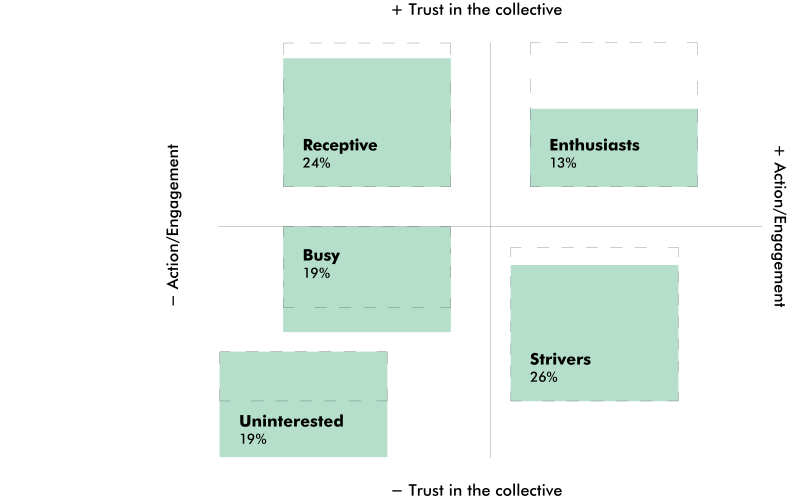
These findings point to the importance of reinforcing environmental education from an early age and creating hands-on, positive experiences that engage young people in meaningful ways, encouraging collective action and long-term commitment.
5. Incentives are more effective than penalties in driving change
What are the main barriers you face in adopting more environmentally sustainable habits?
A key obstacle is the perception that sustainable choices are more expensive: around half of respondents say they don’t do more for the environment because it would involve additional costs or because affordable alternatives are lacking.
This highlights the potential of incentive-based approaches, such as financial benefits, rewards, or discounts, to encourage behaviour change more effectively than punitive measures like fines or tax increases. To foster lasting engagement, it’s crucial to address people’s immediate concerns and clearly show how caring for the environment can bring direct, practical benefits to their daily lives.
6. Environmental organisations need to connect more closely with citizens
While only a small minority of people say they don’t value environmental organisations working in the third-sector, the vast majority recognise their importance across a range of areas. Nonetheless, most have no direct connection to these organisations and are unaware of which ones are active in their local area.
To what extent do you value the work of environmental organisations in your local community?
The organisations themselves acknowledge the difficulty of reaching and involving people, largely due to limited resources: 41% operate exclusively with volunteers, and only 55% have full-time staff. The lack of specialised roles is a major obstacle to effectively communicating their mission and activities.
“You really need specific training [in communication] to reach people, and these organisations are made up of volunteers, who often come from backgrounds that have nothing to do with the issue they’re working on. And it’s not just about creating an Instagram or Facebook account and posting a few pictures from here and there...”
— Striver, 20, Faro
Only 24% of environmental organisation representatives say they have a “well-developed narrative strategy to engage people effectively.” Other major challenges include fundraising and understanding how to access funding programmes – alongside communication and marketing.
7. Environmental organisations as catalysts for change
A lack of awareness about environmental organisations and the initiatives they promote remains a key barrier to citizen engagement. Yet 90% of the organisations surveyed believe that building a structured network is essential to strengthen collaboration and increase the impact of their work.
Conversations with citizens suggest that making environmental causes more visible and embedded in daily life could be a winning strategy for greater involvement.
“Everyone gets together and pays to take part in marathons. It’s not exactly cheap, and we still get thousands of people joining in. If we had forest-cleaning marathons – a collective effort – even if people didn’t have to pay...”
— Focus group participant
Creating community gathering spaces – third places, where people spend time beyond the home (first place) and the workplace (second place) – that also serve as models for sustainable living and spaces for idea-sharing could help foster co-creation and inspire active participation in the environmental transition.
The study also shows that more capable, well-resourced environmental organisations – those with a clear commitment to sustainability and strong connections to people and their local contexts – can act as powerful drivers of change. These organisations are well positioned to bring together municipalities, businesses, schools, cultural spaces, the media, and citizens around a shared vision for transition and systemic transformation.
Read studyYou may also like








No results were found for your criteria.