
Poetry at CAM: works from ‘Tide Line’ exhibition
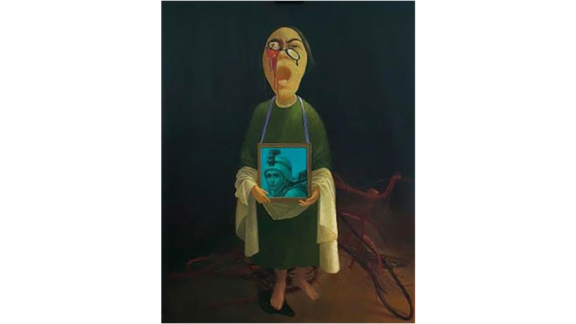
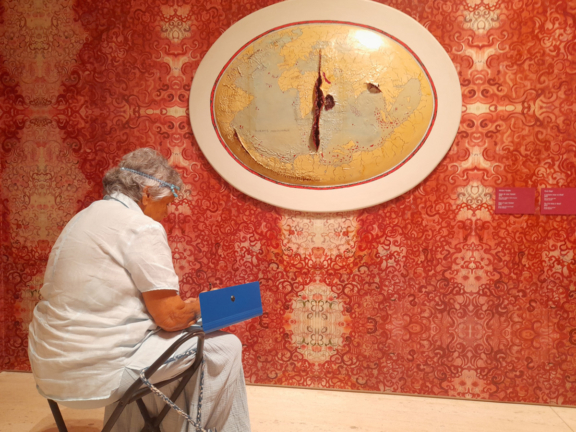
Poem ‘Odessa’ inspired by Jorge Pinheiro’s work ‘Stabat mater’ (2006)
No results were found for your criteria.
‘Battleship Potemkin’ is one of my favourite films and I even wrote an essay about it at university, it was pure chance that I was allocated the work Stabat mater, and in the poem I alluded to some scenes and filming techniques used in the Odessa steps sequence.
Read poem
Odessa
How can you kill your own people?
How you can hear a baby cry
And not hold your fire?
We are all animals of the same race
Yet pain remains
As another war passes
And man's wrath seems limitless
What will it take for the war to end?
How many more will die?
Hearts are all the same
But seemingly... judgements are not
Have you seen the panic in the streets?
Or do you turn away from others' pain?
Have you refused to see the horror of this rampage?
People stumbling down the stairs
Seeing only what you want in their faces
And nothing can convince you
That the ones you hurt
Are men and women
Who could be your son or your mother
If they died before your eyes
Wouldn’t you die too?
But the pain of these people doesn’t bite you
You shrug your shoulders as it passes
You kill all who demonstrate in the square
Because you refuse to understand
That we are all animals
Of the same race.
Leonor Ribeiro
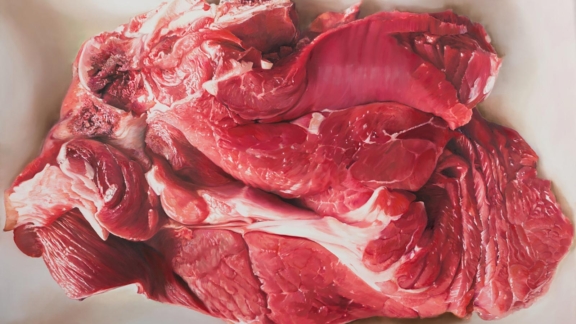
Poem ‘Mutation’ inspired by Rosa Carvalho’s work ‘Posta’ (2013)
No results were found for your criteria.
Starting point. It isn’t the same for us all, whether in art or in life. This was the premise of my creation process for a poetic text for the work ‘Posta‘, by Rosa Carvalho. Flesh, as a common part of animal and humankind. Respect, the changing times, the immediacy and consequences that stem from these troubled times. My relationship with the work was immediate and visceral and my pen wrote my journey in thousands of strokes.
Read poem
Mutation
I am flesh for the cannon.
Layers upon layers wrap me in this ailing world.
Not everything is what it seems. We consume or are consumed by what we refuse to see in the culture of immediacy.
I am sick.
Maybe I need to nourish myself with silence and to silence society.
We often strip the nerve from the flesh. Do you like your words medium or rare?
Not everything seen from a distance is real. Come closer. Look for the difference in the detail.
You are flesh of my flesh. A living being, like me.
May we all live with dignity. May we all be more than a piece of meat.
I nourished, healed myself with words.
In mutation I found the way.
I don't separate the sinews from the meat. I feed on truth and seek, up close, each brushstroke.
They don’t repulse me. One by one, they turn the painting into reality.
We are what we eat. We are sick. I stopped segregating words. Maybe I have cancer in my word glands.
Maybe...
Margarida Azevedo
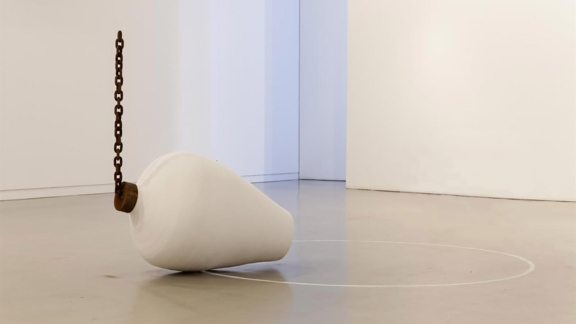
Poem ‘Liquid-metallic axis’ inspired by the work ‘Rotação a 19 graus, translação e prumo’ (2013), by Inês Botelho
No results were found for your criteria.
Poetic amalgam. A swift dive into Inês Botelho’s ‘Rotação a 19 graus, translação e prumo‘ in 20 minutes. I fell like the celestial body rotating perpetually in the middle of the room of the tide line. My heart beating fast, stellar particles detaching from my fingers on the blank page. The celestial body didn’t stop spinning in me and the words foundered with the adrenaline of once again flooding the stage with one last poem.
Read poem
Liquid-metallic axis
A celestial body fell
from the sky
Spinning, spinning, spinning
without ever stopping its rotation
it didn't take long
to reach the water.
Yes, a celestial body fell
No one was injured or died
I think.
At least at first
The waters broke the fall
I think.
A celestial body fell...
Was it a question?
Or a poet?
Question
Or poet
Was it celestial?
Was it a body?
And then the voice:
The voice of a goddess:
A voice of a goddess asking:
– What is a poet
doing standing on the sand in front of the sea
that sweeps towards his feet?
(The poet moves forward)
What is a poet
doing amongst the waves
with the pages all wet
and the words
a faint impulse
among the spray
and the movement of the tides?
...A hand appears from the sky
(No, not another celestial body!)
– What is a poet
doing inside a rowboat
his imagination has built
because his skin was already too shrivelled,
the air was scarce, his will was faltering,
the seas were closing in,
the clouds were crashing on his head like insults directed in a foreign language,
but offensive just the same.
The violence with which the rain burst from the
mouth
Mouth? Celestial body? Oceanic fissure? Oceanic fissure generated by the celestial body? Or...
It was a mouth
A mouth filled with drowned carnations
(Yes, the mouth was full of carnations)
1 million 108 thousand 764 drowned carnations,
to be exact.
An enormous mouth
Like an ocean liner
It kept swallOwing
the Ocean
And the poet in the abyss of the boat
– What is a poet
Doing in a rowboat?
rowing against the tide
as if he wanted to save the poems
that might still jump out of the water...
From his fishing pen
only erased lines
from the past,
Rewriting history
from out of that mouth!
As if they wanted to tie an anchor to the hook
To capsize the boat:
Enough poets, poetry, words,
Enough of anything rhyming with Truth!
– What is a poet
doing with these detached lines,
the intimate storm,
the heart weighed down by the ocean breeze,
the stomach full of plastic waste
What is he doing on a sunken rowboat?
(while the yachts cruise by
showing off
their tanned skins
like tourists watching
chaos
A chaos
that only increases
the abundance of their privilege)
– What is a poet doing...
What is he doing...
What is he...
What is...
What
(He is learning to breathe underwater)
Felipe Castro
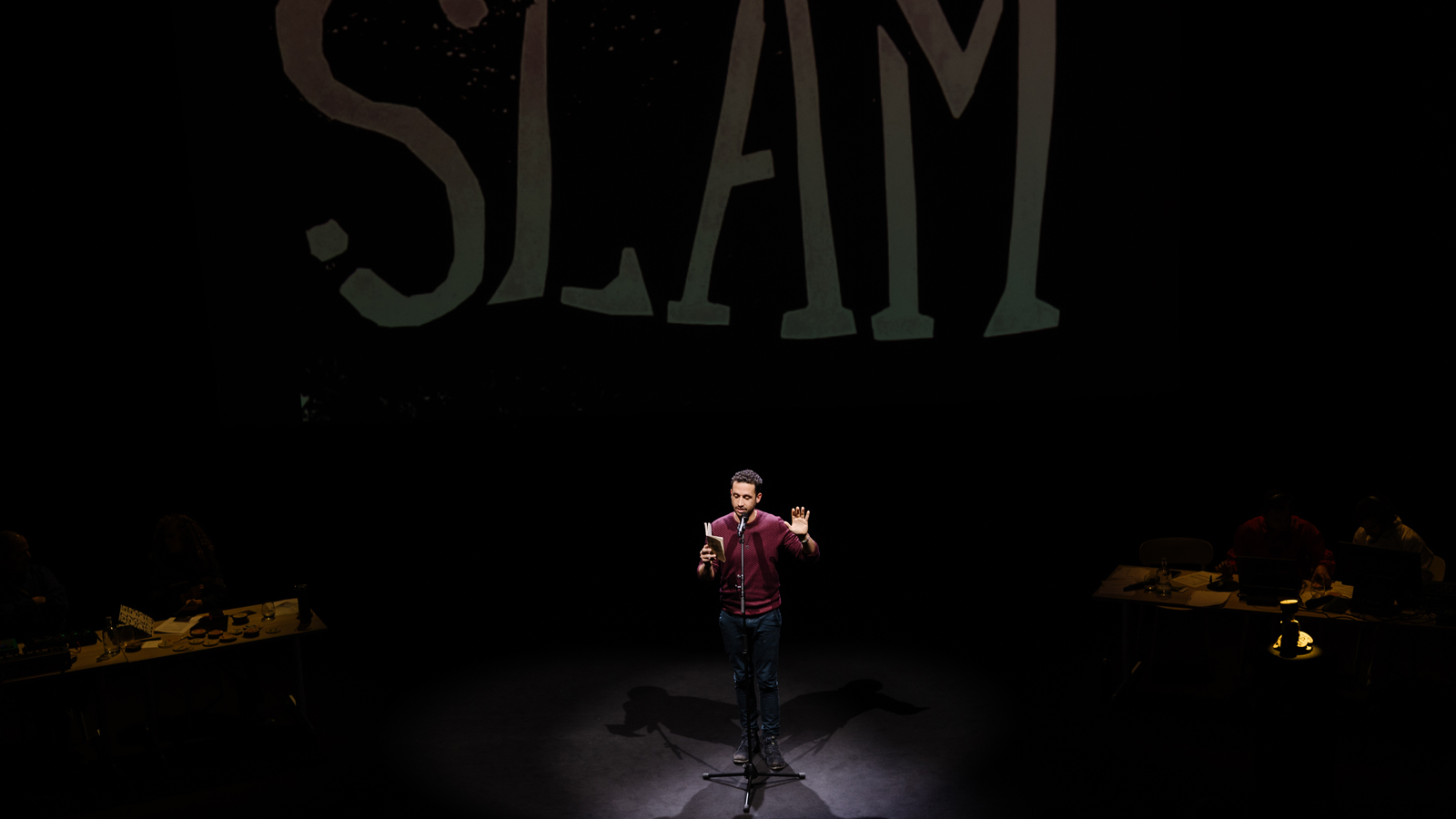
SLAM at CAM
Explore the series


You may also like

No results were found for your criteria.