
Mikhail Karikis: ‘It is only through unity that we can rise against them’
-
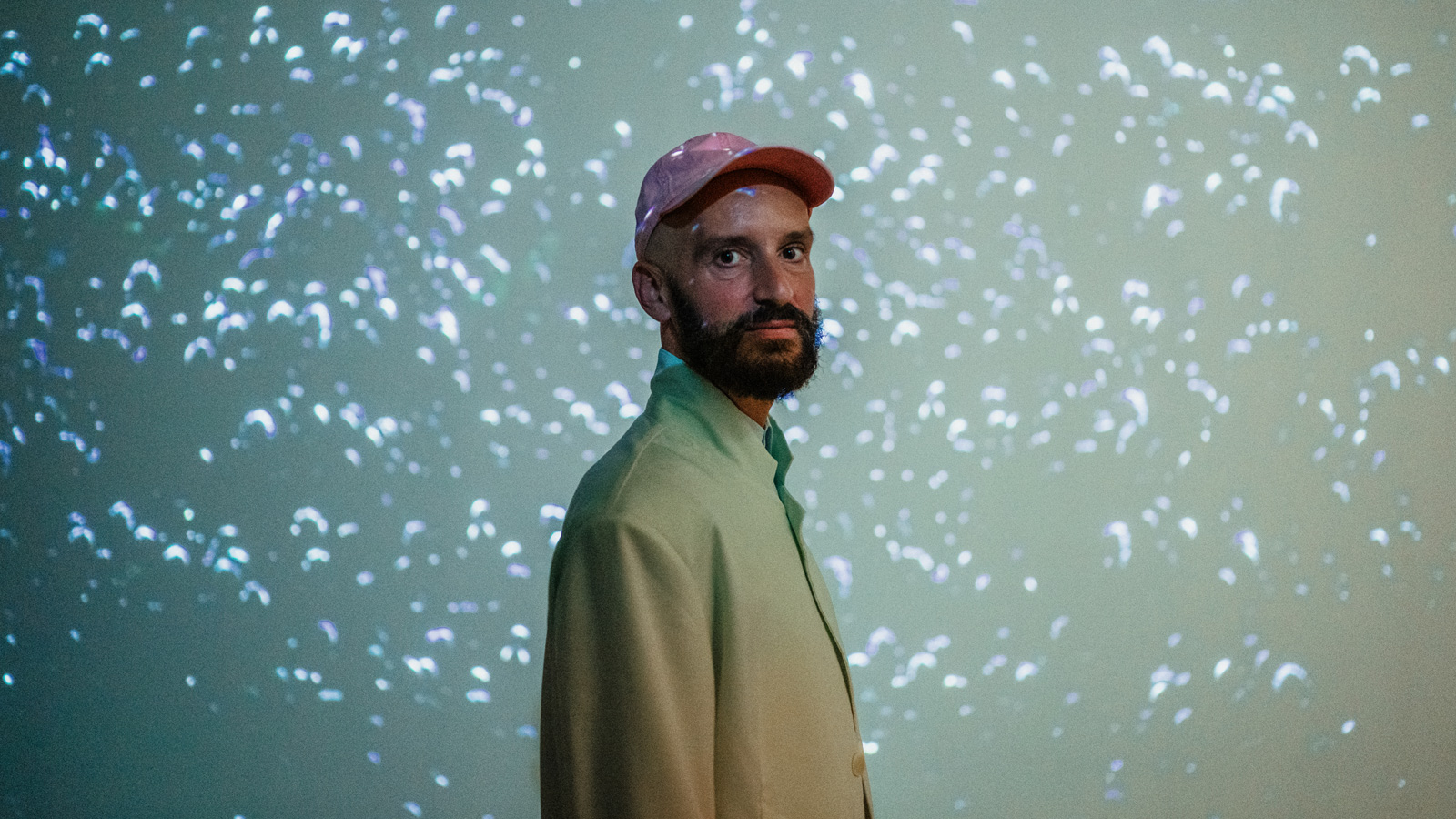
Mikhail Karikis
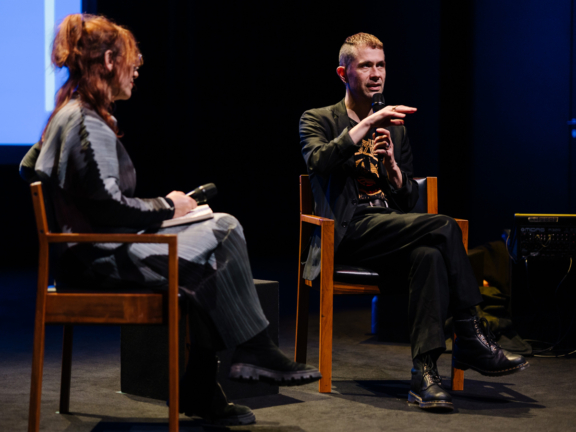
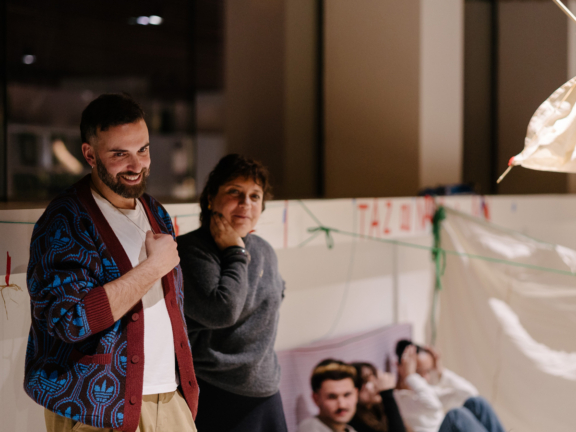
I met Mikhail Karikis for a brief conversation about the opening of his most recent audiovisual installation ‘We Are Together Because…’ at the Drawing Room at CAM. This work is the result of a two-year collaboration between the artist and the project ‘Sounds of a Revolution’, which involved more than 50 students, with ages between 13 to 18 years, from Artallis – Conservatório de Artes de Loures.
Karikis delves into an analysis of his broader practice, guided by questions that have long shaped his collaborative projects, rooted in political, social and cultural contexts. The conversation naturally evolved into a moment where the questions seemed to answer themselves, as the artist revisited his experiences with this group of teenagers and reflected on the main aspects that inform how this work might be read.
The central themes in the film revolve around the group’s concerns on freedom, equity, tolerance, environmental awareness, and the global crisis, highlighting not only the focus of this work but also how it gives voice to a future generation. Personally, I found the approach deeply humane, as it articulately translated into the space the time and care devoted to building these systems of knowledge and to fostering a sustained, effective sense of community.
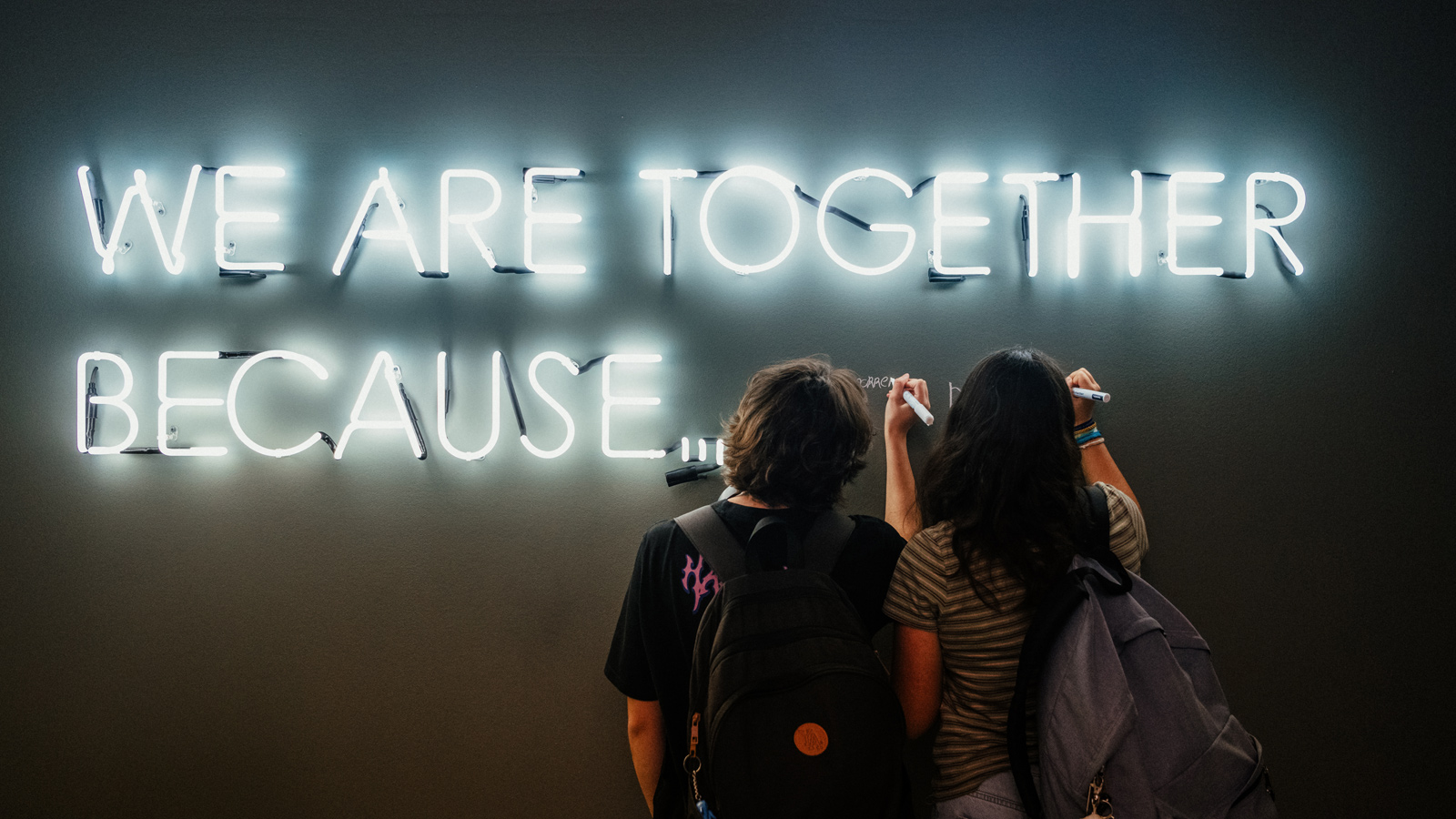
Let’s start with the title ‘We Are Together Because…’, can you tell me more about it? Did it come from the process of working with this group?
I asked the participants: Why are we together? This is how the project started. We focused a lot on concerns and problems at the beginning and several conversations focused on what worries them, what they are fearing and what they look forward to once they become adults. Then at some point, I told them, we can spend the entire two years talking about problems, but what solutions can we imagine? Rather than always thinking about what separates us.
What I have done in this project is to open it up and invite participants to think in a political and futurological way. During some exercises, for example, we imagined it’s 2050 and we looked at climate modeling maps showing how geography will change, particularly in Portugal. I asked, in this context, would we still want to be together? And why?
We used methodologies referencing radical pedagogy, including a queer American composer called Pauline Oliveros. She has a series of instructional scores: just language, no music notes. One of them is titled ‘We are together because…’. Where people are invited to complete in any way they wish. The title of the exhibition is a reference to this score, which she wrote in 1980.
I’m particularly interested in the long-term nature of this two-year process. What were the key stages in its development? And what were your expectations?
When I was invited by the Gulbenkian to create this project, I was really delighted because I would be working with young people and I have done several projects with a similar age group. I think working with teenagers is particularly significant. Children and teenagers both have unique perspectives, but teenagers especially, because they are in a transitional phase: moving from being told what to do by teachers, parents, and other adults, to defining who they are, discovering their responsibilities, and finding their own voice. There is an intensity in that age between 13 and 19 that I find very compelling.
We delivered the concert ‘Sounds of a Revolution’ in September 2024, which marked the first major stage of the project. The composition was structured around the four elements of nature, with each part developed by a different collaborator (myself, Francisco Joaquim, Teresa Gentil and Sara Ross) choreographed by Maruan Sipert and with musical direction by conductor Diogo Costa.
The next task for me was to find a way to condense and encapsulate all of the knowledge and experience accumulated throughout the process into a single artwork. I focused on how to create something that remained faithful to the entire journey, representing what we did in a very condensed but precise way, especially in terms of the message I want to communicate at this point in my life.
This piece is a clear example of your interest in working collaboratively to create films and installations. When did you first start working towards collective creation? And what motivated you?
After spending a number of years performing, I felt there was something missing. It was quite difficult for me to practice my politics or even my citizenship through my art. I now think of my work as a way to practice it and contribute to society. My role became one of service: amplifying the views, conditions and wishes of others. Rather than working with music specialists, I turned to those outside the field to create sound together such as coal miners in the UK, Korean women pearl divers and children in Italy.
I was finding my voice and defining my role as an artist: using my practical and theoretical experience, and the knowledge of my own voice, to orchestrate collective projects which always led to a sound work, choral, musical or abstract proposal. This began in 2008 and it is what I continue to do. This collaborative approach to sound has naturally extended into the films and installations I create, where shared authorship and collective voice remain central.
The film seems to engage with themes of activism, such as political resistance and climate change, yet it does so without direct symbols or narrative signals. Could you expand on this?
I have always asked myself, Why am I making this? The answer is that my work isn’t for me, it’s to serve the public. Art operates in the realm of possibility and while it starts with a critical point, I focus on offering something hopeful, an alternative.
This project begins with the word ‘poderíamos’. It shows the participants tuning their voices to each other, listening and preparing to work together, much like instruments tuning before a concert. Each individual has a role, but we must harmonize to achieve a common goal.
By the end, participants articulate why they are together, offering a reminder of the reasons we stay united rather than focusing on divisions. The final scene, which was recorded in the Gulbenkian’s Grand Auditorium, shows their collective voice bringing down a wall, symbolizing how solidarity can overcome physical barriers. It also connects to the idea of humans as part of nature, as behind the wall there was the garden, emphasizing that we cannot survive without recognizing nature as an ally.
How does the film explore the body as a political and expressive tool, particularly in the context of adolescence? Can you explain how moments like touch and care express a revolutionary practice?
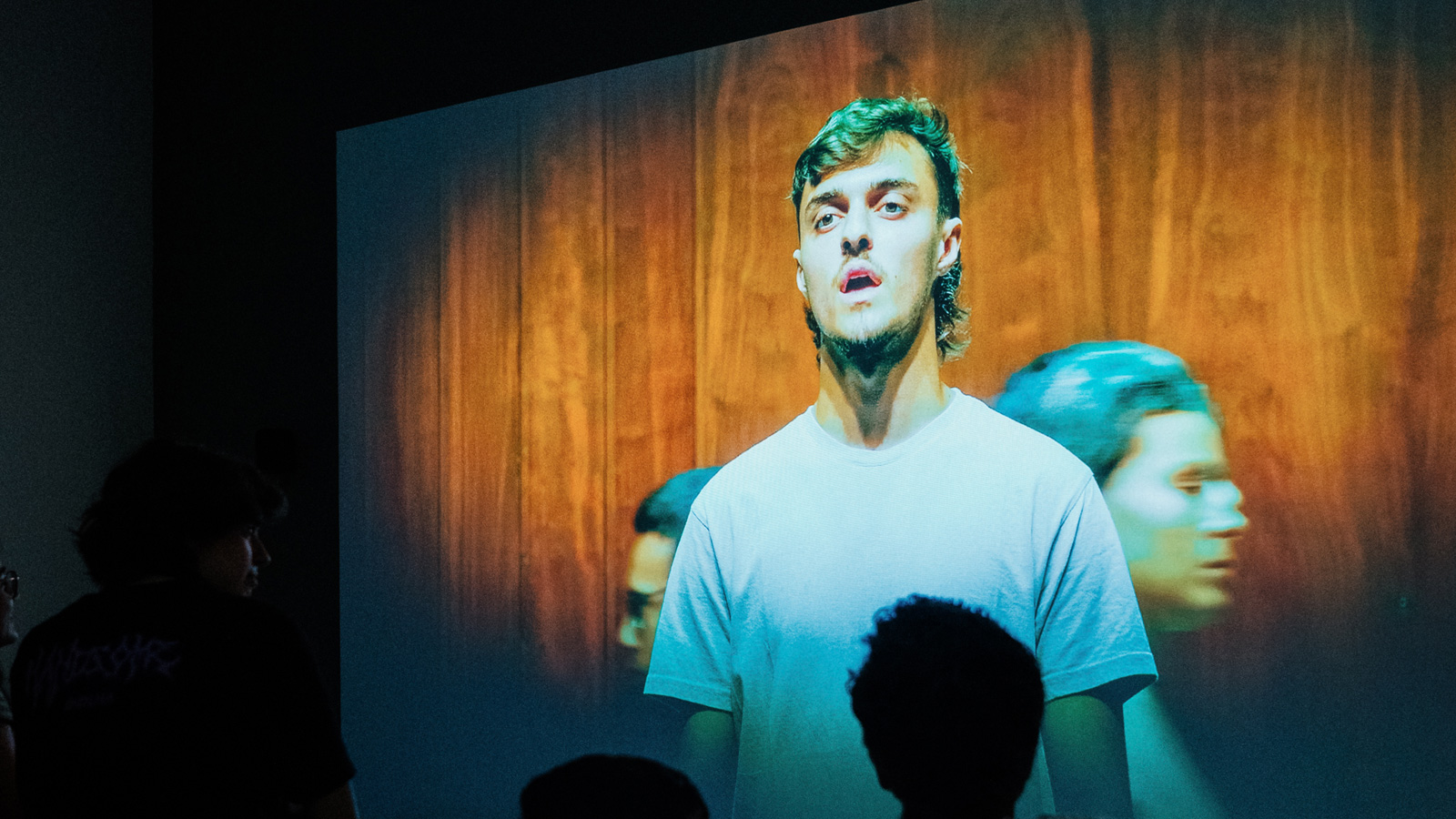
One of the exercises we did, for example, was for them to perform with their eyes closed. This gesture alludes to an inner spiritual world and a connection to something not physically present, the spirit of the revolution. Another moment that is very moving is when we see glimpses of the kids touching, caressing and massaging each other while learning to say and sing the word ‘Mundo’. We just hear ‘Mundo, Mundo, Mundo’, rising in pitch. These teenagers are learning about the world, but they are also creating a world of care through mutual exchange. In this act of touching, they are shaping the world together.
This speaks to the idea I have reflected on: the ability to create a world molded by mutual care. These kids are discovering this process, becoming the world they want to see. Despite the negative ideas we have about the world, this installation shows the opposite. I hope the message reaches people, even if they can’t articulate it verbally, that they leave with it in a more abstract way.
How does the scene where the group of kids come together to say ‘I still believe in people’ [Eu ainda acredito nas pessoas] reflect the film’s broader message about revolution, solidarity and the power of collective voice against oppression?
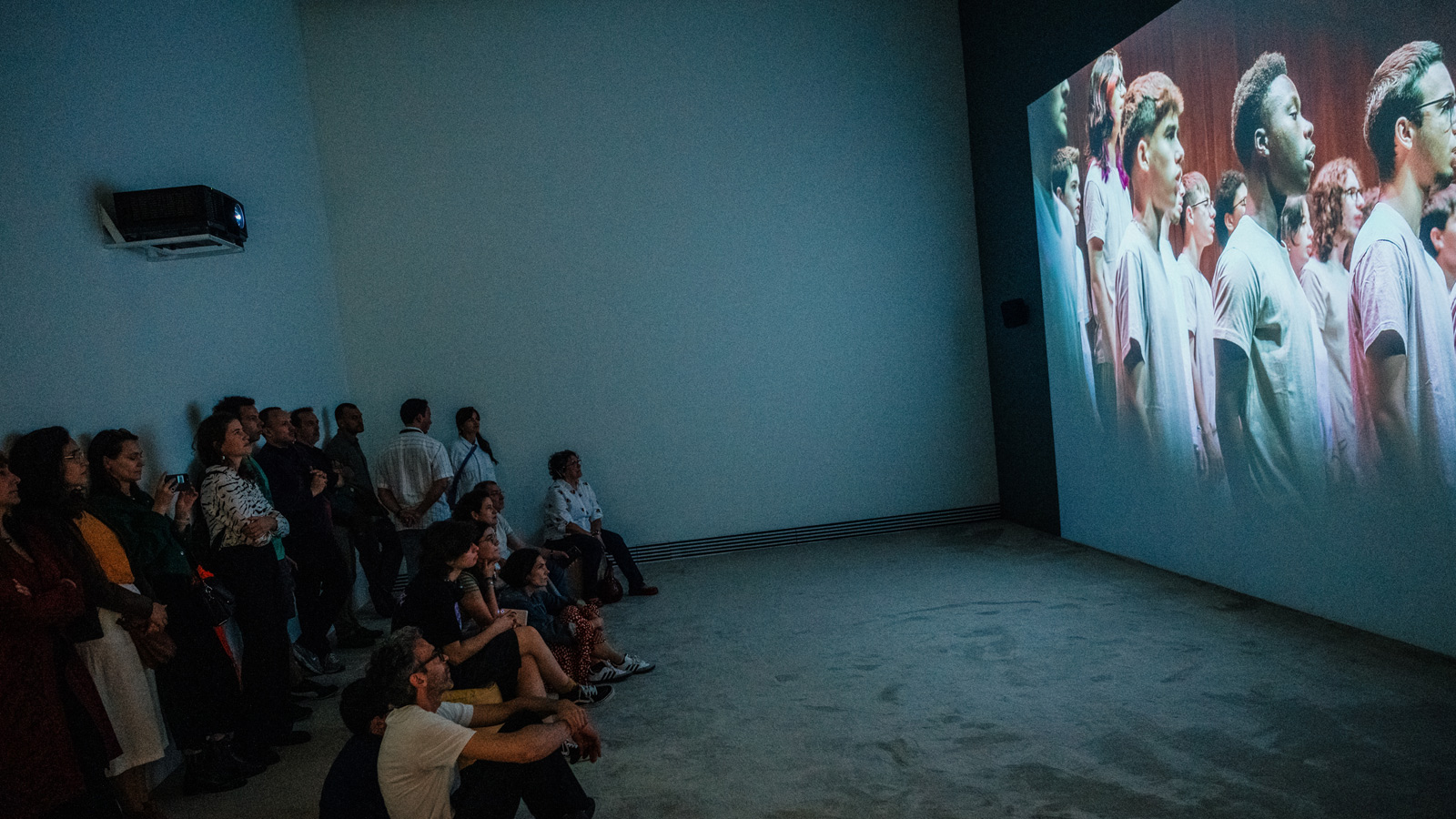
This is a significant moment of the film, as the participants come together, initially overwhelmed by the loud sound of the orchestra, and one by one, they step forward to say the sentence. At first, we couldn’t hear them. But when the group slowly grows and their voices rise above the orchestra, a symbolic moment in the piece is reached. It shows that, unlike the overwhelming sound of the orchestra, our voices as individuals often go unheard. Only through solidarity can we achieve something. This feels politically relevant now, especially with the rise of oppressive regimes worldwide. We can’t overcome these challenges alone, it is only through unity that we can rise against them.
What kind of techniques did you utilize to invite the audience to connect with the message on a deeper level? What role do silence, light and the presence of bodies play?
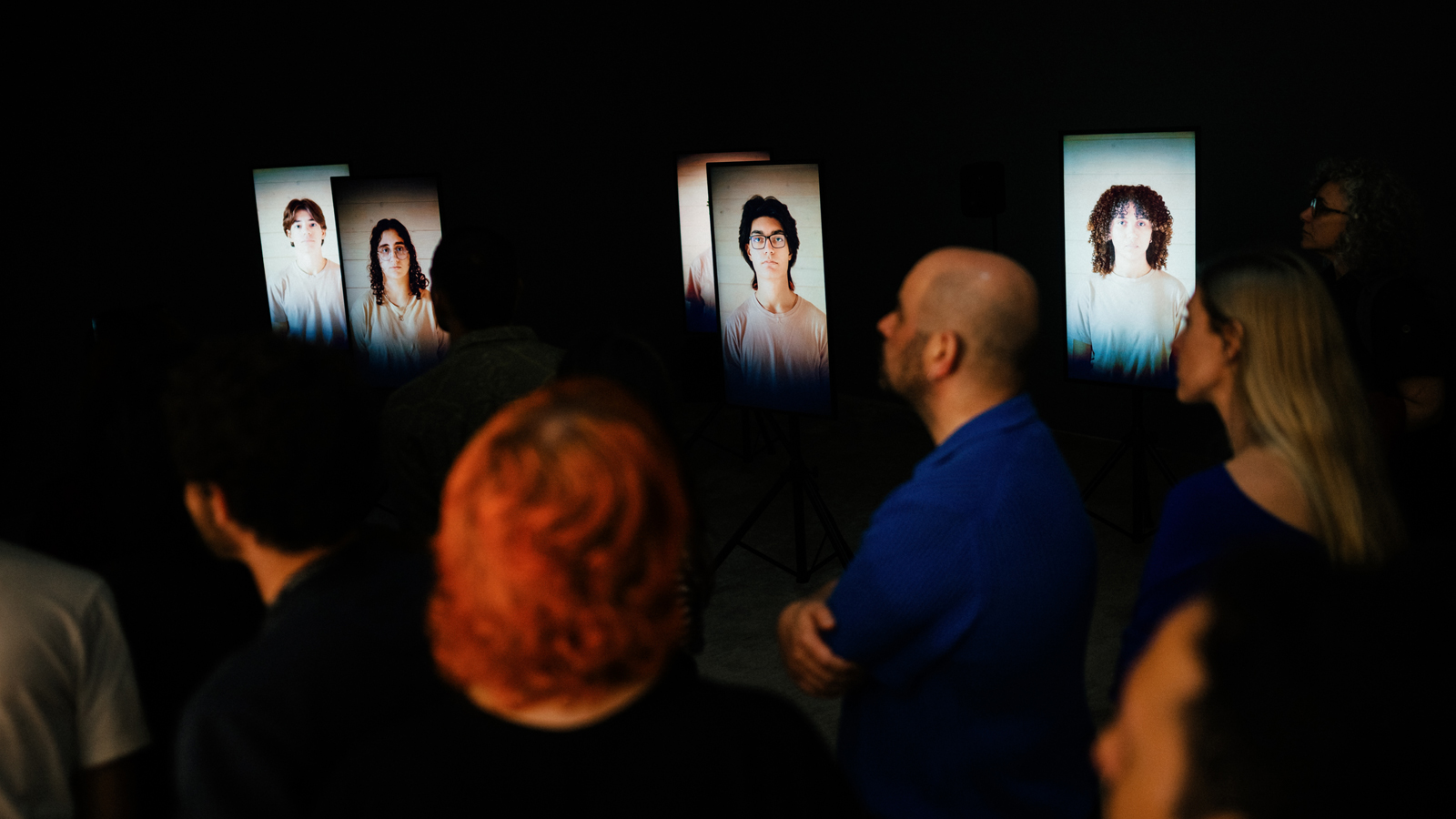
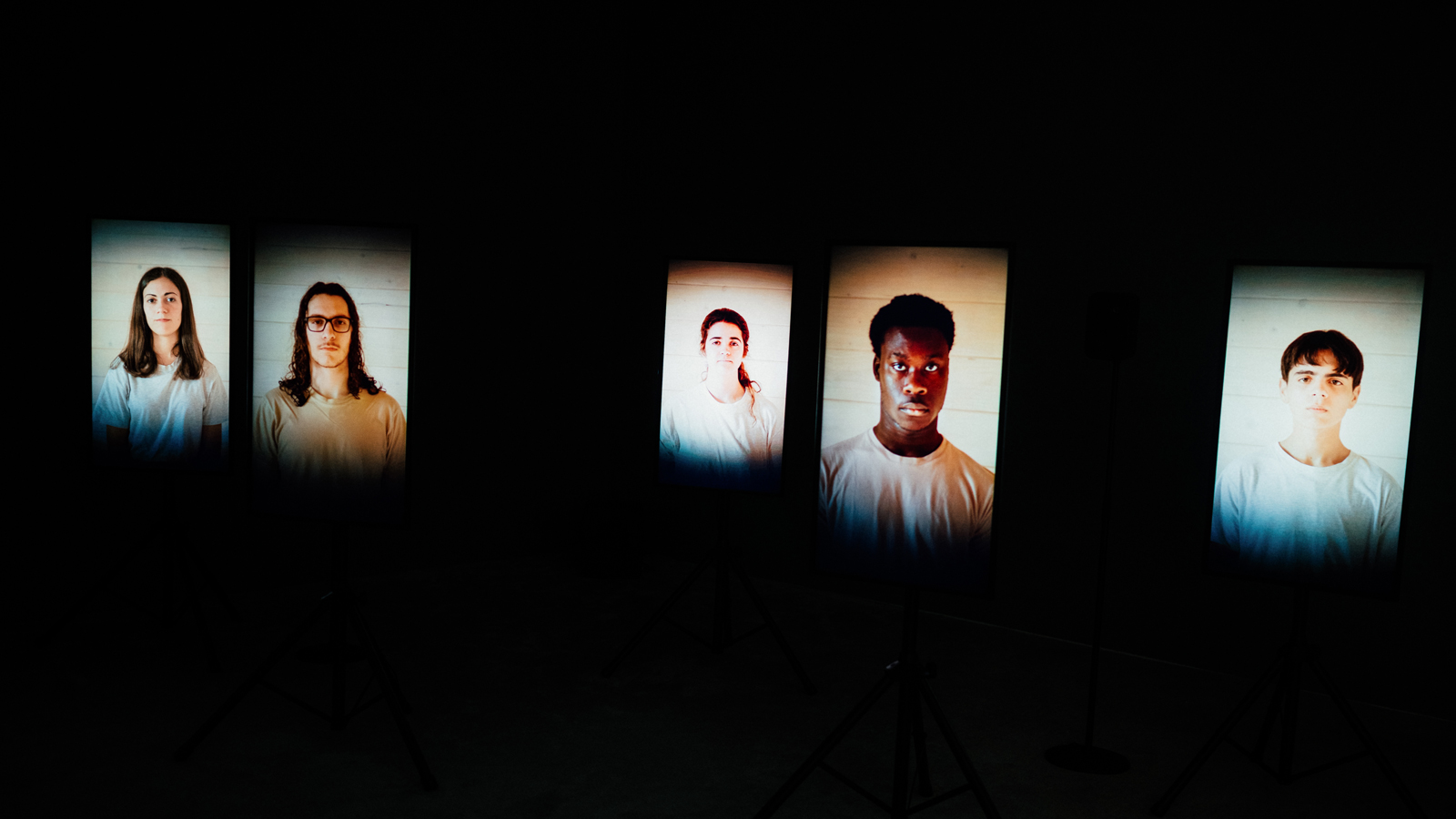
In the installation, the participants are always present through a large projection and five screens, where we see them as individuals or in small groups, they are welcoming the visitor. I find something very moving about seeing their faces, looking at us and asking: ‘What are you doing as a citizen? What are we inheriting from you?’ There is power in the silent gaze, like when animals look at us, it is as if you are being observed. This presence is how they connect with the public.
There are two scenes I would like to mention. One is the spiritual scene, where light breathes with the sound. It was inspired by a film by Krzysztof Kieslowski. Prayers are about sending a positive intention from the present to the future and I wanted to visually communicate this abstract idea. It represents the spirit of the revolution, the intention to continue being free. There is also the idea of the ghosts of the revolution, the people who gave their lives to it and this is reflected in the absence of physical singers in the first two thirds of the performance. We only see the participants at the last minute, alluding to those ghosts and their legacy.
Lastly, I would love to hear more about the repeated phrase ‘We Are Together Because…’ [Estamos Juntos Porque…]. Is this intended as a mantra, a prayer, or perhaps a chorus within a larger piece? Which effect do you hope to create on the public? And will it be ingrained in their minds, almost like hypnosis?
Yes, this is the intention. I have noticed it has already happened with the staff who worked on installing the piece. I caught them singing the songs.
No matter how direct, I know that the general public often feels alienated by contemporary art. This is especially true with video art, which is a comment I often hear. It is our responsibility as artists to reach people – after all, we make work for the public. This piece, I draw on cultural reference points, popular songs, resistance songs and protest songs, that use repetition in a very specific way: to make people remember the message. The goal is that after experiencing the work, something stays with you. Fragments of the melody and the repeated mantra about togetherness remain in the visitor even after leaving the gallery and hopefully affecting the way they face divisive narratives in the world outside the utopian proposal of unity in my exhibition.
You may also like
No results were found for your criteria.