
‘I create my work to be a mirror of ourselves.’
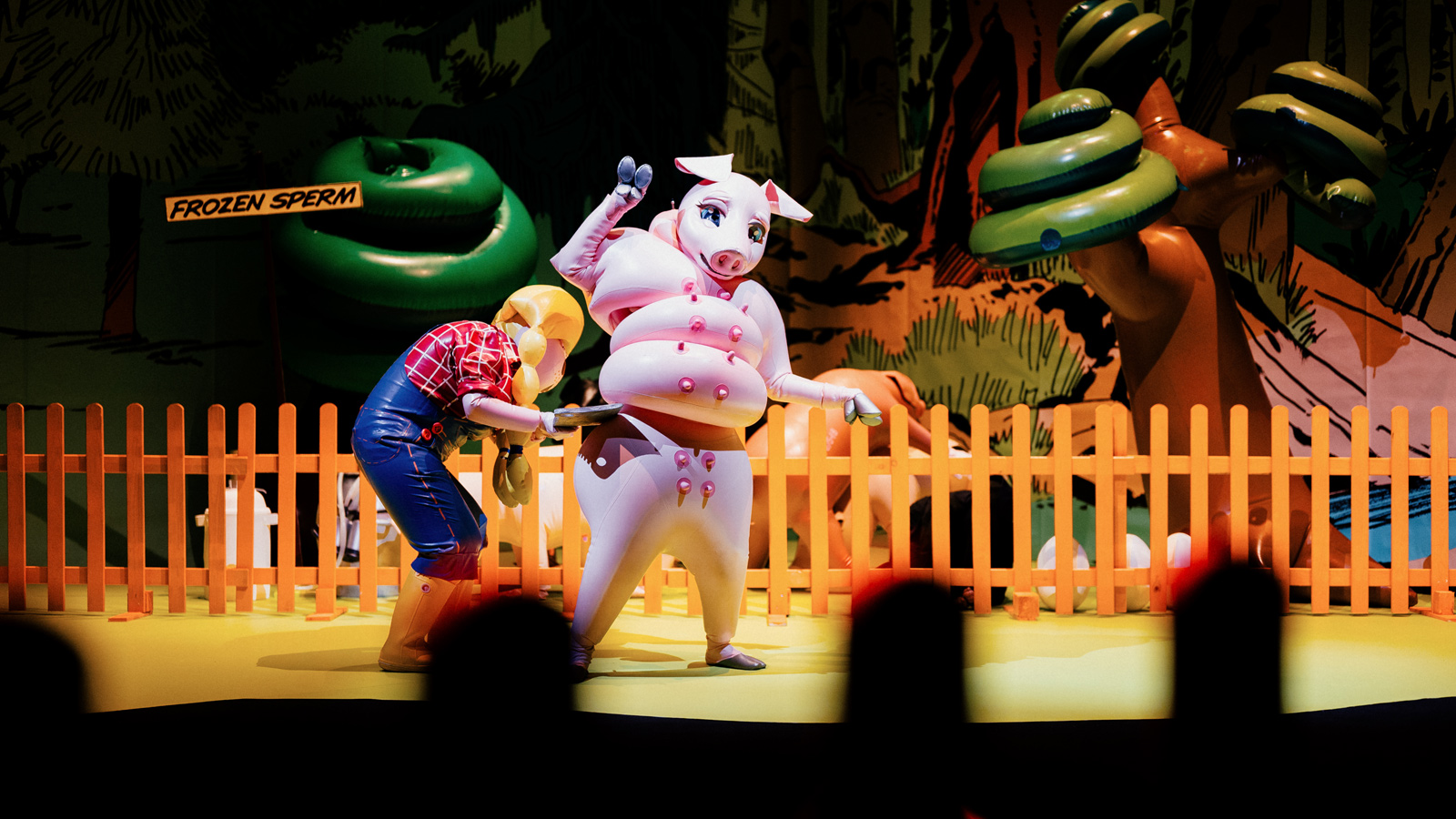
When did you first start incorporating costumes into your performances, and how has their role evolved over time?
The order is actually reversed. I first started making the costumes, before I thought about the structure of the performance.
I started working on the costume as a battle suit to wear to Department-H, a monthly fetish event in Tokyo. At this event, the costume was essential for me to be myself and to embody my fantasy.
I started performing on stage to showcase my fantasies there. Since then, this has always been the place of my presentations. Then I began to be invited to museums and festivals in
For your performances, you create suits as extensions of your skin. What drives you to use these extensions, and do you see this as what defines you as a Saeborg (cyborg)?
I always hated how my role was defined by my own figure, shape and the fact that I was a woman. That was why I wanted a costume that would help me overcome those unpleasant realities and get me high.
At first, I bought and ordered queer fancy fashion and experimented various transformations at Department-H every month. Halfway through, I came to the conclusion that the only way to get what I wanted was to make it myself, and I started making it even though I was quite unskilled.
I am very attracted to latex, a material that you can easily change shapes to transform your body. I think this distorted state of trying to compensate for what you lack is cyborg-like.
In Japan, there used to be a toy called transforming cyborg, which you could also reconfigure by replacing different gadgets. I started to play using my own body.
Performing in latex suits must be physically demanding! What draws you to latex as a material for your work, and how does it affect your experience during a performance, both physically and emotionally?
I am attracted by its plasticity and toy-like texture. This is a dream material.
I also like the high level of synchronisation due to the close contact with my body. Latex makes you either hot or cold when you wear it, and it makes you sweat like crazy. It is inconvenient, but it is not heavy to hear and hygienic because it is washable.
There are many different types of latex costumes. I make mine in an inflatable construction, which is significantly more difficult. Mainly, you are physically restrained. Your body is expanded, so it takes time to get used to it. Because I make my costumes with different combinations of gadgets, I cannot wear them alone. I need someone to help me at all times.
In one of my recent performances, there is a scene where the audience plays caregiver, feeding milk to a newborn piglet. This is a positive way of looking at such inconvenience.
There is only a very short time in a person’s life when they are completely free and independent. Most of the time, from birth to adulthood and before death, people live under someone else’s care. However, this is not a one-way relationship; there are moments when you realise that you are being cared for by caring for others.
I used to think it was an inconvenience not to be able to wear my costume alone, but now I see it as a positive thing.
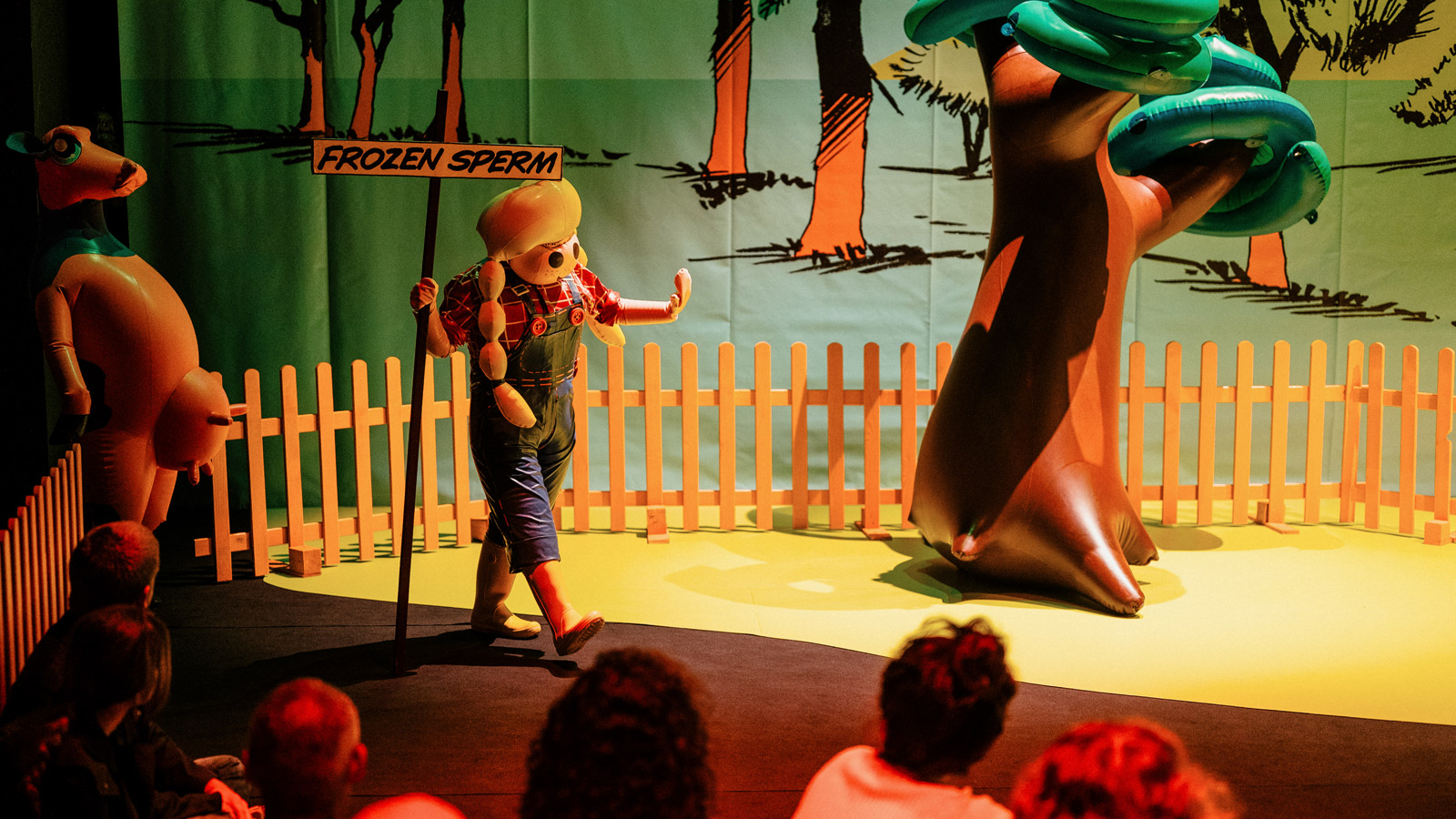
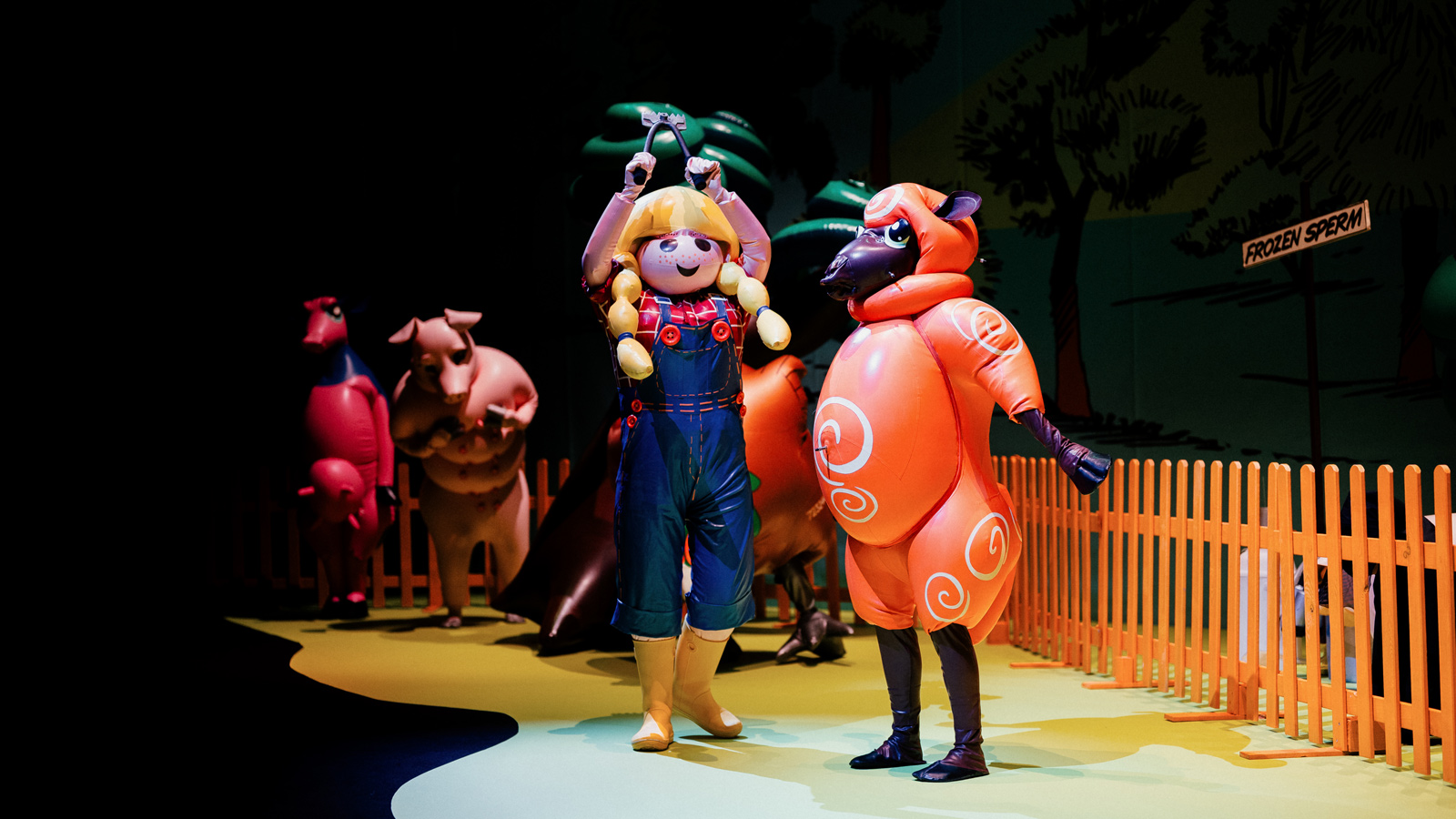
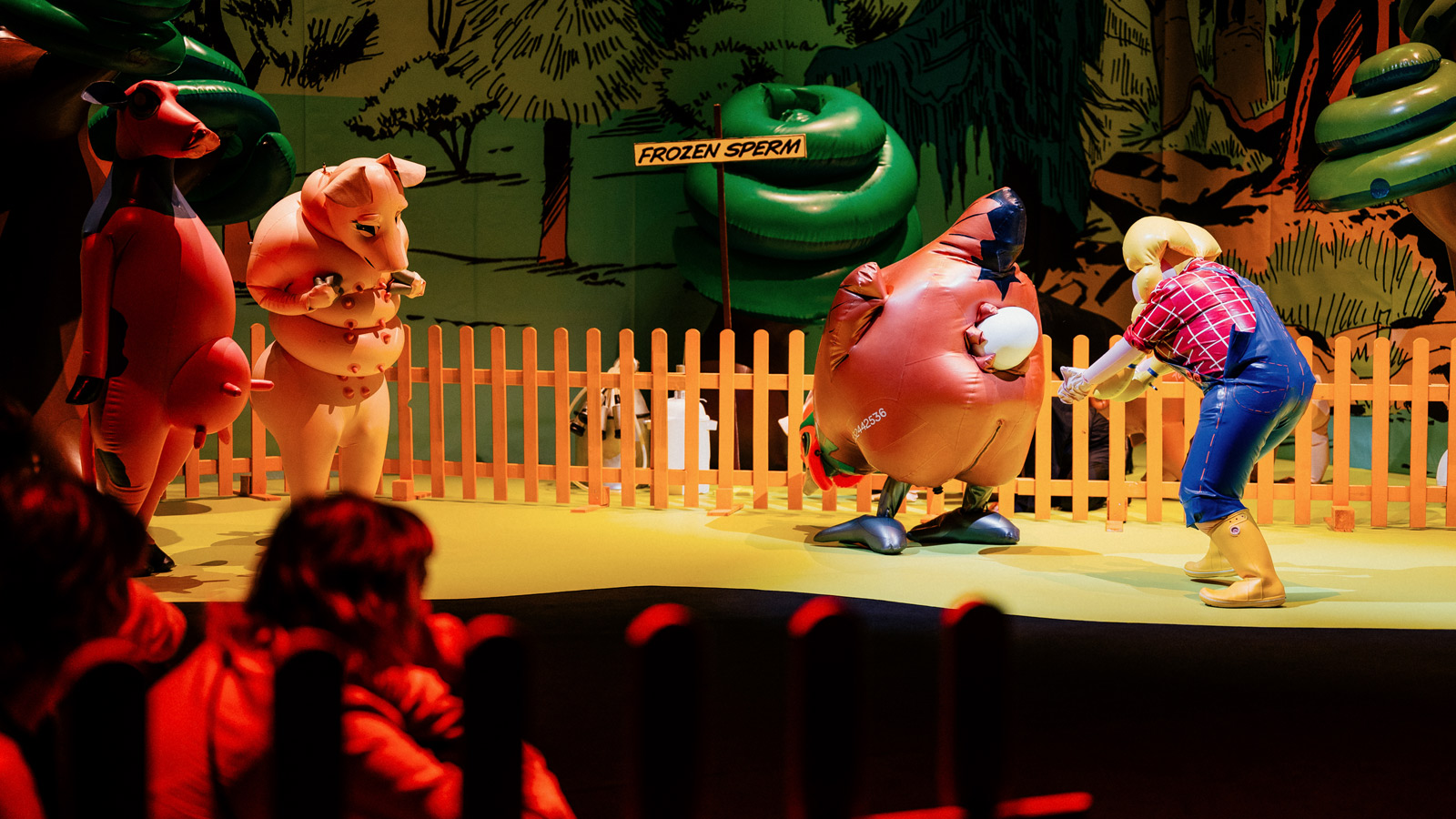
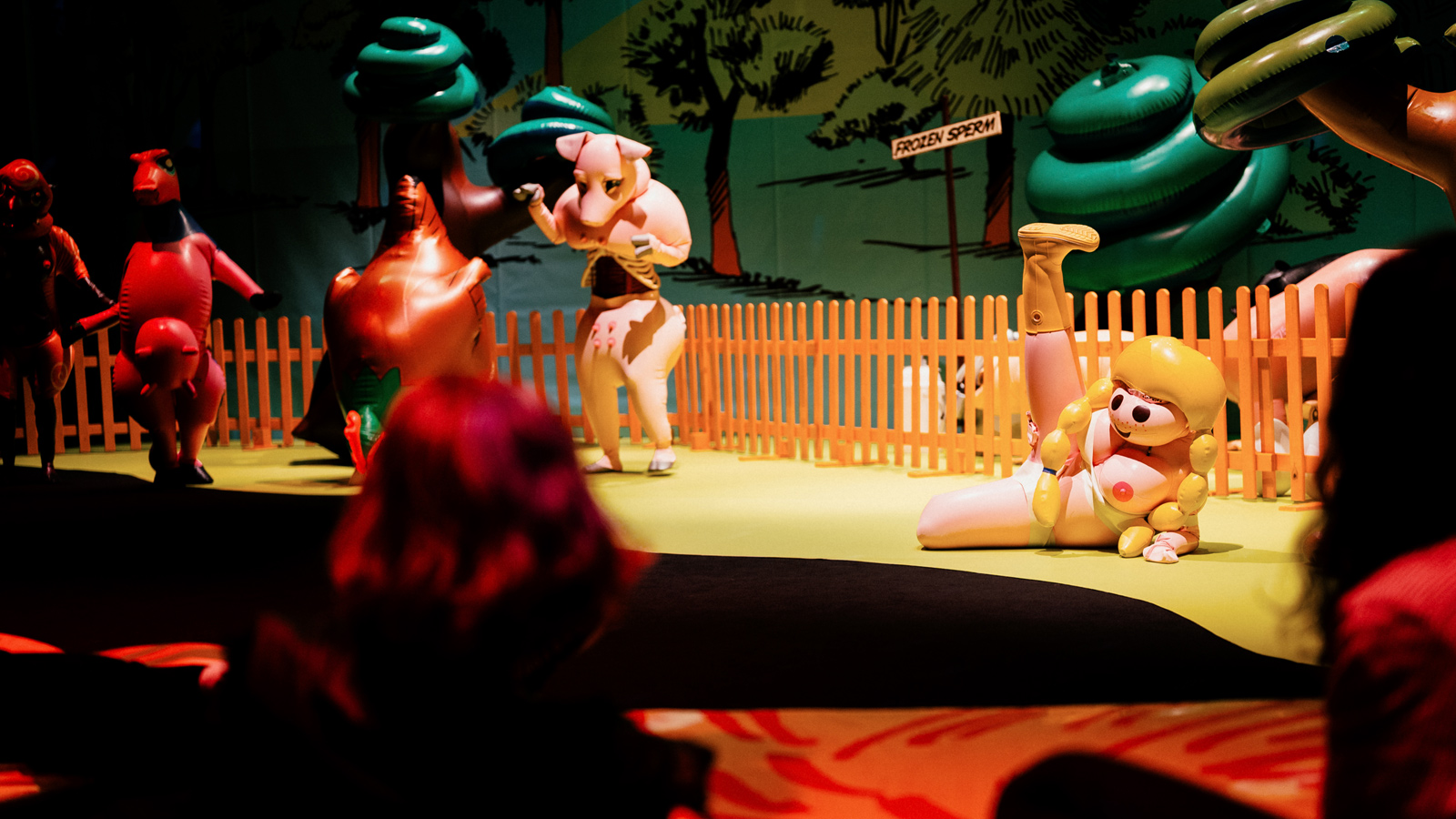
In ‘Slaughterhouse’, you construct an otherworldly dystopian reality. What draws you to dystopias as a narrative tool for your installations and performances?
I always liked reading dystopian science fiction novels, so I was influenced by that. But recently I strongly feel that reality is surpassing fictions. So now I want to experiment with how I can create a utopian reality in my shows.
Your performance explores dense themes like the relationship between humans and animals, the perception of women’s bodies and roles, and larger ideas of exploitation and nature. How do the cute, expressive characters and sets influence the audiences’ understanding of these themes?
I make my characters cute and pop because I think it is crueller, than portraying cruelty as cruelty. Also, my characters do not have lines and they do not say a word. I think this excites people’s imagination more.
I create my work to be a mirror of ourselves. Throughout our long history, humans have been partners with livestock. So I want to look at ourselves through them.
No results were found for your criteria.
The performance ends with a lively dance party where both human and non-human figures join together. Is this a hopeful gesture toward unity, or is there a layer of irony in this excess of joy?
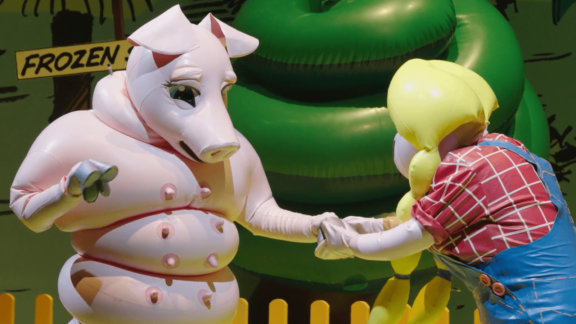
This is related to the fact that I have been involved with Department-H for many years. It is a salon style event and it is important that the participants spend time together. They may be complete strangers to each other or have different political beliefs, but they are in the same place together, if only for a brief moment.
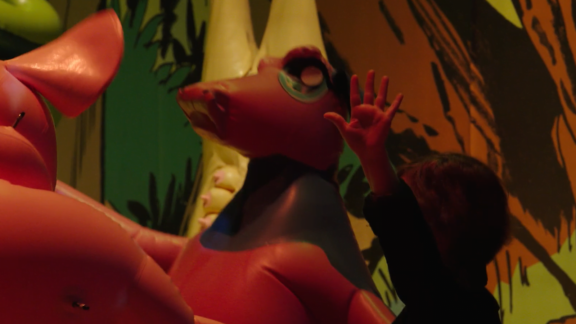
You do not normally get to experience dancing with pigs, which makes it even more special. However, spending time together is more important than dancing. Communication can be so modest, but even high-fiving, patting or looking at each other with livestock characters would, I think, stir up your inner emotions.
No results were found for your criteria.
Do you think audiences see themselves reflected in the figures and world you create, or do they perceive it as a separate reality that exists only within the performance?
Hopefully, the audience would experience a transformation or a rebirth by reconsidering their relationship with the livestock characters.
My works are often described as nightmarish, but I believe that your dream will never change unless you change the reality. In that sense, I think that they are somehow connected to reality.
In Japan, cosplay and character transformation are part of the mainstream culture, especially through manga and anime. However, you create entirely original characters. How have these been received in your home country?
In Japan, both original cosplay and cosplay of existing characters exist. Both embody one’s own fantasy. But I do not think it is as widespread as the Halloween cosplay culture in western countries.
I also love fan fiction culture very much, but I thought it would give me a lot more freedom to work with my original designs.
Having said that, I am of course inspired by many different designs. Whenever I advertise to look for performers, I see that it gets a lot of shares and attention, much more than when I announce my shows. It seems that people are more interested in the opportunity for transformation than in seeing my shows. Maybe everyone wants to be an animal.
You’ve performed internationally – have you noticed any significant differences in how audiences in different countries respond to your work?
If I were to venture to say what the difference is to Japan, I suppose it would be the presence or absence of the culture of eye contact.
In the West, people use eye contact to confirm when they want to get close to someone. In Japan, people often judge that they are allowed to do something if other Japanese people are doing it. So there are no signals to move closer. In other words, there are many situations where personal agreements are not possible.
This seems to be related to the fact that in Japan, compared to the West, there are not many opportunities to contact with people from completely different cultures. We are used to interacting with people with similar values and cultures, and the communication method of confirming or greeting in order to avoid misunderstandings does not seem to be so common.
Also, more than the audience response, I feel that there is a huge difference in the individual body shape of the performers.
All the costumes are made to my size, so one of the conditions of recruitment is to be of a similar size to me. However, even though we are the same height, we have very different bone structures. They often have a higher waist and a smaller head, and in general they are curvier than me. For example, the head of a Western person is narrow at the front but long at the back, while the head of a Japanese person is longer. I am reminded of the fact that I come from a flat-faced race.
It also explains Giger’s design of the Aliens. Their heads are designed like a penis as a symbol of aggression, but their head grows long in the back. A Japanese person would not put it into that kind of design. It would stretch upwards, like Ultraman.
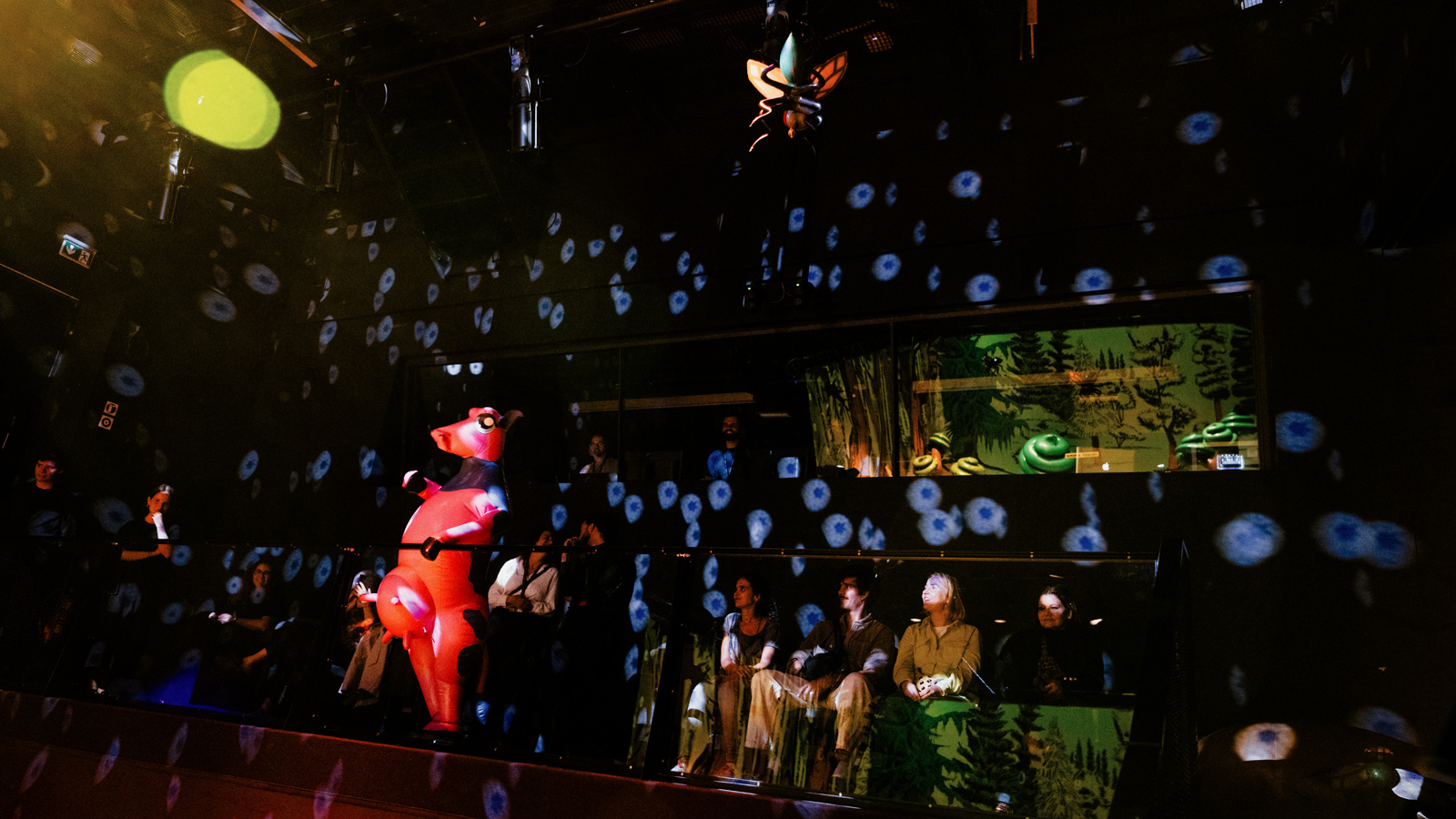
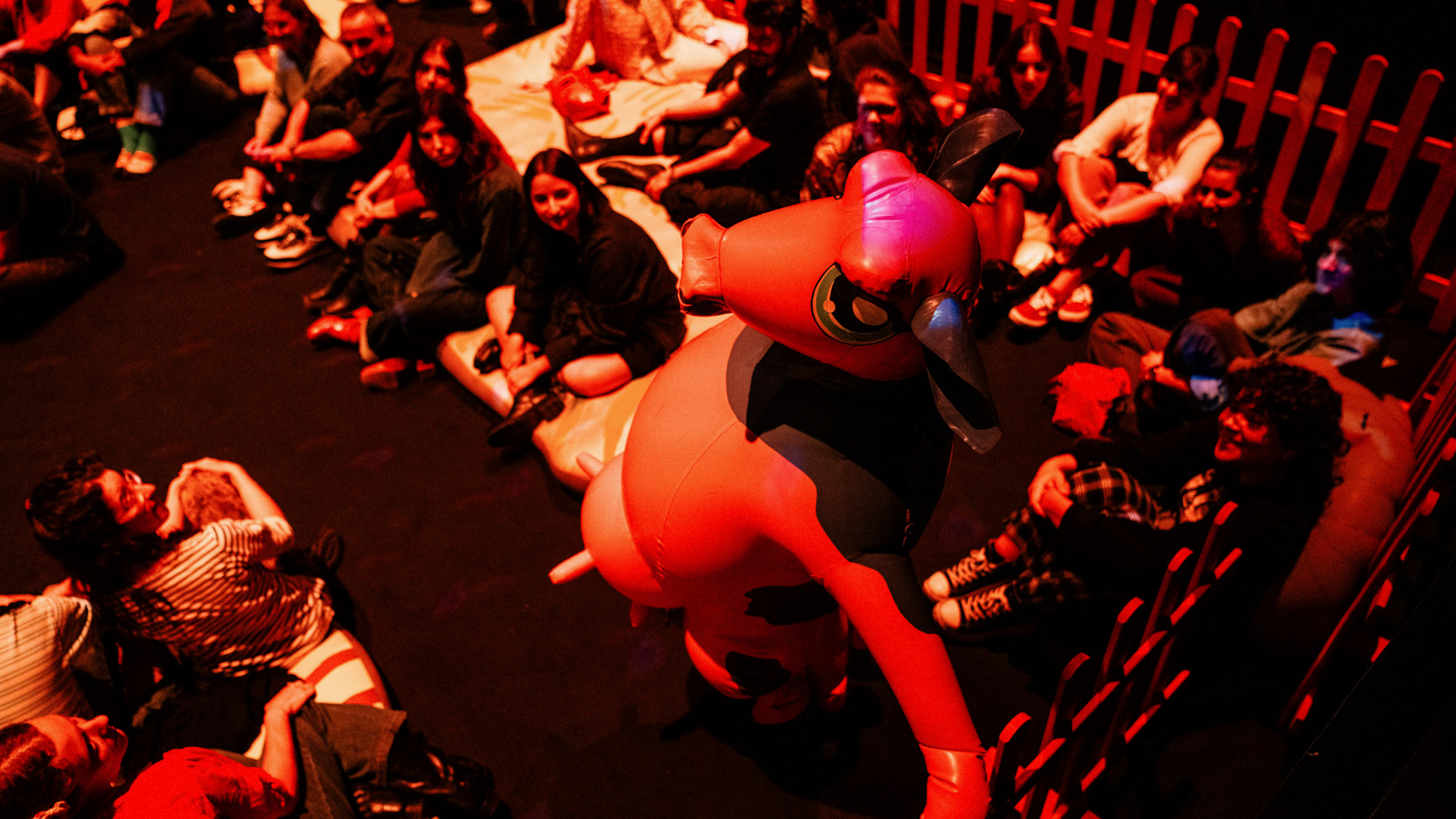
What was the reception like when you performed in Lisbon?
Everyone seemed very relaxed. This time we prepared straw mats and perhaps they helped them to feel comfortable and get assimilated with the mat. So we decided to adjust the communication method for the livestock characters would go around the seats to interact as if they were lounging.
The audiences in Lisbon were difficult to grasp, as they appeared shy but were actually bold, or laid back but actually had something on their mind. This may have something to do with the fact that Lisbon is a city of different ethnicities and a place for everyone.
Portugal, being at the very end of Europe, evokes a tremendous image and its overwhelmingly beautiful lights were very impressive. The city and the sea seem to be in a halation of light. Many times, I experienced the feeling of being enveloped by the light and becoming one with it.
And as represented by Fado, I had imagined to have some nostalgic feelings, but mixed with many tourists, including myself, I felt a chaotic energy.
This time, CAM featured many Japanese artists and I was able to come to Lisbon thanks to that.
In Japan, dishes that came from Portugal a long time ago are still popular and Portuguese food is delicious and preferred by Japanese.
This tour has made me feel close to Portugal and I like the place very much. I sincerely hope that I will be able to come back to Lisbon, a city full of light that could swallow everything.
Engawa
Explore the series

No results were found for your criteria.
You may also like
No results were found for your criteria.