

Hanami
Talk with Denise Fernandes and Binete Undonque
Event Slider
Date
- 20:00 / Cancelled 20:00 / Sold out 20:00 – 22:15
Location
Studio Centro de Arte Moderna Gulbenkian
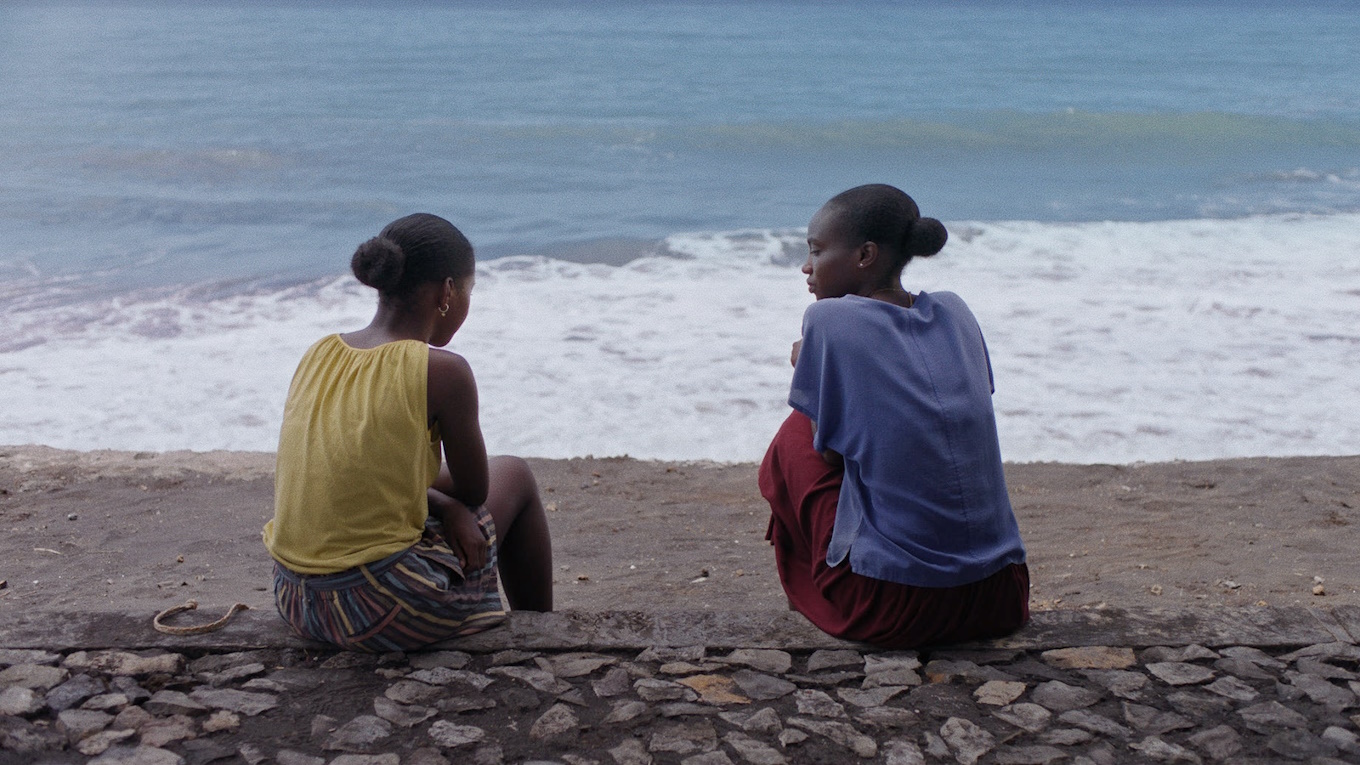
The fiction feature Hanami, filmed on the Fogo island, closes the ‘Re/surgir’ film cycle, which brings a selection of three commented films to the Summer Garden. This will be followed by a talk with director Denise Fernandes and actress Binete Undonque.
Hanami marks Cape Verde’s independence day on 5 July. The first and already award-winning feature film by Cape-Verdean director Denise Fernandes has the Fogo island as the character-matter of her dreams and Nana, in her childhood and adolescence, as the guiding thread of her feet in that land from which she never leaves.
‘Inside us, broken pieces are glued together with gold”: is it really that simple to use the kintsugi technique to bring a broken piece back to life? And why do so many break? A conversation with Denise Fernandes, the film’s director, and Binete Undonque, an actress and film student, will help you contemplate this beautifully photographed fiction.
Film synopsis
On a remote volcanic island, where everyone wants to leave, little Nana learns to stay. Her mother, Nia, who suffers from a mysterious illness, left soon after she was born. When Nana starts running high fevers, she is sent to the foot of a volcano to be cured. There, she finds a world suspended between dreams and reality. Years later, when Nana is a teenager, Nia returns.
Hanami was filmed entirely on Fogo, one of the ten islands of the Cape Verde archipelago. The cast is made up mostly of non-actors, in their first experience of cinema. Daílma Mendes and Sanaya Andrade play Nana as a child and Nana as a teenager. The film also features French-Cape Verdean actress Alice da Luz in the role of Nia and Japanese actor Yuta Nakano in the role of Kenjiro. Hanami is one of the rare fiction feature films shot in Cape Verde and one of the first by a female director of Cape Verdean origin.
'Re/surgir' film cycle
The hustle and bustle of the neighbourhoods on the outskirts of Lisbon, the frenzy of a culture on the rise in the 1980s, the imminent upheaval of a story in a land that is shaking: the ‘Re/surgir’ [Re/emerge] film series features three films that give rise to conversations that don't leave the present day behind. Themes that keep resurfacing and are worth looking at through the cinema.
From the ghettos of Greater Lisbon at the end of the 1990s, in the first session with Outros Bairros [Other Neighbourhoods], we go back in time to the South Bronx where the fictional Beat Street faithfully portrays the emergence of Hip Hop culture. And finally, in the third session, we follow in Hanami the story and growth of Nana on the magical island of Fogo in Cape Verde.
Summer Garden 2025
This event is part of Summer Garden 2025, a free admission festival with concerts, DJ sets, talks, films and dance. Learn more
Biographies
-
Denise Fernandes
Denise Fernandes (1990) was born in Lisbon to Cape Verdean parents and grew up in Switzerland. Her latest short film, Nha Mila (2020), was presented at the Locarno Film Festival in the Pardi di Domani section. Nha Mila was a finalist in the European Film Awards 2020 and has been shown at more than 40 international film festivals. It was nominated for Best Short Film at the Sophia Awards 2021 and invited by MoMA and Lincoln Center in New York to the New Directors/New Films festival. Hanami, filmed in Cape Verde, is her first feature film.
-
Binete Undonque
Binete Undonque is a Portuguese-Guinean actress who moves between Guinea-Bissau, Portugal and the United Kingdom. She trained in acting at the Escola Profissional de Teatro de Cascais (Portugal) and at the Giles Foreman Centre for Acting School (England). Her experience as an actress has been strongly marked by both theatre and cinema. In theatre, she developed her practice with illustrious directors such as Rogério de Carvalho. She has received several awards. She is currently studying film at the School of Arts and Creative Industries at London South Bank University in England.
Credits
Director
Denise Fernandes
Screenplay
Denise Fernandes, Telmo Churro
Production
Eugenia Mumenthaler, David Epiney, Luís Urbano, Sandro Aguilar
Photography
Alana Mejía González
Duration
96 minutes
Genre
Drama
The Calouste Gulbenkian Foundation reserves the right to collect and keep records of images, sounds and voice for the diffusion and preservation of the memory of its cultural and artistic activity. For further information, please contact us through the Information Request form.
Related













No results were found for your criteria.