

Artistic Practices in Prisons
Event Slider
Date
- 10:00 / Cancelled 10:00 / Sold out Monday, 10:00
Location
Auditorium 3 Calouste Gulbenkian Foundation
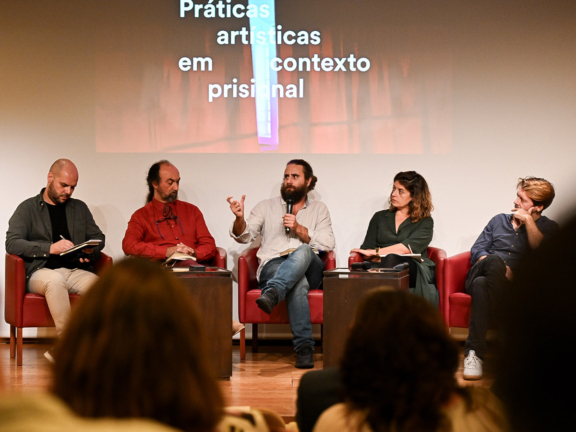
Artistic Practices in Prisons reflects on the role of artistic projects carried out with people who are incarcerated.
This conference brings together artists, project participants and representatives from prisons to share their experiences and perspectives on the impact and future possibilities of these practices.
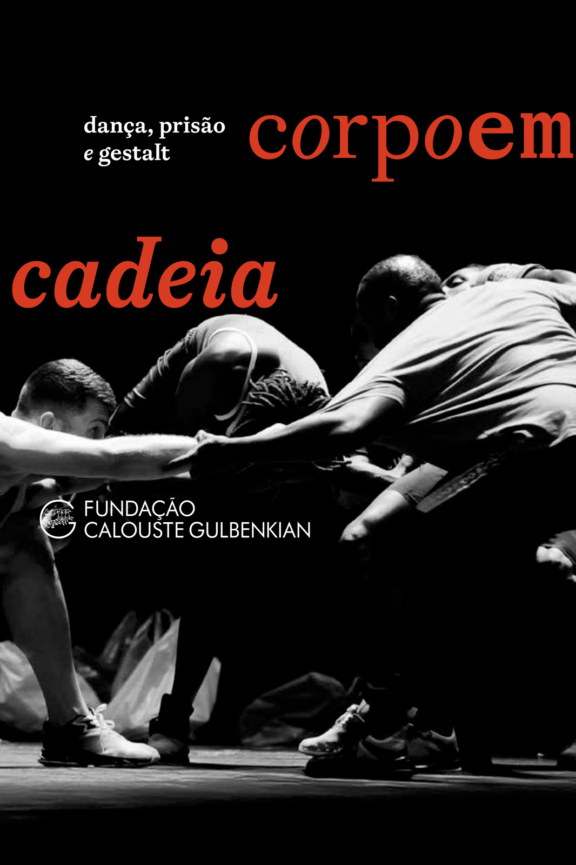
On the first day, the programme includes talks focused on the challenges, learnings and potential of these initiatives, and the of the book corpoemcadeia: dança, prisão e gestalt by Catarina Câmara, based on the project implemented at Linhó Prison.
Day two of the conference includes three workshops for artists who are already carrying out or who intend to carry out projects in prisons. The aim of these sessions is to share methodologies and processes, encouraging exchange between peers.
Over the past decade, the Calouste Gulbenkian Foundation has supported artistic projects implemented in prisons, recognising their importance in empowering and facilitating the social reintegration of people who are incarcerated. The conference, hosted in partnership with Acesso Cultura, aims to contribute to the sustained implementation of these practices to build a more humanised and qualified prison system.
The event will be held in Portuguese with interpretation in Portuguese Sign Language. It will be livestreamed and will be available on this page.
Learn more
Photo © Susana Paiva
Publications
Speakers
-
Acesso Cultura
Acesso Cultura was founded in 2013. It is a non-profit cultural association that brings together cultural professionals and cultural organisations with the mission of promoting physical, social and intellectual access to cultural participation. Its vision is to contribute to the construction of a curious and inclusive society in which anyone can dream, have opportunities to participate and be the best they can be.
-
Avelina Macedo
Born in Caracas, worked at Teatro Experimental do Funchal for nearly 24 years. She has also worked with Teatro Feiticeiro do Norte and the Baltazar Dias Municipal Theatre. Avelina has written theatre scripts, and works as a stage director, stage manager, light, sound and video operator, producer, actress and writer. She is the president of Associação Cenas&Limitadas and co-founder of Mac-Parker productions. She started her career in theatre by participating in a project at the Funchal Prison, called “Experimentar Sentir”.
-
Catarina Câmara
Dancer, choreographer, social activist and a collaborative researcher at the Institute of Criminal Law and Criminal Sciences (FDUL). She holds a bachelor’s degree in Law (FDUL) and Dance (ESD-IPL) and is a Gestalt Psychotherapy counsellor, trained at the Gestalt Institute of Florence. Her work explores the dialogue between artistic practices, social reintegration and criminal law, cutting across the fields of dance, Gestalt and restorative justice. She is the Artistic and Social Coordinator of corpoemcadeia, a project implemented since 2019 at the Linhó Prison and supported by the Calouste Gulbenkian Foundation.
-
Catarina Claro
Cultural and artistic mediator who works in the field of art education. Her projects cover and cut across a wide range of disciplines, and she is particularly interested in exploring the links between creativity and critical thinking, the visual arts, theatre and literature. In 2016, she founded the cultural association Casa Invisível and headed to the island of Madeira. In 2022, she conceived and implemented the project Trégua at the Funchal Prison, of which she is the Executive Director. Trégua is currently being supported by the Calouste Gulbenkian and ‘la Caixa’ Foundations under the initiative PARTIS & Art for Change.
-
Cristina Casalinho
Cristina has a degree in Economics and an MBA in Corporate Management and Business. She took up the position of executive director on the Foundation’s Board of Trustees on February 2024, having held non-executive positions between July 2022 and January 2024. Previously, she chaired the Board of Directors of the Treasury and Public Debt Management Agency (IGCP, E.P.E), having also been a member of its Board of Directors. She has also held the positions of Chief Economist at Banco BPI, as well as Director of Sustainability at the same institution.
-
Filipa Francisco
Choreographer, performer and the current Artistic Director of the association Mundo em Reboliço. Her work includes “Bicho” (2009), with Idoia Zabaleta, “Íman” (2009), with Wonderfull’s Kova M, “Força” (2015), with Companhia Maior, and “saal” (2018), as part of the Artéria network. Filipa implemented the Rexistir (Re-exist) Project with inmates from the Castelo Branco Prison (CENTA, 2000-2006) and was a guest artist in the Reinserção pela Arte (Reintegration through Art) project promoted by the Calouste Gulbenkian Foundation (2007).
-
Francisca Van Dunem
A lawyer, Francisca graduated in law and joined the Public Prosecutor’s Office in 1979, where she built a distinguished career. She was a member of the Attorney General’s Office (1999-2001), director of the Lisbon Department of Criminal Investigation and Prosecution (2001-2007), the District Attorney General of Lisbon (2007-2015), Minister of Justice (2015-2019) and Minister of Internal Affairs (2019-2022).
-
Joana Pedra
Joana has a degree in Social Work. She served in the Portuguese Air Force for seven years.
In 2016, she joined the Senior Technician Career through Casa Pia de Lisboa, where she worked in shelters as an educator and a social worker for 5 years. In 2021, she joined the DGRSP as a Senior Re-education Technician, where she has been working in the Sentence Monitoring and Enforcement Services, Prison Treatment and Preparation for Release. It is in the context of activity management that she has been monitoring the Corpoemcadeia project since that date. -
Luís Vaz Couto
With a degree in Social Work, Luís Vaz Couto began his career in 1983 as a senior social worker. He has been the Director of Guarda Prison since 2012. Among other positions, Luís was Deputy Director-General of the Directorate-General for Social Reintegration and of the Directorate-General for Reintegration and Prison Services, and Vice-President of the Institute for Social Reintegration. Since 2019, he has been President of the Association of Prison Directors and Deputies, and is also a university lecturer, trainer and speaker.
-
Maria João Mota
Maria João holds a postgraduate degree in Human Rights and Democracy and in Theatre as an Intervention Tool in Socio-Educational Contexts. She is co-founder of PELE and of Núcleo de Teatro do Oprimido do Porto, where she has been the Artistic Director and Coordinator of National and International Projects since 2007. Maria João focuses her work on continued action and reflection in the field of Community Art Practices. Since 2009, PELE has been carrying out ongoing work in prisons in the Greater Porto region, including ECOAR project, supported by the Calouste Gulbenkian Foundation.
-
Mónica Guerreiro
Mónica holds a bachelor’s degree in Communication Sciences, with a specialisation in Arts, and a postgraduate degree in Emerging Cultures and Discourses (FCSH-UNL). A journalist and critic, she published regularly in the relevant trade press between 1996 and 2010. She is the author of the biography Olga Roriz, the monograph O Essencial sobre a Companhia Nacional de Bailado and the handbook Manual para um Recrutamento Inclusivo. Mónica carried out functions at the Directorate-General for the Arts, the Municipal Directorate for Culture of the Municipality of Porto, and on the Board of the Coliseu do Porto Ageas. She is currently Artistic Director of Ponto C – Cultura e Criatividade in Penafiel.
-
Orlando Carvalho
Orlando Carvalho is the Director-General of Reintegration and Prison Services. Before taking up his new position in 2024, he was Director of Coimbra Prison and Re-education Advisor at the Directorate-General for Prison Services. Throughout his career, he has held management positions in several prisons, such as Vale de Judeus and Aveiro, having started his career in the prison system as a senior re-education technician in 1990. Previously, he worked as a social services technician in institutions such as Santa Casa da Misericórdia de Aveiro and Segurança Social do Funchal.
-
Óscar Silva
Creator, director and actor. He graduated in Theatre (ESTC), attended the Postgraduate Performance programme (ECA-USP), and completed his Masters in Performance and Practice (UAL). Between 2010 and 2014 Óscar lived and worked in São Paulo where he was assistant director of SP Escola de Teatro and led several educational and artistic projects. He participated in École des Maîtres 2017. Óscar is currently the Artistic Director of Terceira Pessoa, where he has been co-directing the RadioATIVIDADE project at Guarda Prison since 2022, supported by the Calouste Gulbenkian and ‘la Caixa’ Foundations under the initiative PARTIS & Art for Change.
-
Paulo Lameiro
Musicologist and educator. After a brief career as a baritone, he dedicated himself to teaching and took over the administration of different music schools, including the Lisbon National Conservatory, and the SAMP Arts School in Pousos. He has been developing educational and artistic projects in early childhood and community art projects. He was Artistic Director of Ópera na Prisão until 2024, a project implemented since 2014 with young inmates at the Leiria Prison and supported by the Calouste Gulbenkian Foundation under the initiatives PARTIS and PARTIS & Art for Change. Paulo has directed projects in prisons in Catalonia and Luxembourg and is the Artistic Director of Musicalmente.
-
Pedro Gil
He acts, writes, stages, researches and produces. He co-manages the theatre company Razões Pessoais, where he has directed over a dozen plays. As an actor he has worked with companies such as Artistas Unidos, mala voadora and O Bando, and with creators such as Miguel Castro Caldas, Francisco Salgado, Jean-Paul Buchieri, Mónica Calle, Tiago Rodrigues, Rui Horta and Tonan Quito. Pedro began his work in prisons in 2002 at Lisbon Prison. In 2023, he took part in the corpoemcadeia project, implemented at the Linhó Prison. In 2024, he began implementing the República do Vento (Republic of Wind) theatre project at Montijo Prison.
-
Ricardo Loureiro
Ricardo is a sociologist. He is currently a senior technician at the Commission for Citizenship and Gender Equality (CIG), and a researcher at the European Prisons Observatory. Since 2007 he has worked in NGOs, public administration and academia focusing on human rights, gender equality and non-discrimination, prisons, violence, social and community intervention, and vocational training. Ricardo was the social manager of the Lado P project, implemented in the Caxias Prison and funded by the Calouste Gulbenkian. He has been involved in prison-related issues in Portugal since 2009 and is currently a member of social reintegration association CONFIAR.
-
Susana Paiva
Creator, curator, editor, educator, performer and producer of visual arts projects and events. Since 2012, Susana has been the coordinator of the Escola Informal de Fotografia do Espetáculo (Informal School of Performance Photography) project, a long-term educational project for creators in the field of photography.
Between 2019 and 2023, Susana was coordinator of the photography team of the corpoemcadeia project, by Companhia Olga Roriz, a PARTIS/FCGulbenkian initiative. She is currently attending Forum Dança’s 33rd edition of the course in management/production of performing arts (CGPAE).
-
Vanessa Ribeiro Rodrigues
Documentary film director, university lecturer, freelance journalist, researcher at CICANT and media literacy educator. With a PhD in Communication Studies for Development, she has focused on creating narratives about social issues, ecofeminism (“As Guardiãs de Sementes” [The Seed Guardians], 2025) and memory (“Baptismo de Terra” [Baptism of Earth], 2017). “O Feitiço de Areia” (The Spell of Sand), her upcoming feature film, questions what to do with so many silences in the colonial memory in Mozambique. As a journalist, Vanessa has written for The Guardian Visão, Público, Expresso and DN, and radio station TSF. She is the author of the book Ala Feminina about incarcerated women in Brazil and Portugal.
Programme
10:00 / Opening session
IMPACTS, CHALLENGES AND POTENCIAL
10:20 / Talk
— Break 15 min. —11:30 / Painel
Moderation
— Lunch Break 90 min. —14:30 / Artistic projects: learnings and aspirations
Moderation
— Break 30 min. —16:30 / corpoemcadeia: practices beyond good and evil
Presentation of the publication corpoemcadeia: dança, prisão e gestalt (Body in chains: dance, prison and gestalt), by Catarina Câmara. The book is based on the experience of corpoemcadeia, an artistic project that combines dance with Gestalt psychotherapy, implemented at the Linhó Prison between 2019 and 2022.
Moderation
18:00 / Closing
Partner

The Calouste Gulbenkian Foundation reserves the right to collect and keep records of images, sounds and voice for the diffusion and preservation of the memory of its cultural and artistic activity. For further information, please contact us through the Information Request form.
Related

No results were found for your criteria.
Read, Watch, Listen
No results were found for your criteria.