
“Ode à amizade”
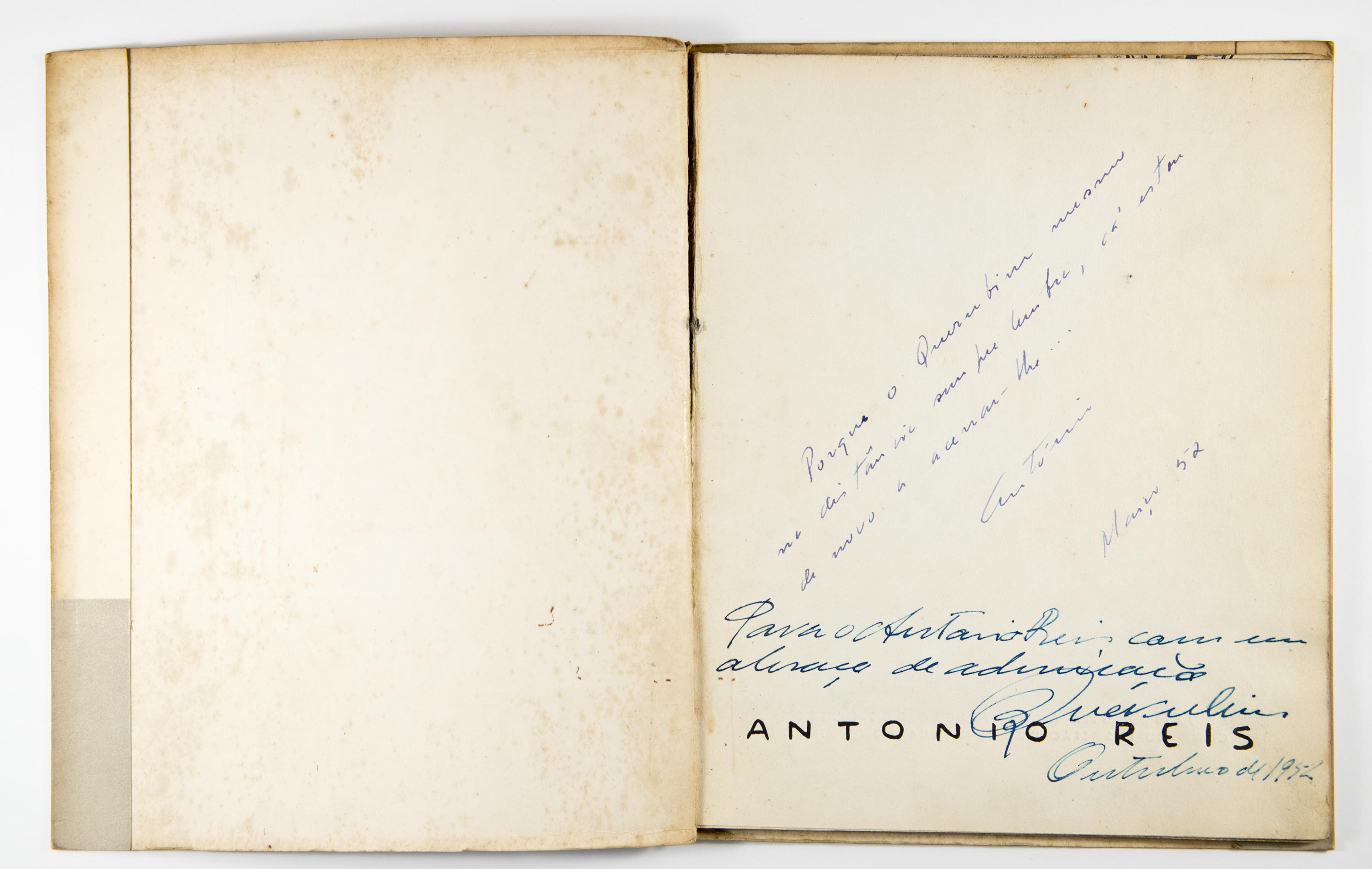
When António Reis (1927-1991) wrote this dedication, Querubim Lapa had returned to living in Lisbon, after a brief but fruitful stay in the city of Porto, where he lived between September 1949 and October of the following year.
“Because Querubim, even at a distance, always remembers, here I am once again waving to him…!”
— António Reis, March 1952
The friendship of which this book is an admirable testimony dates precisely from the period when Lapa moved to Porto to attend the sculpture course at the School of Fine Arts. During this little more than a year, the artist took part in literary and artistic gatherings, socialised with fellow students and other artists – among them Fernando Lanhas and Júlio Resende – and established close bonds of friendship with António Reis.
This friendship did not succumb to the physical separation imposed by the distance between Porto and Lisbon, but instead continued to flourish, sustained by regular correspondence.
At that time, cinema was not yet António Reis’s primary occupation. He earned his living working in the offices of Vista Alegre, in Gaia, where he resided, while simultaneously writing poetry and contributing to newspapers and magazines.
If Reis was, until relatively recently, an almost unknown poet, the same cannot be said of his activity as a filmmaker, which began when he worked as an assistant to Manoel de Oliveira on Acto da Primavera (1962). He directed his first documentary in 1963 and, together with his wife, Margarida Cordeiro, became the author of some of the most significant films of what came to be known as the New Portuguese Cinema, such as Jaime (1974), Trás-os-Montes (1976), Ana (1985) and Rosa de Areia (1989).
Written in 1952, like the other poetry books published before 1957, Ode à amizade is rarely mentioned in studies of the filmmaker’s poetic work. As several authors have noted, the person responsible for this near-omission was Reis himself: “There had already been other books before Poemas quotidianos, but the difference of these – their radical clarity, the prodigy of their concision – led the poet to erase from his bibliography everything that had come before.”[i]
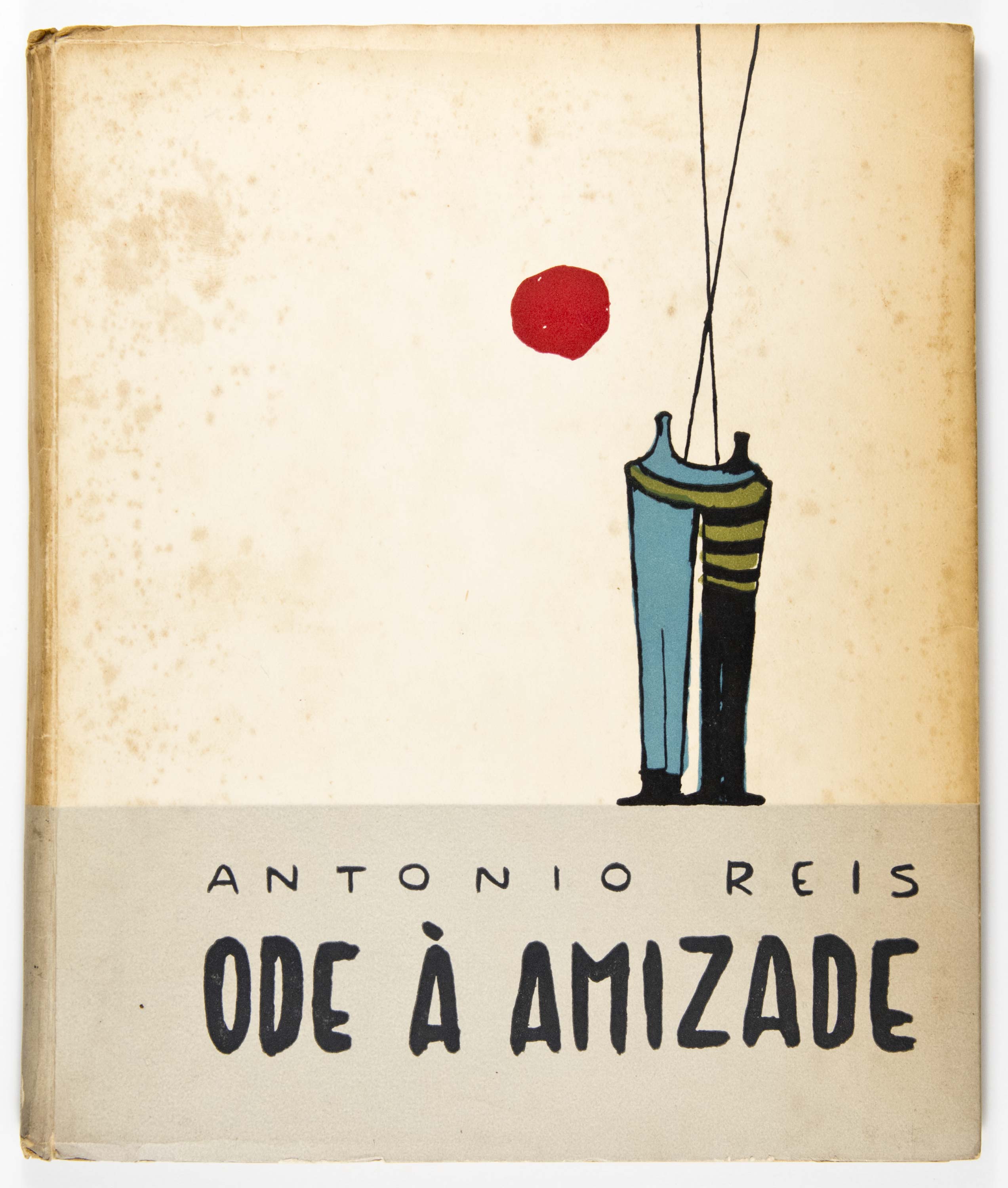
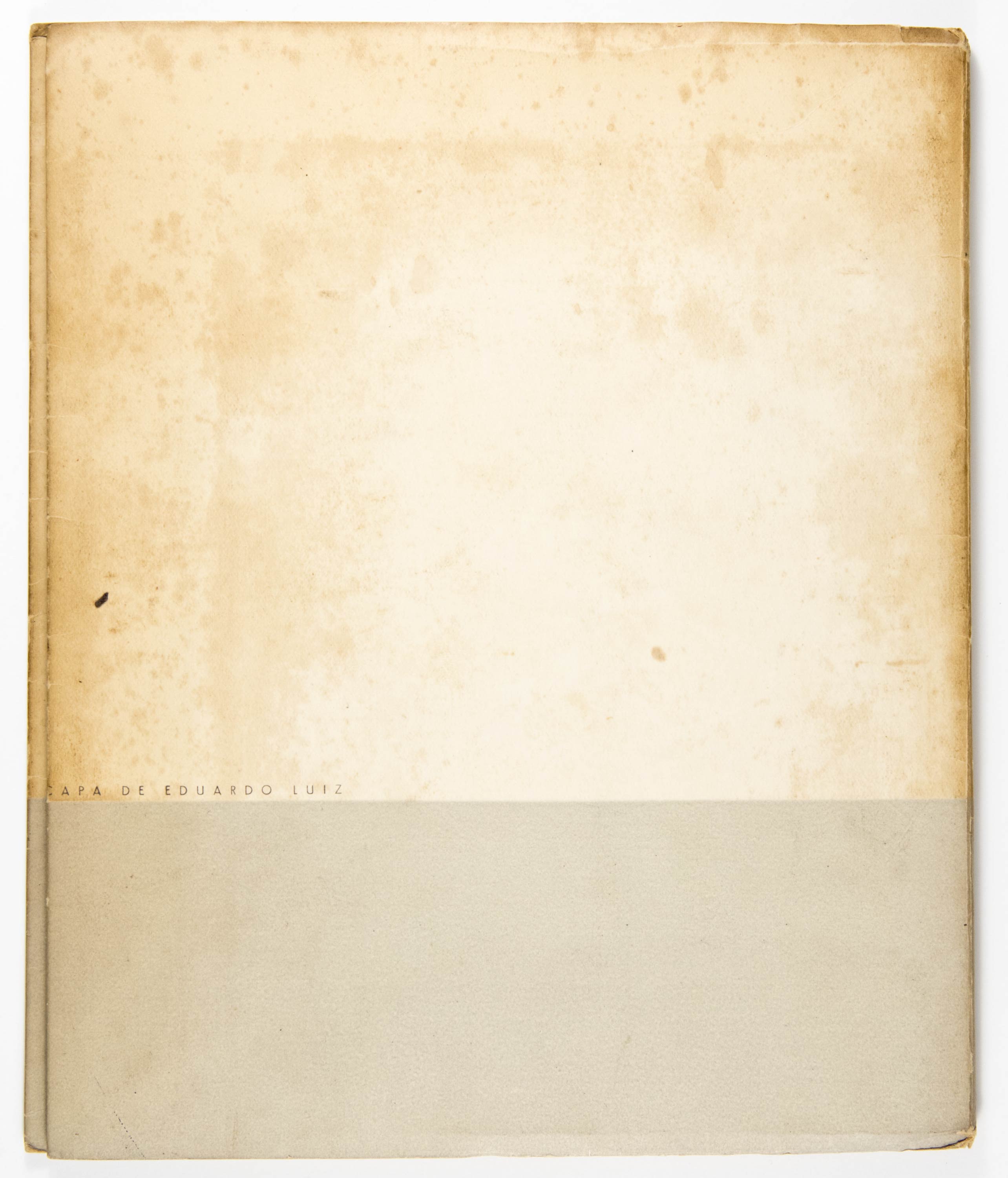
Virtually all of these early poetry books by Reis were self-published. Ode à amizade is no exception, but it stands apart from the others because of its cover, designed by the painter Eduardo Luís (1932-1988), then a painting student at the Porto School of Fine Arts (1946-1952), and certainly a friend of the poet and a colleague of Querubim during the latter’s stay in Porto.
The cover displays an almost austere graphic refinement, divided into two sections: a smaller lower section, in grey, bearing the author’s name and the title, and a larger white upper section, where Eduardo Luís represents friendship through two human figures – whose clothing suggests they are male – shown from behind, embracing, elongated and stylised. The cool colours of their clothing contrast with the vivid red of the sun they are contemplating. This is one of Luís’s early works, produced while he was still attending the School of Fine Arts. In 1958, the artist left Porto and, thanks to a scholarship from the Calouste Gulbenkian Foundation, moved to Paris, where he settled.
“For António Reis, with an embrace of admiration”
— Querubim, October 1952
The book that Querubim Lapa returned to the poet a few months later is an absolutely singular work within the panorama of Portuguese art in the second half of the twentieth century. It bears witness both to the affectionate relationship between the painter and António Reis and to Lapa’s distancing from the formal language of his earliest paintings, produced between 1944 and the early 1950s.
As David Santos observed in his text Realismo, lirismo e memória poética social na pintura de Querubim Lapa (Realism, lyricism and social poetic memory in the painting of Querubim Lapa), during these years the artist began to emphasise “compositional and representational aspects that were increasingly less realist and, by contrast, more lyrical, slightly expressionist, abstract or even tending towards surrealism”, noting that “in this process of distancing from the first neo-realist visual grammar, it also seems evident that a desire for chromatic or even volumetric explosion, of great inventiveness and compositional force… determined works such as Woman selling a swan… Florists, or even oil paintings and works on paper…”[ii]
From this same period date drawings that Querubim produced in 1951 for the magazine Vértice and for the newspaper Comércio do Porto in 1952 and 1953.
As an illuminated book – in the sense that the drawings and paintings bring a distinctive light to the words, illustrating them and enabling other interpretations – the way in which Querubim Lapa illustrated António Reis’s poems is closer to the books created by William Blake at the end of the eighteenth century than to medieval illuminated manuscripts.
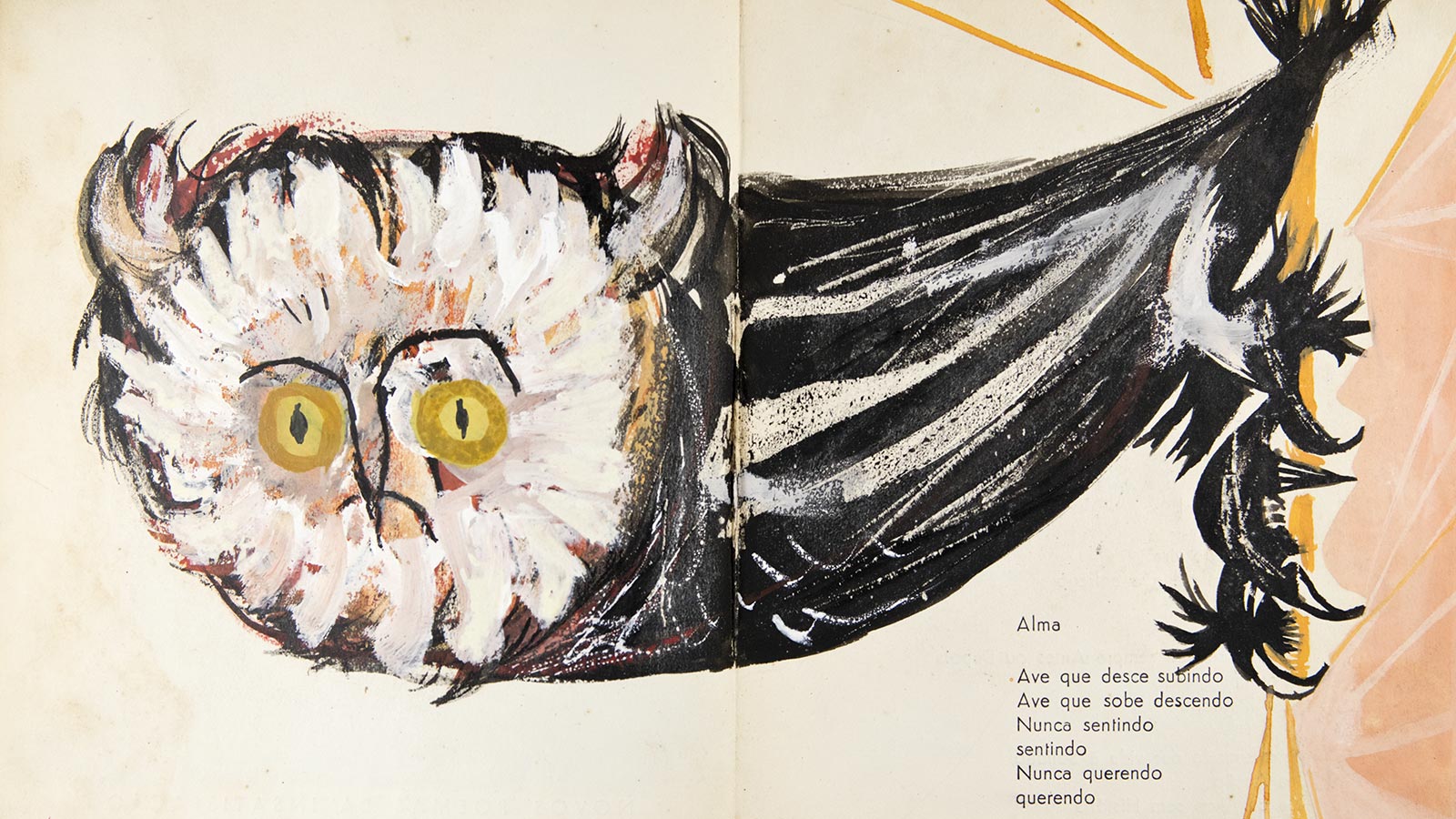
As in the work of the British poet and painter, in Ode à amizade the empty space of each page is filled with drawings and colour, without rigid, pre-defined separations. The poet’s words find their perfect counterpart in the artist’s paintings and drawings. Each poem is illustrated according to Querubim’s free interpretation, in drawings marked by a fluid line in black Indian ink, coloured with gouache using a sumptuous palette.
At times, the empty spaces of the page prove insufficient, and the drawings spread across the entire surface of the paper, even overlapping the writing itself, causing words and images to intertwine and acquire another poetic expression. The register is figurative and lyrical, populated by men, women and children who interact with one another and with other animal creatures, both real – owl, doves, ram, swan – and imaginary: a phoenix with a human head and semi-human butterflies. The colours are vibrant and at times contrasting – oranges, reds, pinks, greens and blues — and the artist uses them with clear chromatic mastery.
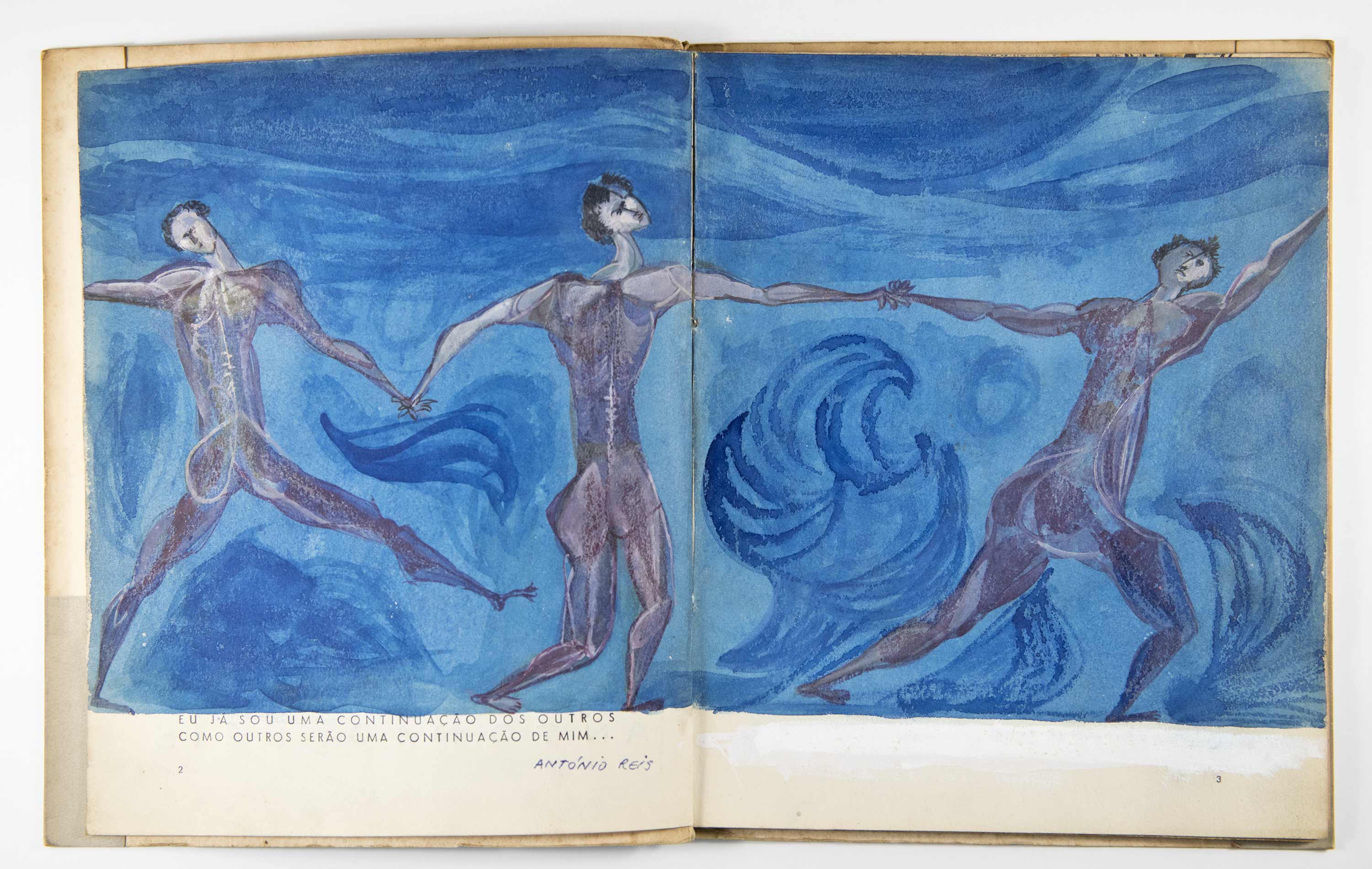
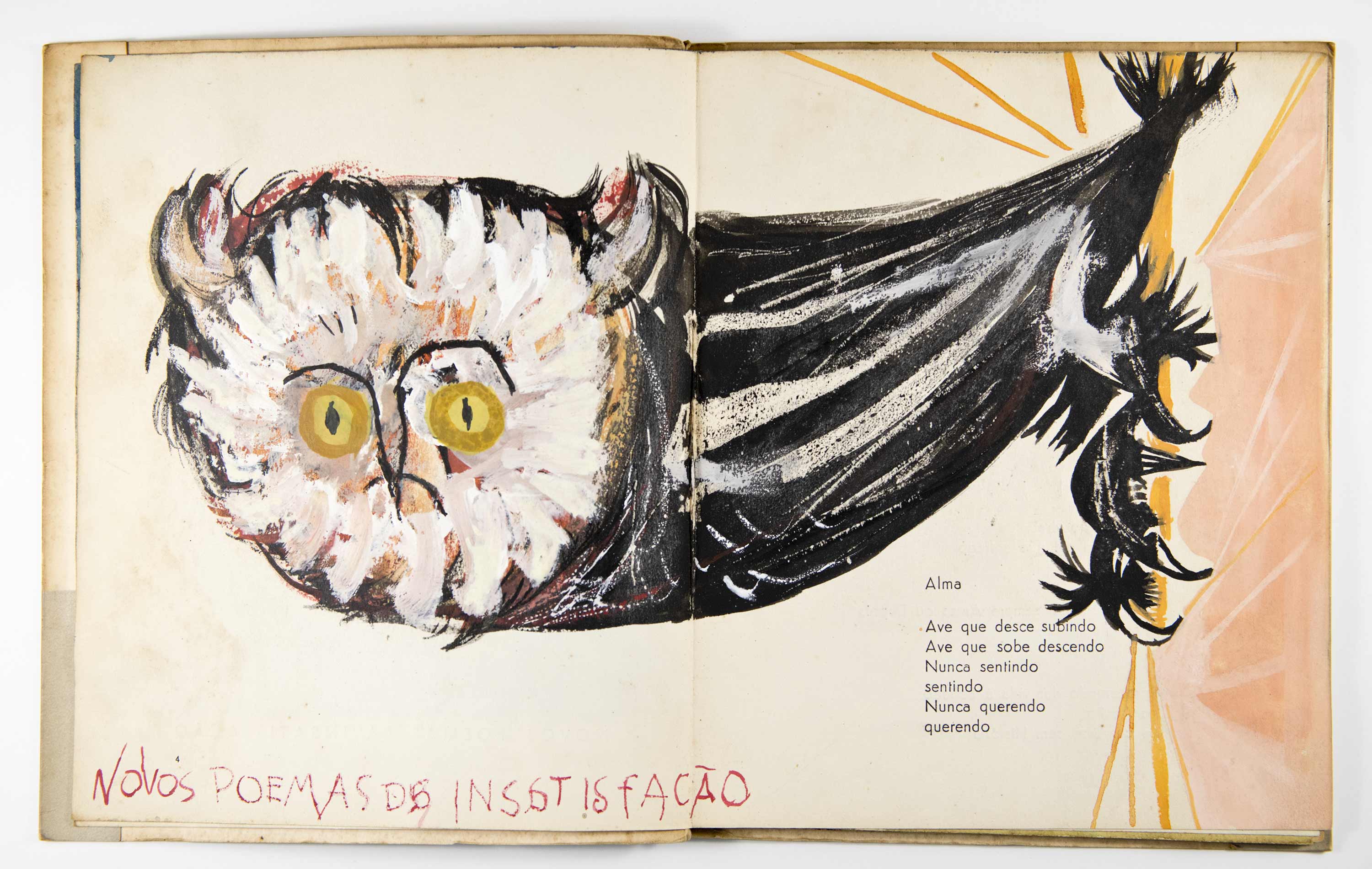
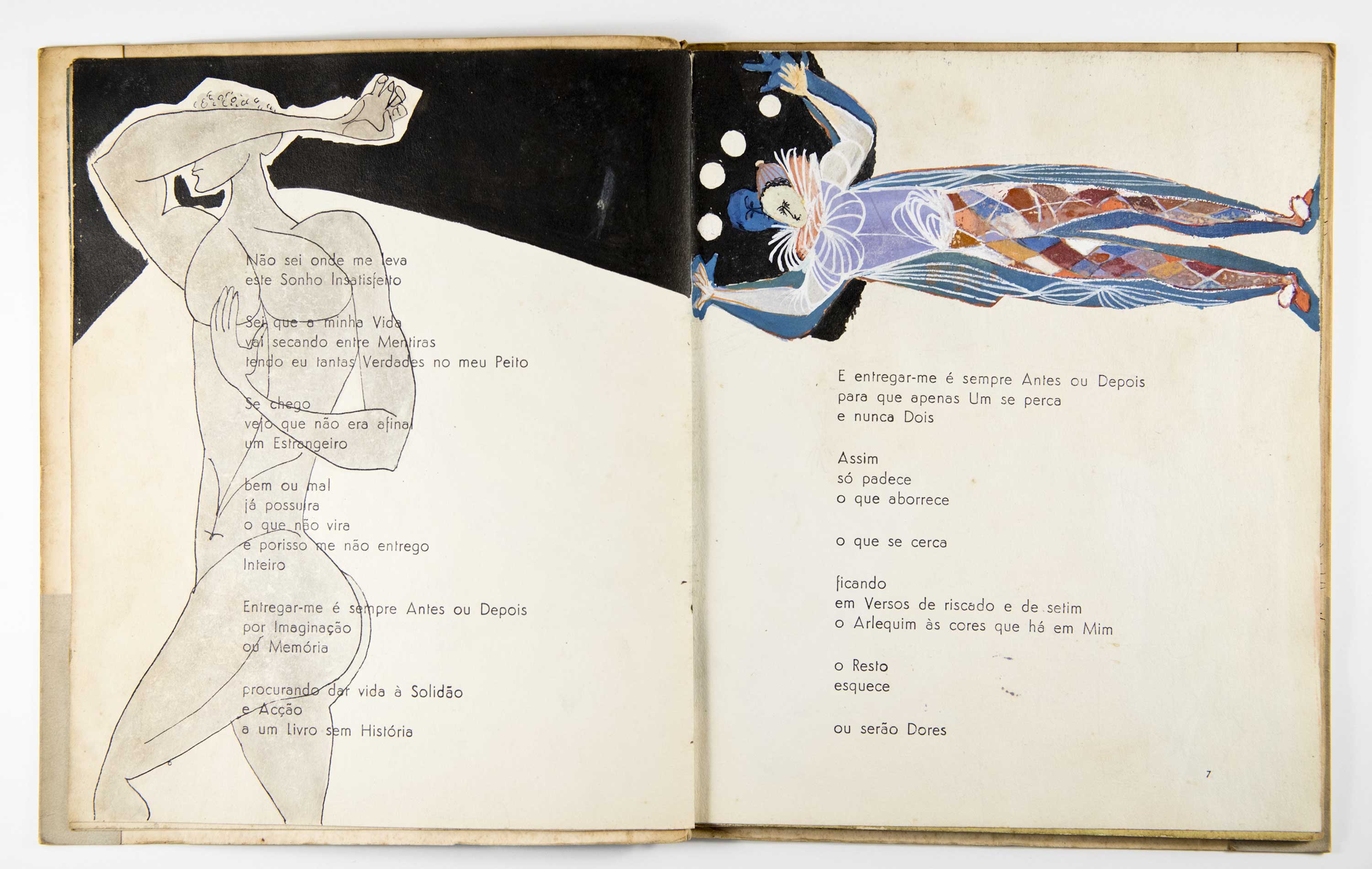
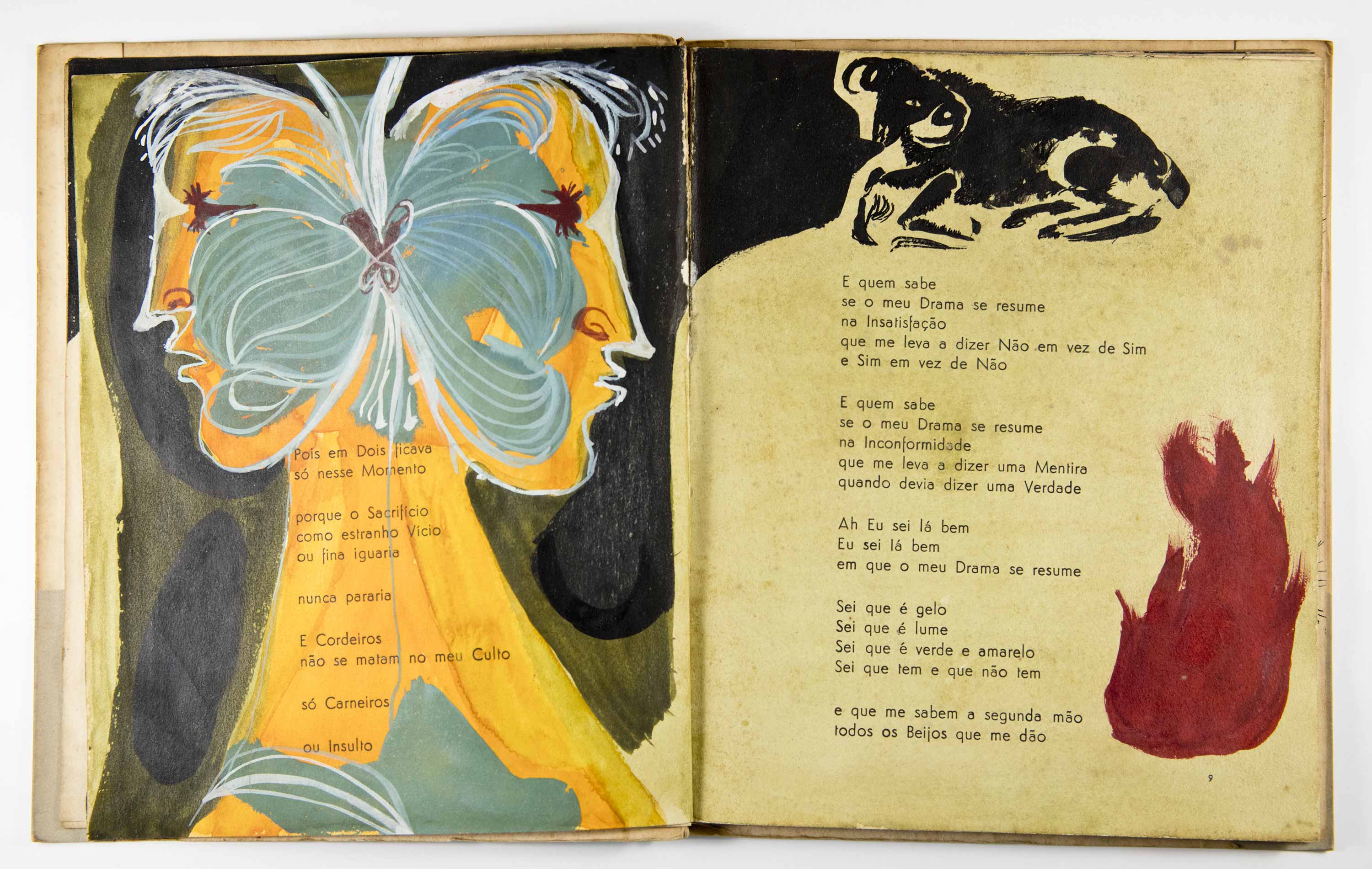
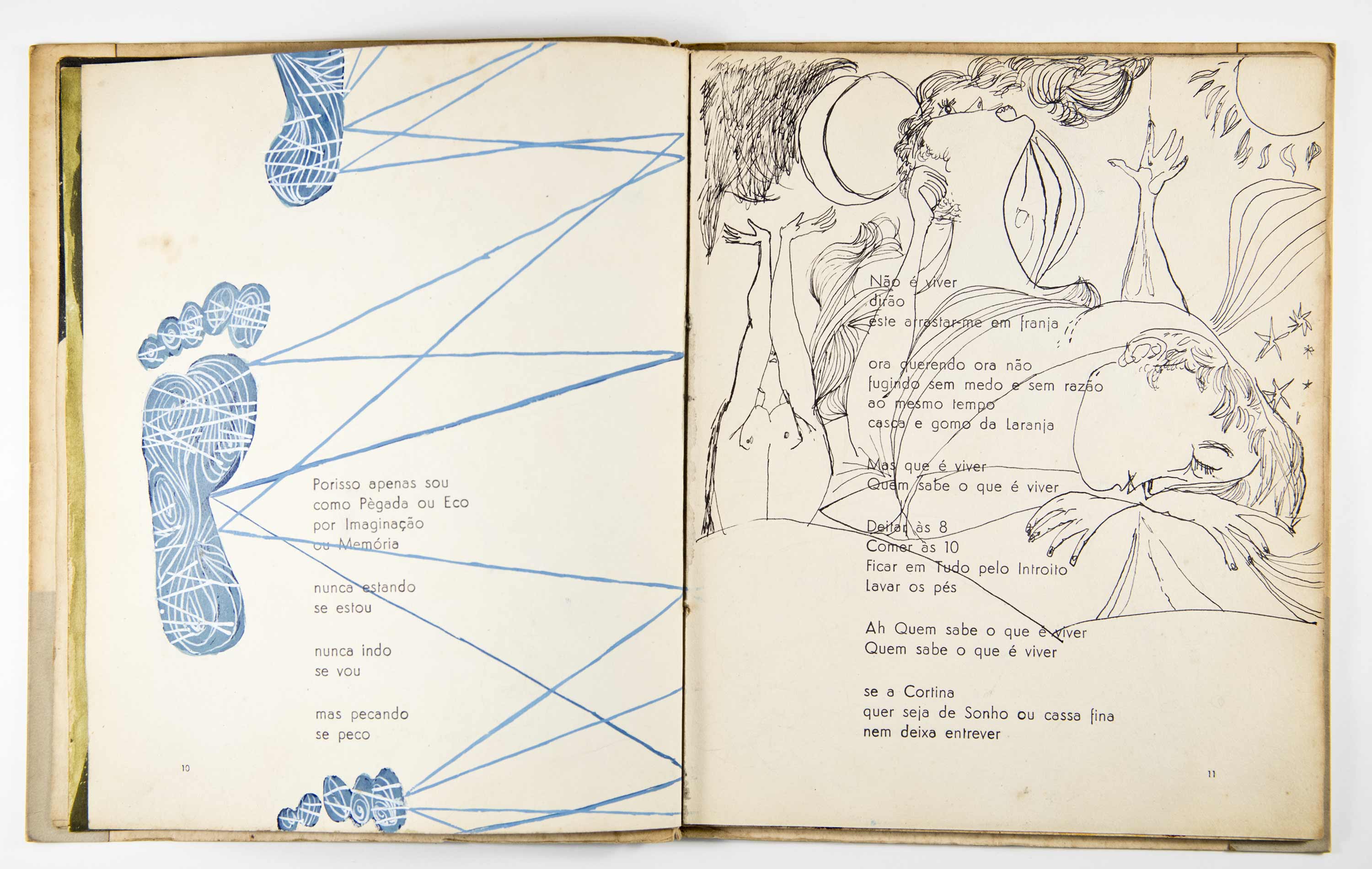
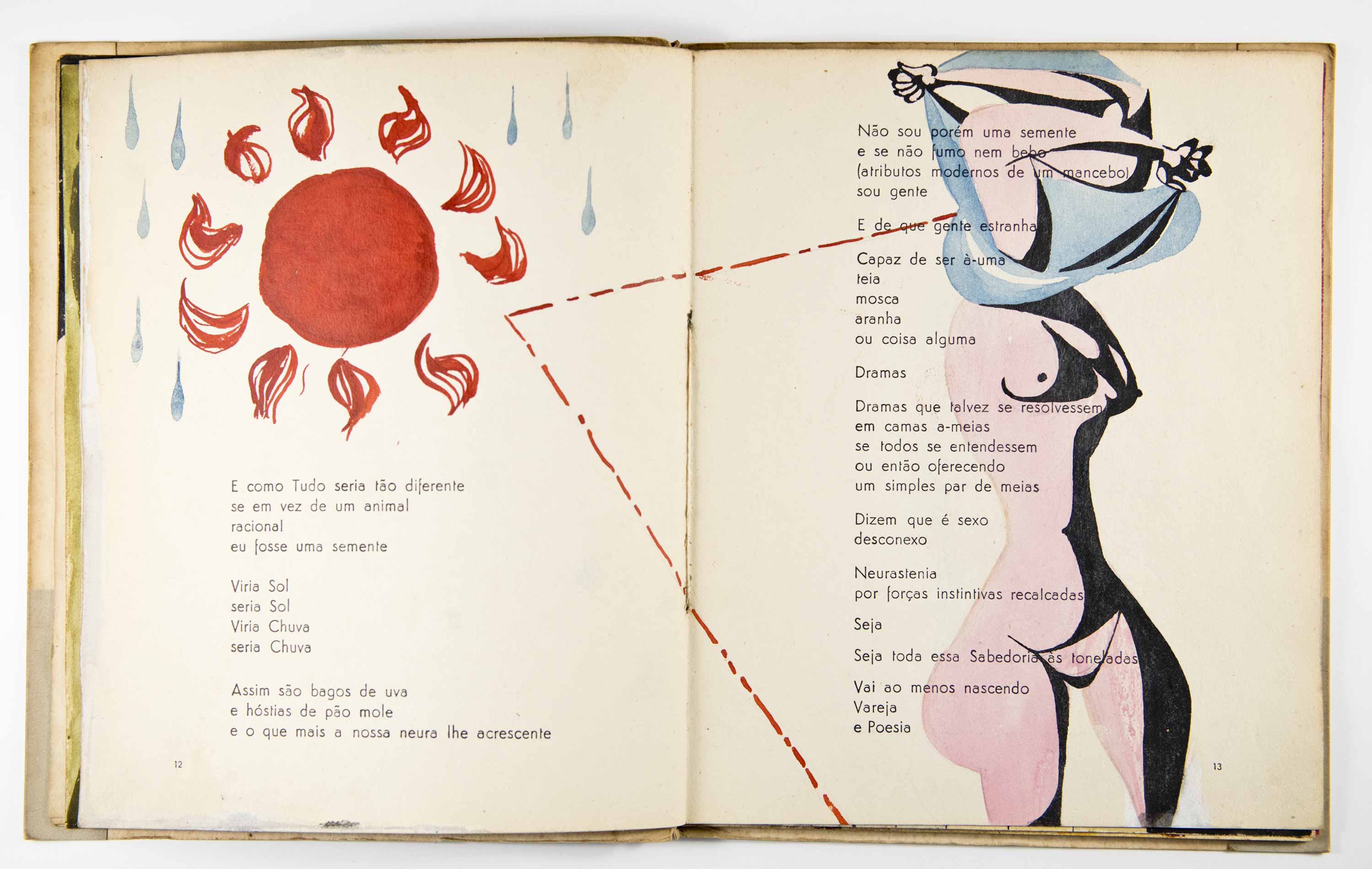
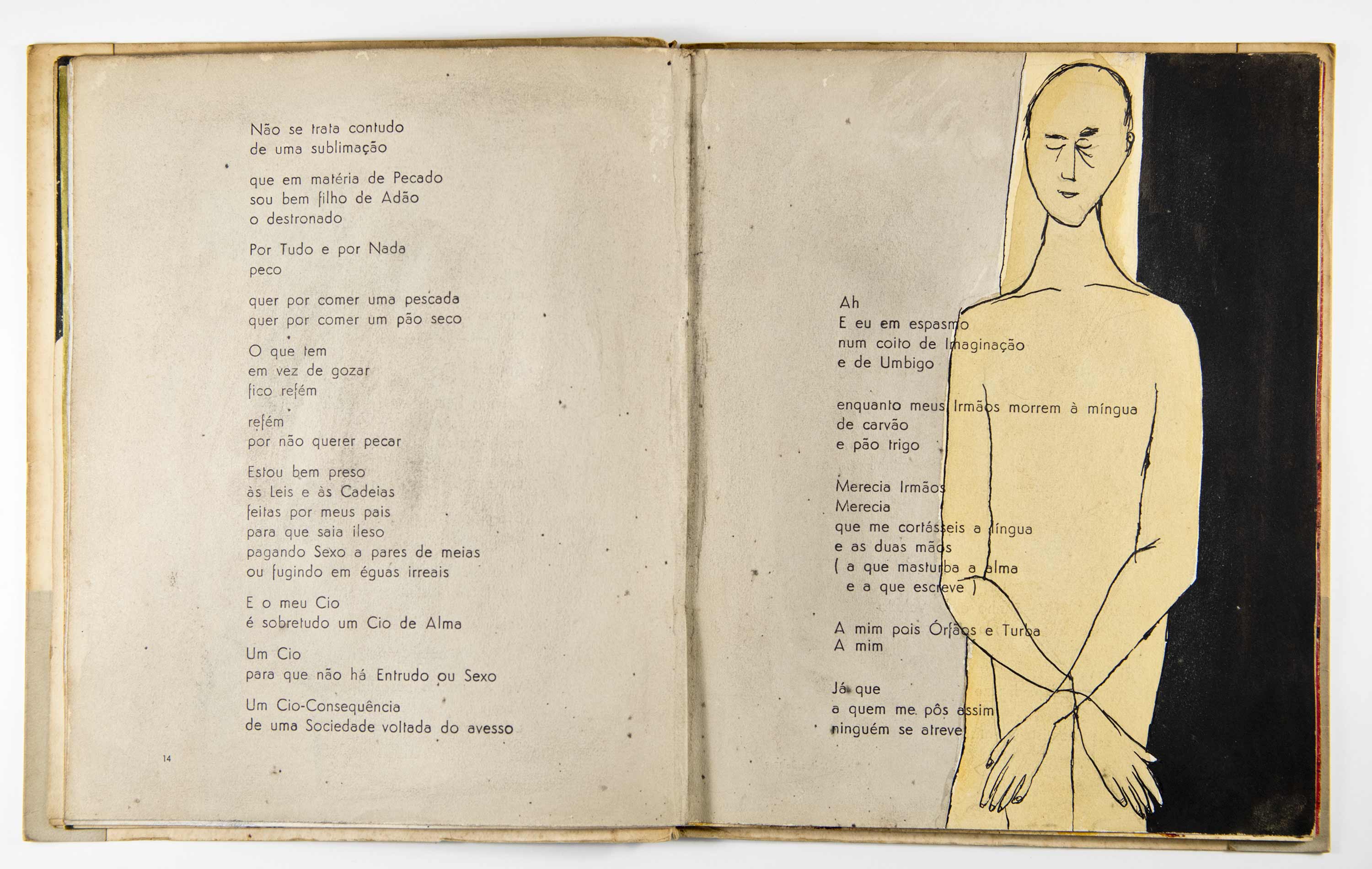
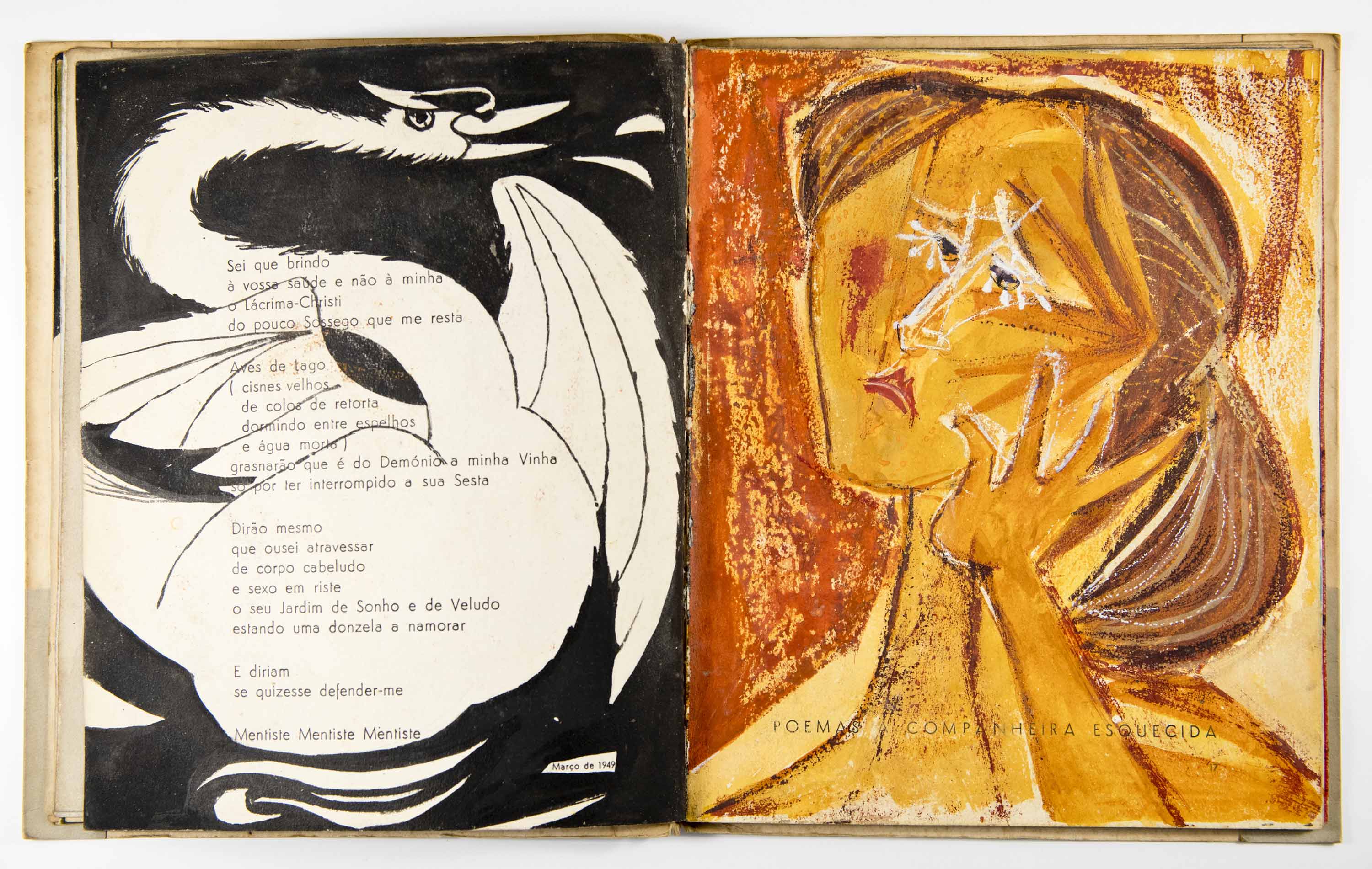
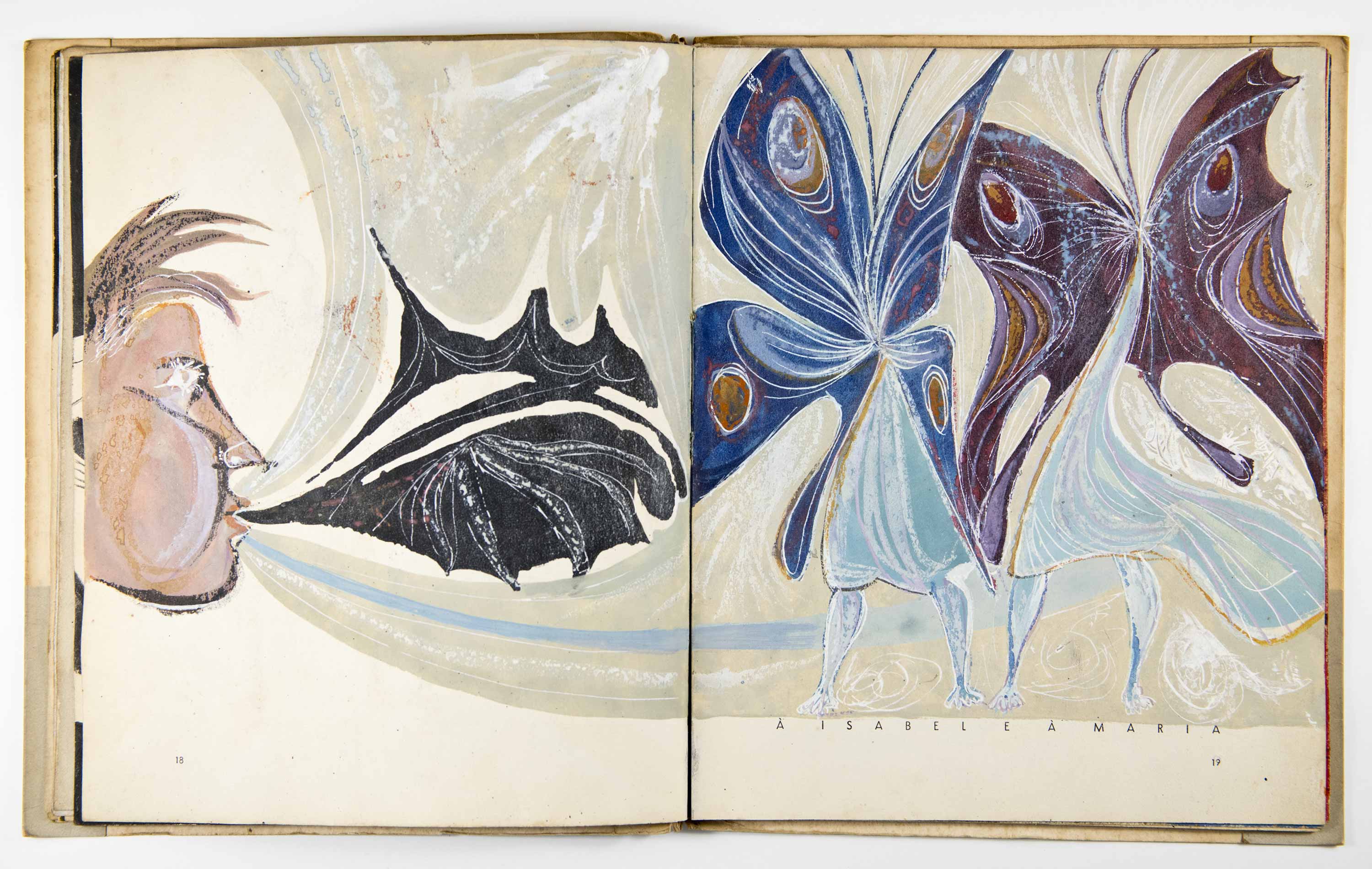
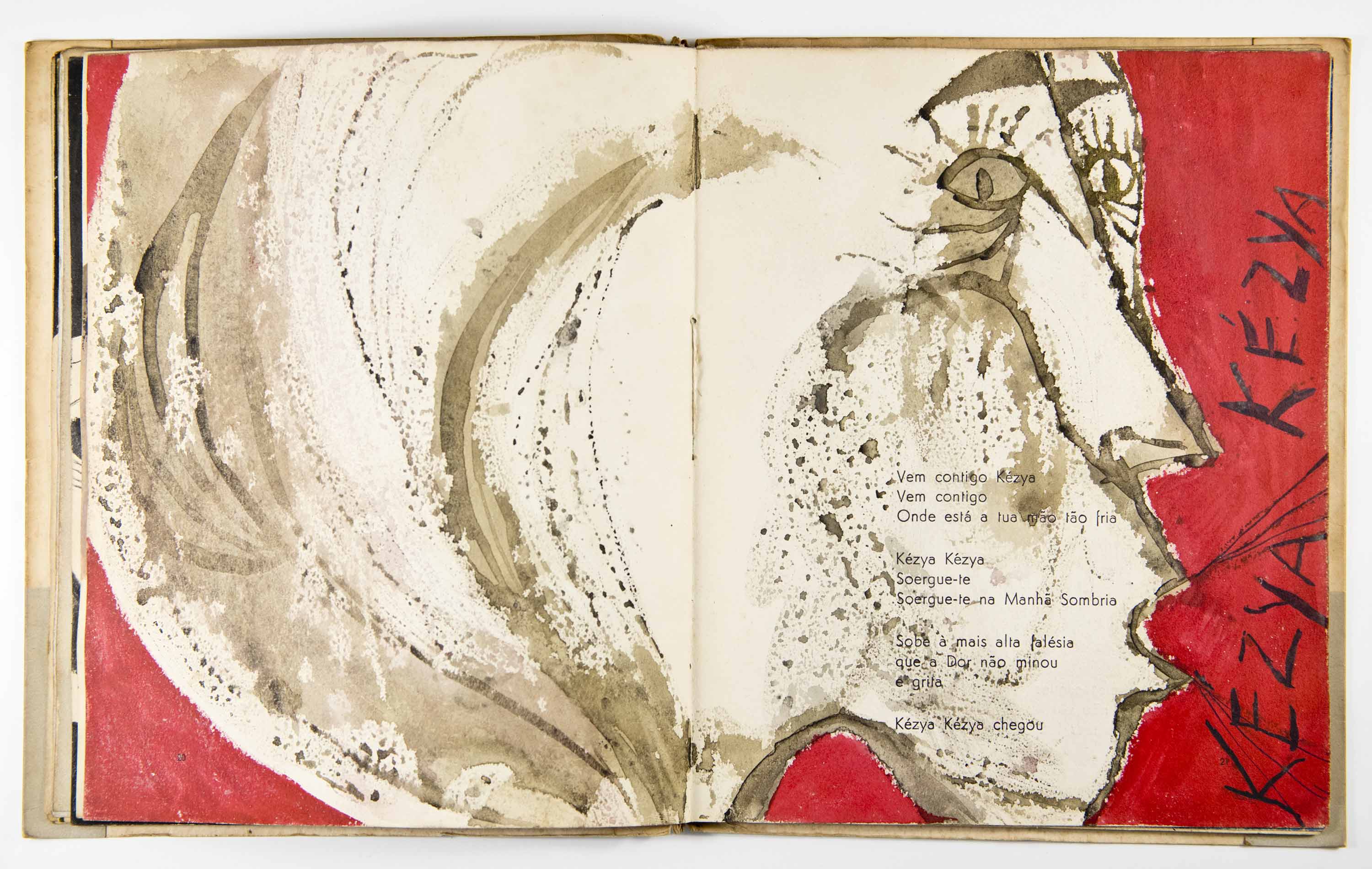
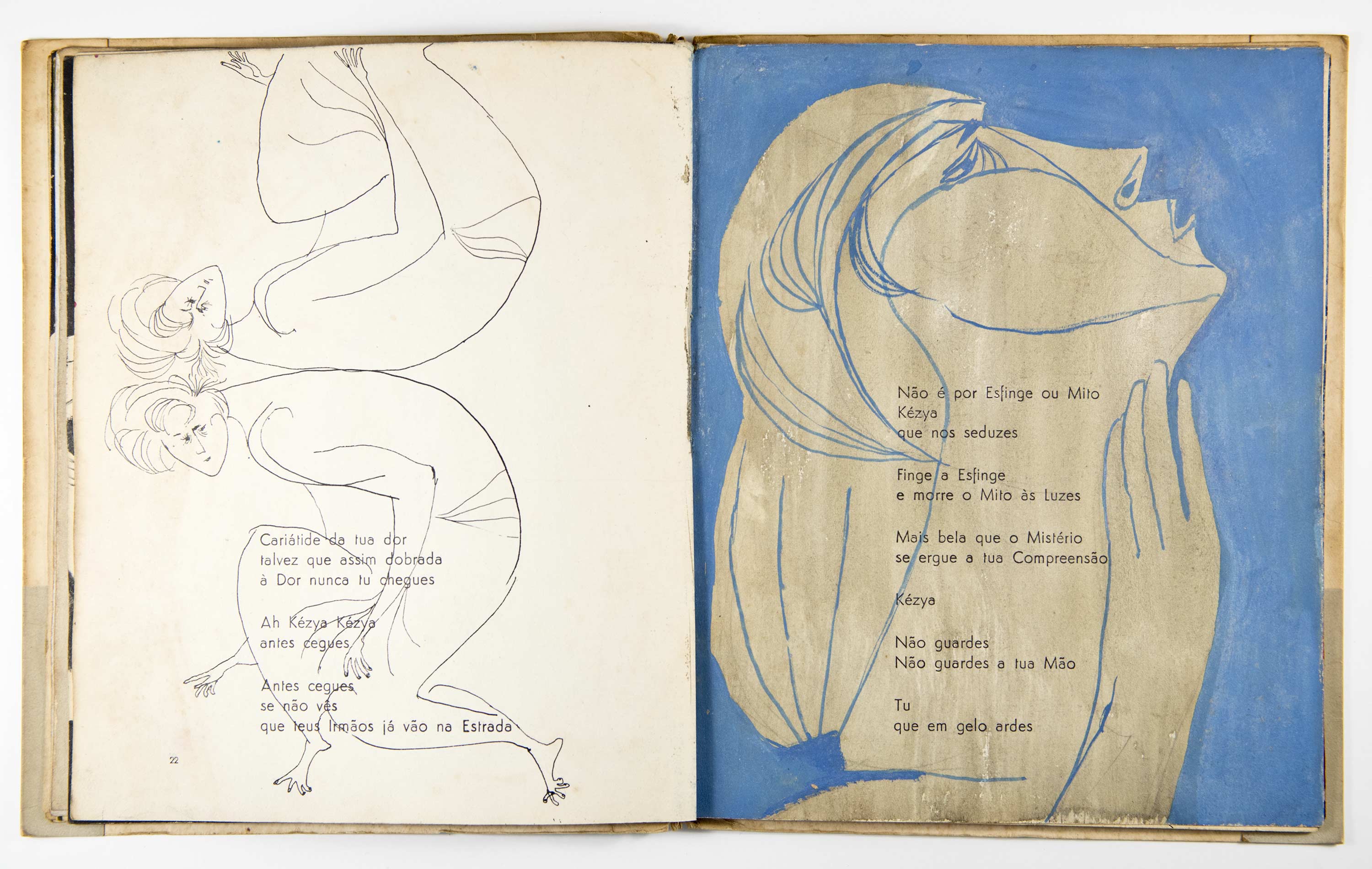
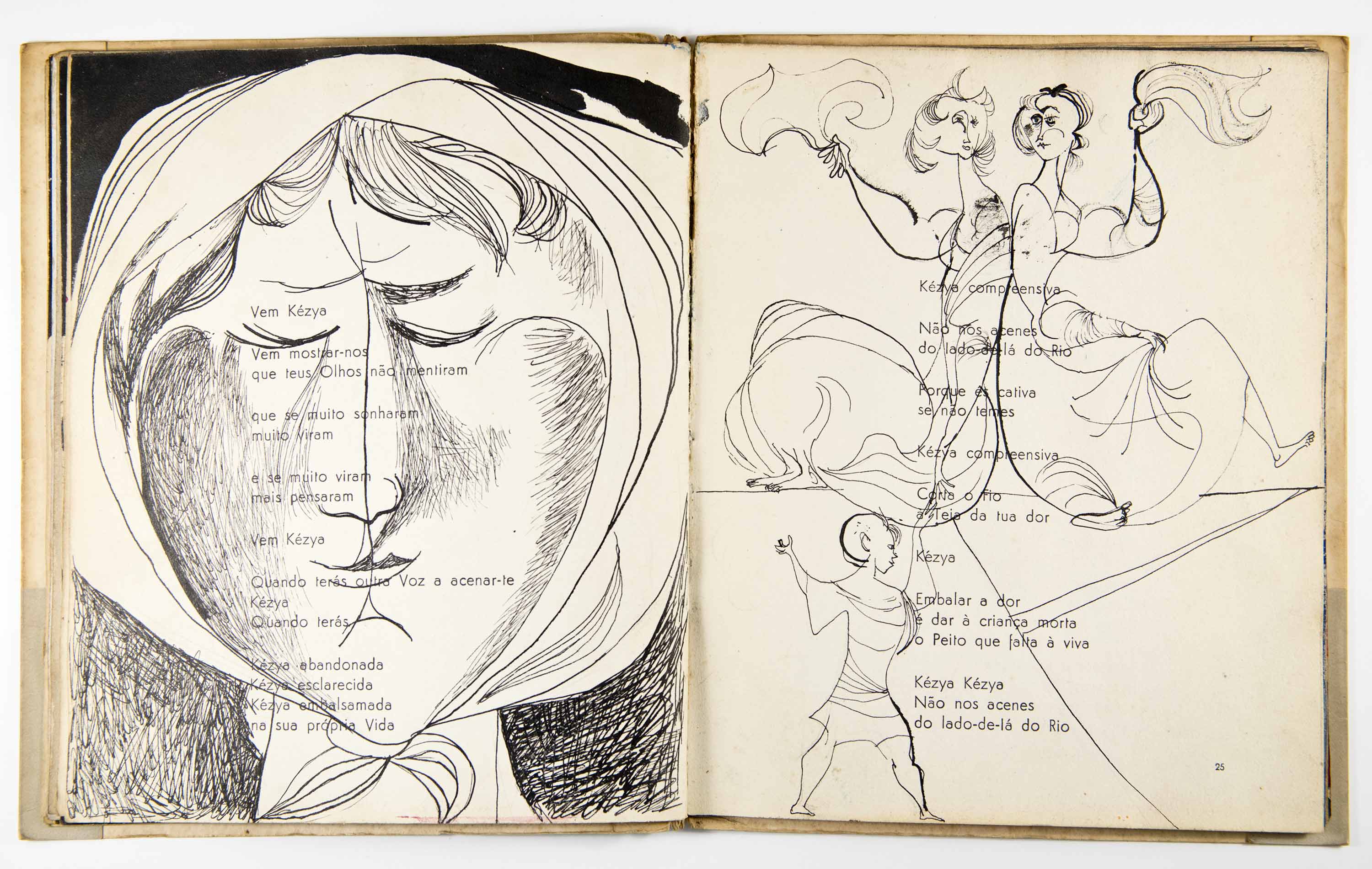
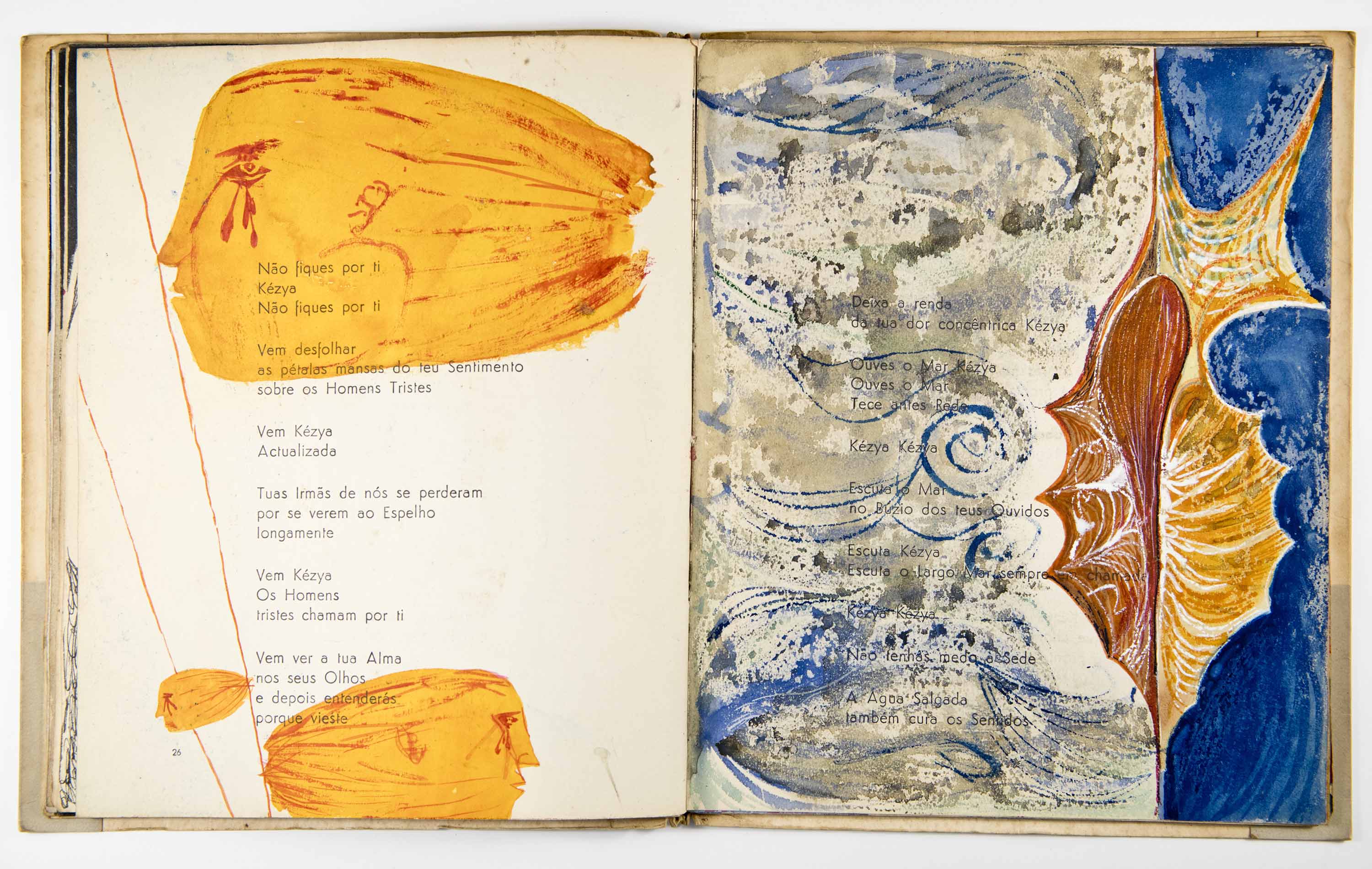
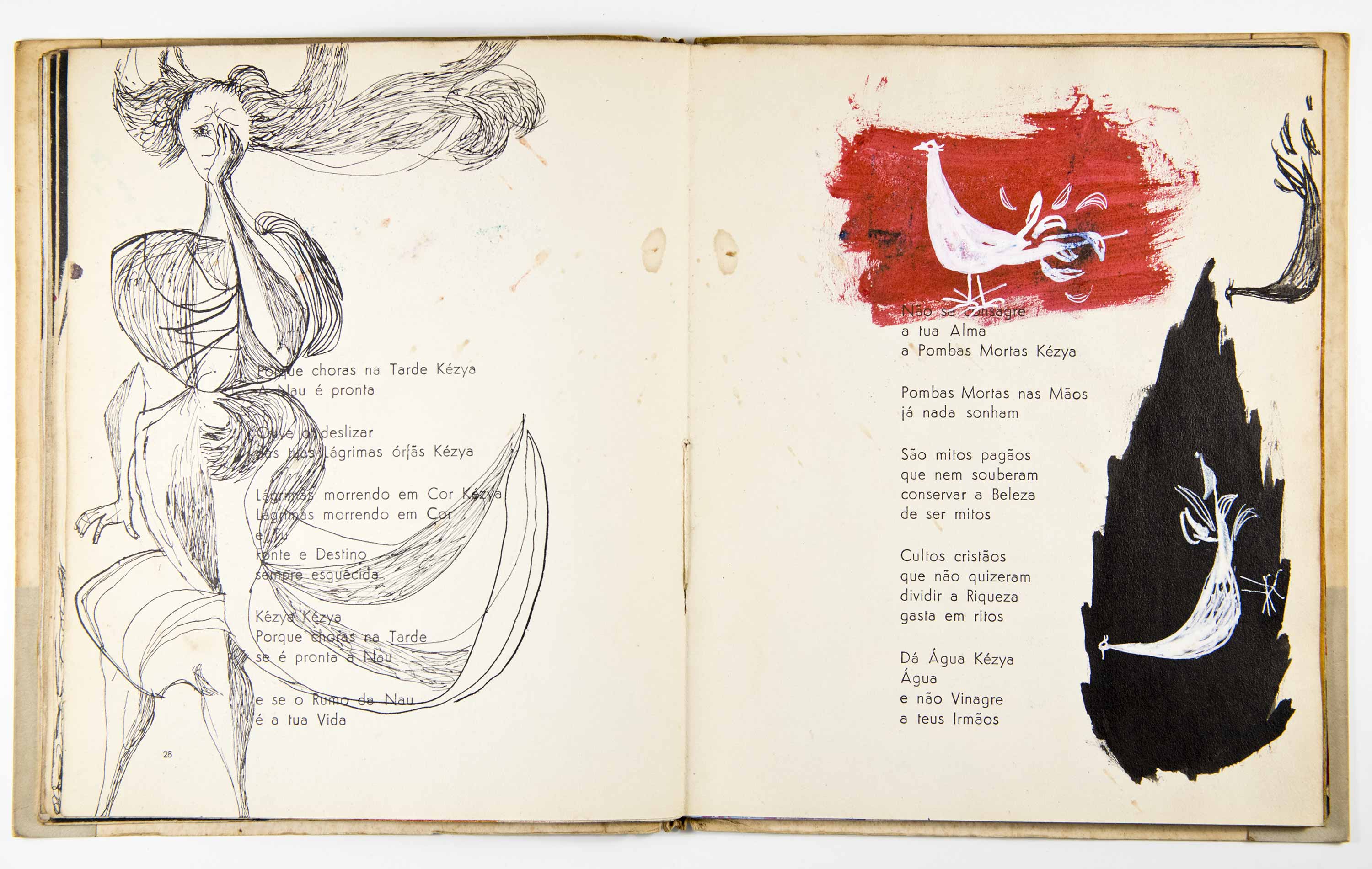
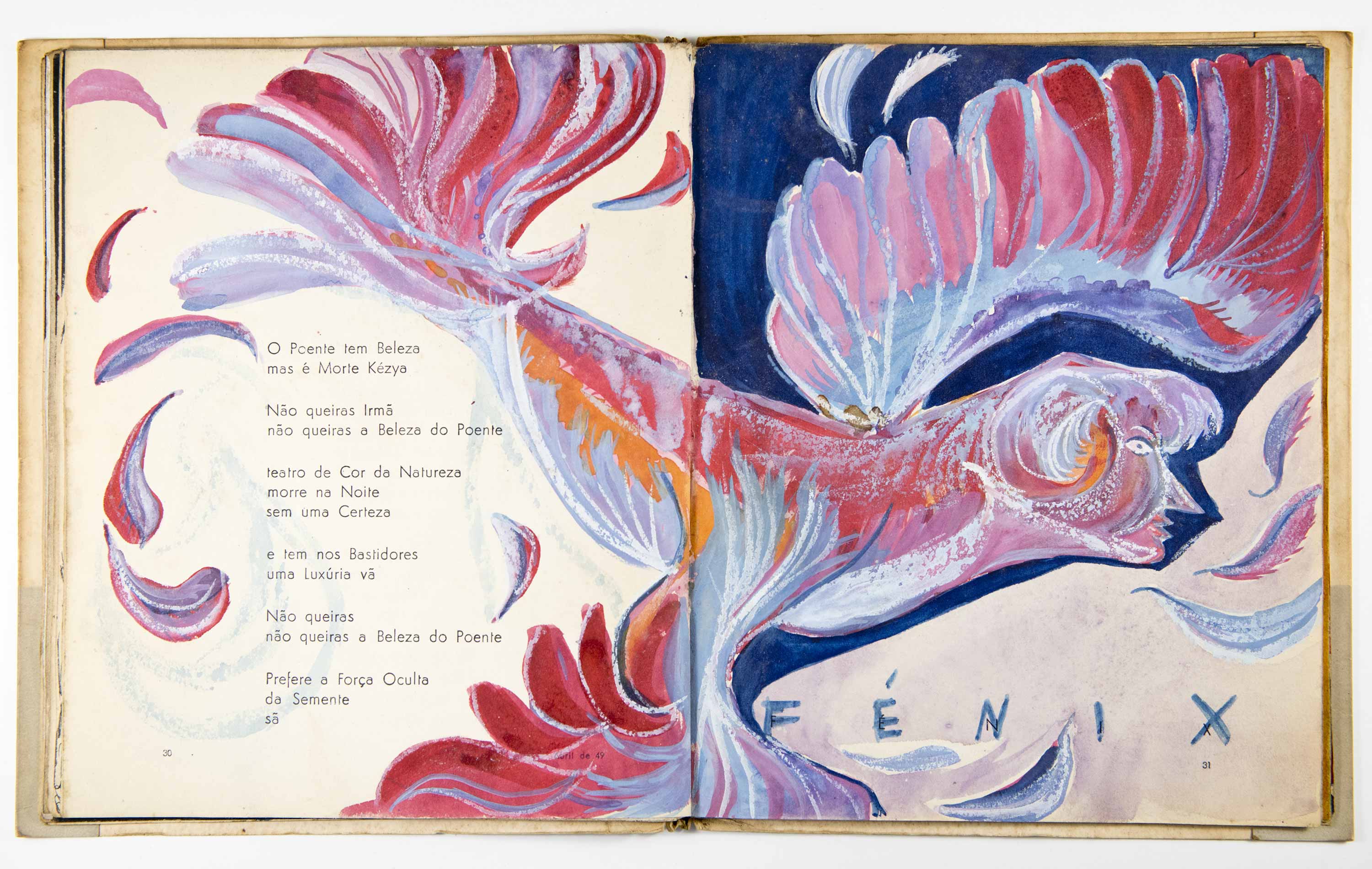
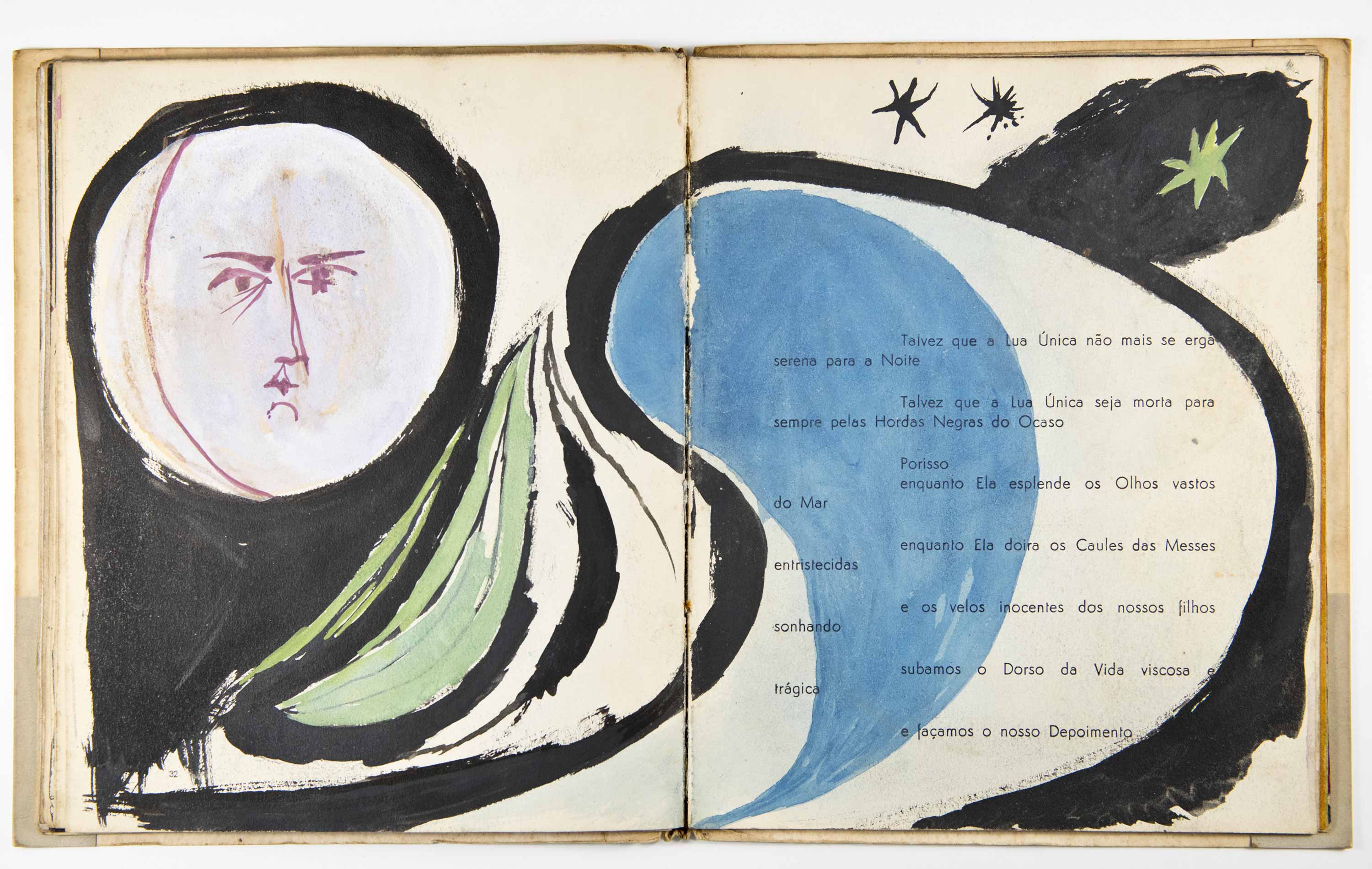
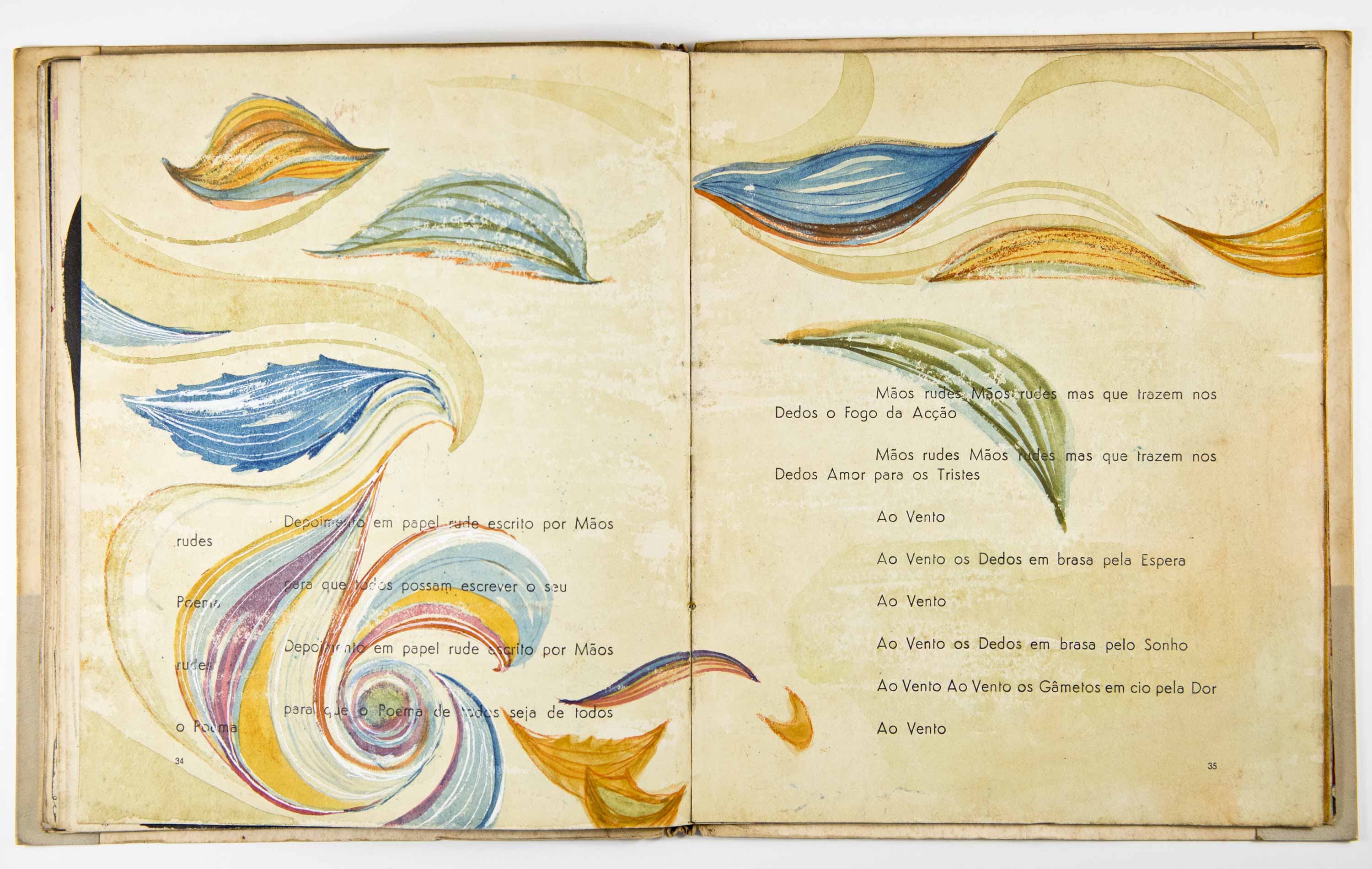
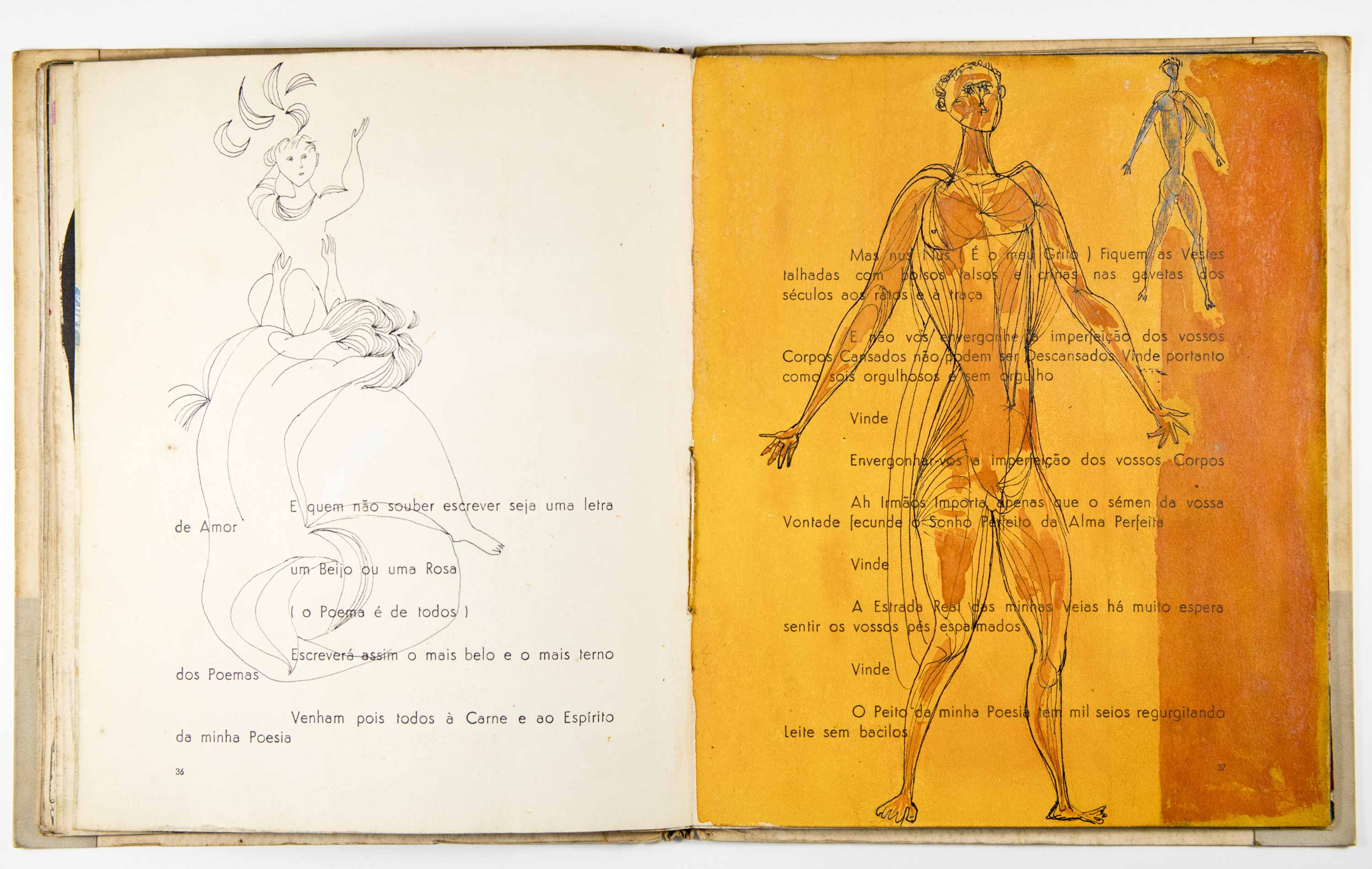
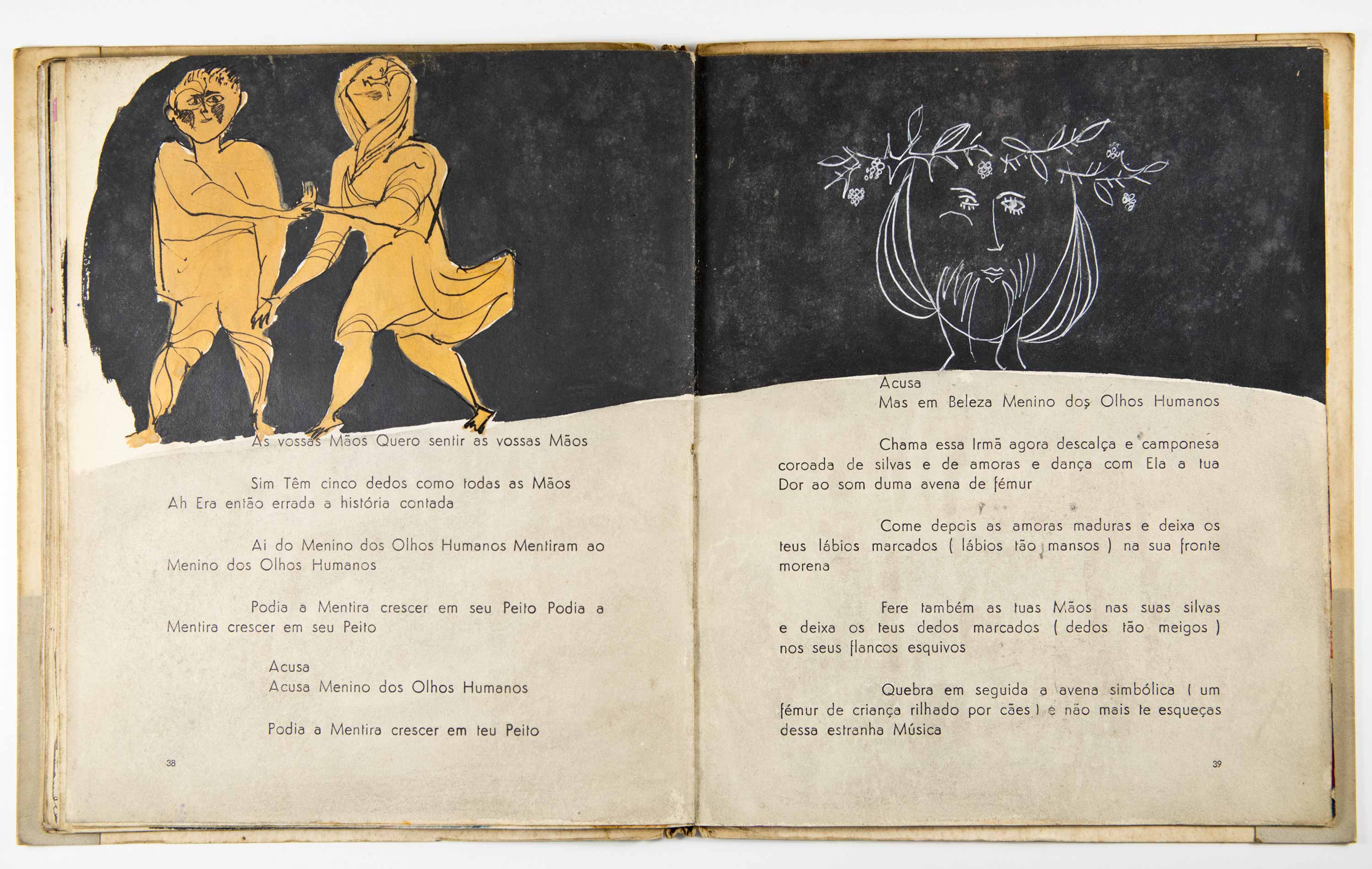
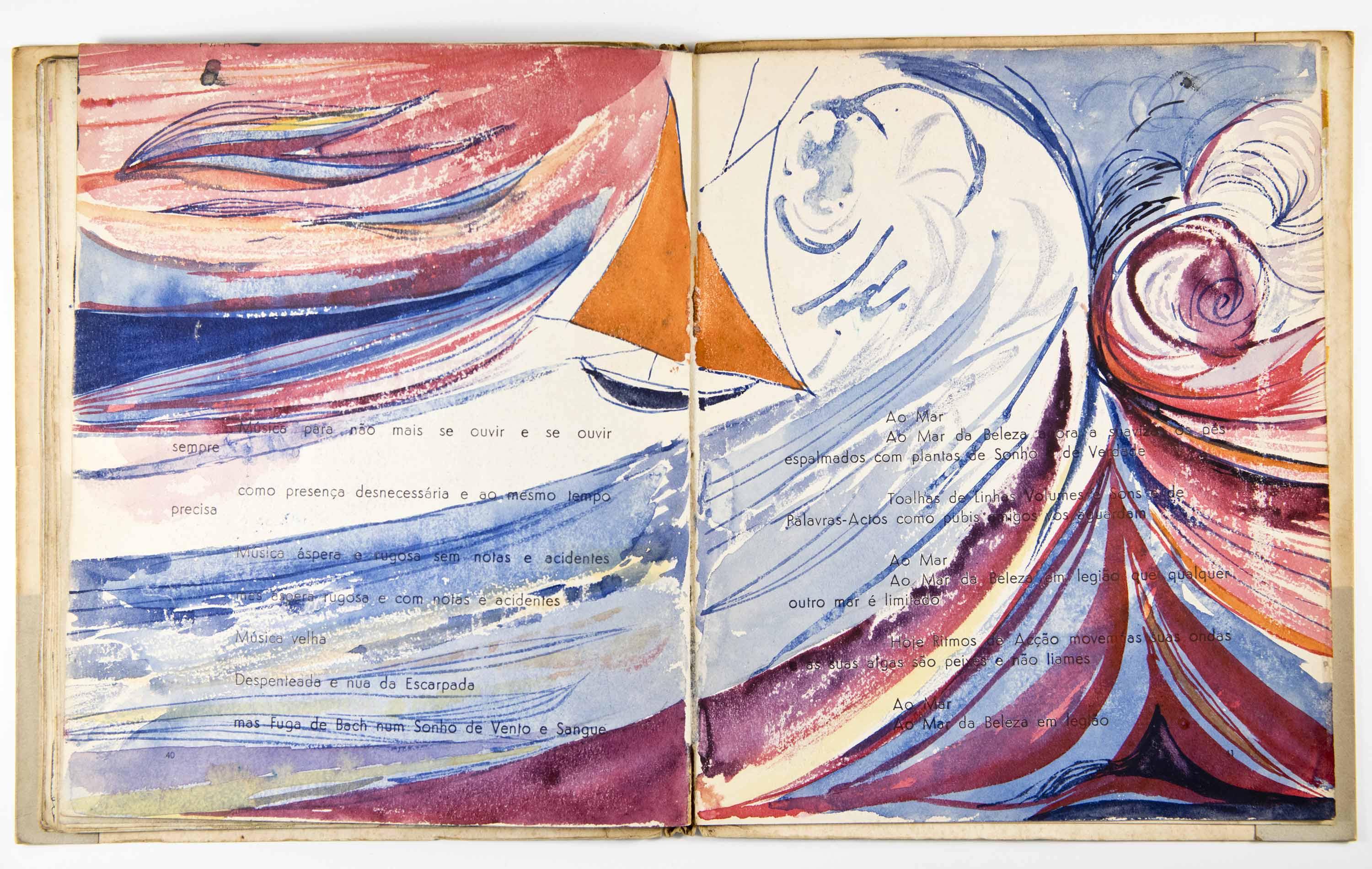
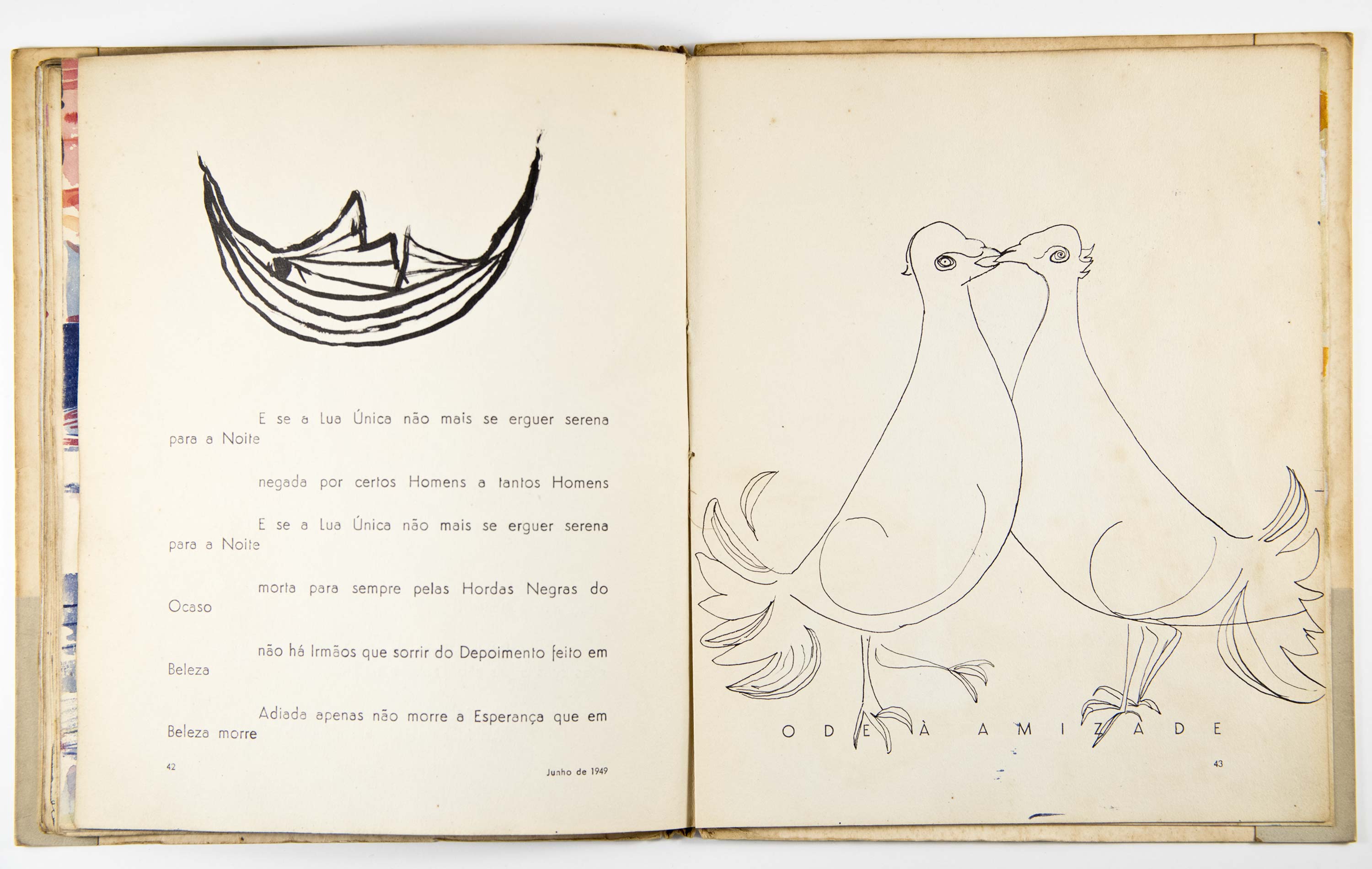
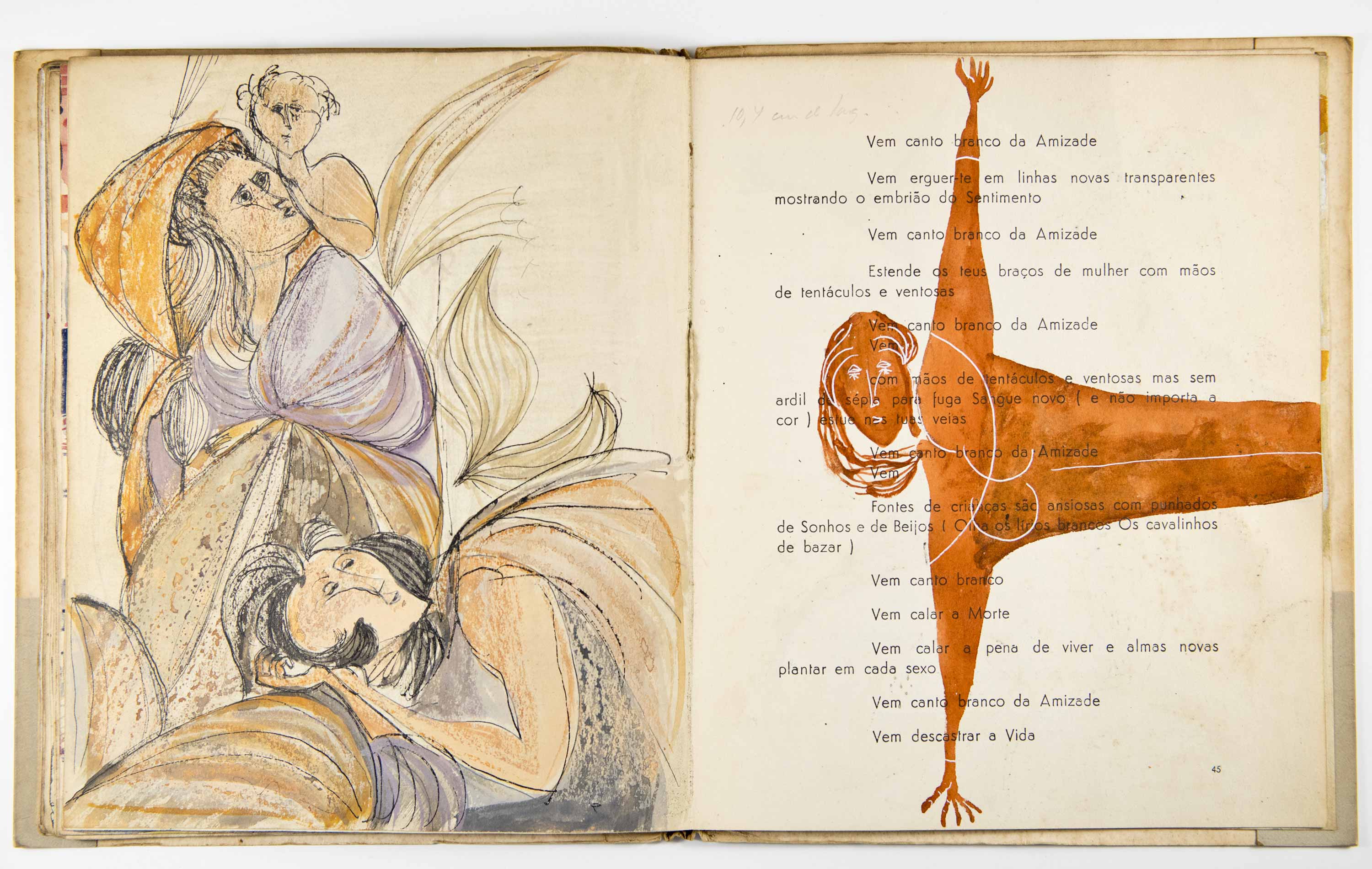
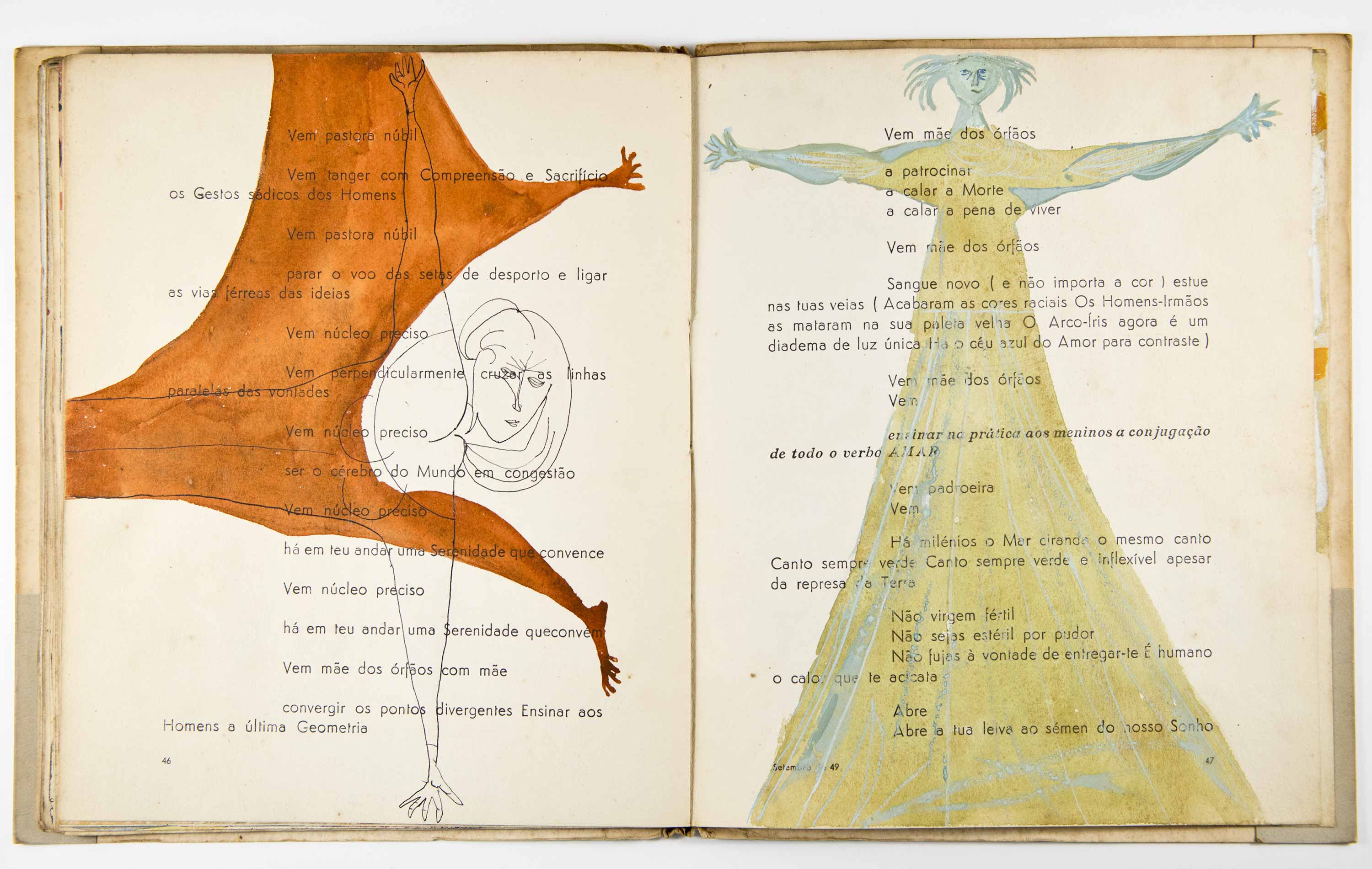
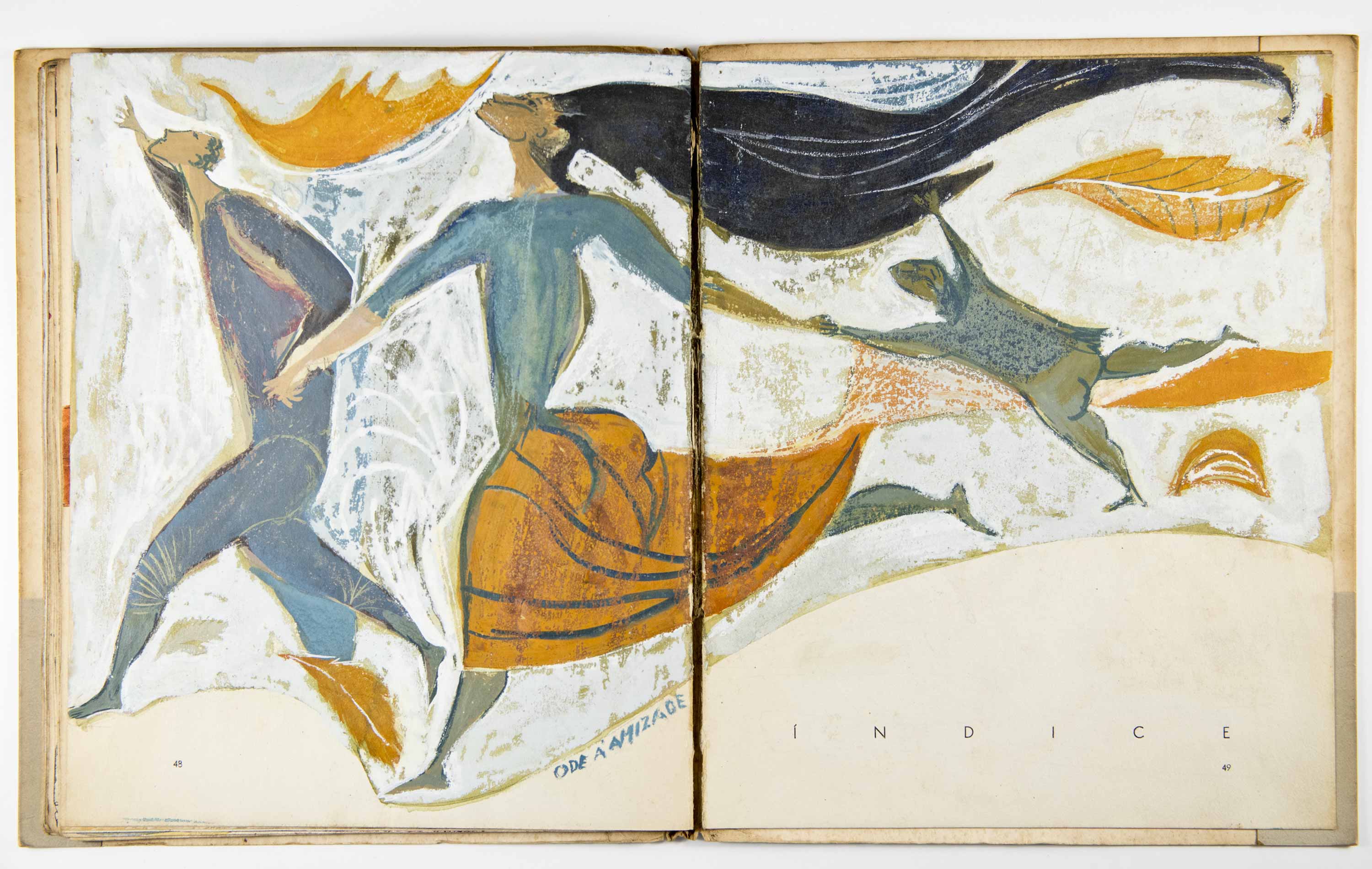
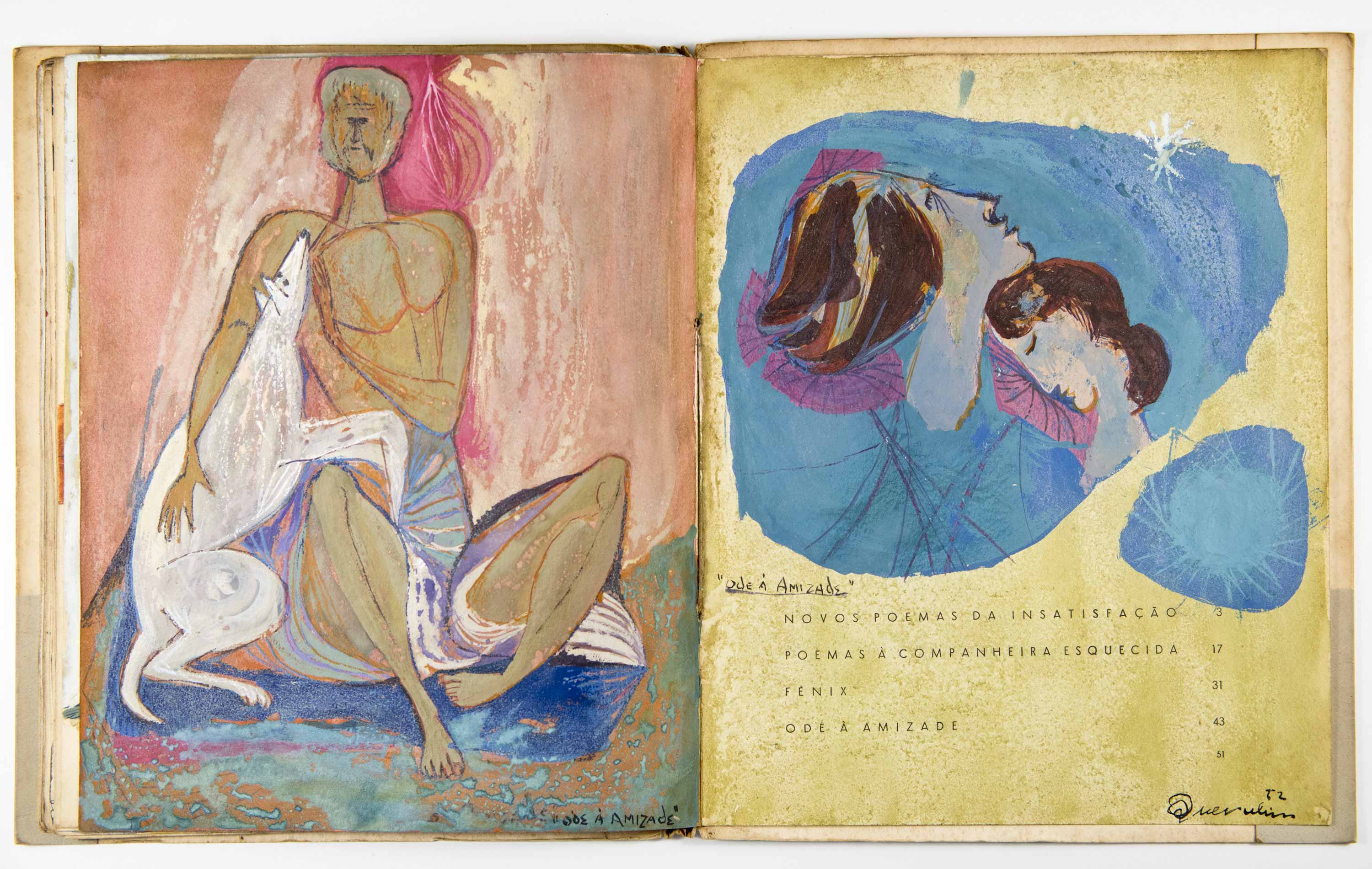
Ode à amizade is thus a unique work within Querubim Lapa’s artistic trajectory. The artist never repeated this experience of illustrating the words of writers and poets. In its singularity, this book stands as an expressive testimony to the creative freedom of composition and to the potential of colour that he would explore both in his pictorial work and in his ceramic creations.
Acquired in 2022 and integrated into the Art Library’s collection of artists’ books and independent editions, Ode à amizade is also a relevant work for understanding the relationships established among figures in the national cultural milieu during the 1950s.
[i] Diogo Vaz Pinto em https://sol.sapo.pt/2017/07/12/antonio-reis-eu-nao-voo-ando-quero-que-me-oicam/ Accessed 23/12/2025.
[ii] SANTOS, David (2023). “Realismo, lirismo e memória poética social na pintura de Querubim Lapa”. In Querubim Lapa: uma poética neorrealista. Vila Franca de Xira: Museu do Neo-Realismo (pages 43-44).
Works from the Library
Explore the series
No results were found for your criteria.
You may also like



No results were found for your criteria.