
Cold case solved: Antoine-Jean Duclos’ erotic study of ‘Delirium’
-
1 009
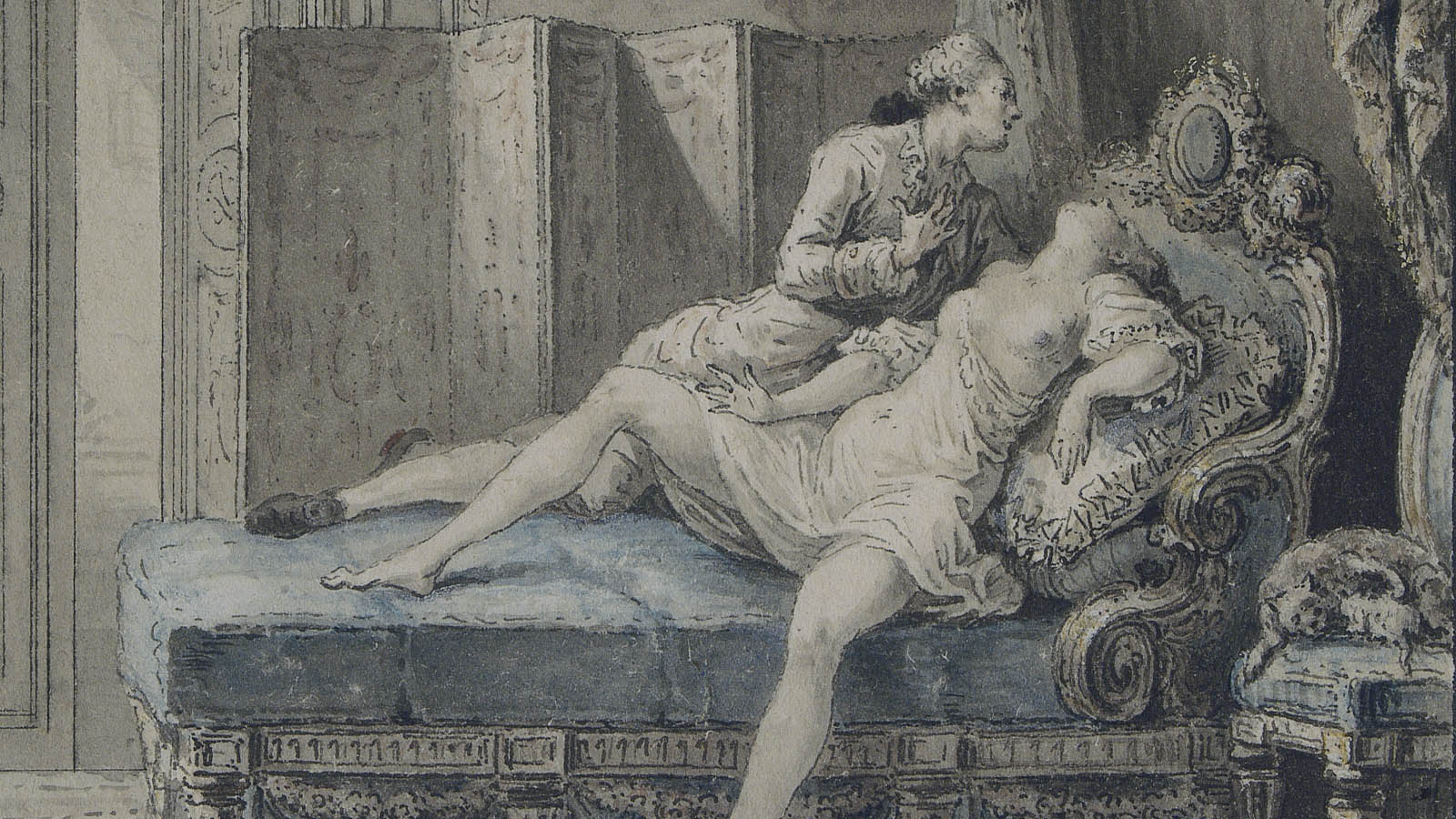
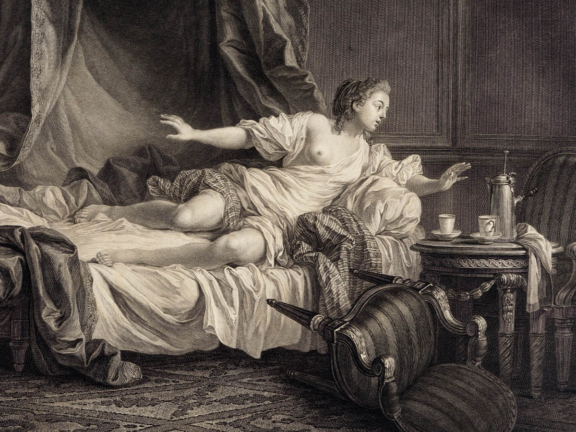
For years the authorship of this seductive illustration – whose overt sensuality surely appealed to Calouste Gulbenkian – remained elusive. Having once been assigned to Gabriel de Saint-Aubin (1724-80), it was attributed to Jean Michel Moreau the younger (1741-1814) when exhibited in 2000–20001 in European Master Drawings from Portuguese Collections, a travelling exhibition organized by my husband, Nicholas Turner, and presented in Cambridge, at the Fitzwilliam Museum; in Lisbon, at Centro Cultural de Belém; and in Oporto, at Museu Nacional de Soares dos Reis. By the time the exhibition moved on to the Prado Museum in Madrid in 2002, it was classified as by Clément Pierre Marillier (1740-1808), as suggested by colleagues from the Fitzwilliam Museum, in Cambridge. None of these hypotheses convinced Gulbenkian Museum’s curator Manuela Fidalgo, who catalogued it as by ‘an unknown author’ when presented at the Gulbenkian Foundation in 2014, in the exhibition Line and Colour: Drawings and Watercolours in the Calouste Gulbenkian Collection.
In preparation for the opening on 13 December 2025 of a new exhibition intitled European Master Drawings from Portuguese Collections, III: France, and curated by Nicholas at the Museu Nacional de Soares dos Reis, Oporto, my job as editor of the catalogue was to update the handful of entries for works previously shown in 2000. Intrigued by this connoisseurship puzzle, I resorted to the most basic of art-historical cheats! I converted a .jpeg of the drawing to black-and-white, flipped it horizontally and conducted a Google image search. Eureka! I found an impression of the related print, which had recently passed through a minor Paris sale (Magnin-Wedry, 6 November 2023, lot 4), identified only as by an 18th-century French engraver. Although the online reproduction of the print was low-res, I was able to read the title of the print, Le Délire (‘Delirium’), and that the invention of the design was credited to Antoine-Jean Duclos (1742-95), well known as a Paris printmaker but extremely rare as a draughtsman.
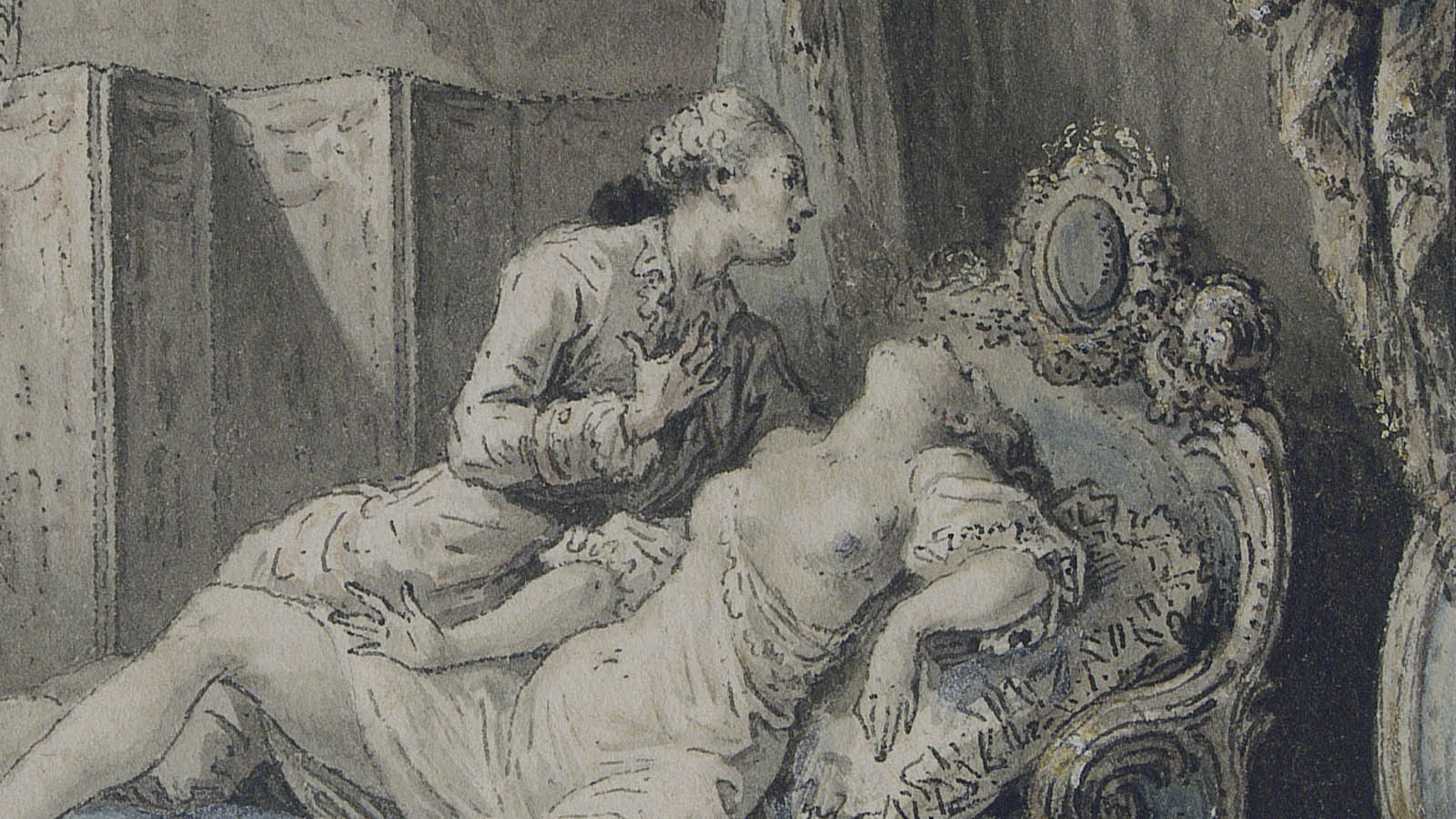
Unable to locate a single other online image of the print, I discovered that the Louvre preserved an impression in its Rothschild collection (inv. no. 17951 LR); however, it was unillustrated on their website. Their curator Jean-Gerald Castex thus kindly provided me with images of the label, citing the creator as A.J. Duclos; the publisher as Chez Martinet, the libraire operated by François Nicolas Martinet (1731-1800) in the Rue du Coq Saint-Honoré, Paris; and the engraver as Jeanne Deny (1749-1836). The text on the drapery pinned below the main scene records the verses of an amorous song by the poet and playwright Jean-Baptiste Rousseau (1670-1741):
Par un baiser ravi sur les lèvres d’Iris,
De ma fidèle ardeur j’ai dérobé le prix;
Mais ce plaisir charmant a passé comme un songe.
Ainsi je doute encore de ma félicité:
Mon bonheur fut trop grand, pour n’être qu’un mensonge
Mais il dura trop peu pour être une verité.
(‘With a kiss so sweetly planted on Iris’s lips,
I stole the prize of my ardent devotion;
But this charming pleasure passed like a dream.
So still I doubt my happiness:
My happiness was too great to be just a lie
But it lasted too short to be a real truth.’)
The only other print with this same format is Le Bouquet déchiré, for which Duclos is again named as the designer and Martinet as the publisher. Impressions of this print are equally uncommon, with one in the Art Institute of Chicago (inv. no. 1926.959), and a previously unillustrated one among the Rothschild holdings in the Louvre (inv. no. 17950 LR). (Owing to the discovery presented here, the Louvre has since photographed and uploaded images of both Duclos prints.) In this second case, no engraver is named. Its seven-line text, Ce jeune Dieu t’a comblé de richesses…, is taken from the satirical poem Le Balai: Poème heroï-comique en xviiichants (1761) by the defrocked friar Abbé Henri Joseph Dulaurens (1719-93/7).
That, however, was only the beginning of the combined curatorial detective work involved in solving this cold case. Ironically, as Gulbenkian Museum’s curator Ana Maria Campino subsequently learnt, the correct authorship and title of the Gulbenkian drawing was actually fully known at the time of Calouste Gulbenkian’s acquisition of it in 1932. Her provenance research established that it was not included in the 1905 sale of the Paris collector Alfred Beurdeley II (1847-1919), as stated in previous literature, but was sold by him to the Stieglitz Museum of Decorative and Applied Arts in Saint Petersburg in 1888. That collection was transferred to the State Hermitage Museum in 1917 or shortly after, and the drawing was included, accurately catalogued, as lot 34 in a sale of deaccessioned items from the Hermitage (Leipzig, C.G. Boerner, 4 May 1932) – from which it was bought by Wildenstein for Gulbenkian. We have no clue as to why the information contained in that sale catalogue was almost immediately lost sight of, for the earliest typescript record in the Gulbenkian files describes the drawing’s author as inconnu. Was Duclos so little known as a draughtsman that the auction description could not be trusted? Indeed, only a handful of drawings are securely given to him (for example, only two in the Louvre). Of these, the Gulbenkian design is arguably the very best in terms of its delicate handling and sophisticated composition and setting.
An exciting discovery! And reassuring to know that we solved it all by ourselves. But the lessons surely lie with the benefits of collaboration, like Duclos and his pals working together in the Rue du Coq Saint-Honoré. As curators and art historians, we rely on all the tools at our disposal, from the Internet to our own dedicated community of art lovers and historians. A toast, then, to cooperation.
You may also like

No results were found for your criteria.