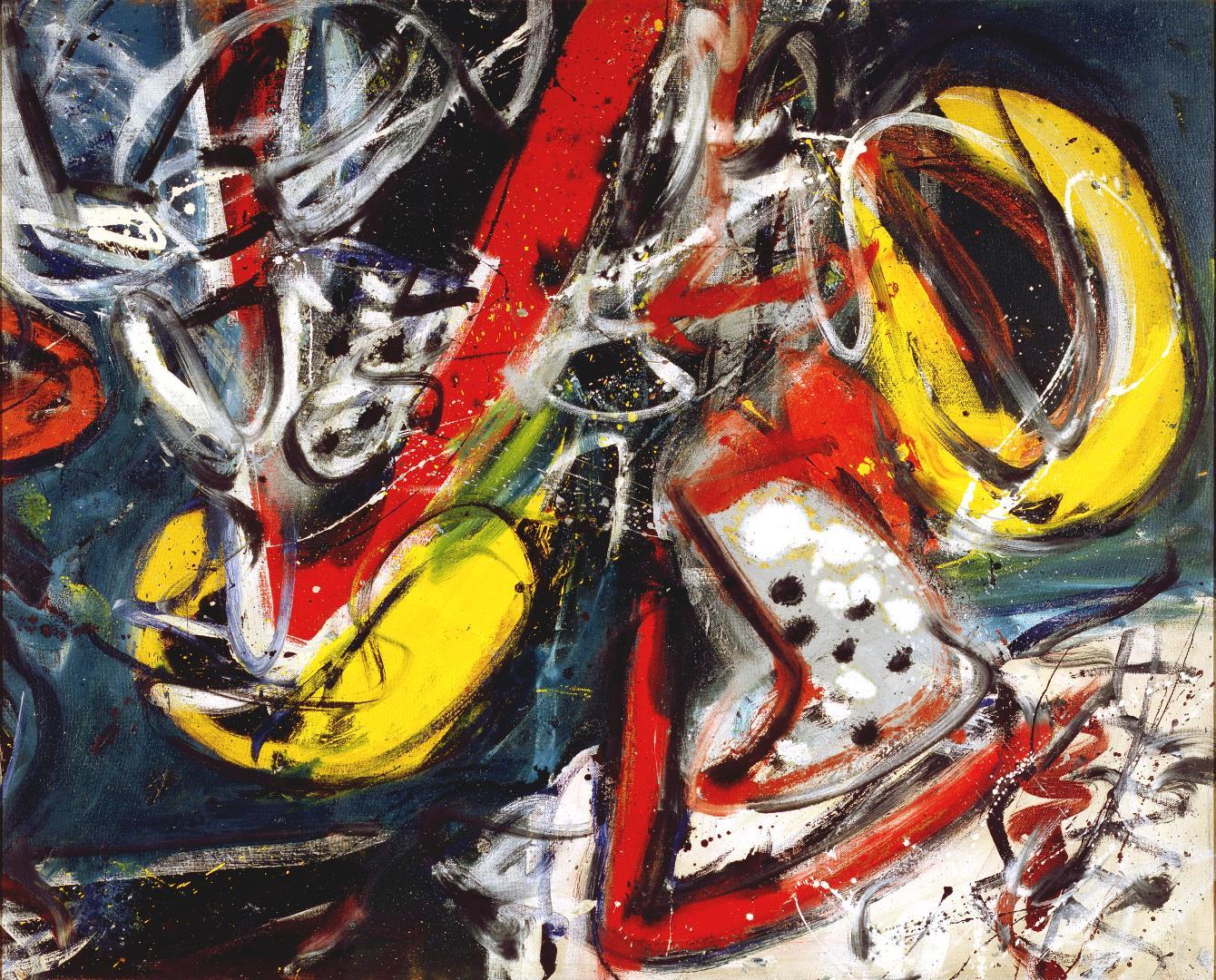
Alan Davie (1920-2014)
Boot it, Inv. PE243


A exposição «Arte Britânica no Século XX» foi organizada pelo British Council, por manifesta vontade da Fundação Calouste Gulbenkian (FCG). O objetivo era apresentar em Portugal um conjunto significativo de obras de arte produzidas no Reino Unido no século XX e representativas de vários movimentos artísticos. Paralelamente, pretendia-se chamar a atenção para a importância das bolsas de arte concedidas pela FCG no seu desenvolvimento: «Our aim would be to send representative works of twenty artists of this century (about three apiece). We would also take the opportunity to show how the Gulbenkian grant is being spent and practical purpose it serves. About half the paintings in an exhibition on these lines would be representational in the traditional sense and about half would be abstract.» (Carta de Lord Bridges para José de Azeredo Perdigão, 26 jan. 1960, Arquivos Gulbenkian, SBA 15339)
As 90 obras apresentadas foram escolhidas por uma comissão de seleção que incluía «o Director da National Gallery de Londres, o Professor de História de Arte do Courtauld Institute, Universidade de Londres, o Presidente do Institute of Contemporary Arts, o antigo Presidente da Fundação da Tate Gallery e a Directora do Serviço de Belas-Artes do British Council» (Nota para imprensa, 13 fev. 1962, Arquivos Gulbenkian, SBA 15339).
O arquiteto José Sommer Ribeiro e o pintor Fernando de Azevedo foram encarregados pela FCG pela conceção do projeto museográfico, dado o sucesso da sua anterior colaboração na «II Exposição de Artes Plásticas» (1961): «[…] e não é de somenos importância sublinhar que este real espírito de cooperação sã e interessada de um e outro [Fernando de Azevedo e Sommer Ribeiro] deram manifesta prova, pois um tal clima é por si mesmo a garantia de que mais se poderá esperar ainda de uma equipe que logo à primeira vez [«II Exposição de Artes Plásticas»] deu tão boa conta de si. Por isso mesmo estamos convencidos de que deve voltar a chamar-se o pintor Fernando de Azevedo, uma vez que a sua substituição reporia em posição inicial e forçosamente problemática a formação de uma nova equipe.» (Apontamento do Serviço de Belas-Artes, 19 fev. 1962, Arquivos Gulbenkian, SBA 15339)
Esta exposição viria a ter uma curta itinerância durante os meses de fevereiro a abril de 1962. Sendo primeiramente apresentada em Lisboa (Sociedade Nacional de Belas-Artes), a sua montagem seguiu-se em Coimbra (Associação Académica de Coimbra) e no Porto (Museu Nacional de Soares dos Reis).
Integradas no âmbito desta mostra foram organizadas três conferências sobre a arte inglesa do século XX, proferidas pelo então diretor do Departamento de Belas-Artes do British Council, Gerald M. Forty.
Leonor de Oliveira, 2015
The exhibition Arte Britânica no Século XX [British Art in the 20th Century], was held by the British Council, as requested by the Calouste Gulbenkian Foundation (FCG).
The aim was to introduce in Portugal a set of significant works of art produced in the United Kingdom during the 20th century that represented several artistic movements, and raise awareness to the importance of art scholarships granted by the FCG in their development:
“(...) our aim would be to send representative works of twenty artists of this century (about three apiece). We would also take the opportunity to show how the Gulbenkian grant is being spent and the practical purpose it serves. About half the paintings in an exhibition on these lines would be representational in the traditional sense and about half would be abstract. (...)” (Letter from Lord Bridges to José de Azeredo Perdigão, 26 Jan. 1960, Gulbenkian Archives, SBA 15339).
The 90 works presented were chosen by a Selection Committee that included “the Director of The National Gallery of London, the Professor of Art History of The Courtauld Institute, London University, the President of the Institute of Contemporary Arts, the former President of the Tate Gallery Foundation and the Director of the Fine Arts Department of the British Council” (Note for the press, 13 Feb. 1962, Gulbenkian Archives, SBA 15339).
The architect José Sommer Ribeiro and the painter Fernando de Azevedo, both from the FCG, were entrusted with the conception of the museum project of this event, due to the success of their previous collaboration in the II Exposição de Artes Plásticas (1961) [II Plastic Arts Exhibition]:
“(...) And it is of no lesser importance to underline that the true spirit of a healthy and willing cooperation from both [Fernando de Azevedo and Sommer Ribeiro] gave evident proof, because such atmosphere is indeed a reassurance of what more can be expected from a team that prospered so well the first time [II Plastic Arts Exhibition]. Therefore, we are convinced that we should hire again the painter Fernando de Azevedo, since his replacement would create a problematic situation as it would be necessary to form a new team” (our translation). (Note from the Fine Arts Department, 19 Feb. 1962, Gulbenkian Archives, SBA 15339)
This exhibition would still have a short itinerancy between February and April of 1962, first being displayed in Lisbon (Sociedade Nacional de Belas-Artes), followed by its installation in Coimbra (Associação Académica) and in Porto (Museu Nacional de Soares dos Reis).
As part of this exhibition, three lectures on British art in the 20th century were organised, given by the Director of the Fine Arts Department of the British Council, Gerald M. Forty.
Boot it, Inv. PE243

The cow that said "how", Inv. PE245

Blue Painting- Venetian Disc and Black Column, Inv. PE214

Rising Wind, Inv. PE187

Maquette for Architectural screen, Inv. EE1

Desolate Beach, Inv. PE206

Red, Black and White "O", Inv. PE231

White Figure, Inv. PE230
Boot it, Inv. PE243
The cow that said "how", Inv. PE245
Blue Painting- Venetian Disc and Black Column, Inv. PE214
Rising Wind, Inv. PE187
Maquette for Architectural screen, Inv. EE1
Desolate Beach, Inv. PE206
Red, Black and White "O", Inv. PE231
White Figure, Inv. PE230