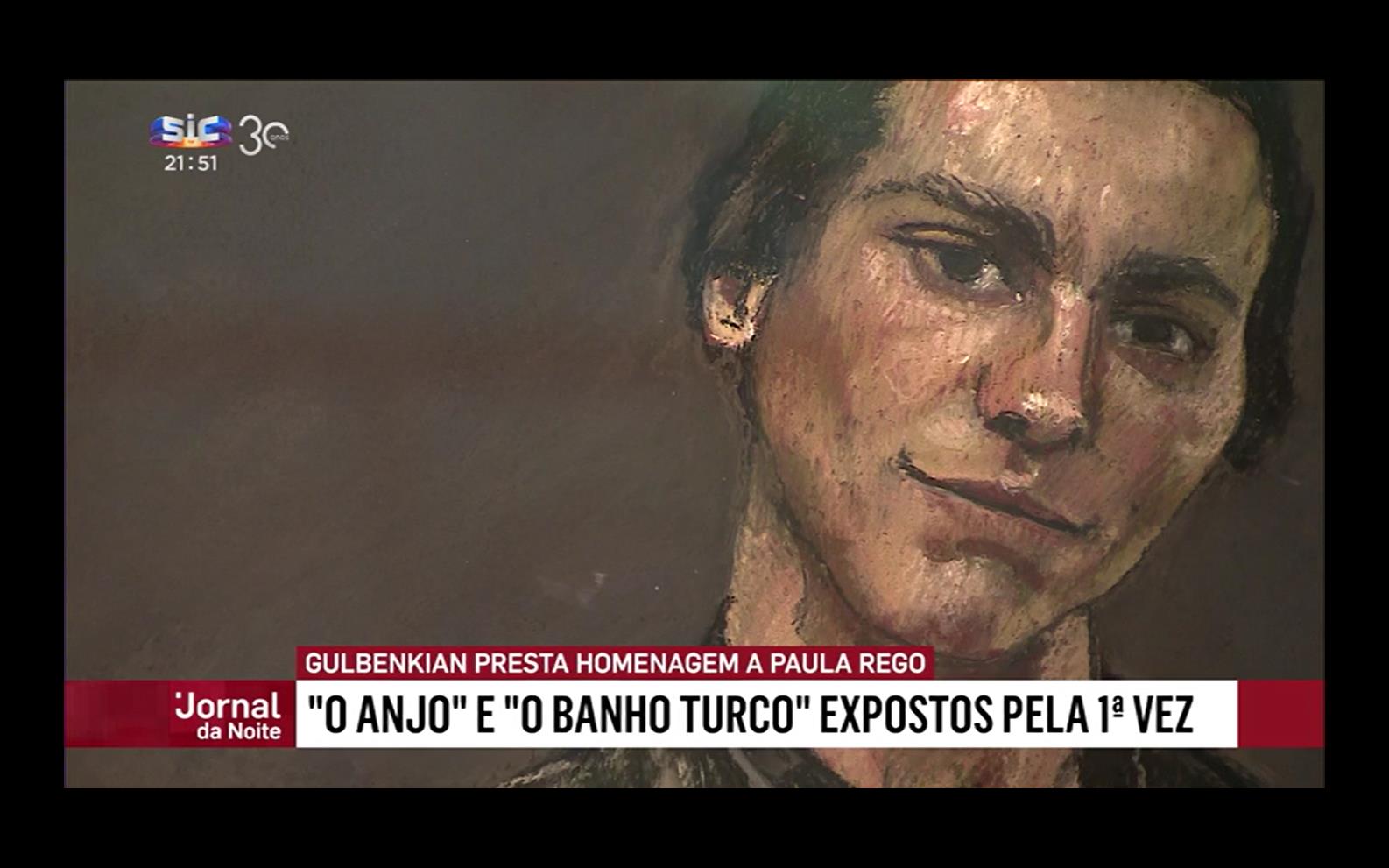
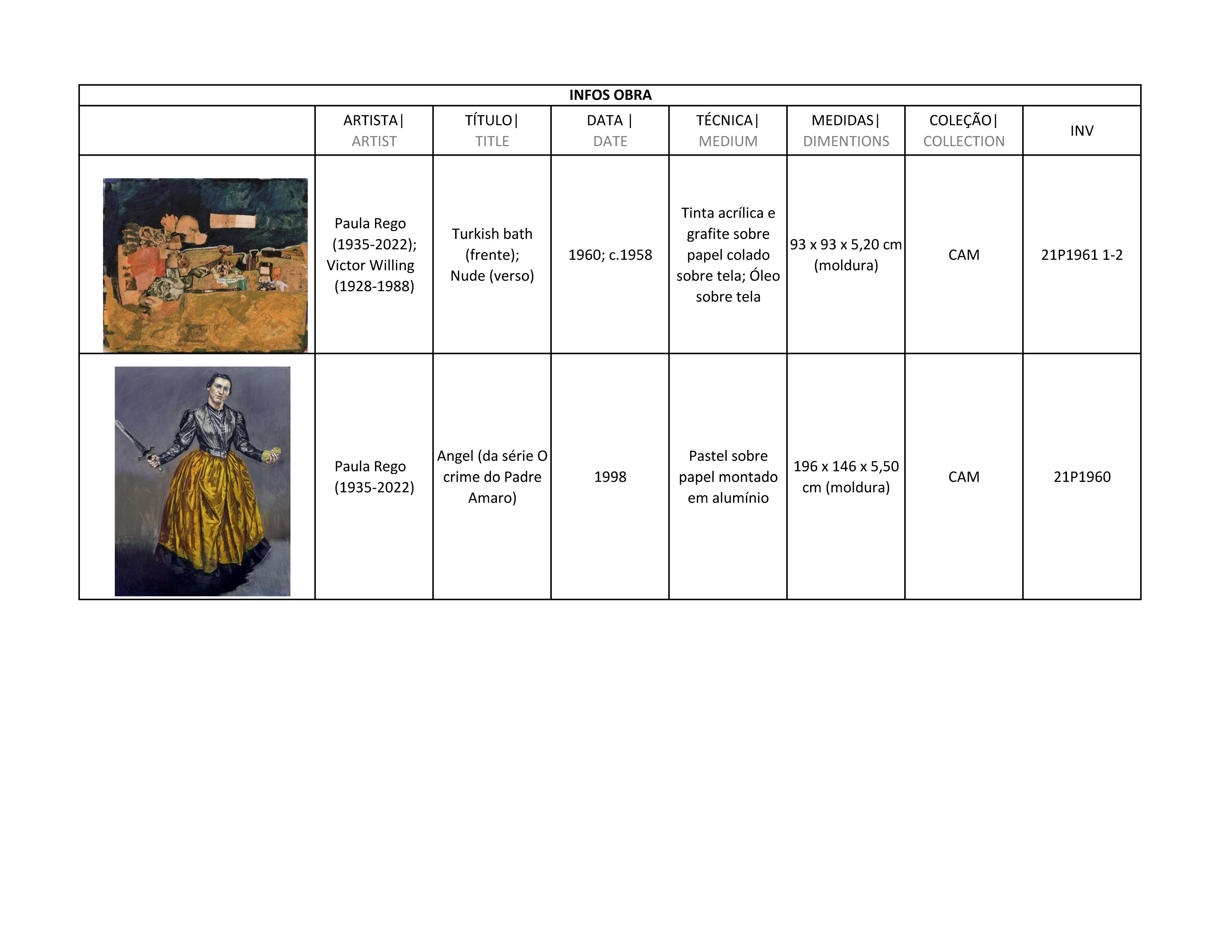
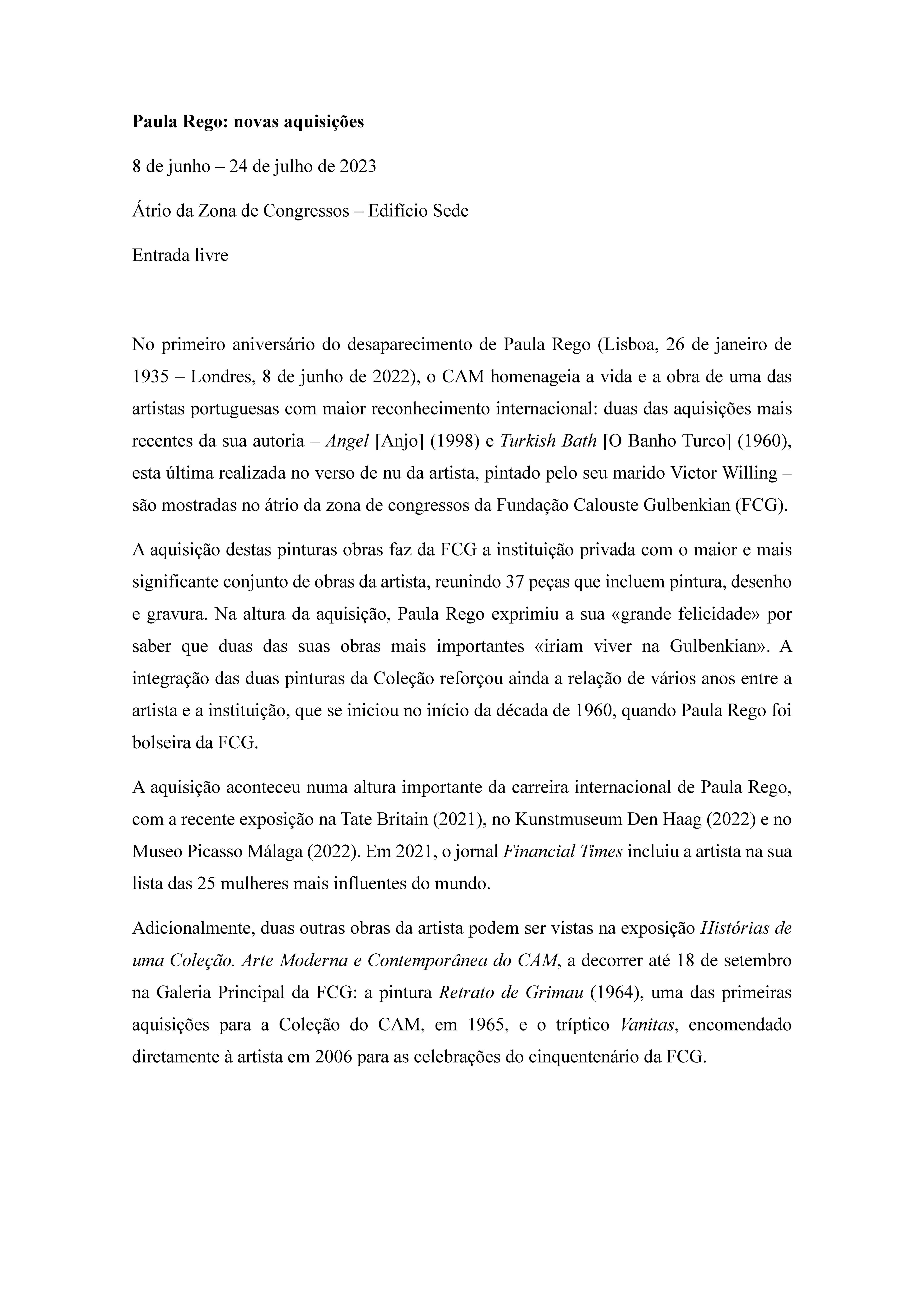
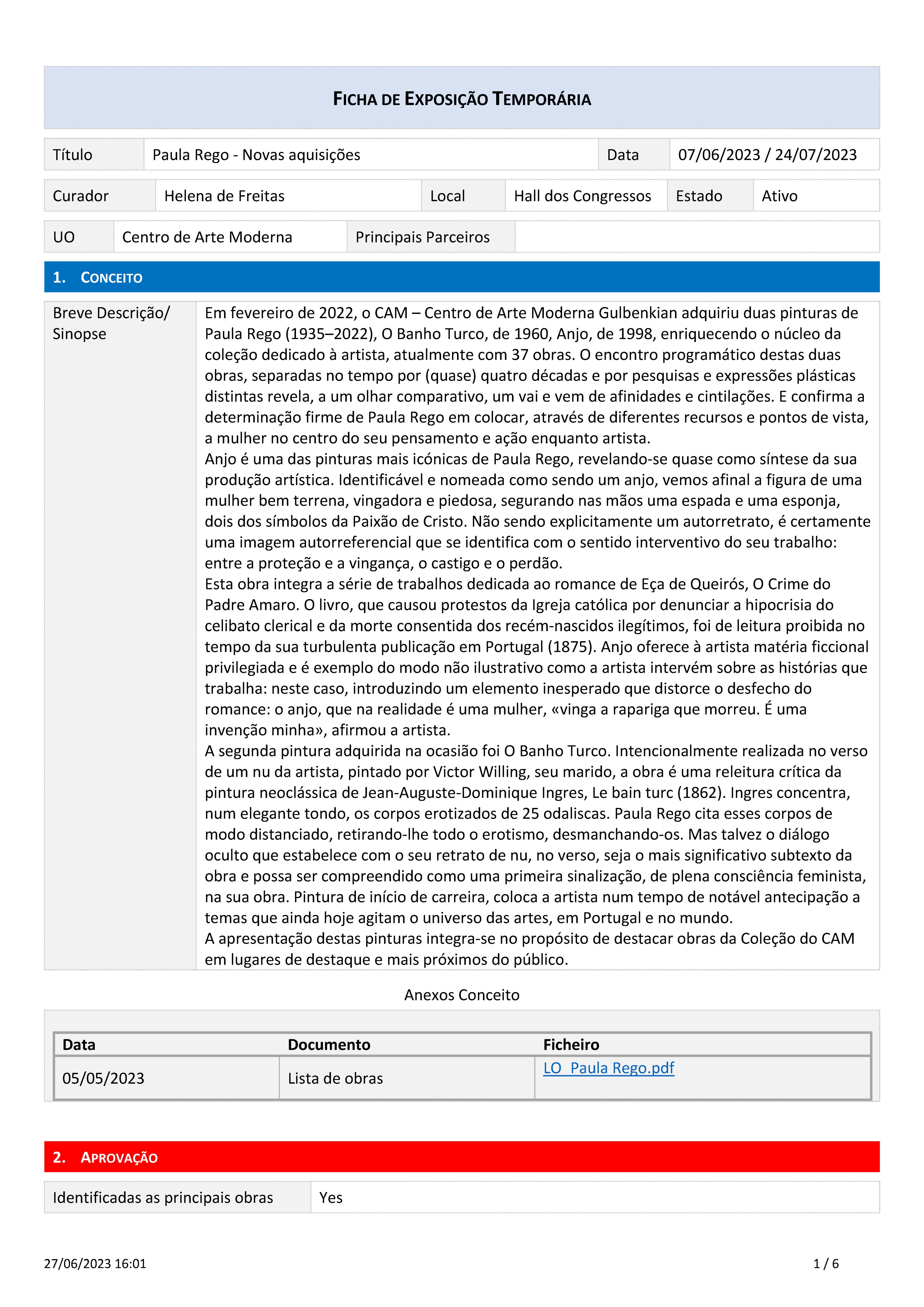
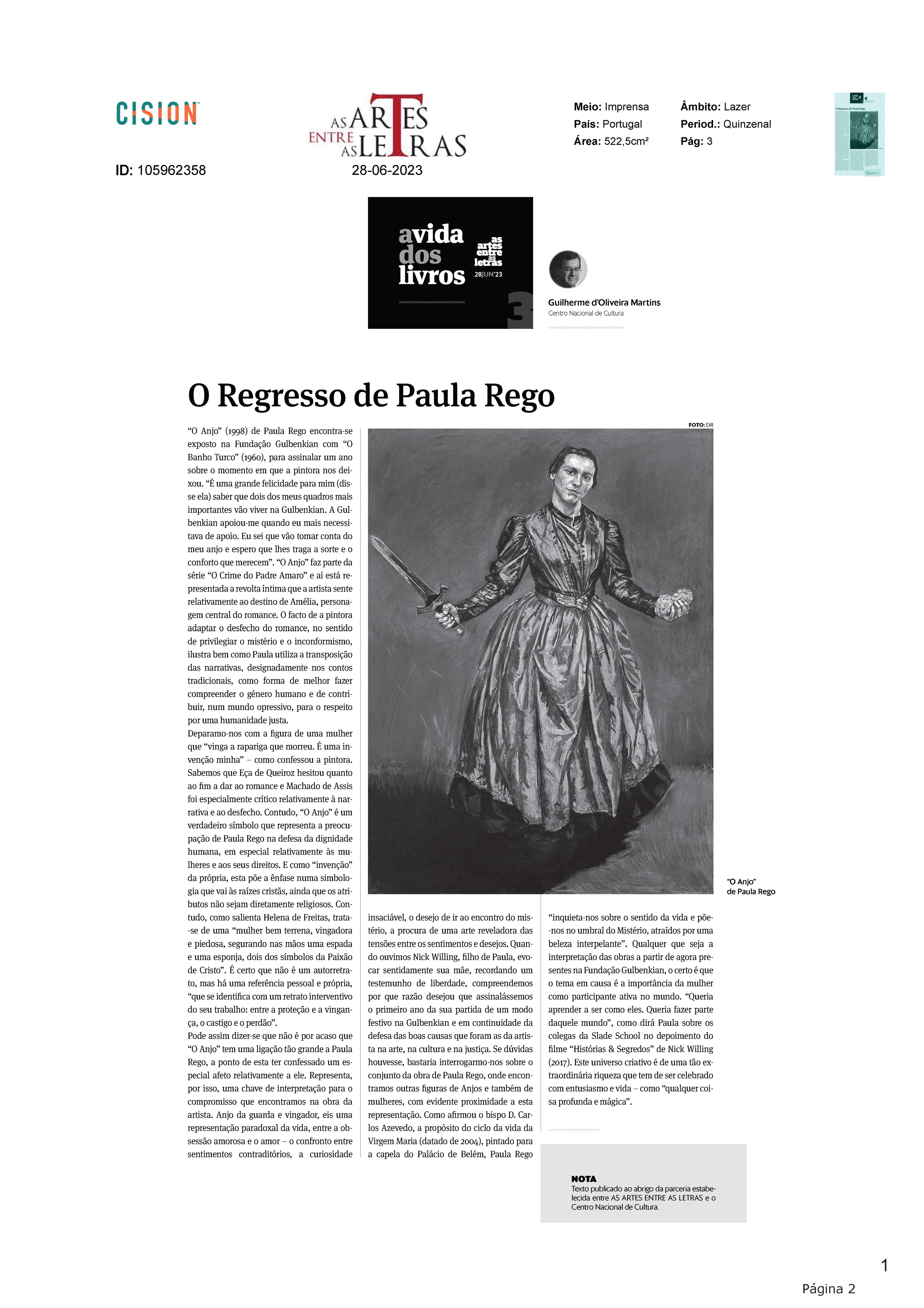
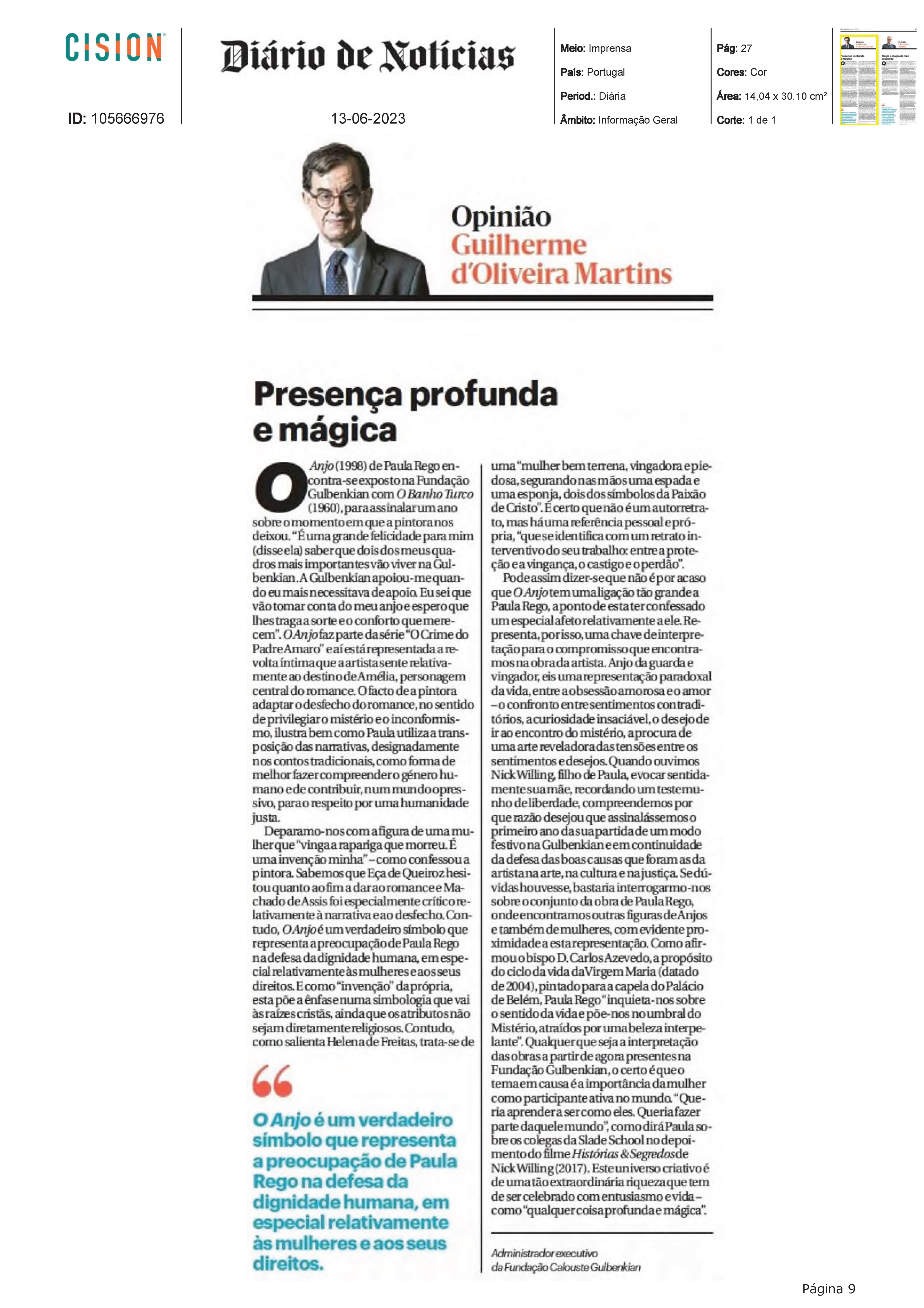
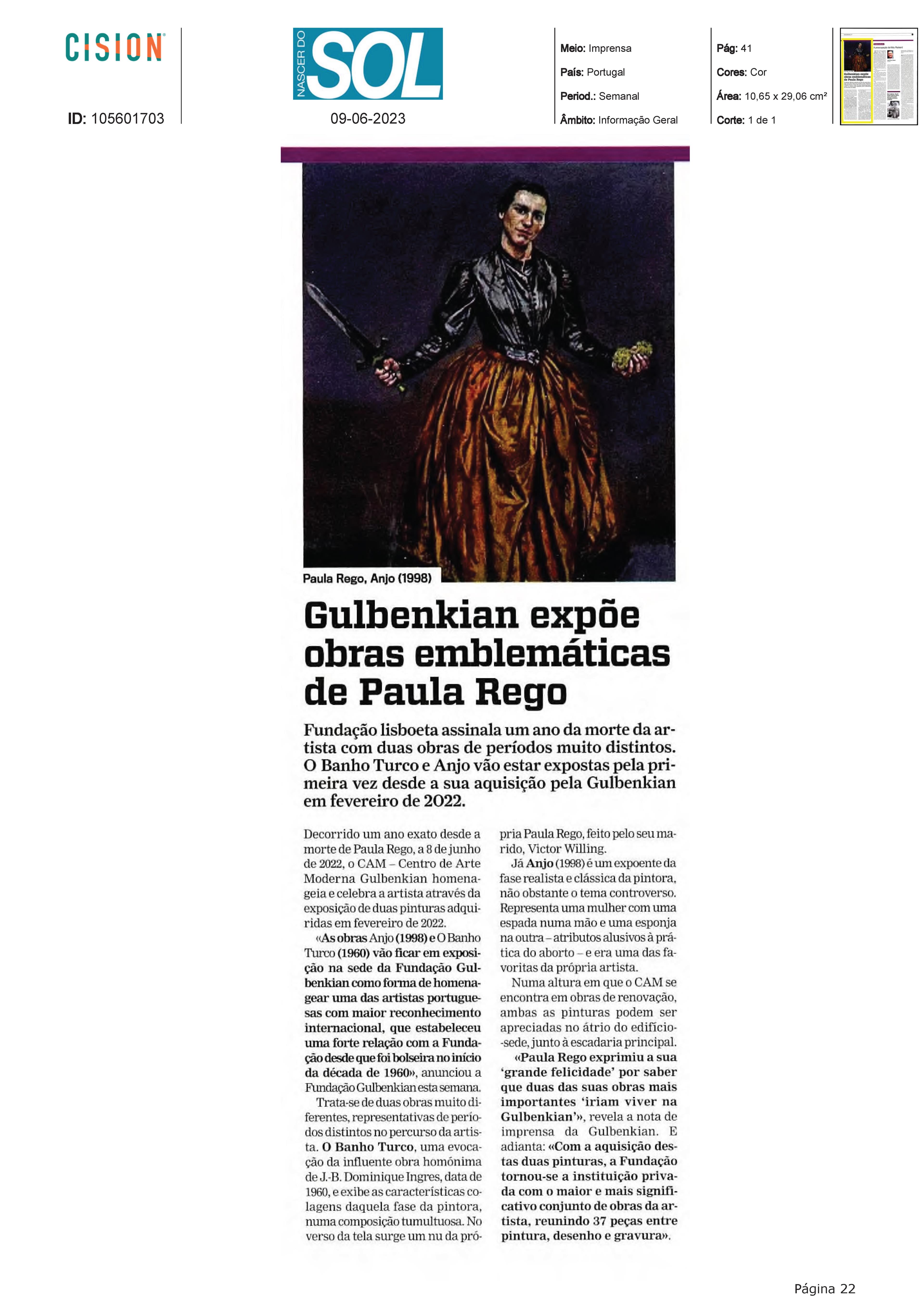
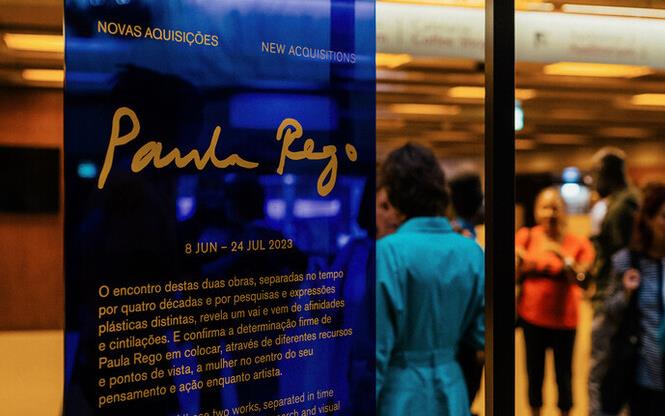
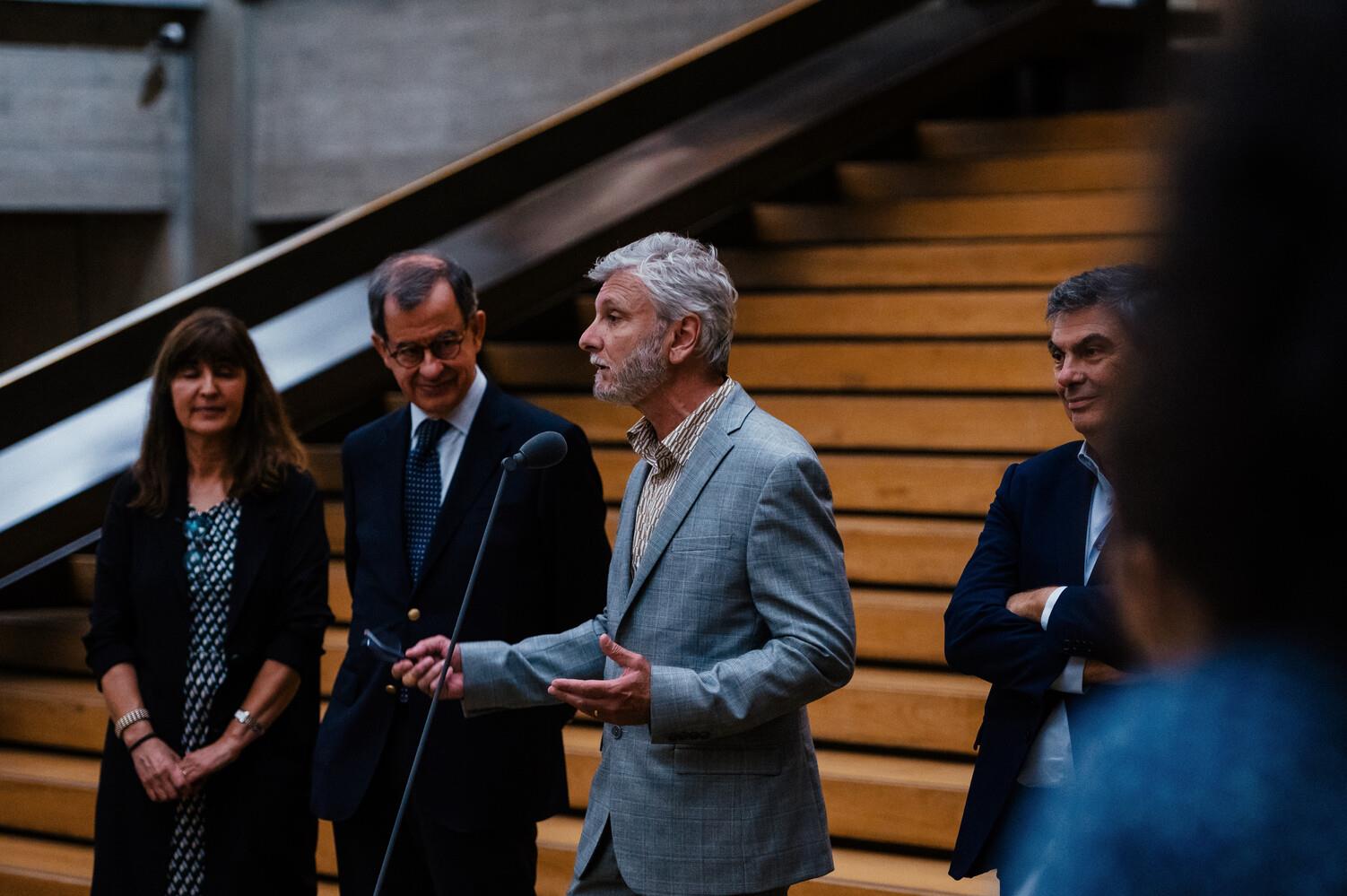
Esta exposição temporária celebrou a aquisição de duas obras de referência da pintora Paula Rego (1935-2022): Turkish Bath [O Banho Turco], realizada em 1960, e Angel [Anjo], datada de 1998, ambas raramente expostas em Portugal. Organizada pelo Centro de Arte Moderna, teve lugar na Sala de Congressos do Museu Gulbenkian, sendo inaugurada a 8 de junho de 2023, exatamente um ano após o falecimento da artista, em Londres.
This pop-up exhibition celebrated the acquisition of two major works by Paula Rego (1935-2022), Turkish Bath produced in 1960 and Angel, dating from 1998, both rarely shown before in Portugal. The exhibition was organised by the Modern Art Centre (CAM) in the Congress Hall of the Gulbenkian Museum and opened on June 8 of 2023 — exactly one year after Paula Rego’s death in London.
Com curadoria de Helena de Freitas e produção de Laura Almeida, a exposição teve como objetivo revelar as duas obras adquiridas entre dezembro de 2021 e fevereiro de 2022, através da Ostrich Arts Limited – empresa londrina criada por Paula Rego em 1997 para gerir os seus projetos artísticos e profissionais, e que, desde 2013, é integralmente gerida pelos herdeiros.
A aquisição, promovida por Helena de Freitas, curadora sénior do Centro de Arte Moderna (CAM), veio consolidar a já significativa secção dedicada à artista na coleção do CAM, atualmente detentor de 37 obras de Paula Rego – o que faz dela a maior coleção institucional da artista em Portugal. Este núcleo é composto maioritariamente por pinturas, desenhos e esculturas têxteis, somando cinco décadas de produção, de 1958 a 2006.
A mostra inseriu-se num conjunto recente de exposições dedicadas à artista, organizadas por várias instituições, tanto em Portugal como no estrangeiro. Recorde-se que a primeira exposição individual de Paula Rego teve lugar na SNBA, em Lisboa, em 1965-1966, durante o regime salazarista – período marcado pelas guerras coloniais e pela crescente repressão estatal à oposição política na sociedade civil. Essa mostra pioneira reuniu 19 dos trabalhos iniciais da artista, incluindo colagens e pinturas arrojadas, politicamente subversivas e experimentais. Coincidindo com as comemorações dos cinquenta anos da Revolução dos Cravos, esta exposição individual foi recriada no âmbito de uma mostra mais ampla na Casa das Histórias, em Cascais, sob a direção das curadoras Catarina Alfaro e Leonor de Oliveira (abril-outubro de 2024).
Em 1999, o programa da Fundação Calouste Gulbenkian para o Dia Internacional dos Museus do ICOM assinalou a inauguração de uma dupla exposição individual de Paula Rego. Pela primeira vez em Portugal, foram apresentadas duas séries desenvolvidas no final da década de 1990: The Crime of Father Amaro [O Crime do Padre Amaro], inspirada no romance homónimo de Eça de Queirós, e Untitled [Sem Título], um conjunto de desenhos sobre o tema tabu do aborto. As duas séries ocuparam a Galeria de Exposições Temporárias do Centro de Arte Moderna. Angel [Anjo] integrou a exposição e foi a imagem escolhida para figurar no cartão de convite.
Em 2007, o Museo Nacional Centro de Arte Reina Sofía, em Madrid, organizou uma das primeiras retrospetivas da obra de Paula Rego, abrangendo diferentes fases e registos artísticos da sua carreira. Em 2010, em parceria com a Casa das Histórias, o Museo de Arte Contemporáneo de Monterrey, no México, apresentou a primeira retrospetiva da obra de Paula Rego na América Latina. Esta exposição, que incluiu Angel [Anjo], viajou em seguida para a Pinacoteca de São Paulo, no Brasil, em 2011.
Em 2018-2019, o Musée de L'Orangerie, em Paris, organizou a primeira exposição de Paula Rego em França – que foi também a primeira mostra dedicada a uma artista viva na história do museu. Intitulada «Les contes cruels de Paula Rego», a exposição de Paris centrou-se na forma como a artista reinterpretava contos populares e histórias infantis, bem como nas suas próprias experiências de vida e memórias. Incluindo Angel [Anjo] entre quase 70 pinturas e desenhos selecionados, a exposição refletia as meditações da artista sobre a condição humana, com as suas alegrias e tristezas, tragicomédias e jogos de poder implacáveis, repletos de ambiguidade, artimanhas, abusos e injustiças.
Além disso, ofereceu ao público francês um vislumbre de alguns dos quadros típicos criados pela artista no seu ateliê de Londres, com modelos tridimensionais concebidos como base para as suas pinturas. Estas composições, que misturam ficção e referências da realidade, combinam bonecas, manequins e efígies, animais empalhados, objetos do quotidiano, caveiras e máscaras. Juntamente com uma reconstrução de algumas das instalações utilizadas para as pinturas de grande formato apresentadas na exposição, foi exibida a pequena escultura hiper-realista Pinocchio (1996), de Ron Mueck. De facto, Paula Rego estabeleceu uma espécie de colaboração com o escultor australiano radicado no Reino Unido – a escultura de Mueck serviu de modelo ao seu Geppetto washing Pinocchio [Gepetto a lavar o Pinóquio] (1996), entre outras pinturas.
Mais recentemente, a Tate Britain organizou uma extensa retrospetiva da obra de Paula Rego, reunindo mais de uma centena de obras, incluindo pinturas, desenhos, gravuras, esculturas e colagens, produzidos entre as décadas de 1950 a 2010. Tanto Turkish Bath [O Banho Turco] como Angel [Anjo] integraram a exposição. Para esta ocasião, o Centro de Arte Moderna cedeu dez obras da coleção da artista, entre as quais S. Vomiting the Pátria [Salazar a vomitar a Pátria] (1960), Manifesto (For a lost cause) [Manifesto (Por uma causa perdida)] (1965) e seis guaches da série Portuguese Folk Tales [Contos Populares Portugueses] (1974-1975).
Antes da sua aquisição pelo CAM, ambas as obras tinham já sido expostas em importantes instituições nacionais e internacionais. Após a retrospetiva na Tate Britain, em 2021, seguiram para o Kunstmuseum Den Haag, nos Países Baixos, e para o Museo Picasso, em Málaga. Importa ainda referir que, entre 2009 e 2019, estas duas peças integraram temporariamente a coleção da Casa das Histórias, ao abrigo de um contrato de comodato entre Paula Rego e a Câmara Municipal de Cascais.
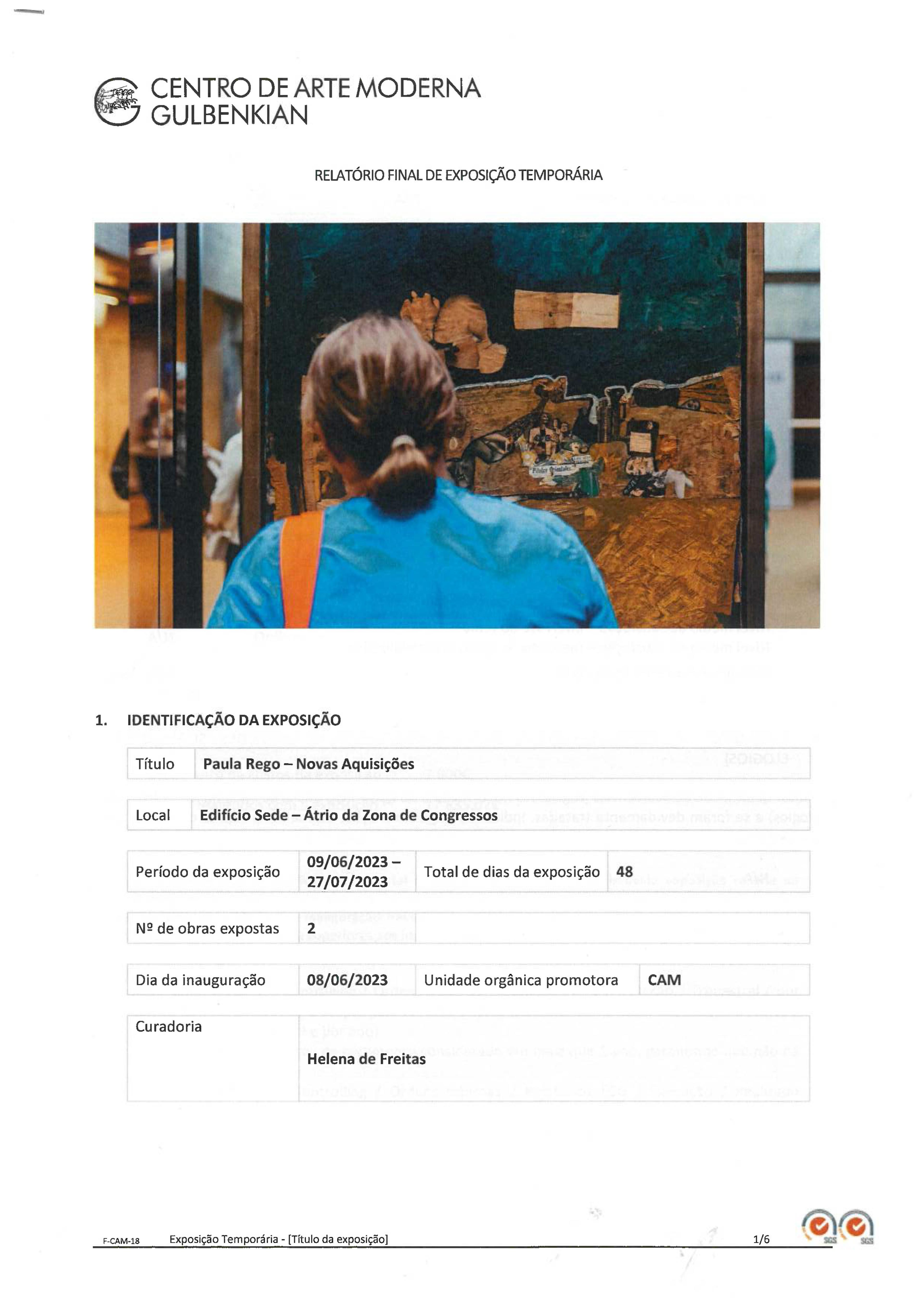
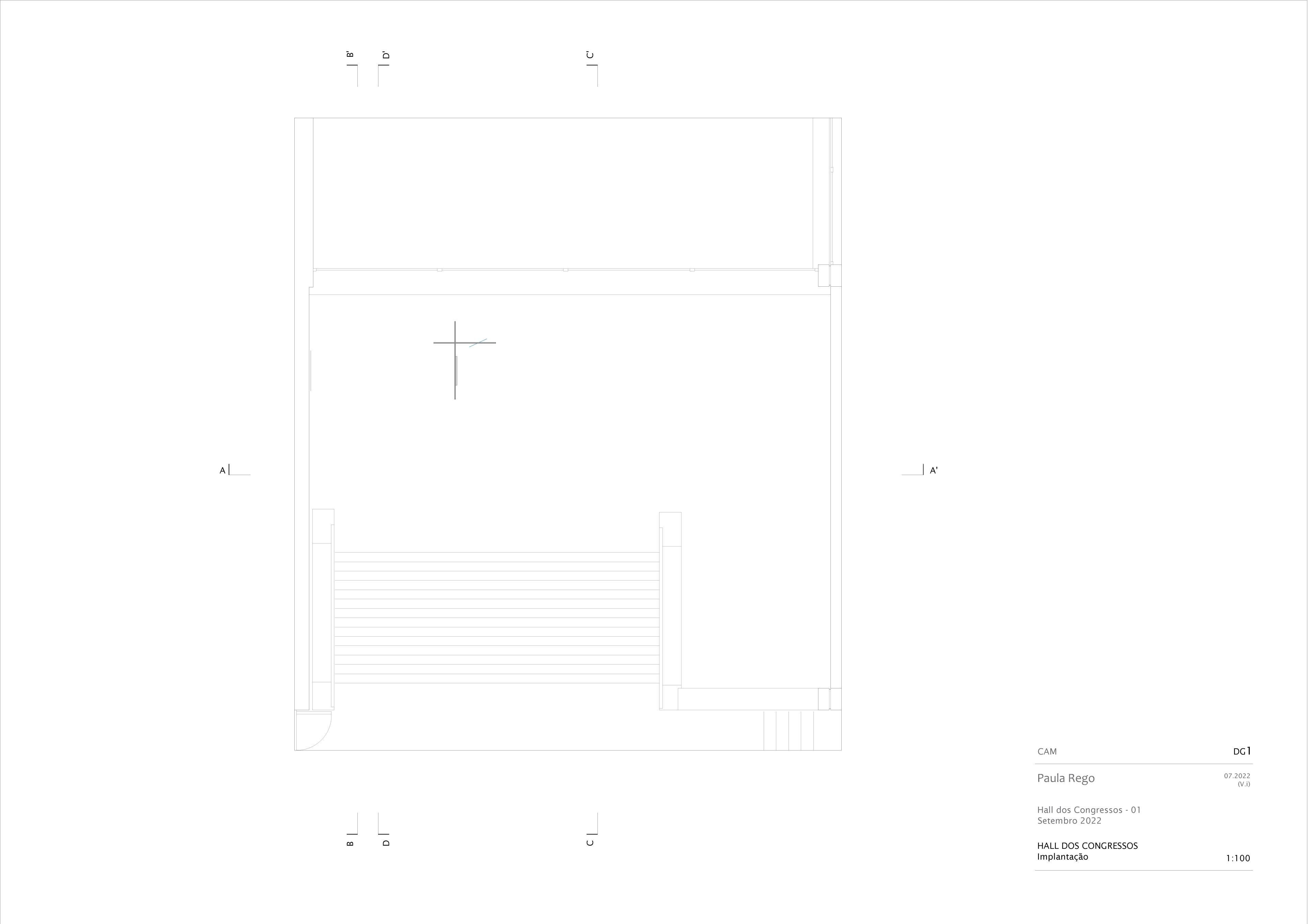
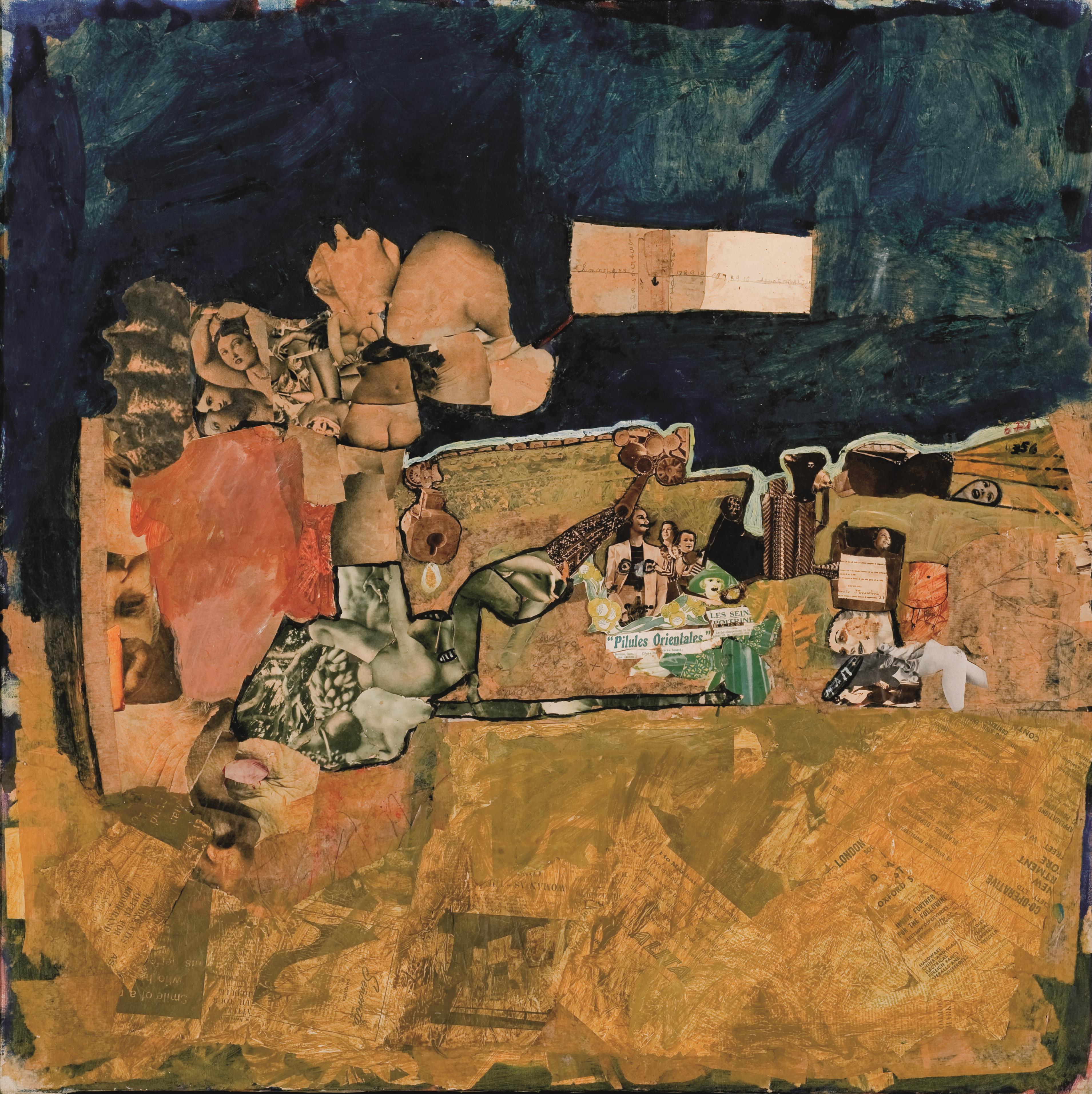
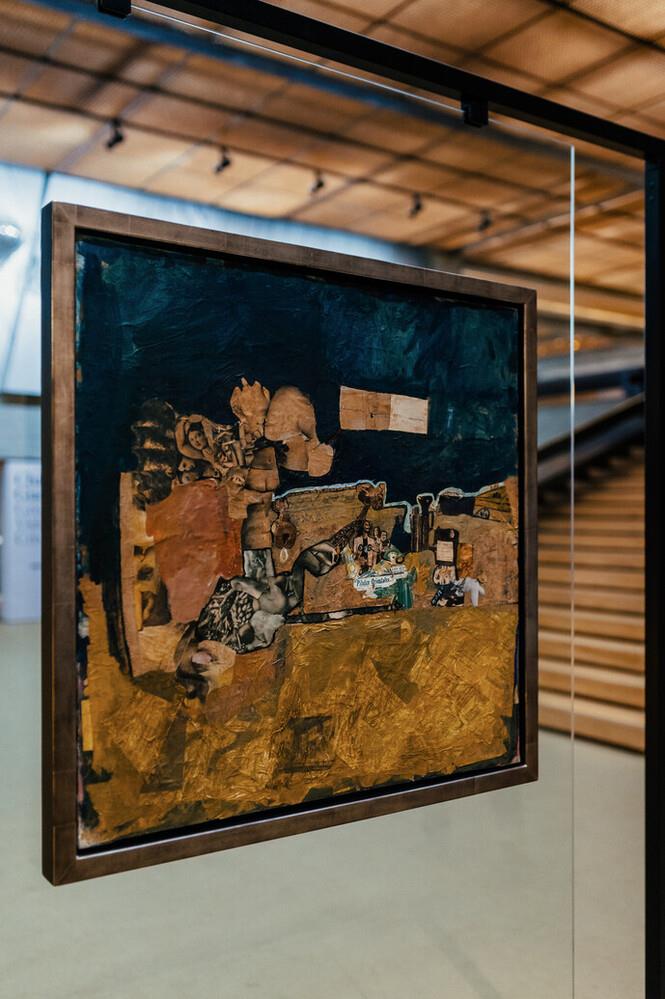
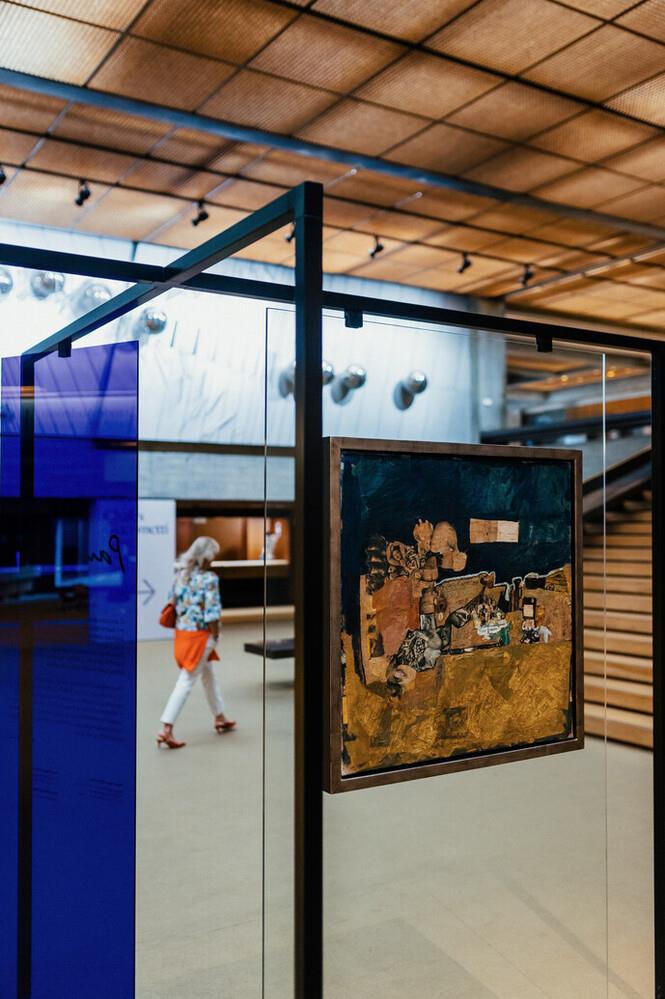
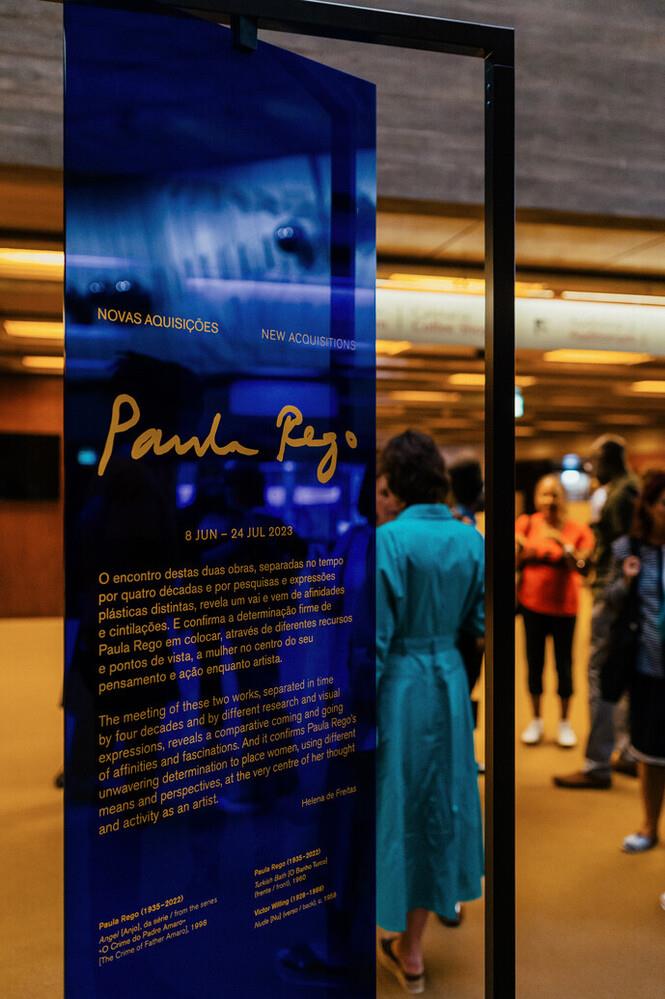
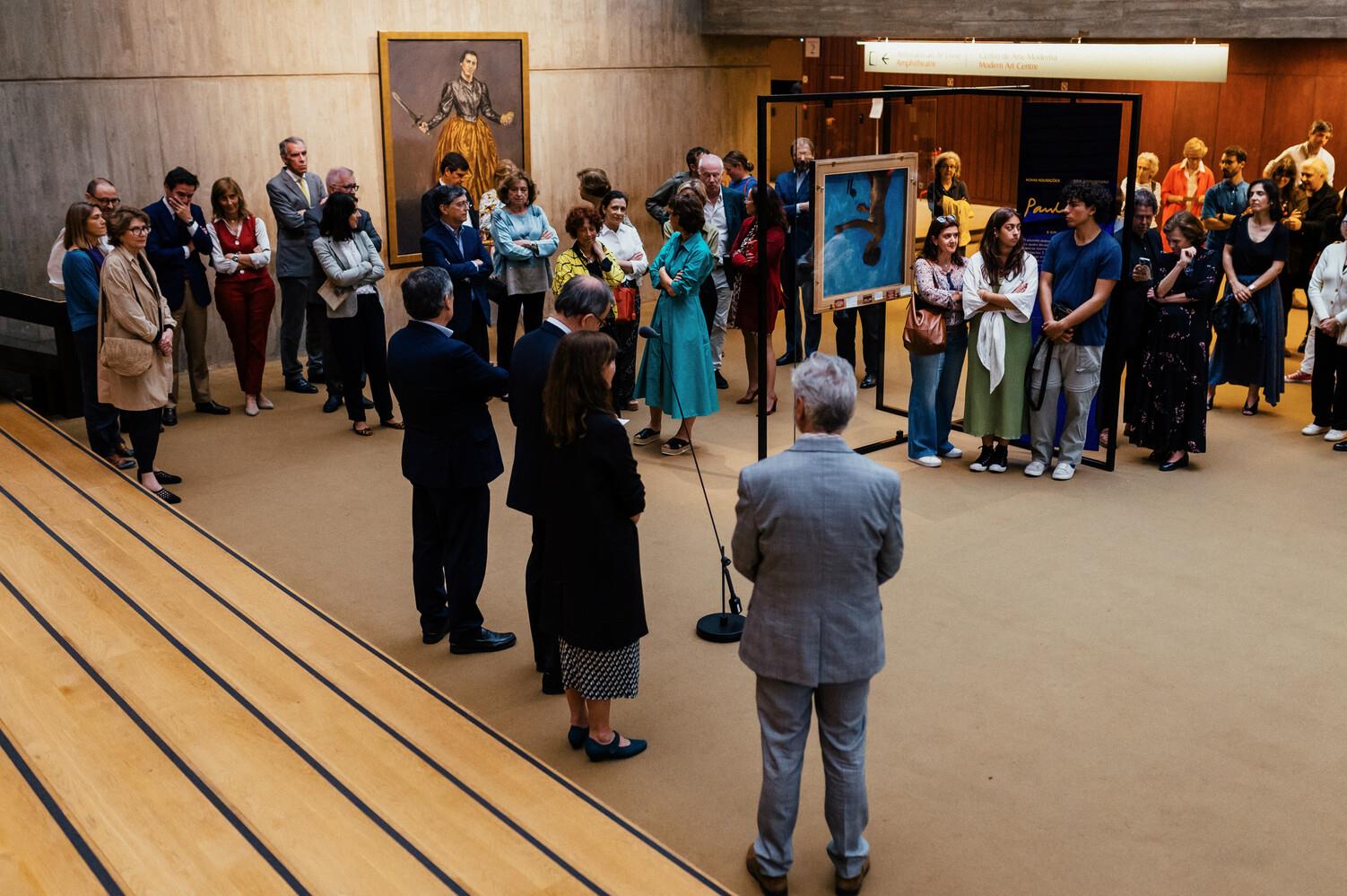
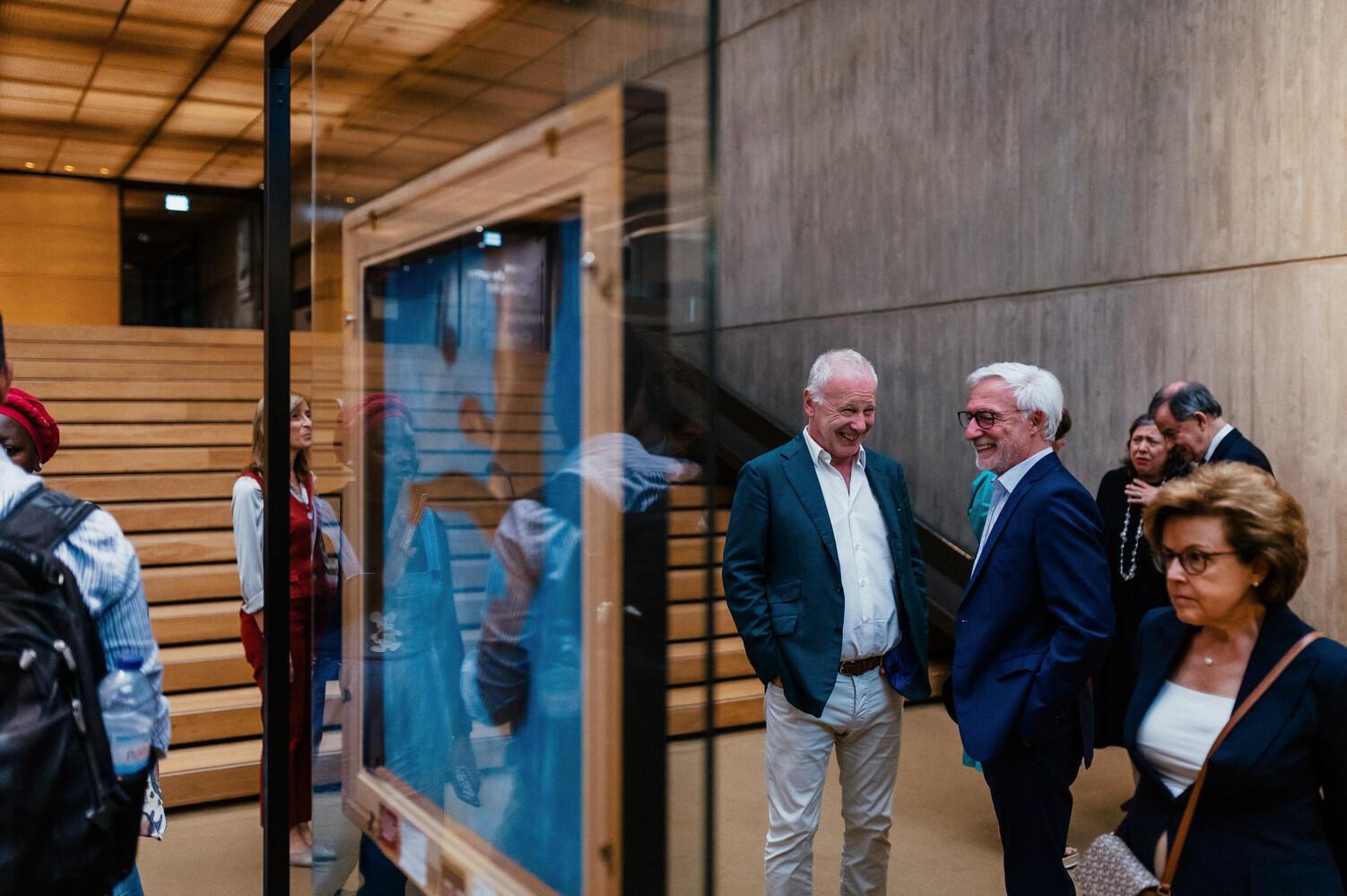
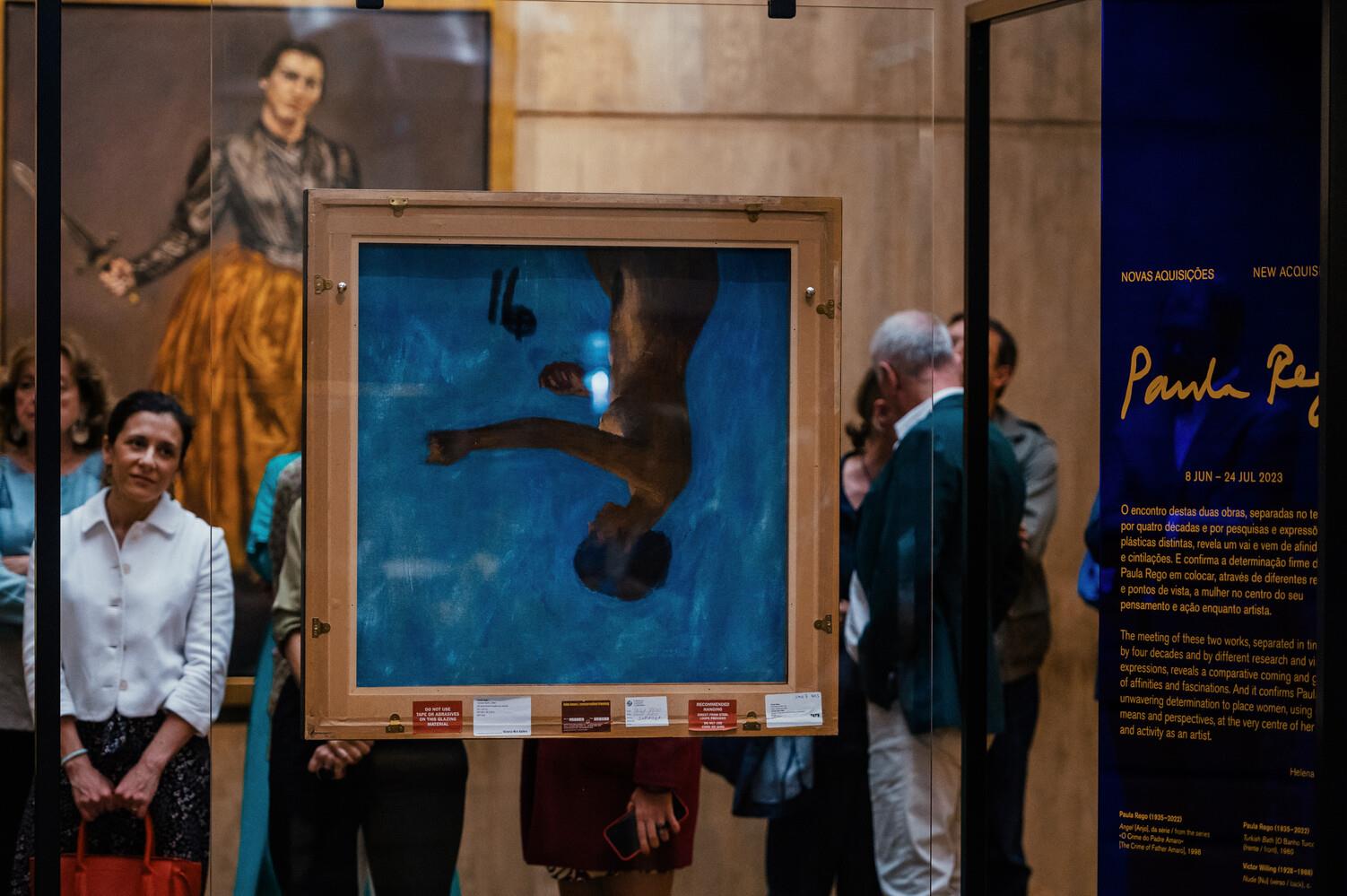
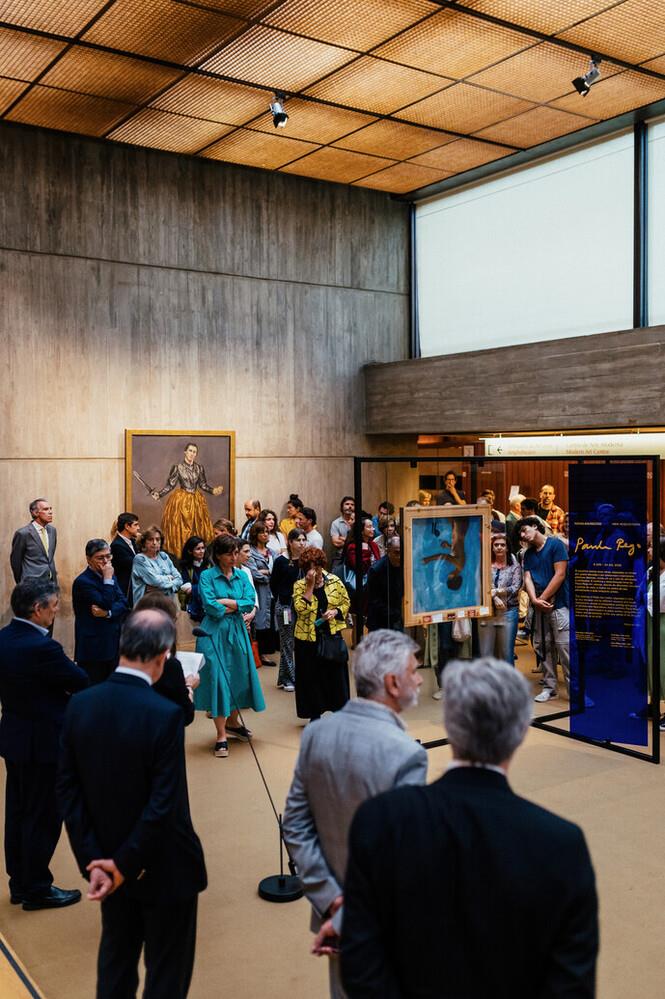
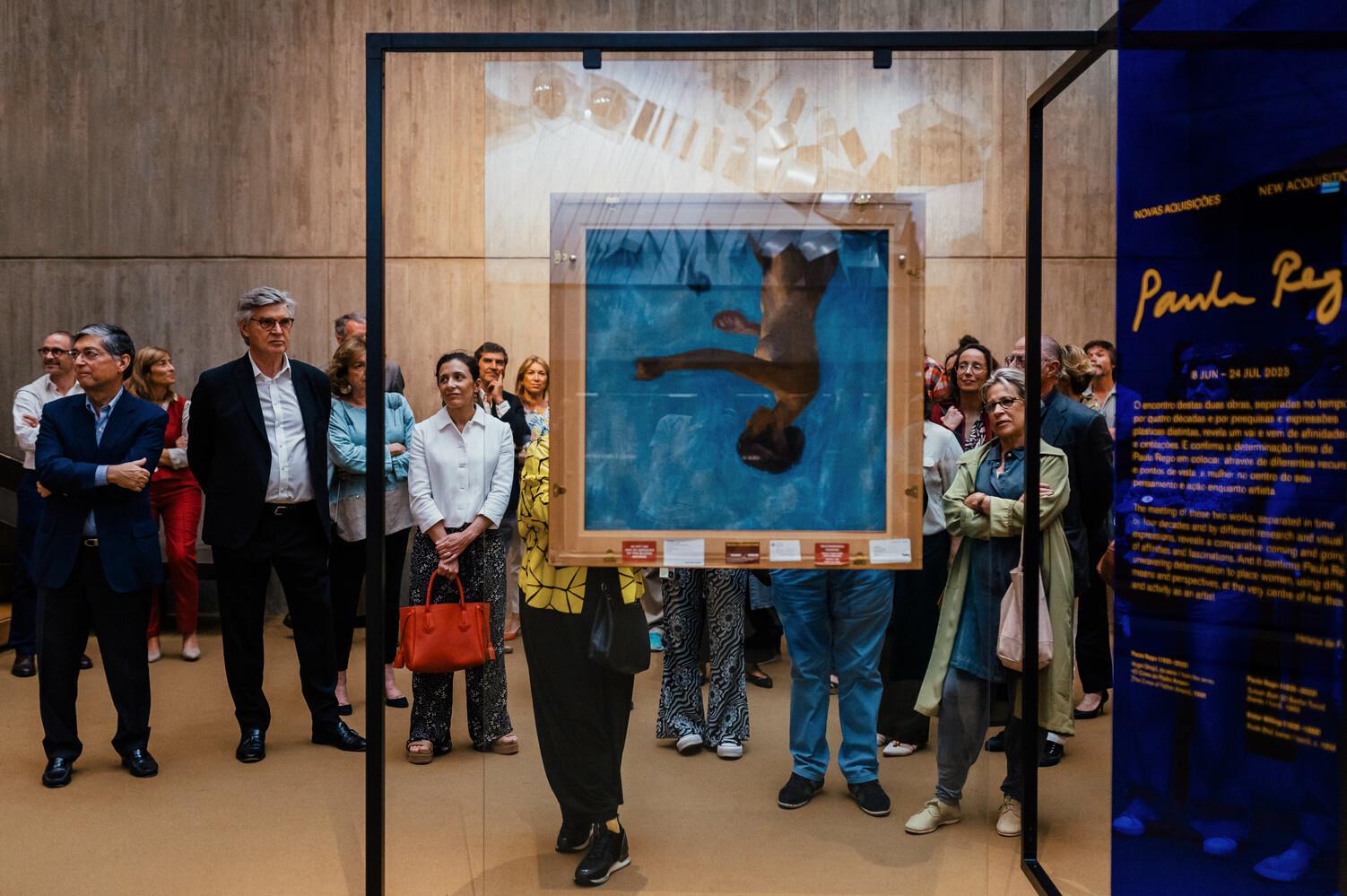
Em junho de 2023, a exposição temporária instalada na escadaria de acesso à Sala de Congressos da Fundação Gulbenkian juntou Angel [Anjo], numa moldura convencional de madeira montada na parede, e Turkish Bath [O Banho Turco], num dispositivo montado no chão, composto por painéis de vidro e metal pintado de preto. Inserido no painel de vidro, com a sua moldura prateada e minimalista, Turkish Bath [O Banho Turco] (tinta acrílica, grafite e colagem sobre uma tela quadrada de 93 × 93 cm) parecia flutuar no espaço. Este dispositivo permitiu ao público circular em torno da estrutura e contemplar tanto a frente como o verso da tela. A obra Turkish Bath [O Banho Turco] foi, de facto, pintada no verso de um retrato nu de Paula Rego, realizado em 1958 pelo seu marido Victor Willing (1928-1988).
Desenhado sobre um fundo azul monocromático e abstrato, o corpo nu da artista, de perfil, surge invertido, de forma a apresentar Turkish Bath [O Banho Turco] na posição certa. Este nu de Willing, anteriormente visível no anverso e agora oculto no verso após o emolduramento, introduz uma dimensão de complexidade e intimidade à obra de Paula Rego. Com esta colagem, a artista faz referência direta à história da arte do século XIX, evocando Le Bain turc, célebre pintura de Jean-Auguste-Dominique Ingres, realizada em 1859. A tela, originalmente de forma retangular, foi transformada num tondo em 1862 pelo próprio Ingres.
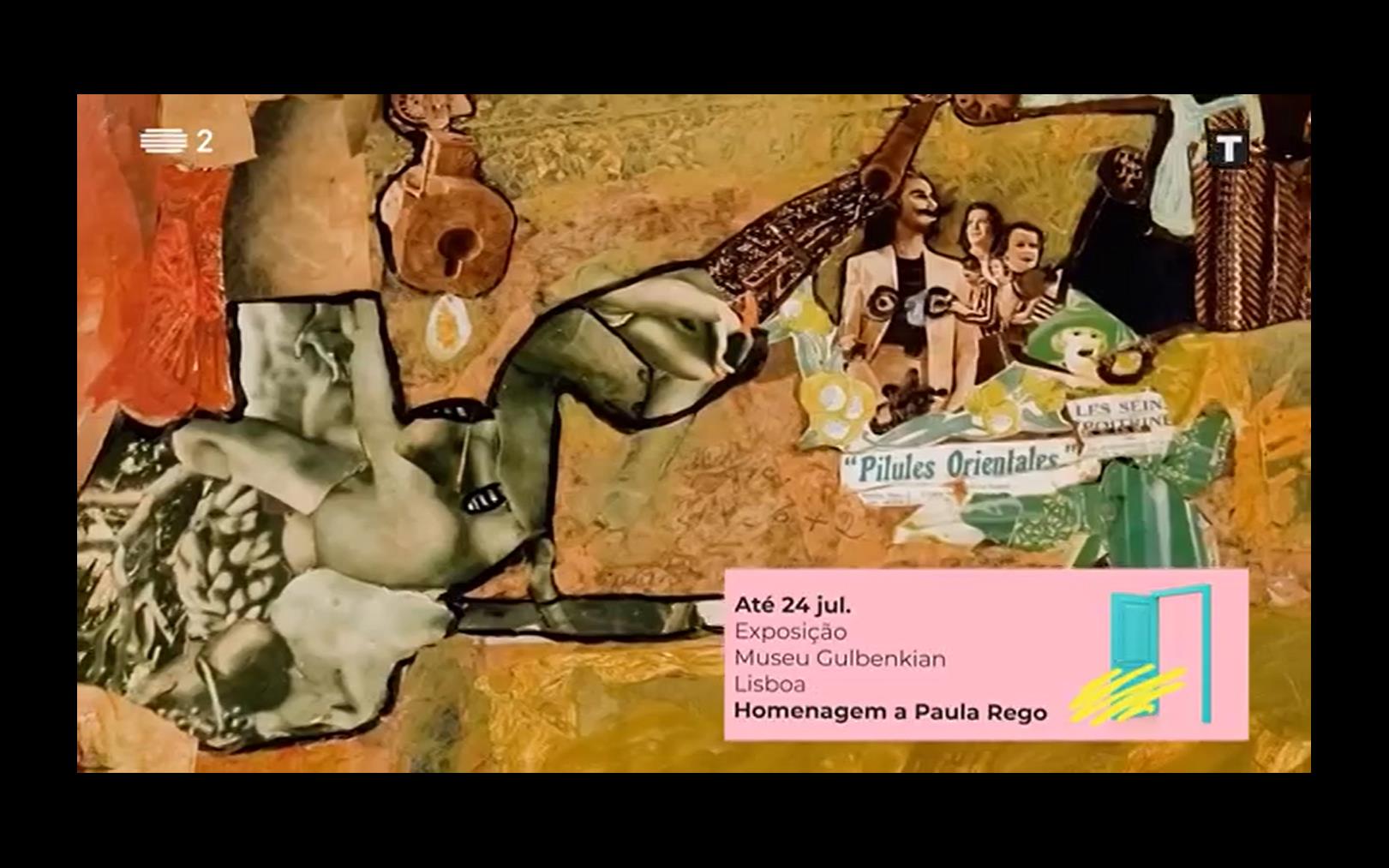
Se a obra-prima de Ingres – com as suas 25 mulheres nuas a banharem-se de costas, de frente, de perfil e a três quartos, sentadas, de pé ou a dançar – está repleta do erotismo exótico do Romantismo tardio, Paula Rego atenua qualquer carga erótica e exótica, ancorando a sua peça num cenário conceptual e esteticamente contemporâneo. Engenhosa miscelânea que combina abstração e motivos figurativos ambíguos, a obra inclui ainda colagens de fotografias a preto-e-branco, reproduções de obras de arte e recortes de jornais e revistas, cobertos por finas camadas translúcidas de tinta amarelada. Num espírito algo neodadaísta, a artista justapõe fragmentos das odaliscas nuas de Ingres com imagens de mulheres modernas completamente vestidas, sob as quais cola o recorte de um anúncio de um composto farmacêutico: as outrora famosas Pilules Orientales. Evocando a lascívia do harém dos sultões, estes comprimidos – criados em 1886 por um farmacêutico parisiense – foram comercializados durante décadas para as mulheres, com o objetivo de lhes realçar os seios e as curvas.
Enquanto Angel [Anjo] é particularmente emblemático da personalidade e da maturidade estilística alcançadas por Paula Rego nas fases posteriores da sua carreira, Turkish Bath [O Banho Turco] reflete a fase crua e experimental do seu trabalho nos anos 60, influenciada pela descoberta de Jean Dubuffet e da sua estética visceral e anticonformista. Mas, embora Turkish Bath [O Banho Turco] tipifique esta etapa inicial da sua produção, a obra determina o estilo de toda a sua carreira. Ao entrar inevitavelmente em diálogo intimista com duas obras masculinas – o nu pintado por Willing e o universo sensual e onírico de Le Bain turc de Ingres –, a pintura de Paula Rego representa uma expressão precoce do seu temperamento. As intervenções que realiza diretamente no verso da tela de Willing, aliadas à desconstrução irónica da obra de Ingres, fazem de Turkish Bath [O Banho Turco] um precursor da produção posterior da artista, revelando o seu caráter crítico e radical, bem como o desejo de transformar o mundo a partir da sua perspetiva, perceção e experiência vivida.
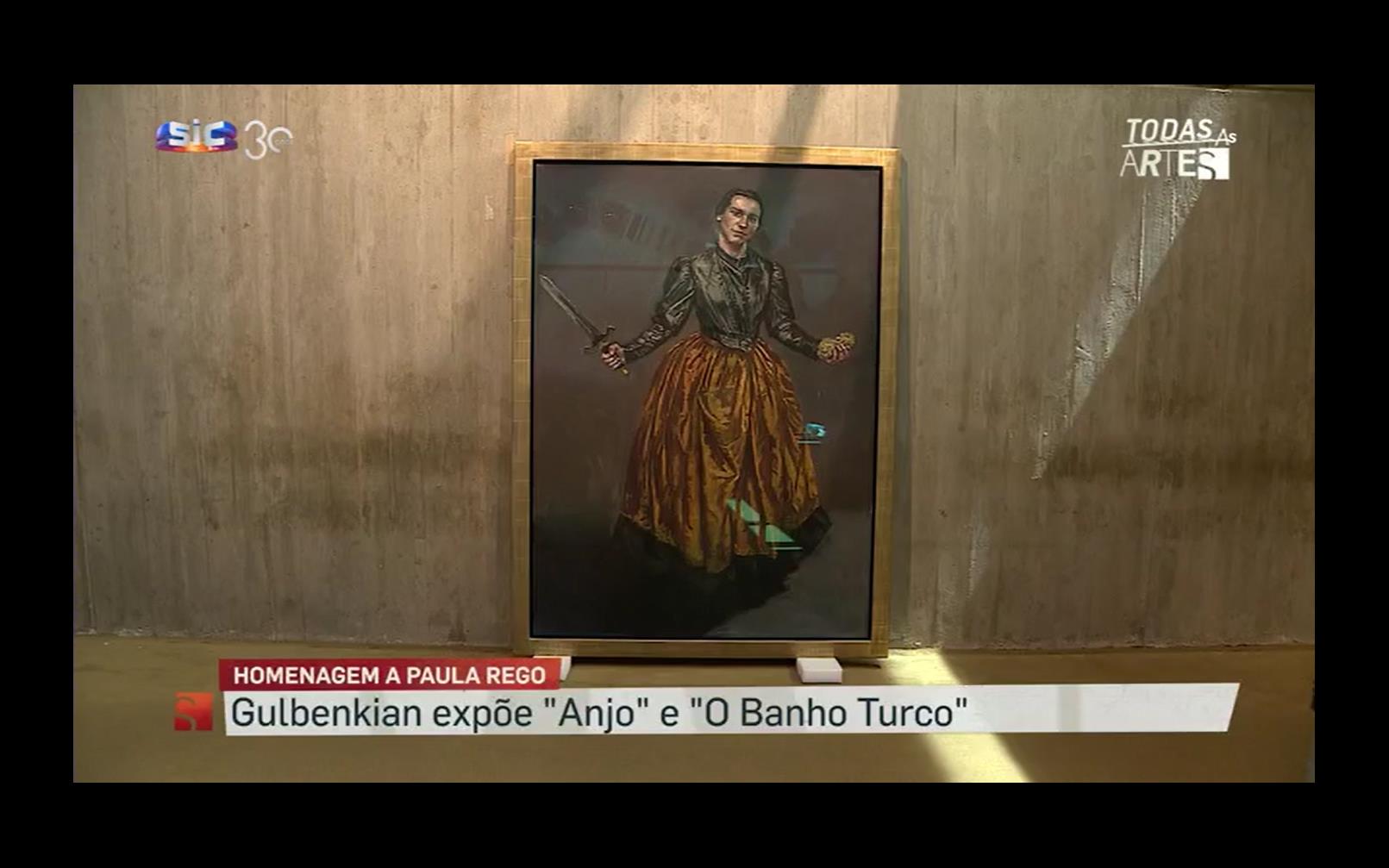
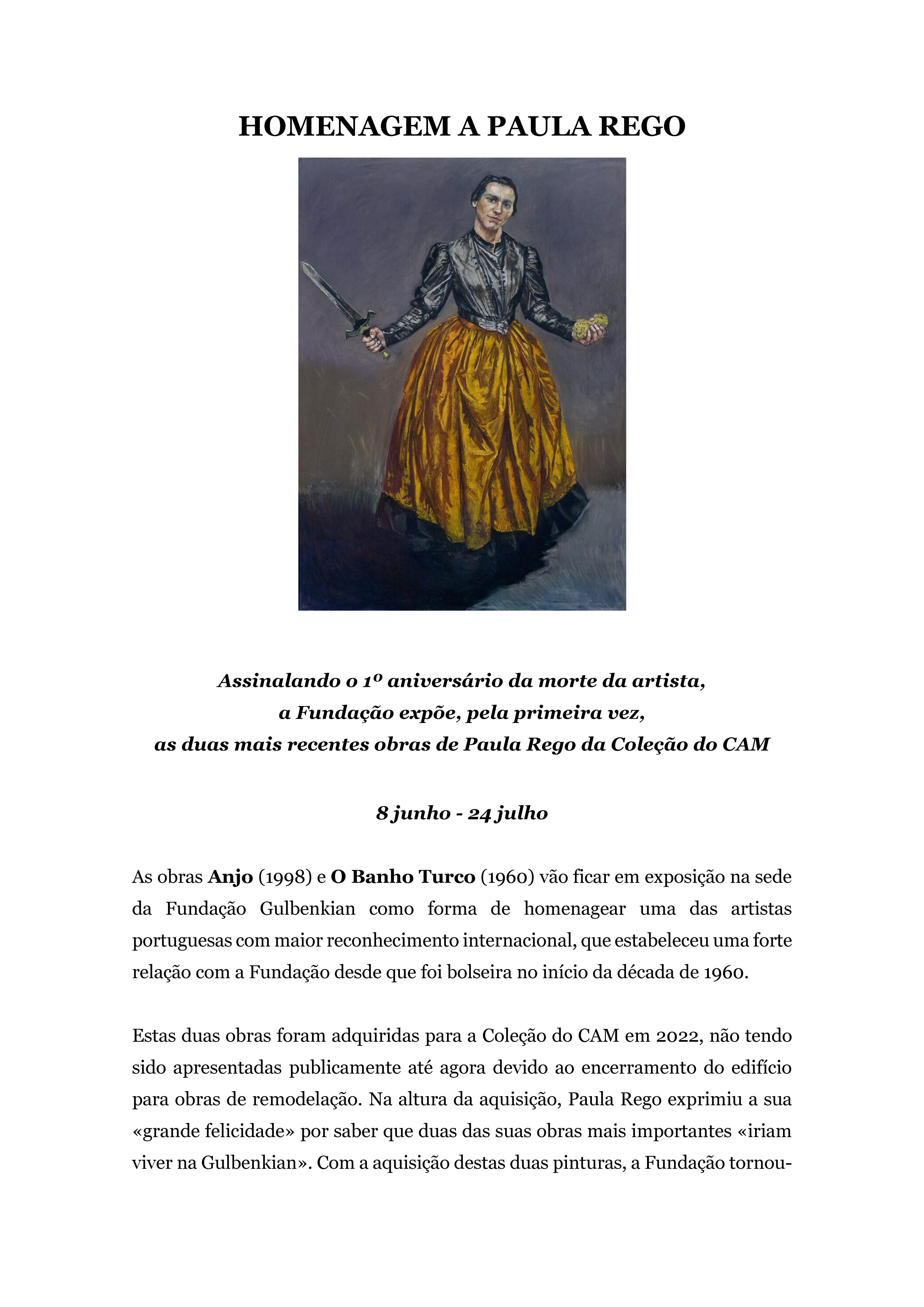
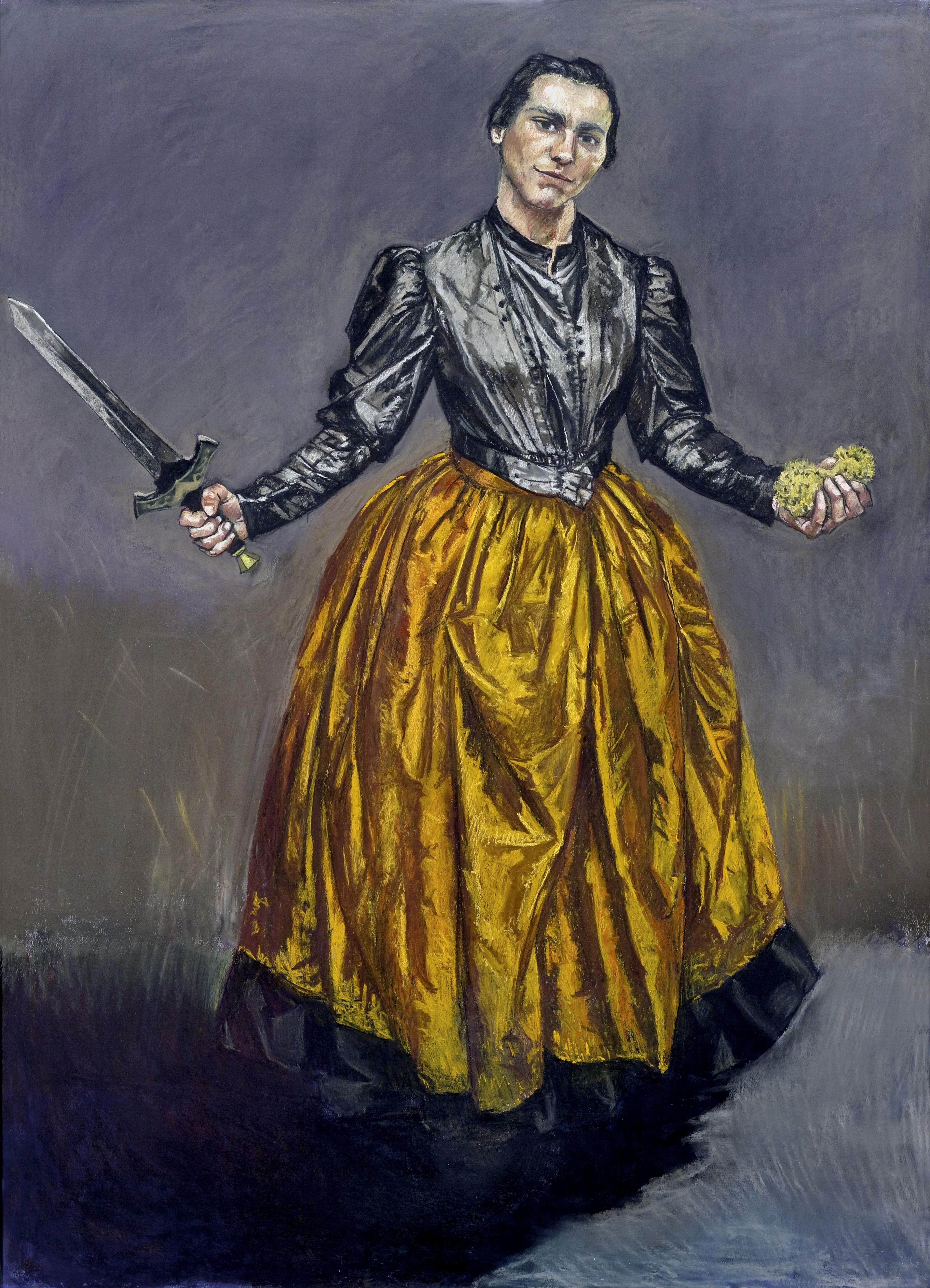
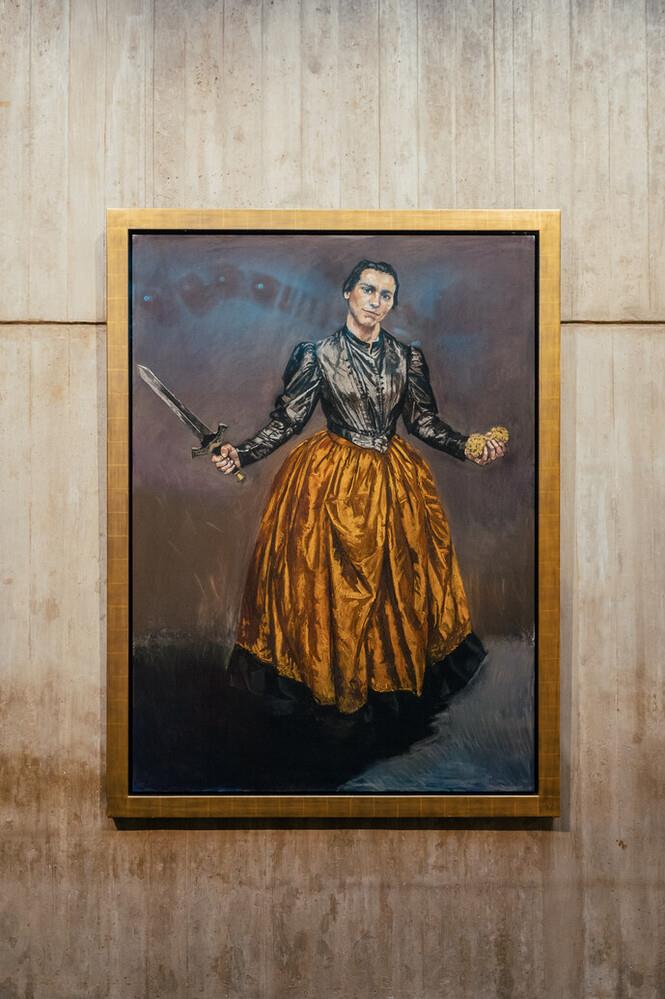
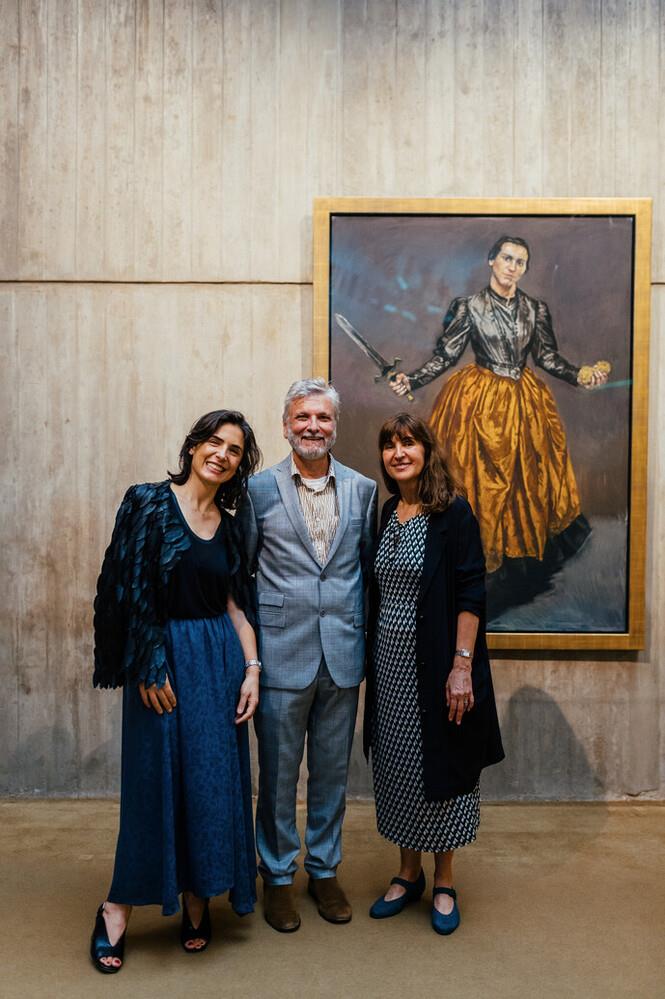
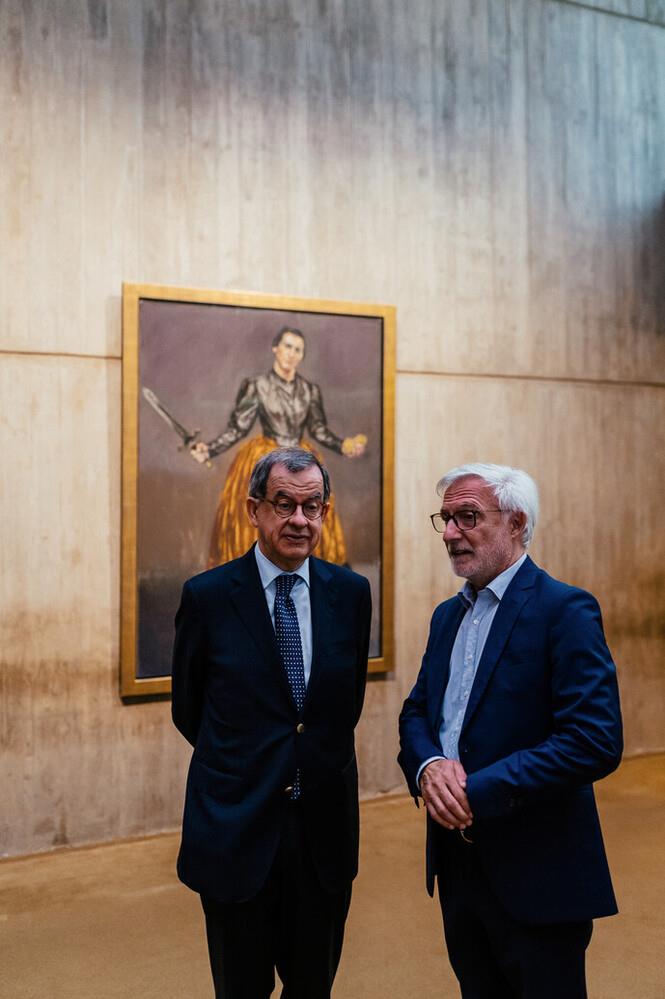
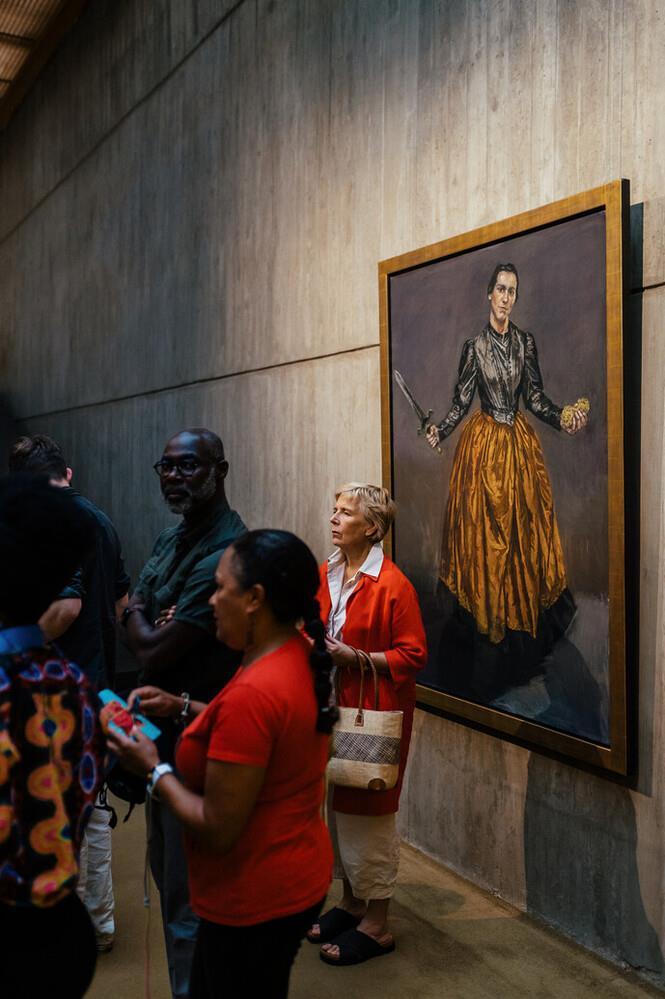
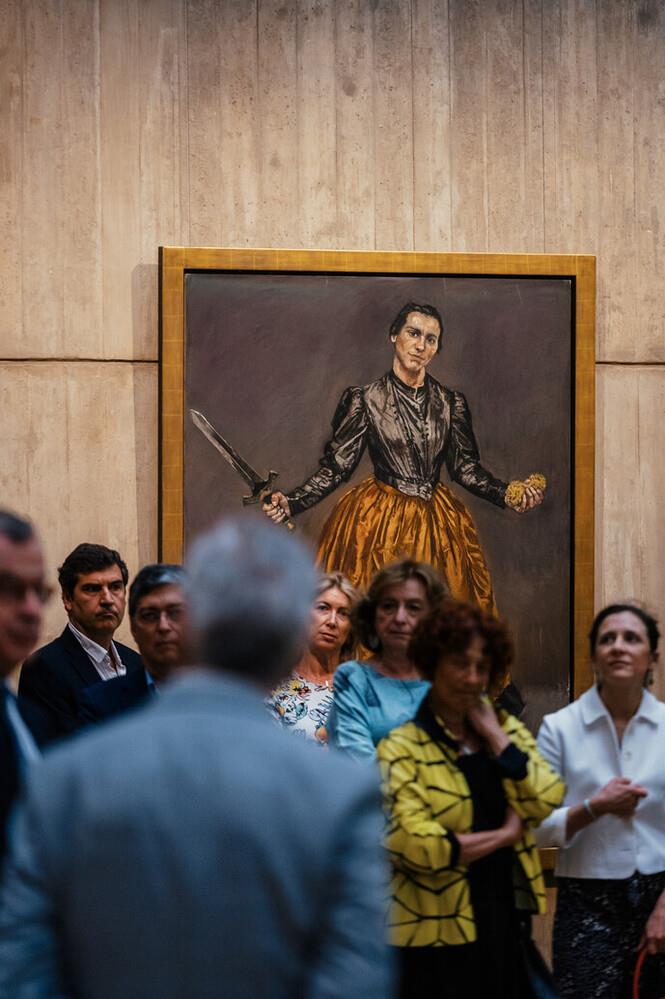
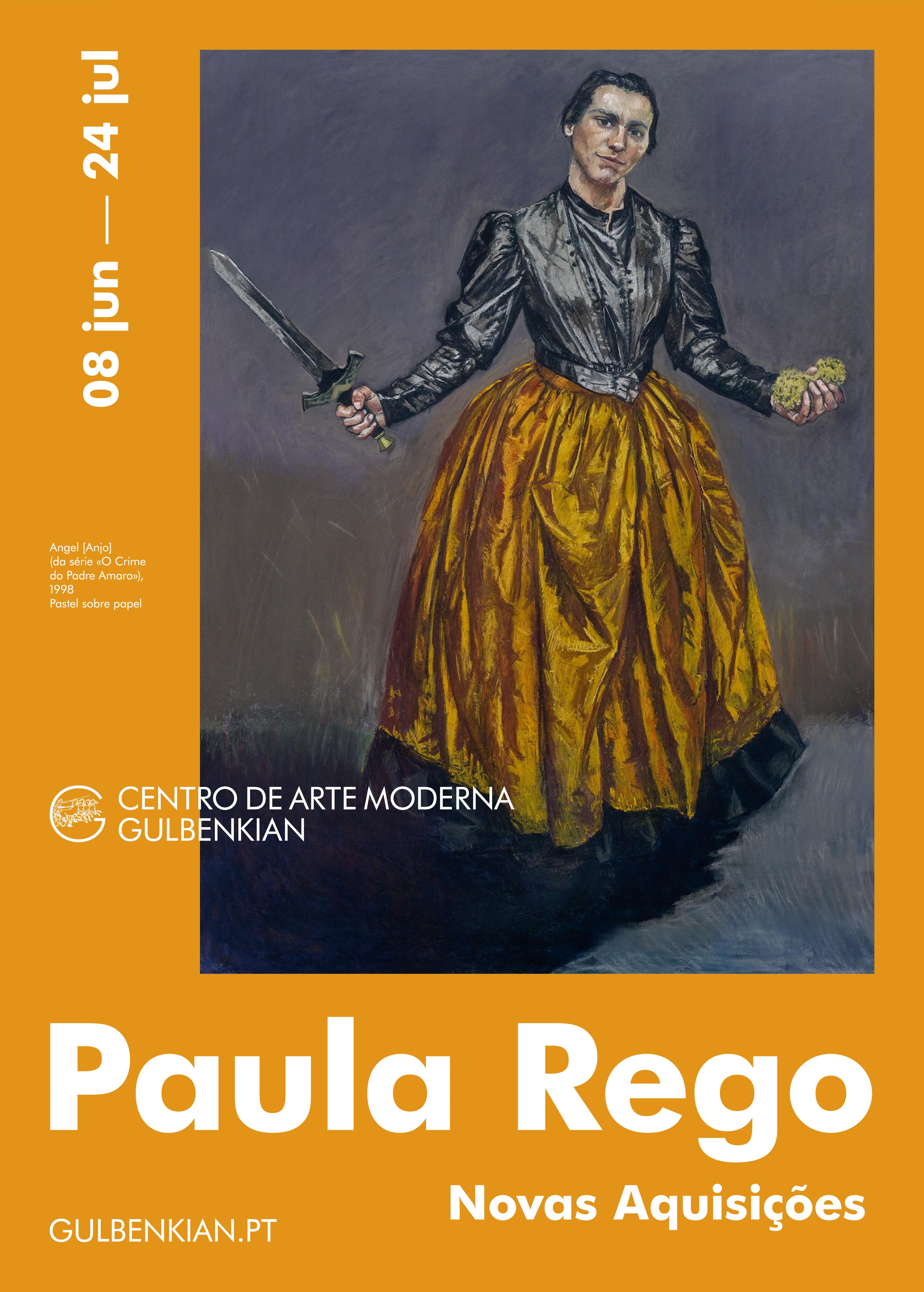
Por sua vez, Angel [Anjo], um pastel de grande formato sobre papel montado em alumínio (180 × 130 cm / 196 × 146 cm, com moldura), integra um conjunto de obras dedicadas ao romance O Crime do Padre Amaro, publicado por Eça de Queirós em 1875. Neste livro, o escritor denuncia a hipocrisia da imposição clerical do celibato e o consequente assassínio bárbaro de bebés ilegítimos, nascidos de relações entre padres e mulheres, solteiras ou casadas. Paula Rego optou por se afastar do romance, introduzindo elementos imaginários na história original. Intervém ficcionalmente ao representar uma mulher como um anjo sem asas, que vem vingar a morte da protagonista feminina do romance. Assim, a artista apresenta o seu «anjo» como uma mulher sólida, de presença terrena e carnal, com uma expressão profunda e complexa. Com um misto de compaixão e desafio, a personagem olha direta e intensamente para o observador, segurando uma espada na mão direita e uma esponja na esquerda. Na pintura de Paula Rego, os dois atributos tradicionais da Paixão de Cristo simbolizam a proteção ou defesa da mulher e o consolo do sofrimento.
Como escreveu Helena de Freitas no breve texto que acompanha a exposição, as duas obras realçam a recorrência e a centralidade da figura feminina no pensamento e na prática artística de Paula Rego. A Tate Britain dedicou uma parte significativa da sua retrospetiva ao tema das mulheres ferozmente independentes e rebeldes. A partir da década de 1980, as figuras femininas passaram a dominar o universo narrativo e contestatário da artista. No mesmo estilo de Angel [Anjo], Paula Rego retratou frequentemente a revolta feminina contra figuras autoritárias e normas sociais coercivas, mas também a vulnerabilidade, a animosidade e a amargura das mulheres, ou ainda os seus desejos libertadores e subversivos. Sem embelezamentos ou idealizações, estas representações não visam agradar ao olhar masculino. Em vez disso, assistimos a uma visão crua e crítica, construída a partir da perspetiva de uma artista mulher, ancorada na sua vida e nas suas experiências – tanto durante o regime ditatorial opressivo de Salazar, como na condição de estrangeira no Reino Unido.
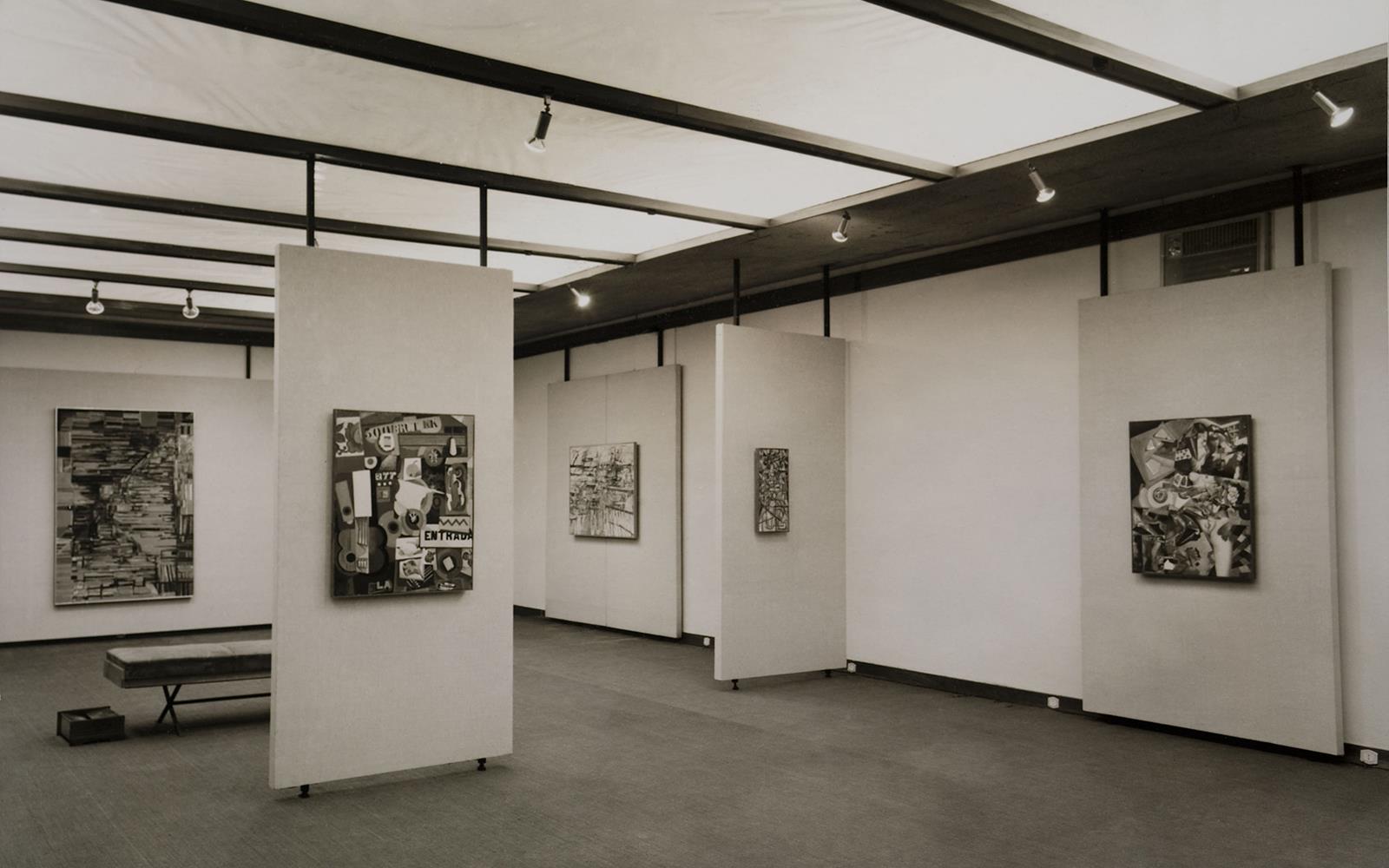
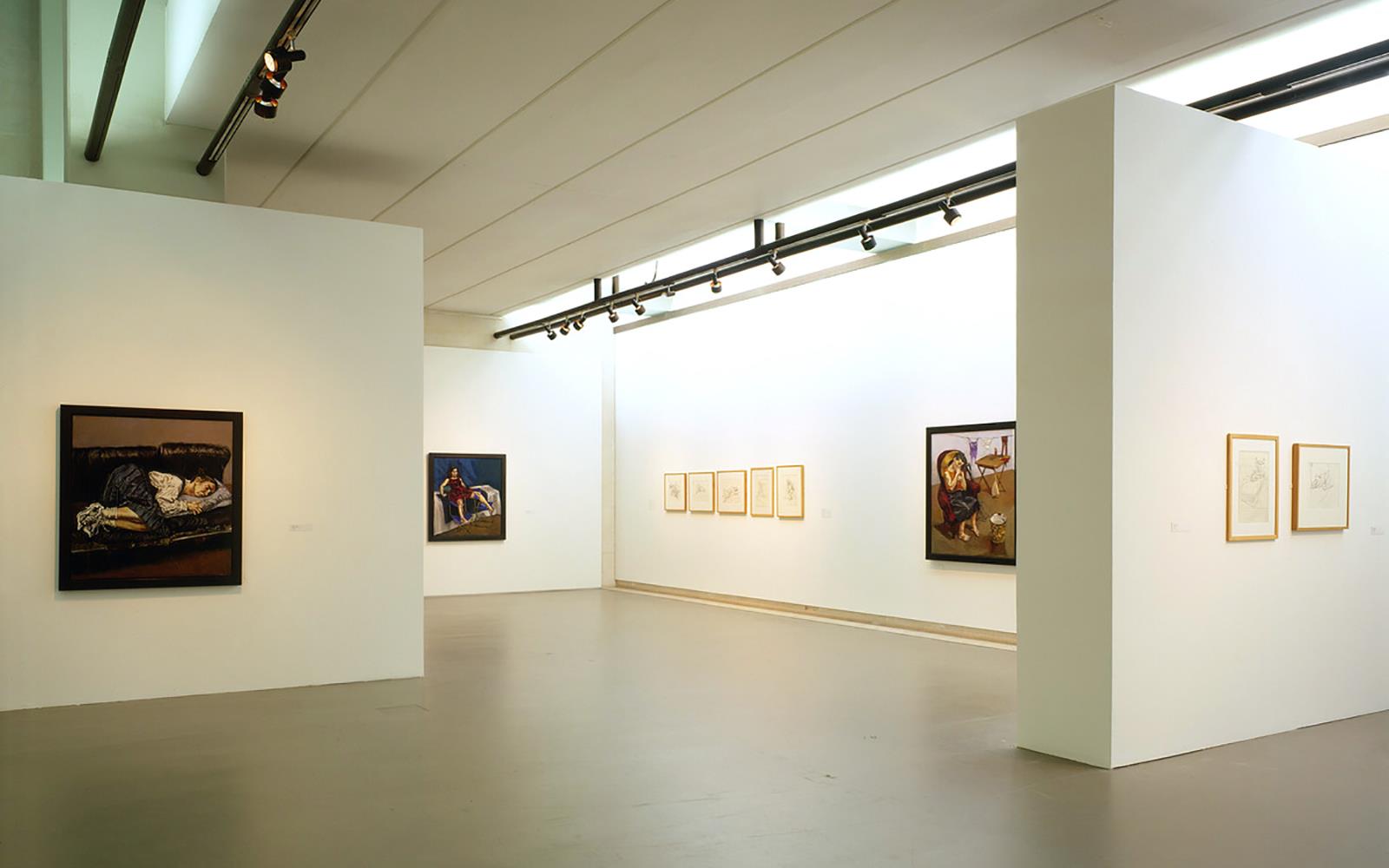
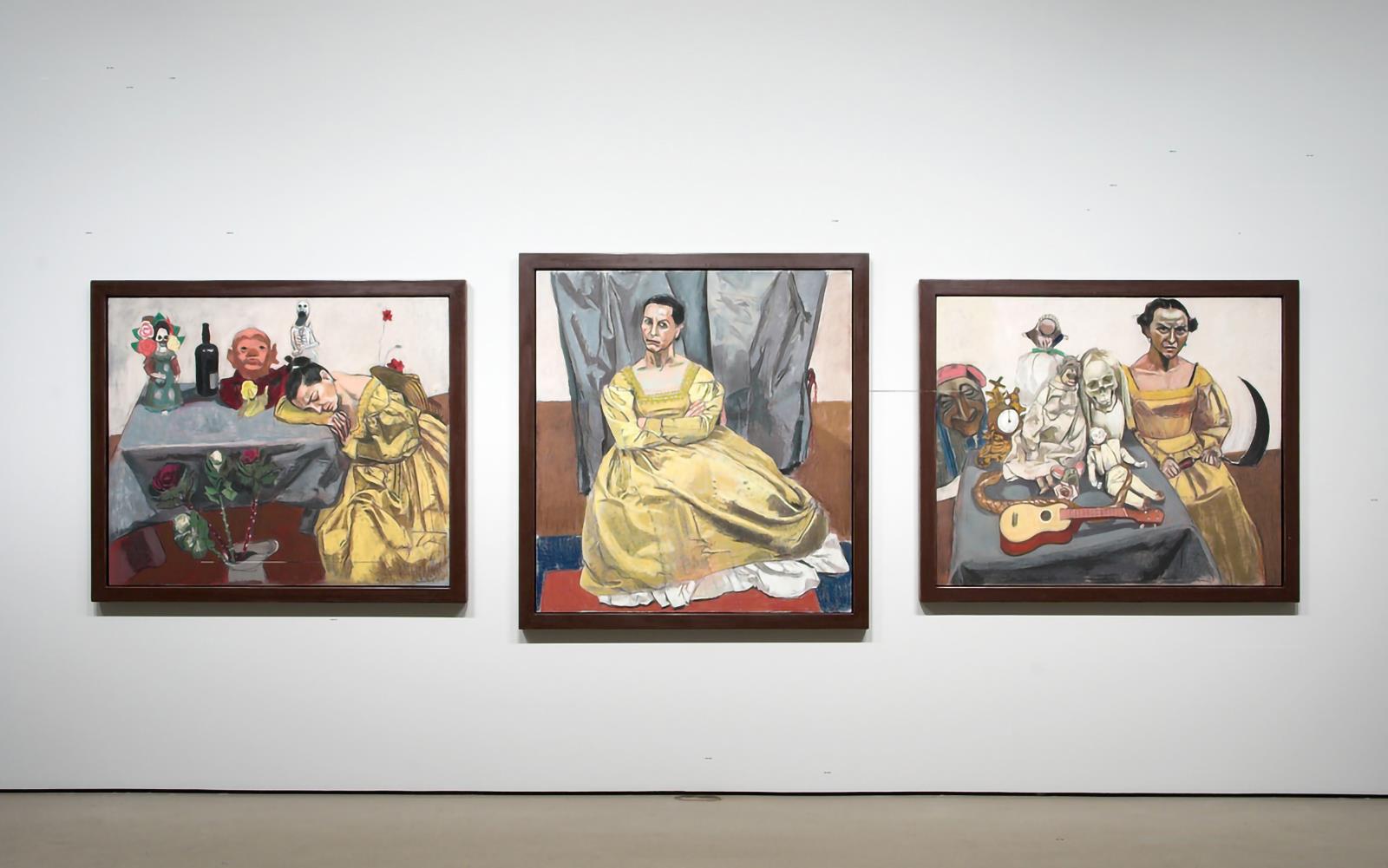
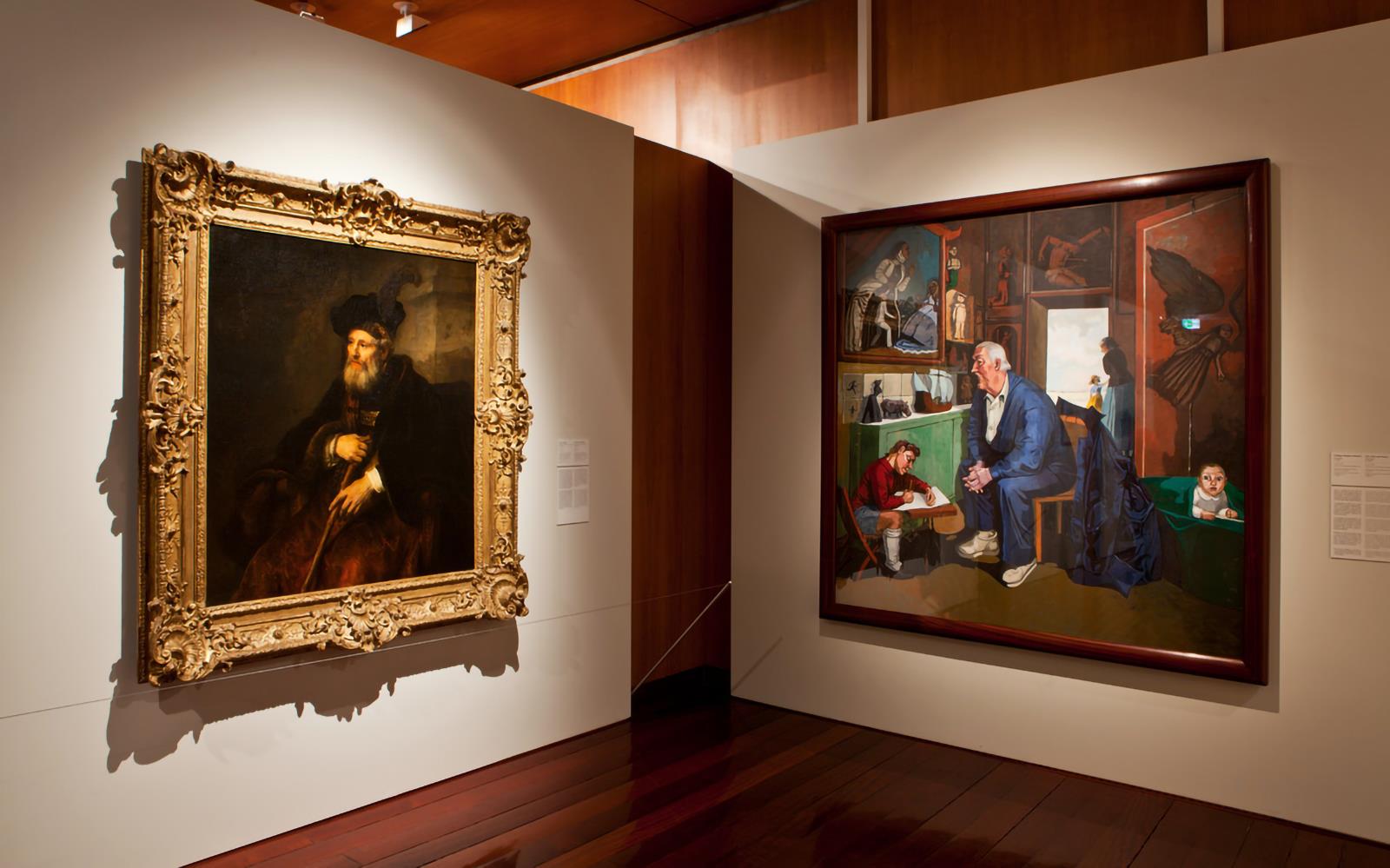
Para complementar a exposição temporária das duas aquisições, o CAM apresentou duas outras obras da sua coleção. Para ilustrar o intervalo temporal entre Turkish Bath [O Banho Turco] e Angel [Anjo], foram selecionados Portrait of Grimau [Retrato de Grimau], produzido em 1964, e Vanitas, tríptico datado de 2006. Ambos estiveram expostos em simultâneo na Galeria Principal da Fundação Gulbenkian.
Paula Rego é uma presença incontornável na história expositiva da Fundação Gulbenkian. Tendo participado em cerca de cinquenta exposições coletivas desde 1961, a artista foi ainda objeto de quatro exposições individuais entre o final da década de 1980 e 2007, incluindo duas antológicas. A exposição «Paula Rego», apresentada em 1988 na Galeria de Exposições Temporárias do Edifício Sede da Fundação Calouste Gulbenkian, reuniu obras que abrangem um período de trinta e cinco anos. Seguiu depois para o Museu de Serralves, no Porto. «Stories of the National Gallery» foi organizada em 1992 pela National Gallery de Londres, em parceria com o Centro de Arte Moderna. Esta exposição individual itinerante documentava o trabalho de Paula Rego durante o seu período como primeira «artista associada» da National Gallery, apresentando uma série de obras inspiradas em pinturas da coleção do museu. Além da Galeria de Exposições Temporárias do Centro de Arte Moderna, a mostra foi também apresentada em vários locais no Reino Unido.
A aquisição destas duas obras icónicas pelo CAM e a decisão de as expor em homenagem à artista refletem igualmente o papel fundamental que a Fundação Gulbenkian desempenhou no desenvolvimento e crescimento de Paula Rego enquanto artista. Durante as difíceis primeiras décadas da sua carreira, a Gulbenkian apoiou-a com diversos financiamentos, ajudando-a a sobreviver no ambiente cosmopolita e estimulante da Londres dos anos de 1960. Em 1976, a Fundação concedeu um financiamento adicional para a realização de uma série de obras inspiradas em contos populares portugueses e europeus. Seguindo a tradição de artistas como Daumier, Degas, Hogarth e Goya, Paula Rego produziu uma série de bonecos têxteis, desenhos, guaches e pinturas acrílicas baseados nessas histórias intemporais e inquietantes, com o intuito de as transportar para a mitologia contemporânea e para a experiência pessoal.
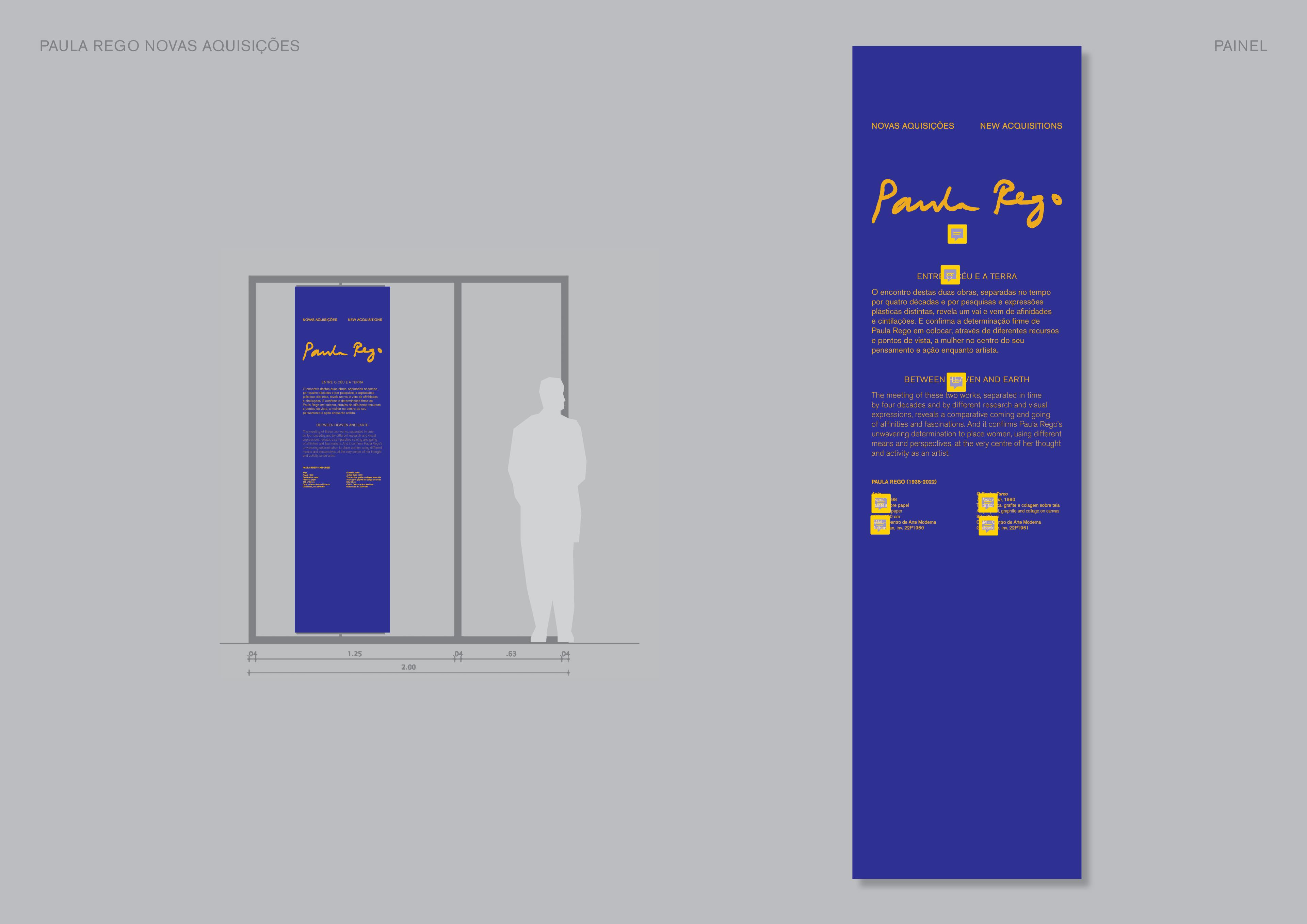
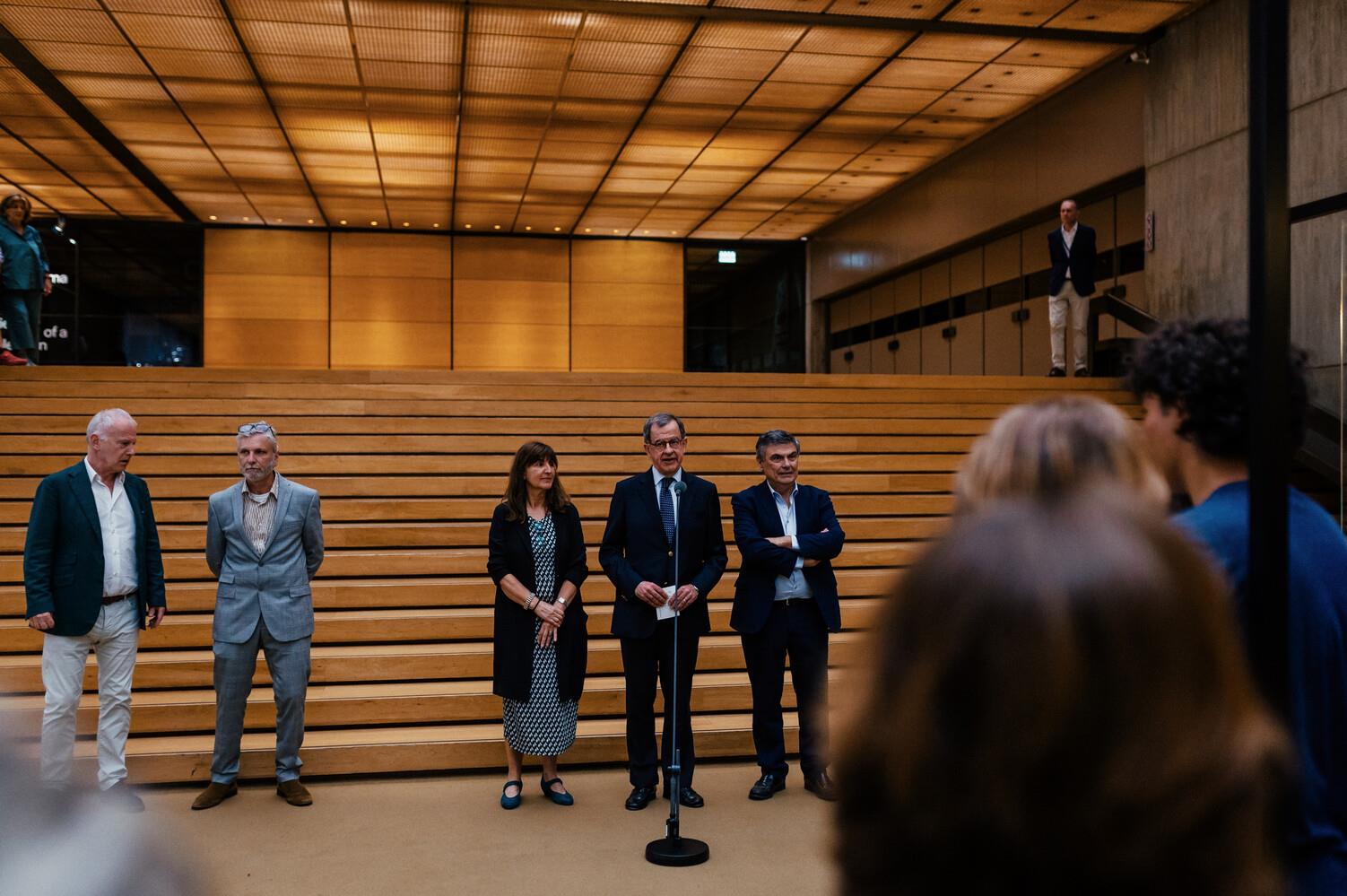
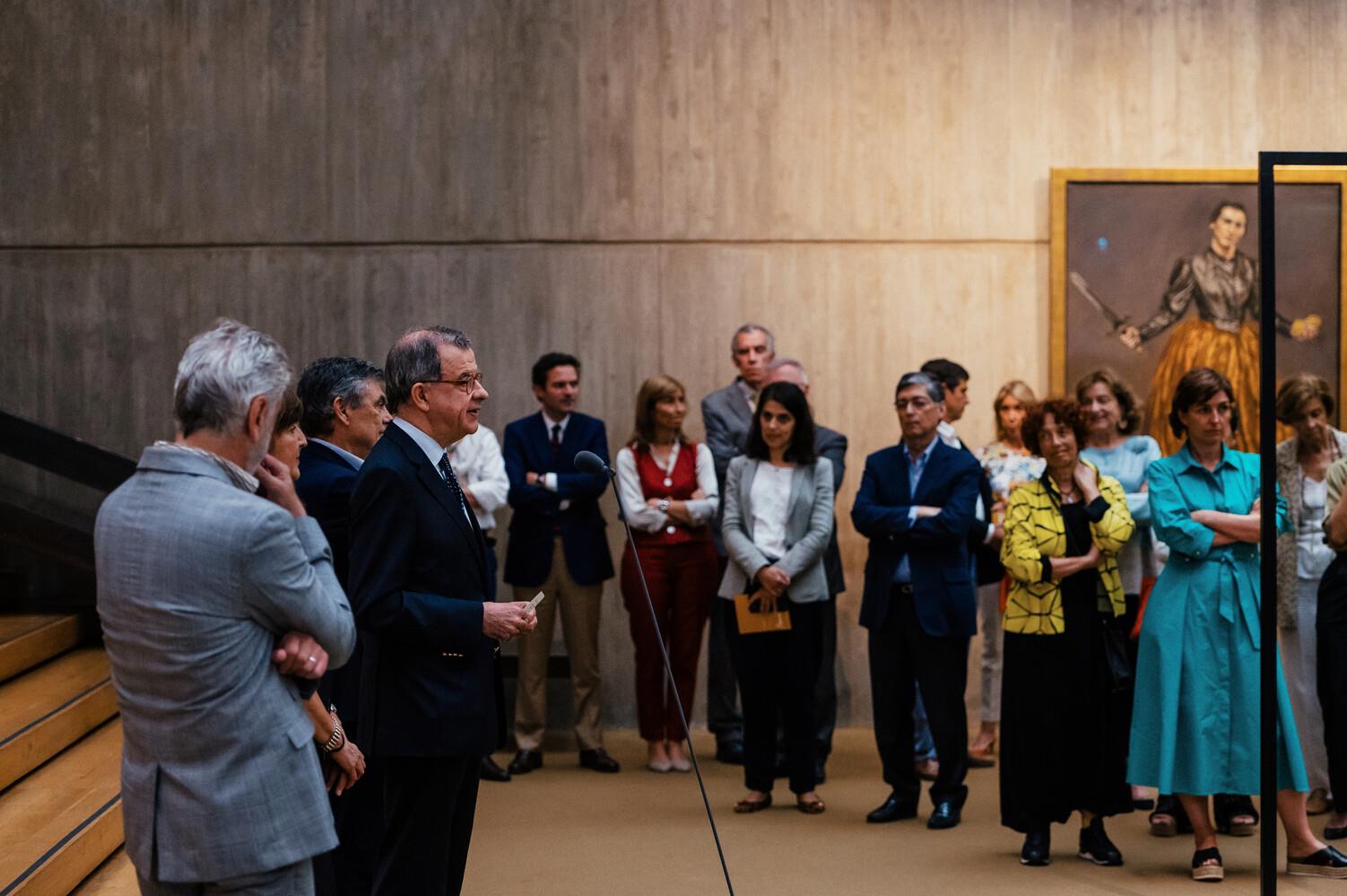
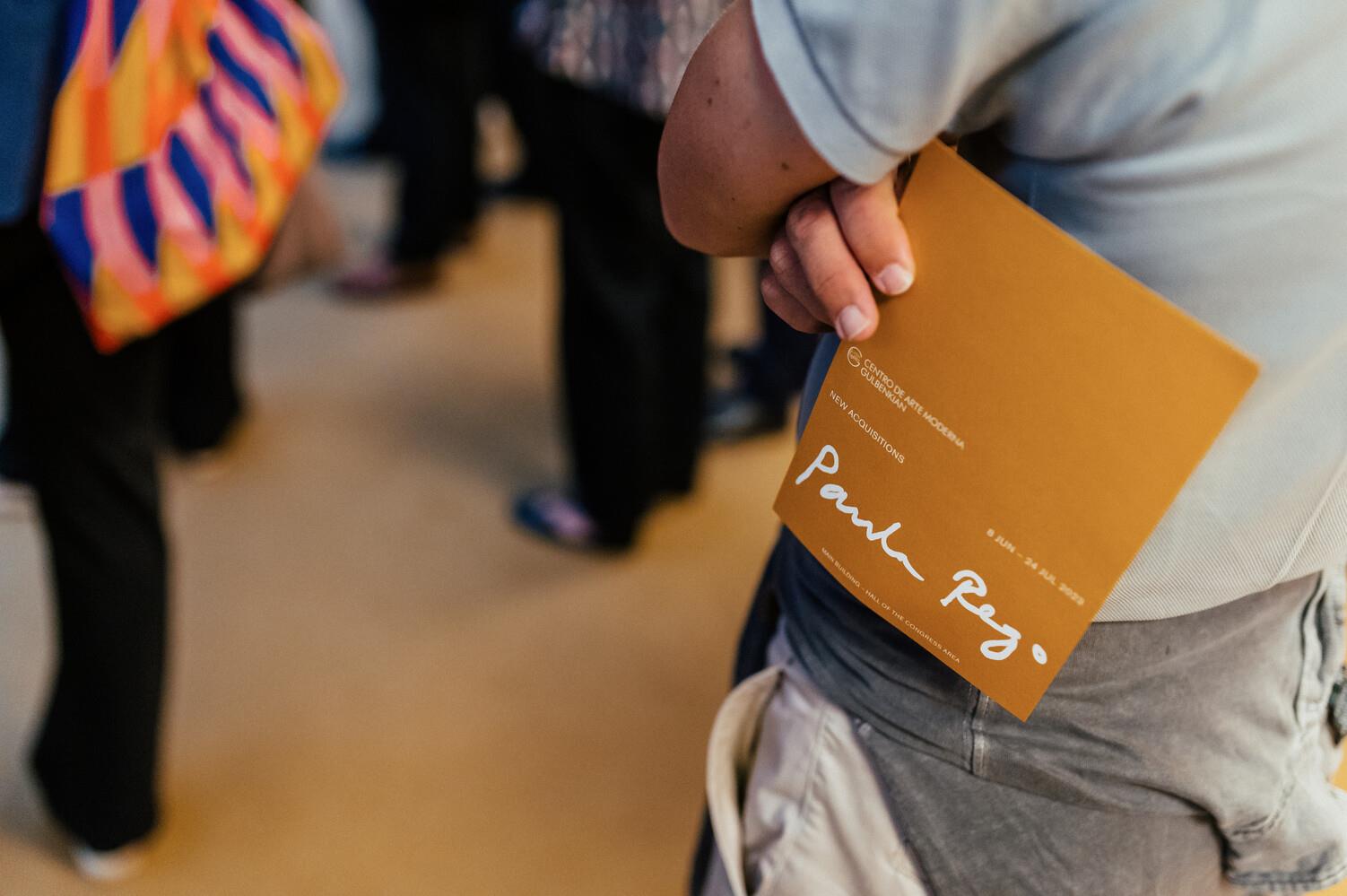
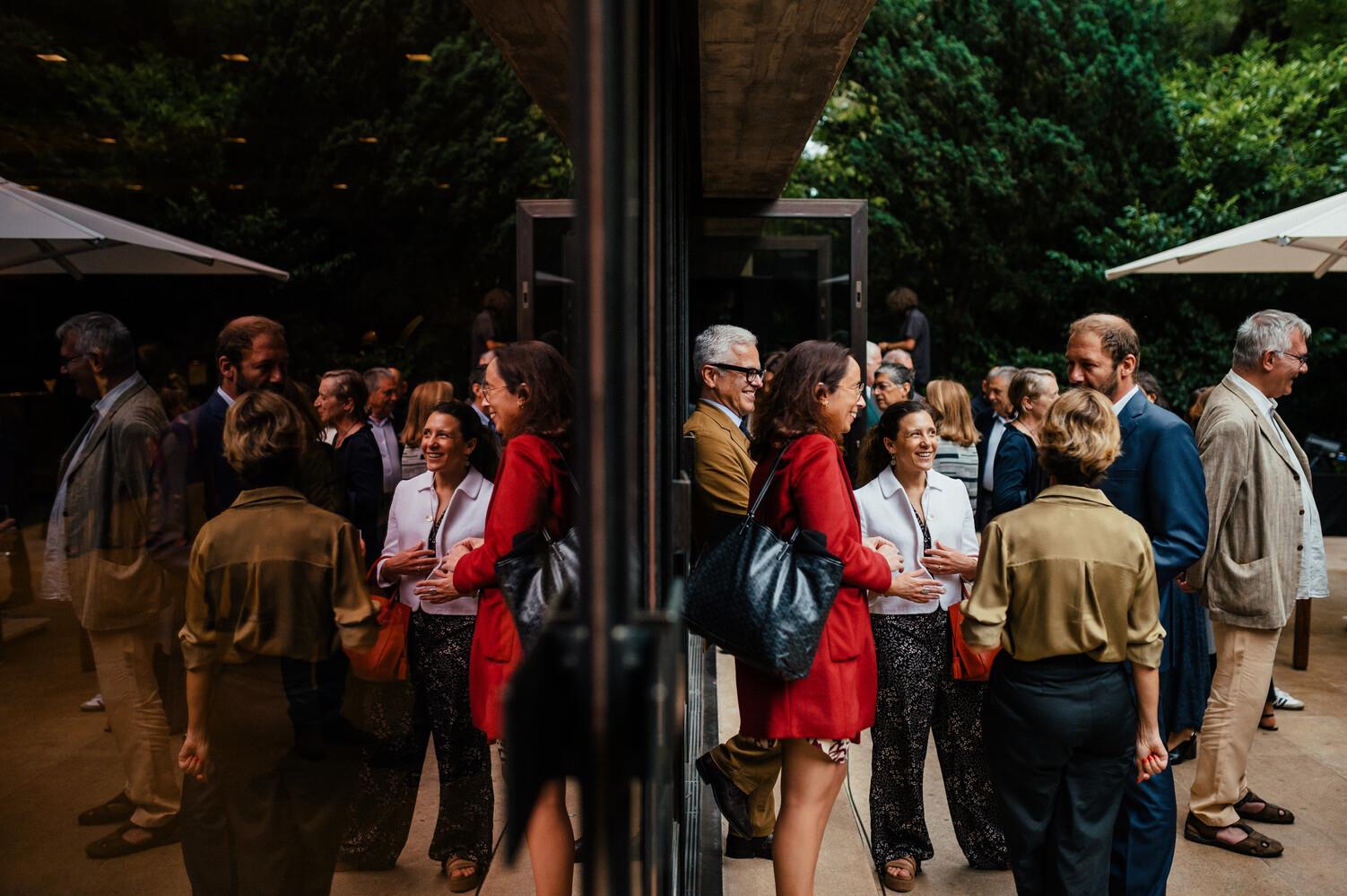
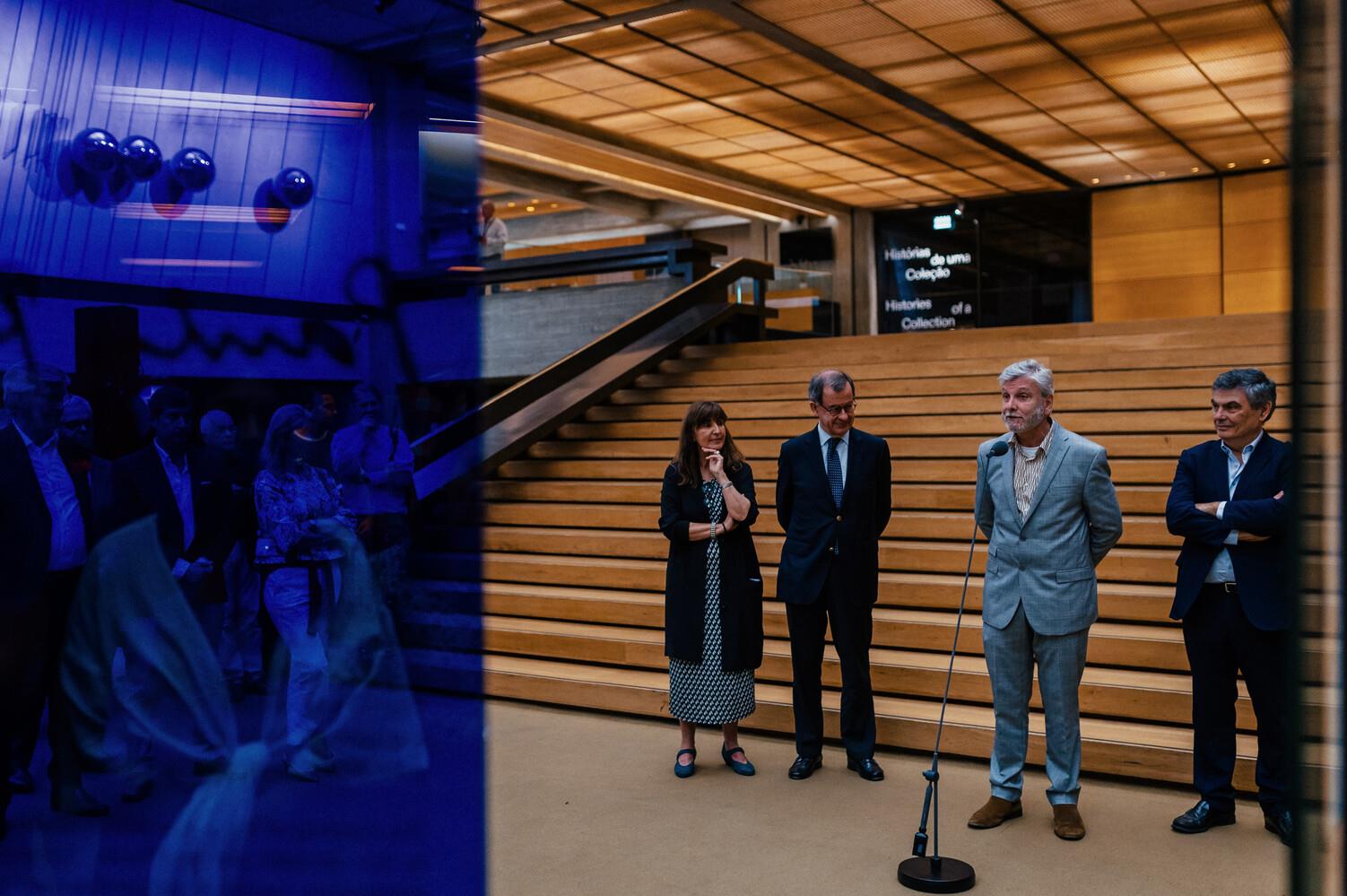
A exposição «Paula Rego. Novas Aquisições» foi extremamente bem-sucedida, tanto pela recetividade do público como pela aclamação crítica nos meios de comunicação social. Concebida como uma celebração, teve como objetivo sensibilizar o público para a importância destas aquisições, apresentando as duas obras num espaço temporário com um design expositivo discreto, instalado informalmente numa zona de grande circulação de público da Fundação Gulbenkian e do Museu.
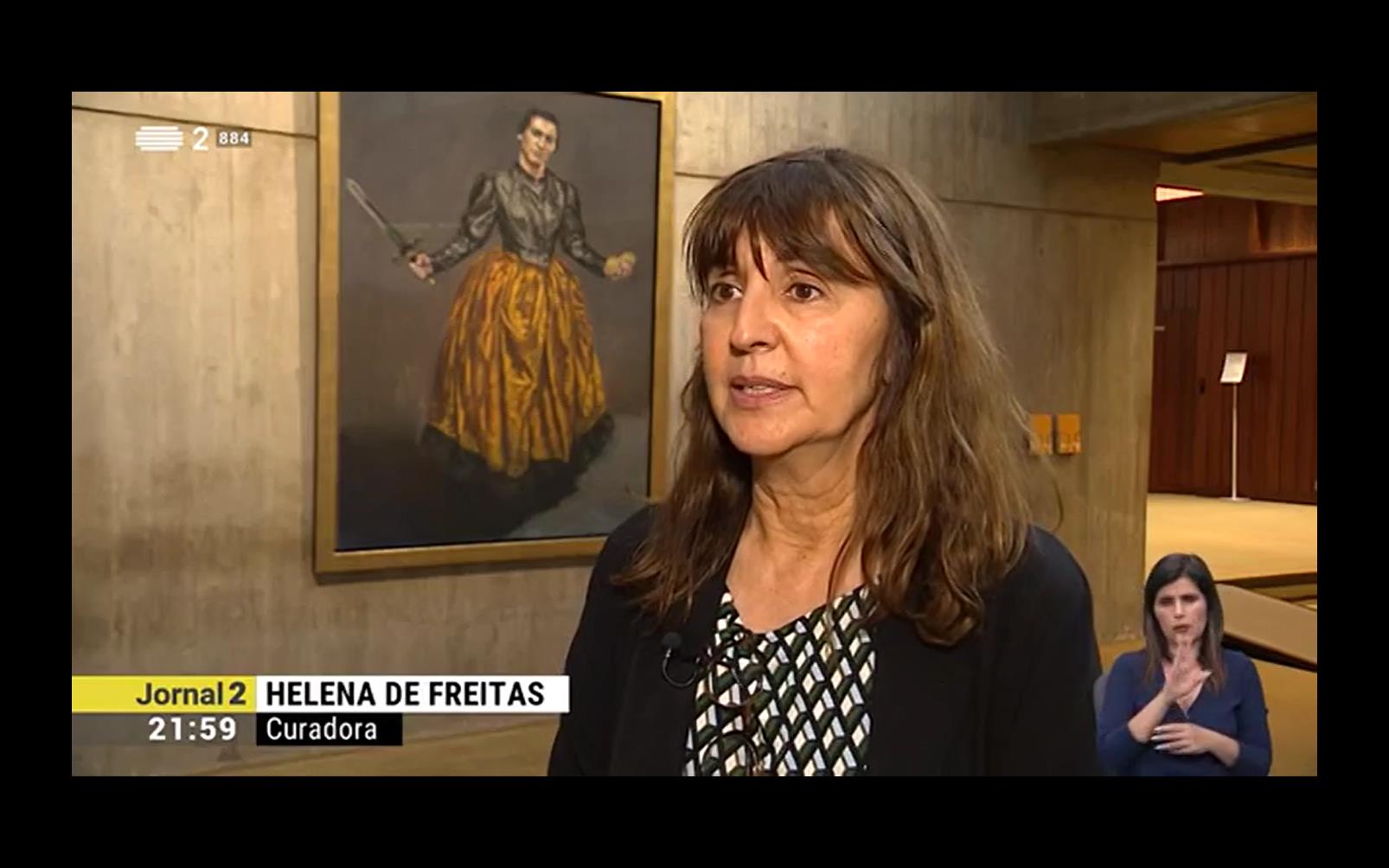
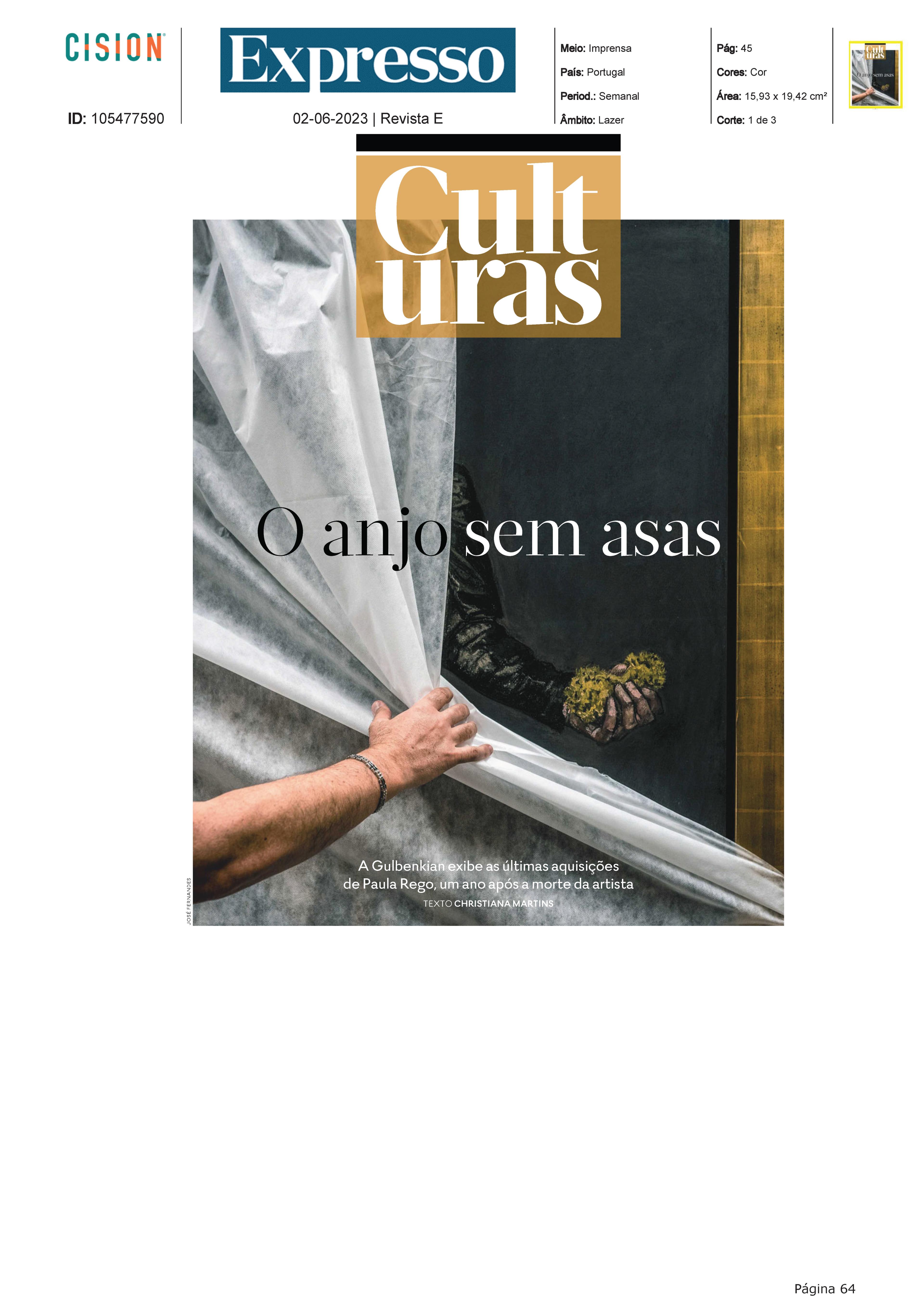
O canal de televisão SIC produziu uma curta reportagem cinematográfica que acompanhou o transporte das obras das oficinas até ao espaço expositivo, incluindo entrevistas com as curadoras Helena de Freitas e Ana Vasconcelos. A RTP também esteve presente, entrevistando Helena de Freitas e o filho da pintora, Nick Willing, e a Antena 1 dedicou à exposição uma emissão com o contributo da curadora. O destaque nos meios de comunicação social incluiu ainda uma peça no magazine Folha de Sala, da RTP2, e uma reportagem principal na secção de cultura da Revista do Expresso, assinada por Christiana Martins, com imagens das obras em depósito e uma entrevista a Helena de Freitas.
A exposição teve cobertura por parte da Visão, do SemanárioSol, do Correio da Manhã, do Jornal de Notícias, da revista Sábado e da Time Out, e objeto de uma menção no Jornal de Negócios. A peça divulgada pela agência Lusa foi reproduzida em diversas plataformas de informação digitais, como Público, Observador, Renascença, PPortodosmuseus, Forever Young, FundsPeople Portugal, Inevitável, TunetRádio, Bica, Comunidade Cultura e Arte e Notícias ao Minuto. Nos media digitais, foi igualmente anunciada em diversos órgãos, como ArteCapital, GQ Portugal e Agenda Cultural de Lisboa.
Katherine Sirois, 2025
Curated by Helena de Freitas and produced by Laura Almeida, the exhibition aimed to unveil the two artworks acquired between December 2021 and February 2022 through Ostrich Arts Limited, a London-based company set up by the painter in 1997 to manage her artistic and professional affairs, and entirely managed by her heirs since 2013.
Instigated by the CAM’s senior curator, Helena de Freitas, the acquisition consolidates the already significant section of the Modern Art Centre collection devoted to the artist. Currently home to 37 pieces by Paula Rego, the CAM possesses the largest institutional collection of the artist´s work in Portugal. This segment of the collection is mainly composed of paintings, drawings and textile sculptures, totaling five decades of production, from 1958 to 2006.
This exhibition was part of a recent series of major exhibitions dedicated to the artist, organised by several institutions in Portugal and abroad. It is worth noting that Paula Rego’s first solo exhibition was held at the SNBA in Lisbon in 1965-1966, during the Salazar regime, a period of colonial wars and growing state repression of political opposition within civil society. The groundbreaking display brought together nineteen early works by the artist, including courageous, politically subversive and experimental collages and paintings. To coincide with the commemoration of the 50th Anniversary of the 25 April Carnation Revolution, this first solo exhibition was recreated as part of a larger exhibition at Casa das Histórias, in Cascais, under the direction of curators Catarina Alfaro and Leonor de Oliveira (April-October 2024).
In 1999, the Calouste Gulbenkian Foundation programme for ICOM International Museum Day marked the opening of a double solo exhibition by Paula Rego. For the first time in Portugal, it presented two series developed in the late 1990s: The Crime of Father Amaro, based on the novel by Eça de Queirós, and Untitled, a group of drawings on the taboo subject of abortion. The two series occupied the Temporary Exhibitions Gallery at the Modern Art Centre. Angel appeared in the show and this image was used for the invitation card.
In 2007, the Museo Nacional Centro de Arte Reina Sofía in Madrid organised one of the first retrospectives of Paula Rego’s work, covering different phases and artistic registers that spanned her entire career. In 2010, in partnership with Casa das Histórias, the Museum of Contemporary Art of Monterrey in Mexico hosted the first retrospective of Paula Rego’s work in Latin America. This exhibition, which included Angel, then travelled to the Pinacoteca de São Paulo, in Brazil, in 2011.
In 2018-2019, the Musée de L’Orangerie in Paris organised the first Paula Rego exhibition in France, which was also the first exhibition of a living artist in the museum’s history. Entitled The Cruel Stories of Paula Rego, the Paris exhibition focused on Rego’s use and interpretation of childhood folk and fairy tales, as well as her own life experiences and memories. Including Angel among almost 70 selected paintings and drawings, the exhibition showed the artist's reflections on the human condition at large, with its joys and miseries, its tragicomedies and ruthless power games, filled with ambiguity, trickery, abuse and injustice.
In addition, it offered the French public a glimpse of some of the typical tableaus set up by the artist in her London atelier as 3D models for her paintings. These compositions, merging fiction and references to reality, combined dolls, mannequins and effigies, stuffed animals, everyday objects, skulls and masks. Along with a reconstruction of some of the installations used for the large format paintings featured in the exhibition, a small hyper realistic sculpture of Pinocchio by Ron Mueck (1996) was shown. Indeed, Rego established a kind of collaboration with the UK-based Australian sculptor. Mueck’s sculpture thus served as a model for her Geppetto Washing Pinocchio (1996), among other paintings.
Most recently, Tate Britain also hosted a major Rego retrospective, bringing together more than a hundred of her works, including paintings, drawings, prints, sculptures and collages, produced between the 1950s and 2010. Both Turkish Bath and Angel were part of the show. For this occasion, the Modern Art Centre loaned ten of the artist's works from its collection, including Salazar Vomiting the Homeland (1960), Manifesto (For a Lost Cause) (1965) and six gouaches from the Portuguese Folk Tales series.
Prior to their acquisition by the CAM, the two works had therefore been shown in leading national and international institutions. Following their inclusion in the Tate Britain retrospective exhibition in 2021, they both subsequently toured from London to the Kunstmuseum Den Haag in the Netherlands and the Picasso Museum, in Malaga. We should also mention that between 2009 and 2019, both pieces were temporarily added to the Casa das Histórias collection under a loan agreement between Paula Rego and Cascais Municipal Council.
In June 2023, the pop-up exhibition on the staircase to the Congress Hall of the Gulbenkian Foundation paired Angel, displayed in a conventional wall mounted wooden frame, with Turkish Bath in a floor-standing apparatus of glass panels and black painted metal. Encased in the glass panel with its minimalist silver frame, Turkish Bath — acrylic paint, graphite and collage on a 93 x 93 cm square canvas — appeared to float in space. This allowed the public to circulate around the glass structure in order to contemplate both the front and the back of the canvas. Turkish Bath was, in fact, painted on the reverse of a nude portrait of Paula Rego produced two years earlier, in 1958, by her husband Victor Willing (1928-1988).
Depicted against an abstract, monochromatic blue backdrop, the naked body of the artist, in profile, appeared upside-down to show Turkish Bath in the right position. Willing’s nude, once the front, now the back after framing, adds a layer of complexity and intimacy to Rego’s work. With this collage, Rego directly references nineteenth century art history by evoking Jean-Auguste-Dominique Ingres’ famous Bain Turc, painted in 1859. Originally rectangular in shape, the canvas was then turned into a tondo in 1862 by Ingres himself.
While Ingres’ masterpiece — with its 25 nude bathing women in back, front, profile and three-quarter view, seated, standing or dancing — is filled with the exotic eroticism of late Romanticism, Paula Rego tones down any erotic and exotic charge, anchoring the work in a conceptually and aesthetically contemporary setting. A clever patchwork that combines abstraction and ambiguous figurative motifs, the piece also includes collages of black and white photographs, reproductions of artworks, and newspaper and magazine clippings covered in thin, translucent layers of yellowish paint. With a somewhat neo-dada spirit, the artist juxtaposes fragments of Ingres’ nude odalisques with images of fully clothed modern women, under which she glues a clipping of an advert for a pharmaceutical preparation, the once famous “Oriental Pills” (Pilules Orientales). Evoking the lasciviousness of the sultans’ harem, these pills, invented in 1886 by a Parisian pharmacist, were marketed to women for decades as a means of enhancing their breasts and curves.
While Angel is particularly emblematic of the artist’s later stylistic personality and maturity, Turkish Bath reflects the raw and experimental phase of her work during the 60s, following her discovery of Jean Dubuffet and his visceral, anti-conformist aesthetic. But while Turkish Bath typifies this earlier stage in her output, it nevertheless sets the tone for her entire career. Since it inevitably establishes a close dialogue with two artworks by men — the nude portrait painted by Willing, along with the sensual and oneiric universe of Ingres’ Bain Turc — Paula Rego’s painting acts as an early expression of her temperament. The interventions she performs directly on the reverse of Willing’s canvas, together with the ironical deconstruction of Ingres’ original work, make Turkish Bath a precursor to Paula Rego’s later output, revealing her critical and radical character and her desire to transform things according to her vision, understanding and lived experience.
Angel, a large format pastel on paper mounted on aluminium (180 x 130 cm / 196 x 146 cm with frame), is part of a series of works devoted to the novel The Crime of Father Amaro, published by Eça de Queirós in 1875. In this book, the writer denounces the hypocrisy of the clerical rule of celibacy and the consequent barbaric murder of illegitimate babies born of relations between priests and single or married women. Paula Rego chose to depart from the novel, introducing new imaginary elements to the original story. She fictionally intervenes by portraying a woman as an angel without wings, come to avenge the death of the main female character of the novel. As such, the artist depicts her “angel” as a solid woman, characterised by her earthly, fleshy presence and her deep, complex expression. With a mix of compassion and defiance, the strong character gazes directly and intensely at the viewer, holding a sword in her right hand and a sponge in the other. In Rego’s painting, the two traditional attributes of the Passion of Christ symbolise protection or defence of women and solace from suffering.
As Helena de Freitas wrote in the short text accompanying the exhibition, the two works highlight the recurrence and centrality of women in Paula Rego’s artistic thought and activity. Tate Britain dedicated a significant part of its retrospective to the theme of fiercely independent and rebellious women. From the 1980s onwards, women came to dominate in the artist’s universe of visual storytelling and dissent. In the same spirit as Angel, Paula Rego often depicted female revolt against authority figures and coercive social norms, but also women’s vulnerabilities, animosity and bitterness, or their liberating and subversive desires. Free from embellishment or idealisation, her depictions of women do not aim to please the male gaze. Instead, we see a raw and critical vision produced from a female artist’s perspective, grounded in a woman’s life and experiences both during Salazar’s oppressive dictatorial regime and as a foreigner in the UK.
To complement the temporary exhibition of the two acquisitions, the Modern Art Centre showcased two other works from its collection. Echoing the time lapse between Turkish Bath and Angel, Portrait of Grimau, produced in 1964 and Vanitas, a triptych dating from 2006, were selected. Both were displayed at the same time in the main gallery of the Gulbenkian Foundation.
Paula Rego is a tremendous presence within the Gulbenkian Foundation’s history of exhibitions. Having participated in some 50 collective exhibitions from 1961 onwards, the artist has also been the subject of 4 solo exhibitions between the late 80s and 2007, including two anthologies. The exhibition “Paula Rego”, shown in 1988 in the Temporary Exhibitions Gallery of the Calouste Gulbenkian Foundation Main Building, brought together works spanning a 35-year period. The exhibition later travelled to Museu Serralves in Porto. “Stories of the National Gallery” was organised in 1992 by the National Gallery of London in partnership with the Modern Art Centre. This travelling solo show documented Paula Rego’s work during her time as the National Gallery’s first “Associate Artist”. It featured a series of works inspired by paintings from the museum’s collection. In addition to the Modern Art Centre's Temporary Exhibitions Gallery, the exhibition was also shown in several locations in the United Kingdom.
The acquisition of these two iconic works by the Modern Art Centre and the decision to display them in honour of the artist also reflect the instrumental role the Gulbenkian Foundation played in helping Rego develop and grow as an artist. During the difficult first decades of her career, the Gulbenkian supported her with funding, helping her to survive in the cosmopolitan and stimulating environment of 1960s London. In 1976, the Foundation granted additional funding for a series of works illustrating Portuguese and European folk tales. In the tradition of artists such as Daumier, Degas, Hogarth and Goya, Rego produced a series of textile dolls, drawings, gouaches and acrylic paintings inspired by these timeless and unsettling stories in order to bring them into our contemporary mythology and personal experience.
“Paula Rego, New Acquisitions” was extremely successful in terms of its public reception and critical acclaim in the media. Intended as a celebration, it aimed to raise awareness of the importance of the acquisitions, displaying the two paintings in a temporary setting with unobtrusive exhibition design, informally utilising a high footfall area of the Gulbenkian Foundation and Museum.
SIC television produced a short film report following the works as they left the stores to be installed in the exhibition space. It included interviews with curators Helena de Freitas and Ana Vasconcelos. RTP was also present, interviewing Helena de Freitas and the painter's son, Nick Willing, as did Antena 1, which produced a piece with a contribution from the curator. It was also featured in media such as RTP2's Folha de Sala. A report by journalist Christiana Martins was published in Expresso Magazine, appearing as the lead article of the Culture section. It included images of the works in storage and an interview with Helena de Freitas. The event received coverage in Visão, Semanário SOL, Correio da Manhã, Jornal de Notícias, Revista Sábado and Time Out Magazine, and was mentioned in Jornal de Negócios by Manuel Falcão. Finally, the exhibition was featured by several digital media outlets such as ArteCapital, GQ Portugal and Lisbon's Cultural Agenda, LUSA. LUSA's take was echoed by various other online platforms such as Público, Observador, Renascença, O Porto dos Museus, Forever Young, Funds People Portugal, Inevitável, TunetRádio, Bica, Comunidade Cultura e Arte and Notícias ao Minuto.

![Paula Rego. Novas Aquisições [telão]](https://content.gulbenkian.pt/inarte/59811_3840x5723.jpg)