
“Being with the world and at its service”: the minds behind the New Talents scholarships
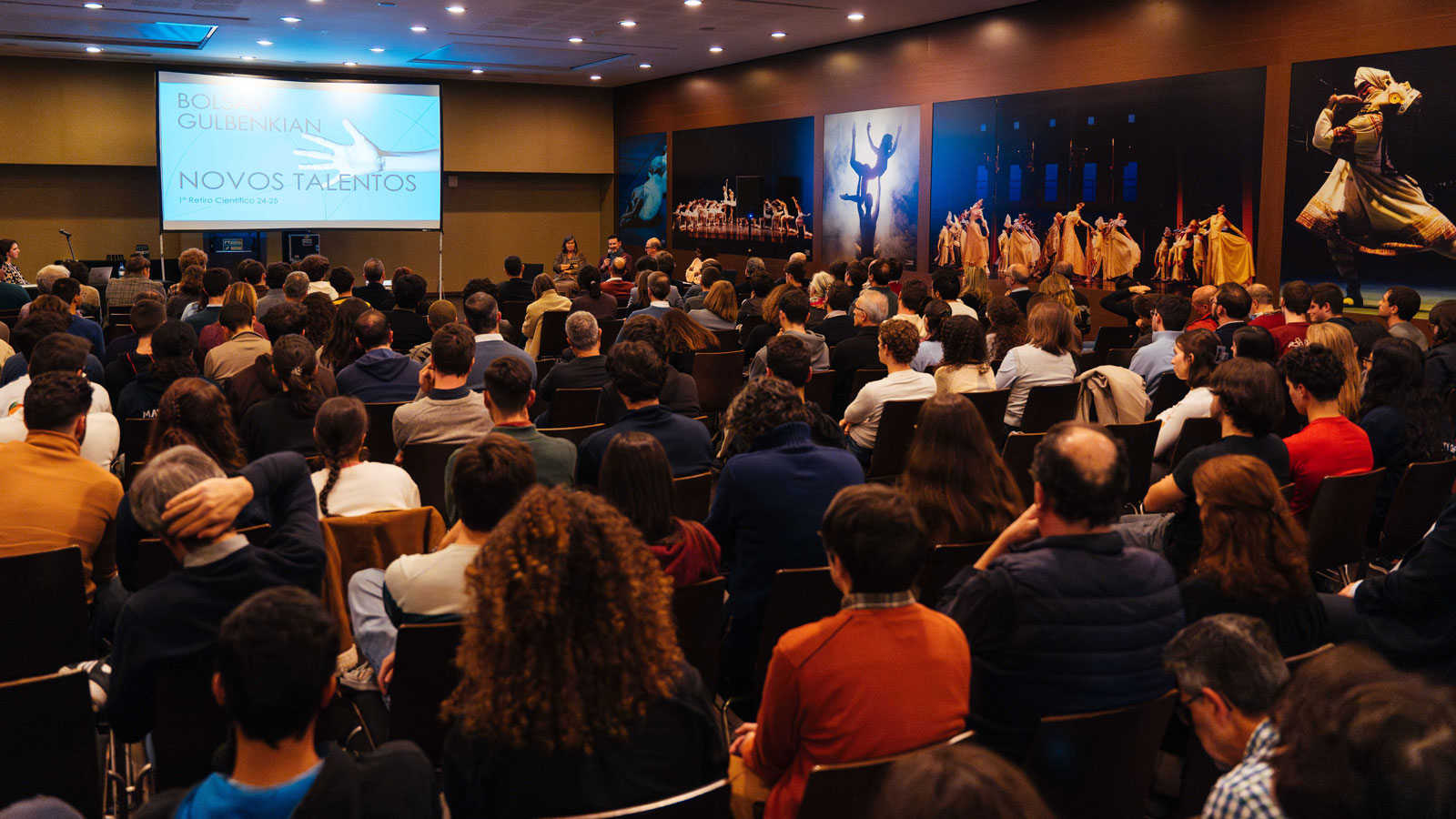
Approximately nine hours and thirty minutes. This is the number of hours of sunlight we can expect for this time of year, according to João Figueirinha, a young scholar from Gulbenkian’s New Talents programme. Not much sunlight comes inside the meeting rooms at Hotel Vila Galé in Coimbra, but the spaces where the socialising takes place transport us to a completely different ambiance: they might not be the Foundation’s own gardens, but they still beckon for a visit.
Twenty-one-year-old João does not study Astronomy, but Chemistry, specifically Pharmaceutical Sciences. Nevertheless, sunlight and the “dancing of the shadows” is something that fascinates him. He had just arrived from the Algarve and, unlike many of the other students, did not appear nervous. Looking around, he buttoned up his blazer and ended the conversation by telling us he would explain his project in more detail later – which he did, at the last day of the retreat, summarising the importance of drug monitoring in the opioids market and mentioning that, according to neuroscientists from Washington University, even the amount of sunlight can influence the treatments that use these drugs.
The retreat took place mainly in the lower floor of the hotel, in six rooms divided by field of study – Humanities, Social Sciences, Biology, Physics, Chemistry, and Mathematics –, as well as in a big auditorium. All of these spaces open up onto a shared space: an inner courtyard, which was used during breaks in the sessions and featured coffee tables, sofas, paintings, and photographs of costumes associated with different genres of dance.
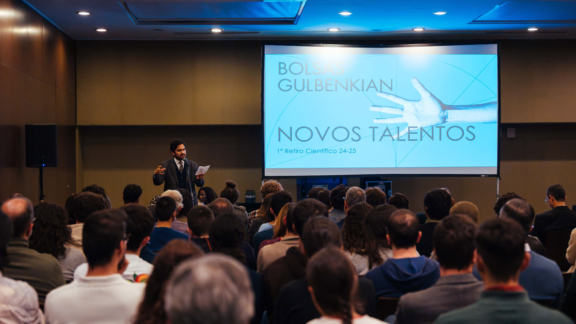
It is the end of another Friday afternoon, and the clock strikes 6 pm. Hundreds of people are walking to and fro. Another greeting, this time between the Scientific Commission and some of the advisers, who are already sitting at the hotel’s auditorium. We are waiting for a few more scholars. The last ones to arrive shuffle past the others with their bags, taking the few remaining seats. Noise gradually subsides into silence. So began the welcome session at the first retreat of the 2024/2025 edition of Gulbenkian’s New Talents scholarship programme.
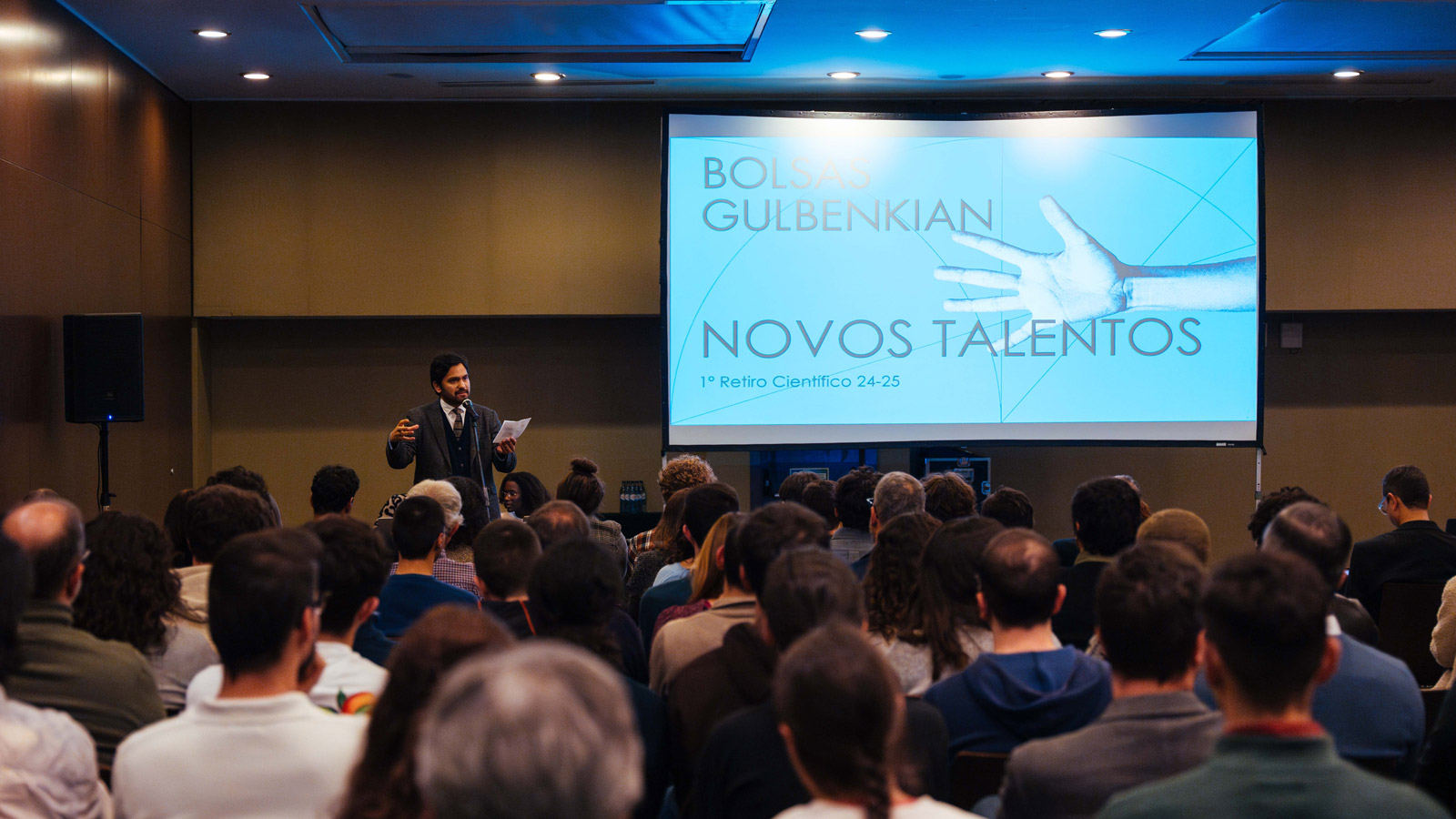
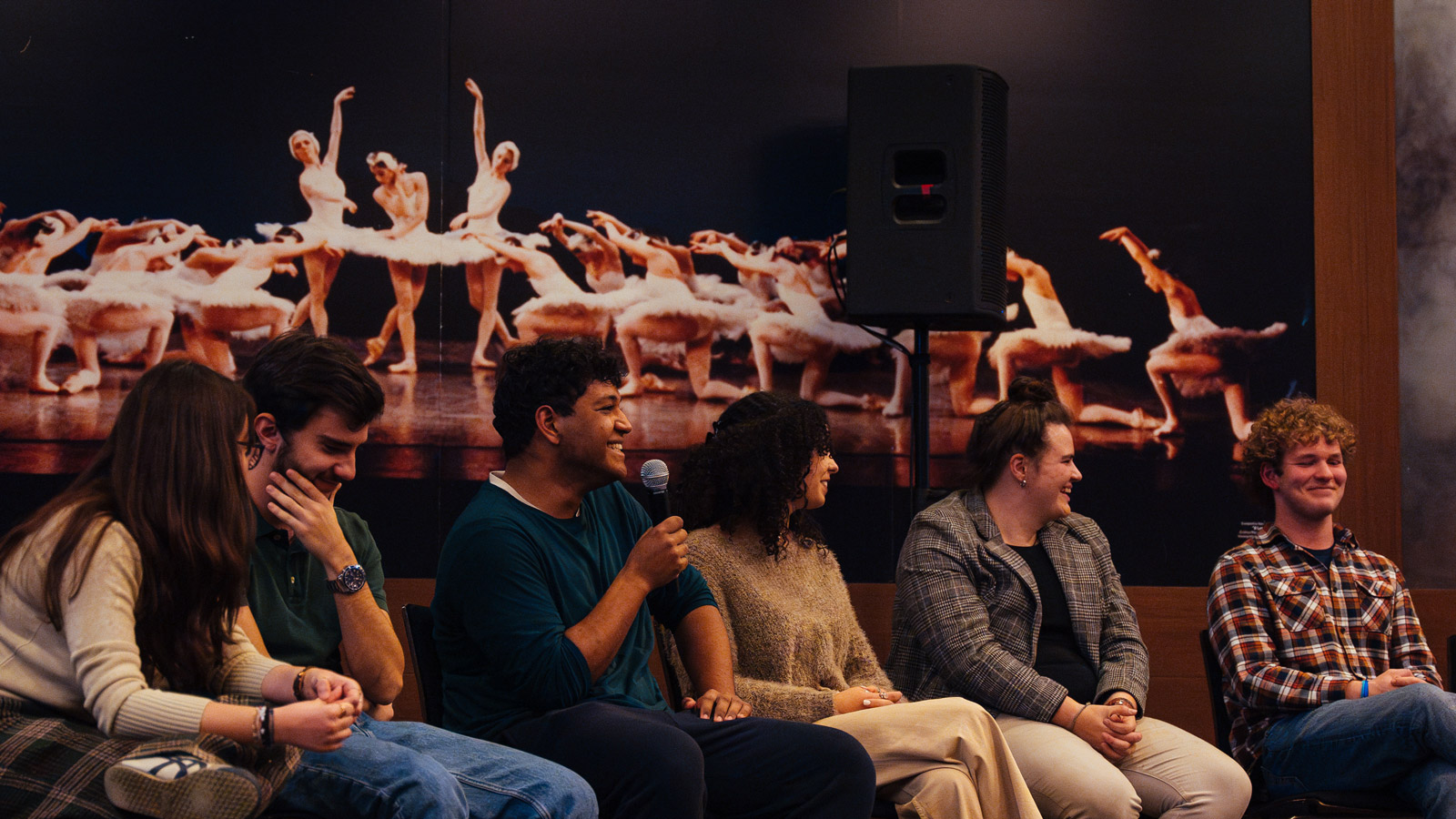
After the introductions, and while six of the students finish their presentations, another group of six is just getting ready. “You are potential agents of transformation”, says Sara Bahia, a professor at the University of Lisbon and a member of the Scientific Commission for the Social Sciences, about the New Talents scholars.
In her opinion, these scholarships represent those whom the research world recognises as key talents. She has been in academia “for decades”, which is why she “dares” to say that the young people present in the session inhabit a world where they try to familiarise themselves with the best that world has to offer and, subsequently, transform it. “If we think of ourselves as one being in an infinite universe, then there has to be some part of it we don’t yet know”, she shares, in the conversation with Hélder Maiato, a scientist from Porto, and João Rocha, a Chemistry professor and researcher from the University of Aveiro, that rounded off the retreat’s first day.
Hélder Maiato mentioned that “were it not for these programmes, we would not get to know some of the people here today”. In practice, that is what scholarships are for: “to find and support exceptional students’ talents and to stimulate their first steps into research work in areas of basic science”.
“Where does it all begin?”
Every day we use objects, such as mobile phones, computers, household appliances and medication, without giving much thought to their existence. It all seems very simple: we acquire these objects and we use them. We want them to work with precision, without fail. But we would be hard-pressed to pinpoint where the materials used in their production come from, or how these objects are made. This, precisely, was the question that served as the starting point for the scholars: “where does it all begin?”.
Answers to this question, and to many others, were expected on the second day of the retreat. “If we really think about it, this is what scientific research is: the practice of questioning what we already have on our hands”, says Bruno Loff, a mathematician and adviser to one of the Mathematics scholars, with a laugh.
In the morning, before a conversation that lasted around one hour, there were dozens of presentations by scholars. The Saturday was set aside for this exchange, where scholars talked about their starting point, the current state of play of their research and the questions that were arising.
The experience that the adviser describes as part of the mentorship provided in the programme represents “what education is supposed to be”. “There is freedom and time to think, and it is important to see things in a way that goes beyond work.” Loff points out that there is a very special feature, or “facet”, as he prefers to call it, to human thought, namely, “the ability to think with precision”. But “without time, it is very difficult to make that happen”, he concludes.
It is now time for Mariana Costa, the student he advises, to take the floor. It is her second time earning a New Talents scholarship. Her project appears to be simpler than the name it was given: cryptography.
Imagine a set of points connected by vertexes, which, in turn, are connected by edges. These small readings can take us to what Mariana Costa defines as a graph: the more it expands, the more random paths each of the vertexes can take. This design might seem difficult to understand when put into practice, but it can be very useful in programming and cryptography, helping to safekeep or preserve our data. “Everyone uses cryptography. Just, for example, by sending someone a message on a social network without everyone in the world finding out what we’ve sent”, she explains, concluding that the aim is to study these empty spaces and these random trajectories that allow for information to be leaked or gathered.
And how can we get to that stage and apply it to other areas? By moving from the moment where you “dream” it to concrete work.
In Mariana’s opinion, all of these exchanges enrich every single domain of study represented at the retreat in one way or another, by interconnecting them. “Mathematics is a field of study that can be applied to anything. For example, there were Biology professors who explained that our brain’s synapses can be represented through these graphs”, she mentioned, with some surprise.
Among the Biology researchers, Tomás Brocô is particularly curious about the way in which all of these fields of study influence each other. “It’s interesting how research can start out going in a certain direction and then do a 180-degree turn and influence a completely different field. Medicine and Biology are examples of this, but there are countless cases of such influences throughout history”, he says.
His field of study cannot be represented by graphs, but it proves to be an important contribution to medicine, in that it helps to understand how physical exercise can influence the reproduction of oligodendrocytes, which are cells that are formed in the central nervous system.
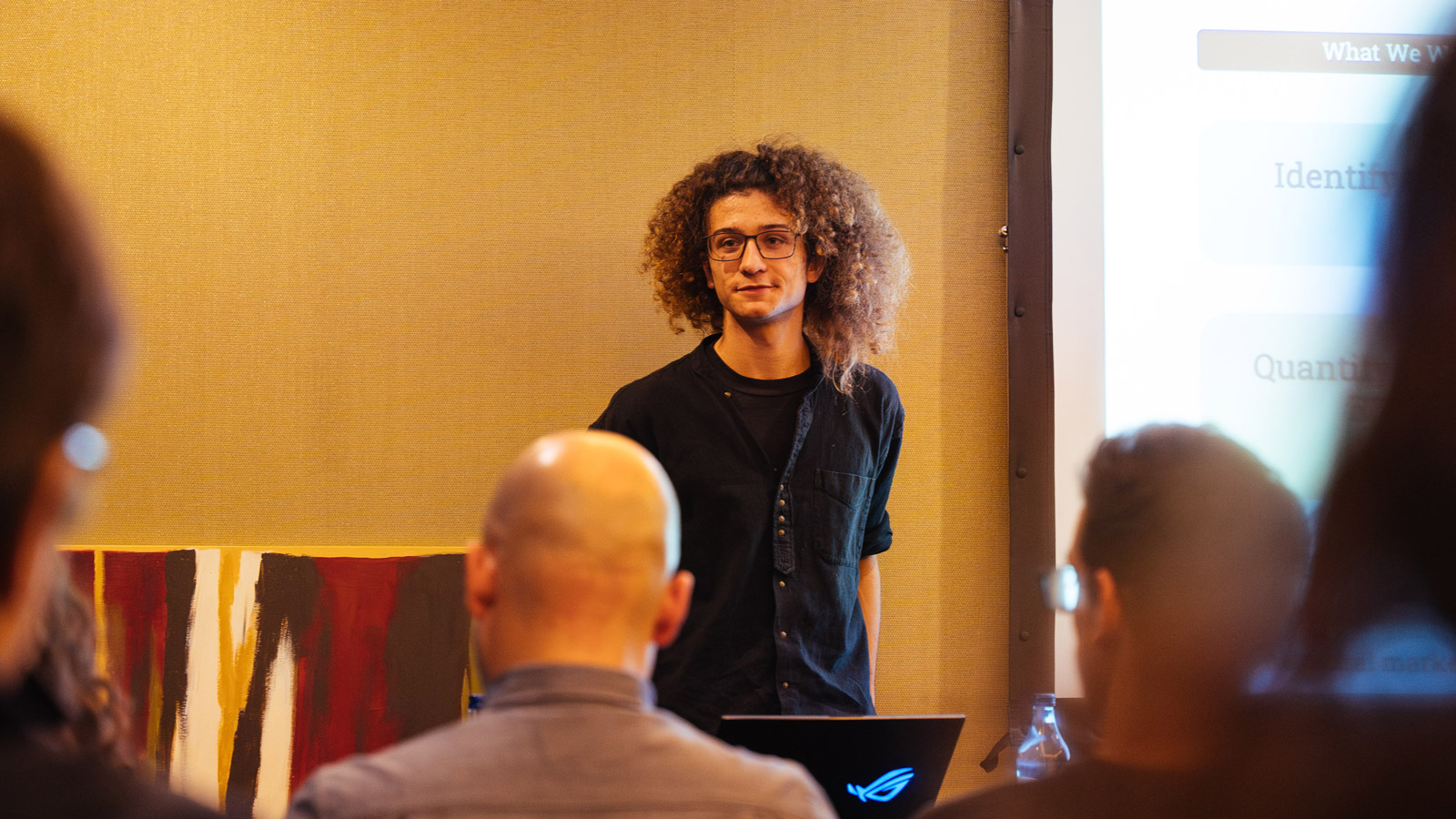
In other areas, theoretical debates are increasingly vivacious. Margarida Martins, a student of Clinical Psychology, applied for a scholarship because she wanted to put theory into practice – i.e., she wanted to do research.
Her project focuses on how blind people perceive vocal identities and, starting from that condition, it evaluates how the recognition of others occurs when one of the senses is impaired.
Besides being a university student, she volunteers in the programme “Growing Well” at Dona Estefânia Hospital, where she works mainly with practices of anticipatory grief. This is important information, because anticipatory grief was one of the topics she considered for her scholarship application. “It is a complex topic, especially in Portugal”, she says, sorrowfully.
In the end, she still focused on emotions, but through a different angle, as she explains. When she decided not to pursue the issue of anticipatory grief, a different window was opened, and she is now part of a research project created by her adviser, Ana Pinheiro.
“We may be the most scientific people, but there is a greater openness to this conversation [mental health], and that is very important because it is ultimately linked to the issue of understanding more about the scope of this problem. Of course, there are other aspects of our current reality that contribute to increasing this problem, namely social media, but even so, it is very positive that this is no longer such a taboo subject”, Margarida says.
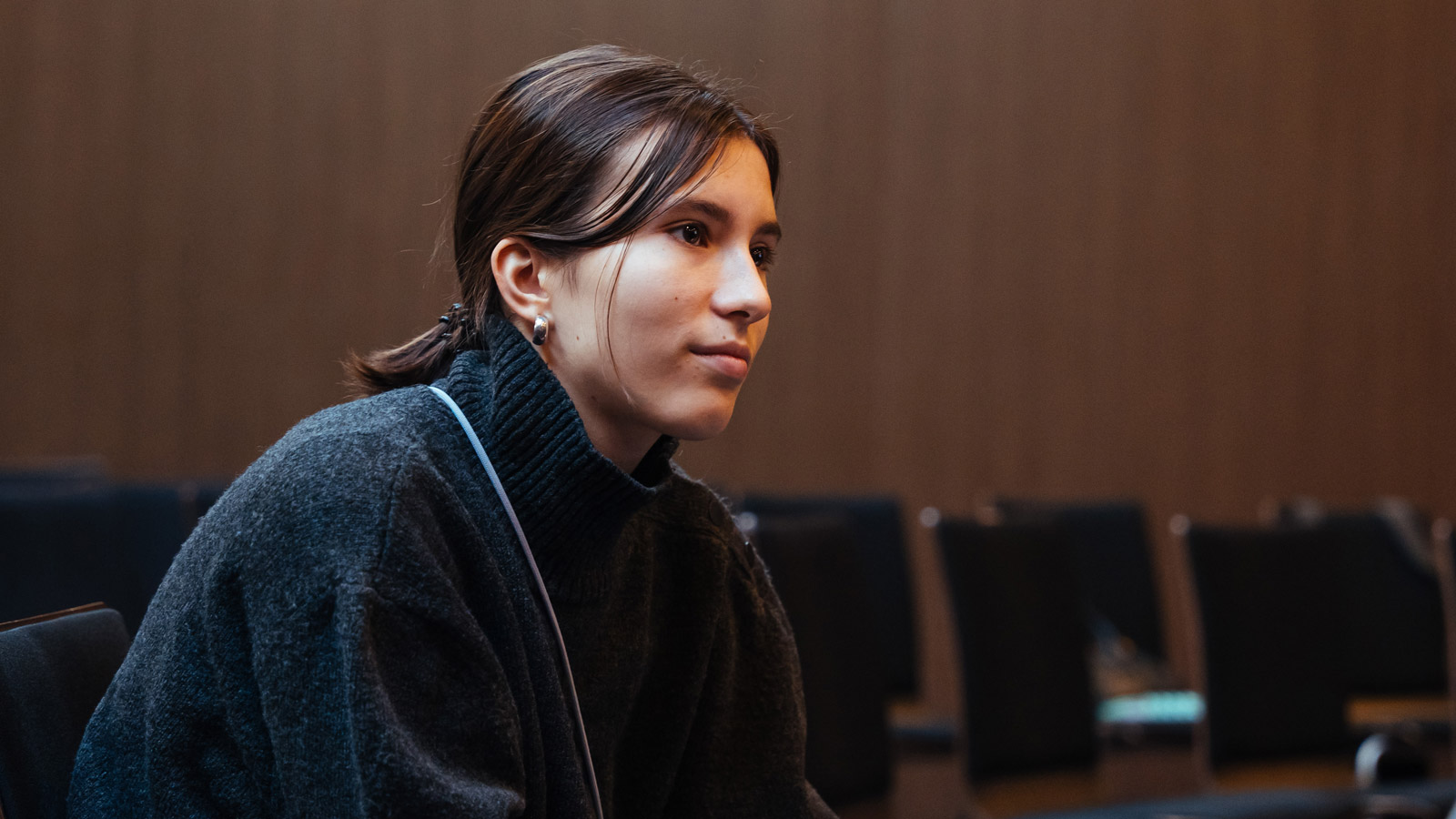
In the midst of this “revolution”, can art and psychology also interconnect? For Miguel Tintim, the answer is yes. “The human being’s tendency for drawing is a well-observed fact. Drawing is a language and a game that has its own rules, and it flows across different ages and cultures”, he says.
The first representative of an Architecture course in the scholarship programme, Miguel says that attending the retreat is essential, because the event provides “a transformational environment, and, just like drawing, being there can give people tools which not only help stimulate their imaginations but also strengthen other people.”
“The metaphysical experience
Innovation was a leitmotiv of the entire retreat, and the last day was no exception.
After two intense days, the objective was now to “calm down”. Vasco Gaspar, the moderator, prepared a set of activities for a calm morning, where the big new challenge was to stop – something these high-performance students acknowledged doesn’t come easily. It’s difficult to close your eyes without feeling uncomfortable, to switch your computer off when it’s time to stop working or studying, or to stop and think about yourself.
Beatriz Teixeira, a Physics scholar, found it very challenging. “I didn’t know where to be, how to sit, or simply to trust”. Why is that? “I’ve always considered myself a very extroverted person. I speak loudly, I laugh a lot, and, just like me, there are many people who feel uncomfortable in that silence, so this was an experience that was far outside of my comfort zone, having to be quiet and listen to my own thoughts. It was chaos!”, she admits.
The activities devised by Vasco Gaspar served mainly to strengthen inclusion and work on interpersonal and social skills. Paying full attention to oneself and to the mental health of each of these hundred young scholars was already a complex challenge, but one which was meant to take this programme “beyond a simple scholarship or project financing”. As Beatriz Teixeira points out, this was a recurring thought in the room, amid all these young students who, a few hours later, would go back to their (other) lives.
Ana Patrícia Silva
No results were found for your criteria.