

Behind the scenes of the Gulbenkian Museum renovation
Follow the work that is shaping the Museum for the future
More than 55 years after its opening, the Gulbenkian Museum has closed for renovation until July 2026. This project aims to provide the best possible conditions to preserve and present the extraordinary Calouste Gulbenkian Collection for generations to come.
We are upgrading the climate control, lighting, and security systems, improving the visitor experience, and harmonising the architectural space, always respecting the Museum’s original vision.
On this page, you can follow the transformation as it unfolds: behind-the-scenes images, conservation and restoration work, insights from the teams involved, artworks on loan to exhibitions in Portugal and abroad, and stories about the Collection and its Collector.
The Museum is going to Paris!
Over the next few months, when visiting our galleries, you may notice that some of our works of art are missing…
There is a good reason for their absence: the Museum is going to Paris!
Between 10 June and 2 October, a part of the collection will find a temporary home in the historic Place de la Concorde. If you travel to the City of Light, do not miss the chance to visit them on exhibition at the Hôtel de la Marine, in Gulbenkian par lui même.
(And, if you are staying with us here in Lisbon, visit the museum to (re)discover the works of art chosen by the museum curators to temporarily replace those that are in Paris!).
Eighteenth-century textiles in the Gulbenkian collection
Along with furniture, textiles played a prominent role in eighteenth-century interiors.
The fabrics on display in the eighteenth-century gallery come from what was known as the Manufacture de Lyon. Silk production in Lyon reached its peak during this century, as a culmination of the momentum that had been building since the previous century, at the initiative of Colbert, a minister of Louis XIV.
This palpable vitality, in addition to better industrial organisation, technical advances, and the influence of Italian weavers who had settled in the country, were some of the factors that allowed this production to achieve an unprecedented level of quality and originality.
This can be seen in the silk fragment attributed to Philippe de Lassale, in a markedly Louis XV style, which came from the private chambers of Stanislas Leckzinsky, the father-in-law of the French monarch, at the Château de Lunéville. Another significant piece of fabric was commissioned for Marie Antoinette’s chambers in Versailles, revealing the height of sophistication of Lyonnaise production at the time.
Floral decoration, very much to the queen’s taste, is a dominant characteristic. However, from 1760 onwards, the classically influenced arabesque style began to be more commonly used. Jacques Gondoin, the king’s architect, designed this composition of arabesque acanthus scrolls punctuated with appliqué medallions. It was produced by Jean Charton, a master of textiles from a renowned family of weavers in Lyon.
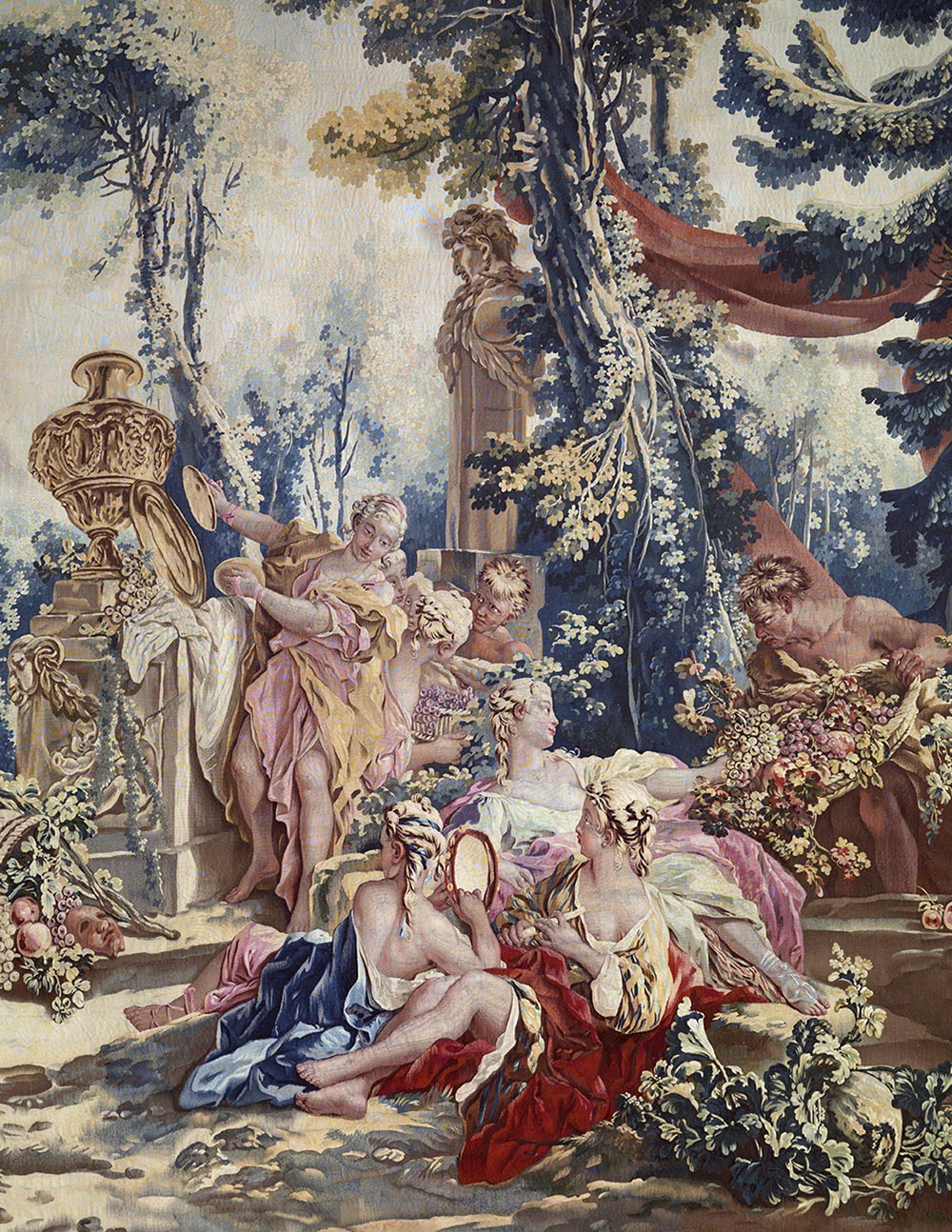
Tapestries also played an important role in interior decoration during this period. With the increasing awareness of the idea of comfort, these objects were vital in making rooms more welcoming. Mythological subjects were often used and served as a theme for scenes of fêtes galantes and amorous narratives.
These bucolic and romantic representations had a strong decorative component that produced a scenic effect that was very popular at the time. François Boucher was one of the painters who most explored this theme with, among others, the tapestry cartoons Jupiter en raisin and La Pipée aux Oiseaux, exhibited in the gallery.
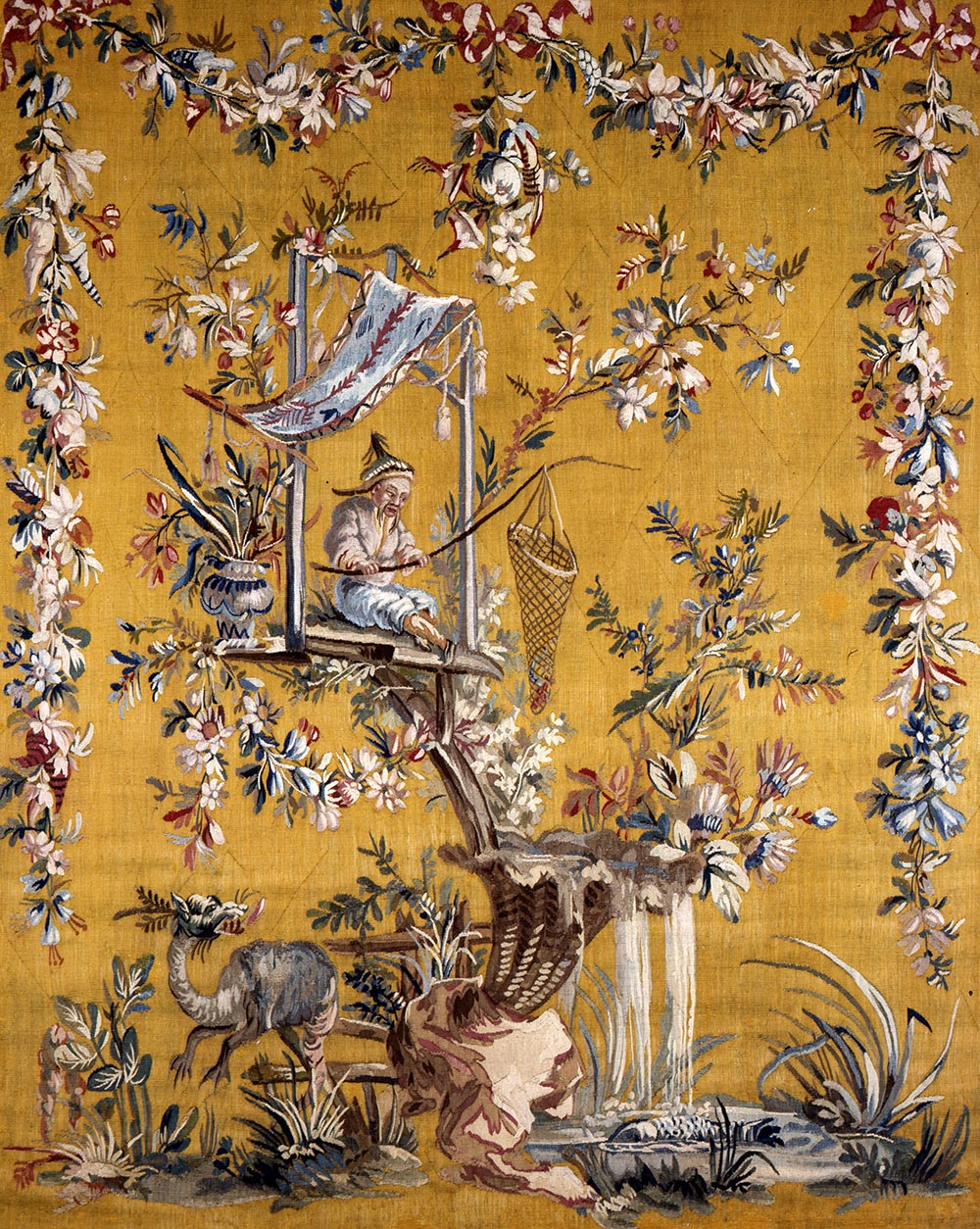
A taste for the exotic was also cultivated during this period and provided a source of inspiration for many artists. With the development of trade with East Asia, many objects from China and Japan reached Europe, leading to the emergence of diverse decorative motifs of oriental inspiration.
Their visual lightness, movement, and asymmetry combined harmoniously with the Rococo style. The French painter and engraver Jean Pillement developed this theme magnificently, as demonstrated by the set of chinoiserie tapestries also on display.
Clara Serra
Curator of the Calouste Gulbenkian Museum
Masters of 18th-century French furniture: Boulle, Cressent and Blanchard
With the renovation of the 18th-century gallery we will have the opportunity to see a new display of the exceptional pieces of furniture that belong to the Gulbenkian collection. We are talking about works produced by some of the most important carpenters and cabinetmakers of the time and which demonstrate the degree of sophistication and artistic and technical quality that this art achieved during this period.
In this gallery we can observe the evolution of furniture over the course of the 18th-century, not only with respect to its lines, but also in terms of materials and techniques, being able, therefore, to have a very approximate idea of what furniture was at this time.
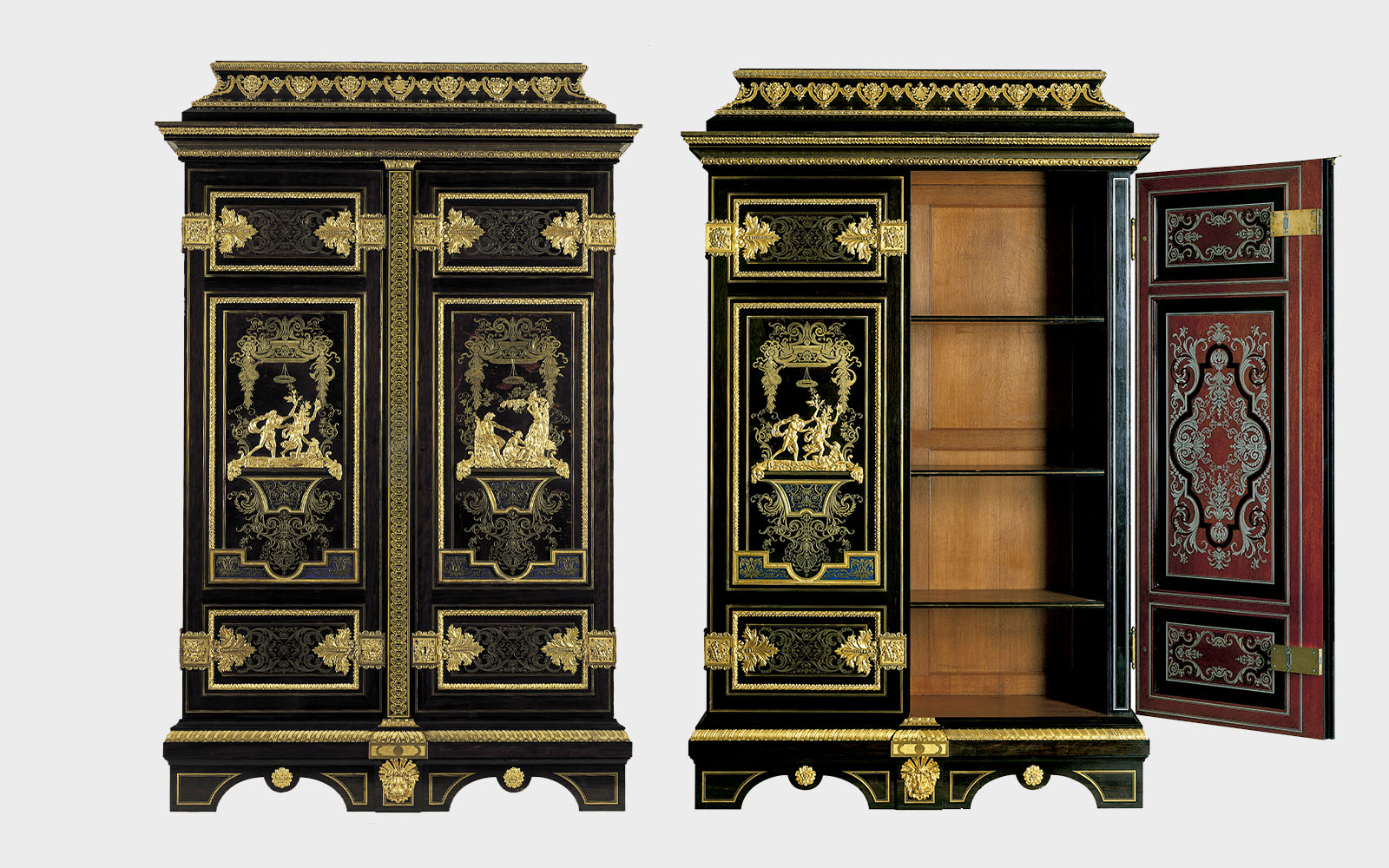
The Boulle armoires are an example of what was produced in the late 17th and early 18th-century. André Charles Boulle’s quality and skill led to his nomination as ‘Master cabinetmaker to the King’ by Louis XIV and to his installation, under royal protection, in the Galleries of the Louvre, in Paris.
His work, of an imposing and majestic nature, was one of those which most identified with the monarch’s personality. The most striking feature of his production is the marquetry work in tortoiseshell and brass. Although Boulle did not invent this technique, it was he who developed it, fully exploiting its potential.
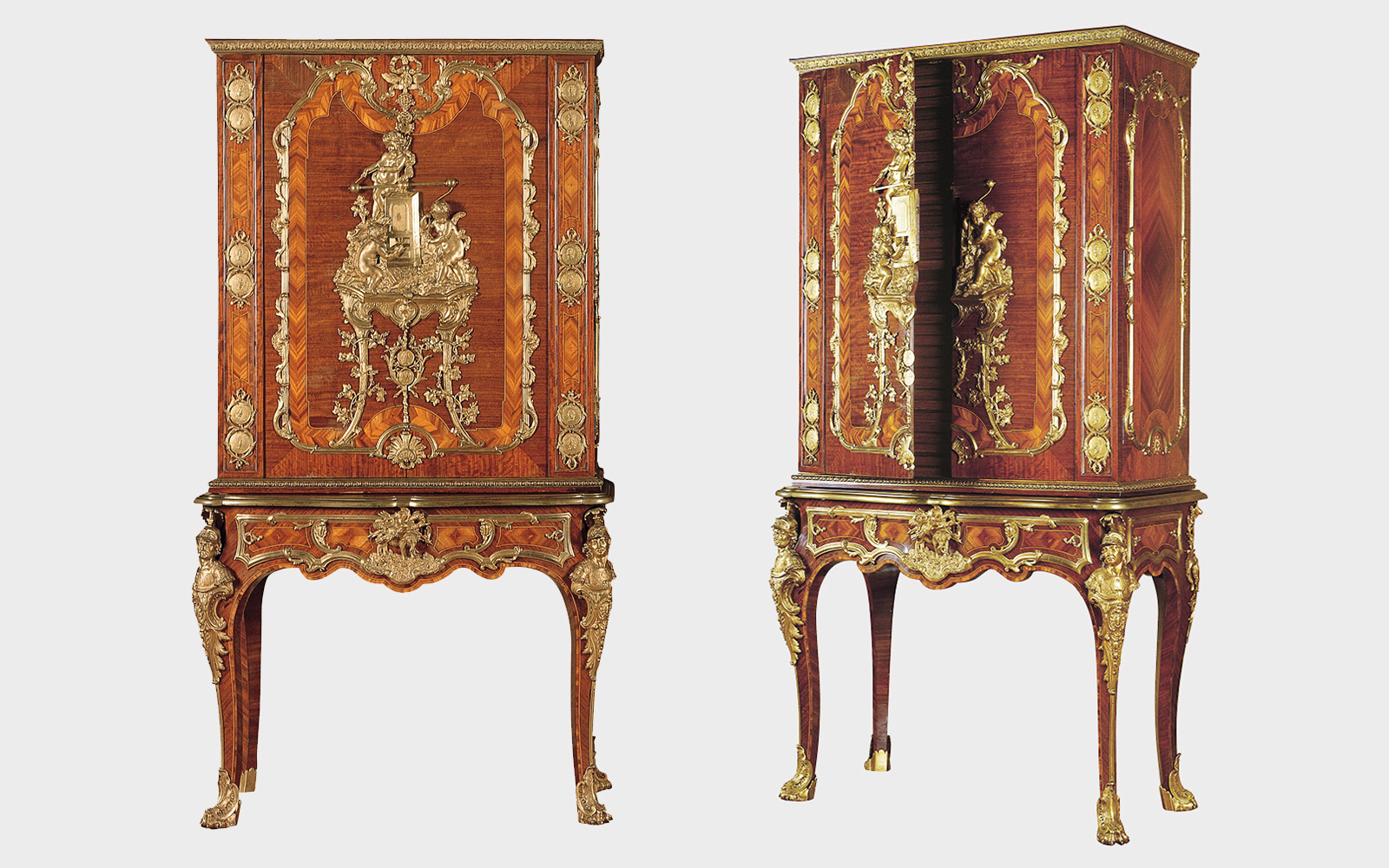
From well into the 18th-century we have the magnificent pieces by Charles Cressent, cabinetmaker of the Regent (Duke of Orleans), and the most prestigious of his time. His work is characterised by a monumentality in which the bronzes, magnificently chiselled and gilded with an enormous artistic sensibility, acquire unprecedented importance and splendour. His inlays and veneers are conceived in order to enhance the bronzes.
Cressent’s work achieved a true international dimension. Although he was active until the second half of the 18th century, well into the reign of Louis XV, he was the regency cabinetmaker par excellence. His production was always faithful to the ‘style’ he created in the 1720s. Cressent worked for most of the French aristocracy. The museum holds an important collection of furniture by this cabinetmaker, the medal cabinets probably being the most imposing.
However, if we are talking about imposing pieces, we cannot fail to mention the ‘canapé à confidents’, commissioned for the summer salon of Louis XVI’s aunts, in the Bellevue Palace. This canapé bears the stamp of Jean-Nicolas Blanchard, a carpenter from a family with a tradition in this art. He became a master in 1771 and shortly afterwards he began to work for the royal family.
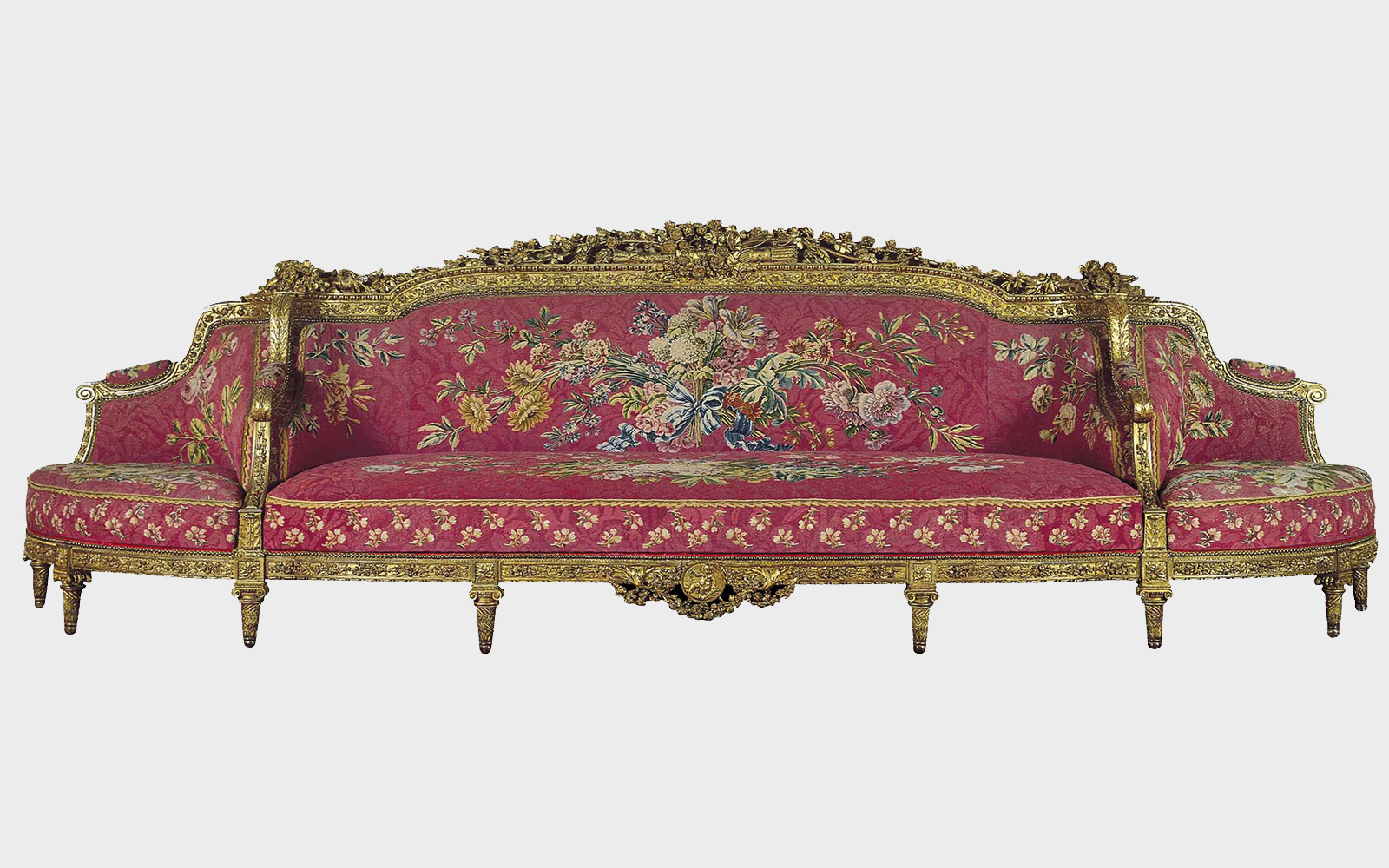
Blanchard specialised in seats. His chairs and sofas, among others, are distinguished by their elegant and proportionate lines, harmoniously combined with rich sculptural decoration. Blanchard was always very demanding when choosing the sculptors with whom he collaborated, and this is reflected in his work. His most interesting phase is perhaps the so-called ‘transition’ phase, where he combined elements of Louis XV and Louis XVI in a surprising way, achieving a great artistic effect. This typology of canapé is an example of the creativity and virtuosity of French carpenters of this period.
Clara Serra
Curator of the Calouste Gulbenkian Museum
Painting and Sculpture in the Gallery of 18th-century French art
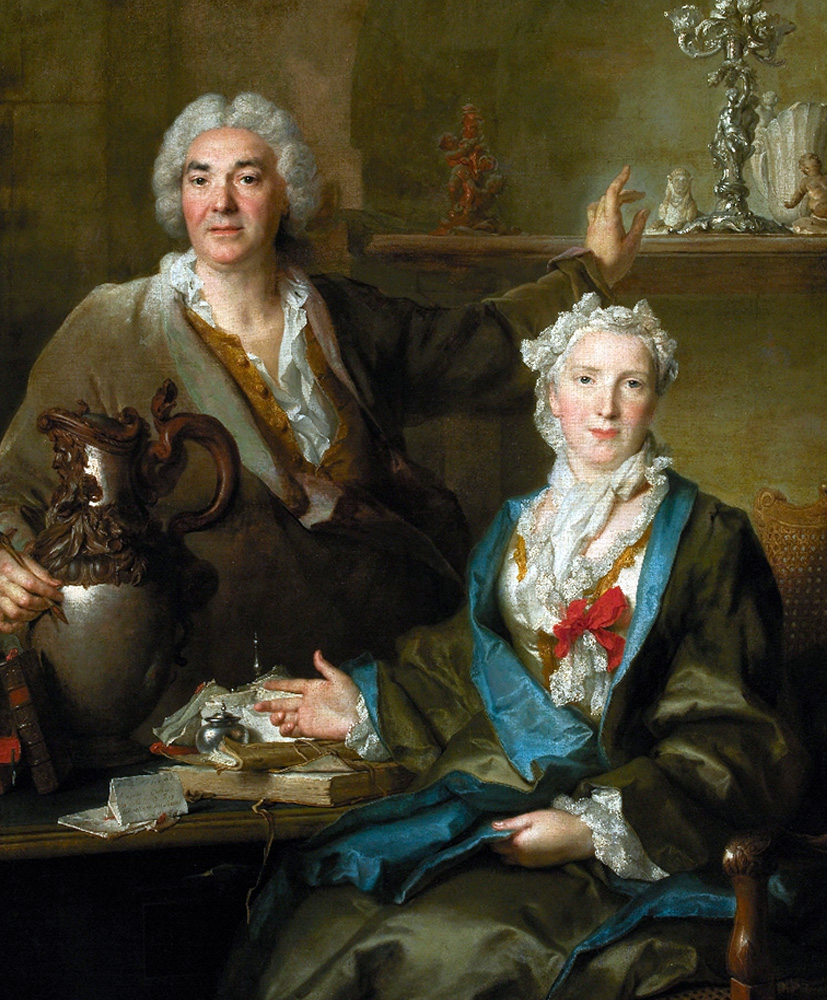
French painting occupies a prominent position in the space that is now the Gallery of 18th-century French Decorative Arts. The work ‘Portrait of Thomas Germain and His Wife’, by Nicolas de Largillièrre, will have a new location, immediately visible from the French gold and silver objects section, which will undergo significant changes in this renovation.
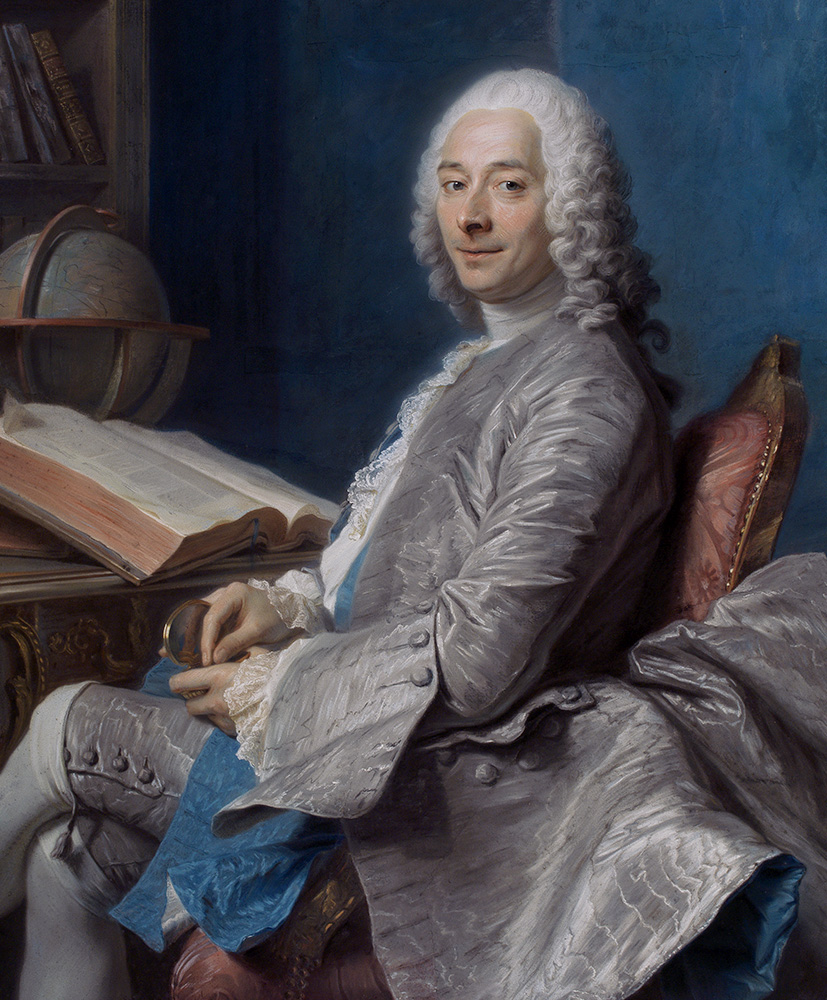
This painting is an excellent example of a ‘portrait of an artist in his studio’, a genre central to 18th-century French painting. Special attention is once again given to ‘Portrait of Duval de L’Épinoy’, by Maurice-Quentin de La Tour, considered ‘the triumph of pastel painting’ in the Paris Salon of 1745. ‘Portrait d’apparat’ is also represented in the ‘Portrait of Marechal Duke of Richelieu’, by Jean-Marc Nattier, a work that occupied A central place in the collector’s painting gallery at his home in Paris.
French landscape painting from this period also includes works of unique quality, a prime example of which is ‘The Island of Love’, by Jean-Honoré Fragonard, a whimsical composition produced around 1770 that pays homage to Antoine Watteau. Figment of the artist’s imagination, the work, initially described as a ‘view of a picturesque garden’, is a remarkable renewal of the theme of a ‘fête galante’ in a fictional garden.
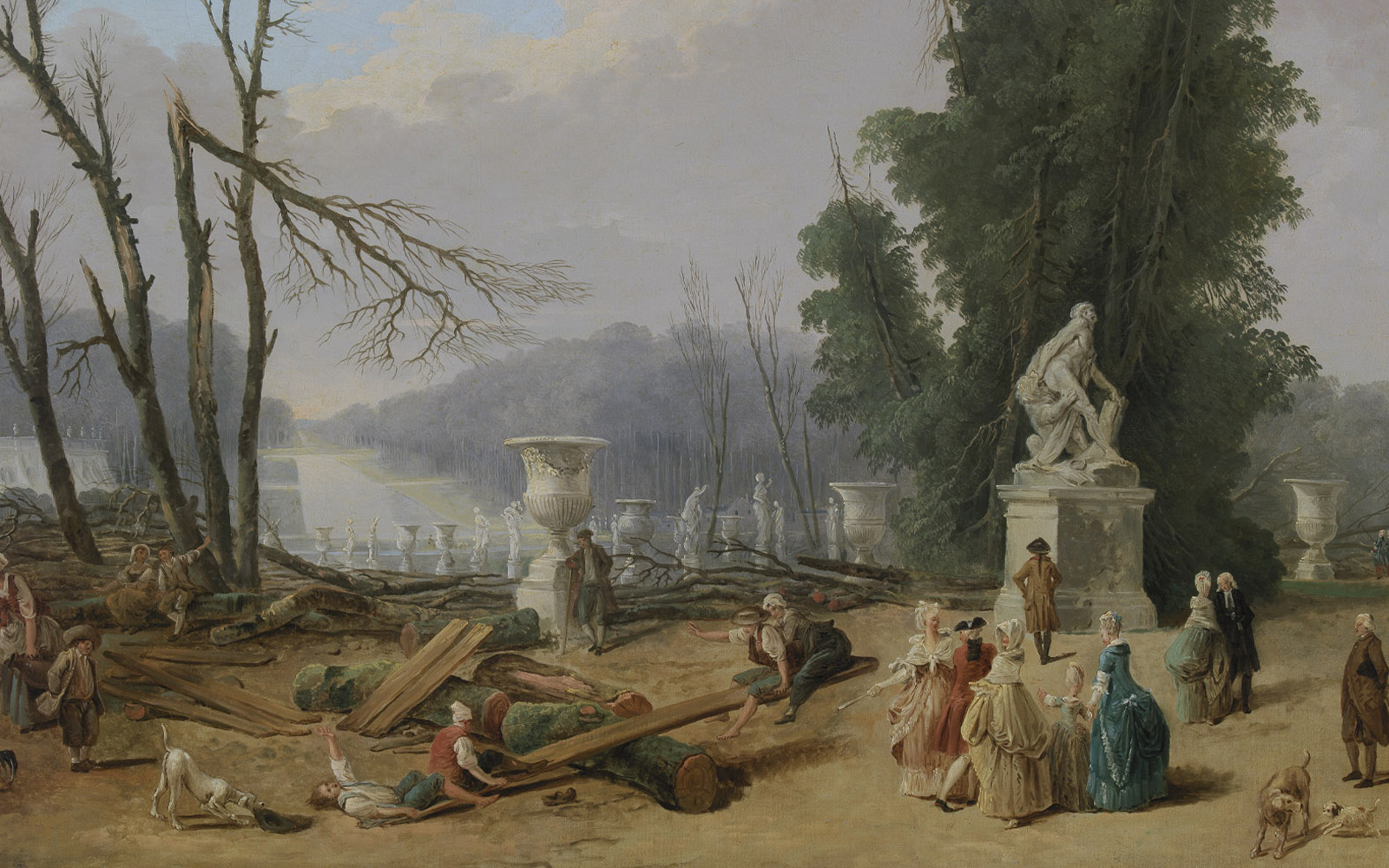
Hubert Robert, the designer of the gardens of King Louis XVI from 1777, caught the collector’s special attention in the 1920s and is represented in this section by a pair of paintings that document the renovation of the Gardens of Versailles: ‘Le Tapis Vert’ and ‘Le Bosquet des Bains d’Apollon’. Both paintings were acquired by Calouste Gulbenkian from the Hermitage Museum, in Saint Petersburg, in 1929.
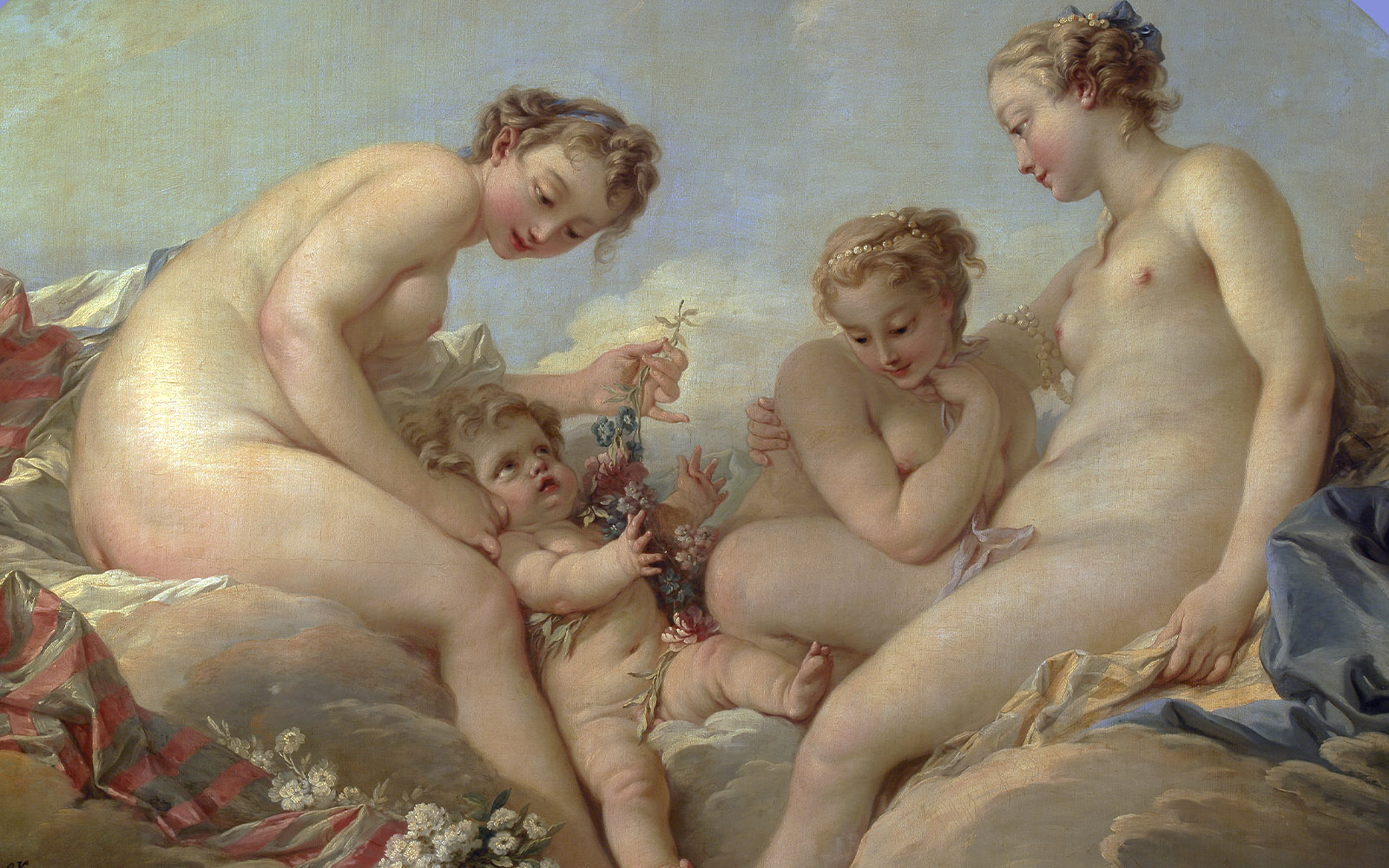
The gallery also presents one work of a genre that was particularly in vogue in 18-th century France, ‘Fête Galante’, a painting by Nicolas Lancret, which had previously belonged to the collection of Frederick the Great, King of Prussia. Finally, it is worth mentioning a painting by François Boucher, ‘Cupid and the Three Graces’, a composition inspired by classical mythology which occupied a central place in the Boucher Salon of the collector’s residence in Paris that is now worthy of a new reading.
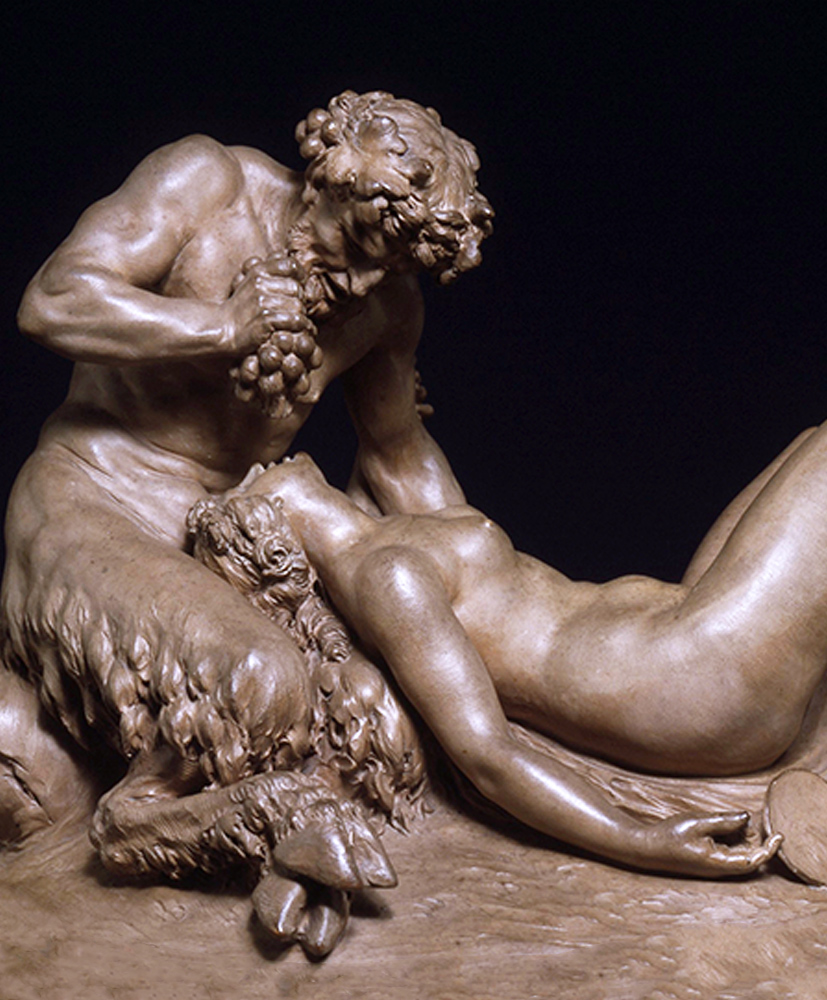
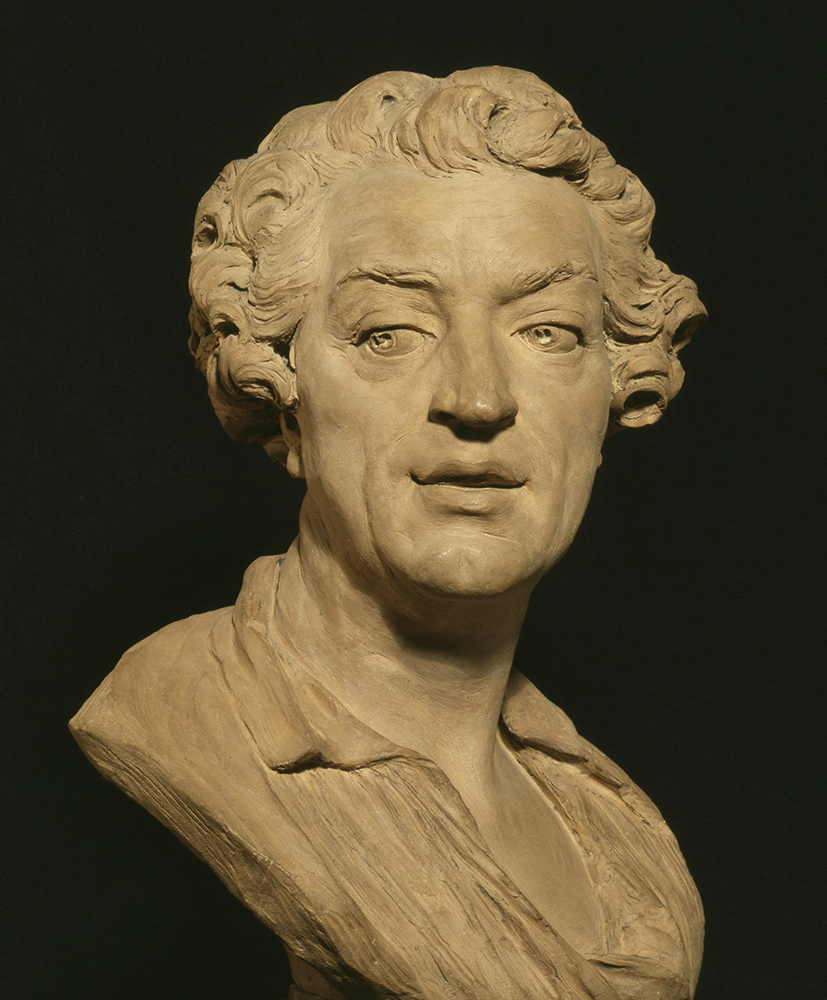
In sculpture, several great French names of the 18th-century such as Clodion, Pigalle, Lemoyne and Caffieri will populate the gallery with small-scale works and terracotta busts.
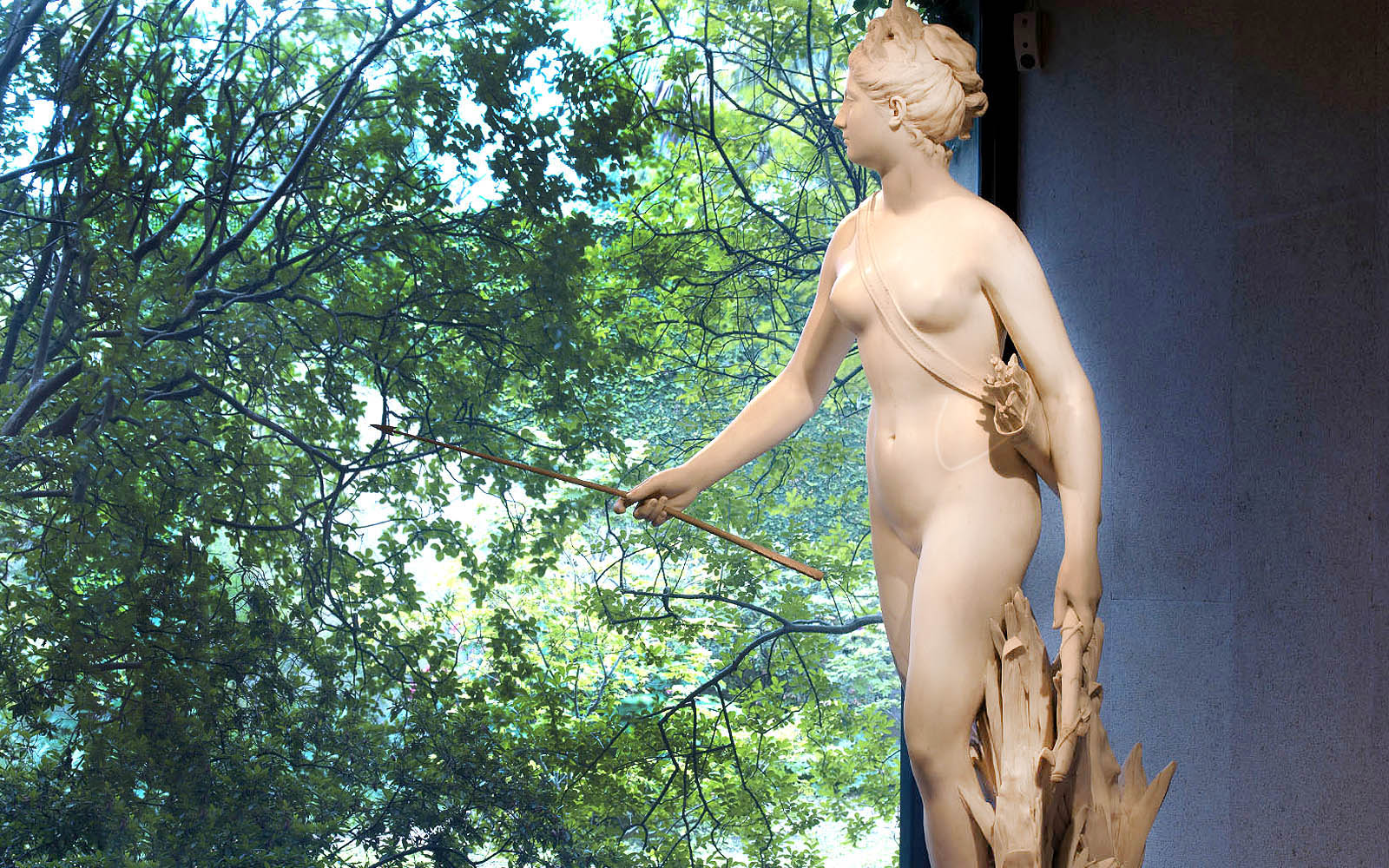
The presentation ends with the transition to the 19th-century gallery, in the space specifically dedicated to the life-size marble representation of ‘Diana’ by Jean-Antoine Houdon, a masterpiece of French neoclassicism produced in 1780, originating from the collection of Catherine II, Empress of Russia.
Luísa Sampaio
Curator of the Calouste Gulbenkian Museum
Museum renovations: 18th-century French art and Objects in silver and gold
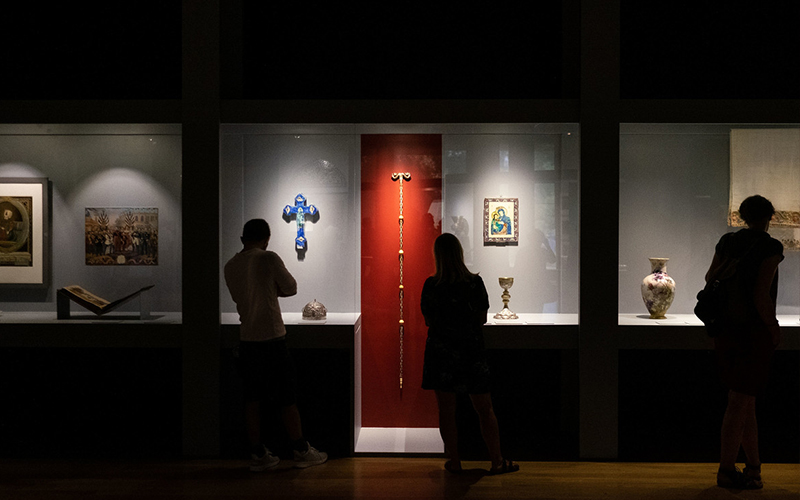
The Museum galleries dedicated to 18th-century French art bring together a remarkable collection of furniture, objects in gold and silver, paintings, sculptures, books, tapestries, porcelain and clocks that testify to the excellence of French artistic production at this time.
Significant renovations of the silver collections display will enable a reappraisal of the collection through new methods of display, highlighting objects and creating new relationships between the objects and the way they are viewed by the public.
The display of paintings, sculpture, decorative arts and books produced in 18th-century France will also benefit from renovations, with the support of Max Mara.
We are currently creating new content to enrich the experience of our visitors. Come and visit us when we reopen!
Patron of the renovation

APOM Award for the Calouste Gulbenkian Museum
At the annual APOM Awards ceremony, held on 29 October at the Museu de Marinha in Lisbon, The Golden Age of French Furniture. From the Workshop to the Palace won in the ‘Temporary Exhibition’ category. On display between 6 March and 28 September 2020 at the Calouste Gulbenkian Museum, this exhibition had one of the museum’s curators, Clara Serra, as curator, with Mariano Piçarra in charge of the museographic project, and it was held in partnership with the Ricardo do Espírito Santo Silva Foundation.
Drawing on some emblematic pieces from the Calouste Gulbenkian Museum collection, such as the Jean-Henri Riesener roll-top desk, the exhibition aimed to highlight French furniture from the 18th century, a period in which it attained an unprecedented degree of excellency. Generous loans from other institutions, in Portugal and abroad, such as the Museu Nacional de Arte Antiga in Lisbon and the Musée des Arts Décoratifs in Paris, enhanced and strengthened the exhibition discourse, which sought to explore, in an educational and accessible way, the different production phases of these pieces: from the raw material, the wood, to the delicate and extravagant furniture made for royal palaces. By revealing this demanding and painstaking creation process, the exhibition also unveiled the secrets behind these works: the craftsmen and workshops that produced them, the materials of choice, and the techniques and tools that facilitated their design.
The exhibition was complemented by a 360º tour, which can still be viewed online and which allowed the public virtual access during the 2020 lockdown resulting from the COVID-19 pandemic. The exhibition was also accompanied by a bilingual publication, on sale in the shops of the Calouste Gulbenkian Foundation, which included texts by Clara Serra and Helen Jacobsen, curator of French 18th-century Decorative Arts at the Wallace Collection, London.
‘Minai’ footed bowl
Ceramic production in Seljuk Persia was effectively concentrated around two major poles, which were also two of the most important urban centres of the late 12th and early 13th centuries: Kashan and Ray, capital of the Seljuks (who reigned in Persia between 1038 and 1184). These two cities were responsible for the majority of the production of luxury ceramics, including minai ware and lustreware.
Ceramic production in Persia burgeoned in the 11th century, inheriting a tradition of luxury objects rooted in the Islamic world dating back to the 9th century, which had been developed significantly in Fatimid Egypt. The peak of Iranian ceramics in the early 13th century might also be explained by the migration of Egyptian ceramicists at the time of the decline of that dynasty, between the late 11th and early 12th centuries.
What we know for certain is that one of the great points of reference for ceramic production in Persia, as well as in a large part of the Islamic world, continued to be Chinese ceramics – with its fine porcelain and decoration recognisable for its blue drawings and white backgrounds – imported via the ports of Yemen and transported through the Arabian Peninsula to the Mediterranean basin, Persia and Central Asia.
The technical development that allowed for painting under and over the matt glaze contributed greatly to the success of minai – or enamelled – ceramics, where each piece was a precious decorative object. Pieces underwent a complex process of firing, the first time at higher temperatures and a second time at a temperature below 600 degrees, to allow for the fixing of the most fragile pigments, including gold.
The piece in question, decorated predominantly in blue and white, but also containing pigments of green and black manganese and flecks of gold, shows, in the centre, a sitting figure, who seems to be listening to a story being told (most likely representing the person who commissioned the piece), surrounded by four figures, also seated, probably two storytellers – these figures are depicted differently in green and black, adopting a more active, staged posture – and another two listeners – in blue, like the central figure, and in a more contemplative pose. Drawn among the figures are decorative palms, arranged radially.
The inner rim shows a pseudo-inscription in characters, in white over a band of blue background, at a time when calligraphy held increasingly significant decorative value in Islamic art.
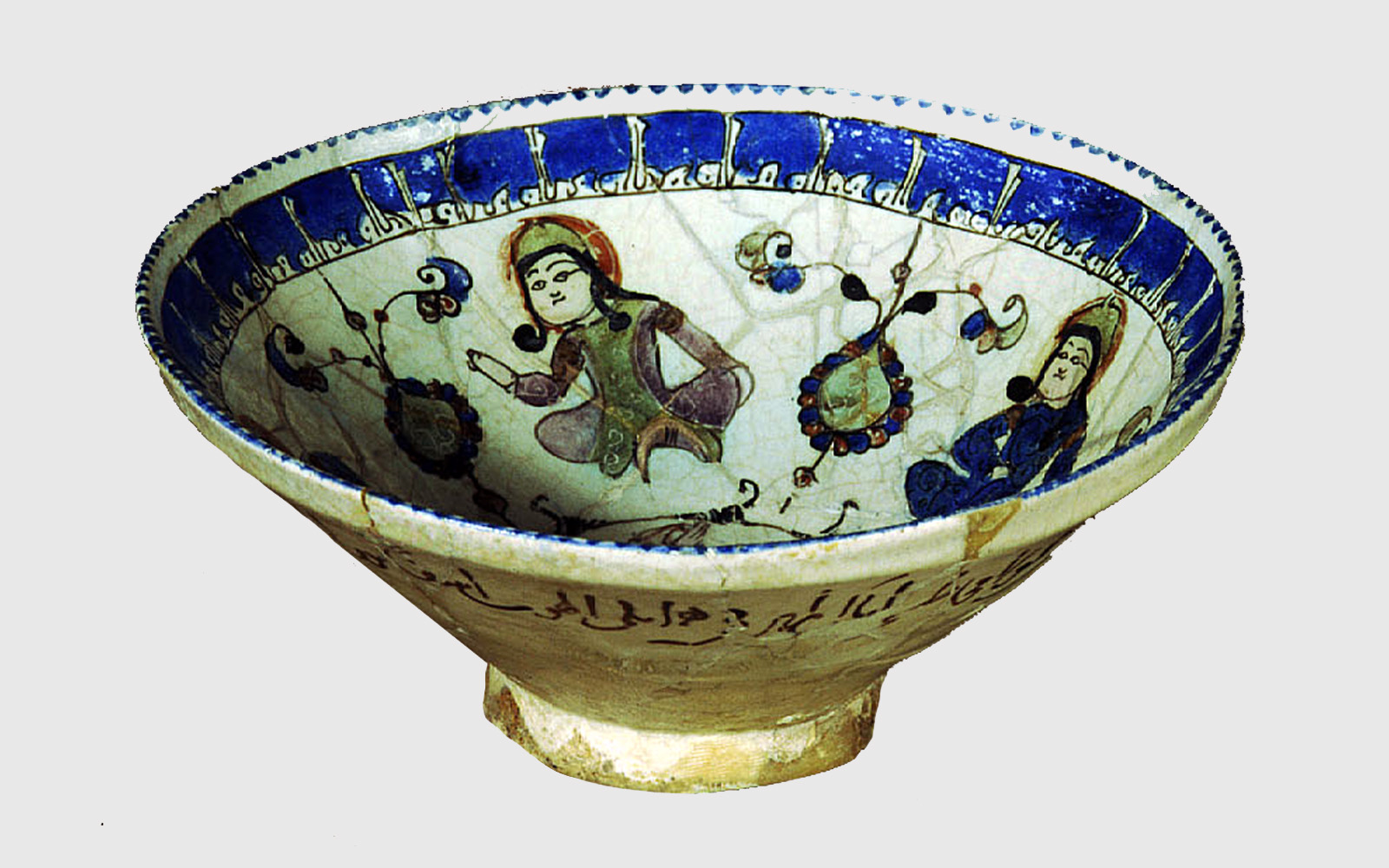
On the outer rim, an inscription in nashki characters reproduces a poem by the famous poet Motanabbi, who died in the year 968 A. D. This was not unusual in Persian iconography of the 13th-15th centuries, which often depicted poems and heroic themes in ceramics and illuminations:
On the day of separation such was my anguish that fear turned my body old and decrepit. And the distance forged a separation between my eyes and gentle sleep. My soul reigns in a body that has become slim as a reed. If a breeze were to pass through my clothing there would be nothing to discover – to describe my gauntness suffice it to say that you would not find me if I were to put up no resistance.
Jorge Rodrigues
Curator at the Calouste Gulbenkian Museum
Ulug Beg’s jade jug: the ‘Gurgan’ and its heritage
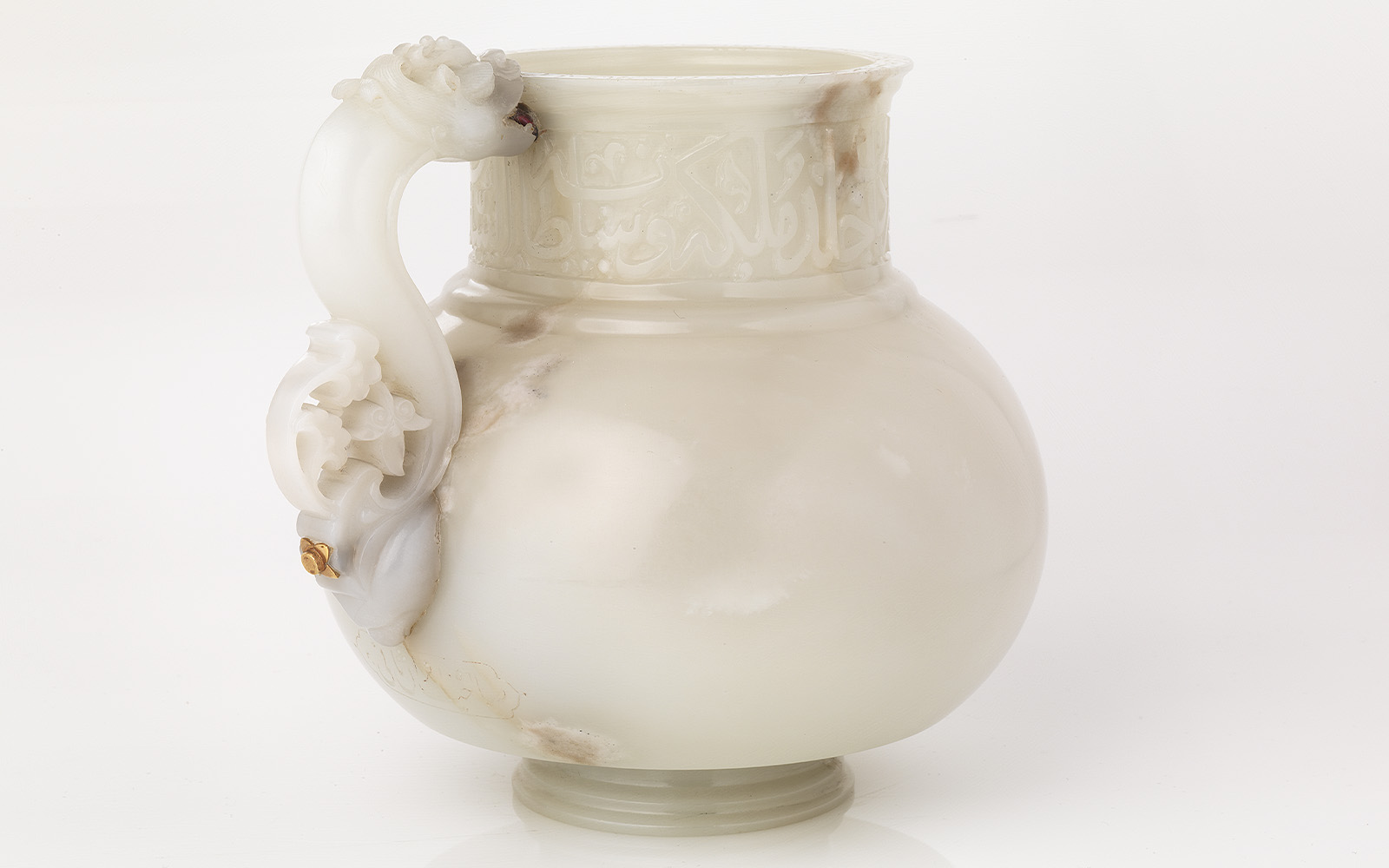
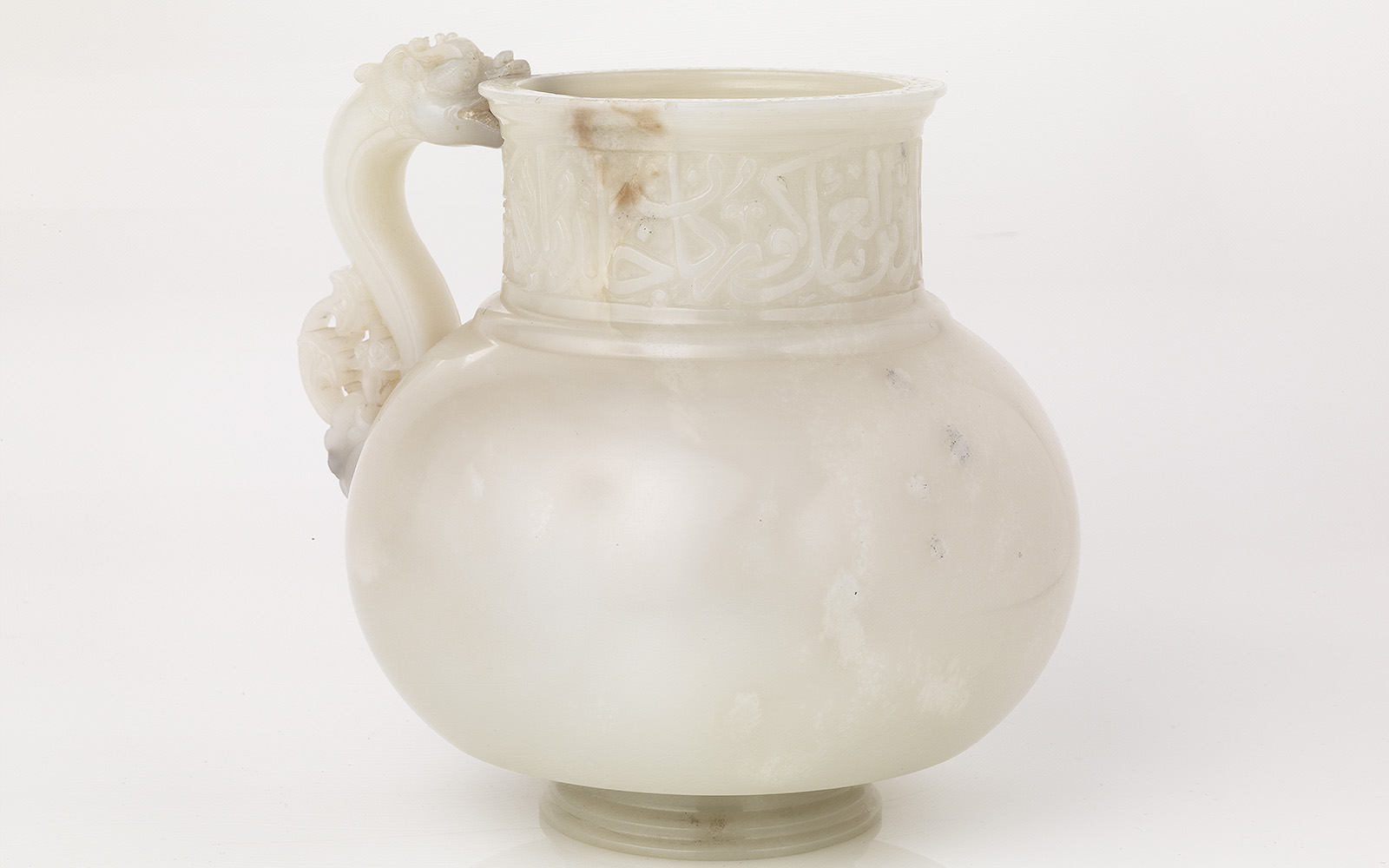
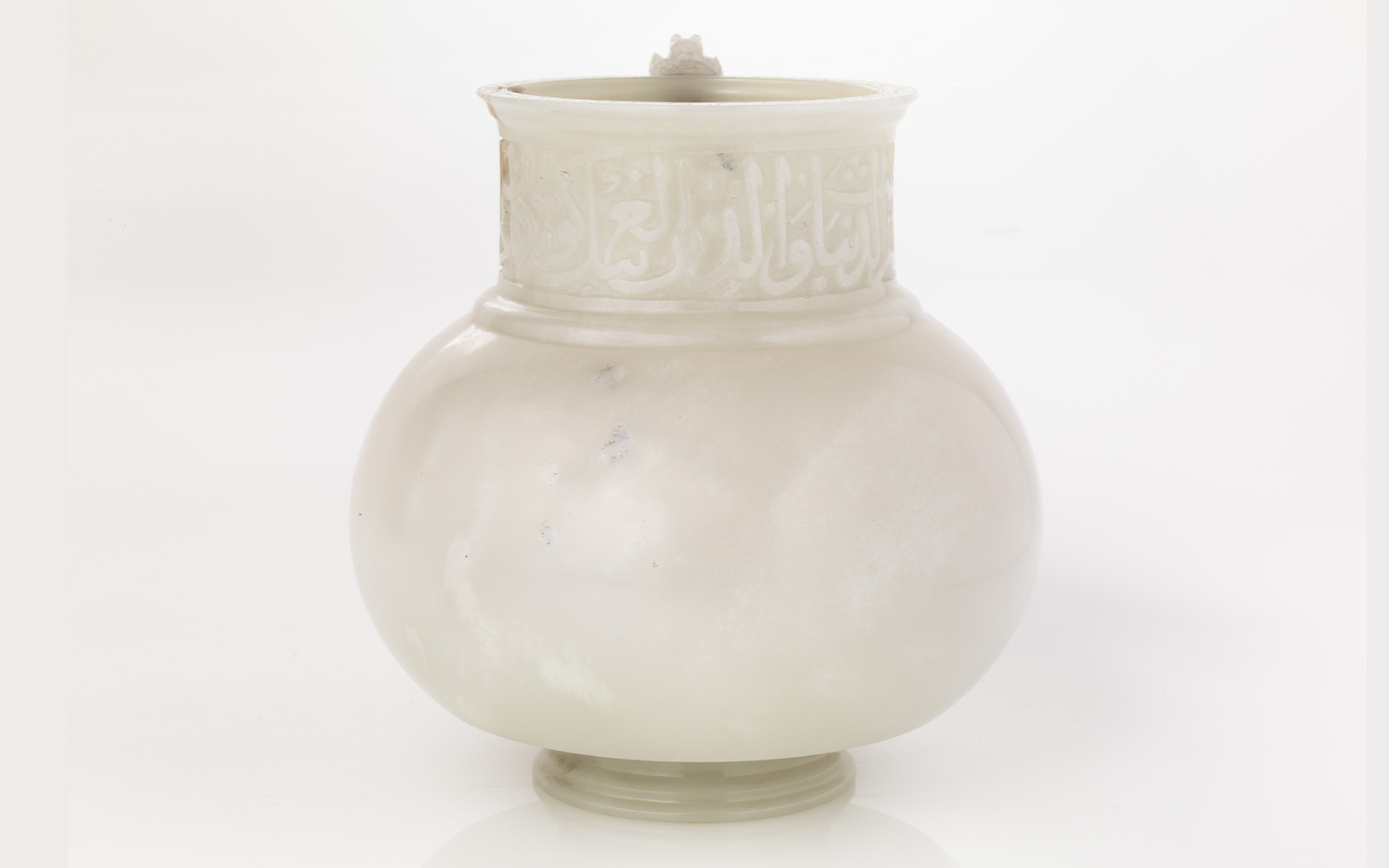
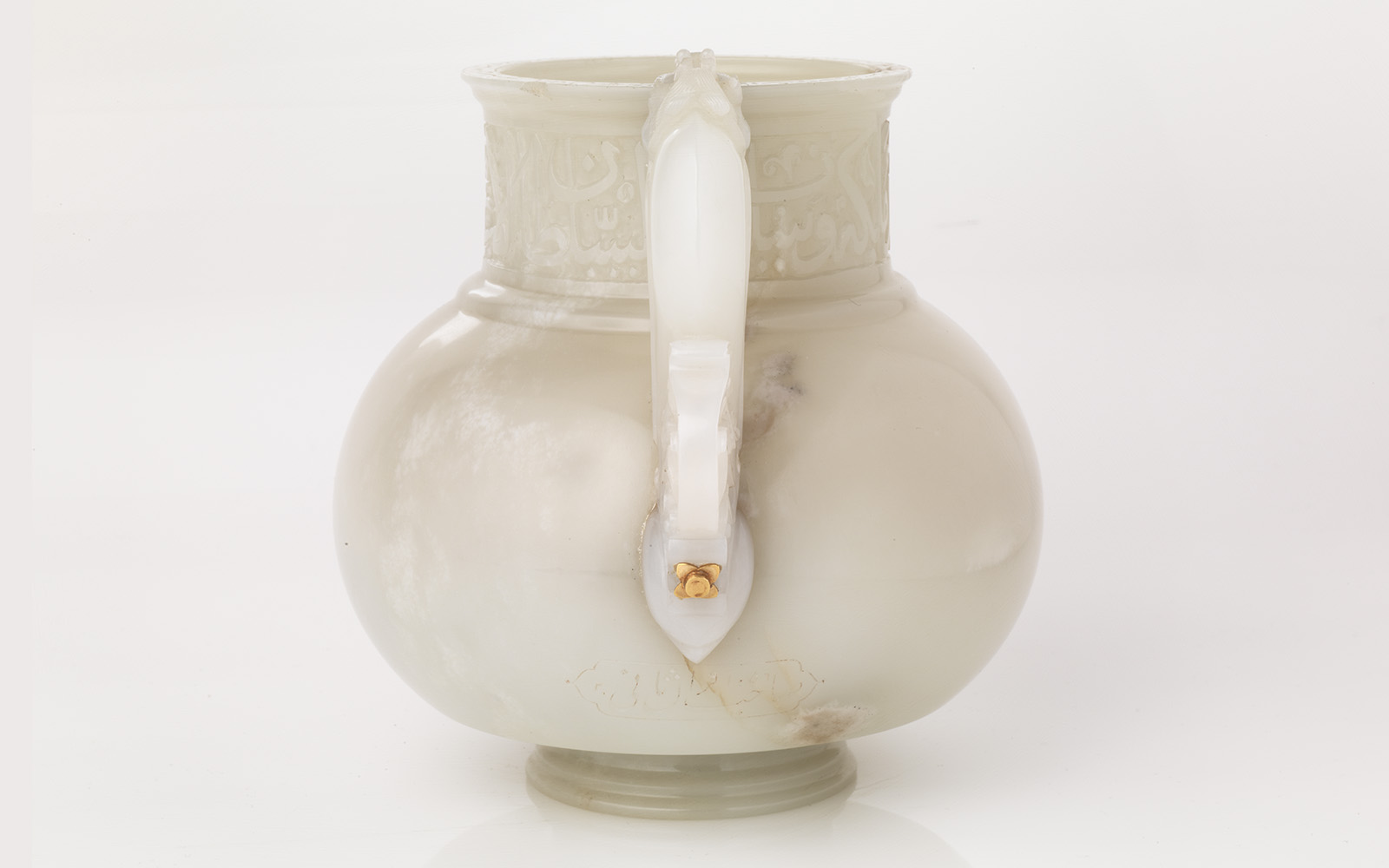
The white jade jug (mashraba) that belonged to Ulugh Beg – son of Shah Rukh and grandson of the great Timur Lang – is a unique piece in the Islamic collection of the Gulbenkian Museum, partly because it is the only one made from this material and partly because of its shape, which reproduces a type of bronze vessel common in the Khorasan – a vast region of central and northern Asia, including parts of Afghan and Iranian territory – frequently decorated in silver or gold. This jug is thought to have been part of a set of twelve jade pieces produced for Ulugh Beg between 1417 – the year in which he assumed the title of Gurgan (or governor) – and 1449, the year of his death, and, as a masterpiece of Timurid decorative arts, it also reveals Ulugh Beg’s sophisticated taste and his preference for precious materials.
Jade was considered a noble stone with talismanic powers, by both the Mongols and the Turks, and was mined in the Kunlun mountains (today in the Chinese province of Xinjiang), to the west of Samarkand. It had a long tradition in the Chinese decorative arts (well represented in the Gulbenkian Museum collection), but it was an exceptional material – and for that reason highly valued – for the Timurids, who promoted its use in rare decorative pieces.
One of the more sophisticated and original elements of this piece is the handle in the shape of a dragon – a recurring theme in Timurid art – finishing in a floral element, all of which was produced independently of the body of the jug, to which it was carefully attached with gold rivets. The chronology of the two pieces has raised some discussion, splitting authors into two camps: those who point to the contemporaneity of the jug and its handle – although this was made from a slightly different, whiter jade that is more highly polished – and those who claim that the handle is a slightly later addition to the pre-existing vessel. The fact that the floral border on the handle rests on what seems to be a bird’s head – probably a falcon, common in Sasanian art – seems to attest to a different workshop and chronology for this element of the piece.
/
The place of production of the jug is also a source of debate, dividing authors between a Persian workshop, the Afghan city of Herat or, the most likely case, the major city of Samarkand, Ulugh Beg’s capital, in central Asia, one of the most important metropolises – in political, economic, cultural and artistic terms – of the Timurid period. The handle appears to have been produced in a Persian or Hindustani workshop.
The jade jar has three inscriptions in different locations, the most important naturally being that which can be read in relief on the neck, in Arabic thuluth calligraphy, referring to its commission by Ulugh Beg; the second is on the rim of the vessel, carved in taliq calligraphy and dated 1613, with the name of the Mughal Emperor Jahangir, who acquired the jug and later passed it on to his son Shah Jahan, who was responsible for the third inscription made below the handle. The Mughal Emperors – and Shah Jahan in particular – asserted their Timurid inheritance, competing with their ancestors in order to justify their dynastic ambitions.
Jorge Rodrigues
Curator at the Calouste Gulbenkian Museum
Glass vase
The most original piece of Mamluk period glassware in the Gulbenkian Museum is an object with a secular use, despite mosque lamps featuring more significantly in this section of the collection. The originality of this vase is obvious, not just for its shape – with a cylindrical profile widening towards the top, a smooth and simple brim and a convex base – but also for its size, being, with a height of 33.5 centimetres, the largest known vase of this type, comparable only to those of the Bayerisches Nationalmuseum (Munich), the Freer Gallery of Art (Washington) and the Stätisches Museum (Mönchengladbach). Originating in China, where it was acquired by Georges Eumorfopoulos in around 1918, it was later auctioned by Sotheby’s, in London, in 1940, when it was purchased for the collection.
Its intricate and vibrant iconography includes a series of asymmetrical representations of birds, both real and mythical, copied on both sides with small variations, including a goshawk or kite, a duck, a goose, a parrot, a hoopoe, a vulture or magpie, among which we can also see a fantastical phoenix: the bird of fire popularised in the west through Greek mythology, probably originating in eastern legend, being a very popular myth in China; it would have had bright red and golden feathers, replicating the tone and flicker of flames, by which it was consumed when it died, to then be reborn from its own ashes. Next to the disc that forms its circular base, it has a wide border with fish against a blue background, with a red, green and gold wave churning within. Around the brim and base, there is also delicate gilded filigree decoration.
The depiction of birds in flight extends all around the vase, without mouldings or divisions, as if in a continual roll. The composition is dominated by the phoenix and the vulture, which seem to fly above the other birds. All the representations are extremely realistic in relation to the anatomy of the various species portrayed – even maintaining an approximation of their relative proportions – but this realism does not extend to the vibrant colour of their plumages, in tones of red, blue, green, yellow and white, clearly homologous to precious stones; the brightness of these colours (now rather faded, but still perceptible) would help create a lustre that, completed by the colour and transparency of the piece, would make it seem as though the birds are almost floating in the space. This is in spite of the fact that most of the birds are not actually depicted in flight – particularly the hoopoe, the magpie and the parrot – with the exception of the bird of prey and the geese on the verge of collision. The entire composition is dominated by a clear hierarchy, with the phoenix and the vulture, larger, at the top of the composition, and the wild birds in the middle, while the domestic birds appear next to the base.
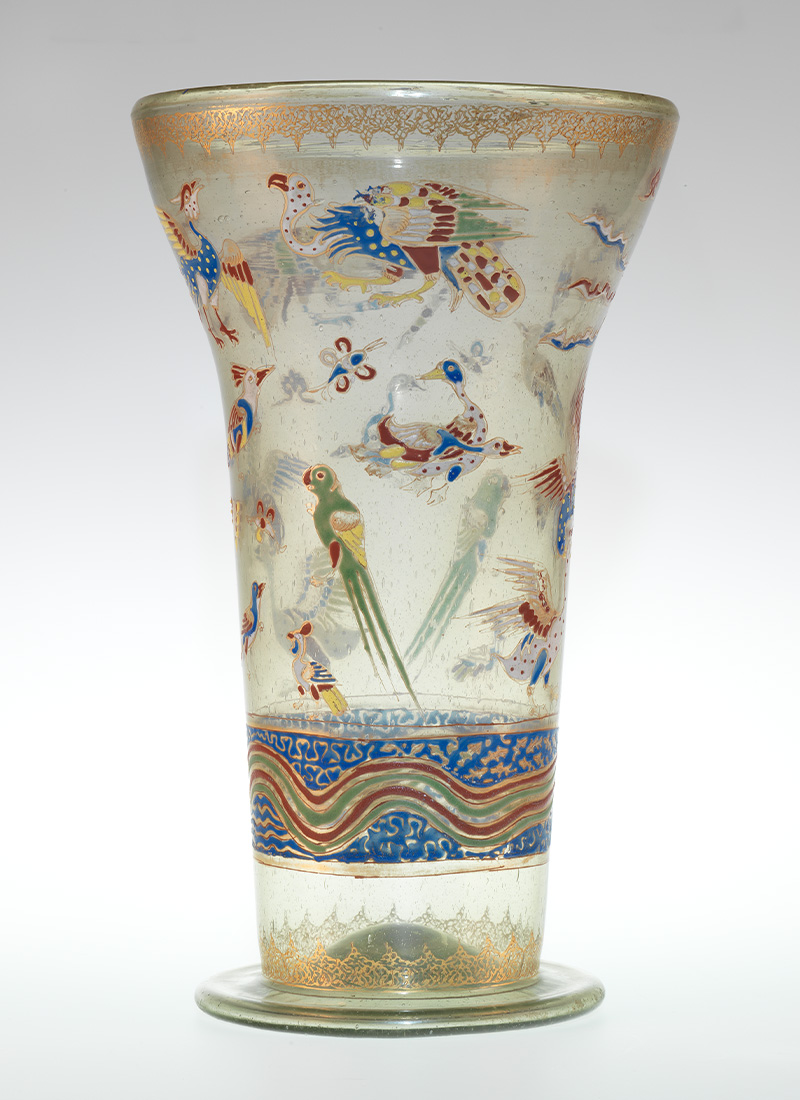
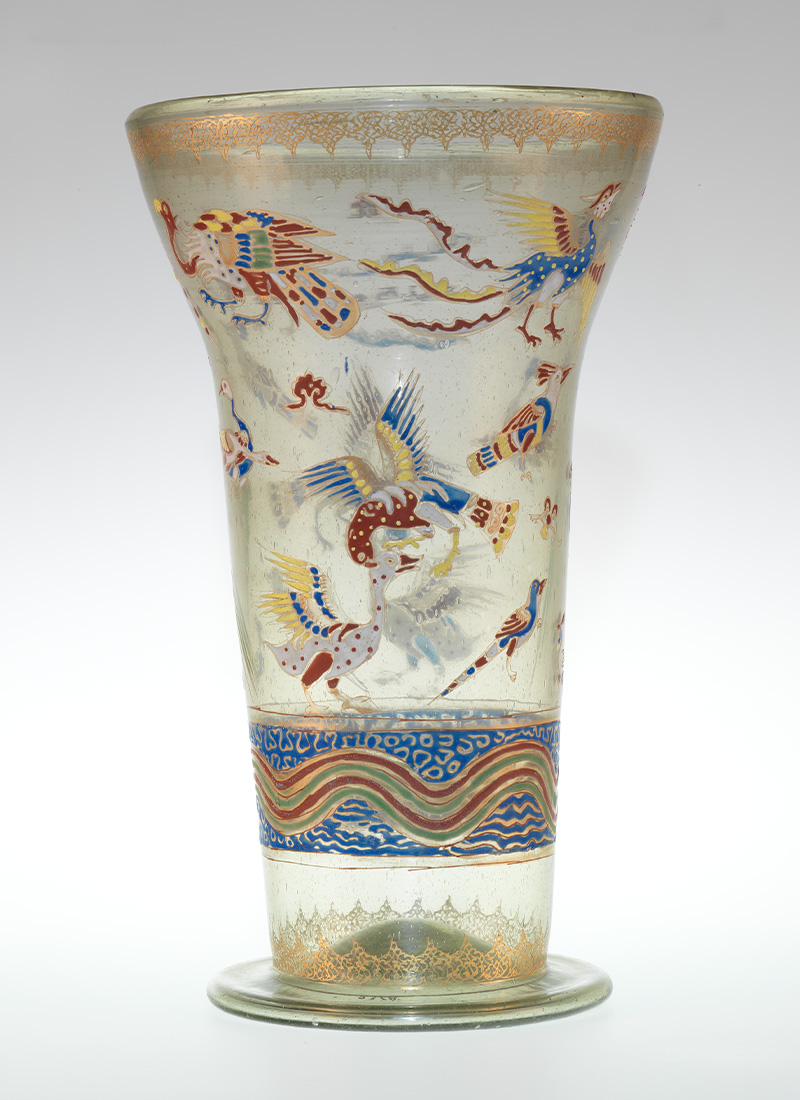
The inspiration for this elaborate iconography is thought to be found in illustrated scientific manuscripts and bestiaries – more common in the Islamic world than the Christian – a highlight among which is the Kitab Manafi’ al-Hayawan [Book on Animal Utility], of which an original Mamluk copy, from 1354, compiled by Ibn al-Durayhim al-Mawsili, has been preserved in the Royal Library of El Escorial.
Jorge Rodrigues
Curator at the Calouste Gulbenkian Museum
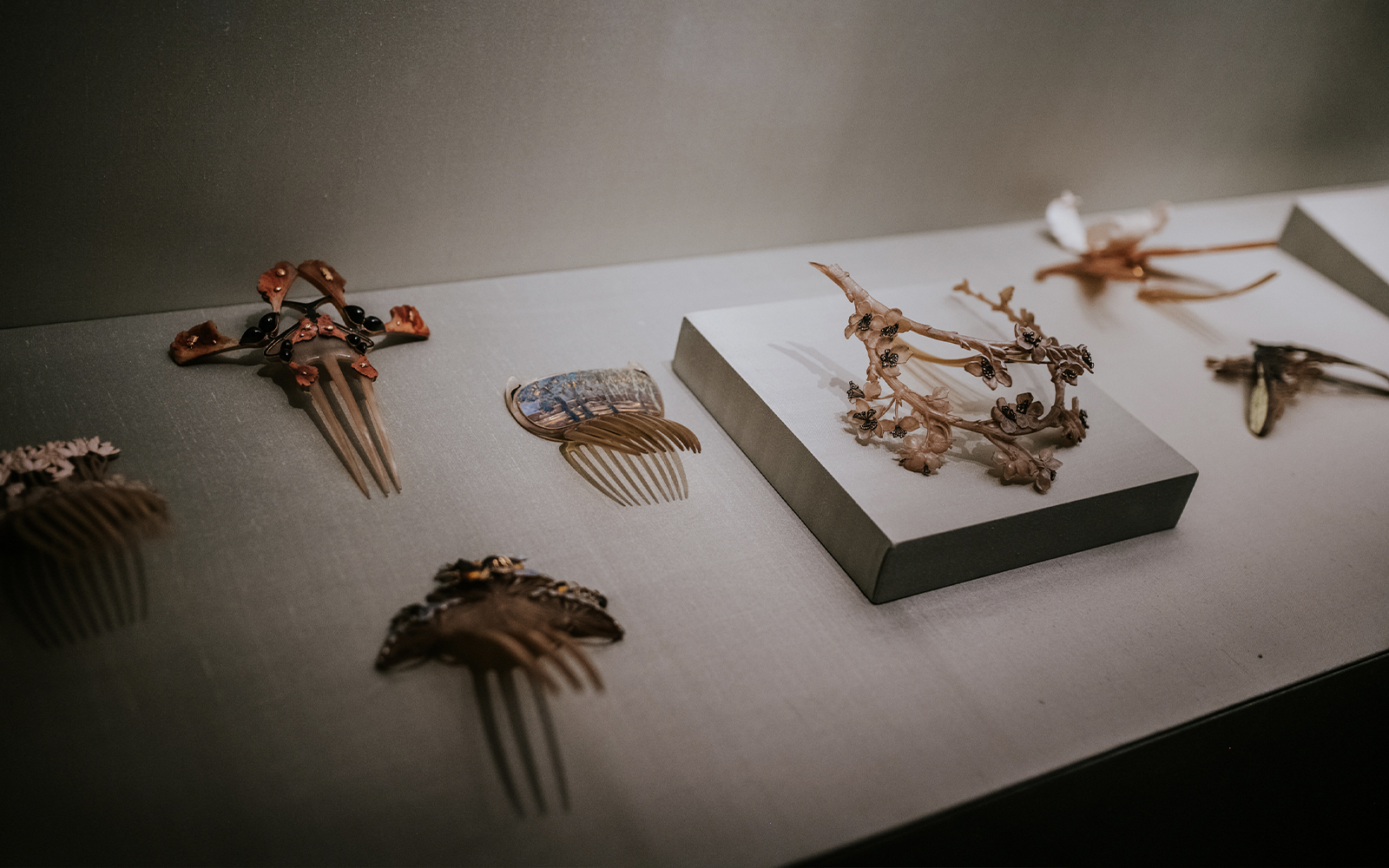
Reopening of the René Lalique Room
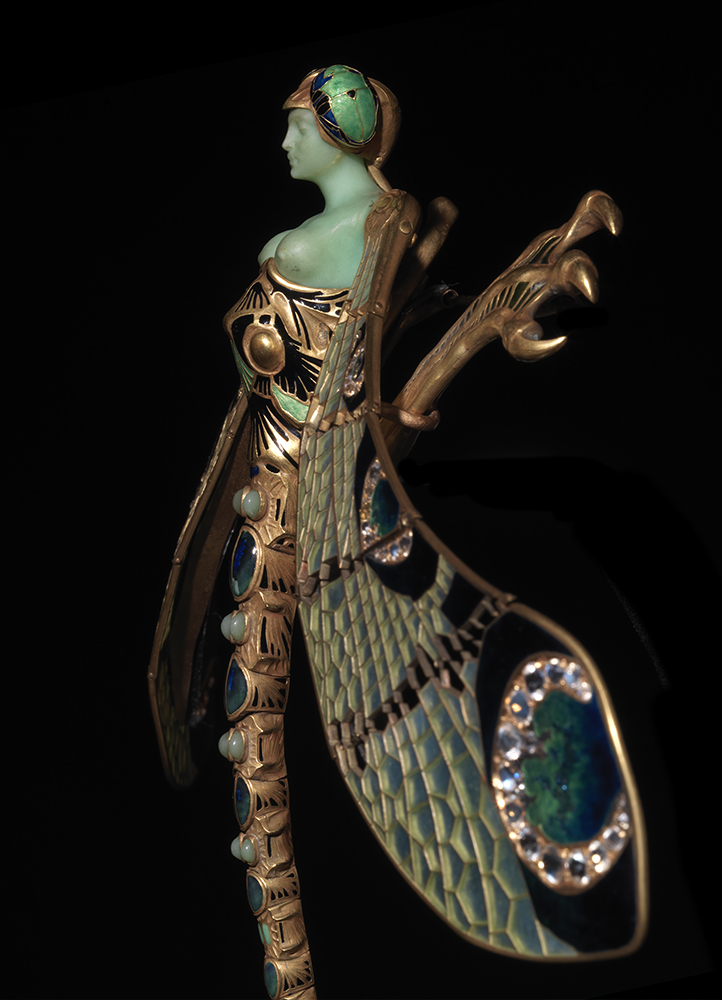
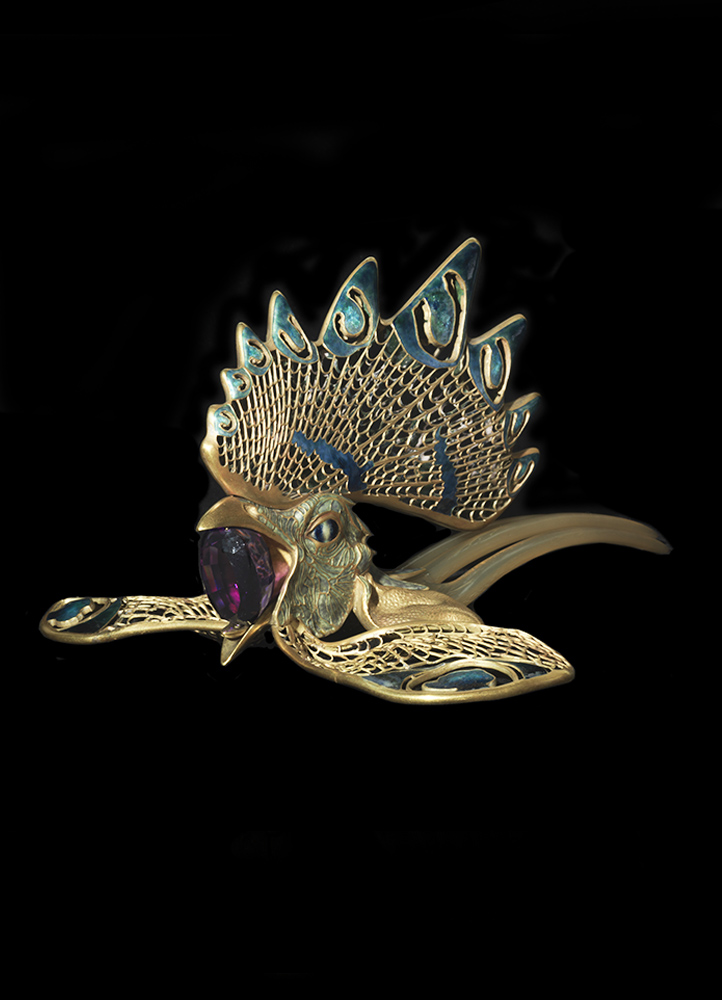
The Calouste Gulbenkian Collection boasts around 200 objects by René Lalique, including 82 jewels, purchased directly from the artist by the collector himself.
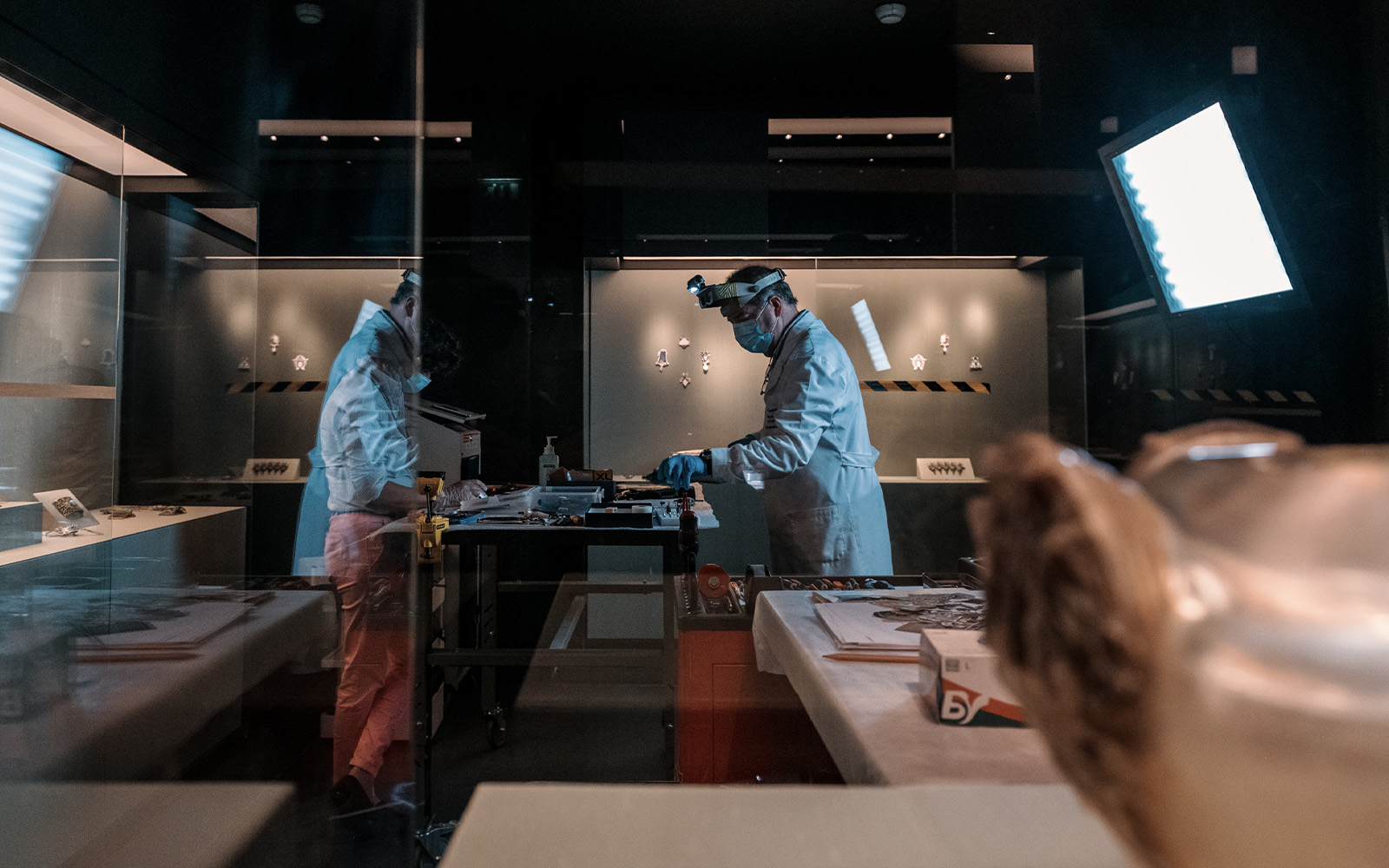
The room exclusively dedicated to Lalique’s jewellery and glass objects has assumed three different presentations to date: the first on the opening of the Calouste Gulbenkian Museum in 1969; the second in the 1990s; and a third in 2000, as part of an extended project to refurbish the museum.
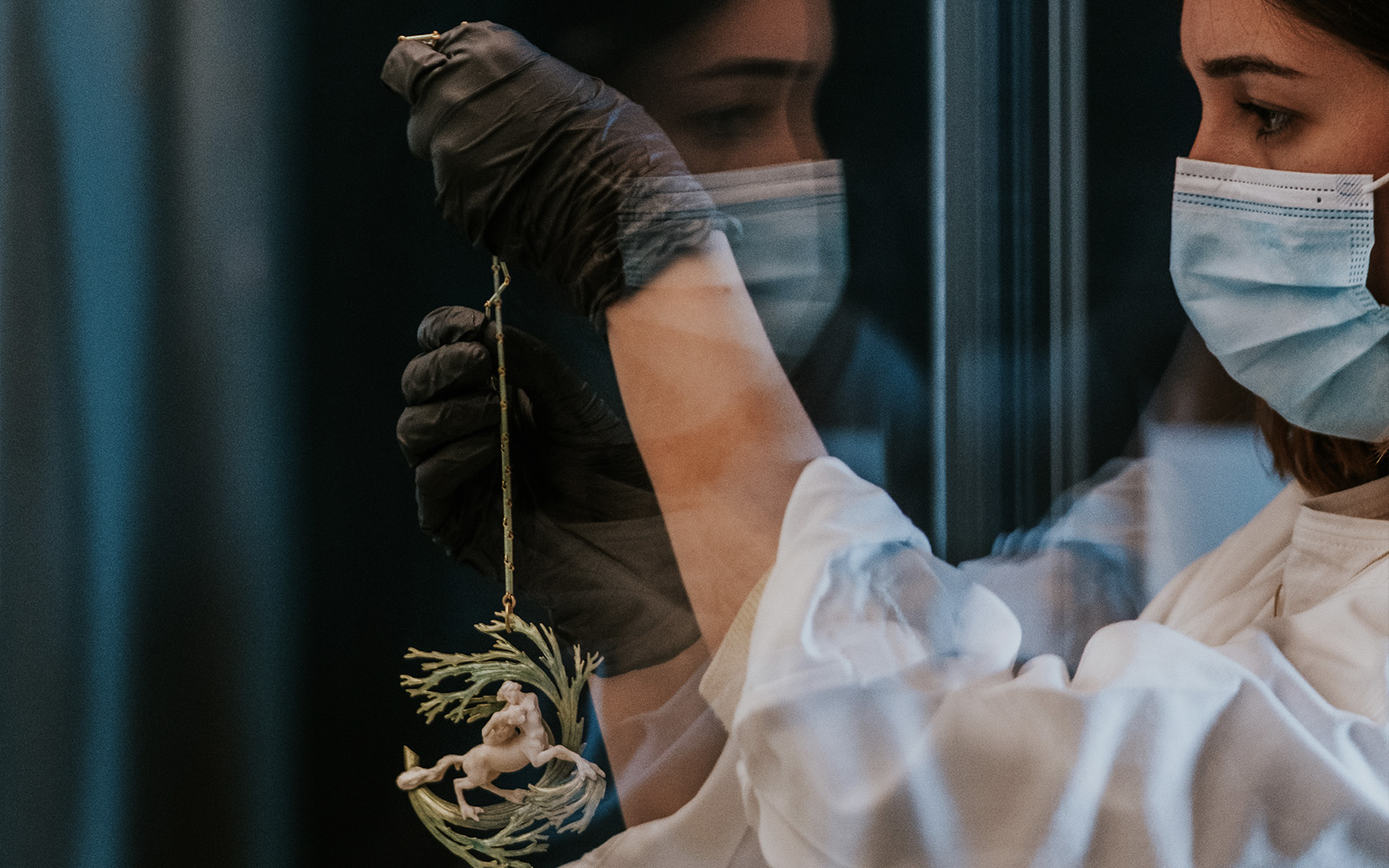
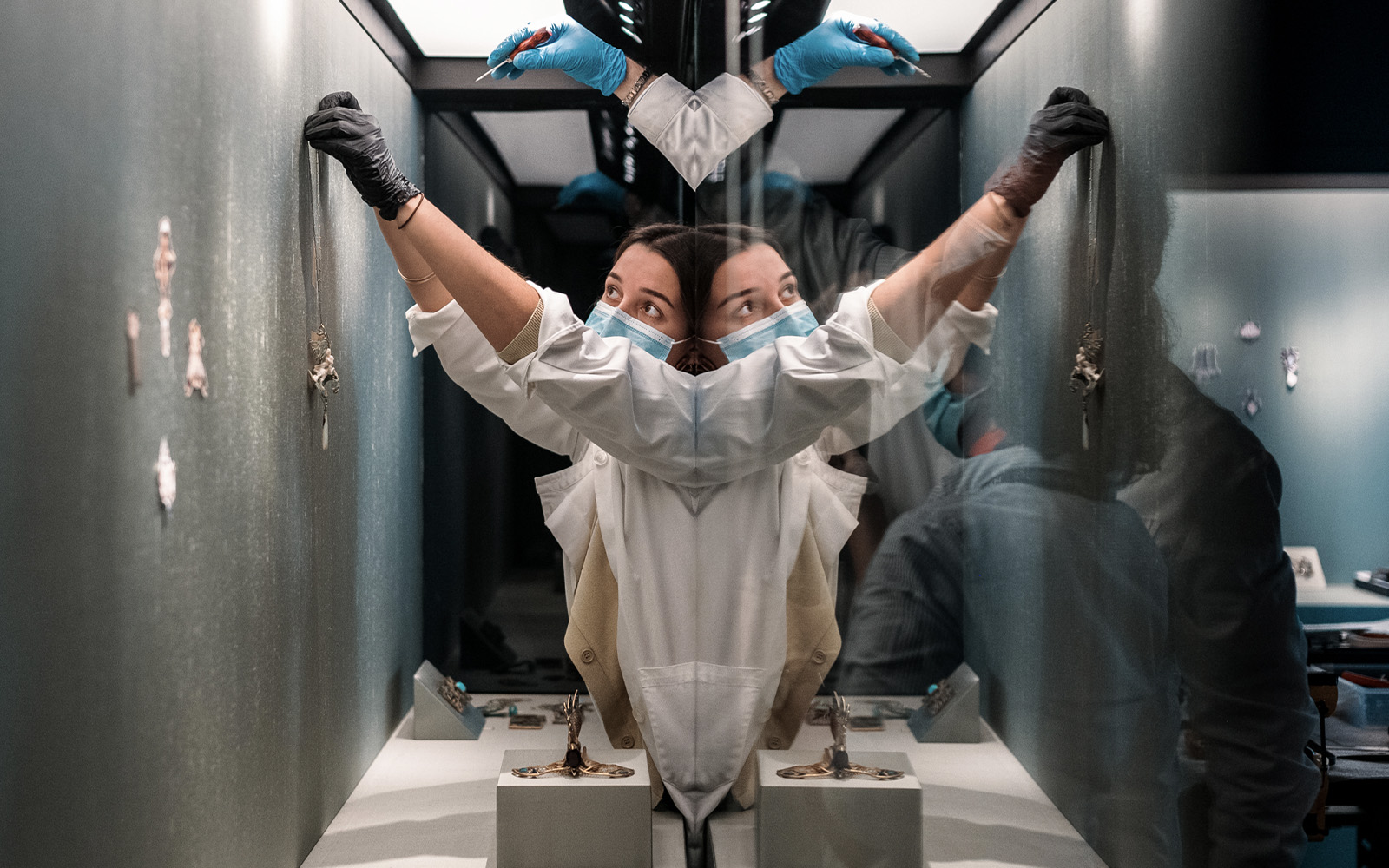
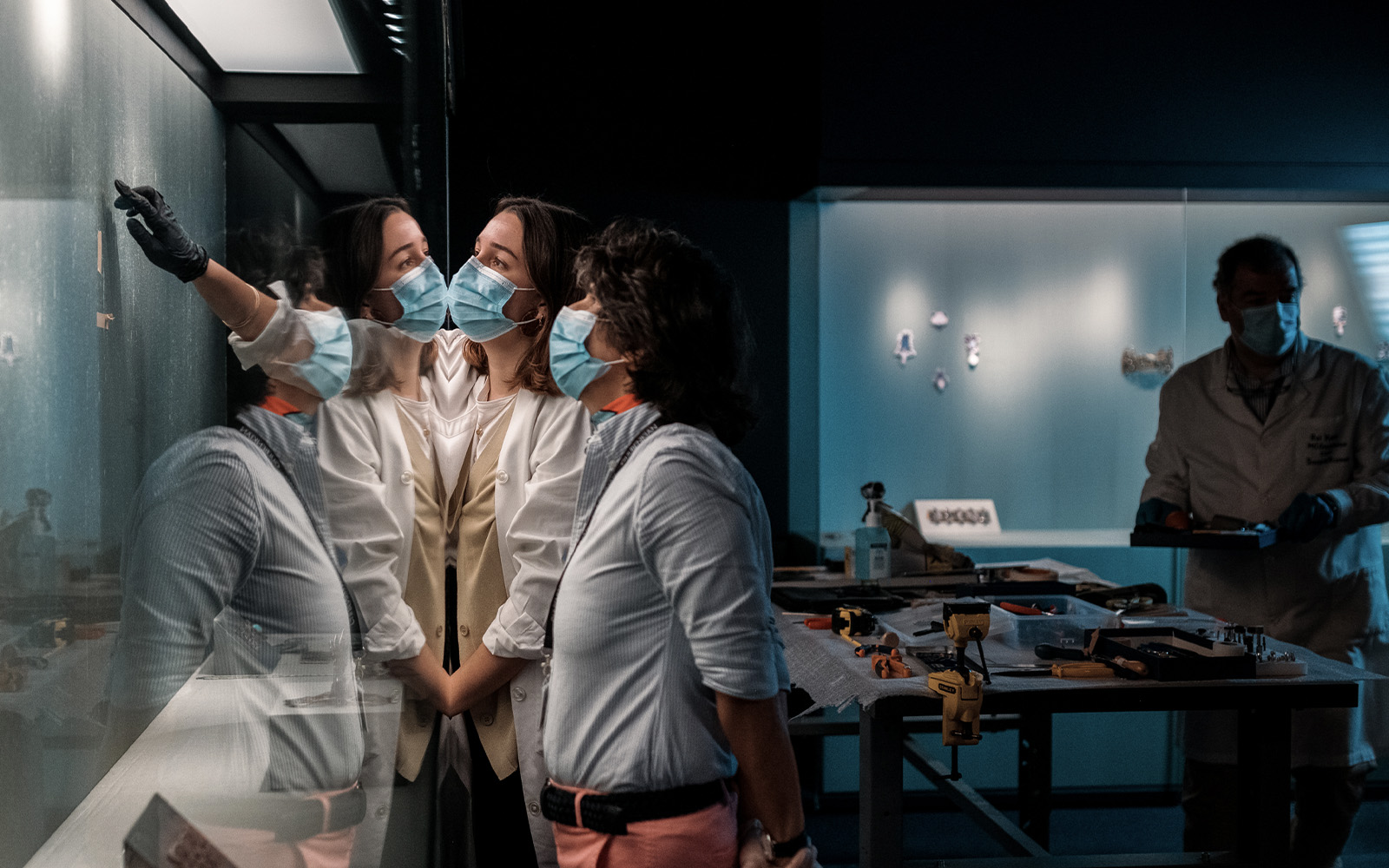
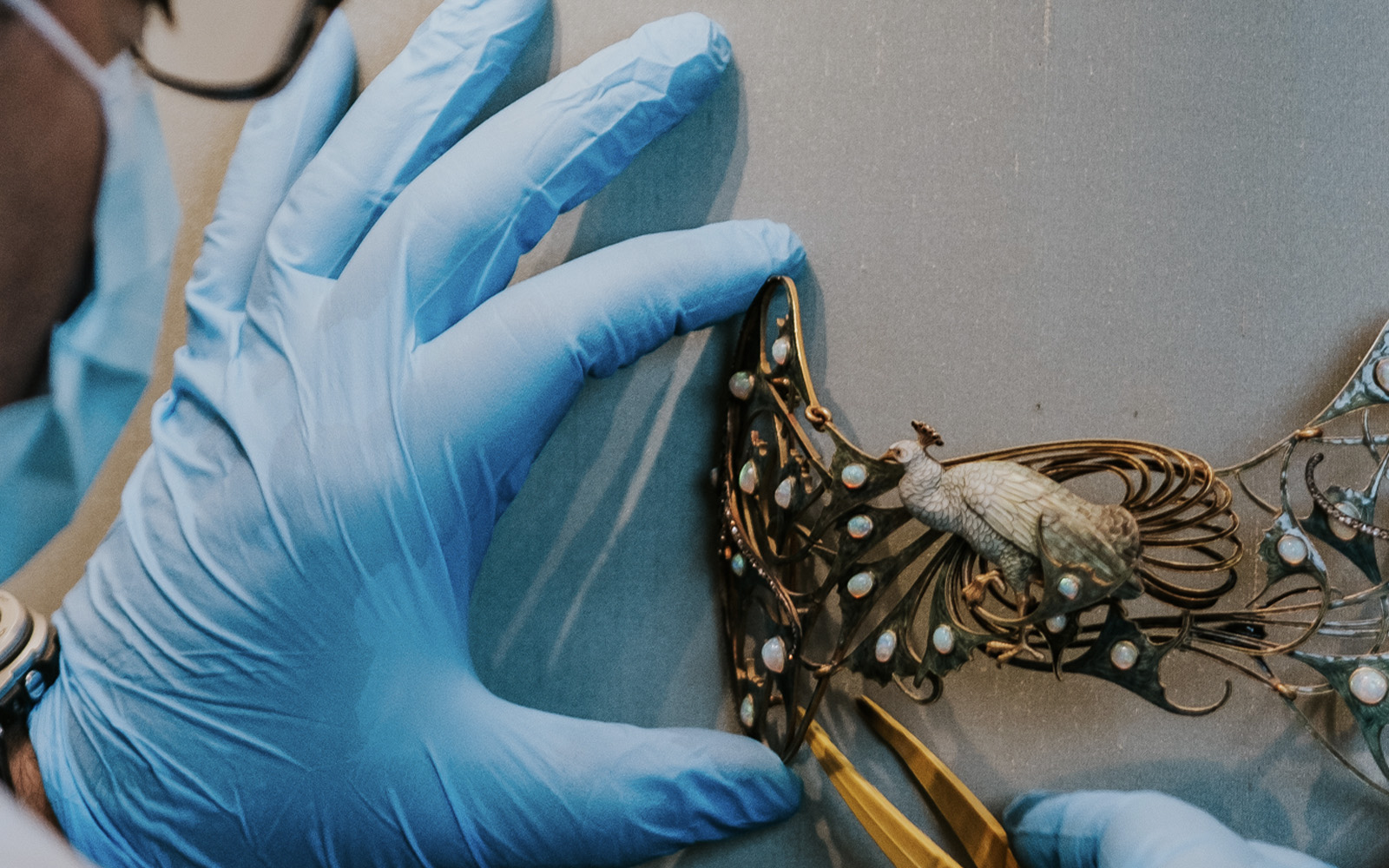
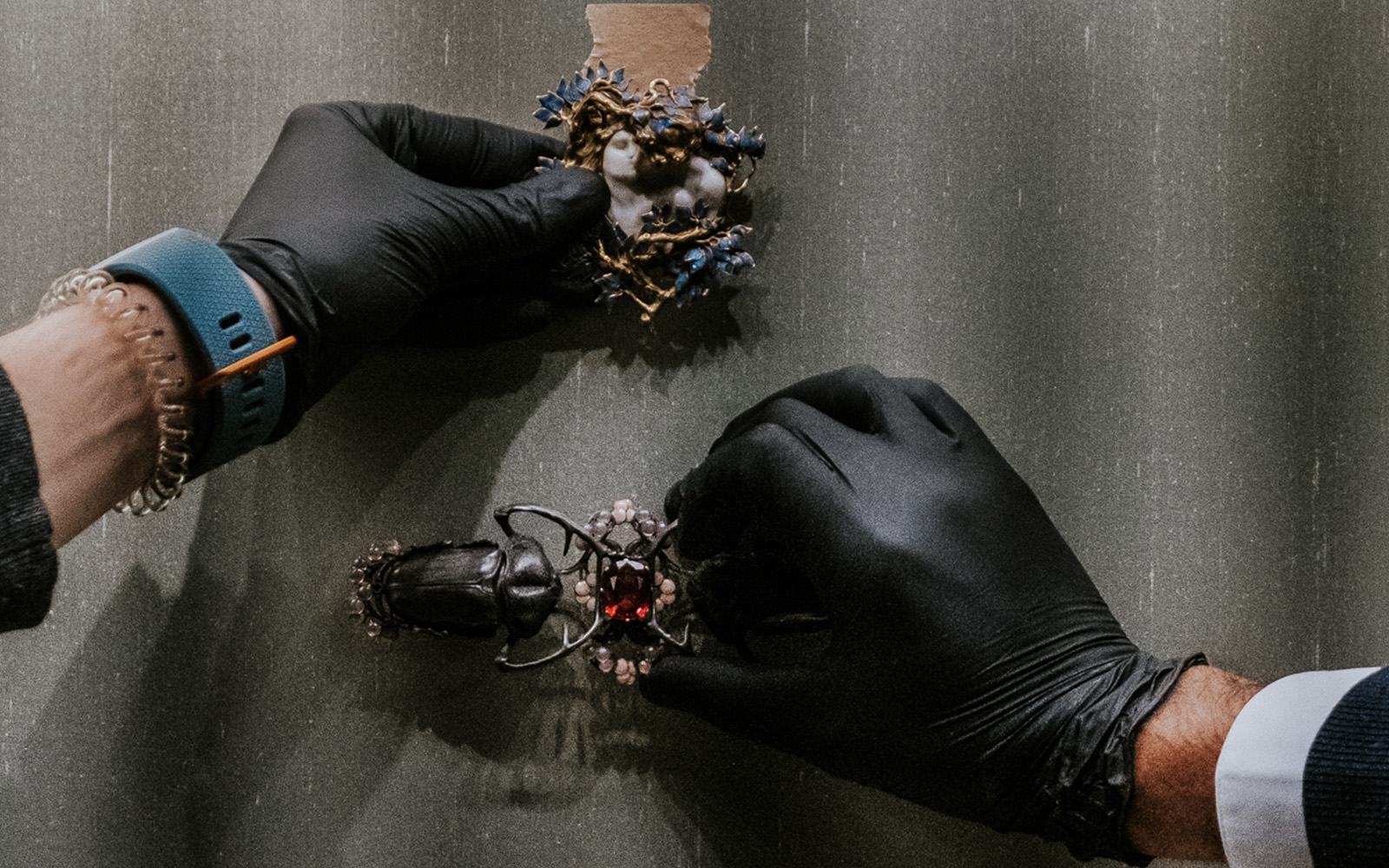
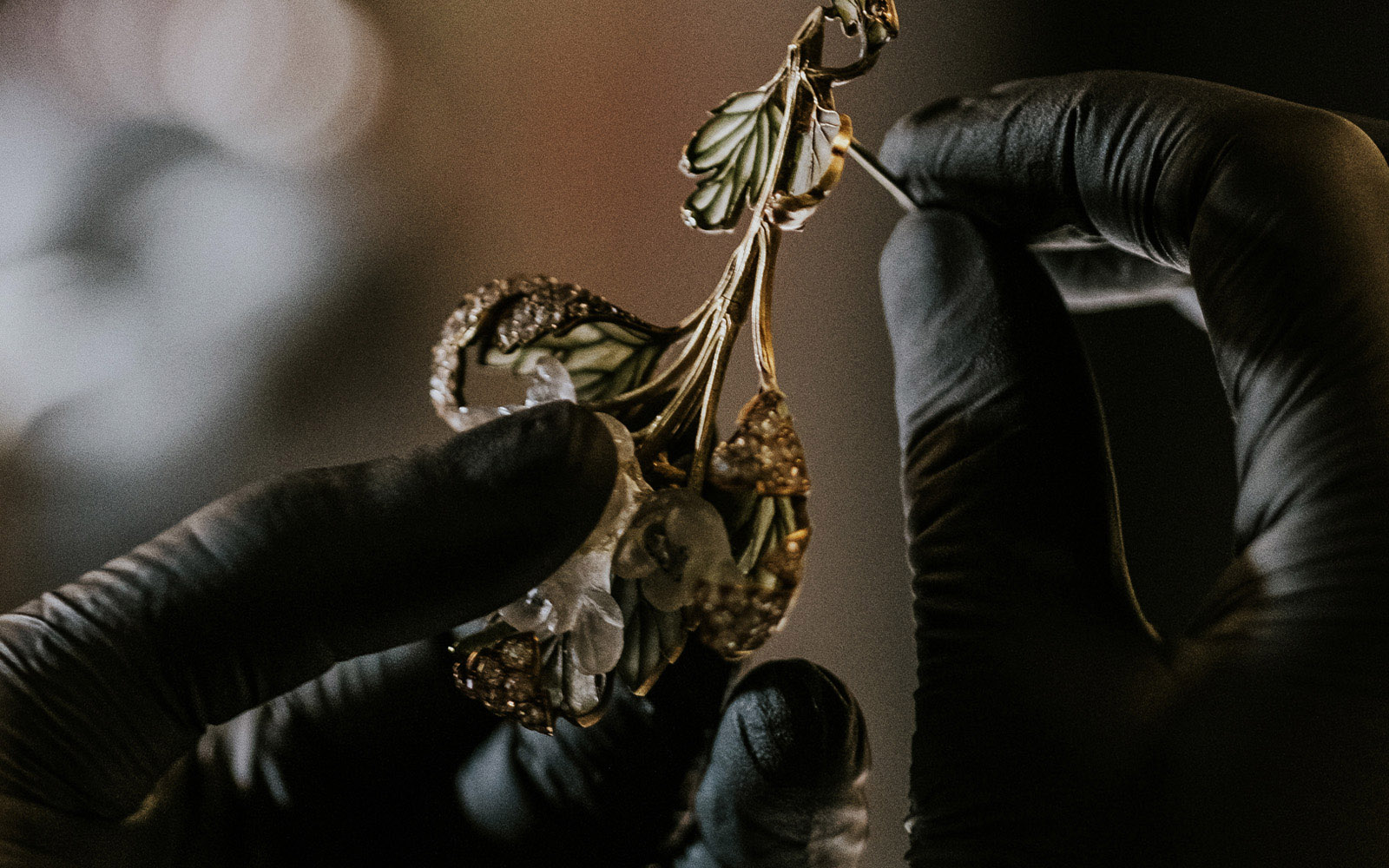
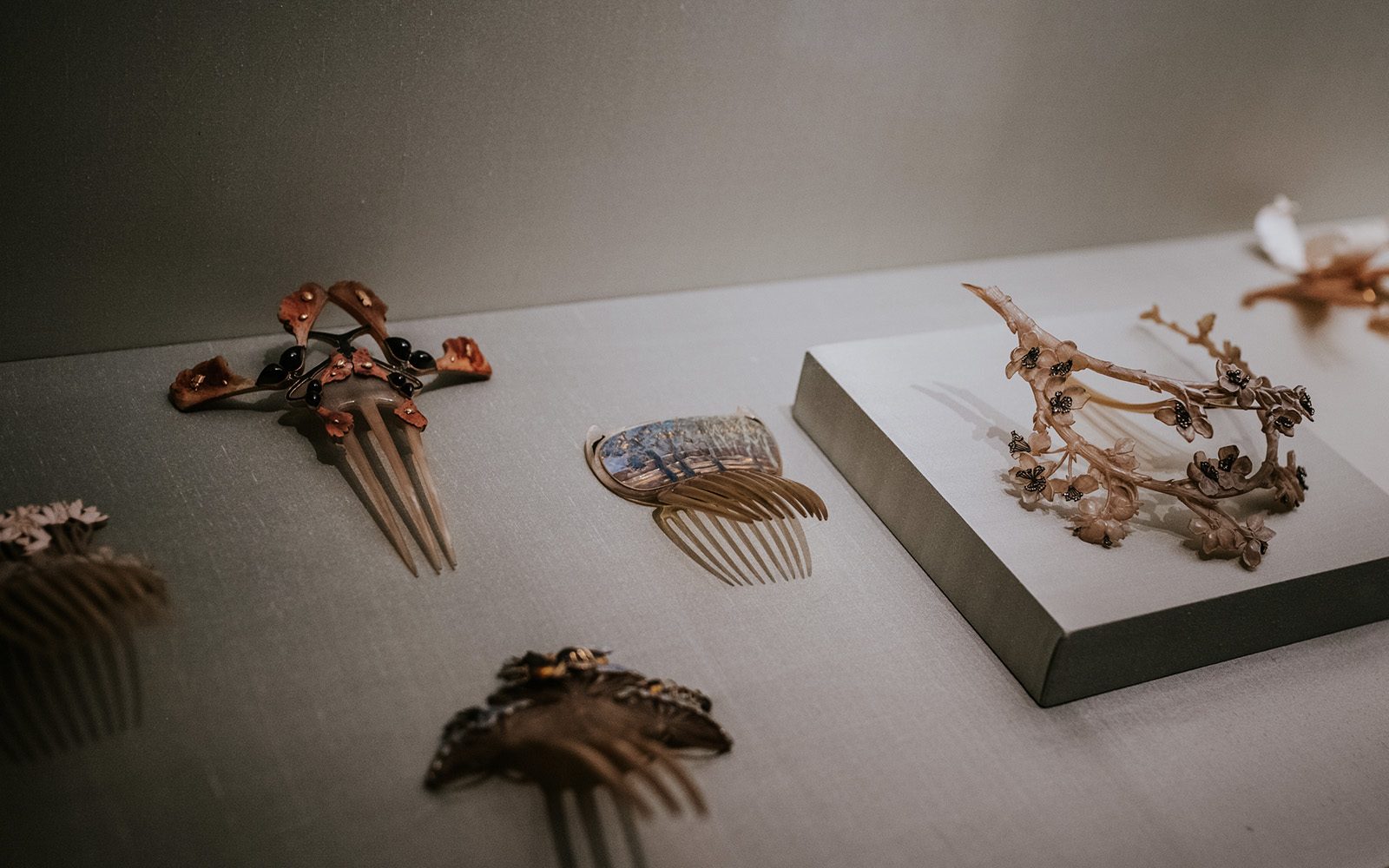
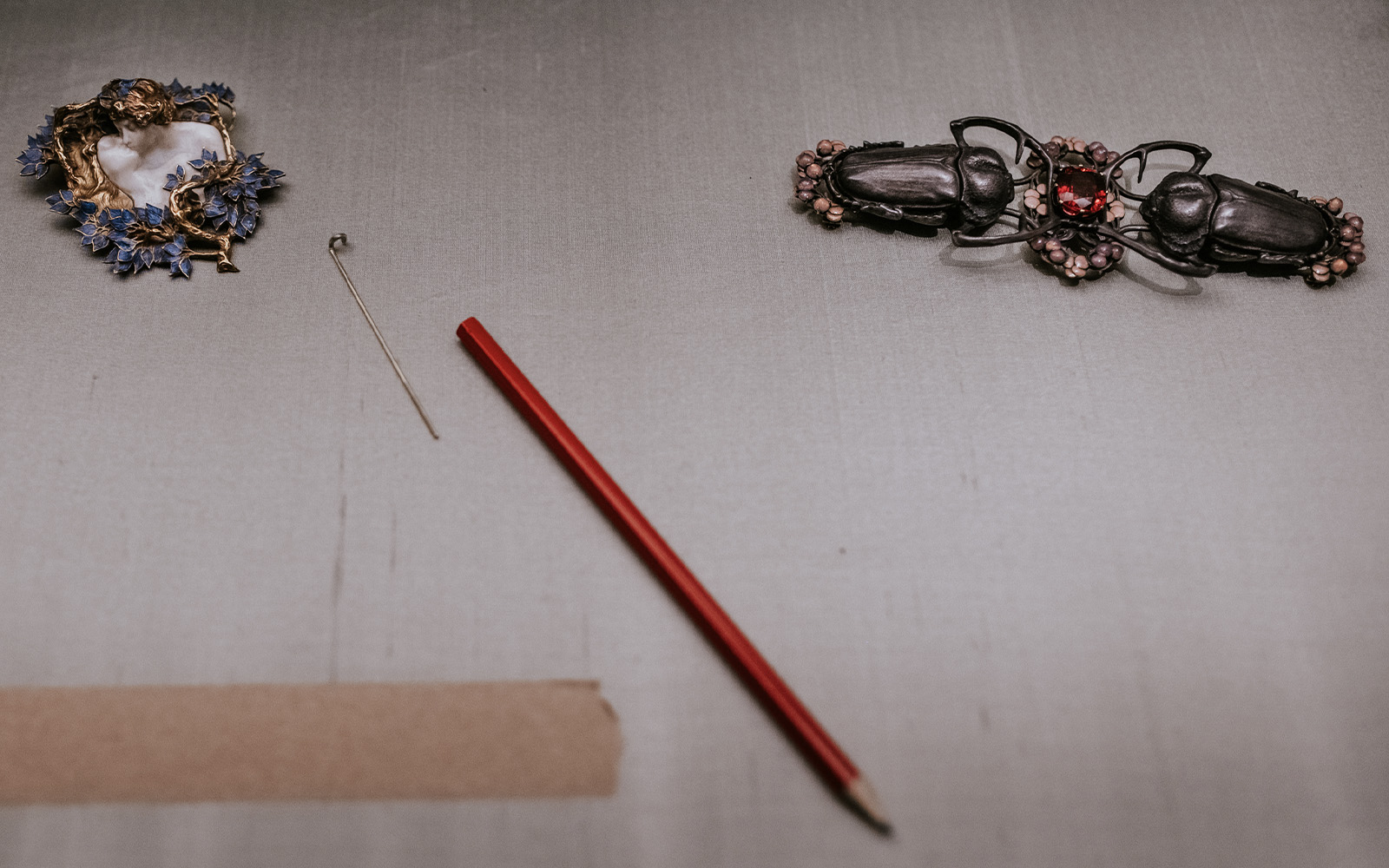
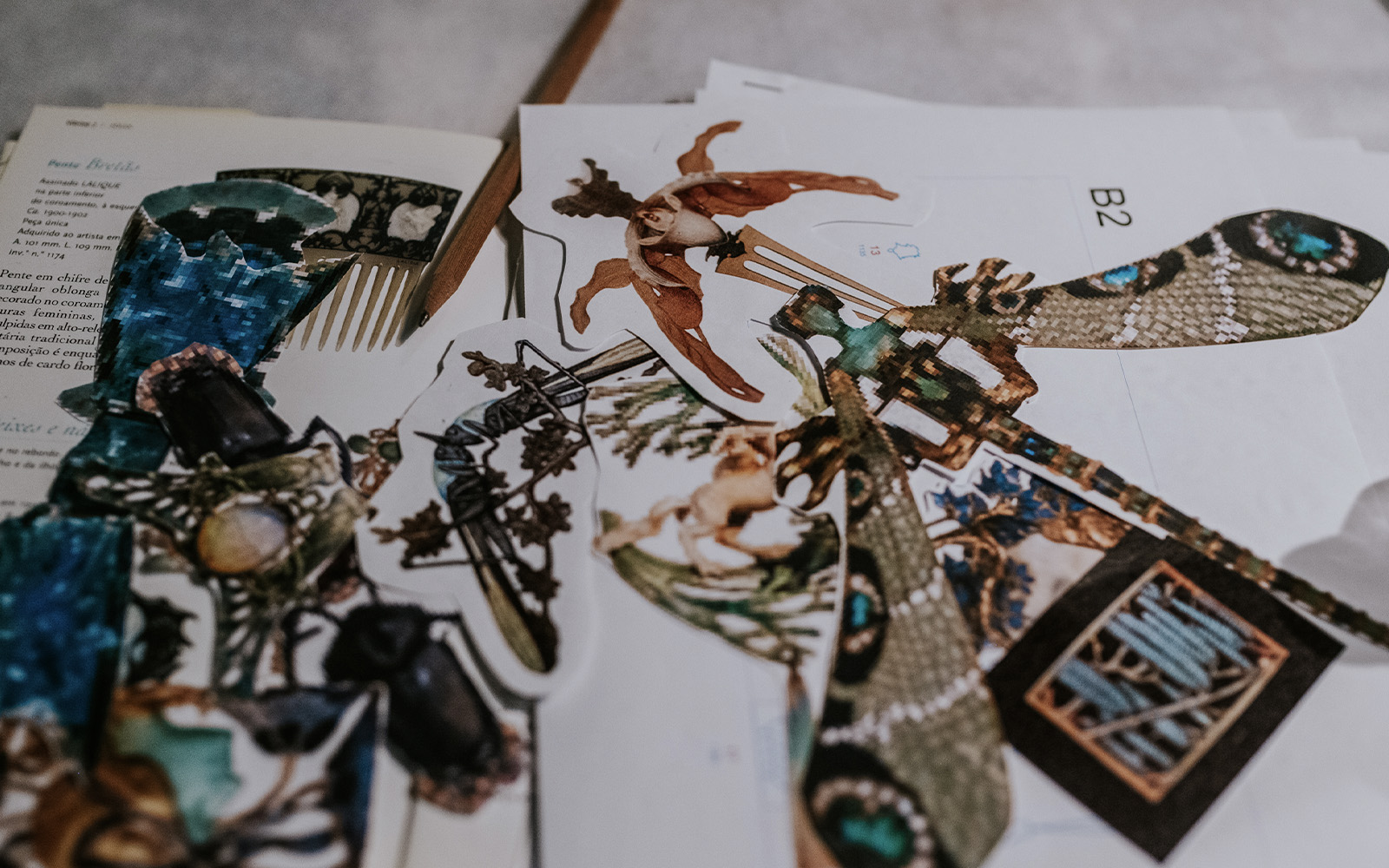
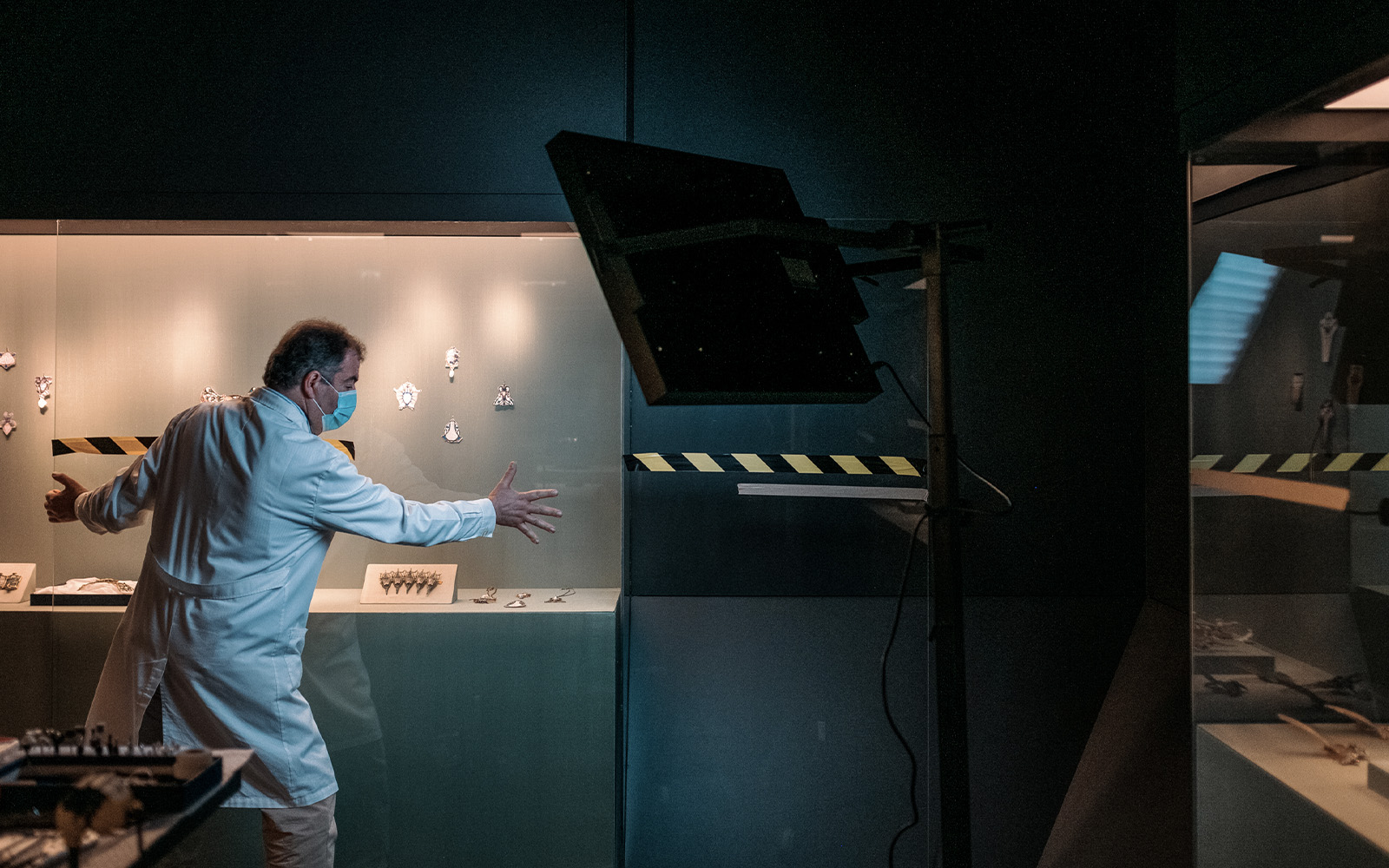
/
Now, after 20 years, it became necessary to look again at the room in order to rethink the space, while offering a reinterpretation of the artist’s work, showcasing his ideas, multiple sources of inspiration and the renowned originality of his creations, qualities which led him to becoming known as ‘the inventor of modern jewellery’.
Each section of the display has been specially designed to showcase and highlight the diversity of the artist’s favoured themes – from exuberant nature recreated through the use of unusual materials, to the female figure in its multiple manifestations.
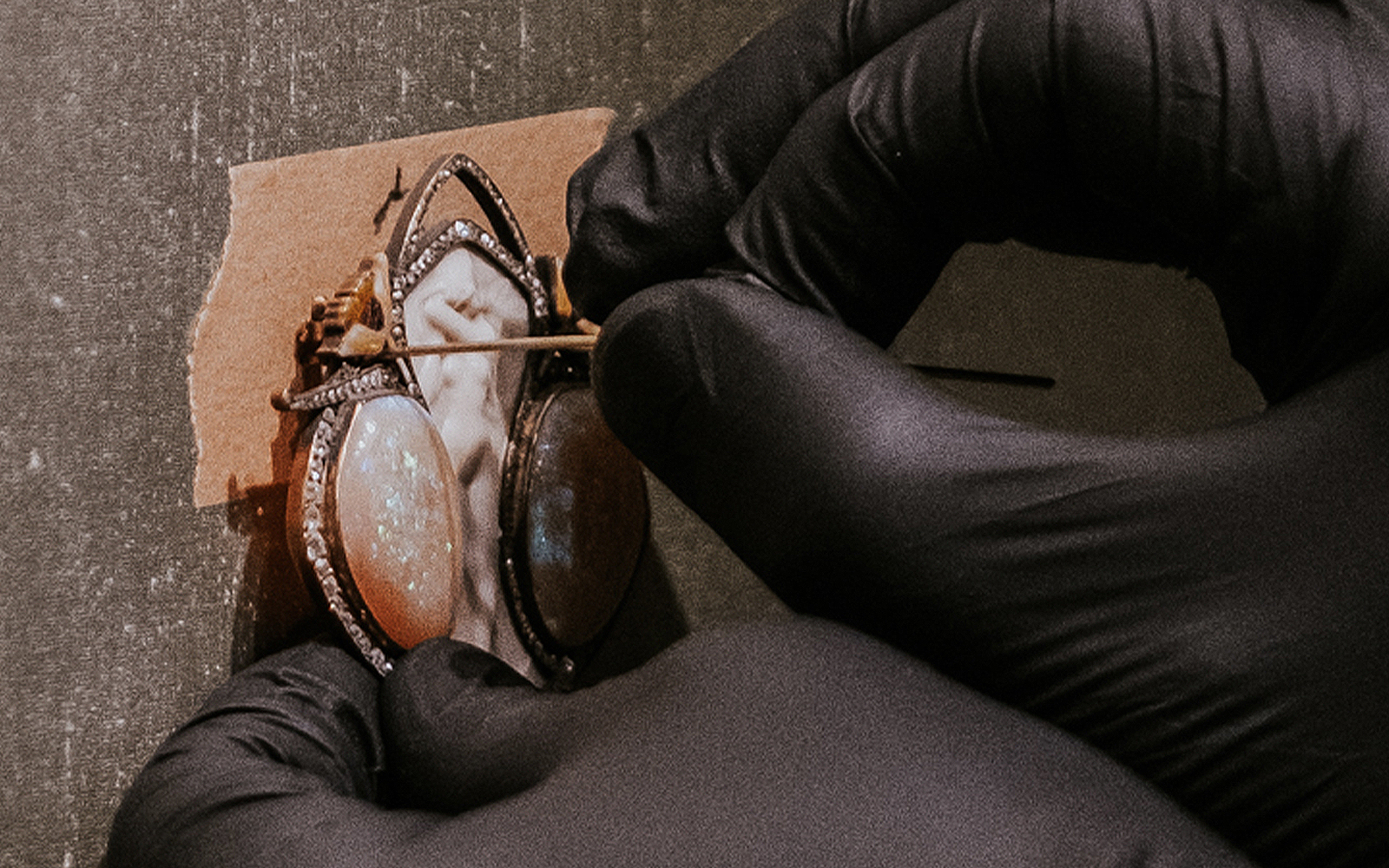
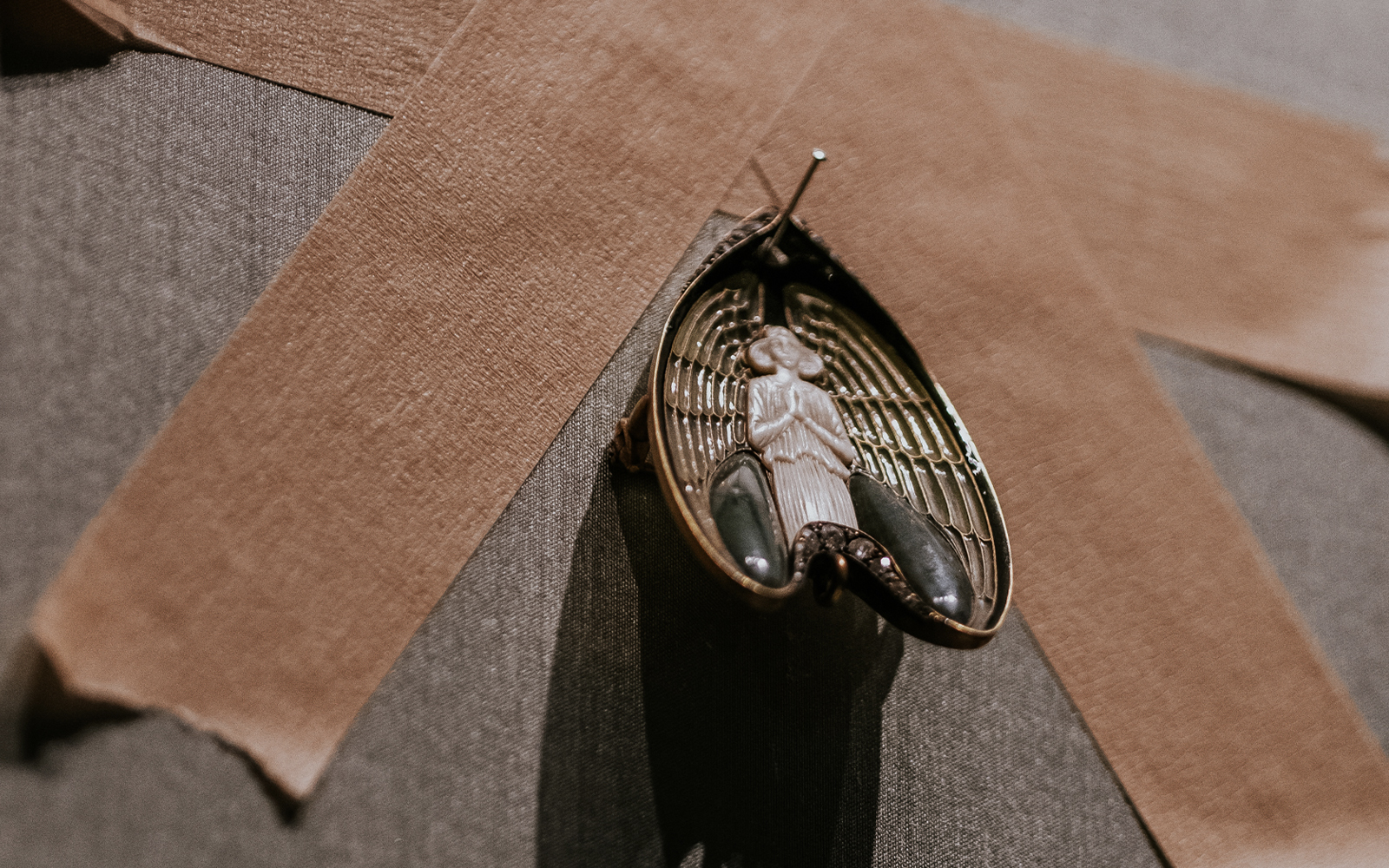
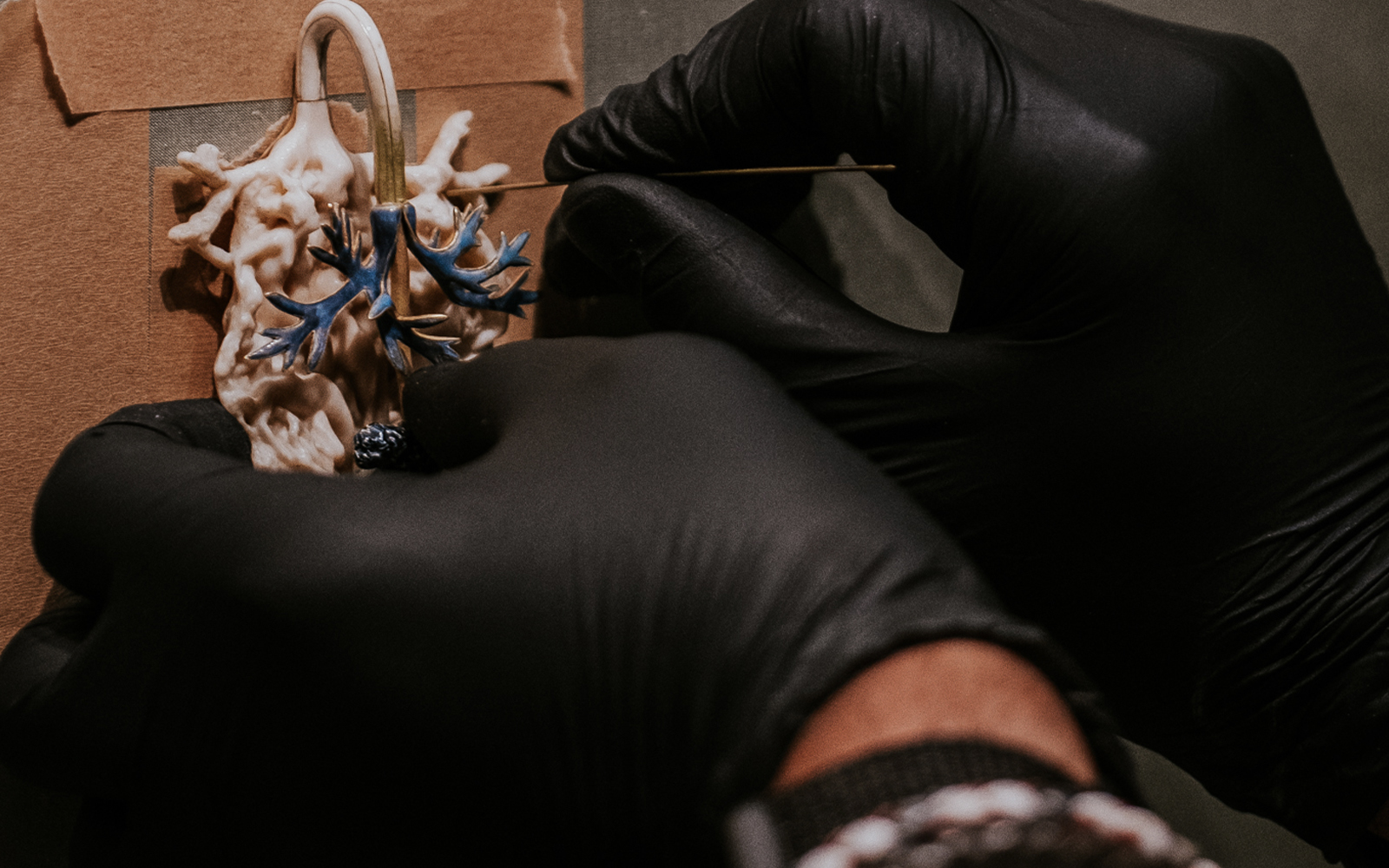
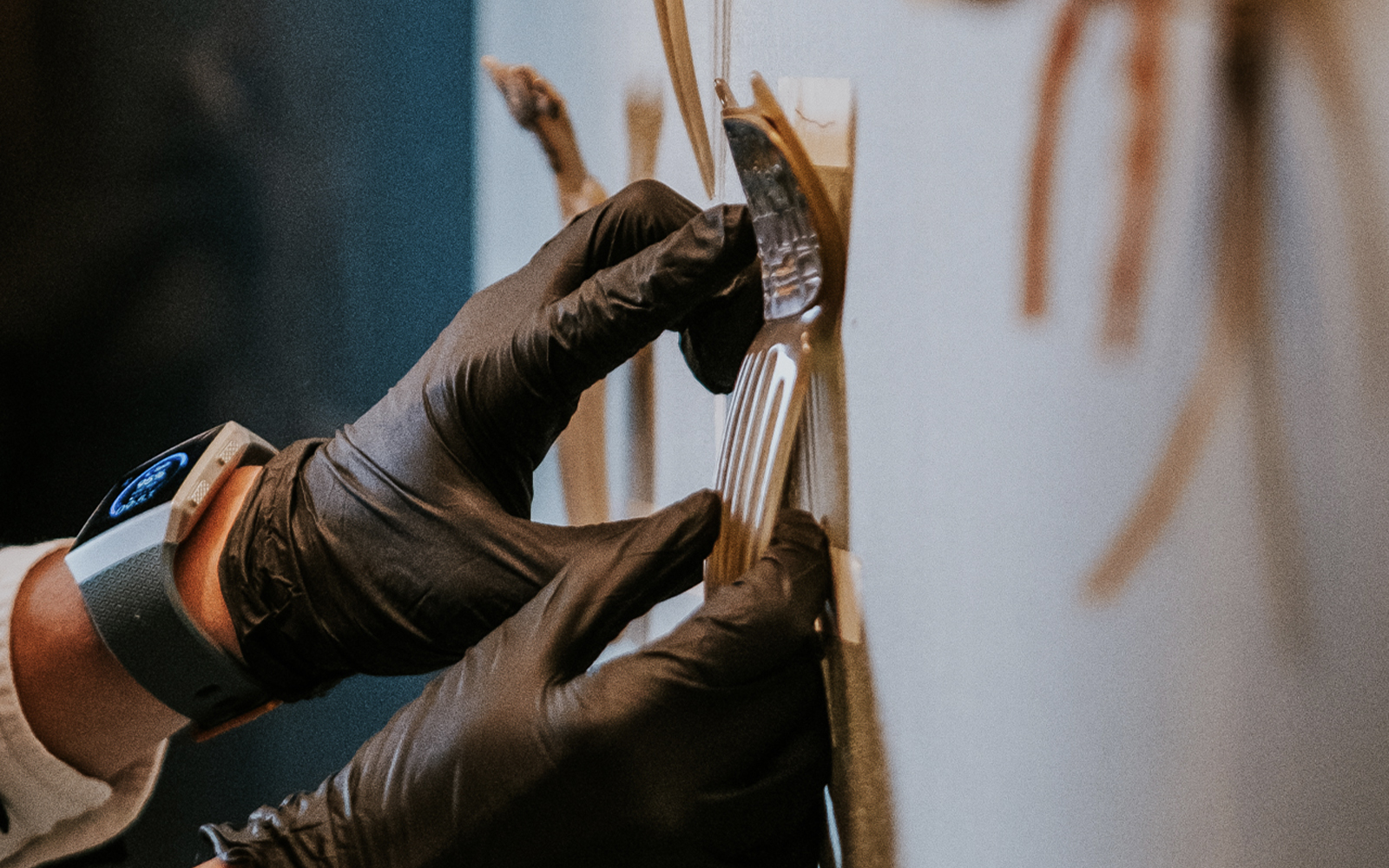
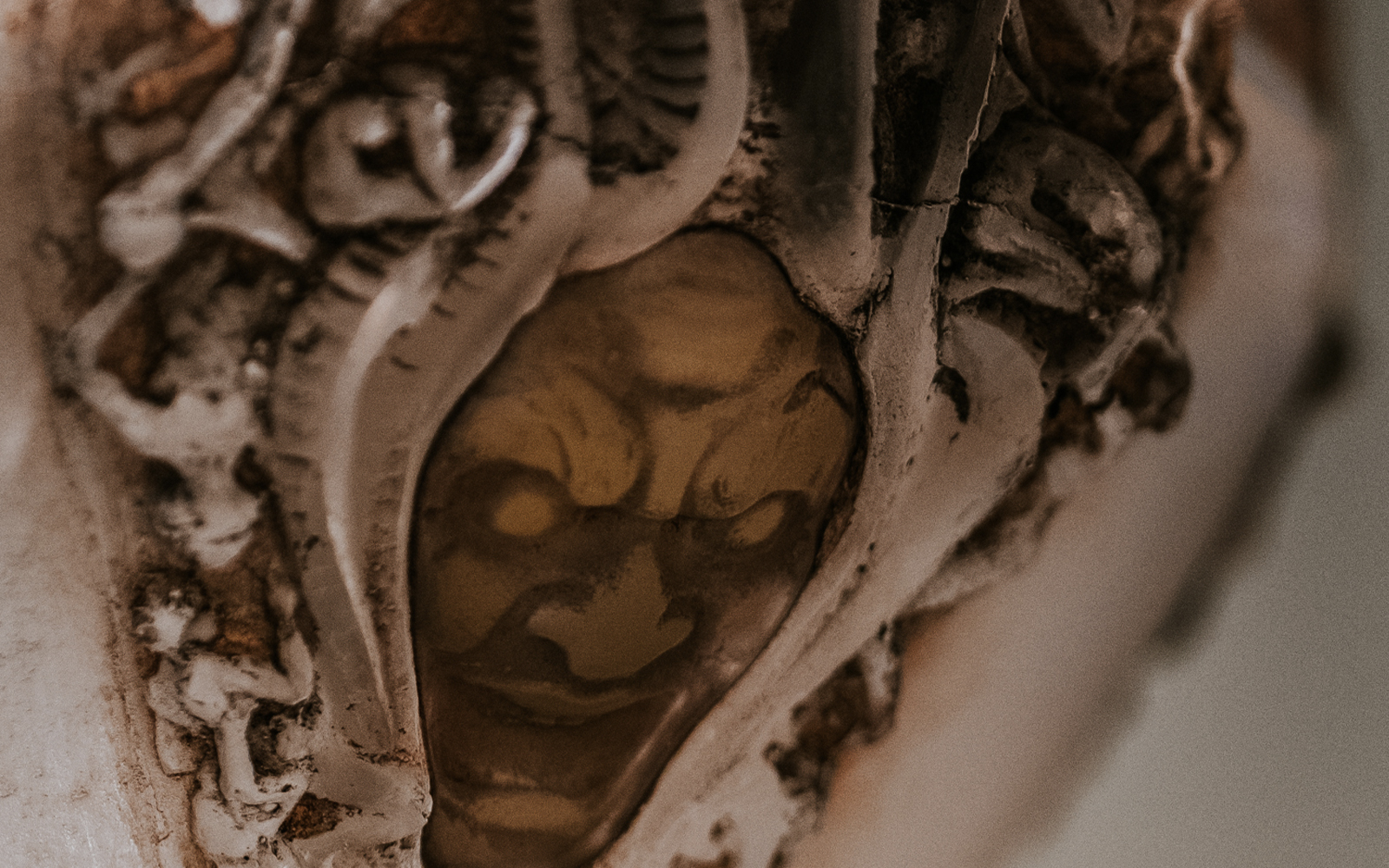
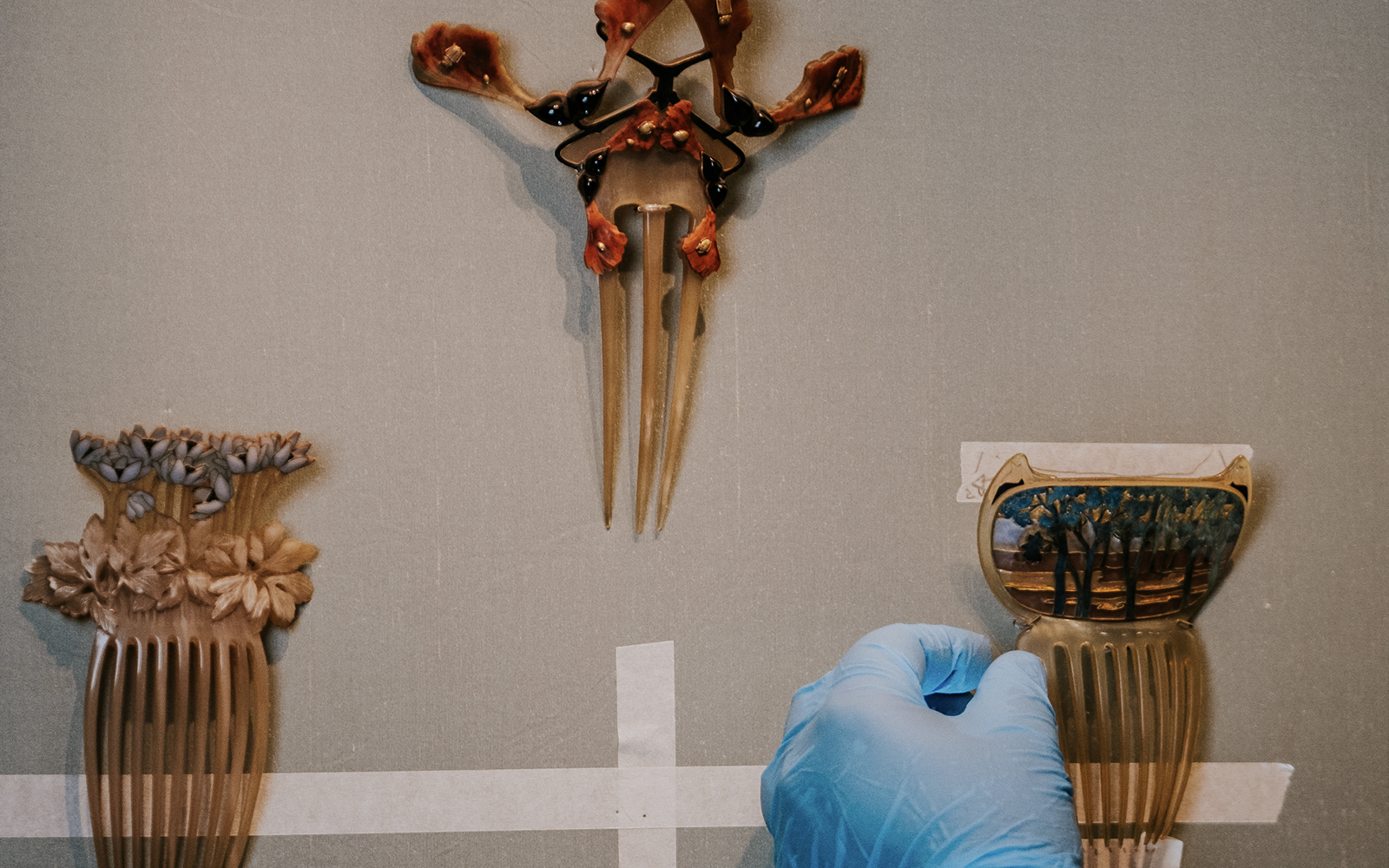
/
The art of glassmaking, which Lalique embraced exclusively from 1912 onwards, is thoroughly re-examined in this project, reflecting an ever-present concern in the artist’s production during both the Art Nouveau and Art Deco periods: the search for transparency.
Sponsor of the Renovation

Celebrating Life
Like a healing balm at the end of a painful trek – that’s what the Calouste Gulbenkian Museum’s new awakening feels like after almost three months of closure to the public imposed by the public health restrictions with which all of us, both the Foundation and the country more widely, have sought to control the pandemic that has befallen us so dramatically.
Now, however (aware of the need for continuing caution), we are embarking on a path that we all hope will restore our abruptly interrupted lives as much as possible. The fact that this has coincided with the start of spring, when gradually awakening energies merge with memories of the long winter fading behind us, seems to be symbolic of auspicious times to come.
What’s more, the museum’s reopening, with renewed offerings from its exquisite collection, also comes just in time to reap the fruits of one of its biggest projects in recent times: the important exhibition René Lalique and the Age of Glass, made available for visitors for one more week, could not be more timely – with the additional coincidence of the anniversary of the birth of this wonderful artist, whose works make up one of the most extensive and valuable collections held by the Calouste Gulbenkian Collection.
Spanning Art Nouveau and Art Deco, Lalique’s body of work represents an eloquent hymn to life, in which creative energies are backed by rigorous technical and scientific knowledge, which allowed him to confidently forge new creative paths with an unusual fusion of themes and materials that would shape the future of artistic creation itself. A century later, his work provides us with a valuable lesson on the importance of prudence at every step we take: a virtue that (without contradiction) must illuminate and nurture the rightful celebration of life.
António Filipe Pimentel
Director of the Calouste Gulbenkian Museum
Reopening of the exhibition ‘René Lalique and the Age of Glass’
The exhibition René Lalique and the Age of Glass will open for an extra week (6-12 April), with extended opening hours on Friday (10:00-21:00) to allow a greater number of visitors to attend. This exhibition, which was closed prematurely due to the pandemic, was originally scheduled to close on 1 February.
This reopening gives the public another opportunity to admire around one hundred pieces by this artist, a selection of pieces which features some of Lalique’s most beautiful creations, including jewellery, decorative pieces and everyday objects.
In addition to works in glass or with glass components that belong to the Gulbenkian Museum, this exhibition also includes exceptional works from the Lalique Museum in Wingen-sur-Moder, France, and from some of the most important private collections in the world. Curated by Luísa Sampaio, the exhibition covers the most significant milestones in the artist’s career, from his time as an artisan jeweller during the Art Nouveau period to his later role as a ‘creative industrialist’, when he focused solely on glass. Room attendance is limited to 25 people at any one time.
The Collection of the Calouste Gulbenkian Museum can also be visited from 7 April.
The Modern Art Centre remains closed for remodelling works in order to realise the project of Japanese architect Kengo Kuma and of Lebanese architect Vladimir Djurovic, the latter of which is behind the landscape intervention in the new garden area that will expand the green spaces of the Gulbenkian Foundation.
Footed bowl
This minai bowl was made in Kashan in the late 12th or early 13th century, during the Seljuk period. It was manufactured from very fine minai ware, an exquisite kind of porcelain that was mainly produced in two Persian cities, Kashan and Ray, during this period.
The piece is 8 cm high with a diameter of 20 cm and was acquired for the original collection of Calouste Sarkis Gulbenkian in Paris on 23 June 1914.

The techniques used in its manufacture include underglaze and overglaze decoration and haft-rang, or seven colours, making this kind of minai (enamelled) ware a luxury item, the crowning glory of a very rich artistic production and a very wealthy Persian court and elite. The piece was initially fired at a high temperature (around 600 degrees Celsius) for the pale blue, purple and green pigments under the glaze, while the black, brown, red and white and the gold leaf were subsequently applied and fired at lower temperatures to prevent colours from running or mixing at different melting points.
The centre of this ivory-white footed bowl depicts a court scene where a young and sumptuously dressed prince can be seen sitting on a high-backed throne. Two falcons are perched on the throne and the prince is flanked by two courtiers, with two confronting peacocks – symbols of royalty, but also the birds of Paradise – at his feet. The confronted position of the birds – both the peacocks and the falcons – seems to have some sort of heraldic quality of representation of power, but the falcons also add a playful note to this courtly scene (also present in another of our minai bowls, Inv. 935): the taste for the art of falconry amongst the Persian elites.

The inner rim of the bowl bears a votive inscription in Kufic script, whilst the outer rim has a pseudo-Kufic inscription amongst arabesques, a common ornamental feature in Islamic art. Like other pieces in this miniature style, this was inspired by Seljuk book illustrations or miniatures, where the frequent court scenes range from the narrative (mainly from the Shahnama) to the purely decorative.
The inner decoration also includes four pairs of sphinxes depicted below the inner rim, mythological creatures of eastern origin that can be found in Egypt, Mesopotamia, Persia and Greece and later – through eastern and Greek influence – in Roman art.
Jorge Rodrigues
Curator at the Calouste Gulbenkian Museum
Calouste Gulbenkian Museum distinguished by APOM
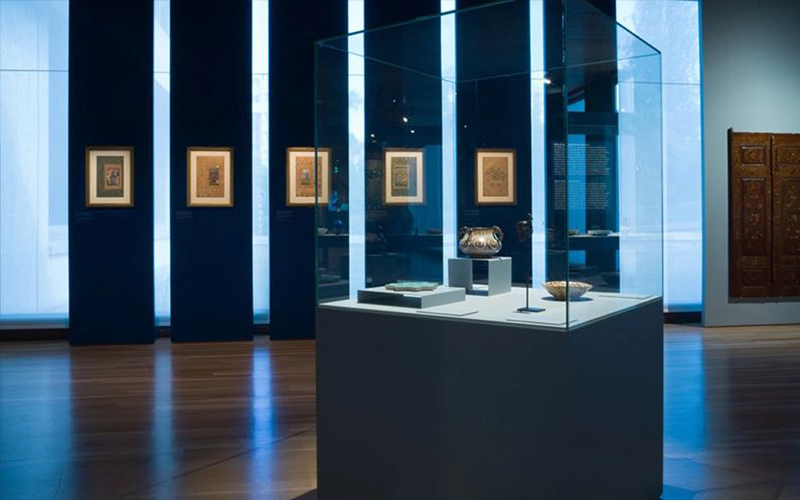
Each year, the Portuguese Museum Association (APOM) awards prizes to institutions and projects in a variety areas, from research and communication to exhibitions and education. This year, the 25th edition of the ceremony was held online on 10 December, bringing the representatives of Portugal’s most prominent cultural institutions together for the first time in a virtual format.
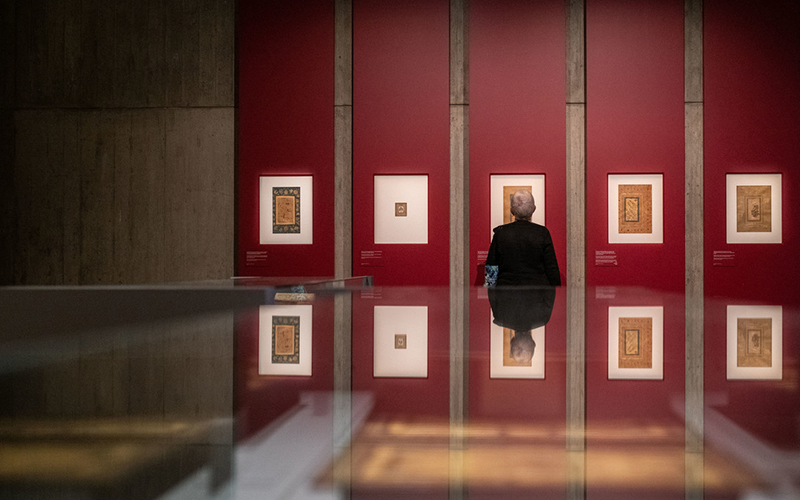
The exhibition The Rise of Islamic Art. 1869–1939, which was held from 12 July to 7 October 2019, was awarded the prize for best ‘Temporary Exhibition’. This show, curated by Jessica Hallett, comprised masterpieces of Islamic art from the Calouste Gulbenkian Collection as well as important international museums, and sought to understand the growing fascination with collecting ‘the Orient’ developed by the collector and his contemporaries.
The category of ‘Islamic Art’ took shape during this period and even stimulated the creation of new artistic styles and art forms in Europe, and the exhibition aimed to bring attention to the striking relationship between collecting and Realpolitik, pin-pointing the remarkable synergies between Gulbenkian’s acquisitions between 1900 and 1930 and concurrent developments in world history and the field of ‘Islamic art’.
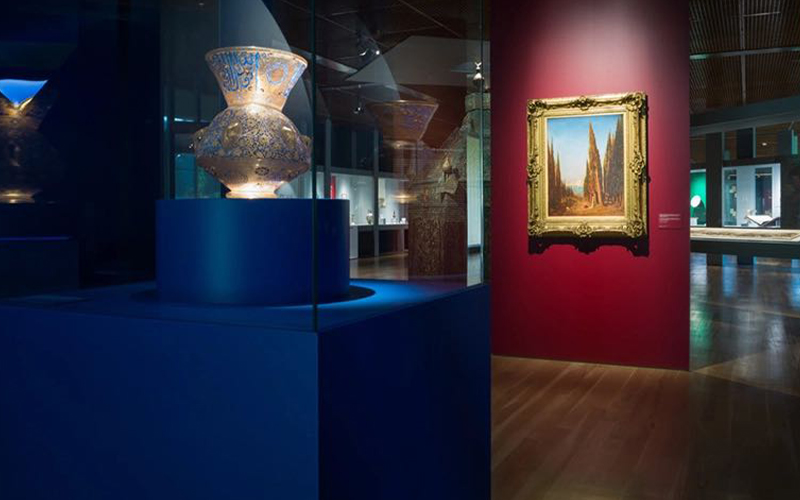
The exhibition was accompanied by a catalogue, available at the Foundation’s gift shops. The publication is profusely illustrated and includes contributions from international experts.
Bernard Quaritch
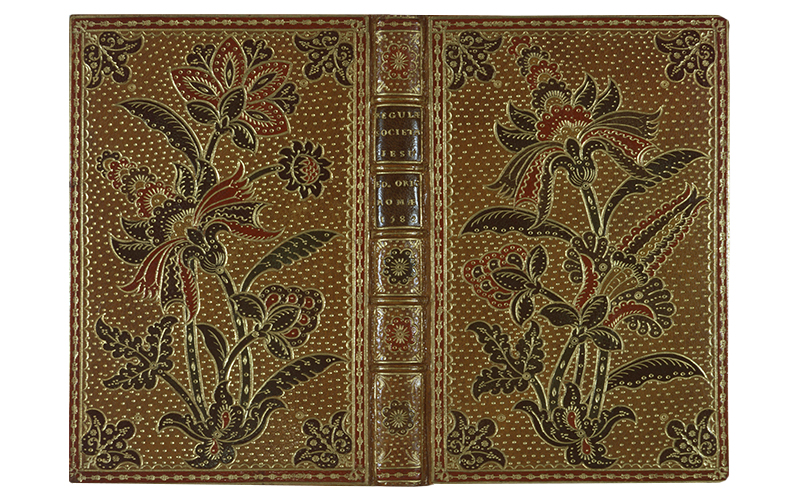
Usually stored out of sight of the public gaze, exhibited on rotation for conservation reasons, Calouste Gulbenkian’s book collection boasts important and rare editions, including manuscripts and printed books, fragments and bindings, produced between the 12th century and the early 20th century.
A significant number of works in this section were acquired by the collector from Bernard Quaritch, Ltd., a shop devoted to the sale of rare books and manuscripts, which opened in 1847. The founder, Bernard Quaritch (1819-1899), was born in a small German town and from an early age worked in bookshops in his home country. In 1842, he moved to London, where he worked with Henry Bohn, the best-known bookseller in the city.
Some years later, in 1847, Quaritch opened his own business in Leicester Square, in central London, and quickly amassed a significant clientèle. The dealer was interested in books on diverse themes, but he became known for selling ancient editions, among them incunables, manuscripts, bibles and historical bindings. One of the first books he bought was a ‘Gutenberg Bible,’ an incunable printed by Johannes Gutenberg between 1450 and 1455, which marked the beginning of mass production in Europe. Only 49 copies survived – it is thought that six of them passed through Quaritch’s hands.
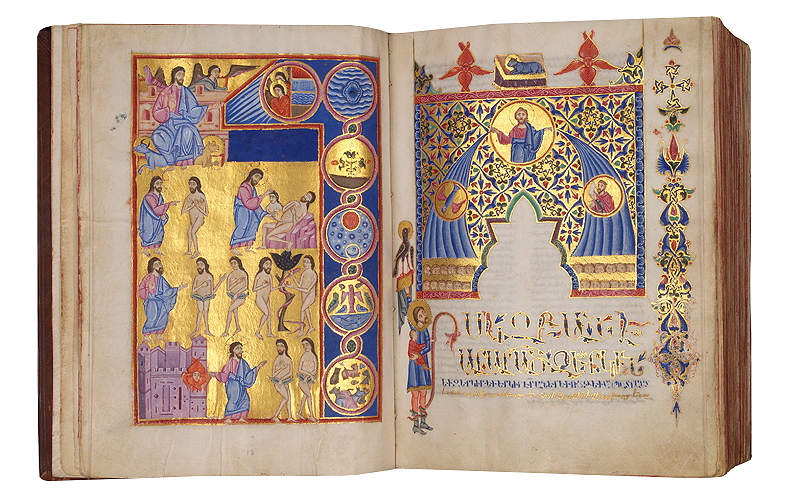
Bernard’s sons continued their father’s work after his death, with E. H. Dring becoming director – the Dring family would work for the company for approximately 113 years. F. S. Ferguson later took over management of the firm. A colleague since 1897, Ferguson had worked directly with the shop’s founder and was recognised not just as a bookseller but also as a well-regarded bibliographer.
Although the Quaritch family decided to sell the business in the 1970s, the firm is still in operation today under the same name, owned by the book collector and investor John Koh. The company now offers evaluations of collections and advice on purchases, and continues to buy and sell books at auction. Bernard Quaritch, Ltd., also publishes books and catalogues and holds an archive of documents that includes correspondence with some illustrious names, such as the famous collector J. Pierpont Morgan and the writer, editor and collector William Morris.
A Collection of Stories
On a weekly basis, we shared a story around Calouste Gulbenkian’s collection. This section was created in 2020, which is why the articles refer to the Calouste Gulbenkian Museum collection as the Founder’s Collection.
Other storiesDikran Kelekian
Born in Kayseri, in modern-day Turkey, the Armenian businessman, writer and archaeologist Dikran Kelekian (1867–1951) had a career that ran parallel to that of his contemporary, Calouste Gulbenkian.
In the early 1890s, Dikran and his brother Kevork started a business dealing in art and antiques in Istanbul, and were among the first dealers to introduce artworks from the Middle East to the European and North American markets. The firm was highly successful and quickly expanded to New York, London, Paris and Cairo.
Kelekian was also well regarded as a collector, having exhibited his ceramics collection for several decades in the Victoria and Albert Museum in London, where there are still some pieces belonging to his collection. His works were also loaned to various exhibitions in Europe and the United States, where he lived until the end of his life.
In the early 20th century, experts Jules Guiffrey, from the Gobelins Manufactory, and Gaston Migen, from the Louvre Museum, compiled an illustrated catalogue of Kelekian’s collection of textiles and rugs. The collector ended up giving a copy to Calouste Gulbenkian, possibly to arouse his curiosity about the merchandise he wanted to sell.
Dikran Kelekian joined several archaeological expeditions, particularly in Rayy, Raqqa, Sultanabad and Varamin, and started by selling Raqqa ceramics items to Gulbenkian, later followed by pieces from Iznik and Ottoman textiles. From 1900, Kelekian also began to sell works of modern art, although Gulbenkian didn’t purchase any of these works from the dealer.
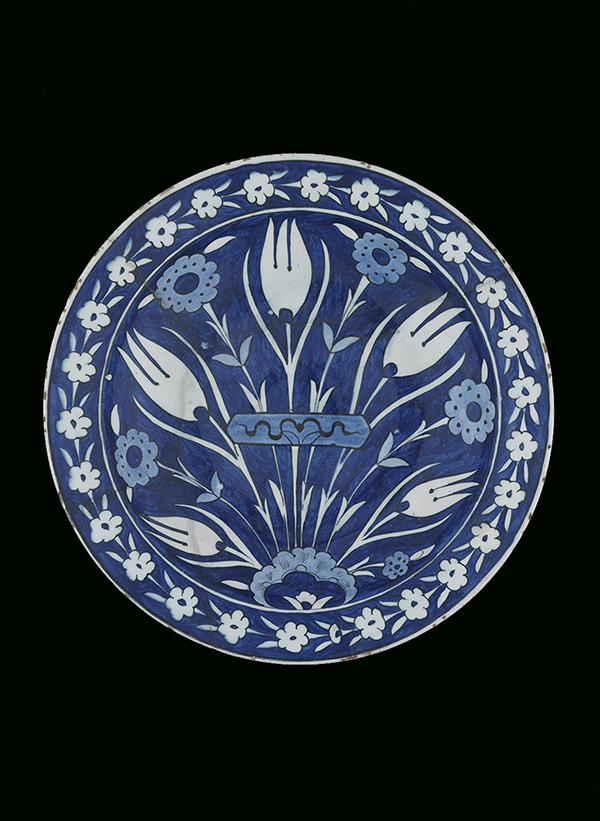
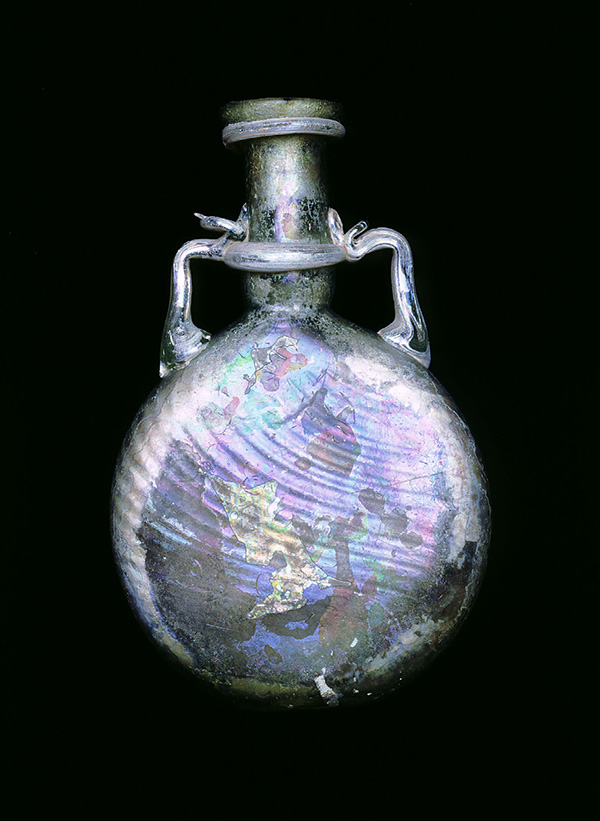
As well as Gulbenkian, Dikran sold works to other renowned collectors, such as John D. Rockefeller, Henry Walters and Charles Freer. Kelekian’s curious appearance also sparked the interest of various artists, such as Milton Avery and Walt Kuhn. In 1944, the Durand-Ruel Galleries in New York held an exhibition entitled Kelekian: As the Artist Sees Him, which showed diverse portraits of the Armenian art dealer.
Dikran was close to various artists, for example Mary Cassatt, who ended up painting more than one portrait of his son Charles, heir to his fortune and responsible for the running of the business after his father’s death in 1951. These portraits are currently to be found in museums such as the Metropolitan Museum of Art and the Walters Art Museum. A significant part of Kelekian’s collection is currently in the Metropolitan Museum of Art, in New York.
A Collection of Stories
On a weekly basis, we shared a story around Calouste Gulbenkian’s collection. This section was created in 2020, which is why the articles refer to the Calouste Gulbenkian Museum collection as the Founder’s Collection.
Other storiesRenovation of the Lalique Room
The room devoted to the work of René Lalique, which rounds off a visit to the Founder’s Collection, will be closed for renovation, supported by the BFF Banking Group. The reopening will bring some novelties, with the return of the monumental silver and glass centrepiece Female Figure.
Between 30 October and 1 February, a selection of the artist’s works, with a focus on the important series of glass pieces acquired by Gulbenkian, will be on display in the exhibition René Lalique and the Age of Glass. Art and Industry. This exhibition, with free entry, will be shown in the Lower Gallery of the Founder’s Collection.
Support

Power of the Word II / From India to Europe, The Journey of Bidpay’s Fables
One of the most copied, translated and printed sets of fables trace their roots to the Sanskrit Panchatantra, or ‘Five Treatises’, collected between the second and third centuries CE. The original version, now lost, is claimed to have been brought to Persia by Borzuya the physician to the Sassanid king Khosrow I (r. 531−79) and translated to Middle Persian or Pahlavi. This version is also lost, but was translated into Arabic by Ibn al-Muqaffa (died c. 756−59) and called Kalila and Dimna, after two jackals who are subjects.
The Arabic version was later translated into Syriac, Hebrew, Latin and Modern Persian in the Middle Ages, and then to almost every other language in the world. Jean de La Fontaine (1621−1695), the famous French writer owes much to this oriental book, as he himself admitted, citing the French translation of the Anvâr-e Soheyli, entitled Livre des Lumières, edited by Gilbert Gaulman in 1644, as a source of inspiration.
From its inception, the Panchatantra texts were intended to serve as an educational tool for the ruling elite, a literary genre called ‘Mirror for Princes’. The animal protagonists reflect human characters, with all their noble strengths and weaknesses, each story offering a prudent moral lesson for the reader. Their themes range from deceit and contentment to mortality. Today, some of these stories still resonate with modern society, while others elicit criticism for being outdated; something that was explored by the working-group Power of the Word.
This small exhibition focuses on a rediscovered unbound manuscript from Calouste Gulbenkian’s collection (LA170), with paintings miraculously preserved from the 1967 Lisbon flood. It is a copy of Anvâr-e Sohayli (Lights of Canopus), a Persian translation of Kalila and Dimna by Va’ez Kashefi in the late 15th century, at the court of the Timurid prince of Herat, Sultan Husayn Bayqara (r. 1469−70; 1470−1506). The title derives from the name of Sultan’s commander in chief, Amir Sheikh Ahmad Sohayli.
Our manuscript was copied and illustrated in Iran, in 1842, during the reign of the third Qajar ruler, Muhammad Shah (r. 1834−48). Its fine paintings are very close though to those made under his father, Fath ‘Ali Shah (r. 1797−1834), seen, for example, in the now dismembered Shahanshahnama commissioned by him, in 1810 (now dispersed, in the British Library, the Louvre and other public and private collections).
Fath ‘Ali Shah is even portrayed in our images, appearing in the guise of the royal king. The manuscript might therefore be a copy of an earlier one made for him, yet to be identified, with ours ordered by one of his sons possibly depicted as the young prince in the fables, or perhaps made for the wider commercial market which still held the recently-deceased shah in high esteem.
Anvâr-e Soheyli
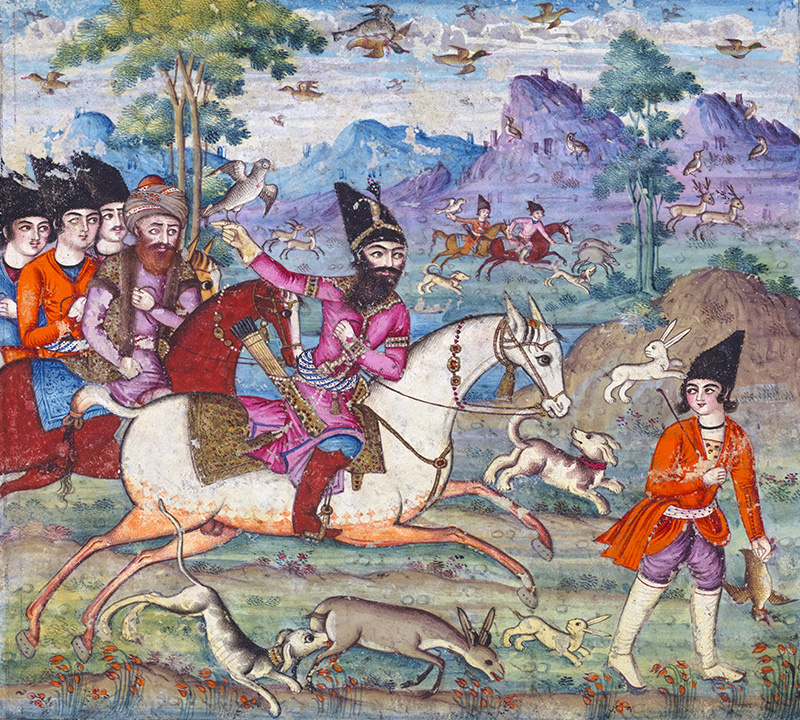
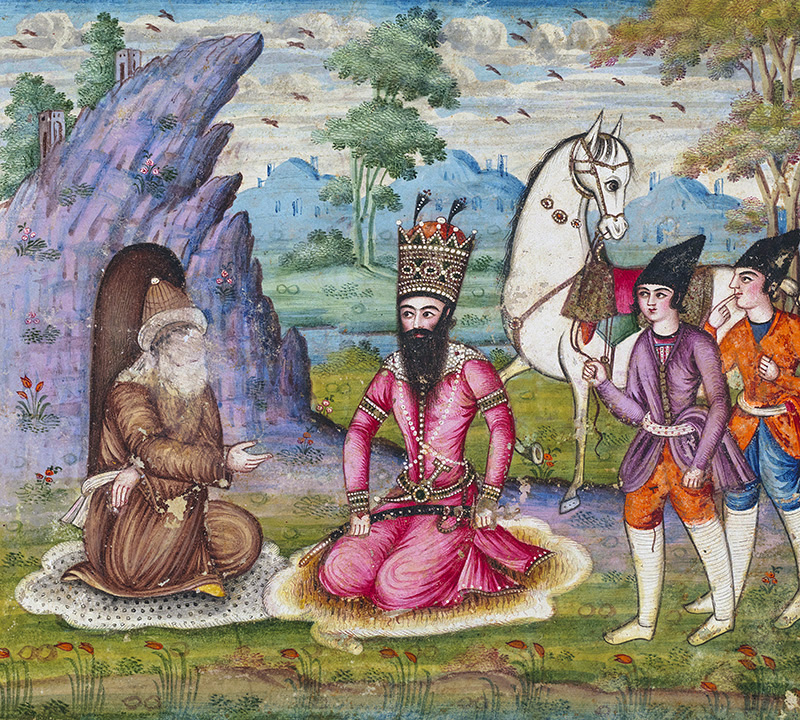
In the introductory story, King Humayun-fâl or ‘Blessed fortune’ goes on a hunt with his vazir, Khujasta-ra’i or ‘Auspicious judgement’. The vazir advises the king that to be great he must be instructed by sages, like the fictional Indian king Dabishlim who was tutored by the Brahman Bidpay. This serves as the frame for the book, which thereafter comprises a series of conversations between Dabishlim and Bidpay in which the latter educates the king using the device of moral stories.
Here we see the first two episodes. In both, the central figure can easily be identified from his long beard and clothing as Fath ‘Ali Shah; thus these images serve as a direct mirror of the prince, picturing him as the major protagonist of the book. Interestingly, Bidbay’s face seems to have been intentionally rubbed out. Possibly the figure portrayed was a contemporary political personality, who had fallen into disgrace, or was interpreted as a saint of some sort and eradicated for religious reasons. Meanwhile, the background reveals a mixture of artistic traditions: on the left, the mountain is formed of Chinese-derived wavy rocks integrated into Persian painting in the fourteenth century, while European shading and perspective are applied to the sky and idyllic rural landscape.
Kalila and Dimna
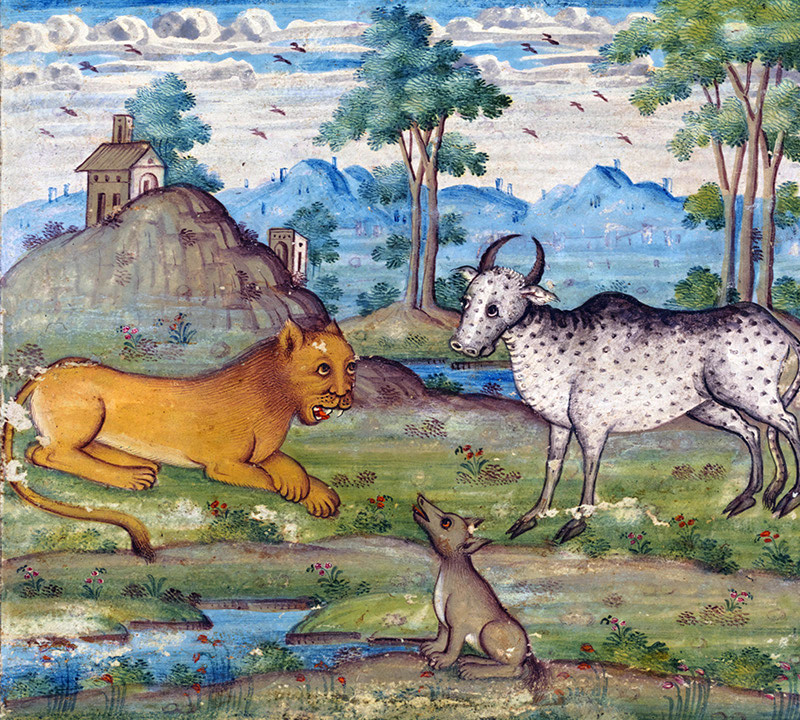
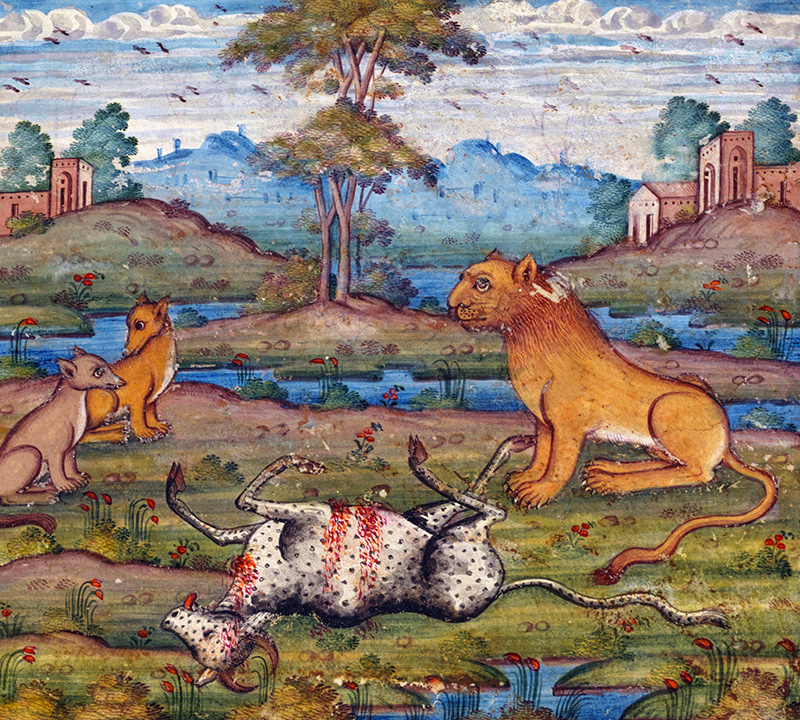
A runaway ox, Shanzabah, arrives at a lush pasture near a forest. The mighty lion king is frightened by the ox’s bellows and hides. Two of his courtiers, the jackals Kalila and Dimna (after whom the Arabic version of the fables is named), worry they will go hungry while the king, paralysed with fear, shies away from the chase. Dimna decides to introduce the ox to the lion. To his great displeasure, Shanzabah becomes the lion’s closest confidant and favourite. Dimna then persuades the king that the ox is conspiring against him, inciting him to kill the ox.
Deceit
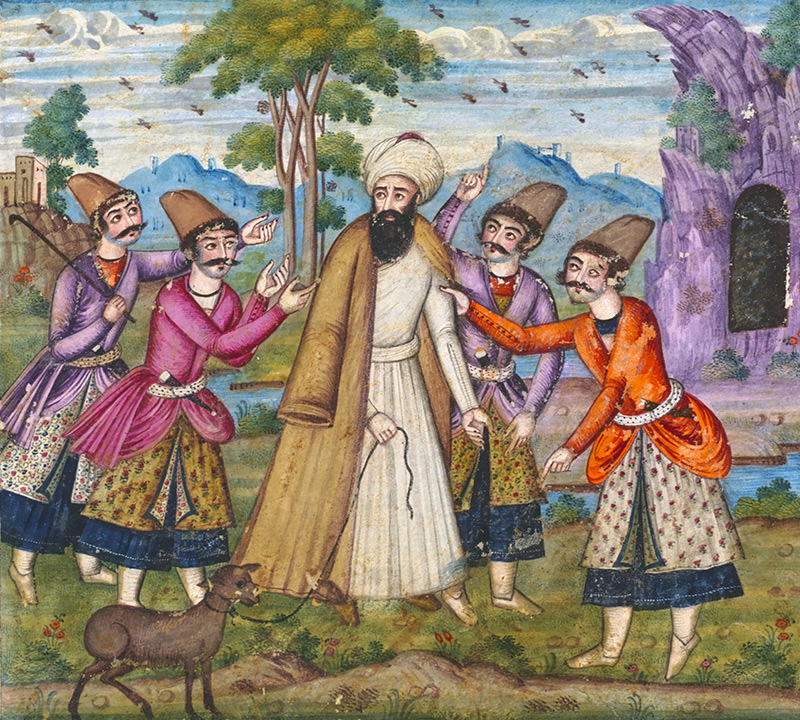
A holy man buys a sheep to sacrifice (seen at the bottom). A party of thieves spot him and develop a strategy to steal his sheep. One asks how a holy man can be accompanied by a ‘dirty dog’, while another questions whether he is going hunting with this ‘hound’, and yet others argue about the breed of the so-called dog… The poor man protests that it is a sheep, but they act so convincingly, he ends up giving them the ‘dog’ and returns to the market to try to recover his money.
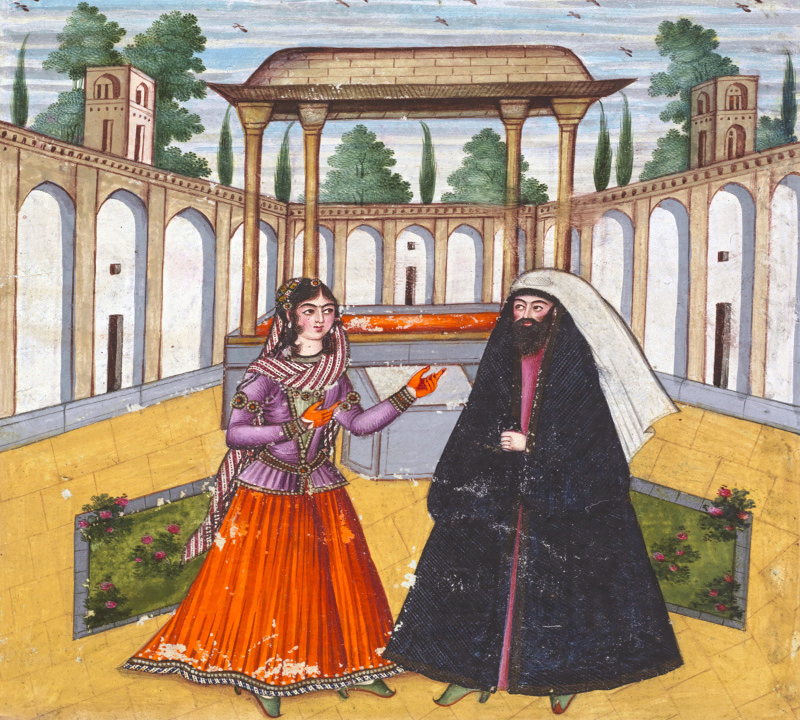
A merchant’s young wife and a painter in the neighbourhood fall in love. In order to avoid gossip, they hatch a plan for the man to enter the woman’s house disguised in a ladies’ (black-and-white) mantle. Meanwhile, the painter’s slave, having overheard them, takes the mantle and goes to the meeting. The merchant’s wife, in her haste to enjoy intercourse with her lover, does not recognise the intruder. Shortly afterwards, the painter (bearded) comes home and dresses himself in the same mantle to meet his mistress. The latter asks why he has returned so quickly (seen here). Thus, the painter deduces the deceit and punishes his slave, and the hasty woman never sets eyes on her lover again.
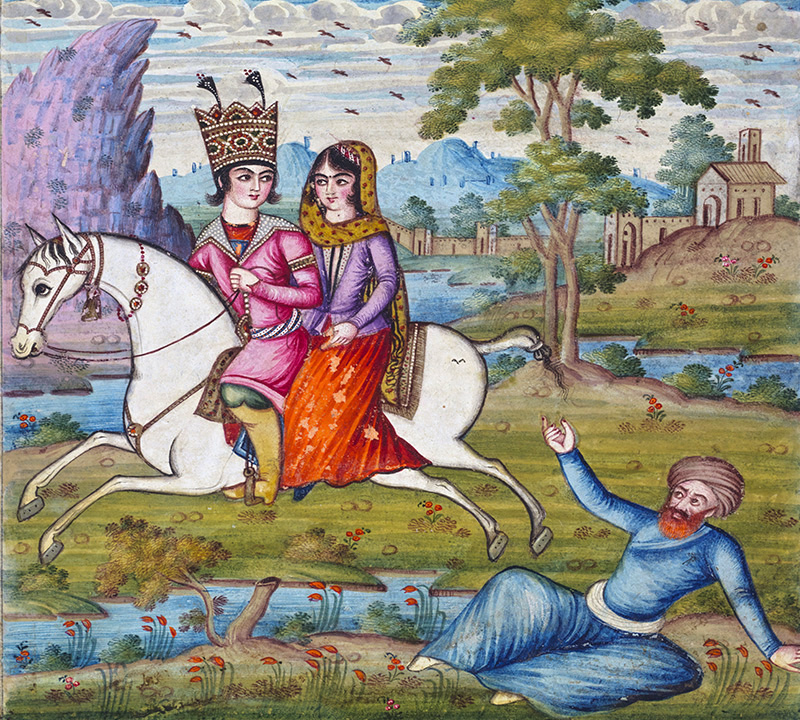
A farmer’s young wife persuades her old husband to leave his miserable farm to go with her to a big city. When the farmer shares his fright at the lechery he may witness there, the woman swears an oath of faithfulness to him. On their way to Baghdad, while the farmer is taking a nap, a handsome prince passes by and as soon as he shows interest in her, the young woman promptly agrees to abandon her husband (here she flies off on the prince’s horse). After a short walk, the couple stop to rest. A lion attacks them and the prince swiftly flees, leaving the woman behind to be devoured by the lion.
Contentment
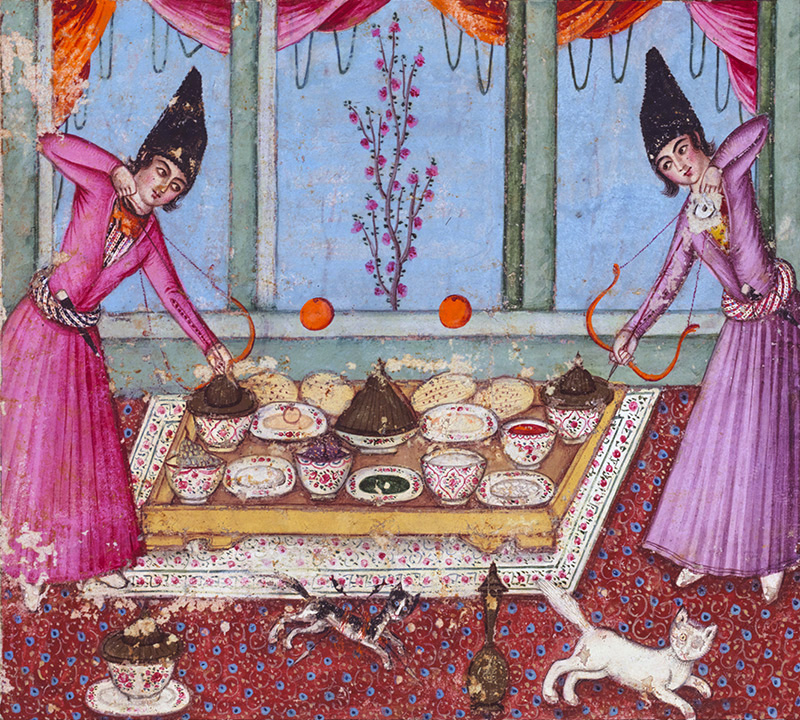
A poor woman’s cat (black and white) meets a fat, well-fed cat (white) who boasts of feasting at the sultan’s table and takes him there. Unfortunately, the day before the fat cat had created such a mess of the food that the sultan ordered his archers to wait in ambush. The poor woman’s cat, unaware, is the victim of their arrows.
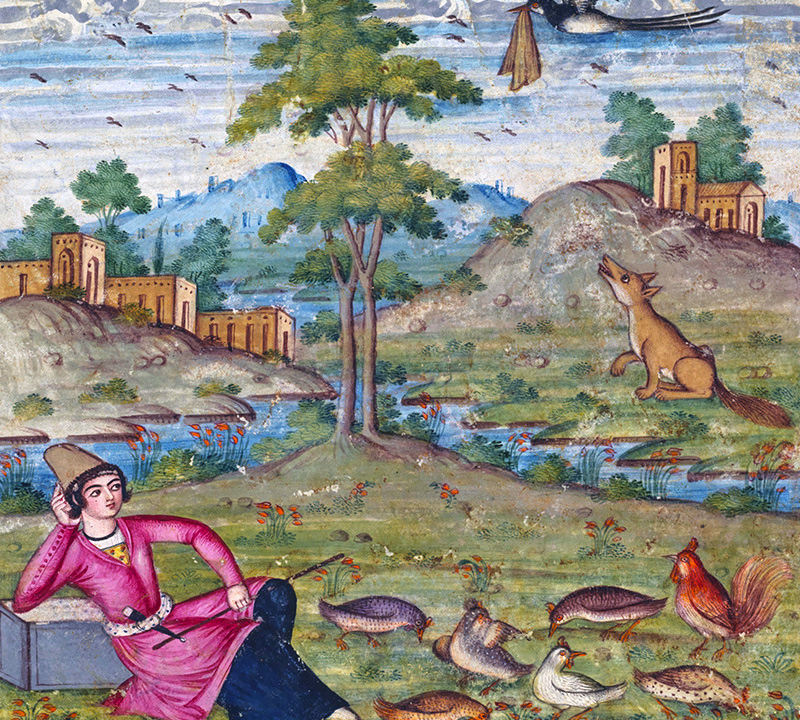
A starving fox manages to find a piece of fresh hide left over from a wild beast’s meal. While taking the skin to his den, he comes across a group of fowls, being watched closely by a man. The fox abandons the hide to catch a fowl, but is beaten by the guardian while a kite (shown here as a magpie) flies off with the animal skin.
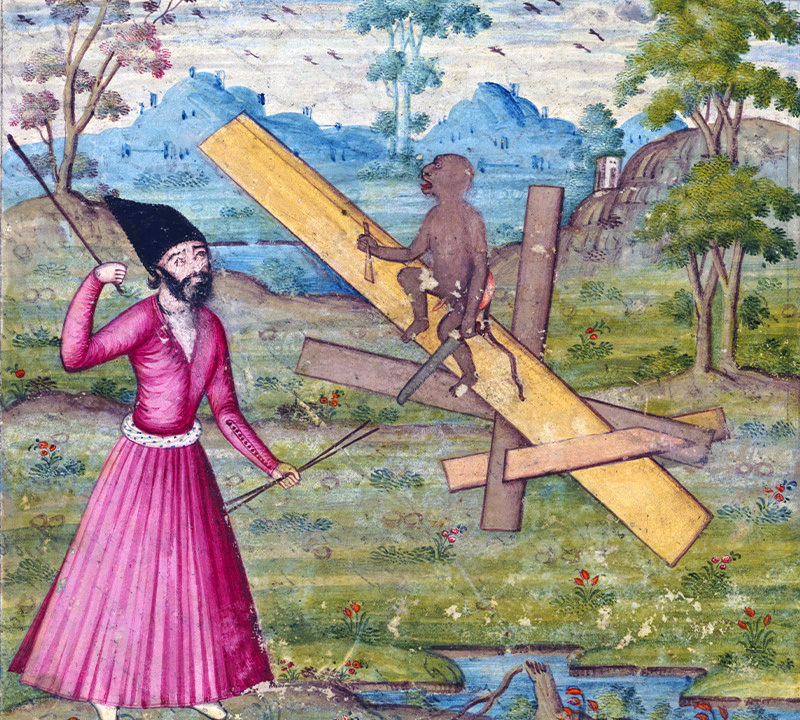
A nosey monkey sees a carpenter sawing timber cleverly using two wedges to aid his progress. As soon as the carpenter leaves, the monkey takes his place, assuming the task is easy. But by taking out one of the wedges, he gets his genitals caught in the cleft in the log, and when the carpenter returns, he is severely punished.
Unity
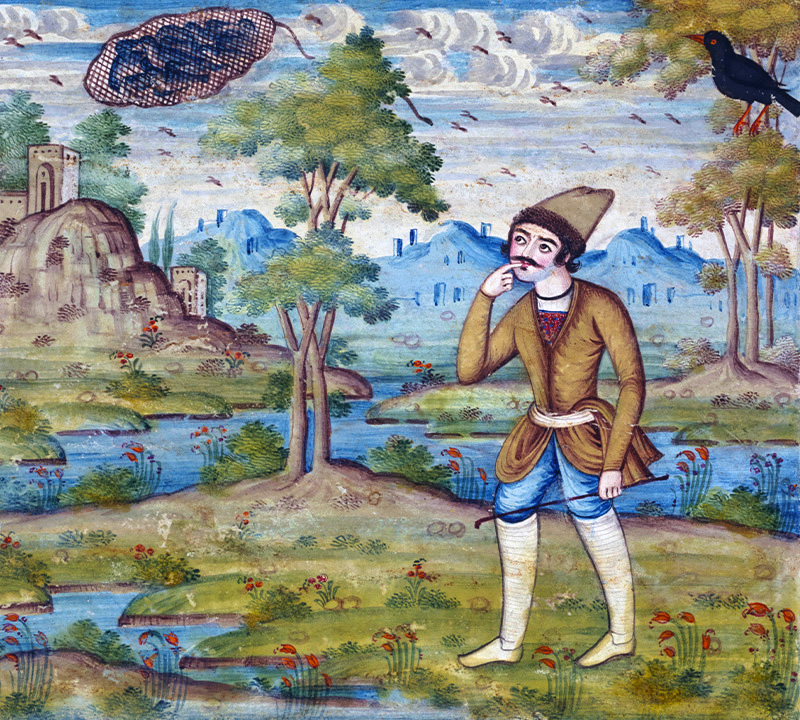
A crow watches a fowler set a net to catch birds, and then hide. A group of pigeons get caught. They fight desperately to flee. Their king, Ring-dove, instructs them to fly together, all at once. By doing so, the pigeons manage to raise the net into the air (seen here), and fly to a nearby town where a friendly rat comes to their rescue, by gnawing a hole in the net. Ring-dove, who epitomizes a just king, insists on being the last to be rescued, consenting only after all his subjects are safely released.
Ingratitude
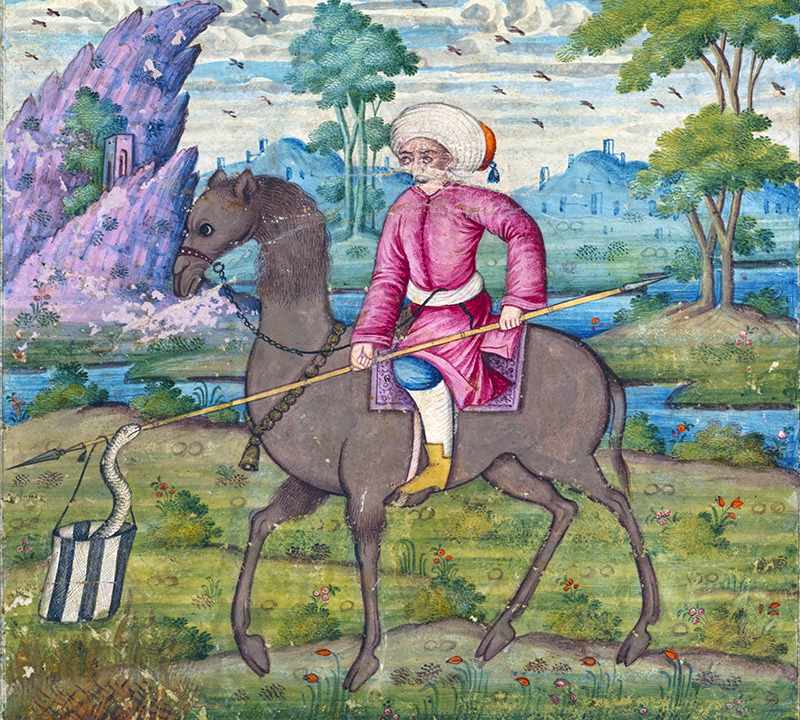
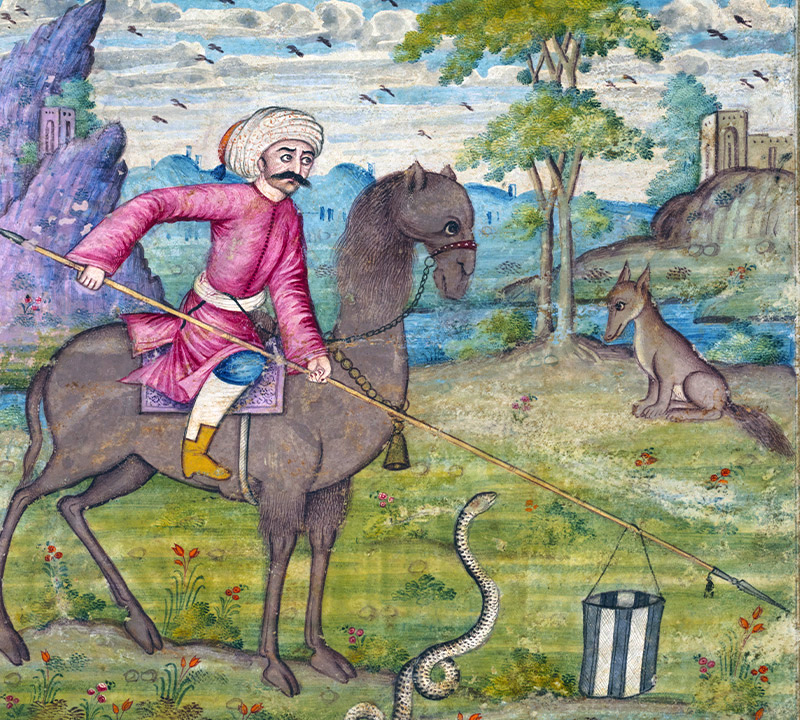
A camel-driver sees a snake caught in a fire and rescues it with a bag fixed to the point of his spear (first image, slightly damaged). As soon as it is released, the snake announces that it will not leave before biting both the camel-driver and his camel. There follows an argument over whether the snake is unjust, or the man foolish in misplacing his clemency. The two agree to seek other opinions. A buffalo cow agrees that in the human realm, the answer to good is evil: ‘over many years I have produced good milk and calves for my owner, but now that I have no more milk he intends to sell me to a butcher!’ A tree then testifies similarly: ‘I offer shadow for travelers to rest in the hot desert, but they saw off my branches’. A fox passes by, and after hearing their stories, says he will answer at the trial only if he can understand how such an enormous snake got into such a small bag (second image). The snake then slithers back into the bag, and the fox instructs the camel-driver to smash and kill it.
Knowledge
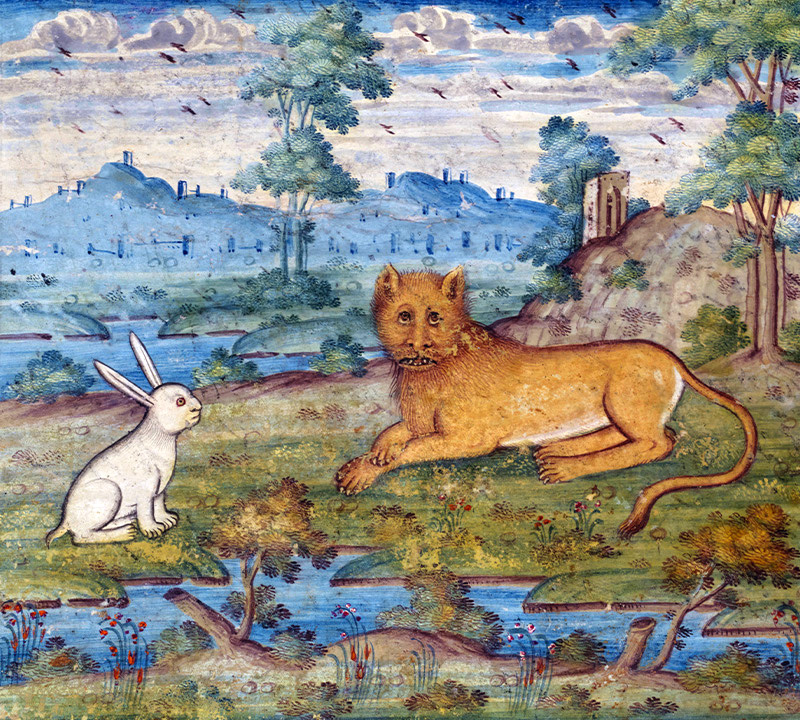
A ferocious lion dwells in a meadow, where the other animals get no rest owing to his persistent hunting. One day, they propose to the king that they offer one willing animal for his royal kitchens daily to avoid the distress and anxiety of the hunt, which the lion readily accepts. Every day the animals draw lots to choose the ill-fated among them. One day the lot is cast in favour of a hare who purposefully delays his arrival at the lion’s den. Angry with hunger and at waiting, the lion asks why he is late. The hare tells him two hares were sent that day, and on the way, they met another lion who caught the first and then hid in a well. The king, furious, accompanies the hare to the well to kill this audacious challenger. The hare asks the lion to climb up onto the ledge of the well (here a stream) so he can show him the other. The king follows and sees a ferocious lion beneath him, clutching a white hare in his claws. He immediately dives into the well and the animals are liberated by the hare’s cleverness.
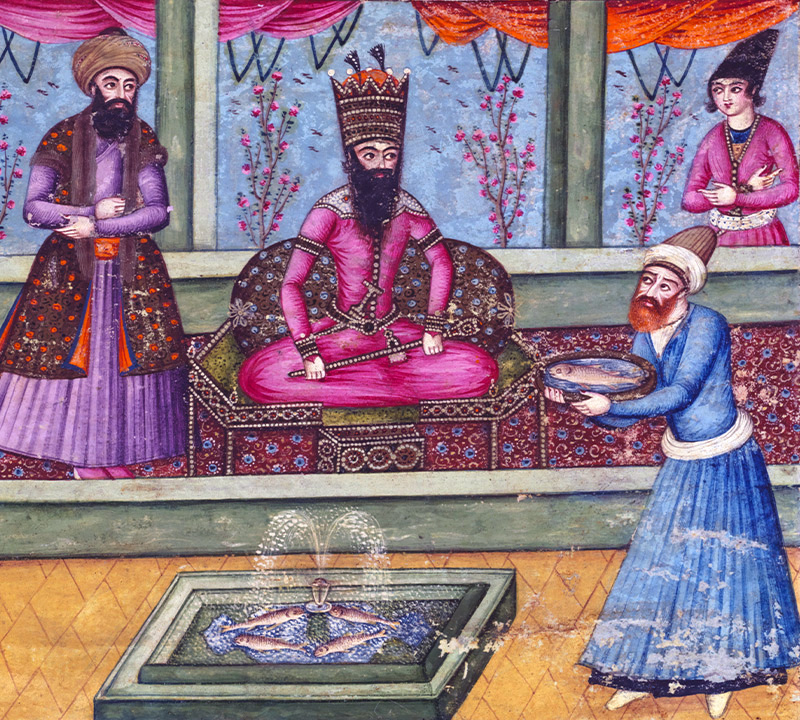
A poor hunter spends a whole day catching three birds. While trying to catch more, he overhears two law students involved in a noisy argument. When he asks them to keep quiet, they agree but only in exchange for two birds, to the great sorrow of the poor hunter, who reluctantly accepts. Then the hunter asks them why they were arguing, to which they respond: ‘about hermaphrodites, and how inheritance laws should apply to them’. The poor hunter who has only one bird to feed his entire family, then attempts to catch some fish. By chance, he reels-in a beautiful fish, with bright colours, and decides to present it to the sultan. When he arrives at the royal court, the sultan is so pleased with the gift that he orders his vazir to grant him a thousand dinars (seen here). The vazir whispers to the sultan that the prize is totally disproportionate and advises the ruler, who has loudly voiced his intentions, to trick the hunter. He proposes that he ask if the fish is male or female, and regardless of the answer, requests an identical one of the opposite sex before giving the prize. When the sultan presents the question, the old hunter foresees the trick, and remembering the students’ argument, explains that the fish is a hermaphrodite! The king is amazed by this clever answer, and grants the hunter double the previous prize.
Humankind and Mortality
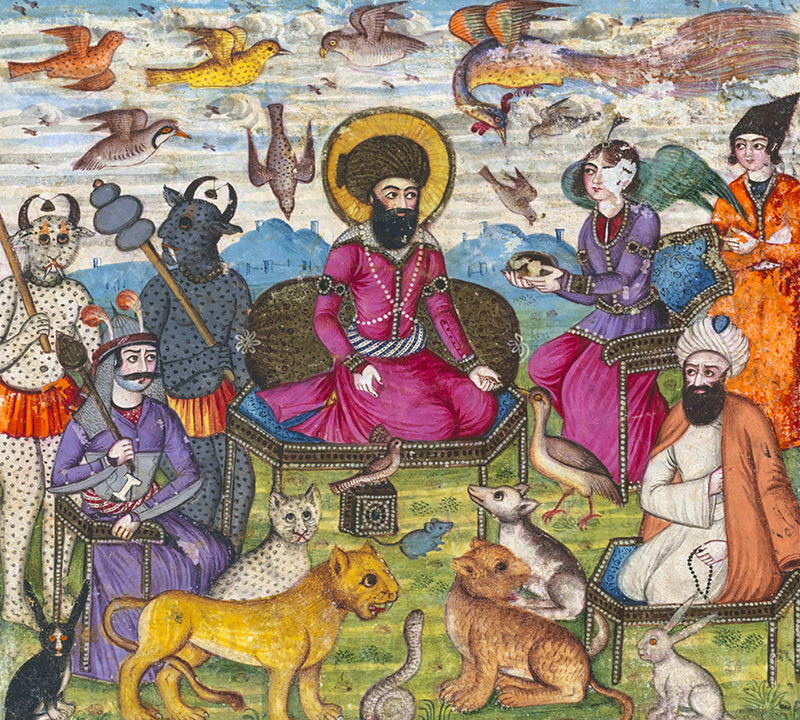
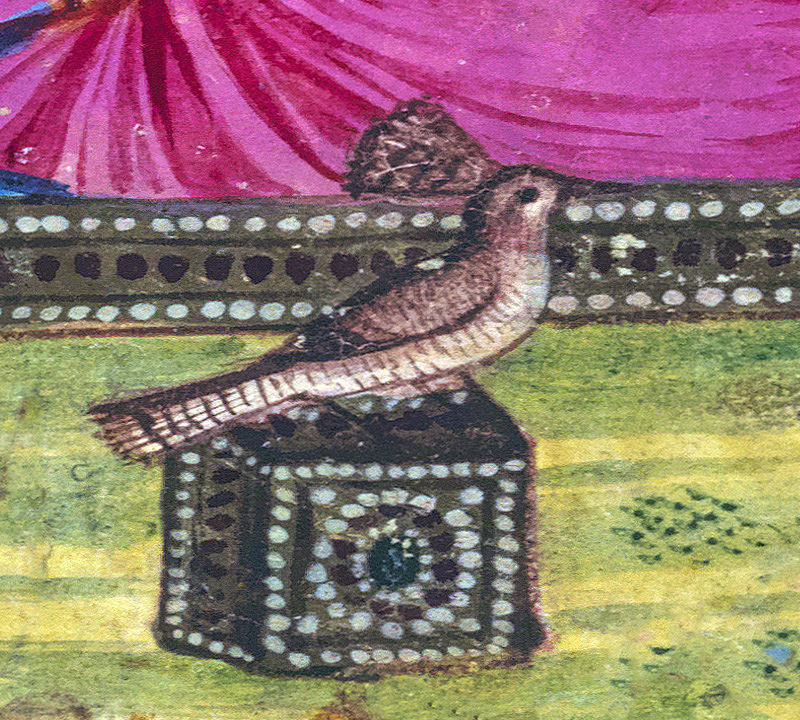
An angel (top right) appears before King Solomon and presents a cup of water for eternal life, offering him the choice between drinking it and becoming immortal or not. The wise king asks the advice of all his courtiers, humans, demons and animals alike. Everyone agrees that their king should live forever; only the heron is absent. When he is summoned to give his opinion, the heron approaches the king (shown here) and asks if he is willing to share this potion with others. The king replies that the beverage has been sent for him alone. The heron responds that he would never drink it to achieve everlasting life, only to witness his friends and relatives steadily dying. Solomon sends the angel away, and declines to drink the potion.
The subject of a king seeking immortality dates back to at least the third millennium BCE, with the epic story of the mythical Sumerian king Gilgamesh. The Greek myth of Orpheus is similar and Ferdowsi (died c. 1020), the famed author of the Shahnama (Persian ‘Book of Kings’), tells a related story about Iskandar, a mythical version of Alexander the Great.
In this painting above, Fath ‘Ali Shah’s features are recognizable in the figure of Solomon, the paragon of the wise and powerful king, able to speak to birds and master the wind and jinns (Qur’an XXVII:16; XXXIV:12-13). The hoopoe is frequently represented at Solomon’s side (here at his feet) and is said to have carried messages from the king to the Queen of Sheba (XXVII:20-28). This bird is also a central figure of the twelfth-century Persian masterpiece, Conference of the Birds, by the mystic Farid al-Din Attar, in which the hoopoe leads the birds of the world on a journey to seek their sovereign, in a metaphorical search for God.
Farhad Kazemi
Guest curator, Institut national du patrimoine, Paris
Coordinated by Jessica Hallett (curator) and Diana Pereira (Learning Department)
Calouste Gulbenkian Museum
Collaboration: Fabrizio Boscaglia, Joana Simões Piedade, João Teles e Cunha, Leila Namazi, Maryam Loutfi, Maryam Nasirpour, Rahman Haghighi, Raquel Feliciano, Ricardo Mendes, Omid Bahrami, Samaneh Sharif, Sara Domingos, Shahd Wadi.
Power of the Word is a participatory curatorial project at the Calouste Gulbenkian Museum, involving principally Arabic and Persian speakers who join curatorial and educational staff and guest researchers to study the Middle East collection. It aims to enhance our experience of these works by encouraging collaborative research and vibrant, contemporary interpretations which affirm intangible culture.
In this working group, the participants played a crucial role in interpreting the texts and images from different cultural viewpoints, and discussed the relevance of traditional stories and archetypes to our lives today. A panel in the rotation shares cross-cultural aphorisms and contemporary questions that arose during this process.
The project was shared with the public on International Museum Day with the Conference: How Many Voices does a Museum have? and a story for families, The Lion and the Hare.