
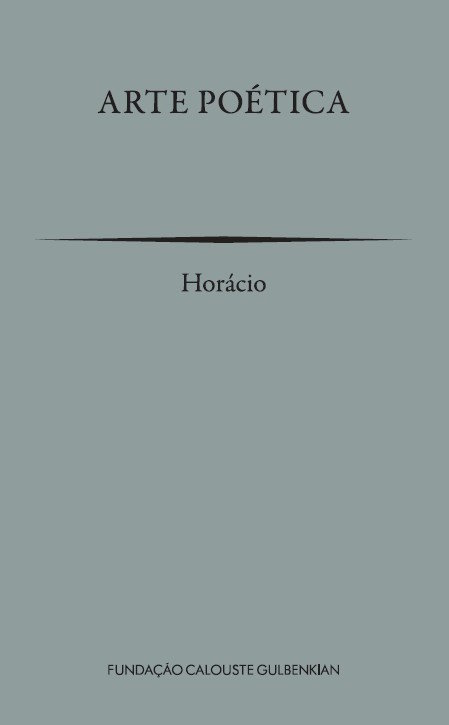
Arte Poética
Horatio
‘The poet urges the Romans, his compatriots, to forget the world of business and more rustic activities, to immerse themselves in the world of poetic and literary creation, drawing inspiration from good Greek literary texts, in a mimetic effort, and to expel, however, any servile imitation. Indeed, everything that comes from our memories and imagination is made up of fragments of what we have read and retained, and that is why J. L. Borges called this process rewriting, which does not imply resorting to the archetypes that Plato describes in the Republic, when conceiving a dual reality, the one found here on earth, and the pure, initial one, hovering in the divine heights of the universe.
It is interesting to verify the influence of Horace’s Poetics throughout the centuries, and it suffices to point to the unsurpassed and biting satirist Boileau, a contemporary of Louis xiv and author of L’Art Poétique (1674), or the less-known Geoffroi de Vinsauf, in the 13th century, a contemporary of Chaucer, who, to distinguish his Art of Poetry from Horace’s work, carefully titles it Poetria Nova […] as well as the famous Bishop of Cremona, Marcus Girolamo Vida, of the turbulent 16th century, a contemporary of Charles v, author of De Arte Poetica, published in 1527.
Horace insists on a principle, right at the beginning of the Art of Poetry, to which the imagistic reality of the Roman territory imposes certain reservations. He says “Vt pictura poesis”: and with this solemnly stated principle, he wishes to convince us that in poetry, just as in painting, one cannot mix parts of animals, that is, of images and literary styles of any kind. In other words, and without any certainty that he adheres to this entirely throughout his poetic work, for I even doubt it, one must obey the principle of decorum (beauty) and concinity, in Latin concinnitas, which we can translate as harmony, in which disparate elements should not be joined together in a surrealist combination.’
(From the Preface by Raul Miguel Rosado Fernandes)
Technical information
- Responsabilities:
Introduction, translation and commentary by Raul Miguel Rosado Fernandes
- Language:
- Portuguese
- Edited:
- Lisbon, 2026
- Dimensions:
- 220 x 138 mm
- Pages:
- 175 p.
- ISBN:
- 978-972-31-1444-7