
Scheherazade, the Never-ending Collection of CAM
Event Slider
Date
20 Sep 2025 – 20 Sep 2027
- Sat,
- Closed on Tuesday
Location
Collection Gallery Centro de Arte Moderna GulbenkianPricing
- 12,00 €
Included in the Centro de Arte Moderna Gulbenkian admission ticket
Join Cartão Gulbenkian to book tickets.
Join
You need to access this event.
Free – Under 18
25% – Under 30
10% – Over 65
Cartão Gulbenkian:
Free – Under 30, saturdays,
18:00 – 21:00
50% – Under 30
20% – Over 65
10% – 30 to 64
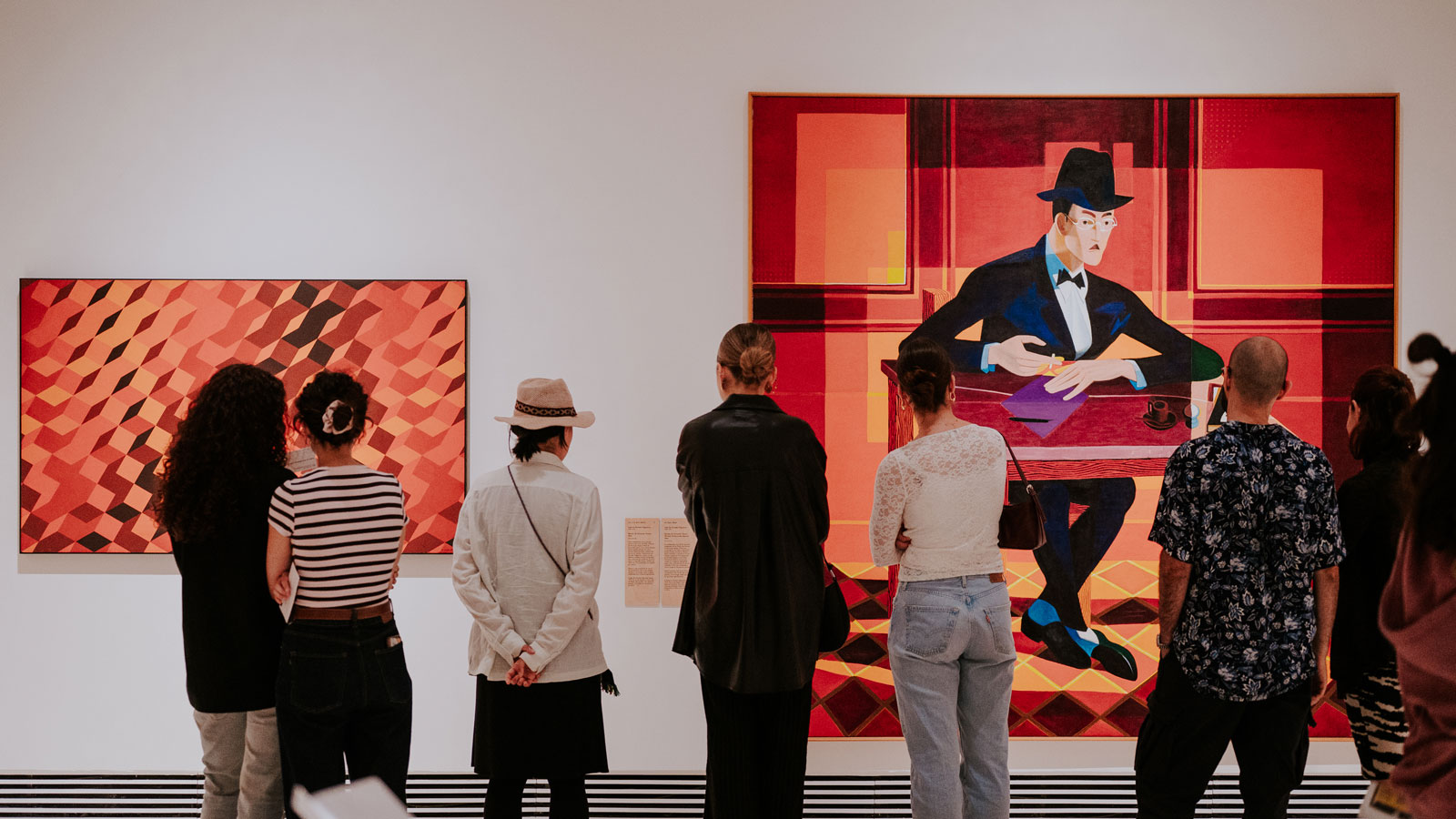
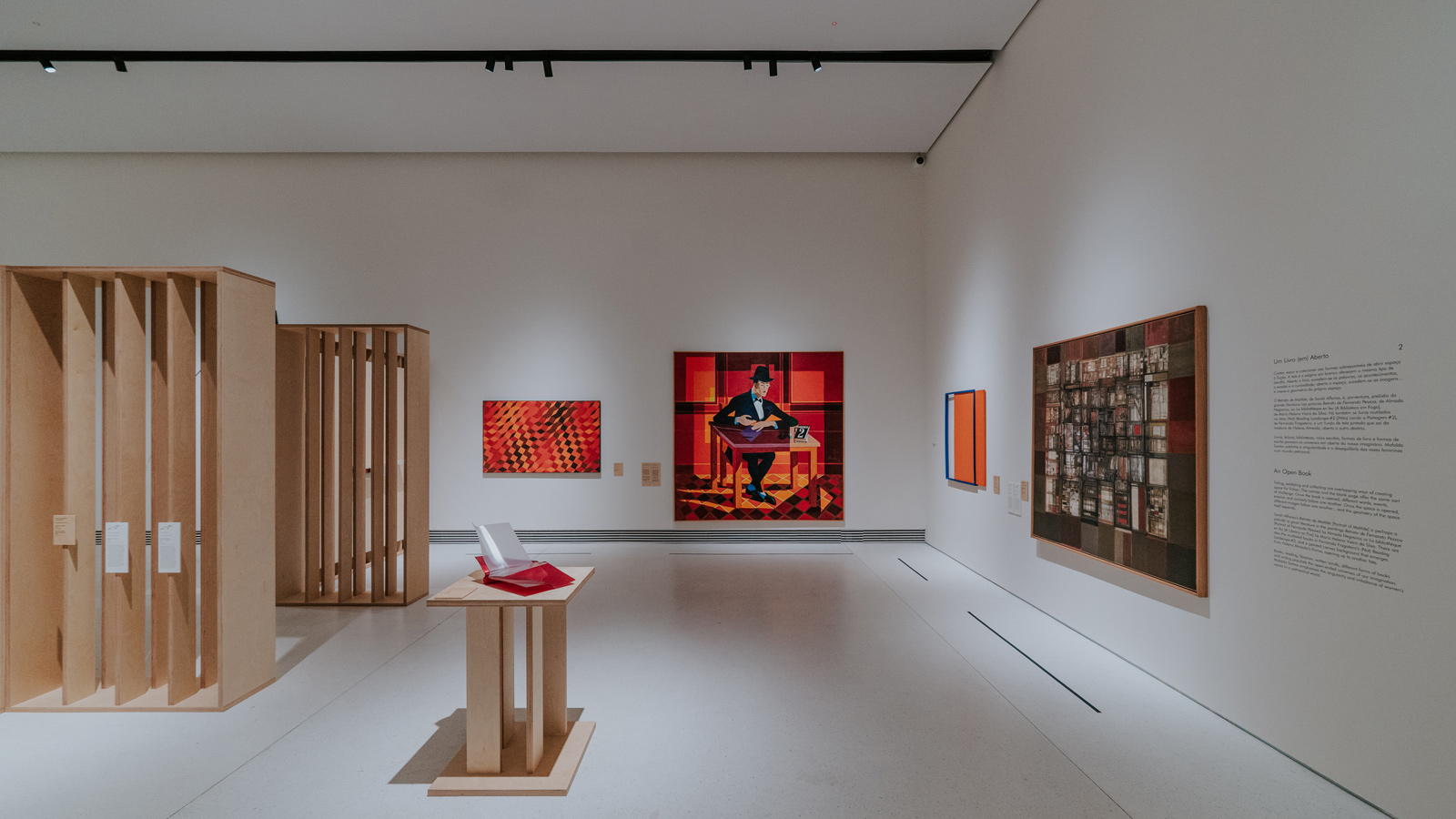
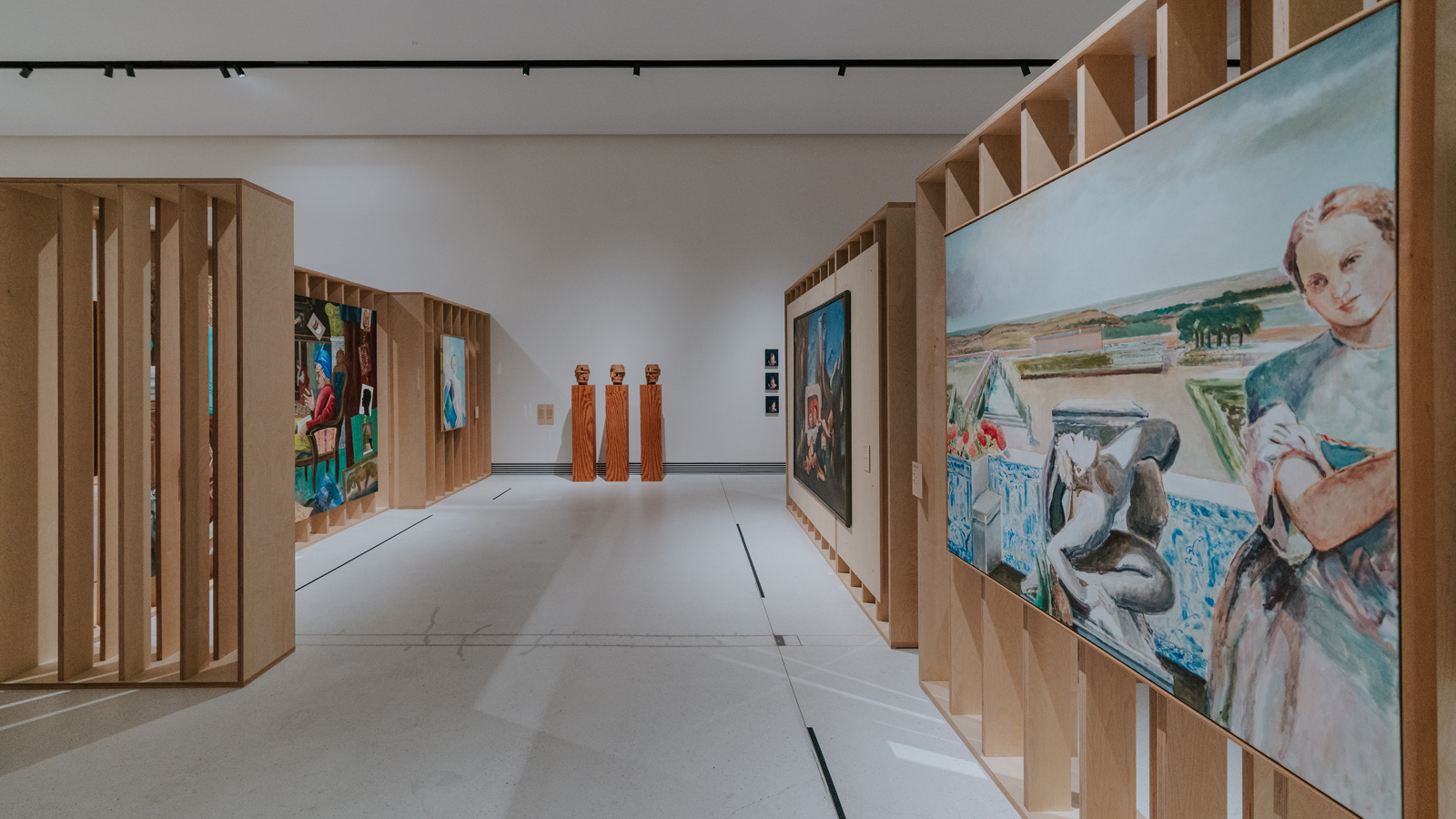
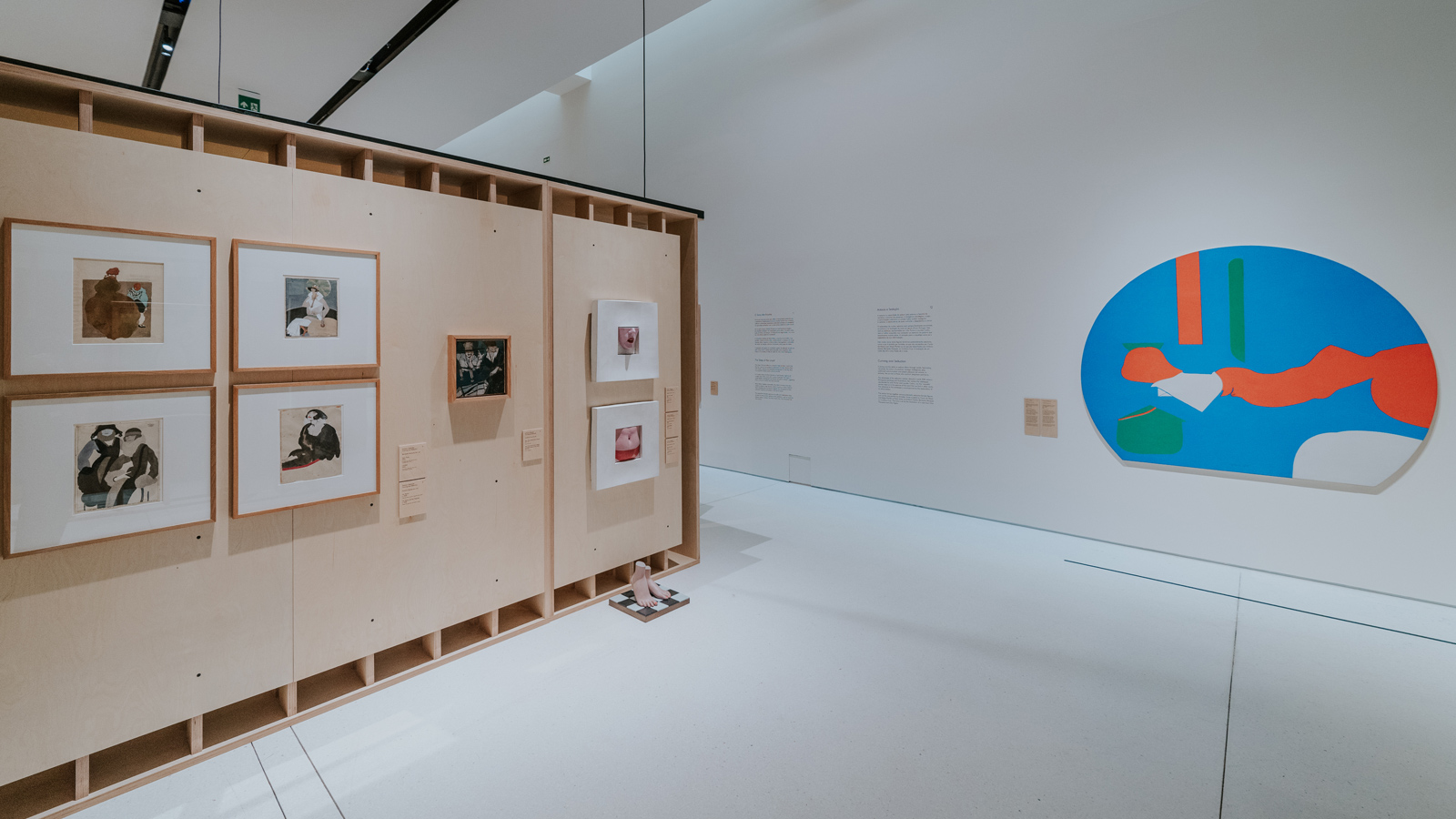
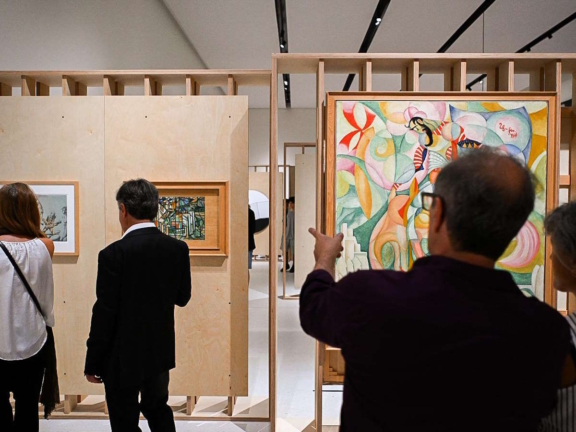
Motivated and guided by Scheherazade, the protagonist of the tales of ‘One Thousand and One Nights’, CAM proposes an exhibition of its Collection that draws inspiration from the fictional device of that ancient anthology.
By evoking some significant facets that shape those stories, and organising the exhibition route into fourteen sections, this naturally subjective gaze also seeks to bring the legendary protagonist, Scheherazade, to the present day, removing her from her specific cultural context.
Scheherazade, whose prodigious memory was praised by King Shahryar, became synonymous with infinite narrative and seduction by words. But in this exhibition, her symbolic rebellion is taken beyond that capacity for enchantment. The strong call of magic and verbal language, foundational in human nature and in the realm of individual identity, permeates stories, books and artworks.
/
The CAM Collection grows every year through its programme of acquisitions and is now presenting its 65th group exhibition since its opening in 1983. The multiplicity of stories of which it is formed and the potential points of view that its 12,000 works have already inspired – and will continue to inspire – in the creation of exhibitions is, naturally, never-ending.
With ‘Histories of a Collection’ (2023), ‘Tide Line’ (2024), Leonor Antunes’ proposal for the Collection (2024), and now ‘Scheherazade’, CAM has sought to show recent acquisitions as well as some usually less visible works.

/
Storytelling, exhibiting and collecting are ways of making room for fiction and for memory that can be layered over time. Viewed as an open book, this exhibition will be periodically changed, with alterations being made to the sections and works, seeking adjustments according to the vague time of stories and the complex time of history. The greatest imperative will always be to keep it alive.
Exhibiting artists
Adelina Lopes, Alexandre Conefrey, Álvaro Lapa, Ângelo de Sousa, Amadeo de Souza-Cardoso, Ana Hatherly, Ana Jotta, Ana Vidigal, António Areal, António Carneiro, António Dacosta, António Duarte, António Júlio Duarte, António Sena, António Sena da Silva, António Soares. Arpad Szenes, Arshile Gorky. Artur Cruzeiro Seixas, Augusto Alves da Silva, Belén Uriel, Bernardo Marques, Candido Portinari, Canto da Maya, Carla Filipe, Carlos Botelho, Cecília Costa, Craigie Horsfield, Cristiano Cruz, Daniel Blaufuks, Eduardo Nery, Eduardo Viana, Emmerico Nunes, Eva Gaspar, Fernanda Fragateiro, Fernando Lanhas, Fernand Léger, Fernão Cruz, Flávia Monsaraz, Francisco Tropa, Gaëtan, Gil Heitor Cortesão, Gonçalo Duarte, Helena Almeida, Ilda David, Irene Buarque, Jane & Louise Wilson, Joana Bértholo, João Cutileiro, João Onofre, João Tabarra, João Vieira, Jorge Martins, Jorge Molder, Jorge Pinheiro, Jorge Queiroz, José de Almada Negreiros, José de Guimarães, José Dominguez Alvarez, José Escada, Julião Sarmento, Júlio dos Reis Pereira, Júlio Pomar, Leonor Antunes, Lourdes Castro, Luís Noronha da Costa, Luís Silveirinha, Mafalda Santos, Manuela Marques, Manuel João Vieira, Maria Antónia Siza, Maria Beatriz, Maria Helena Vieira da Silva, Mário Botas, Mário Cesariny, Mário Eloy, Menez, Michael Biberstein, Musa paradisiaca, Nuno Cera, Nuno Henrique, Nikias Skapinakis, Noé Sendas, Paula Rego, Paulo Catrica, Pedro Cabrita Reis, Pedro Valdez Cardoso, Pires Vieira, Publius Ovidius Naso, Robert Delaunay, Rolando Sá Nogueira, Rui Calçada Bastos, Rui Chafes, Rui Sanches, Sandra Rocha, Sarah Affonso, Sara Bichão, Sérgio Pombo, Sonia Delaunay, Susanne Themlitz, Teresa Magalhães, Waltercio Caldas.
Topics
An Open Book
Suspense
Prodigious Memory
Combat
The Glitter of the World
Intense Labour
A Thousand and One Things
Each Person's Life
A Thousand and One Dawns
The Sleep of the Unjust
Cunning and Seduction
Sources of Inspiration
Be Alive Tomorrow
-
You’re Telling Me a Lot
When we want to express surprise, we sometimes remark: ‘You’re telling me a lot’. Telling stories is a specific skill and amplifying their impact is another, complementary skill. An engaging story captives, fascinates and maintains an audience loyal. We anxiously wait for the next steps, fresh details, images, connections, characters, endings and, at the same time, a sense of continuity!
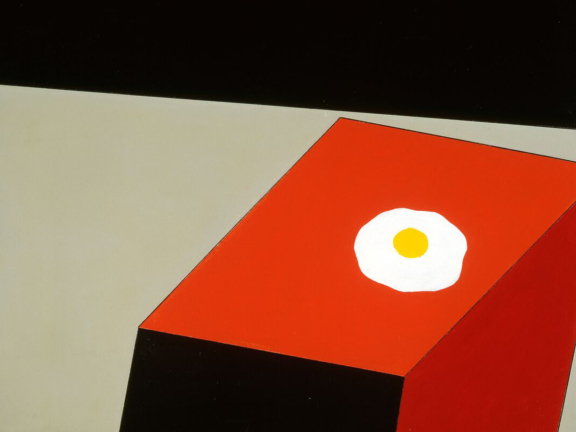
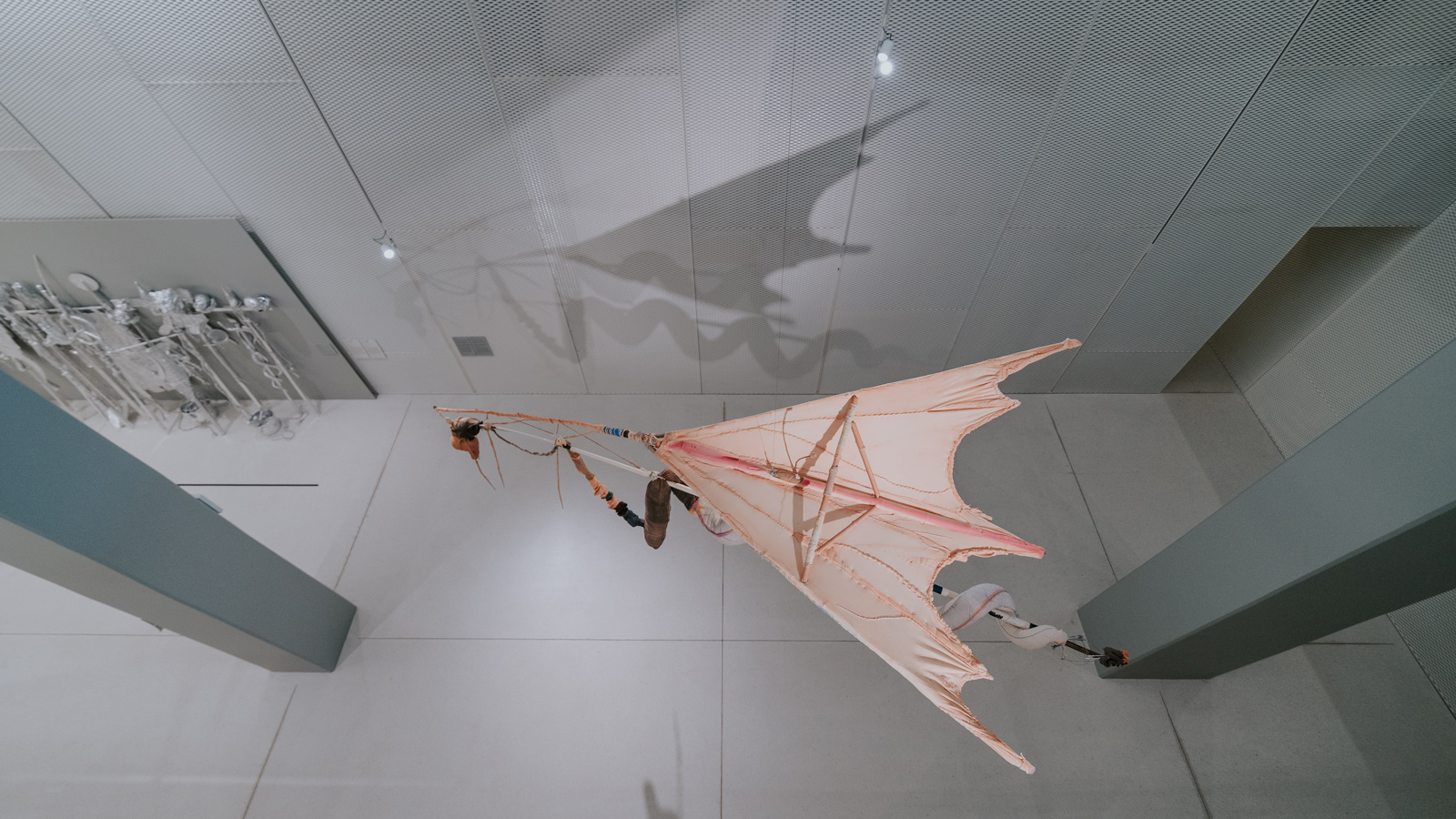
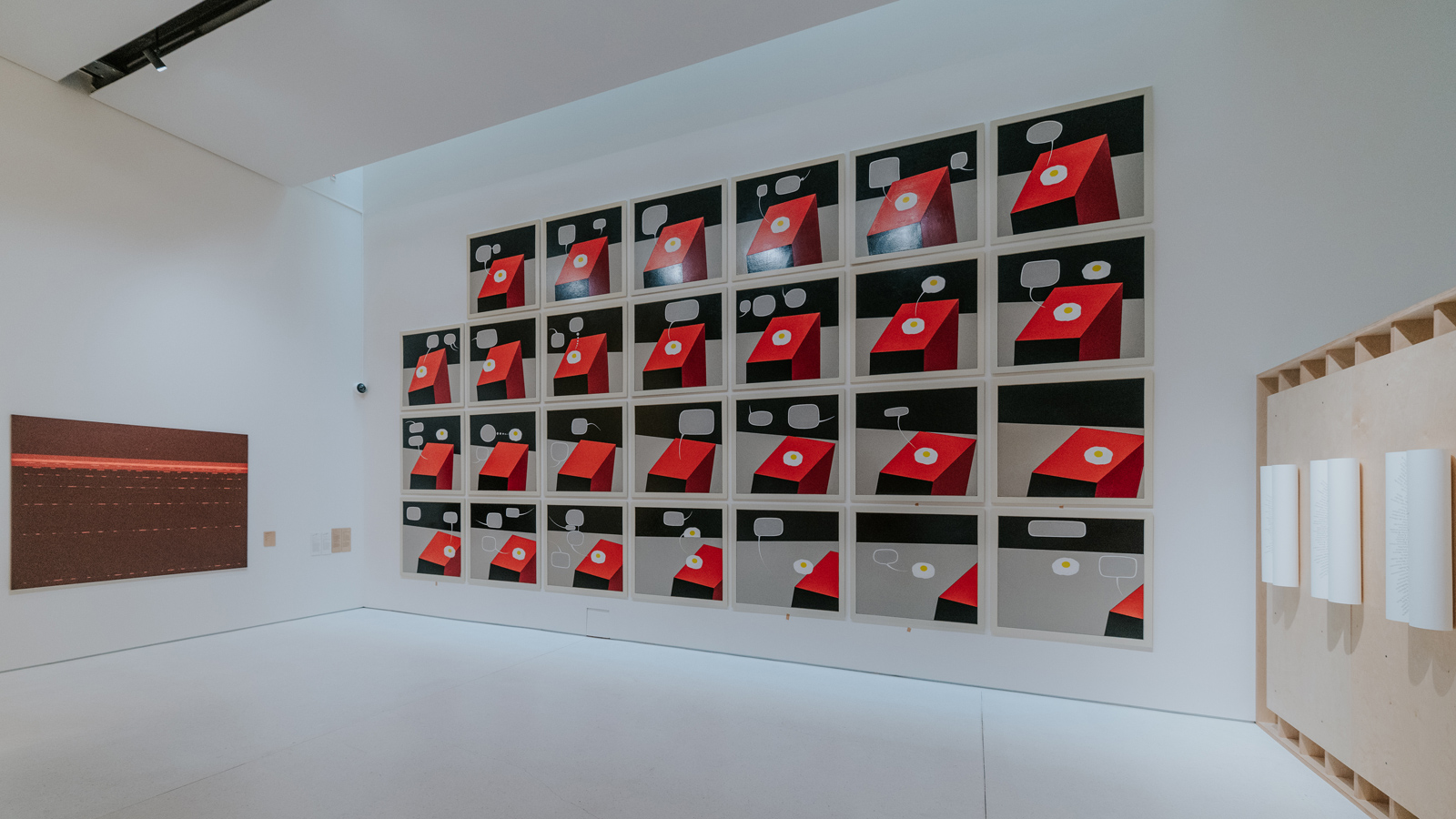
From the speech bubbles of António Areal’s ‘A História Dramática de um Ovo’ [The Dramatic History of an Egg] to the letters moulded by João Vieira and those drawn by Sonia Delaunay, the reference to verbal expression is a space that opens up to endless possibilities and combinations. Alongside these works, the reference to Francisco Tropa’s installation ‘Maquetas para L’Orage’ [Models for L’Orage] based on its model boxes, leads us, at the start of the exhibition, to the generic principle of its underlying fictional narrative.
-
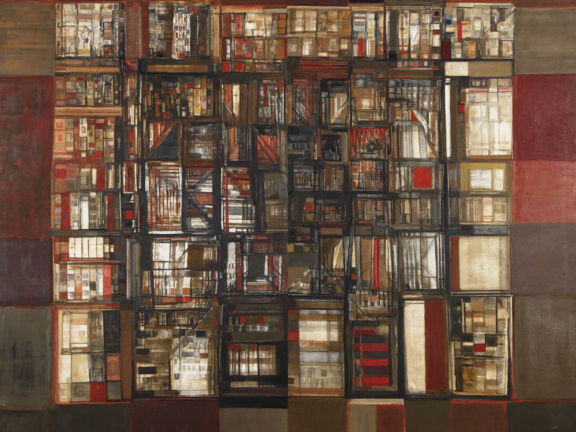
An Open Book
Telling, exhibiting and collecting are overlapping ways of creating space for fiction. The canvas and the blank page offer the same sort of challenge. Once the book is opened, different words, events, evasion and curiosity follow one another. Once the space is opened, different images follow one another… and the geometry of the space itself expands.
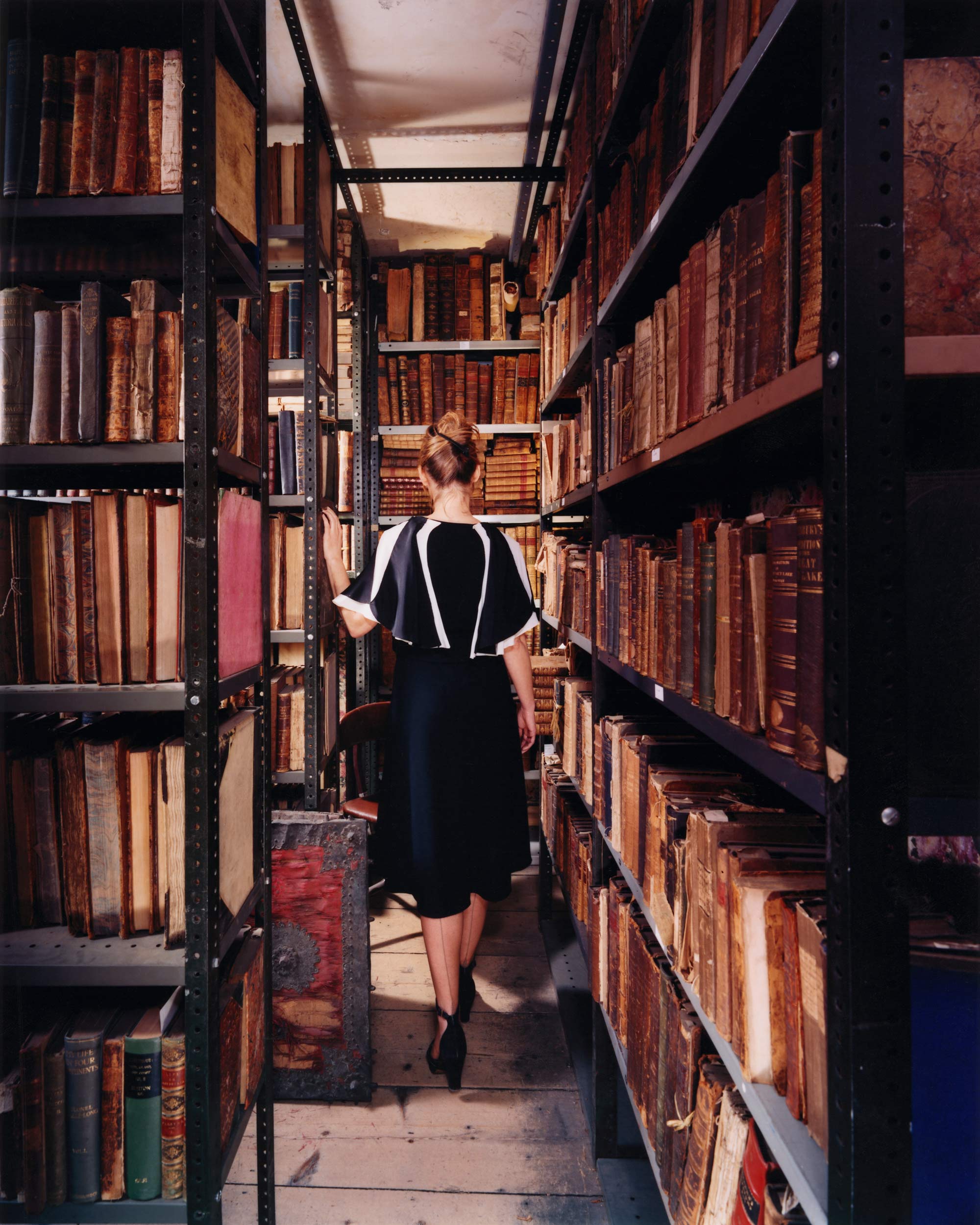
Sarah Affonso’s ‘Retrato de Matilde’ [Portrait of Matilde] is perhaps a prelude to great literature in the paintings ‘Retrato de Fernando Pessoa’ [Portrait of Fernando Pessoa] by Almada Negreiros or ‘La bibliothèque en feu’ [A Library on Fire] by Maria Helena Vieira da Silva. There are also the mutilated books in Fernanda Fragateiro’s ‘(Not) Reading Landscape #2’, and a painted canvas background that emerges from Helena Almeida’s frame, opening up to another fate.
Books, reading, libraries, written scrolls, different forms of books and writing populate the open-ended universes of our imagination. Mafalda Santos emphasises the singularity and imbalance of women’s voices in a patriarchal world.
-
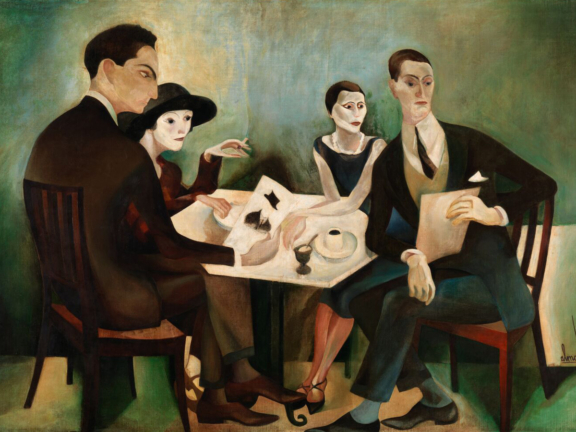
Suspense
The secret lies in leaving everything else until tomorrow; in stopping at the most tantalising moment in the story… or plot; in suspending our gaze and waiting; in managing the promise, and fuelling the desire to hear the rest.
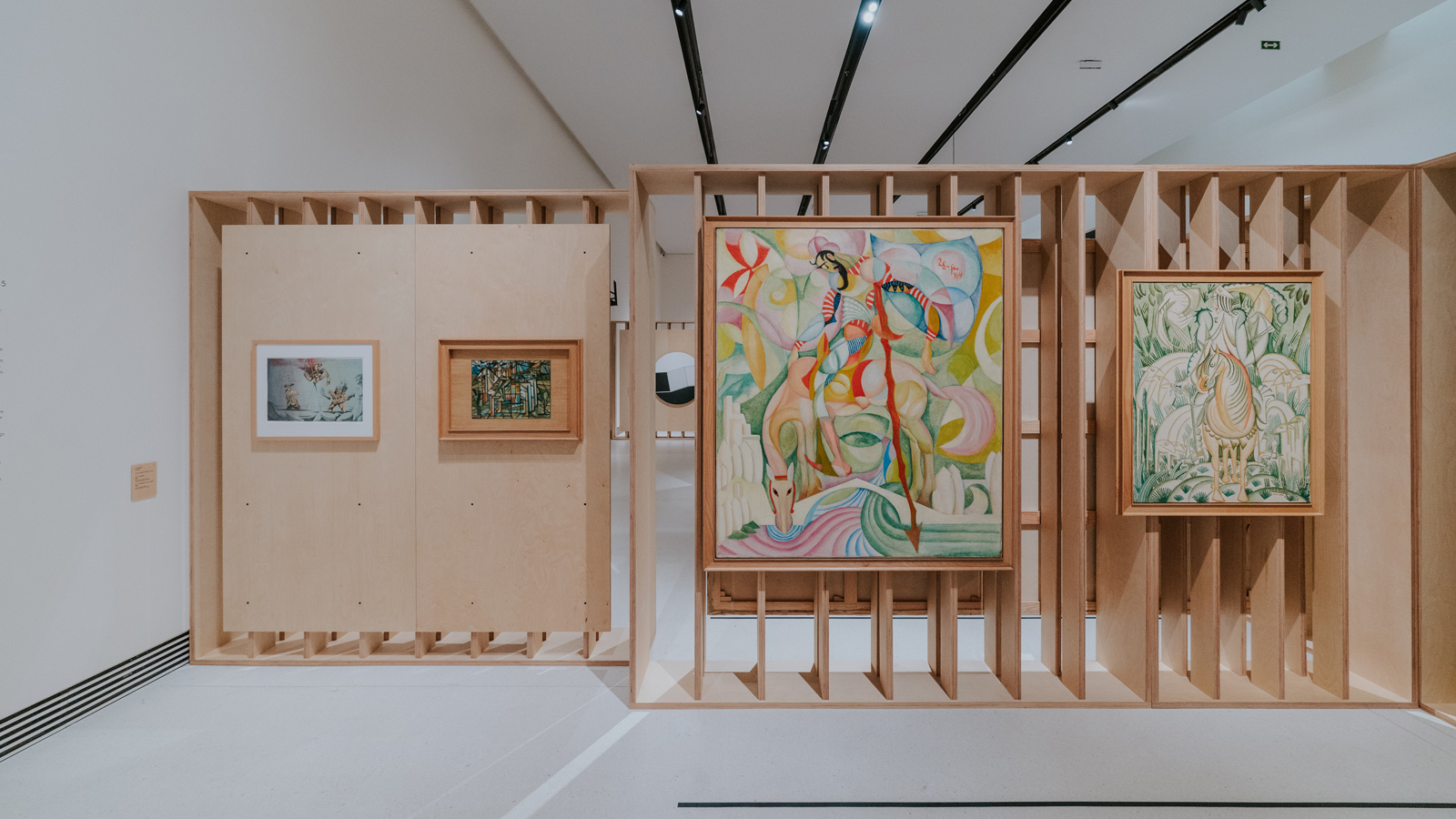
Gustave Flaubert’s ‘The Legend of Saint Julien the Hospitaller’ is a story of crime and redemption, of cruelty and repentance, like that of Scheherazade. The lavishly illustrated book dedicated to him by Amadeo de Souza-Cardoso is quite breathtaking and his painting, ‘Lévriers / Os Galgos’ [The Greyhounds], could easily inhabit the atmosphere of the story.
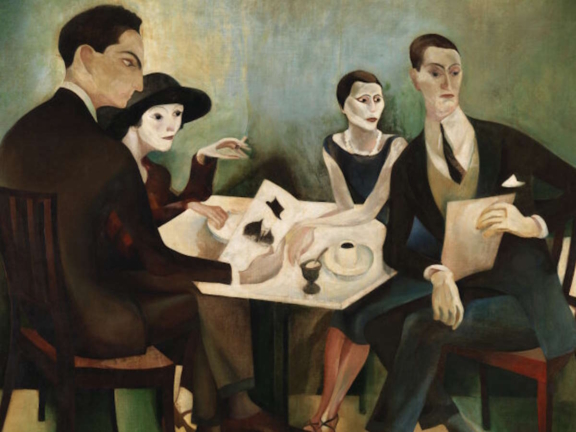
In urban and contemporary contexts, the expression of expectation assumes other shapes, for example in Helena Almeida or Cecília Costa; Flávia Monsaraz’s enigmatic ‘Mocho’ [Owl], Susanne Themlitz’s deviant self-representation in ‘Trigémeos Inofensivos’ [Harmless Triplets], Fernando Lanhas’s geometric openness and movement, Amadeo’s representations of the countryside and the expectant gaze of all the characters in Almada Negreiros’s ‘Auto-Retrato num grupo’ [Self-Portrait in a group], all refer to the sorcery of stories and narratives.
-
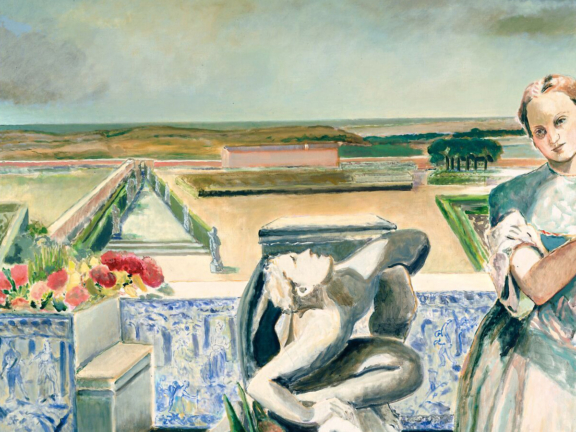
Prodigious Memory
King Shahryar praises Scheherazade’s prodigious memory. At the end of ‘One Thousand and One Nights’, he admits that he feels at peace. Exceptional memory is usually associated with youth, intelligence and vitality. But is memory the most important cognitive ability? And is an overflowing memory a burden or a benefit?
The suspension of time in Menez’s artwork suggests a diffuse and uncertain mode of mnesic inscription. Memory has flaws and gaps in Rui Sanches sculpture, but also constant recreation and restarting.
The thinking dog painted by Gil Heitor Cortesão, Gaëtan’s tormented face, Manuel João Vieira’s ‘O Colecionador’ [The Collector] or António Dacosta’s Cena Aberta [Open Scene] all reinforce the idea of the intense labour of memory, reflection and time, consumed by each story.
-
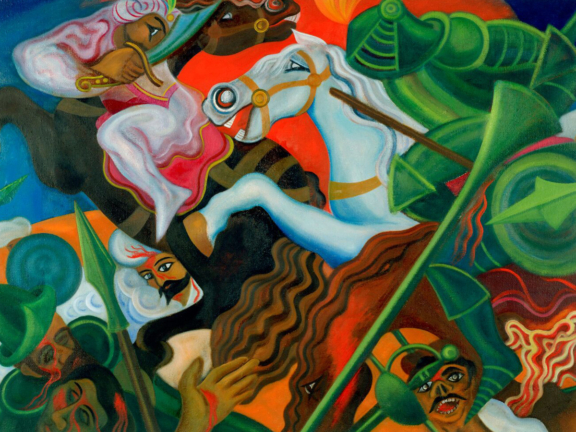
Combat
Stories and legends of real or symbolic battles populate the collective imagination of all peoples. Interior and exterior combat – in the face of multiple obstacles, emergencies, trials and ambushes.
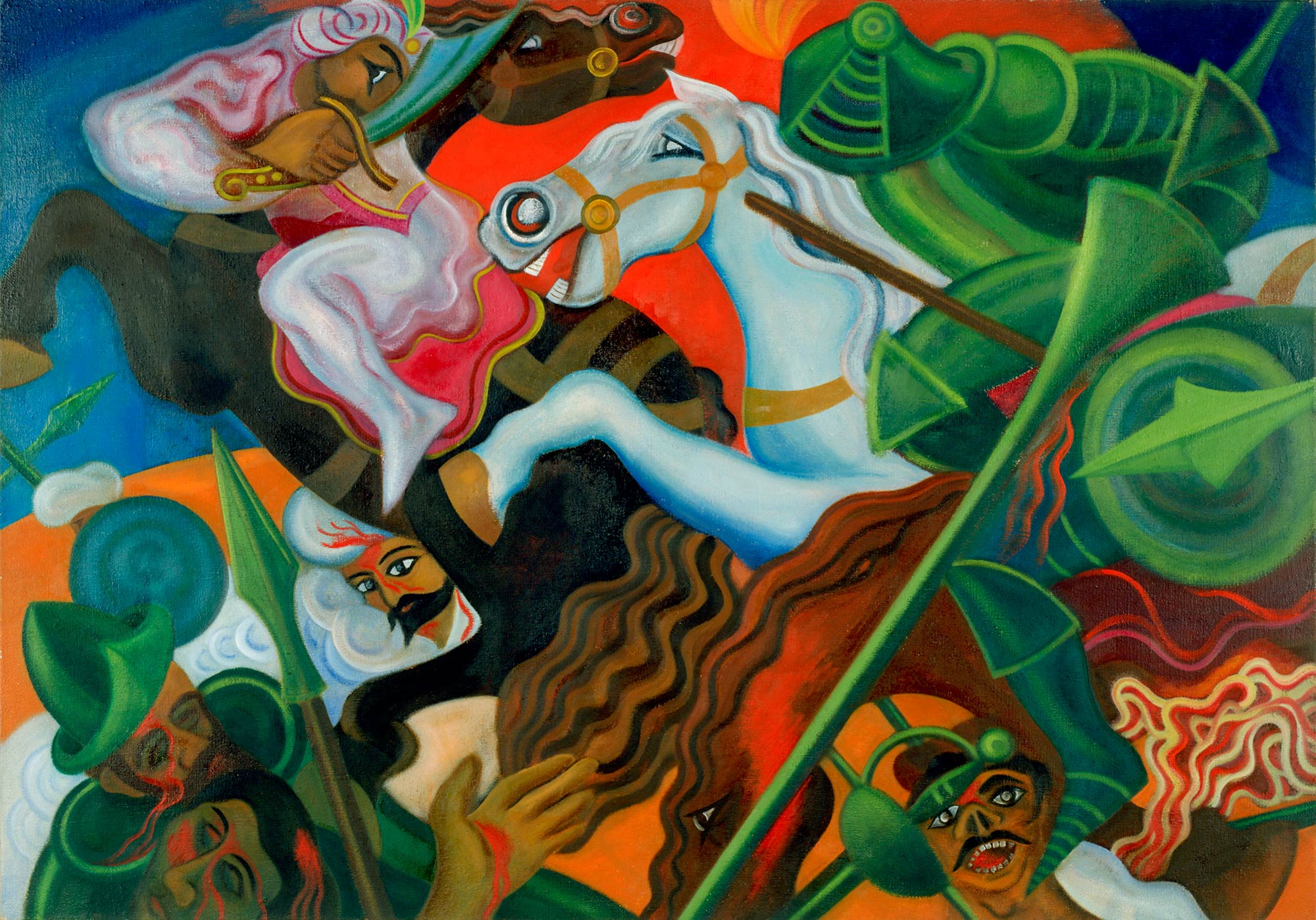
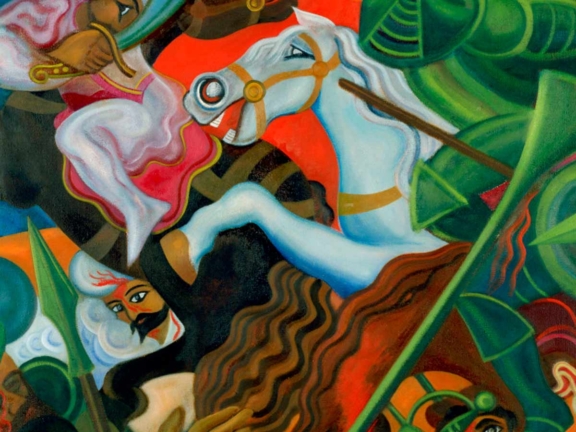
The knight is an archetypal character and bursts forth in the clearings of life painted in the works of Amadeo de Souza-Cardoso and Gonçalo Duarte, or in the sculptures of João Cutileiro.
Outside the gallery, Pedro Valdez Cardoso’s ‘Livro de Actos’ [Book of Acts] portrays banners on the wall and what appear to be the spoils of a (historical and biblical) battle. Cruzeiro Seixas’ drawing places us in the imagery of armed struggle. The titles on the paintings by Vieira da Silva and José de Guimarães refer to the space of combat. Rui Chafes’ more abstract sculpture suggests a cloistered perimeter.
-
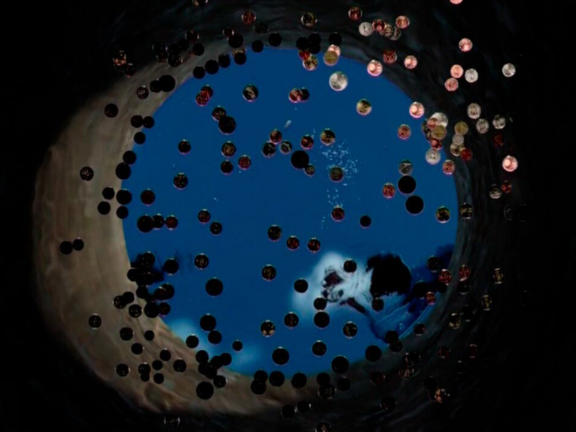
The Glitter of the World
Treasures, filigree, miracles, talismans, epiphanies and miraculous things bring a shining brilliance to the world that is sometimes false and deceitful. Not all that glitters is gold! Glitter dazzles and intoxicates. But sometimes, if you’re lucky, it’s the real thing.
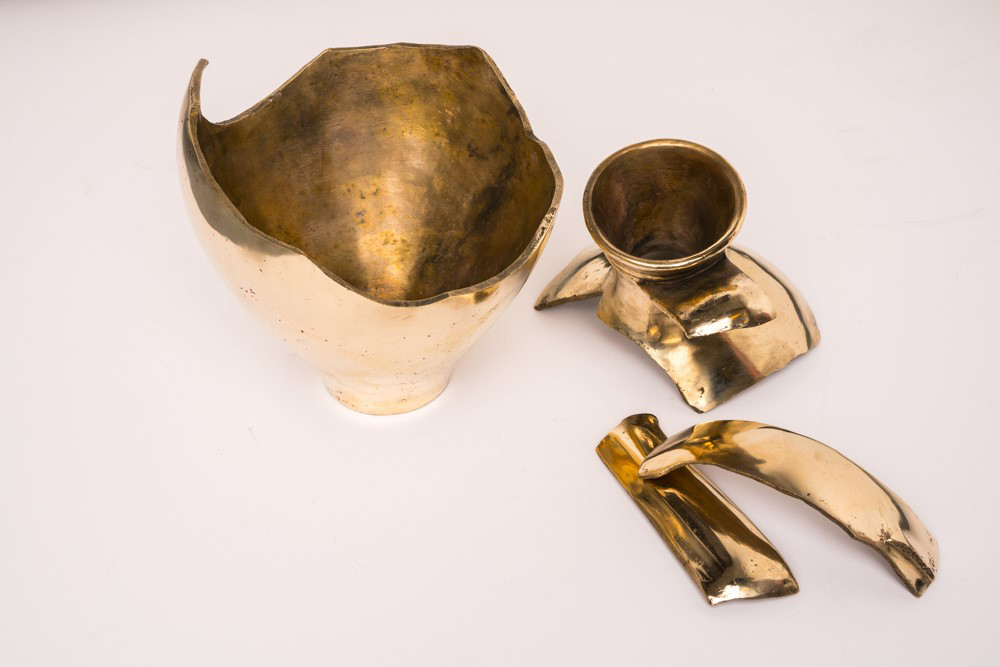
In João Tabarra’s ‘Poço dos Murmúrios’ [Wishing Well], once the coin has been thrown into the lake, the wish is expected to come true. Golden colour and luminescence cover objects, buildings and surfaces. Leonor Antunes’ curtain shimmers, as if constellations were rising from it.
In this section, Belén Uriel, Ana Jotta or António Sena da Silva propose tiny glowing ‘jewels’, while in a photograph by António Júlio Duarte a building seems to float immaterially, made solely of light. The photographs of Manuela Marques, the paintings of Ângelo de Sousa and Jorge Martins or the drawing of Jorge Pinheiro highlight the effects of preciousness, scintillation, vibration and reverberation.
-
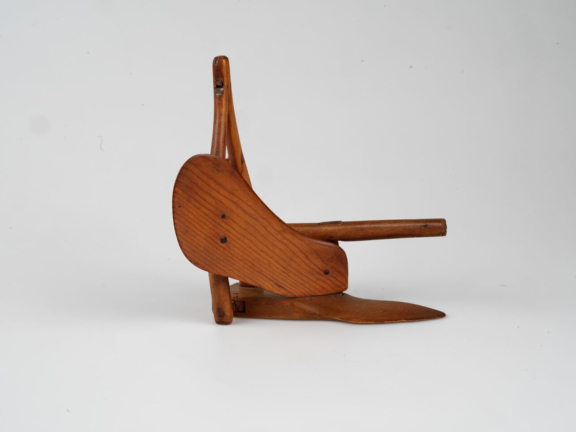
Intense Labour
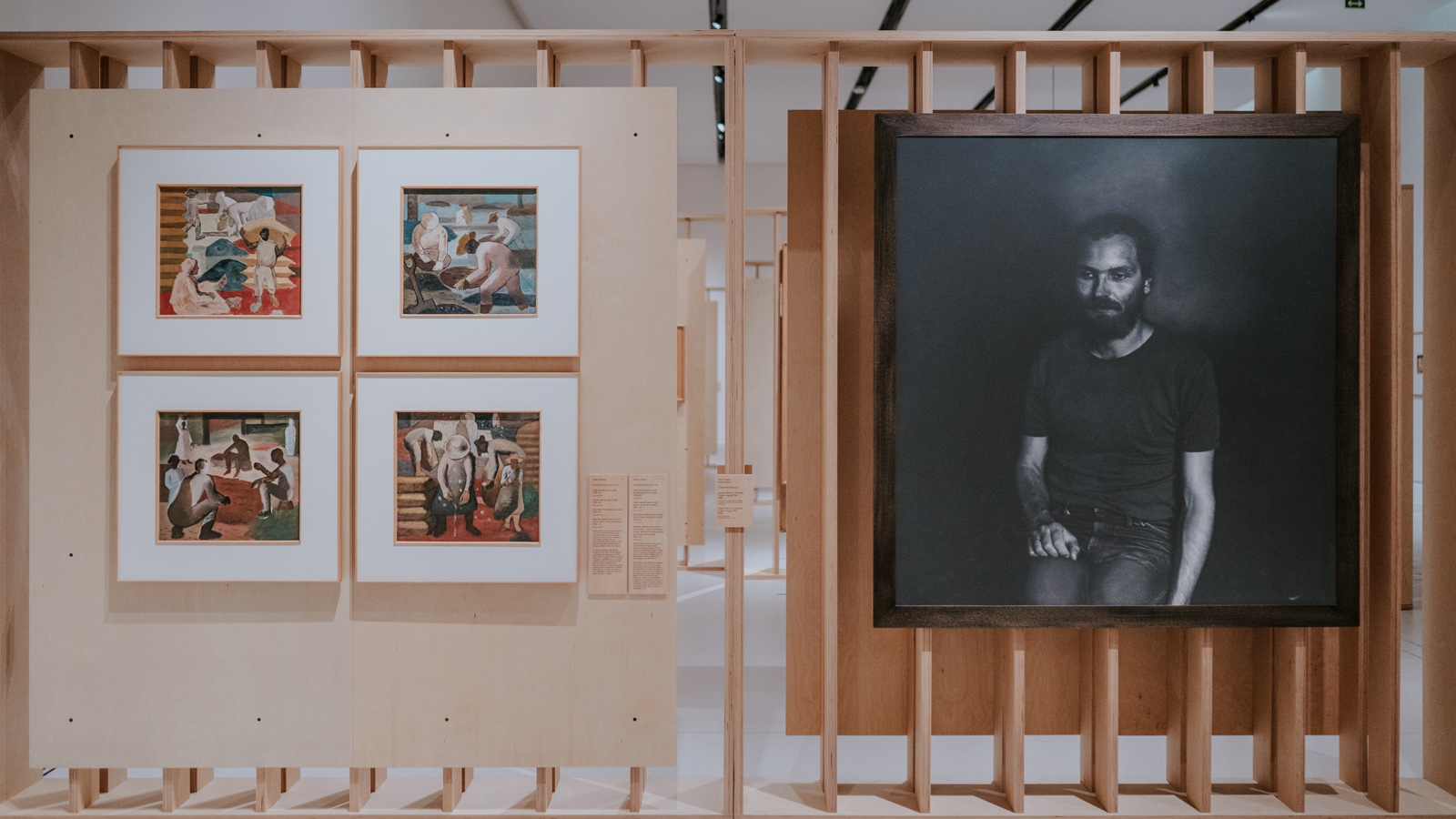
Scheherazade works tirelessly. She is an expert storyteller. Many of her stories are set in poor and unequal communities, in stark contrast to the lives of the powerful. The lives of most people and, above all, those who live close to the poverty line, whose fate can’t be explained through lack of hard work and who aren’t rewarded by freedom, are still too numerous in the world today.
Júlio Pomar’s fishwife indicates the clear influence of Almada Negreiros in this phase of the painter’s oeuvre. The geometric decomposition in Arshile Gorky’s paintings is also curiously close to his formal solutions.
In the artworks of Craigie Horsfield, Alvarez or Mário Eloy, inner density brings a sense of disquiet and disturbance to the surface of the faces. The souls, like the bodies of the fishwives or peasants, are furrowed by intense labour. In this ensemble, Gorky’s plough projects reality and metaphor.
-
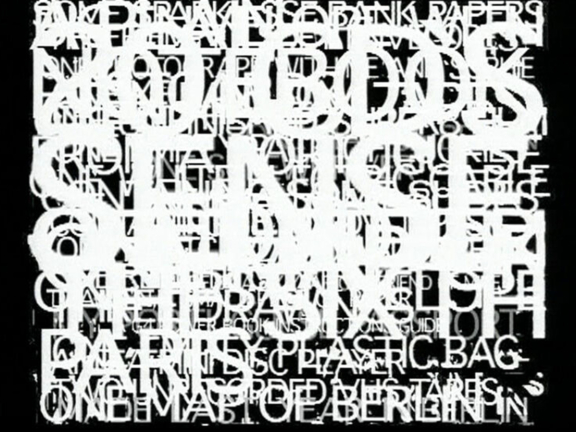
A Thousand and One Things
Banal objects: bits, pieces and trifles. Letters and words endlessly rewritten over themselves. Emblematic objects. Accumulation and expression of abundance. Diversity.
Things and words are equivalent in reciprocal referrals: they circulate, fill, demonstrate, hide, mirror, decorate and/or express; and are reflected in Salette Tavares’ spatial poem or in Rui Calçada Bastos’ exclusively verbal film image. Vanity and futility are also played with and risked, as in the case of the perfume brand, ‘Coty’, that inspired the title of Amadeo de Souza-Cardoso’s painting.
In Almada Negreiros’ self-portrait, Ana Hatherly’s drawings and António Sena and Álvaro Lapa’s canvases, letters and words create a thick curtain of meanings that almost cancel each other out, through the prevalence of a visual effect.
Words, like collected objects or small shapes, proliferate in the works of Amadeo, Carla Filipe, Musa paradisiaca and Rui Moreira.
-
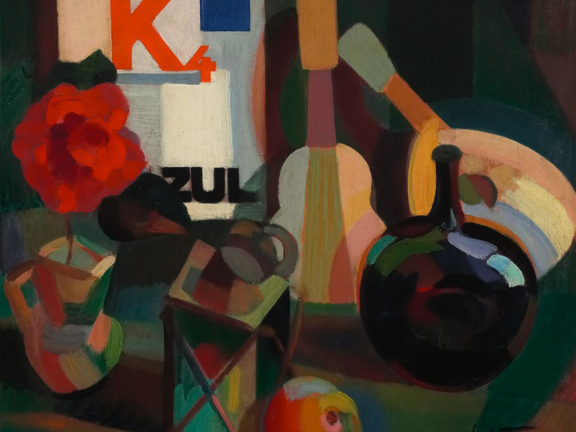
Each Person’s Life
In all the multiple, anonymous, prosaic, routine and similar lives that populate the planet, many unexpected, uplifting or disturbing events erupt, combining banal episodes and miraculous moments.
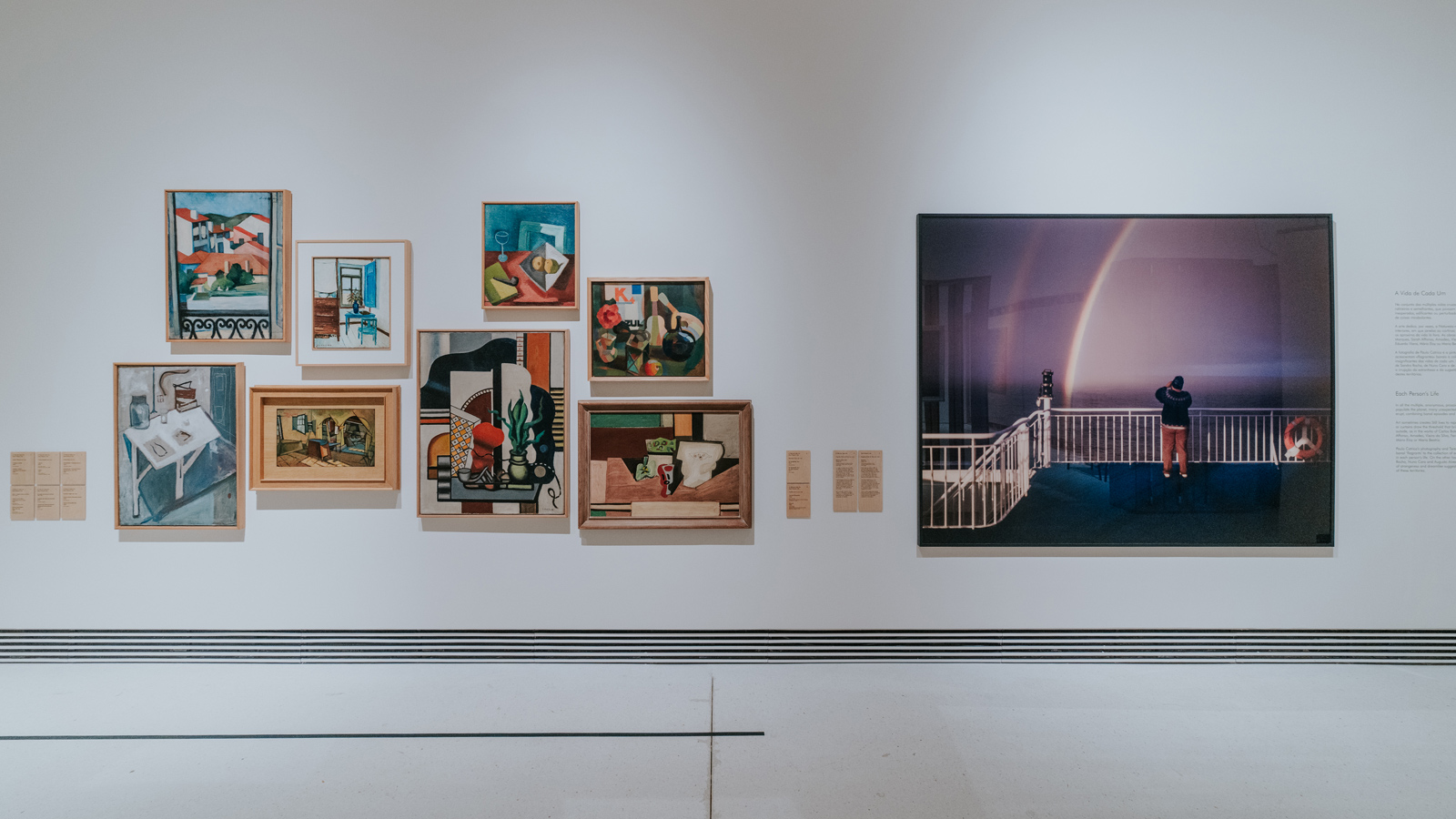
Art sometimes creates Still lives to represent interiors, where windows or curtains draw the threshold that brings them closer to the world outside, as in the works of Carlos Botelho, Bernardo Marques, Sarah Affonso, Amadeo, Vieira da Silva, Fernand Léger, Eduardo Viana, Mário Eloy or Maria Beatriz.
Paulo Catrica’s photography and Teresa Magalhães’ painting add banal ‘flagrants’ to the collection of equally insignificant moments in each person’s life. On the other hand, the photographs by Sandra Rocha, Nuno Cera and Augusto Alves da Silva propose the irruption of strangeness and dreamlike suggestion into the trivial geography of these territories.
-
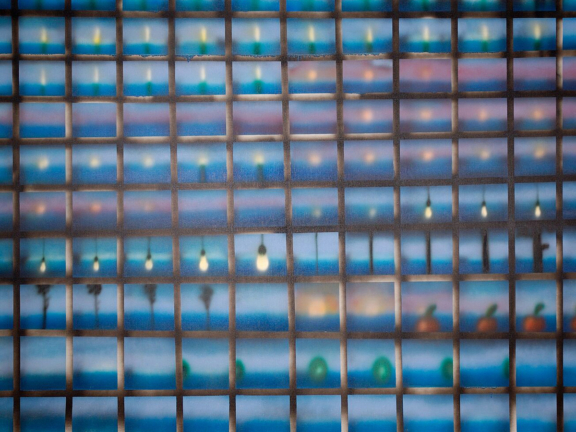
A Thousand and One Dawns
Scheherazade tells her stories from dusk to dawn, when she finally retires, with her life on hold until the following evening. In the collective imagination, the number 1001 has come to symbolise ‘many things’, of an indefinite or infinite number. That’s the time of this narrative, in a palimpsest.
The natural or artificial atmosphere of light (at dawn or dusk) marks the rhythm of the succession of days and nights in these paintings from different times in the 20th century and in the installation through which Maria Beatriz pays homage to Almada Negreiros.
With proximity of Noronha da Costa, the works of Emmerico Nunes, Sá Nogueira, Alexandre Conefrey and António Carneiro make the uninterrupted passage of day and night an essential mould that shapes the condition of our soul.
-
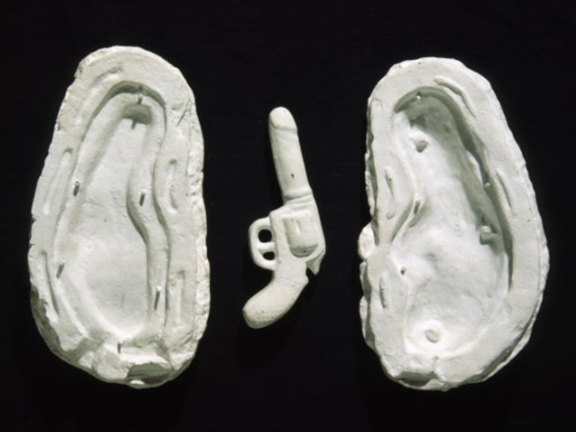
The Sleep of the Unjust
The sleep of the just refers to a peaceful deep slumber. Could it be that the unjust are tormented by nightmares and their dreams filled with threats, violence and disturbing strangeness? Or do they revel in an eccentric dream world, without morals?
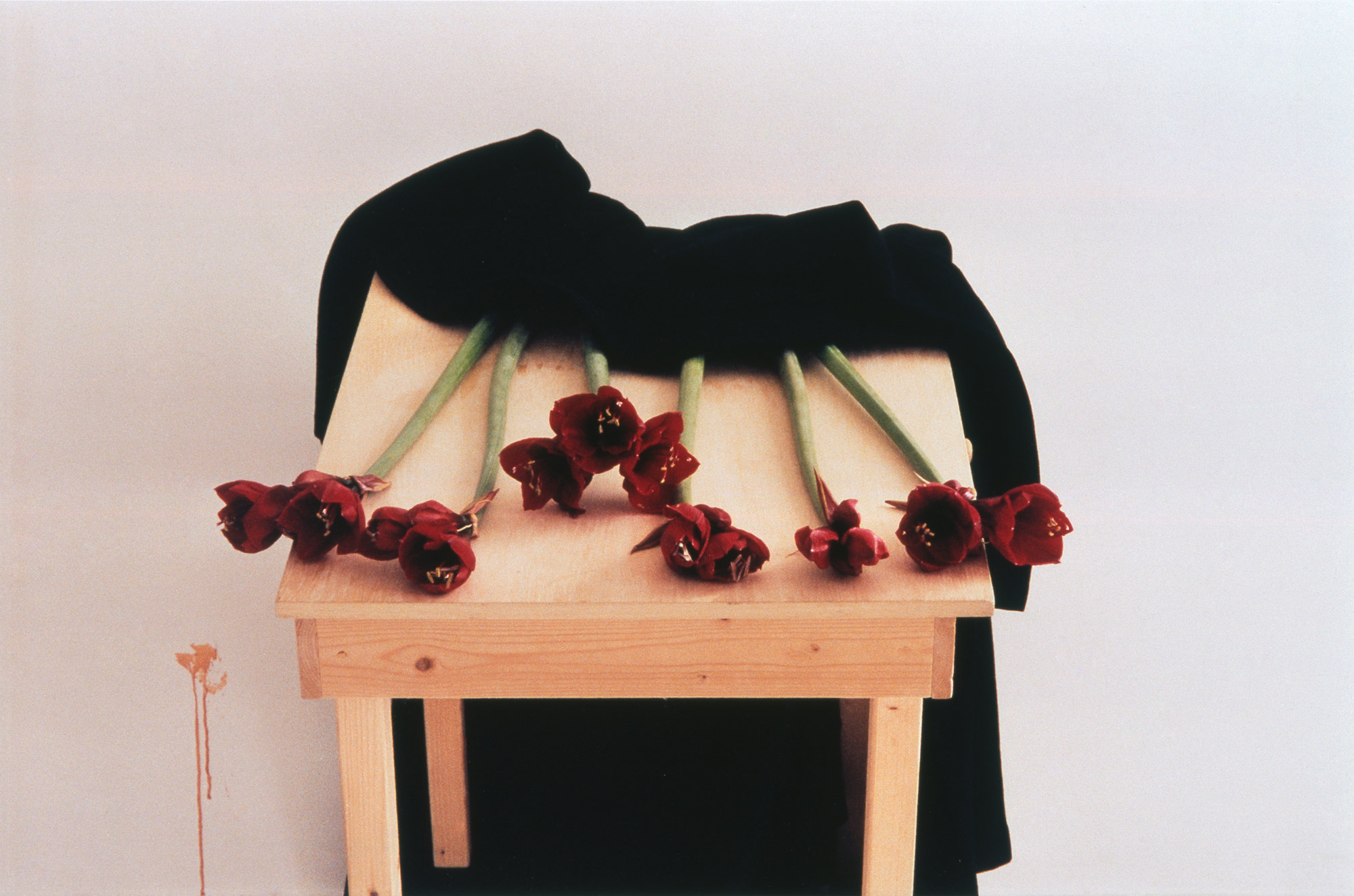
In Cruzeiro Seixas, António Dacosta or José Escada, nightmarish images infect other works with a sense of disquiet. The fingers in Jorge Molder’s photograph are stained with paint or blood – suggesting that a crime (or a work) may have occurred.
Mário Botas’ helpless marionette, Ana Jotta’s humorous but also violent sculpture, Jorge Queiroz, Mário Cesariny or Maria Antónia Siza’s shapelessness and excess heighten the atmosphere of fear, instinctive rejection and tension in this set of works.
The opposition between gestures of cruelty and redemption takes us back to various other sections of this exhibition, such as ‘Suspense’, ‘Intense Labour’, ‘Combat’, ‘The Life of Each One’, ‘One Thousand and One Dawns’.
-
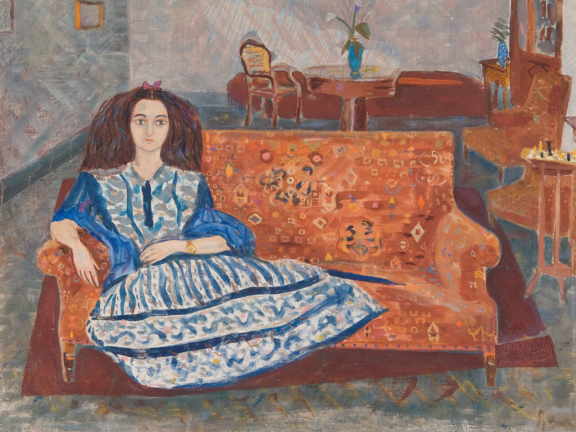
Cunning and Seduction
Cunning and the ability to seduce others through words, fascinating narratives, the charm of presence, strategic intelligence, play, subliminal communication and playful pleasure can ensure, ‘in extremis’, the survival of those who confront despotism and terror.
The stereotype of the seductive woman abound in early 20th century Portuguese paintings and illustrations. But neither the odalisques represented by Júlio Pomar and Lourdes Castro, nor the ‘coquette’ woman lead us to the exercise of the word that we find in other works. The reference to this archetype is accompanied by the expectation of its reformulation.
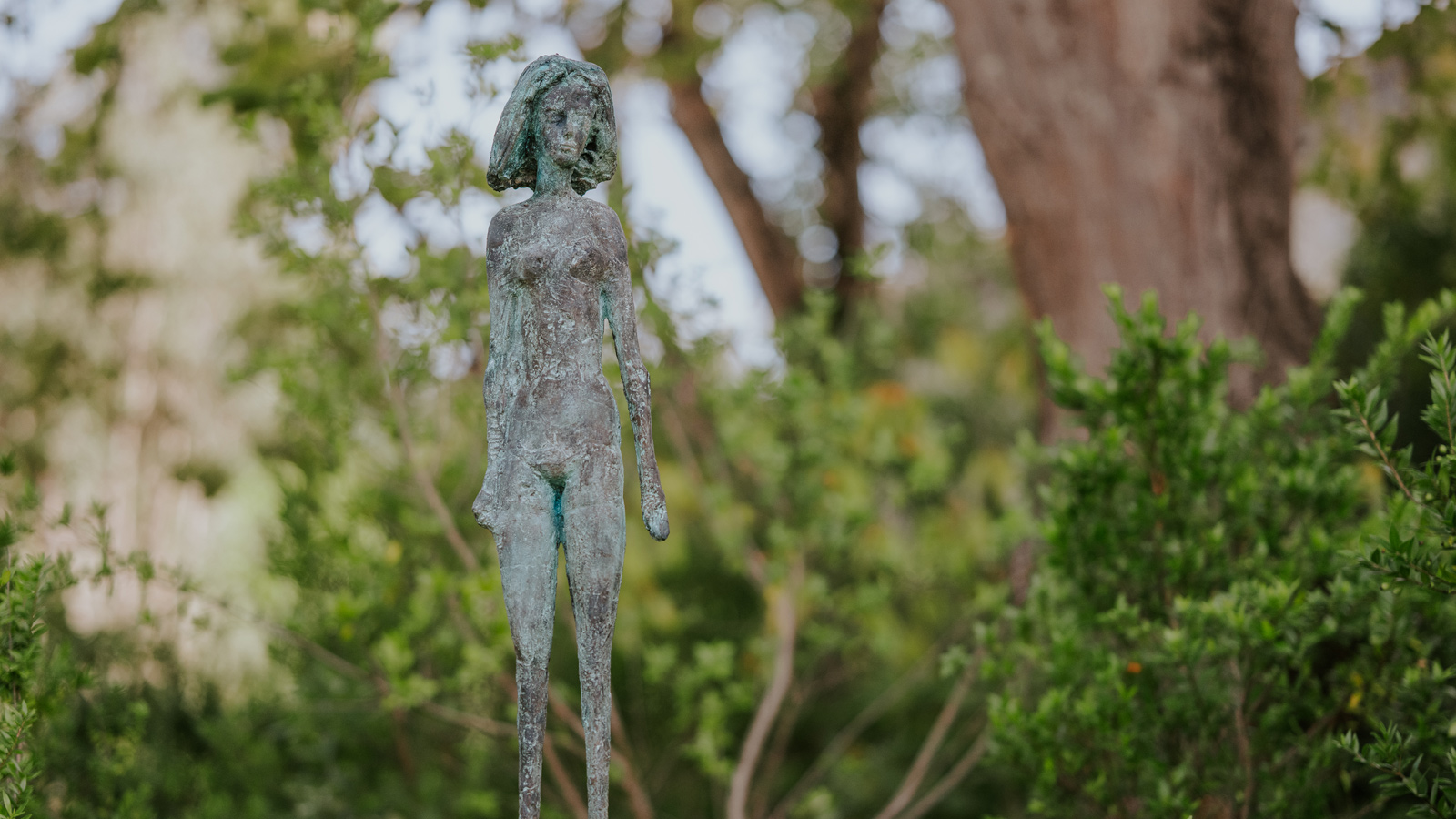
This section brings together various potentially seductive female figures, such as the one painted by Amadeo, those sculpted by Canto da Maya and Sérgio Pombo or those drawn by António Soares, Bernardo Marques or Cristiano Cruz. The tone is set by the illustration of a tale from ‘One Thousand and One Nights’.
-
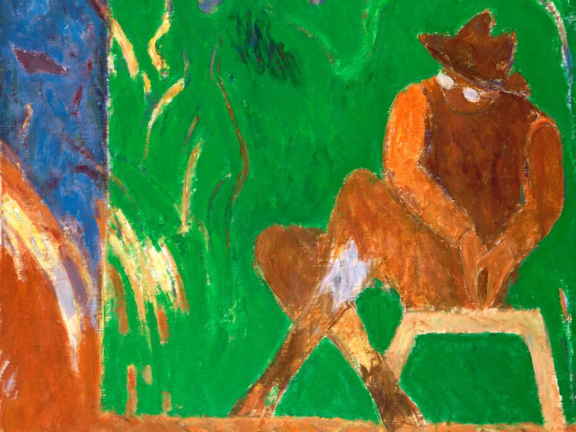
Sources of Inspiration
It is impossible to determine the authors of many of the legends and instructive tales of the world’s literary heritage. Their ability to enchant us is reinforced by their multiple, collective, anonymous and ancient origins. Inspiration is a mysterious condition; the sources never run dry or cease to multiply. Are they like natural springs that replenish nature, as in the works of Ilda David, António Dacosta and Alexandre Conefrey? Or are they more invisible, lingering in the void from which everything emerges?
Some works refer to the almost invisible and abstract instant in which inspiration suddenly erupts: like in front of Waltercio Caldas’ mirror, where we see ourselves at the precise moment that a luminous idea appears, the restricted place in which Michael Biberstein inscribes sinuous lines, or the water line photographed by Adelina Lopes.
From ‘Ecologia’ [Ecology] by Joana Bértholo, we evoke the goddess Echo, who is also a victim of cruelty, but who, for various reasons, is the exact opposite of Scheherazade.
-
Be Alive Tomorrow
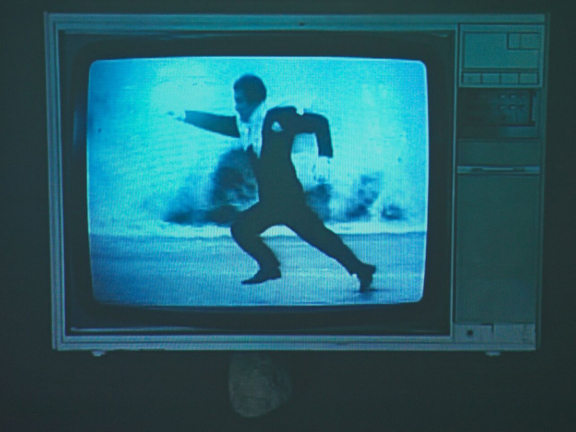
This is Scheherazade’s ultimate imperative: not to be killed the next day. It’s a swordless combat, on the edge of the precipice. Escape and salvation, appearance and retreat, fear and exile, initiative, challenge and success emerge on the stage of possibilities.
The sword brandished by a cruel ‘Angel’, by Paula Rego, is said to have fatally wounded and engendered the absence of the invisible body ‘sculpted’ by Fernão Cruz, of which only the fallen and impotent hands remain. There are threats of enclosure and death, but also of survival and the endless desire for a new dawn in João Onofre’s work.
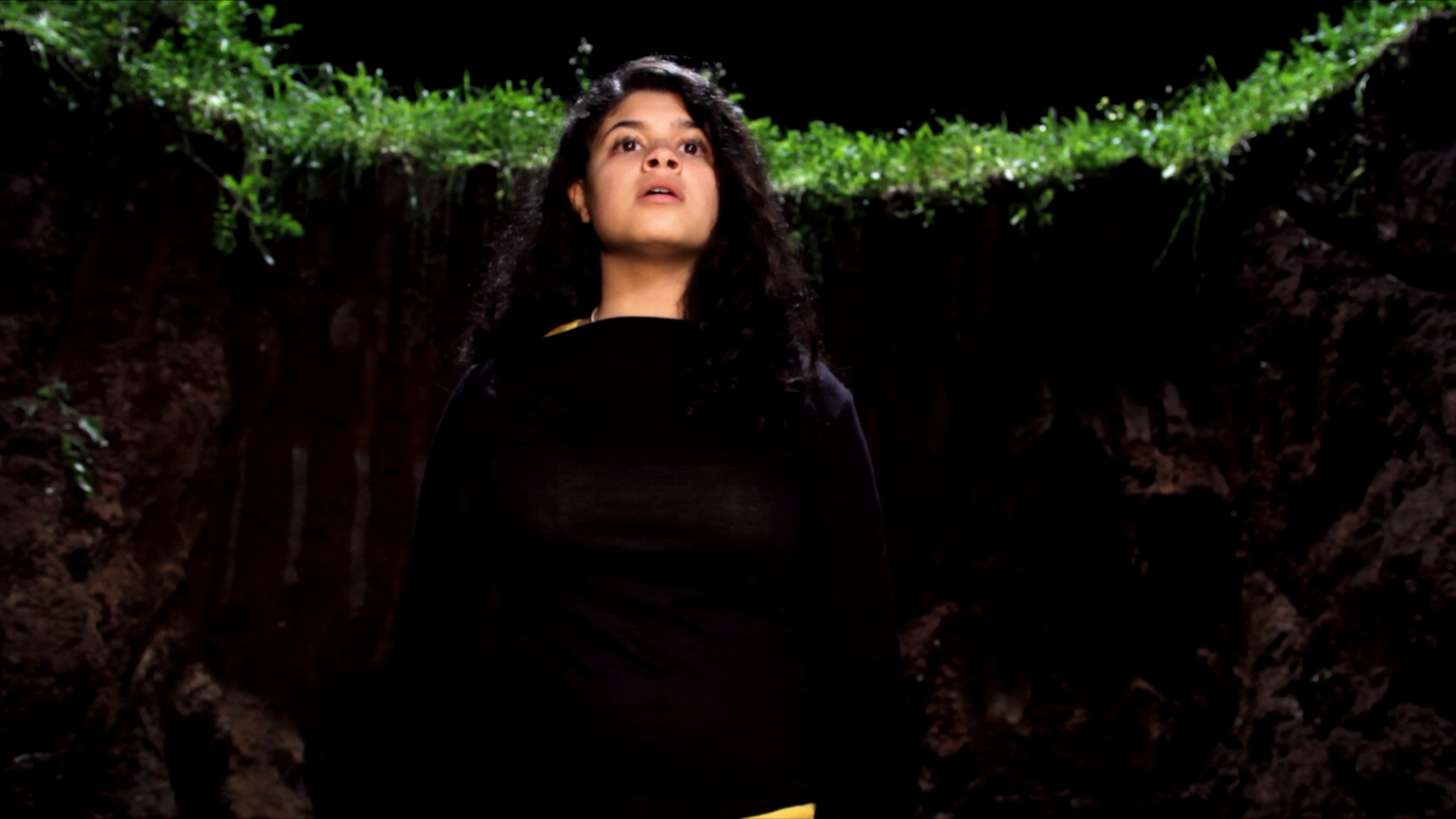
A contourless space opens up to some of these bodies, sometimes freed and sometimes imprisoned by actions and words. It also echoes stories of cruelty and seduction that can be glimpsed in the works of Julião Sarmento or Lourdes Castro, in the fugitive in Noé Sendas’ film, or in the stone bust crystallised in time in Daniel Blaufuks’ photograph.
Credits
Curator
Leonor Nazaré
Scenography
Rita Albergaria with the collaboration of Ana Teresa Torres
The Calouste Gulbenkian Foundation reserves the right to collect and keep records of images, sounds and voice for the diffusion and preservation of the memory of its cultural and artistic activity. For further information, please contact us through the Information Request form.
Related
No results were found for your criteria.