
Mahler's 2nd
Gulbenkian Orchestra and Choir
Event Slider
Date
- 20:00 / Cancelled 20:00 / Sold out Thursday, 20:00
- 19:00 / Cancelled 19:00 / Sold out Friday, 19:00
Location
Grand Auditorium Calouste Gulbenkian FoundationThis concert will be broadcast live on 24 November at 19:00 (GMT).
Pricing
50% – Under 30 years old
15% – Over 65 years old
- Conductor
- Soprano
- Contralto
-
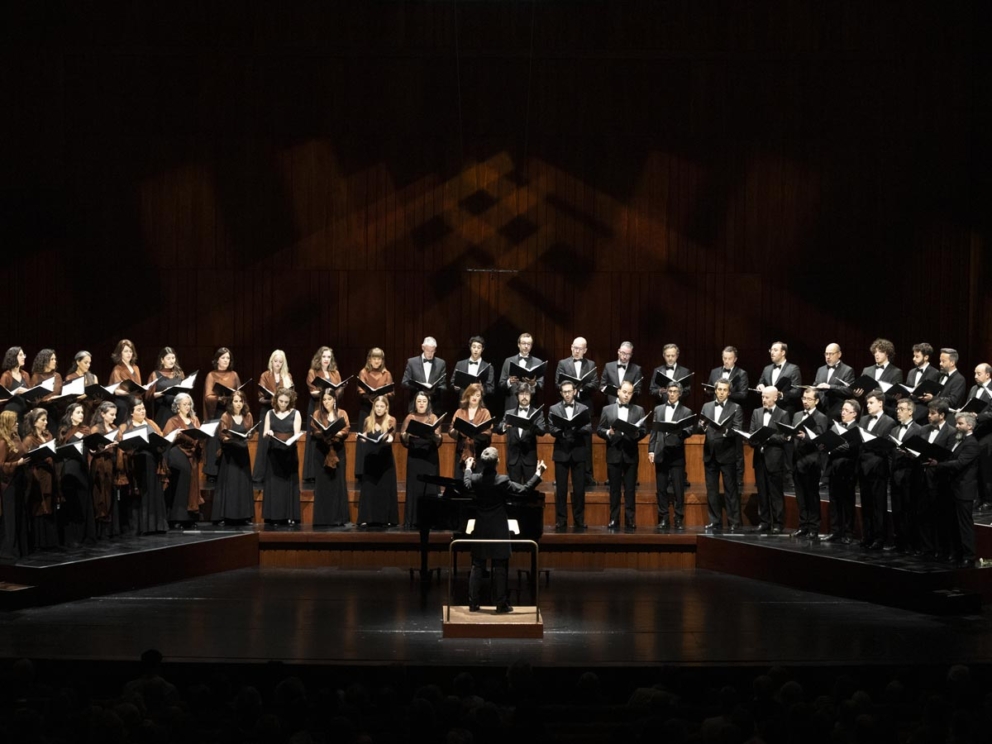
Gulbenkian Choir
The Gulbenkian Choir was founded in 1964 by the Calouste Gulbenkian Foundation as a full symphonic body of around 100 singers. The choir joins the Orquestra Gulbenkian and other orchestras to perform Classical, Romantic and Contemporary choral-symphonic repertoire, but can also perform a cappella. It has performed – and often premiered – many 20th century works by Portuguese and international composers.
The Gulbenkian Choir has been invited to collaborate with major international orchestras, under the direction of conductors such as Claudio Abbado, Colin Davis, John Nelson, Emmanuel Krivine, Esa-Pekka Salonen, Frans Brüggen, Franz Welser-Möst, Gerd Albrecht, Michael Gielen, Michael Tilson Thomas, Rafael Frübeck de Burgos, René Jacobs and Leonard Slatkin, among others.
Besides its regular season of concerts in Lisbon and frequent national tours, the Gulbenkian Choir has repeatedly toured Argentina, Belgium, Brazil, Canada, Denmark, France, Germany, Hungary, India, Iraq, Israel, Italy, Japan, Macao, Malta, Monaco, Netherlands, Spain, the United Kingdom, the United States of America and Uruguay.
The Gulbenkian Choir has recorded extensively for Philips, Deutsche Grammophon, Erato, Cascavelle, Musifrance, as well as FNAC-Music, performing a wide range of repertoire, from Early-Renaissance polyphony to Xenakis. Several of these albums received international awards.
Martina Batič is the current Principal Conductor, succeeding Michel Corboz (1969–2019), Inês Tavares Lopes the Associate Conductor and Jorge Matta the artistic consultant.
-
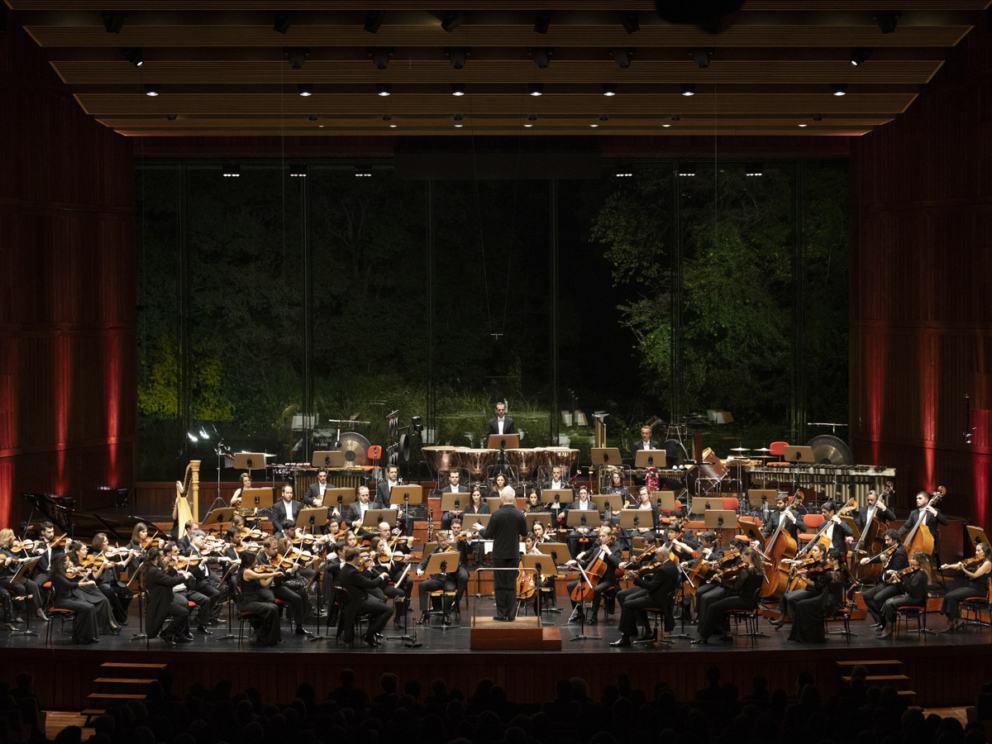
Gulbenkian Orchestra
In 1962, the Calouste Gulbenkian Foundation decided to establish a permanent orchestral ensemble. Originally with only twelve musicians (strings and continuo) it was named “Orquestra de Câmara Gulbenkian”. This collective was successively enlarged and today the “Orquestra Gulbenkian” (the name it has adopted since 1971) has a permanent body of sixty instrumentalists, a number that can be expanded depending on the repertoire.
This structure allows the Gulbenkian Orchestra to interpret works from the Baroque and Classical periods, a significant part of 19th century orchestral literature and much of the music of the 20th century, including works belonging to the current repertoire of the traditional symphonic orchestras. In each season, the orchestra performs on a regular series of concerts at the Gulbenkian Grand Auditorium in Lisbon, where it has had the opportunity of working together with some of leading names of the world of music (conductors and soloists). It has also performed on numerous locations all over Portugal, in an effort to decentralize music and culture.
The orchestra has been constantly expanding its activities in the international level, performing in Europe, Asia Africa, and the Americas. In the recording field, Orquestra Gulbenkian is associated to labels as Philips, Deutsche Grammophon, Hyperion, Teldec, Erato, Adès, Nimbus, Lyrinx, Naïve and Pentatone, among others, and this activity was recognized with several international prizes.
Hannu Lintu is the Music Director of the Gulbenkian Orchestra since 2023.
-
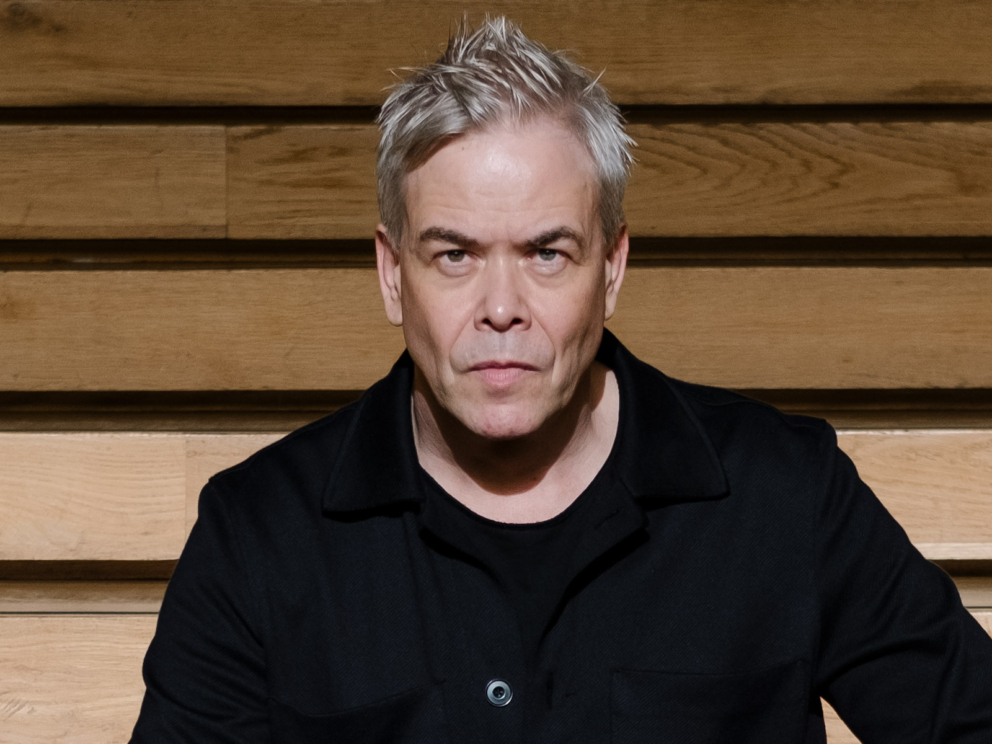
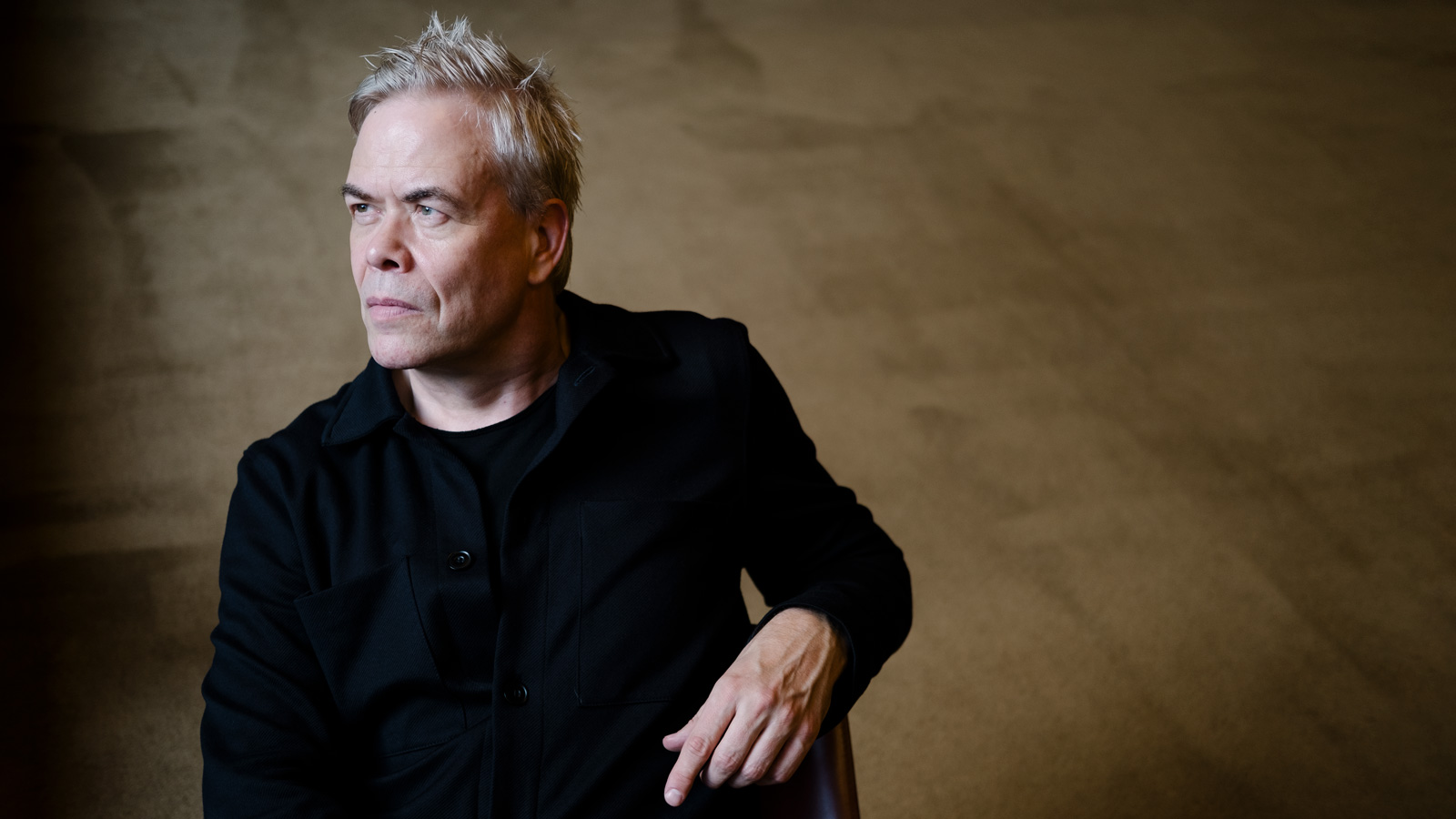
Hannu Lintu
Music Director
“Dynamic and sharp on the podium” (Bachtrack) and with an “extreme clarity of purpose, every detail worth noting” (Los Angeles Times), Hannu Lintu maintains his reputation as one of the world’s finest conductors. This season Lintu continues his tenures as Music Director of Orquestra Gulbenkian and Chief Conductor of Finnish National Opera and Ballet, proving himself a master of both symphonic and operatic repertoire, as well as beginning his tenures as Artistic Partner of the Lahti Symphony Orchestra and Artistic Director of the International Sibelius Festival.
Last season also saw Lintu’s appointment as Music Director of Singapore Symphony Orchestra from 2026/27, where he will appear this season for several performances, including for Haydn’s Nelson Mass and Shostakovich’s 7th Leningrad Symphony. Other highlights include returns to the BBC, St Louis, Toronto, Baltimore and Detroit Symphonies, as well as productions of Strauss’ Elektra and a world premiere of Sebastian Fagerlund’s The Morning Star at Finnish National Opera.
Symphonic highlights of recent years have seen Lintu conduct the Chicago Symphony, New York Philharmonic (including an immediate re-invitation from the orchestra to perform at Bravo! Vail Festival), Berliner Philharmoniker, The Cleveland Orchestra, Bavarian Radio Symphony Orchestra, Orchestre National de Radio France, Boston Symphony Orchestra, Swedish Radio Symphony Orchestra, BBC Symphony, Deutsches Symphonie-Orchester Berlin, Radio Filharmonisch Orkest, London Philharmonic, Atlanta Symphony Orchestra, Konzerthausorchester Berlin, St Louis Symphony, and Orchestre Symphonique de Montréal.
As an expert in both operatic as well as symphonic repertoire, Lintu’s recent opera highlights have included Enescu’s Œdipe with the Vienna Symphony at Bregenz Festspiele, Wagner’s Der fliegende Holländer at Opera de Paris and Debussy’s Pelléas et Mélisande at Bayerische Staatsoper as a guest conductor, as well as multiple productions at Finnish National Opera and Ballet, including a recent multi-season Ring Cycle, Poulenc’s Dialogues des Carmélites, Mozart’s Don Giovanni, a choregraphed reimagining of Verdi’s Messa da Requiem, Puccini’s Turandot, Richard Strauss’ Salome, and Britten’s Billy Budd.
Lintu has made several recordings for Ondine, BIS Records, Naxos, Avie Records and Hyperion Records. His diverse discography comprises recordings of Magnus Lindberg’s orchestral works, the complete Beethoven Piano Concertos with Stephen Hough, and Lutoslawski’s Symphonies Nos. 1-4, all with Finnish Radio Symphony Orchestra. His often-gilded work boasts two International Classical Music Awards and several nominations for Gramophone and GRAMMY awards in recognition of recording projects such as Bartók’s Violin Concertos with Christian Tetzlaff, works by Sibelius featuring Anne Sofie von Otter, Rautavaara’s Kaivos, and the Violin Concertos of Sibelius and Thomas Adès with Augustin Hadelich and Royal Liverpool Philharmonic Orchestra.
Lintu studied cello and piano at the Sibelius Academy, where he also later studied conducting with Jorma Panula. He participated in masterclasses with Myung-Whun Chung at L’Accademia Musicale Chigiana in Siena, Italy, and took first prize at the Nordic Conducting Competition in Bergen in 1994.
-
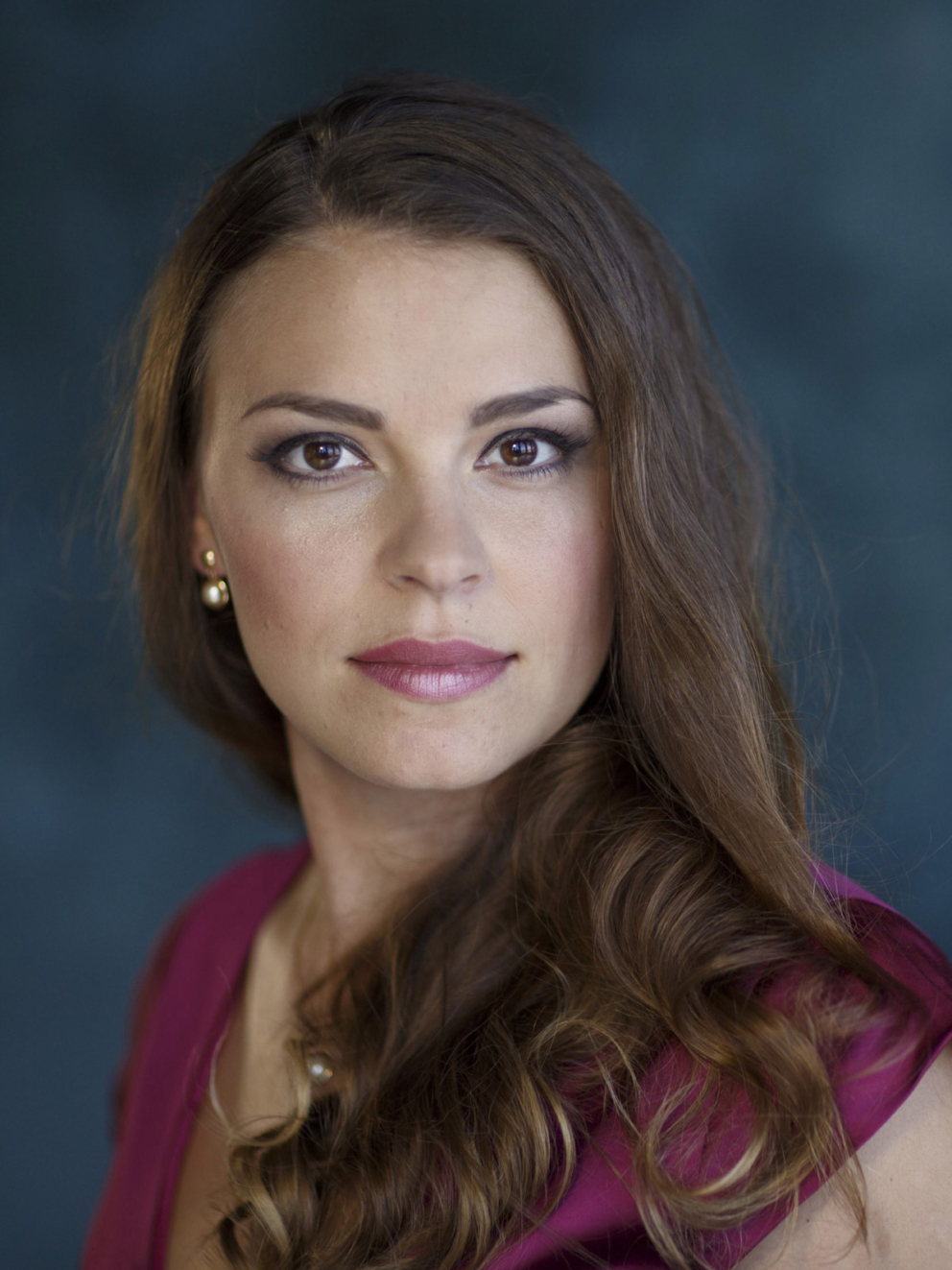
Tuuli Takala
Soprano
Finnish soprano Tuuli Takala was born in Helsinki and studied voice, violin and music education at the Sibelius Academy in her hometown. She made her professional debut in 2013 at the Finnish National Opera as the Queen of the Night in Mozart’s Die Zauberflöte. In 2014 she returned there as Susanna (Le nozze di Figaro) as well as in 2021 as Violetta Valéry (La traviata).
Since 2015, she has been an ensemble member of the Semperoper Dresden where she has performed roles such as Lucia (Lucia di Lammermoor), Gilda (Rigoletto), Micaëla (Carmen), Capriccio-Sängerin, Sophie (Der Rosenkavalier), Blonde (Die Entführung aus dem Serail), Marzelline (Fidelio), the Queen of the Night, and since the 19/20 season also as Pamina (Die Zauberflöte), Susanna, Waldvogel (Siegfried), Olympia (Les contes d’Hoffmann), La Contessa di Folleville (Il viaggio a Reims), Echo (Ariadne auf Naxos) and Valencienne (Die lustige Witwe).
In the 2023/24 season Tuuli Takala will make her role debut at the Semperoper as Adina (L’elisir d’amore), she can be seen again as Pamina and she will embody the role of Teresa in the new production of Hector Berlioz’ Benvenuto Cellini. She will also make her role debuts as Mimì (La bohème) at the Opéra-Théâtre de Metz Métropole, as Blanche (Dialogues des Carmélites) at the Finnish National Opera and she will return to Hamburg State Opera in the title role of Lucia di Lammermoor.
Guest appearances in recent seasons have taken her to the Hamburg State Opera as Konstanze (Die Entführung aus dem Serail), the Opéra-Théâtre de Metz Métropole as Violetta Valéry, Zurich Opera as Donna Anna (Don Giovanni), and to the Tampere Opera as Pamina and as Amanda Rossi in the world premiere of Olli Kortekangas’ Veljeni Vartija. In 2021, she made her Bayreuth Festival debut as the Flower Girl (Parsifal) and returned to the 2022 Festival as the Shepherd (Tannhäuser). Other guest engagements to date have taken her to the Savonlinna Opera Festival as Pamina, Gilda, Marguerite (Faust) and Zerlina (Don Giovanni), as the Queen of the Night to all three Berlin opera houses, the Royal Opera House in Covent Garden, the Volksoper Wien, the Aalto Theater Essen, Opéra de Toulon, among others.
Tuuli Takala is an award-winning artist with 1st Prizes from both the Timo Mustakallio and Kangasniemi singing competitions in Finland 2013, prizes from the 2015 Belvedere Competition in Amsterdam, and the Arnold Schönberg Center Prize from the 2013 Hilde Zadek competition in Vienna. In 2014 the Pro Musica Foundation in Finland named her Young Musician of the Year, and in 2018 the Semperoper Dresden awarded her the Curt Taucher Förderpreis.
On the concert stage, Tuuli Takala was heard in the 2022/23 season as soprano soloist in Beethoven’s 9th Symphony with the BBC Philharmonic Orchestra conducted by Eva Ollikainen and in the world premiere of Olli Kortekangas’ new song cycle Songs of Meena with the Helsinki Philharmonic Orchestra conducted by Osmo Vänskä. She also sang in Orff’s Carmina Burana with the Lahti Symphony Orchestra under the baton of Dalia Stasevska and also in Mahler’s 8th Symphony (Mater Gloriosa) with the NDR Radiophilharmonie under Ingo Metzmacher at the Hanover Art Festival.
Further, her concert repertoire includes Requiem, Exsultate jubilate and the Mass in C minor by Mozart, Ein deutsches Requiem by Brahms, Händel’s Messiah, Poulenc’s Gloria, Rossini’s Petite messe solennelle, and J. S. Bach’s Passions, the Mass in b minor and the Christmas Oratorio. In 2017 Takala was featured as soprano soloist in the ZDF Advent Concert at Dresden’s Frauenkirche with Staatskapelle Dresden under the baton of Christian Thielemann.
She is also a passionate singer of lieder and art song and has performed in recitals and concerts across Finland and in London, Vienna and Tokyo among others.
-

Wiebke Lehmkuhl
Contralto
Born in Oldenburg, Germany, alto Wiebke Lehmkuhl received her vocal training from Ulla Groenewold and Hanna Schwarz at the Hochschule für Musik und Theater in Hamburg. After guest engagements at the Kiel Opera and the Hamburg and Hanover State Operas, Wiebke Lehmkuhl received her first permanent engagement at the Zurich Opera House while still a student. In 2012 she made her debut at the Salzburg Festival under Nikolaus Harnoncourt. Her extraordinary versatility gives Wiebke Lehmkuhl a broad repertoire ranging from Monteverdi, Handel and Bach to Romantic oratorios, Mahler and Wagner, making her a much sought-after soloist on the international concert podium and opera stage. She is a regular guest with major orchestras such as the Berlin Philharmonic, Cleveland Orchestra, Tonhalle Zurich, Gewandhaus Leipzig, Bavarian Radio Symphony Orchestra, Bamberg Symphony, Orchestre de Paris and Swedish Symphony, where she has worked with conductors such as Kirill Petrenko, Klaus Mäkelä, Daniel Hardig and Riccardo Chailly. She is also a welcome guest at festivals such as the Schleswig-Holstein, Rheingau and Lucerne Festivals.
Wiebke Lehmkuhl has appeared at the Salzburg and Bayreuth Festivals. She made her debut at the Nederlandse Opera in Amsterdam in Handel's Jephta. Her absolute key role, however, is without doubt Erda in Wagner's Rheingold and Siegfried: "And with Wiebke Lehmkuhl's Erda, an operatic miracle happened in the third act: a performance that had long been very good with very good singers was raised to a lonely world level by a very special singer. Weighing every word and yet weaving every word into the legato line, the registers of her dreamlike alto voice melting together like ebony - this is how Wiebke Lehmkuhl's grandmother deserves the crown of the evening. (Peter Krause, "OPERN-KRITIK: GRAND THÉÂTRE DE GENÈVE - SIEGFRIED - Poesie statt Politik", www.concerti.de; 15 February 2019) This role has since taken her to the stages of the Bavarian State Opera in Munich, the Grand Théâtre de Genève, the Opéra de Bastille in Paris and the Royal Opera House Covent Garden in London, with conductors such as Yannick Nézet-Séguin, Marek Janowski and Philippe Jordan. She will also be heard as Erda at the Royal Opera House Covent Garden under Antonio Pappano in the new London Ring, which opens in the 23/24 season with Rheingold. She then accepted an invitation from the Opéra nationale de Paris to sing Cornelia in Handel's Giulio Cesare.
In the concert repertoire, Wiebke Lehmkuhl's heart beats above all for Baroque music, and in particular for Johann Sebastian Bach. She has been invited to perform the alto arias from the St John Passion with the Concertgebouw Orchestra under Trevor Pinnock. However, the works of Gustav Mahler and Ludwig van Beethoven are always in the foreground. In Lisbon and Valencia, Mahler's Symphony No. 2 and the Rückert Lieder are on the programme. Wiebke Lehmkuhl returns to the Teatro alla Scala di Milano for Beethoven's Symphony No. 9 under Riccardo Chailly, before closing the season with the Missa Solemnis at the Auditorio Nacional de la Musica Madrid under David Afkham.
Wiebke Lehmkuhl has made numerous recordings, including J.S. Bach's Christmas Oratorio with the Gewandhausorchester zu Leipzig under Riccardo Chailly (Decca) and C.P.E. Bach's Magnificat with the RIAS Kammerchor and the Akademie für Alte Musik Berlin under Hans-Christoph Rademann (Harmonia Mundi).
György Ligeti
Atmosphères *
Gustav Mahler
Symphony No. 2, in C minor, Resurrection
* Birth centenary of György Ligeti
TRANSMISSION
https://www.youtube.com/watch?v=33mWtDlr968
In his first concert as Music Director of the Gulbenkian Orchestra, Hannu Lintu conducts Ligeti’s Atmosphères and Mahler’s 2nd Symphony. Certain of his future as a conductor since he watched Leif Segerstam conduct Verdi at the Savonlinna Opera Festival at the age of ten, Lintu’s main references are Bernstein for his courage, Abbado for his ability to keep the music moving and Solti for having awakened him to Wagner’s operas and Mahler’s symphonies through remarkable recordings. It is the long-awaited official appearance of one of the most relevant conductors of our days.
Sponsor Gulbenkian Music

The Calouste Gulbenkian Foundation reserves the right to collect and keep records of images, sounds and voice for the diffusion and preservation of the memory of its cultural and artistic activity. For further information, please contact us through the Information Request form.