
The Collection’s Journey to Lisbon
Sob o mesmo teto – episode 1
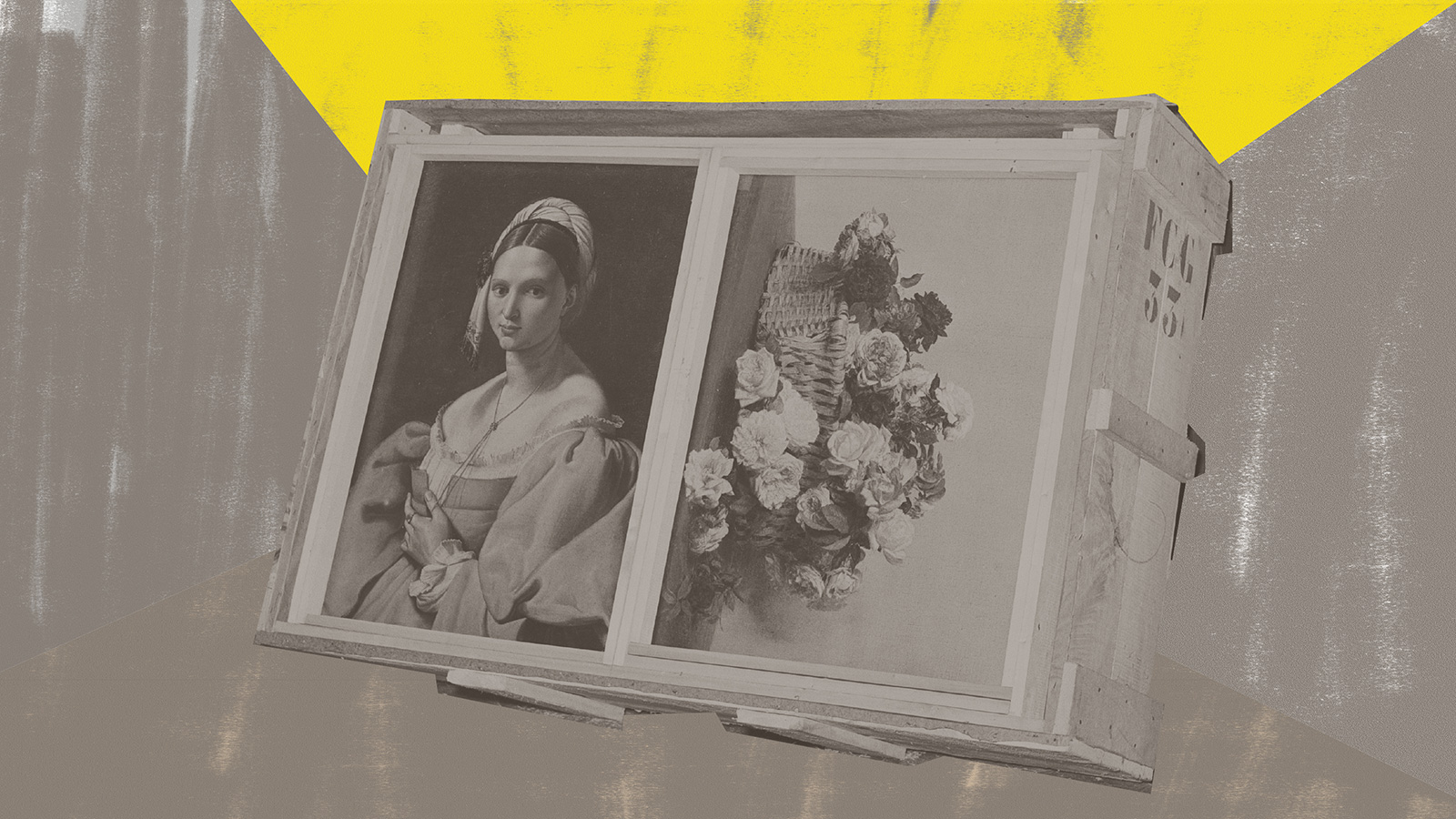
When Calouste Gulbenkian died in 1955, his Collection was still scattered across three cities: Paris, London, Washington. A year later, a foundation bearing his name was established in Lisbon to bring it all together.
So why Lisbon? And what lay behind the long, tangled journey the Collection took before it finally ended up ‘under the same roof’?
That question drives the podcast’s first episode, in which João Carvalho Dias sits down with Vera Mariz—curator at the Gulbenkian Museum and author of a book series on the Collection—to mark the release of its first volume.
An undecided destination
Armenian by descent and born in Istambul, Gulbenkian spent most of his life shuttling between Paris and London. Lisbon only entered the picture in 1942, when the German occupation of Paris drove him out, first to Vichy, then to Portugal, a neutral country that had become a haven for wealthy exiles.
He never meant to stay. Lisbon was supposed to be a stopover on the way to the United States. Instead, he spent his last thirteen years there, at the old Hotel Aviz.
It was in these final years of his life that the Collection’s future became an urgent question. Gulbenkian was already 73 when he reached Portugal and, though he liked to think he might live to 106 like his grandfather, two world wars had taught him not to leave things to chance.
And yet—surprisingly, for such a meticulous man—he never fully settled what should happen to the Collection.
A 1916 will already ruled out selling any of it, except to reinvest in art or property. A second, in 1923, called for the Collection to stay together, ideally in a museum in London or Paris. By 1950, now settled in Lisbon, he drew up another will proposing a foundation, without specifying where it would be based or how it would work.
Only in 1953, two years before his death, did his fullest set of wishes finally emerge: the foundation would be Portuguese, based in Lisbon, dedicated to charity, art, education and science. Even then, it said nothing directly about the Collection.
That silence left room for two very different interpretations. José de Azeredo Perdigão, Gulbenkian’s Portuguese lawyer, believed his client had always wanted the Collection kept together under one roof, in Lisbon. Cyril Radcliffe, his longtime British lawyer, disagreed, arguing there was no such obligation, and that the works should instead be distributed among English museums.
Getting out of Paris
Much of the Collection was still housed at Gulbenkian’s residence on avenue d’Iéna in Paris, and getting it out of the country became a priority for both the Gulbenkian Foundation and the Portuguese government. José de Azeredo Perdigão and António de Oliveira Salazar had been discussing it since 1953, while in Paris, ambassador Marcelo Mathias kept up steady pressure on the Quai d’Orsay.
None of it proved simple. French law required a permit from the Ministry of National Education before anything of national interest could leave the country, and that permit could easily be refused.
When French museum curators inspected the Collection on avenue d’Iéna, they flagged 55 works they felt shouldn’t leave France: mostly decorative arts, furniture and tapestries, including a striking set of 18th-century French silverware by François-Thomas Germain and Antoine-Sébastien Durand.
The resistance came almost entirely from the curators themselves, who felt no compensation could offset the loss of such pieces.
But French law had a weak spot. The list of 55 was only ever indicative, and the law made an exception for works bought abroad and later brought into France, which covered most of the flagged pieces, many originally from the Russian imperial collections and bought by Gulbenkian from the Soviet government.
That argument carried the day, and the French government eventually authorised a first batch of twelve “minor” works, including a Gothic ivory diptych and three celadon vases.
Even that small concession unsettled the French curators, Pierre Verlet of the Louvre among them, who went so far as to block the export of a piece that wasn’t even on the original list: the The Ball Game tapestry, from the set Children Playing, which Gulbenkian had bought back in 1920.
Houdon’s Diana
Few pieces were as fiercely contested as Houdon’s marble sculpture Diana, once owned by Catherine the Great and bought by Gulbenkian from the Soviet government in 1930. Two bronze versions of the same work existed in France, but neither matched this one for quality.
By 1959, Diana was still among 43 works awaiting export permits, which only came through at the end of that year—and even then, the sculpture’s pose, with an arm and a leg elegantly suspended in mid-air, made it a nightmare to pack, delaying its departure further still.
Consideration was even given to holding a final public exhibition in Paris before the Collection’s final journey to Lisbon, fittingly staged at Gulbenkian’s own former residence, which was by then being converted into the Luso-French Cultural Centre as part of the broader export negotiations. That gesture, together with the construction of a residence for Portuguese students in Paris, brought a kind of symbolic closure to the whole affair.
A major logistical operation
Moving a collection of this scale took months of planning. Maria José de Mendonça, curator at the Museu Nacional de Arte Antiga, was brought in both to help shape the future Gulbenkian Museum and to oversee the packing in Paris. Chenue, the firm Gulbenkian had long relied on, turned the atrium of his Paris residence into a makeshift workshop—more than 1,200 crates passed through it.
Marcelle Chanet, who had worked with Gulbenkian for years and knew the Collection intimately, oversaw the process, alongside engineer João Vaz Raposo of the Gulbenkian Foundation, who personally escorted every shipment.
Between August 1958 and February 1960, the Collection travelled from Paris to Lisbon in four shipments, mostly by rail to Santo Amaro de Oeiras. The larger sculptures, Rodin’s Jean D’Aire, Burgher of Calais among them, went by lorry; the smaller, more valuable pieces, like the Durand and Germain silverware, went by air.
London and Washington
Not everything was in Paris. An important group of paintings— including two Rembrandts, Rubens Portrait of Helena Fourment and Manet’s Boy Blowing Bubbles—had been on long-term loan at the National Gallery of Art in Washington since 1949–50, along with the Egyptian antiquities and other pieces from the Collection.
Gulbenkian had once discussed with chief curator John Walker the possibility of a dedicated Gulbenkian wing at the National Gallery, but after his death, the transfer to Lisbon went smoothly, helped, in part, by legal guarantees Congress had approved when the loan was first arranged. Preparations began in 1959, with Maria José de Mendonça, José de Azeredo Perdigão and João Vaz Raposo all travelling to Washington, later joined by conservator Martin de Wild.
In London, the process was more straightforward, though not without its own snag: the Board of Trade required every manuscript to be photographed before leaving the country, a step the Foundation would have preferred to avoid, given how fragile these paper works were. Once that hurdle was cleared, the manuscripts and other papers, including the Renaissance medal collection, travelled by sea to Lisbon, joining the rest of the Collection already installed at the Palácio do Marquês de Pombal.