
'The Ball Game' Tapestry (from the set 'Children Playing')
Gallery
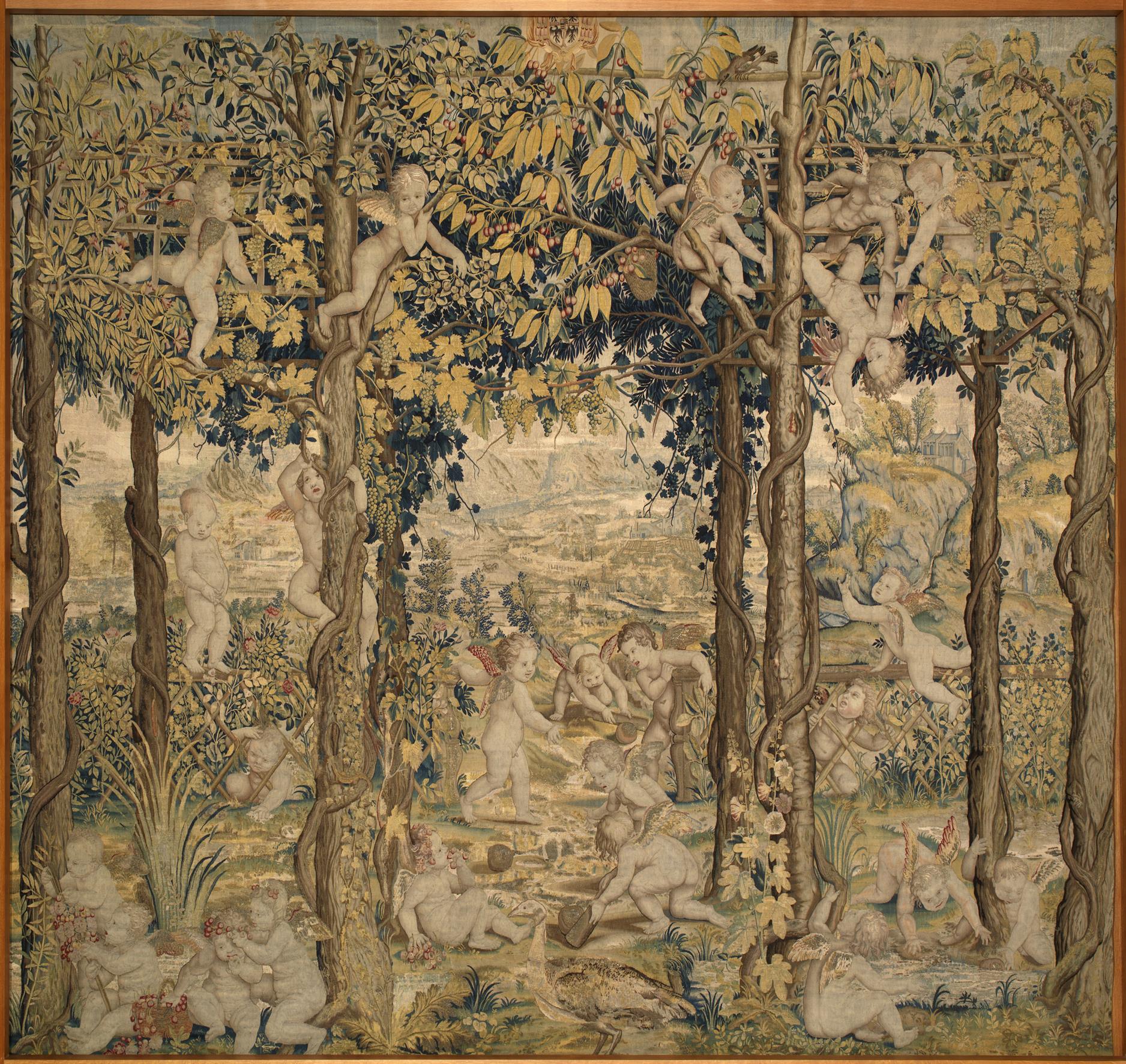
The tapestries from the Children Playing set were acquired by Calouste Gulbenkian in May 1920 and decorated the dining room in his mansion on Avenue d’Iéna, in Paris. This remarkable group perfectly illustrates the level of artistic and technical quality achieved in this art form during the sixteenth century and is one of the most impressive sets of tapestries produced in Italy.
From the late fourteenth century, Italian courts began to amass significant collections of tapestries, many of them woven in Flanders and some manufactured locally. The House of Gonzaga, a prominent family who ruled Mantua from 1328 to 1708, competed with other Italian courts to acquire important series of tapestries, the production of which reached a peak in the sixteenth century. This period coincided with the commissions by the sons of Isabella d’Este and Francesco II Gonzaga: Federico II, Ercole and Ferrante.
The Children Playing set is thought to have been produced for Cardinal Ercole Gonzaga, whose coat of arms is visible in some of the tapestries, which are thought to have been woven in Mantua at the workshop of Nicolas Karcher, a master weaver from Brussels who settled in Italy.
Object details
- Author(s)
- Nikolas Karcher (?), Weaver; Giulio Romano (1499 – 1546), Painter (artist)
- Title
- 'The Ball Game' Tapestry (from the set 'Children Playing')
- Origin
- Mantua (present-day Italy)
- Date
- c. 1545 – 1550
- Materials
- Wool; Silk; Gold; Silver
- Dimensions
- Height 350,00 cm; Width 370,00 cm
- Inventory no.
- 29B
Provenance
Incorporation
- Type
- Purchased
- Place
- Paris
- Provenance
- Cahen d'Anvers Collection
- Intermediary
- Georges Petit Galleries
- Date
- 14 May 1920