
The arts and participation: a route to scaling climate action
The Calouste Gulbenkian Foundation has a decades-long history of championing arts organisations that drive positive social change in collaboration with their communities. Since 2020, we have also been supporting organisations that create opportunities for more people to have a say in climate action. Last year our teams working on socially engaged arts and citizen engagement on climate began to explore work at the place where arts, community participation, and climate action meet: Arts X Participation X Climate Action.
Our research found that there is a lot of place-based creative climate action already happening – often under the radar and caught in the gap between ‘arts’ and ‘environment’ funding priorities. It has also highlighted the variety of ways that arts organisations are responding creatively to climate change: igniting collective imaginations about green futures; enabling emotional connections to global and local issues; modelling truly sustainable practice and many more.
We have been particularly excited to see the way some arts organisations are engaging deeply with communities about what climate change and climate justice means for them and their local area. This goes beyond artistic programming on environmental themes. It involves creating vibrant spaces for residents to come together, identify collective priorities, and collaborate with decision-makers to deliver meaningful change.
We believe this kind of creative community engagement has huge potential for scaling public engagement on climate change – complementing more formal ways to give the public a say.
In 2021, Scotland’s ‘Net Zero Nation’ public engagement on climate strategy highlighted the power of the arts and set out to maximise the sector’s potential. In 2025, the UK Government will launch a national strategy for public participation on climate, and we think the arts sector can help put the wind in its sails.
Creative engagement: the untapped potential for climate
The arts sector is engaging audiences on climate change, but audiences want more.
Artists have always been at the vanguard of social progress, and it’s no different with climate change. The engagement of arts organisations with climate change has increased in tandem with public appetite for climate action. All of the UK Arts Councils’ funding strategies now cite environmental action as a priority, accelerating the increase of creative climate engagement programmes. Julie’s Bicycle’s latest annual report on England’s publicly funded arts organisations found that 71% had produced work exploring environmental themes within the last year.
When it comes to UK arts audiences and their preferences, Indigo Ltd’s 2024 Act Green survey found that 72% think cultural organisations have a responsibility to influence society about the climate emergency, yet only 16% think organisations are placing great importance on tackling the climate crisis.
Many arts organisations work with communities outside the ‘climate bubble’.
In many places, people and communities are underserved by arts organisations, and many people are rarely involved in creative activities. But through initiatives like the UK Branch’s The Award for Civic Arts Organisations we’ve seen countless examples of arts organisations who have real, deep and meaningful ties with their communities of place and interest.
Another good example comes from Culture Declares Emergency, which CGF began funding back in 2019, is the Hub in Birmingham and West Midlands. This has been using arts-based approaches to engage with South Asian and Pakistani heritage groups to foster climate resilience in partnership with other community partners and the local authority.
Many arts professionals are skilled facilitators of climate conversations.
Artists and arts organisations are often expert at bringing people together, engaging with complex and competing ideas, activating emotions, and navigating cultural values. These are important skills that can help shape how society responds and adapts to climate impacts.
Culture for Climate Scotland, led by former theatre director Ben Twist, has long-recognised the common overlap of skills required to intervene in complex social systems and work in the arts. Inspired by the artist Frances Whitehead, Culture for Climate Scotland has developed a specific process to embed artists in non-arts organisations to address key societal issues. Approaches in the Embedded Artists’ toolkit range from challenging existing paradigms that limit adaptation to involving new stakeholders and audiences in responding to climate change.
Arts practices can get people talking about transformative change and systemic injustice.
Many public authorities, like local councils, have commissioned work to involve their residents in deliberative discussions about how to respond to climate change in recent years. But the status quo assumptions of the commissioning organisation can constrain discussions and inadvertently discourage systemic thinking and transformative ideas.
Creative approaches, on the other hand, seem to extend the horizon of possibility. Participants in a creative workshop are perhaps more likely to contemplate big questions about purpose, meaning and justice than they would in a more formal deliberation setting. And this effect applies both to resident participants and the organisers. A quote about the ‘Artists of Change’ who worked with Lewisham Council’s climate team to engage with residents and shape a community-led Climate Manifesto makes a similar point:
“The work I do is ultimately about big existential questions of our time – it’s about how we live, equality and justice. However, my day to day work in the council didn’t always reflect that. Artists of Change bridged that gap in a really meaningful way.”
Martin O’Brien, Climate Resilience Manager at Lewisham Council
Marine protection and origami boats: An example from Culture for Climate Scotland
One of the richest learning reports we found is from Culture for Climate Scotland’s work with communities in the Outer Hebrides on how best to manage Marine Protected Areas. This work took place as part of an EU-funded project (SEASOH) whose team wanted an inspiring, different and accessible way to work with Outer Hebrides communities.
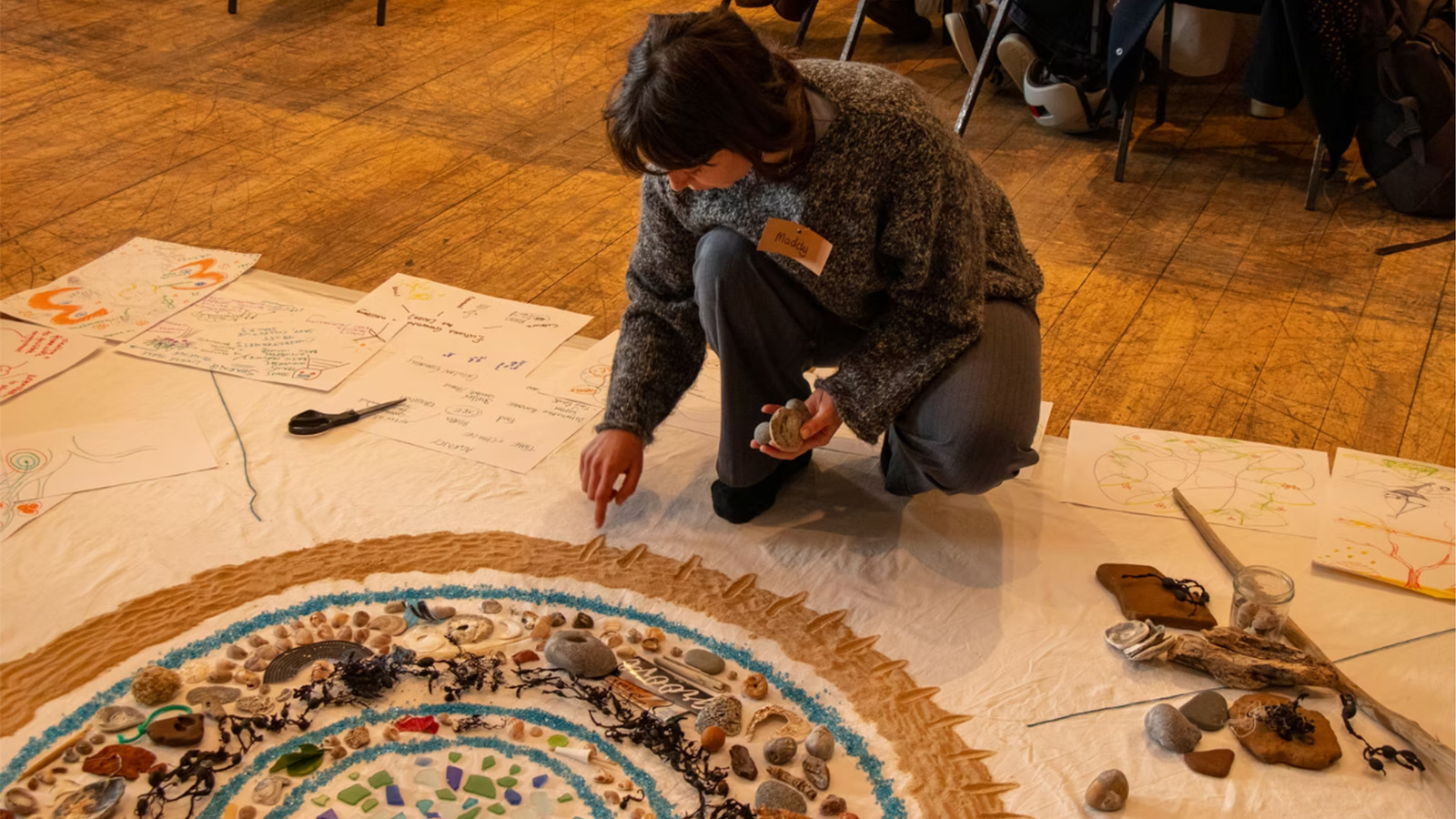
Culture for Climate Scotland (formerly Creative Carbon Scotland) hosted a series of creative engagement events with communities including post film-screening conversation spaces, printing workshops using found objects from the shoreline, and sea swims. In one workshop, participants made origami paper boats on which they anonymously wrote their ‘hopes and fears’ about marine protection to share with project practitioners.
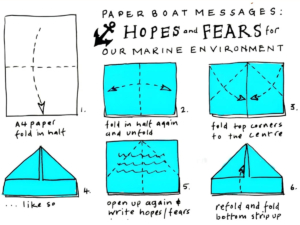
Paper boat messages: hopes and fears for our marine environment. Created for Seas of the Outer Hebrides Winter Workshops, 2020. Image credit: Kirsty O’Connor.
Alongside these activities, Culture for Climate Scotland evaluated the role of creative practice in a public engagement context. The learning report details how participants found the creative workshops refreshing, fun and made the issues more personal. The SEASOH project team believed that the involvement of artists aided the building of trust and ‘raised the benchmark of the collective output’.
The collaboration with artists also catalysed changes to the SEASOH project team’s individual and collective working practice, resulting in different ways of thinking and delivering more inclusive and innovative project outcomes.
This example highlighted how creative methods of public participation have the potential not only to be inclusive and engaging, but also to deliver more effective environmental projects through community contributions to policymaking.
New Arts X Community Participation X Climate Action partners
In the next few weeks, the UK Branch will be sharing news about three new grant partnerships for long-term creative climate (and ocean) community engagement work. These new partnerships align with the Foundation’s strategic commitment to Sustainability and Equity. They complement wider other initiatives such as the life-cycle assessment of the Europe Oxalá exhibition, which examined the environmental impact of curatorial practice, and the Foundation’s role as an Active Member of the Gallery Climate Coalition, supporting emissions reduction and sustainable practices across the international arts sector.
Even though this quite specific practice is just one way that the arts sector is engaging with audiences about climate action, we found many more examples than we are in a position to support directly. The UK Branch has aimed to highlight the potential that we see in this kind of work, and has hosted conversations with other funders who could support such work or are already doing so.
Resources