
How to prepare
Welcome to the Calouste Gulbenkian Foundation and the Gulbenkian Music Season. If this is the first time you visit us, you may find these answers to some frequently asked questions helpful.
About the Music
What is classical music?
The term “classical music” generally refers to music written to be performed by a group of musicians playing orchestral instruments: strings (such as violins and cellos), woodwinds (such as flutes and clarinets), brass (such as trumpets and horns), and percussion (such as timpani or the xylophone).
The two most common forms in orchestral music are the symphony and the concerto. A symphony is a large scale work interpreted by the entire orchestra, composed of two or more parts called “movements”.
A concerto is a work performed by the orchestra and a soloist, who play in dialogue with each other, and usually consists of three movements.
What is a movement?
A movement is a section of a large scale work such as a symphony, a sonata or a concerto, and is usually characterised by contrasting variations in tempo, rhythm or character.
In a classical music concert there are small pauses of silence between each movement, during which the public does not applaud. The applause is kept for the end of the work, at the moment when the conductor indicates it has ended. You can find an indication of the number of movements in each work in the concert programme.
What is an orchestra composed of?
An orchestra consists of four sections or families of instruments: strings, woodwinds, brass and percussion. The instruments included in each section are as follows:
Strings: violins, violas, cellos, double basses
Woodwinds: flutes, clarinets, oboes, bassoons, cor anglais
Brass: trumpets, trombones, horns, tubas
Percussion: timpani, harp, xylophone, etc.
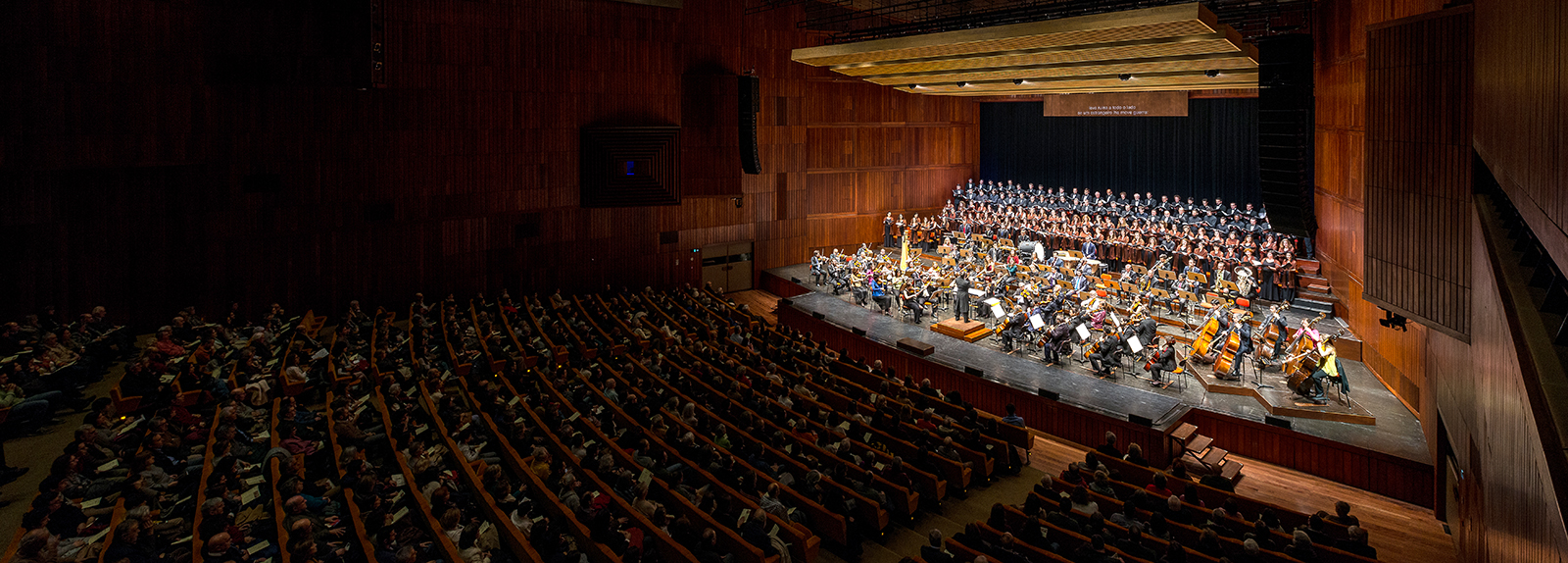
Although it may vary according to the works to be performed or the conductor’s preference, the arrangement of the instruments is as follows:

The 60 or so instrumentalists of the Gulbenkian Orchestra are professional musicians who work and rehearse daily in the Grand Auditorium throughout the season (September to June), giving about 60 concerts a year. They also perform in free concerts in the city centre during the summer, and on national and international tours.
How can I learn more about music?
The concert program, available for free on the Foundation’s website a few days prior to the concerts, is an excellent guide, containing information on the composers and works that will be performed.
You can also attend the Pre-Concert Talks for free, which consists of a short session held one hour before the concert, with musical excerpts and commentaries on the works.
The Sunday Concerts, commentated in a relaxed atmosphere and designed to be enjoyed by the whole family, are another excellent opportunity to discover works, composers and performers.
How can I find out more about the Gulbenkian Music Season?
The best place to obtain information about the Season is on our dedicated area on the website. You can also subscribe to our fortnightly E-News or consult our brochure, available for free at the Calouste Gulbenkian Foundation. We are also available to answer any questions at our box office, by telephone (+351 217 823 700) or by email at [email protected].
Box Office Information
How can I buy tickets?
There are three ways to purchase your tickets or season tickets: online, in person or by post. Consult the information on our box office page.
Do I need to print out tickets purchased online?
No. After making a purchase on our website, you will receive an e-mail with your tickets attached, which you can print out or present at the entrance. In the same e-mail you will find a purchase reference number, which alternatively you can present at our box office.
Are there discounts?
No. In view of the current epidemic situation and the reduced capacity of the Grand Auditorium, in the 20/21 Season, discounts will not be available for the purchase of individual tickets, with the exception of family tickets for Sunday Concerts.
What is the difference between single tickets and a season ticket?
If you are interested in attending several performances, you may consider purchasing a season ticket or pass, which includes tickets for a number of performances of a particular cycle or theme. Otherwise, you can purchase single tickets for one or more concerts.
What are the advantages of purchasing a season ticket?
Subscribers are able to purchase tickets long before the general public, ensuring their preferred seats and benefiting from the associated discount.
If I am unable to go a concert, can I change it for another?
Yes. If you cannot attend a performance, you can exchange your ticket for another of equal or higher price at our box office up to one hour before the performance starts. However, we do not make refunds.
Plan your visit
Where do the performances take place?
The vast majority of the Gulbenkian Music Season performances takes place in the Grand Auditorium in the Main Building of the Calouste Gulbenkian Foundation. Some concerts may take place outside the Foundation: in churches, theatres or in other venues in the city centre.
Should I arrive earlier?
Yes. As a rule, Grand Auditorium doors open to the public 30 minutes before the start of the performance.
Always take into account the possibility of traffic delays, parking time and other unforseen events.
What if I arrive late?
When the performance starts, entry into the Grand Auditorium is not allowed, unless otherwise indicated by the room assistants.
In order not to disturb the concentration of the musicians and the audience, as a rule, entry to the auditorium must be made between movements (parts or sections of the work) or at the end of a work. You may have to occupy a seat other than that stated on your ticket.
Where can I park?
The Calouste Gulbenkian Foundation has a paid car park with around 200 parking slots, equipped with the Via Verde payment system. However, in the case of sold-out perfomances, it is common for it to be full. Alternatively you can use Parque Berna (underground) or the car park in Praça de Espanha.
Is there access for people with limited mobility?
Yes. The Main Building of the Gulbenkian Foundation is equipped to receive concertgoers with limited mobility, and has adapted equipment and facilities.
What should I wear?
There is no special dress code. Some people regard a classical music concert as a special event and tend to dress up for the occasion. Others opt for a more casual style.
Is there a place where I can leave coats, backpacks or other personal belongings?
Yes. At all events at the Calouste Gulbenkian Foundation, there is a free cloakroom service where you can leave bags, coats, umbrellas, musical instruments and large objects.
Are there catering areas for concertgoers?
Yes. For one hour before the start of each concert, and during the interval, you can make use of the foyer bar, which offers a wide range of products and has a pleasant terrace in the garden.
On days of broadcasts from the Met Opera, you can buy a cocktail ticket, which includes a selection of drinks and aperitifs at your discretion.
About the Concerts
I’ve never been to a classical concert. What should I expect?
A new experience.
It is important to free yourself of preconceived ideas about the formality or atmosphere of a classical music concert, which nowadays is relaxed and informal.
You do not need any previous musical background to attend a concert and it is likely that you will recognise parts of some symphonies, concertos or choral works. Music written by great composers is often used in film soundtracks, television programmes and advertisements.
At the heart of every Gulbenkian Music season are the Gulbenkian Choir and Orchestra, two of the most prestigious ensembles in Portugal and Europe. The Grand Auditorium is a hall with a unique acoustic quality that makes the experience of listening live to some of the greatest names in classical music today an unforgettable experience.
Should I know the works or know about music to go to a concert?
No, the music speaks for itself. It is not necessary to be an expert to be able to appreciate any musical genre.
One of the greatest pleasures of attending a live concert is the possibility of coming into contact with a work for the first time, attending a great performance, or rediscovering a piece.
To enrich the concert experience, some regular concertgoers find some pre-concert preparation useful.
This can be something as simple as reading the concert programme, or something more engaging like listening to a recording of the works that are to be performed or attending the Pre-Concert Talks.
How can I obtain the concert programme?
The concert programme can be downloaded for free on our website a few days before the concert on the page of each concert. On the day of the concert you can also obtain a copy at the box office.
Can I take photos or film the concert?
No. You can take photos without flash inside the auditorium only until the start of the concert, after which no unauthorised sound or image recording is allowed.
When should I applaud?
Moments before the concert begins, and after all the members of the orchestra are seated on stage, the audience applauds the entrance of the Concertmaster – the violinist who sits in the first chair in the front row of the orchestra, next to the conductor. After the orchestra has tuned up, the audience applauds the entrance of the conductor, who may be accompanied by the soloist(s). After the concert starts, the audience only applauds at the end of each work. Some longer pieces may have several sections or movements, separated by a brief pause of silence, during which the audience does not applaud. You can find an indication of the number of movements in each work in the concert programme.
Can I go out and re-enter during a concert?
Yes. If you need to leave the auditorium during the concert, you may only re-enter when indicated by the room attendants, between movements or at the end of a work. You may have to occupy a seat other than that stated on your ticket.
Can I use my phone or tablet during a concert?
No. Although the use of mobile phones or tablets inside the auditorium is not explicitly prohibited (provided they are in silent mode), the light emitted by their screens can be extremely disturbing to the concentration of the audience or the musicians.
Can I eat or drink during the concert?
No. With the exception of water bottles, no food, drinks, coffee cups or glass objects are allowed inside the auditorium.
Can I bring children to concerts?
Yes, our performances are age rated for those over 6 years old, in accordance with the terms of Law 23/2014, Article 27, which covers all music, dance, sports and similar performances.
However, at our Sunday Concerts, which are aimed specifically at families, the minimum age is 3 years old.
What is the average length of a concert?
The average length of a concert is about 2 hours, including an interval of 20 minutes. However, this can vary according to the nature of the concert and the repertoire to be performed. Some performances might not include an interval. You can find an indication of the length of the concert and of each work in the concert programme.
A concert is sold out. Can I go on a waiting list?
No. Unfortunately there are no waiting lists for sold out concerts. On the day of the concert you can check with our box office if there have been any cancellations.
Are there any concerts for schools?
Yes. Gulbenkian Music organises educational activities specially for schools and groups with special educational needs, as well as senior academies.
I am a music teacher. Can I bring my students to a Music Season concert?
Yes. Although there are no discounts for groups, music teachers and their students are welcome at all our performances, with students (up to the age of 30) entitled to a 50% discount.
We also offer a range of activities for schools, such as guided visits, workshop-visits and concerts for schools. You may also bring your students to one of our Sunday Concerts.