
“The beautiful open-air amphitheatre will give us a perfect context for the intention of our music”
Interview with Matt Hollenberg
-
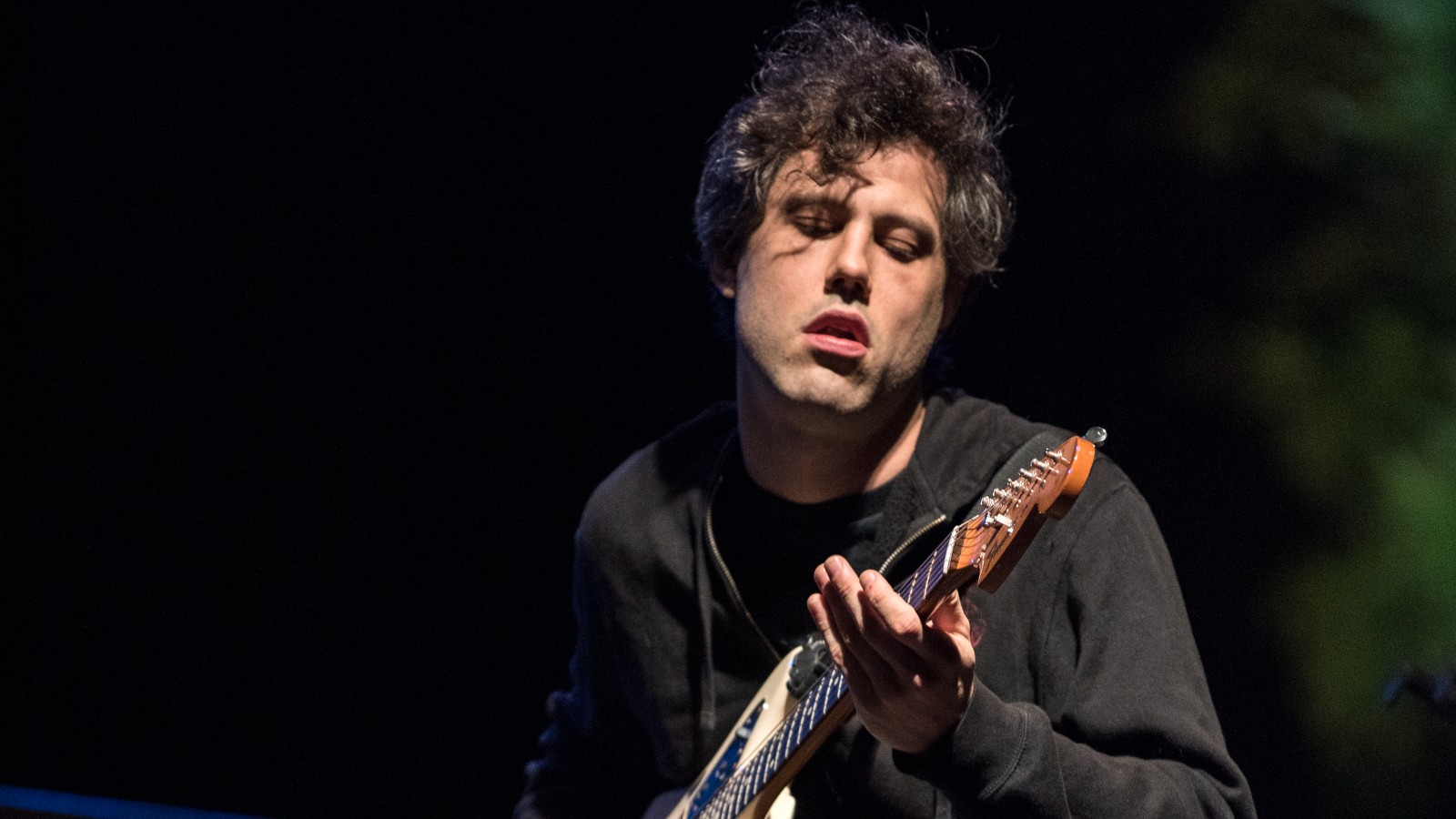
Matt Hollenberg in Jazz em Agosto 2018 © Petra Cvelbar
Shardik’s music draws on a wide range of musical styles. How do you find a balance between such different musical languages and the desire to explore still-uncharted sonic territories?
I am a true lover of music and appreciator of all forms of expression if pure and honest. The “uncharted” as you say, sonic territories, simply emerge through thoughtless improvisation. Composition is about sensing a space that already exists. This space/landscape then must be articulated through detailed musical and compositional work. My experience does not center around figuring something out outside of directly interacting with the thing itself. The mind element of what I do isn’t self-conscious, but simply using curation to arrange the unthought elements that have evolved organically through simple musical and artistic curiosity, nothing more.
Your work often addresses themes such as the erosion of empathy and the normalization of violence. How do these social and political concerns influence your music and your compositional process?
I obviously have my own political perspectives, but they’re not directly relevant to the musical world Shardik is operating in. I engage with my visceral horror at the deterioration and decay of environmental, social and political norms across the board. The horror at the new violence and venom is a subconscious experience as well as a conscious one. Since this energy is being channeled into an artistic musical space, it is not quite the same as writing lyrics, because it is strictly instrumental music. It’s analogous to physically being in the eye of a hurricane and writing down your emotional experience.
In Cruelty Bacchanal, the pieces seem to be constantly building and dismantling themselves, as if fragments were being reorganized into new forms. Does this approach reflect the band’s view of the contemporary world?
Yes, it reflects this pace and speed at which events emerge and get destroyed in the social, political, and environmental space. Events occur and get destroyed in the music, and the faster that happens, the musical effect naturally becomes smaller and more microscopic. Micro details that matter have to become smaller in the music, but ultimately of primary function. Sometimes the details are more felt than heard, but they all have to be there in order to create the effect you were just alluding to. The world around us does not honor the dead. It just keeps moving forward thoughtlessly, an inevitability that is pure horror. That ominous atmosphere enters the compositional space.
Jazz em Agosto has a long tradition of presenting artists who challenge aesthetic boundaries. How does Shardik see its place in today’s musical landscape, and what do you hope Portuguese audiences will discover through your performance?
We seek to present new worlds to audiences who are looking for a fresh landscape. We would like to push a musical culture that gets back to visceral intent coming from pure curiosity. We hope to present music that is at once incredibly familiar, but also incredibly alien at the same time something that is a thrilling adventure and an emotional ritual catharsis. We are supremely honored to offer this to Portuguese audiences, in the context of Jazz em Agosto, as the beautiful open-air amphitheatre will give us a perfect context for the intention of our music, which is supposed to be an experience above all else.
You may also like


No results were found for your criteria.