
“I can say we are going to take as many chances as possible, and I feel confident about the outcomes”
Interview with Ches Smith
-
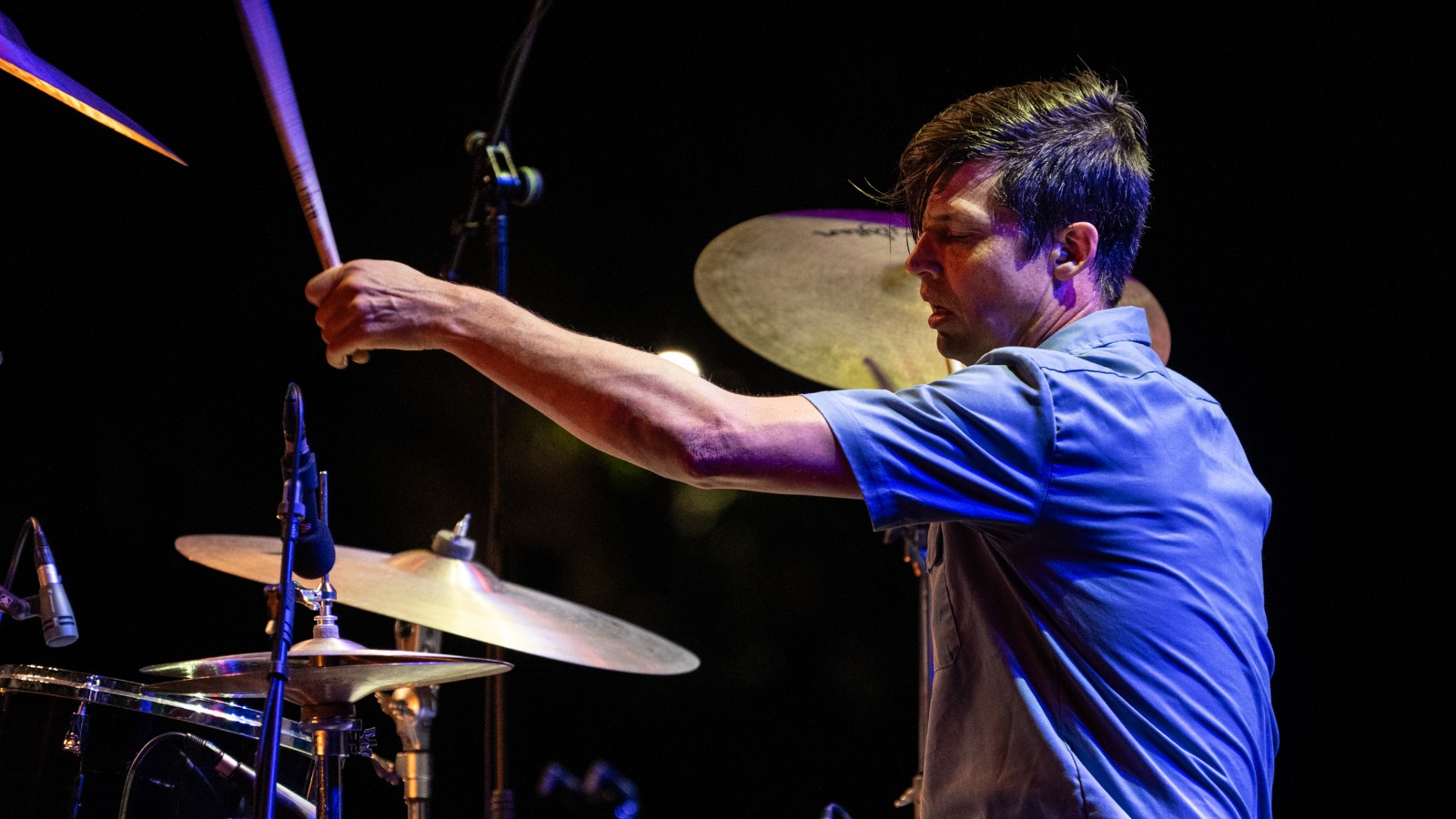
Ches Smith performing at Jazz em Agosto 2024 © Petra Cvelbar
You are widely recognized as one of the most creative drummers in contemporary improvised music, yet Clone Row places the spotlight on your work as a composer. What was the process of creating music that is so distinct from what audiences usually associate with you as an instrumentalist?
With any new project, I am trying to make it “its own thing” and not like any other project I’m involved in, so in that broad sense, it’s similar to what I am always trying to do. A few things in the process of writing and recording this music helped achieve this. First, I was writing for the four distinct individuals involved, so that alone led to something new when I put all of the parts together. All of us have a relationship with electronics, so I wanted that to be a focus as well. I have been programming electronic tracks for a while now (first heard on my Laugh Ash record), and I wanted that to be a part of Clone Row, but in a more flexible way, where I could improvise with the programming. Also, I write music away from the drums and vibes, usually on piano, which has the benefit of getting away from my tendencies on those instruments. When each piece is finished, I “assign” myself a drum or percussion part the same way I give parts to Mary Liberty and Nick. So, hopefully it’ll end up as something different and also challenging for me to play.
Mary Halvorson’s and Liberty Ellman’s guitars play a central role in the group’s sound. When composing for Clone Row, do you write with the particular qualities of each guitarist in mind, or do you seek to create situations that push them into unexpected territory?
I write for Mary and Liberty with both approaches that you mention in mind. I have been close with both of them for a long time now, so the way they play–tendencies, interests, etc–are in my mind when I start a piece, same with when I’m arranging. Although I’ve studied composing for guitar and how the instrument is laid out, I don’t write on guitar, so I usually leave it to them to figure out how to play what I’ve written. This in itself surely puts the music in unexpected, or at least non-idiomatic-for-guitar places. Then, the way we improvise together pushes us all into unexpected territory. Which is a defining feature of the band, and the reason I assembled it with these particular people in the first place.
Clone Row’s music seems to move constantly between carefully constructed structures and moments of great unpredictability. How do you approach that tension between composition and freedom?
Before I thought about the compositions, I was focused on the idea of improvising with the three of them. That was paramount in my mind. Eventually, I thought generally about compositional parameters that I would like to hear their sounds and personalities engage with. In this case, it was things like tone rows (with flexibility of “rules” applied to them), tonality, grooves, “free time,” electronic programming, and other things.
I try to have each piece and each section have a strong “hook” (in the widest sense), a strong identity to help inform the improvs; so we get to the open part, and we can’t help but respond to what just happened, and what is coming up. Then sometimes, of course, there are written parts nestled in the improv section that we’re dealing with on the fly–vamps, chords, melodies, etc., which are intended to be extrapolated on.
Throughout your career, you have been involved in numerous projects that challenge the boundaries between musical genres. What attracts you to festivals such as Jazz em Agosto, where experimentation and discovery seem to play such a central role?
I love Jazz em Agosto because it feels like the audience has the same expectations as me: no expectations. Or to put it another way, the audience seems to trust the artists that it’s going to be worth the effort and uncertainty of the journey to discover something new. At this concert, I can say we are going to take as many chances as possible, and I feel confident about the outcomes, even if I can’t yet guess what they are. The band has been playing a lot since fall 2025 with this approach. We’ve really learned how to deal in the moment. It also helps that we’ve become so close as friends as well.
You may also like

No results were found for your criteria.