
Tabakobon (smoking set)
Gallery
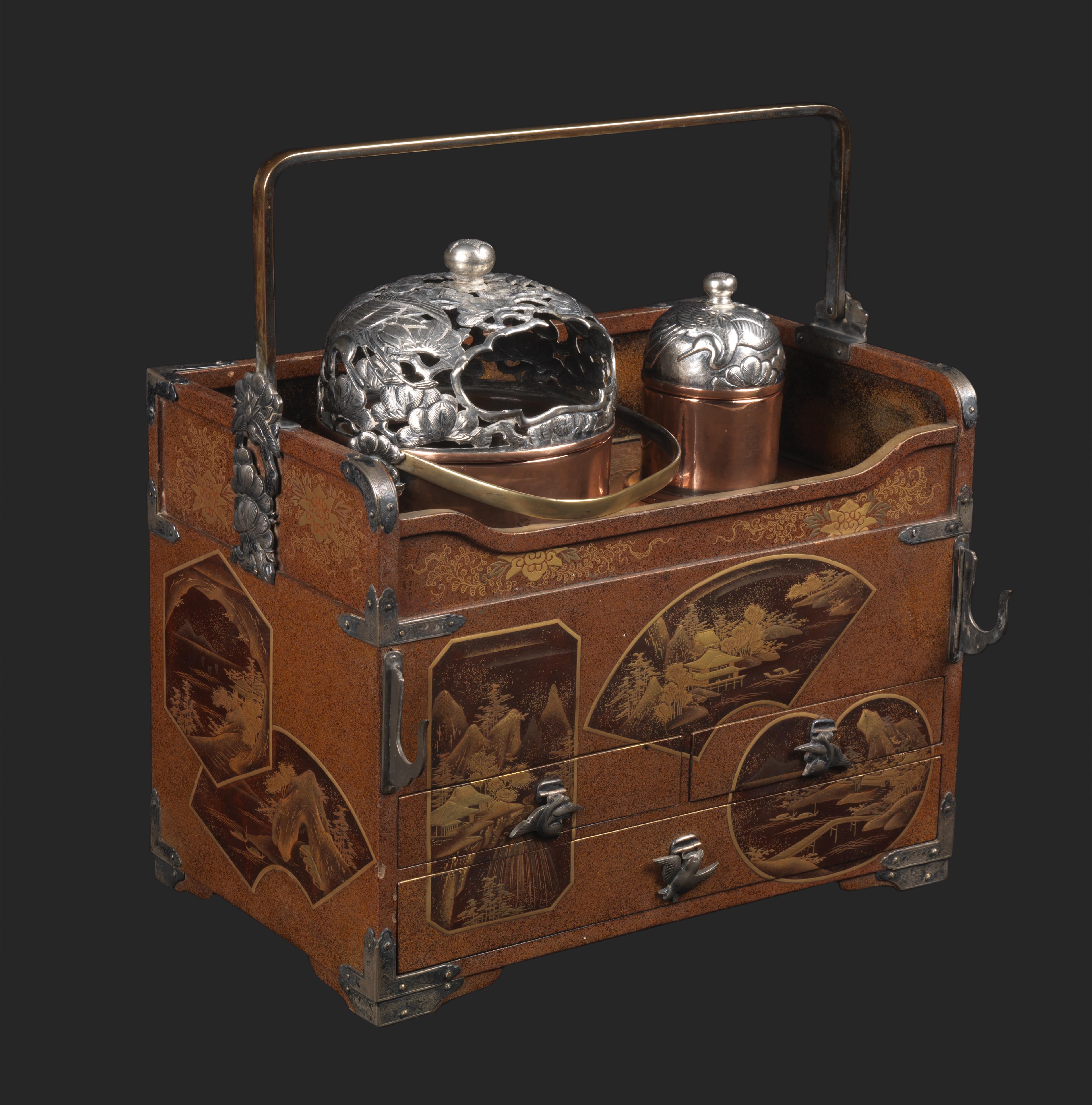
Given its size and carrying handle – which suggests a portable object – this smoking set was not intended to be hung from the belt of traditional clothing, unlike the inrō. These sets began to be widely used in the second half of the eighteenth century, having probably been introduced to Japan in the sixteenth century by the Portuguese.
All the decoration and lacquering on this piece, made up of floral motifs and geometric cartouches with landscapes, was mostly done using hiramakie and takamakie techniques, with kirikane details on a background of ‘black’ lacquer [roiro urushi] with kimpun.
The lower part of the box consists of a set of drawers, while the base of the upper support consists of a fixed, hollowed-out tray where the two silver-plated copper containers are inserted. These elements, with removable lids, functioned as a small furnace (the larger one) and an ash container (the smaller one). Also visible on the front are two silver hooks that open out to hold a pipe.
Object details
- Title
- Tabakobon (smoking set)
- Origin
- Japan
- Date
- 19th century
- Technique
- Nashiji lacquer; Lacquer\Kimpum lacquer; Hiramaki-e lacquer; Takamaki-e lacquer; Lacquer\lacquer Mura nashiji; Lacquer\Kirikane lacquer
- Materials
- Wood; Lacquer; Bronze; Silver; Copper; Gold
- Dimensions
- Height 22,00 cm; Width 23,00 cm; Depth 14,00 cm
- Inventory no.
- 1372
Incorporation
- Type
- Unknown
- Date
- [February 1894?]