
Mosque lamp
Gallery
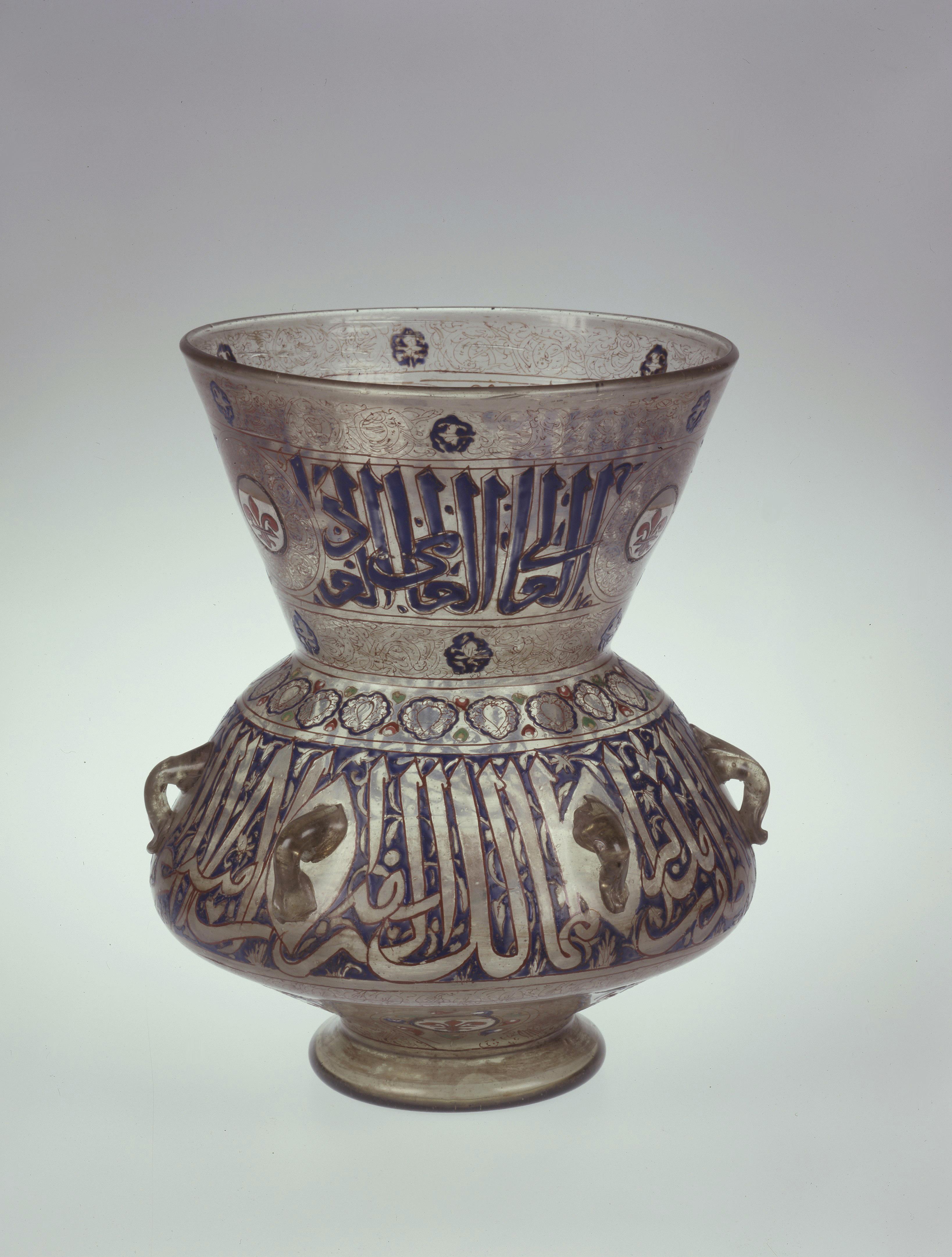
Light and its myriad effects have always fascinated artists in the Islamic world. In the Quran (24:35), God is compared to light: ‘God is the Light of the heavens and the earth. The example of His light is that of a niche, within which there is a lamp; the lamp is within a glass – the glass as it were a glittering star’. The lamp thus became the symbol of divine light.
Transparent glass vessels gilded and painted in polychrome enamels, made in Egypt in the thirteenth and fourteenth centuries, represented the height of glass working globally. This lamp was made for Amir Mahmud ibn Shirwin (c. 1346–47) and bears his heraldic emblem: a red fleur-de-lys on a white ground. The heraldic form of the fleur-de-lys is of Islamic origin and was adopted in Europe after the Second Crusade (1145–49), as a response to what the Crusaders had witnessed in the Middle East.
Object details
- Title
- Mosque lamp
- Origin
- Egypt
- Date
- Mamluk period, after 1321
- Technique
- Enamelled, gilt and blown glass
- Materials
- Glass
- Dimensions
- Height 33,50 cm; Diameter 26,00 cm
- Inventory no.
- 1032
Incorporation
- Type
- Purchased
- Place
- London
- Date
- 11 Aug 1919