
Inro (case)
Gallery
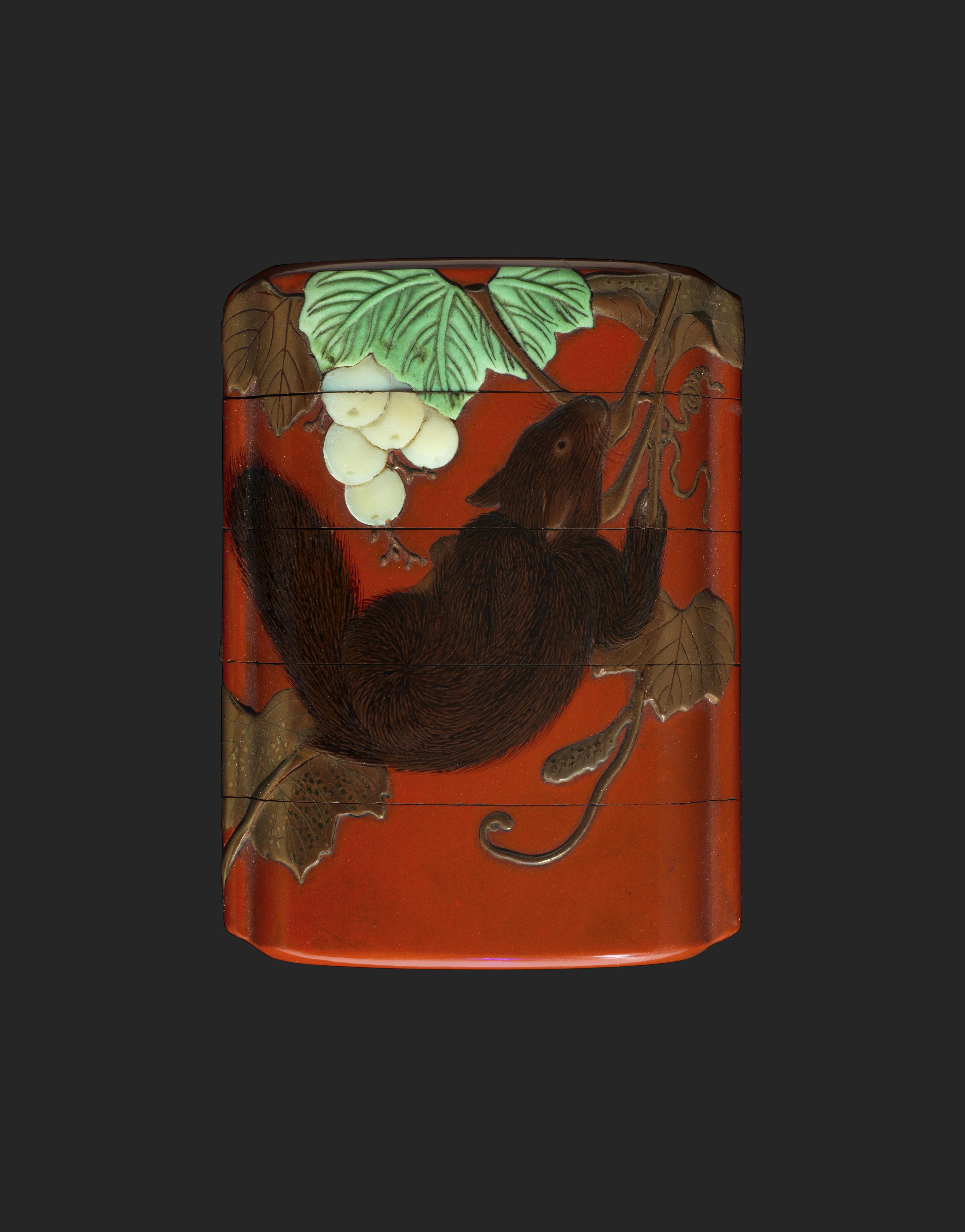
Inrō were essentially cases for carrying small objects (such as a personal stamp or medicines) and were associated with traditional men’s clothing, which had no pockets. Suspended from the sash, the wide belt of the kimono, they became sophisticated fashion accessories thanks to the decorative talents of the Japanese craftsmen involved in their creation.
Hara Yoyosai, who worked in Edo and was tasked with design and lacquering, decorated this four-sectioned inrō with an image that extends across the entire piece, depicting a squirrel suspended from the branches of a vine, applied using hiramakie (paint sprinkled with gold particles), kirikane and takamakie (other gold application techniques), with inlays of mother-of-pearl and gemstones on urushi of various shades.
Inside, the inrō is decorated using another decorative technique, nashiji, a mixture of ‘black’ lacquer and gold, exuberant in its appearance and reflection.
Object details
- Author(s)
- Hara Yoyosai (1772 – 1845), Lacquer artist
- Title
- Inro (case)
- Origin
- Japan
- Date
- late 18th – early 19th century
- Technique
- Hiramaki-e lacquer; Takamaki-e lacquer; Urushi-e lacquer; Lacquer\Kirikane lacquer; Inlay; Lacquer\Nashiji lacquer
- Materials
- Lacquer; Mother of pearl; Hardstones; Wood
- Dimensions
- Height 7,50 cm; Width 5,50 cm; Depth 2,50 cm
- Inventory no.
- 1364
Incorporation
- Type
- Purchased
- Place
- Christie's, London
- Provenance
- Coleção Sir Trevor Lawrence
- Intermediary
- B. Coureau
- Date
- 4 Dec 1916