
Fabric fragment
Isfahan, Safavid period, 16th-17th centuries
Gallery
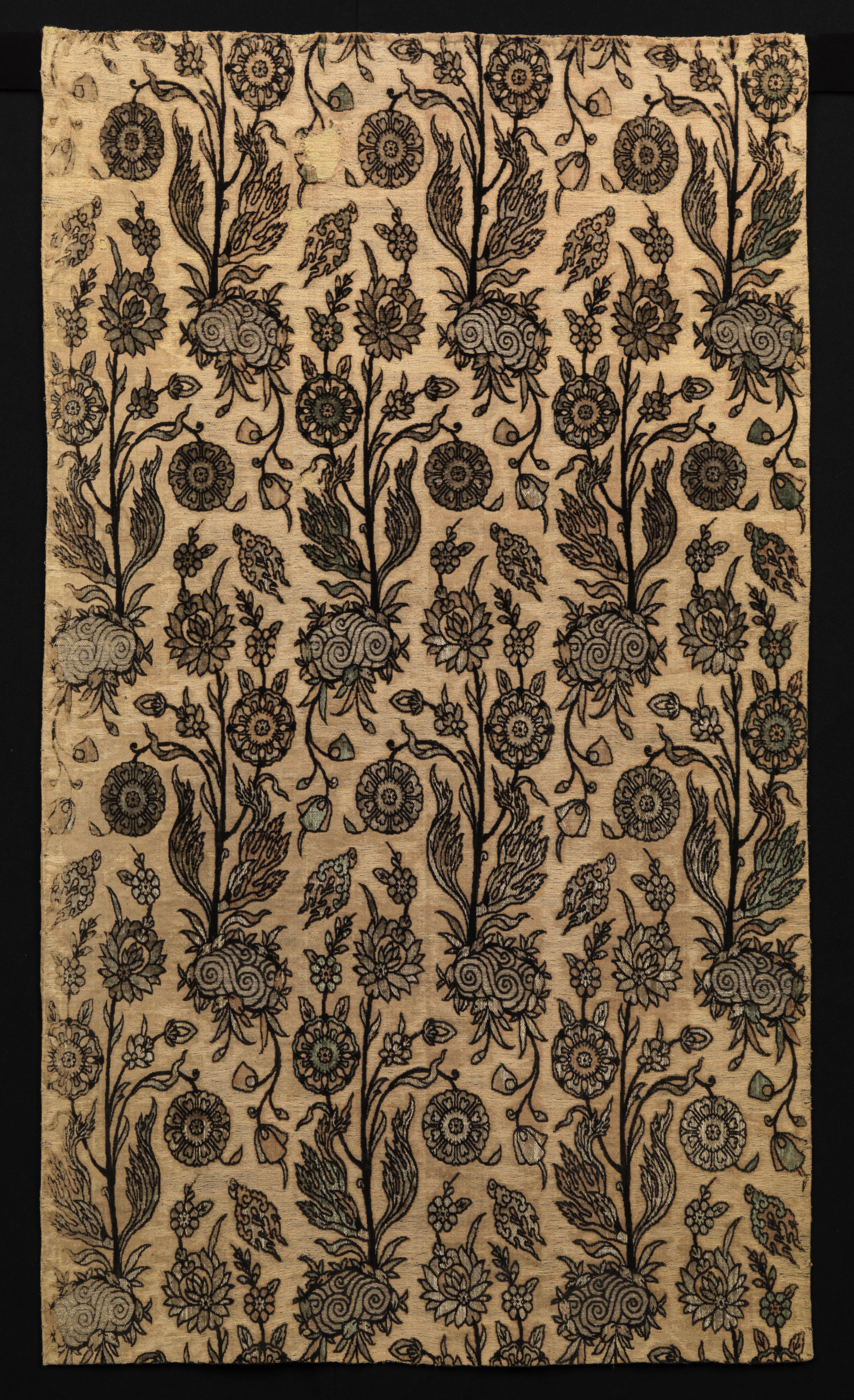
In the seventeenth century, floral decoration dominated all across Persia, Turkey and India.
In this fragment we can observe rows of flowers that are repeated, stylised, and elegantly arranged, with a highly aesthetic spatial organisation. The designers who produced these patterns had to have mathematical and weaving knowledge to make the designs feasible for the loom.
This type of precious fabric was used for decoration purposes inside palaces and tents, its considerable cost making it a sign of high social status and economic power.
Velvets like this were produced in urban, often imperial, workshops and were intended for use at court.
There is a very similar fragment in the Metropolitan Museum of Art in New York.
Object details
- Title
- Fabric fragment
- Origin
- Isfahan
- Date
- Safavid period, 16th-17th centuries
- Technique
- Cut velvet
- Materials
- Silk; Metallic thread\Silver metallic thread
- Dimensions
- Height 117,00 cm; Width 70,00 cm
- Inventory no.
- 1437
Incorporation
- Type
- Purchased
- Place
- London
- Date
- 9 May 1911