
Dish
Gallery
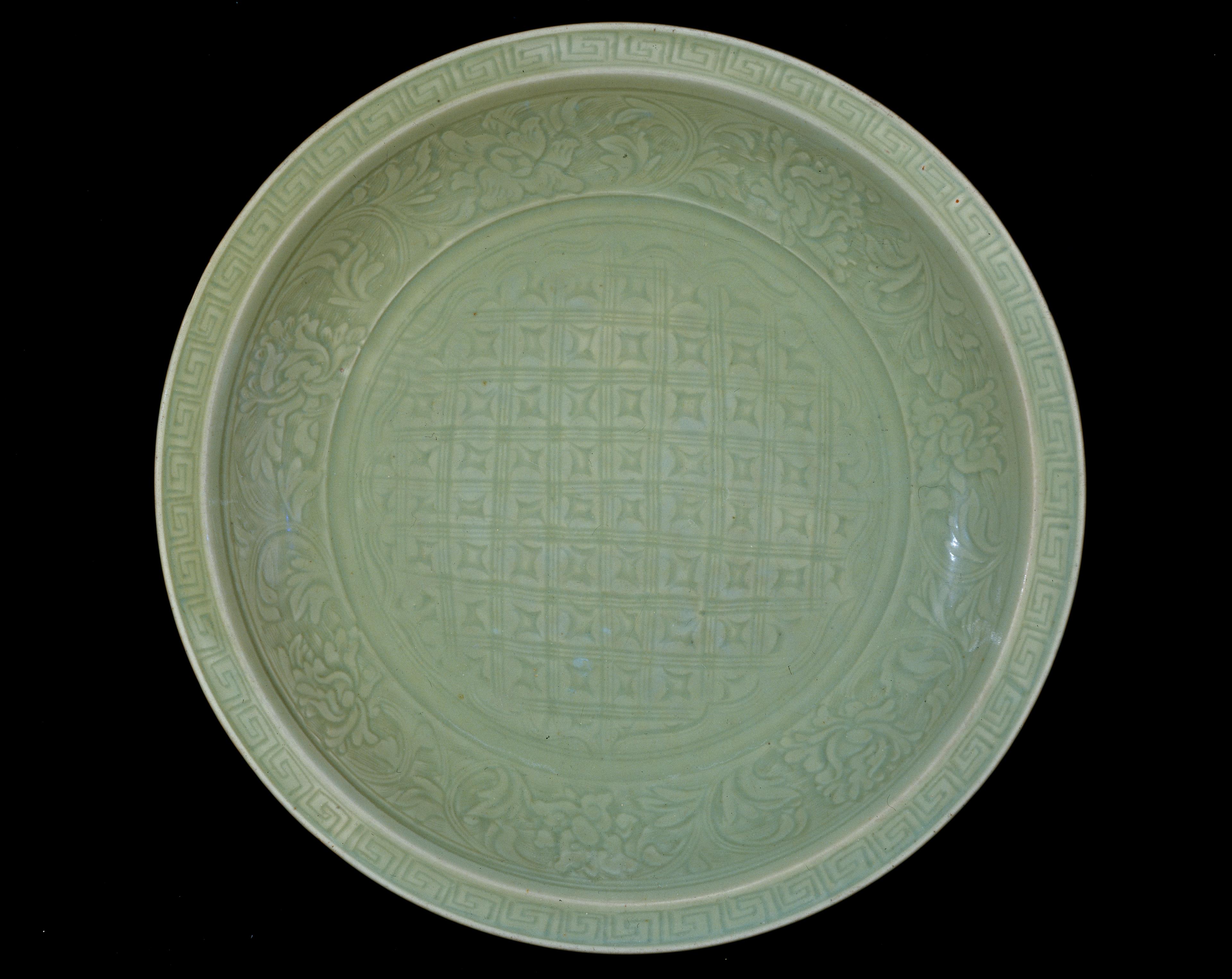
This greyish-green celadon dish with subtle geometric engraving stands apart from Calouste Gulbenkian’s usual taste for ceramics with brilliant glazes and naturalistic ornament. Indeed, the dish was not acquired by him but offered as a gift by the Gulbenkian family tutor, Setrak Devgantz.
Made of heavy stoneware, the centre is decorated with a foliate medallion filled with cash-and-trellis diaper, all incised under the greenish glaze. The well has peony scrolls in low relief, while Greek key motifs are incised around the rim.
Celadons were widely exported to Islamic markets, and several dishes with similar decoration can be found at the Topkapi Saray, in Istanbul. These wares were also well known in Europe from the fourteenth century, and the term ‘celadon’, still used today, came from France. The soft green glaze takes its name from the green ribbons worn by the shepherd Celadon, the hero of Honoré d’Urfé’s seventeenth-century novel L’Astrée.
Object details
- Title
- Dish
- Origin
- Longquan (Zhejiang province)
- Date
- Ming dynasty, 15th century
- Technique
- Stonepaste with incised and carved decoration under 'céladon' glaze
- Materials
- Ceramic\Stonepaste
- Dimensions
- Height 7,60 cm; Diameter 32,00 cm
- Inventory no.
- 920
Incorporation
- Type
- Donation
- Place
- London