
Apocalypse
Gallery
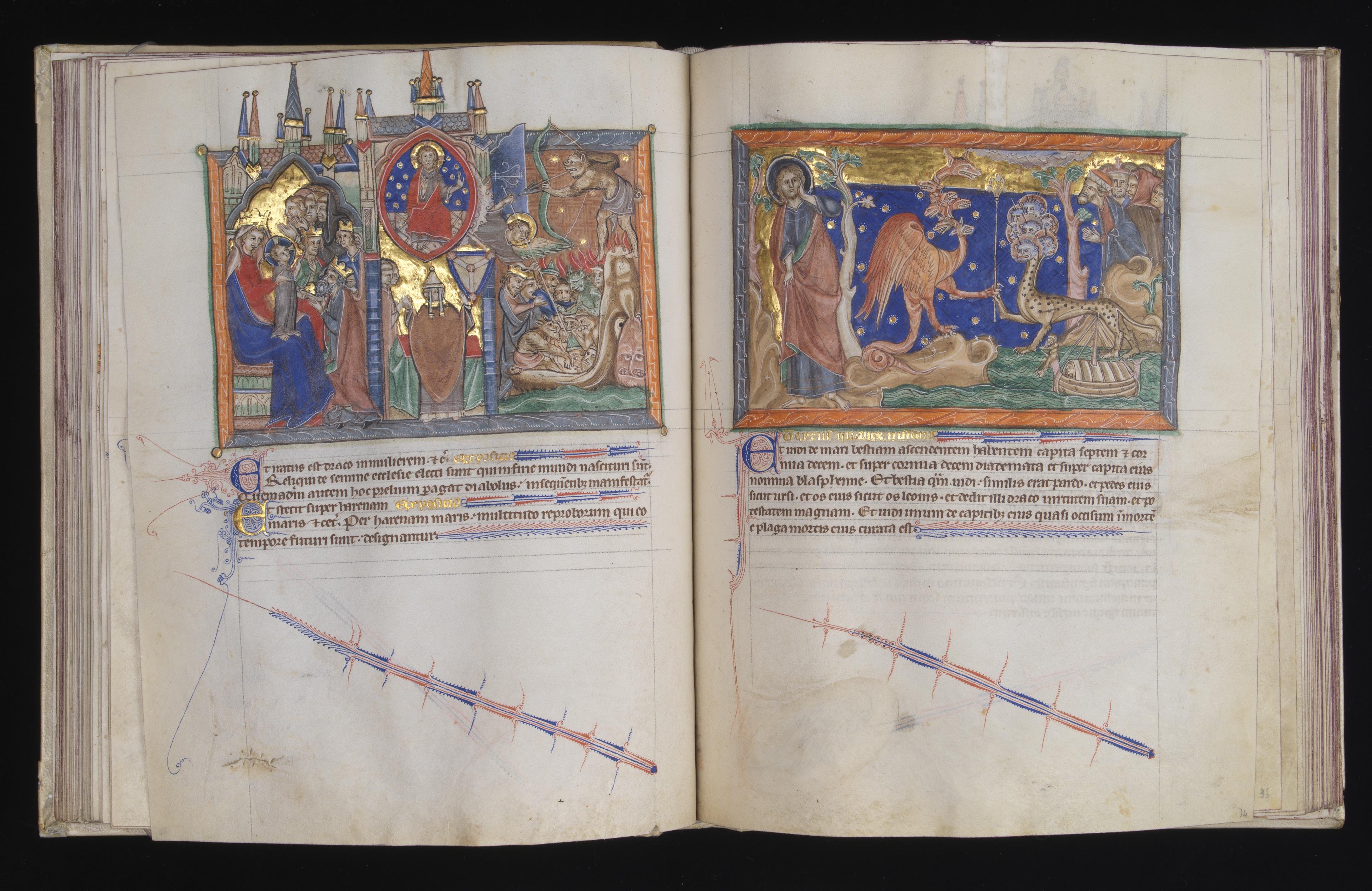
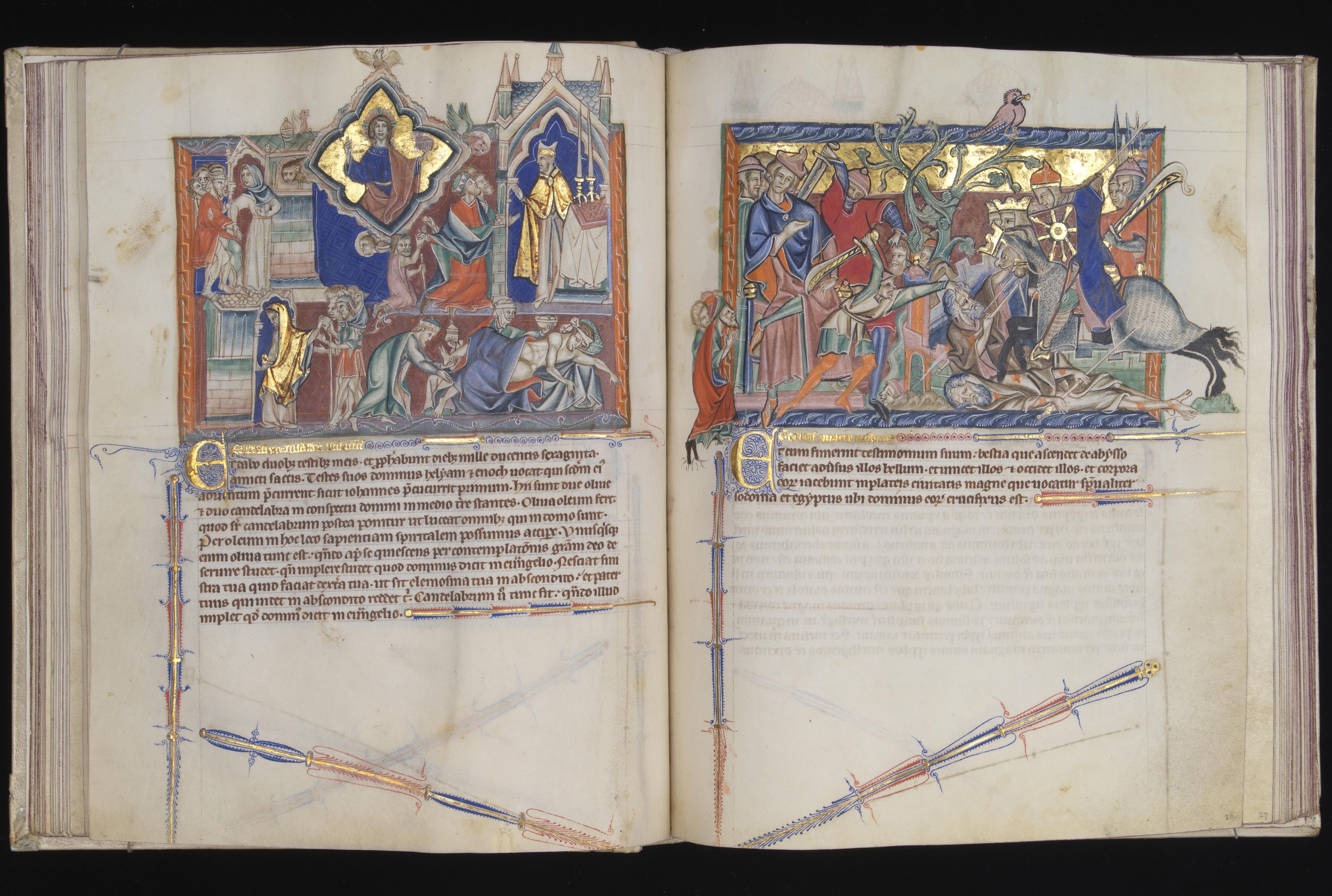
In England in the mid-thirteenth century, the biblical text of the Apocalypse was widely disseminated by means of manuscripts featuring extensive commentaries and illustrations. In the case of the Gulbenkian Apocalypse, probably produced in London, Salisbury or Winchester for an important patron, the author of the commentaries is Berengaudus of Ferrières.
Two other English Apocalypses from this period, the Lambeth and the Abingdon Apocalypses, contain commentaries by the same author and share artistic similarities with the Gulbenkian Apocalypse, for example in the rectangular frames that delimit the miniatures above the text, which is bordered by arabesques.
The folios reproduced here are very typical of this codex’s stylistic characteristics. Both in the miniature on the left, which illustrates a commentary by Berengaudus, and in the one on the right, which relates to a passage of the Apocalypse, there is a sense of dynamic action – in some places almost theatrical – in the way the figures inhabit the confined space of the representation. With vigorous poses and gestures and their clothing with angular folds, these figures often spill over the frames. The use of bright colours contrasting with the gold of the background and in some of the details reinforces the dynamism and intensity of the composition.
Object details
- Author(s)
- Iacob?, Copyist
- Title
- Apocalypse
- Origin
- London or Salisbury or Winchester
- Date
- c. 1265 – 1275; 18th century
- Technique
- Parchment manuscript
- Materials
- Parchment; Vellum
- Dimensions
- Height 27,40 cm (folio); Width 21,80 cm (folio); Height 28,40 cm (binding); Width 22,90 cm (binding); Thickness 3,10 cm (binding)
- Inventory no.
- LA139
Provenance
Incorporation
- Type
- Purchased
- Place
- Sotheby's, London
- Provenance
- Henry Yates Thompson
- Intermediary
- M. Devgantz
- Date
- 23 Mar 1920