
“I am very honoured that my first work for a cappella choir is being performed by the Gulbenkian Choir”
Interview with Andreia Pinto Correia
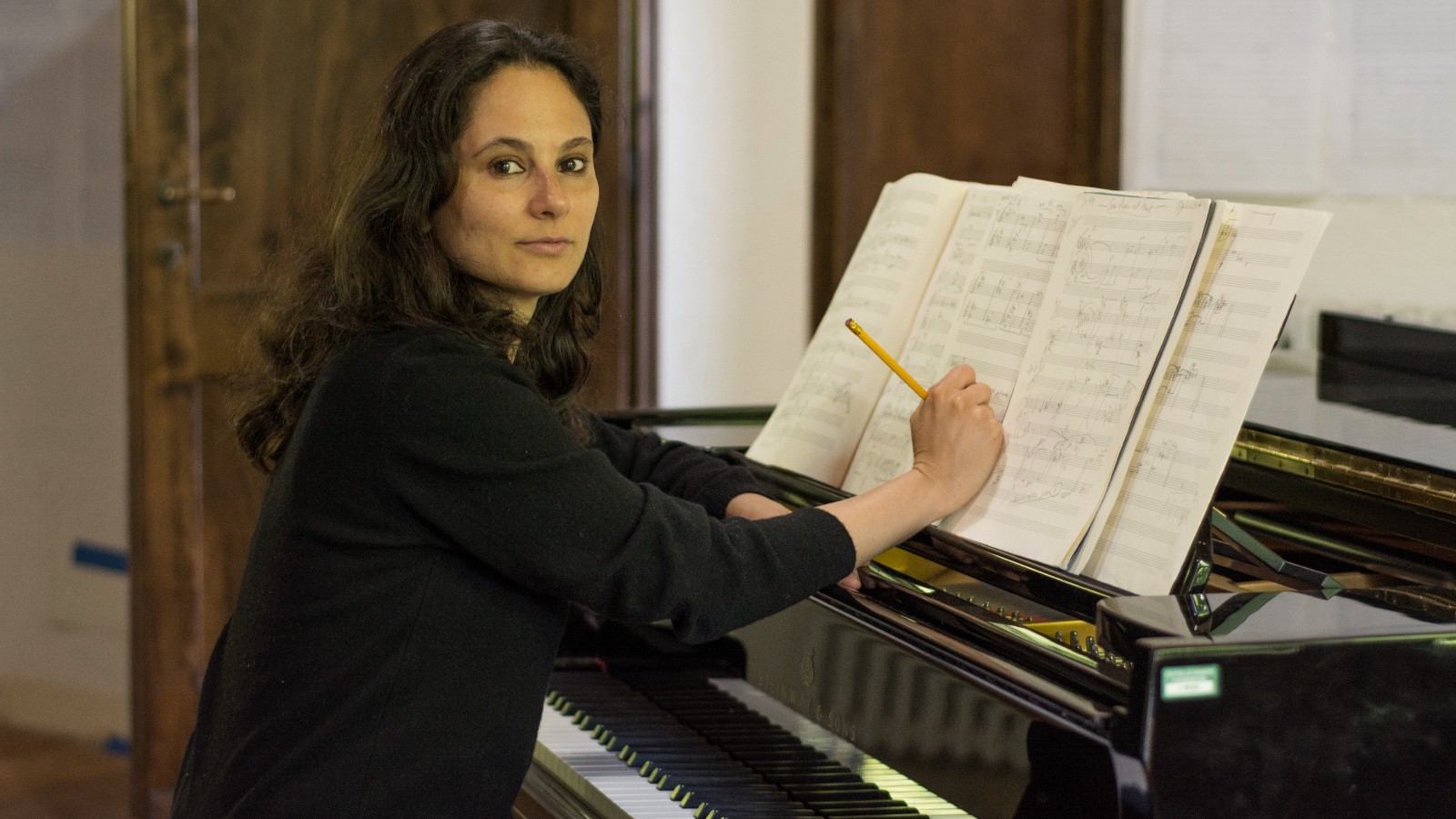
The work Deste mund’outro was commissioned by the Gulbenkian Foundation as part of the celebration of its 70th anniversary. How did you approach this challenge?
For me, it is always a great honour to be able to return to the Gulbenkian Foundation, an institution that has supported and welcomed me so warmly since my student days. I should add that my parents were avid visitors to the Foundation, both to the museum and the library, but also to concerts and, in their day, to the incredible ballet company, Ballet Gulbenkian.
And so, from childhood, I grew up surrounded by these wonderful gardens and in this very special place, absorbing its unique atmosphere. To be able to take part in this celebration of its 70th anniversary and in the first season of the new director, Fredrik Andersson, is undoubtedly very special.
But to answer the second part of your question, my initial reaction was to conceive a work that would have a strong connection with our country, language and culture, thereby establishing a link with the Gulbenkian Foundation’s mission.
In this context, the idea of using a medieval text was a natural continuation of the work I have been developing over the past few decades and, to a large extent, a consequence of my father’s influence and the experiences I had during my childhood. A Cantiga de Amor, in which we originally have a troubadour declaring his love for his senhor (“courtly” love), is thus transformed, with the object of Love—my Love, in this case—being my country, my language, my culture.
What led you to choose a cantiga de amor by Rui Queimado, a 13th-century Portuguese troubadour, as the starting point for composing this work in a contemporary language?
Deste mund’outro is a text (among other Cantigas de Amor and also Cantigas de Amigo) that has accompanied me for many, many years. A Cantiga de Amor which, by its nature, is a song in a male voice, is here amplified for an a cappella choir through the exploration of resonances, timbres, harmonic maps and distinct sound atmospheres.
Themes of distant love and nostalgia are ones with which I feel a strong affinity, perhaps because I am at a distance, living in another city, New York, always looking towards Portugal with a certain nostalgia and saudade. As such, this work represents a certain continuity with other works in my catalogue, in which I had already explored both structural questions and thematic aspects of medieval cantigas, but always in a purely instrumental context.
In this particular case, I worked on the structure of the piece by focusing my attention on certain sections of the text, using particular words and thematic moments as if they were structural seeds or, in some cases, harmonic anchors for a given section. For example, the words “moi’re”, “senhor” and “Deus” represent these key instants or moments in the composition, being, in a certain sense, moments of great temporal elasticity.
I should add that the text, being too extensive for this particular situation, was not used in its entirety. I hope that, in the near future, I will have the opportunity to return to this magnificent text.
Your choice may also have a personal motivation, linked to the work of your father, João David Pinto Correia, as a researcher of popular traditions. In what way did this influence the composition of Deste mund’outro?
My father’s world, with the regular presence of his mentors Lindley Cintra and Viegas Guerreiro, among other figures from our culture, left a profound mark on me. From childhood, I absorbed a sense of wonder and discovery that I hope never to lose—but also other immensely important values, such as hard work, discipline, a sense of mission and, above all, the enormous respect with which these great scholars—and here I include my father—devoted themselves to our rich and profound traditions.
Perhaps, unconsciously, I wanted my father—my parents—to be symbolically present in this work. I feel great sadness that they are not here to celebrate the Gulbenkian Foundation. To feel that I am continuing, in a personal way, with themes and affinities that were crucial throughout their lives and that profoundly shaped my own life is, without a doubt, extremely important to me. I should add that my mother, Maria Assunção Pinto Correia, although connected with German literature, wrote about Carolina Michaellis who, as you know, wrote a crucial work on our Romanceiro, Estudos sobre o Romanceiro Peninsular: Romances Velhos em Portugal, a work that I read voraciously as a teenager.
What was the process of transforming a medieval text into a work for a cappella choir? You have certainly followed the work of the Gulbenkian Choir over the years?
I certainly know the Gulbenkian Choir, which I have followed for many years, and which is an extraordinary choir. I am very honoured that my first work for a cappella choir is being performed by the Gulbenkian Choir and conductor Martina Batič. Many years ago, I wrote for choirs both in Portugal and in the US, but in a different context, writing works for children’s choir accompanied by a chamber ensemble. Although my work has had a strongly orchestral dimension for several decades, I have always felt a great affinity with the voice, undoubtedly our supreme instrument.
To answer the first part of your question, the use of medieval texts and themes in the light of contemporary sensibilities is something that greatly appeals to me. As for the process of transforming this particular medieval text, Deste mund’outro is perhaps a more conservative work within the context of my catalogue. It is a work in which priority is given to exploring the resonance of the voices, within a certain register of spirituality and nostalgia, surely anchored in respect for a magnificent text.
Finally, I believe it is relevant to mention that, before beginning the composition process and in the absence of my father, who had always been a reference point in my works connected with our traditions, I contacted several academics who very generously welcomed me and assisted me with questions relating to the text. I would like to thank Professors Manuel Pedro Ferreira, Esperança Cardeira and Pedro Cardim for their availability and kindness. I would also like to make a brief note about the excellent website of NOVA University Lisbon on Galician-Portuguese Medieval Cantigas.
You may also like

No results were found for your criteria.