Alberto Carneiro (1937-2017)
Uma floresta para os teus sonhos, 1970 / Inv. 96E379

Programa «Abertura do novo CAM»

A exposição ocupou a galeria situada no piso inferior, um espaço longitudinal, austero e marcadamente estreito, caracterizado pela ausência de luz natural. A entrada era desde logo marcada pela presença de Hamish Fulton, reconhecido artista britânico cuja prática artística se construiu a partir das suas caminhadas por diferentes geografias do mundo. A sua grande colagem em vinil Tide Line (1994–2005), apresentada como prelúdio à exposição, imediatamente antes da entrada da galeria, deu-lhe o título. Evocando a caminhada realizada pelo artista ao longo da costa portuguesa, a obra articula clareza gráfica, precisão verbal e uma dimensão discretamente poética: «Two days walking north, two days walking south. Atlantic coast Portugal, January full moon 1994.»
Para além da referência direta a Hamish Fulton e da ligação particular desta obra a Portugal, o título remete para a oceanografia, designando o ponto onde duas correntes convergem, formando linhas sinuosas à superfície da água – as chamadas tidelines. Esta dimensão aquática, bem como a ideia de fluxos que se cruzam, convergem e se transformam mutuamente, estruturava conceptualmente toda a exposição, concebida como um conjunto orgânico e fluido de obras contrastantes, organizadas em torno de cinco núcleos temáticos que se intersectavam e entrelaçavam.
Distanciando-se de uma apresentação cronológica convencional, as obras, apesar de pertencerem a diferentes períodos históricos, misturavam-se e respondiam entre si. Procurando preservar a sensação de abertura e unidade do espaço expositivo, as curadoras evitaram cuidadosamente separar rigidamente os diferentes núcleos através de painéis murais, textos explicativos ou sinalética demasiado compartimentadora.
Em coerência com o conceito museográfico desenvolvido pela equipa curatorial do CAM – que procurava transformar a galeria convencional num espaço orgânico, onde a relação com o mundo vivo pudesse ser simultaneamente questionada e redescoberta –, o estúdio berlinense Diogo Passarinho foi convidado a conceber o desenho expositivo. Em vez de se desenvolver ao nível do solo, a intervenção cenográfica afirmava-se a cerca de seis metros de altura, imediatamente abaixo do teto. Painéis retangulares curvos, suspensos e executados em tecidos leves, criavam discretas zonas aéreas, formando um contínuo ondulante que atravessava toda a galeria.
Os cinco núcleos temáticos cruzavam-se assim de forma natural, tal como as obras reunidas em cada um deles estabeleciam ligações explícitas ou implícitas com outras secções da exposição. Algumas peças assumiam mesmo a função de criar passagens subtis entre núcleos distintos, ocupando posições estrategicamente pensadas no espaço. Embora estas relações fossem, antes de mais, conceptuais e temáticas, emergiam igualmente afinidades formais e estéticas entre obras muito distintas.
Na galeria longitudinal, com cerca de 600 metros quadrados, uma sequência de instalações ao nível do chão pontuava o percurso dos visitantes, assinalando e conferindo destaque a cada núcleo temático. Estas cinco grandes instalações funcionavam como elementos estruturantes da exposição, servindo de pontos de concentração em torno dos quais os diferentes conjuntos de obras se organizavam. Em todos os núcleos, cruzavam-se suportes e linguagens muito diversos, da pintura, desenho e escultura à fotografia, filme e vídeo.
Para além da forte presença de obras contemporâneas – incluindo numerosas aquisições recentes –, o projeto curatorial procurou estabelecer um diálogo explícito e contínuo com um conjunto de obras emblemáticas da arte portuguesa pertencentes à coleção do museu. A presença de artistas históricos e modernistas visava precisamente criar relações inéditas e inesperadas com obras mais recentes da coleção CAM. Destacadas museograficamente pela forma como surgiam em relevo sobre as paredes, encontravam-se aqui obras de Amadeo de Souza-Cardoso, António Carneiro, Eduardo Viana, Maria Helena Vieira da Silva, Mário Eloy e Mário Cesariny, entre outros. Distribuídas ao longo de toda a galeria, estas obras revelavam afinidades subtis com os grandes eixos estruturantes da exposição.
Espelhando a riqueza e a ampla abrangência cronológica da coleção CAM, o conjunto apresentado em «Linha de Maré» atravessava praticamente todo o século XX, desde a década de 1910 até à contemporaneidade. A este arco temporal somava-se ainda um salto inesperado até meados do século XIX, com a inclusão da obra mais antiga da coleção: Regresso da vaga (1847), paisagem romântica de João Cristino da Silva.
No contexto das comemorações dos cinquenta anos da Revolução dos Cravos, a exposição ancorava a sua estrutura temática na ideia de revolução. Partindo de um acontecimento histórico e nacional específico, o conceito expandia-se para uma reflexão mais ampla sobre a revolução enquanto ideia e sobre as transformações que o estado contemporâneo do mundo continua a exigir. Os cinco núcleos temáticos – «Transgressão», «Manifesto», «Interioridade», «Mutação» e «Evocação» – organizavam esse percurso conceptual. Como se afirmava na definição inicial do projeto: «A revolução necessária deixou de ser apenas transgressão para ser também mutação, apenas local para ser também global, apenas exterior para ser também interior, apenas escrita e programática para ser também ação manifesta, apenas realidade para ser também matriz utópica e intemporal».
A par da noção de revolução, a articulação entre estes cinco núcleos era igualmente sustentada por uma reflexão sobre a relação da humanidade com a natureza e, de forma mais abrangente, com o mundo vivo. Como um fio condutor entrelaçado, a revolução e a interação com o vivo – ora conflituosa, ora harmoniosa – atravessavam simultaneamente a política, os grandes movimentos ideológicos e sociais e conceitos como subversão, desvio, destruição, resistência, introversão ou união.
O primeiro núcleo, «Transgressão», ancorava-se na experiência da ditadura portuguesa e na rutura histórica representada pela Revolução de Abril de 1974, evocada no ano do seu quinquagésimo aniversário. Reunidas em torno da projeção do filme Le Passeur (2008, 34’30’’), de Filipa César, as obras apresentadas neste núcleo refletiam sobre os ecos desse momento histórico no tempo e no espaço: as guerras coloniais, os movimentos de deserção e migração, os processos de independência em Angola e Moçambique, bem como as múltiplas reverberações do período pós-revolucionário. Dialogavam com a obra de Filipa César a instalação vídeo Soldier Playing with Dead Lizard (2008), de Daniel Barroca, duas fotografias da série Confidencial/Desclassificado (2007–2008), de Manuel Botelho, o filme Path to the Stars (2022), de Mónica de Miranda, e a fotografia Blackness, Cabinda (2008), de Kiluanji Kia Henda.
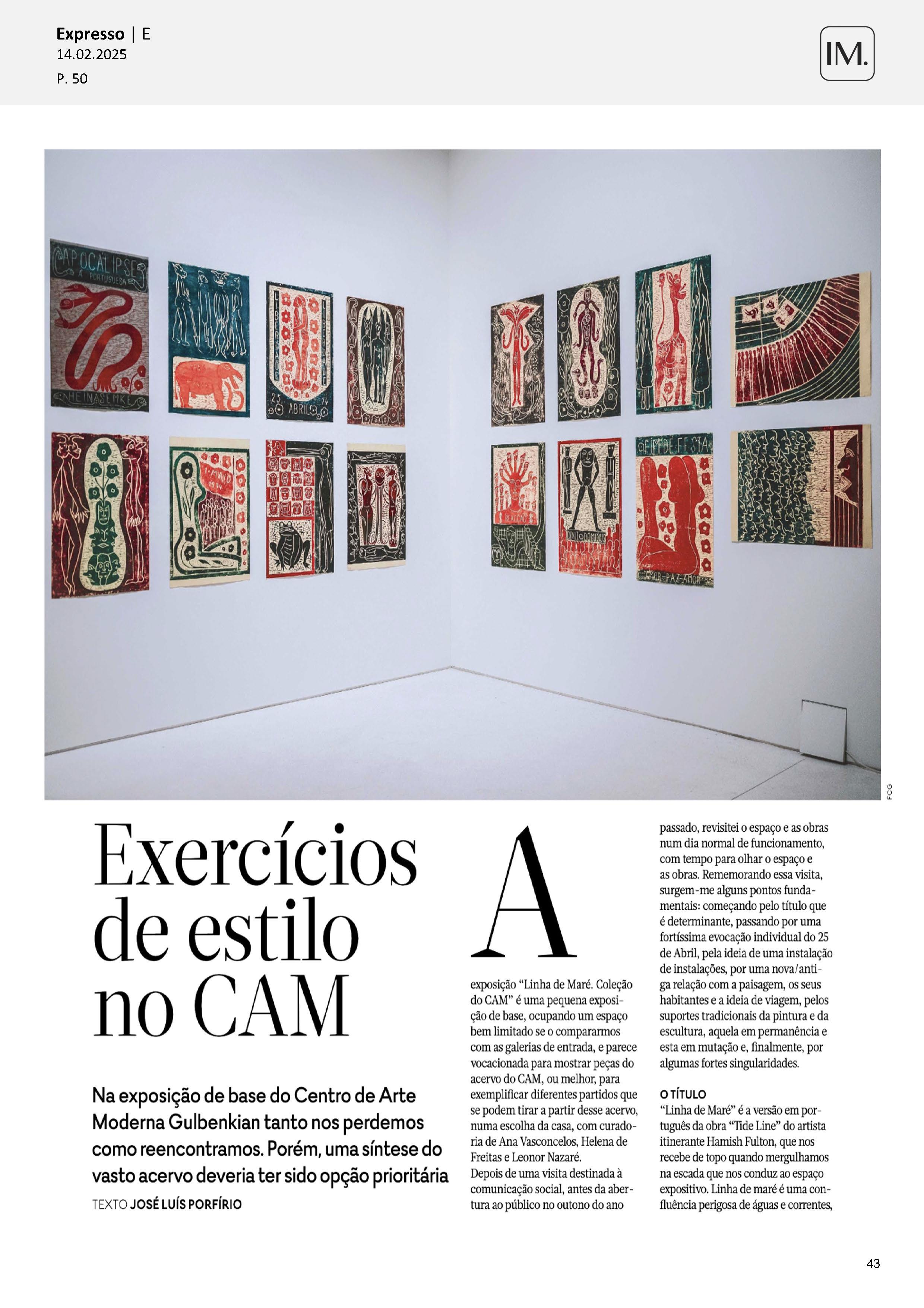
A série de dezoito xilogravuras de Hein Semke, cujos títulos remetem diretamente para os anos da ditadura, da revolta e para os dias da Revolução dos Cravos, expandia esta reflexão sobre a transformação radical para um registo mais poético, onírico e metamórfico. Outras obras deslocavam o conceito de revolução para contextos mais amplos, como Stabat Mater (2006), de Jorge Pinheiro, com a sua referência a Eisenstein e à Revolução Bolchevique de outubro de 1917.
O segundo núcleo, «Manifesto», prestava homenagem a Alberto Carneiro e às suas Notas para um manifesto de arte ecológica (1968–1972), primeira proclamação portuguesa deste género. A secção explorava ideias de liberdade artística, compromisso e ativismo em defesa da natureza, estendendo-se a uma reflexão sobre a sua regeneração e capacidade reparadora. No centro deste núcleo encontrava-se a monumental instalação imersiva Uma floresta para os teus sonhos, cuja presença se impunha de imediato pela escala. Composta por 200 troncos de pinheiro de diferentes dimensões e alturas, distribuídos num conjunto com 36 metros de diâmetro, a obra foi concebida para ser atravessada, sentida e tocada. Durante o período inicial de maior afluência, contudo, o CAM viu-se temporariamente obrigado a restringir essa dimensão participativa à contemplação visual.
Este núcleo reunia ainda obras associadas a motivos naturais, nomeadamente paisagens de Amadeo de Souza-Cardoso e Miguel Branco, mas também referências a modos de vida alternativos e a uma relação mais essencial com a natureza, como a evocação do livro de culto Walden. Life in the Woods, de Henry David Thoreau, convocado por João Louro através da reprodução ampliada e pintada da sua capa. A presença de um curso de água filmado num dos vídeos experimentais e não narrativos realizados por Ângelo de Sousa na década de 1970, bem como obras marcadas por cromatismos terrosos ou pelo recurso a materiais naturais – como a têmpera e a argila crua em Madrid-Vallauris (1969), de Joaquim Rodrigo, ou The First Step (1995), de Maria José Oliveira – aprofundavam esta relação entre criação artística, matéria e mundo natural.
Libertos da ancoragem inicial em acontecimentos históricos e referências especificamente nacionais, os três núcleos seguintes deslocavam a reflexão para um plano mais universal. Segundo o texto introdutório da exposição, o terceiro núcleo, «Interioridade», remetia para «a interioridade da experiência proporcionada pelas obras de arte». Esta formulação podia ser entendida sob diferentes perspetivas: quer a partir da poiesis, através de obras que exploravam espacialidades ambíguas entre interior e exterior ou dimensões metafóricas da vida interior; quer do ponto de vista da receção, considerando o movimento introspectivo que estas obras podiam suscitar no visitante.
A instalação central deste núcleo distinguia-se pela sua presença simultaneamente escultórica e enigmática. Journey into the Unknown Interior Through Parallel Lines (2015), de Graça Pereira Coutinho, consistia numa vasta estrutura cúbica, simultaneamente aberta e fechada. Composta sobretudo por fios verticais e paralelos de sisal e algodão, convidava o visitante a perscrutar esta densa trama fibrosa para entrever um espaço interior íntimo que, paradoxalmente, parecia querer preservar a sua inacessibilidade. A pintura Composition (1936), de Vieira da Silva, com a sua rede de linhas entrecruzadas, revelava afinidades formais evidentes com os fios suspensos de Pereira Coutinho. Já a série Invisible Chains (2005), de Maria José Oliveira – quatro obras sobre papel vegetal – evocava fragmentos corporais, órgãos ou peles animais, convocando a ideia de interioridade em relação ao corpo vivo, morto ou desmembrado. A preservação surgia aqui como palavra-chave, preparando a transição para a reflexão sobre as ameaças que recaem sobre o mundo vivo e a biosfera.
O quarto núcleo, «Mutação», assumia uma perspetiva mais crítica, inquietante e distópica, centrando-se em questões associadas ao pós-humanismo ou transumanismo. Reunia obras que abordavam temas como dissolução, hibridação, excesso tecnológico ou substituição da naturalidade pela artificialidade. A instalação central, Close II (1993), de Anthony Gormley, propunha uma imagem particularmente contundente da condição humana. A escultura representa uma figura humana com braços e pernas abertos; mas, ao contrário da verticalidade afirmativa do modelo vitruviano, surge cravada diretamente no chão, de bruços, como um corpo tombado.
Este núcleo reunia ainda as paisagens biológicas fotográficas de Tim Head, os universos subaquáticos virtuais de Miguel Soares em vídeos de animação 3D, e a forma escultórica mural, escura e indecifrável, de Rui Chafes. A pintura de Rosa Carvalho, representando carne animal crua, podia remeter tanto para a escravização e exploração industrial dos animais como para a crescente artificialização da alimentação e a tendência da chamada carne sintética.
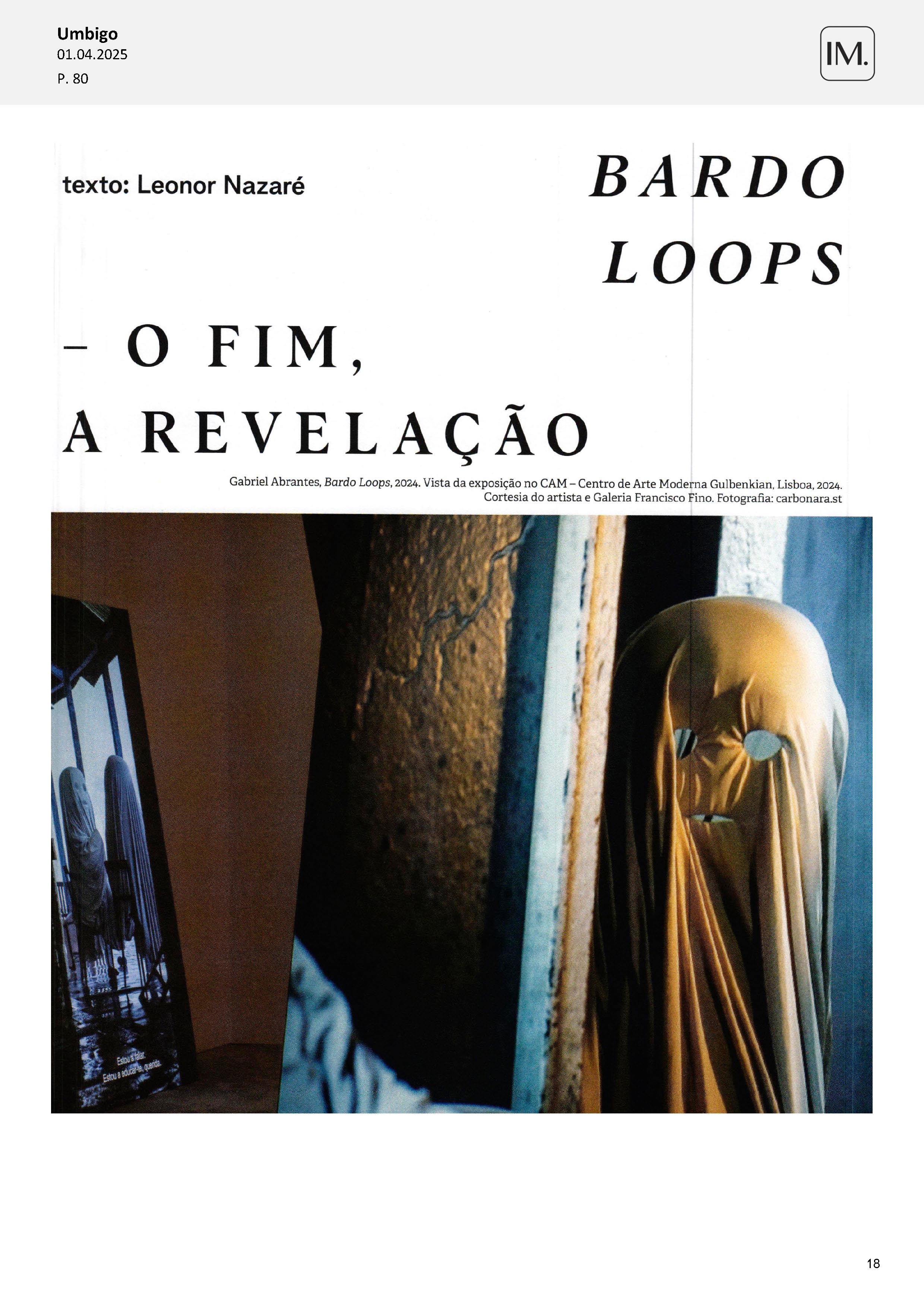
Embora não instalada na galeria principal, mas na adjacente Drawing Room, a obra central associada a este núcleo – encomendada pelo CAM – era a instalação vídeo Bardo Loops, de Gabriel Abrantes. Composta por quatro curtas-metragens apresentadas em simultâneo, em loop, sobre ecrãs verticais inclinados, a obra desenvolvia narrativas melodramáticas atravessadas por ansiedade existencial, protagonizadas por fantasmas que falam, vivem e agem como seres humanos. Inspirando-se em episódios autobiográficos, Abrantes explorava aqui a ideia de desastre em múltiplas escalas e naturezas: individual e coletiva, interior e exterior, real e surreal, vivida ou antecipada. No universo visual e conceptual do artista, os fantasmas tornavam-se representantes da perda acelerada da humanidade e do mundo vivo. Simultaneamente patéticas e trágicas, estas figuras permaneciam aprisionadas num circuito perpétuo, como uma metáfora de uma humanidade cada vez mais enclausurada em impasses artificiais e sem saída[1].
Outro elemento distintivo deste núcleo era a deslocação de duas obras para fora da galeria principal: Manifestation (2004), de Gil Heitor Cortesão, e Citymobil (1967–68), de António Costa Pinheiro, ambas instaladas na área contígua à entrada, próxima da obra inaugural de Hamish Fulton. Esta última, versão lúdica dos projetos urbanísticos utópicos característicos da década de 1960, composta por 55 elementos arquitetónicos, encenava a chegada de visitantes oriundos de um planeta altamente evoluído, onde guerra, violência, fome, fronteiras, discriminação ou crimes ambientais simplesmente deixaram de existir.
O quinto núcleo, «Evocação», retomava, nas palavras das curadoras, as «evocações de uma ligação real ao mundo vivo». Depois da passagem pelo território da tecnologia e das distopias pós-humanas, a exposição propunha aqui um regresso à relação entre humanidade, natureza e biosfera – entendida como a camada viva da Terra onde a vida orgânica se manifesta –, agora sem a mediação tecnológica. Uma das instalações mais marcantes deste núcleo era 19-degree rotation, translation and plumb line (2013), de Inês Botelho. A obra consistia num grande vaso branco de argila, invertido, colocado sobre a circunferência de um círculo branco desenhado no chão, ao qual se ligava uma corrente de ferro negra que se erguia verticalmente com precisão quase impossível, como se obedecesse a uma força invisível ou estivesse ligada a outra dimensão por uma espécie de magnetismo oculto. A instalação podia evocar a imagem de um corpo celeste que, vindo do espaço, tivesse alcançado a superfície terrestre.
A este núcleo pertenciam também uma paisagem surrealista de António Pedro (1947), a homenagem de Mário Cesariny a Marcel Duchamp sob a forma de um «Quadro muito doente» (1977), bem como paisagens contemporâneas de Paulo Brighenti e Maria Capelo. No extremo da galeria, a grande instalação vídeo Tour du Mont-Blanc (2014), de Pedro Vaz, funcionava como elemento conclusivo entre as grandes estruturas da exposição. De natureza contemplativa, a obra mergulhava o visitante numa vasta paisagem montanhosa. Realizada a partir de uma expedição pedestre ao Mont Blanc, estabelecia um fecho particularmente coerente com a peça inaugural de Hamish Fulton, completando o percurso através de uma evidente afinidade conceptual.
A maioria das aquisições recentes selecionadas para a exposição pertencia a artistas portugueses contemporâneos, entre os quais Mónica de Miranda, Rui Chafes, Paulo Nozolino, Graça Pereira Coutinho, André Romão, Maria Capelo, Inês Botelho, Rosa Carvalho, Daniel Barroca, Filipa César e Maria José Oliveira. A exposição constituiu, por isso, uma oportunidade para apresentar publicamente, pela primeira vez, parte significativa destas incorporações recentes. Outro conjunto expressivo de obras datava das décadas de 1990 e 2000, incluindo artistas como Bruno Pacheco, João Queiroz, Richard Deacon ou Michael Biberstein. Obras mais antigas, produzidas entre as décadas de 1950 e 1980, integravam igualmente o percurso, com nomes como Lourdes Castro, Fernando Calhau, António Dacosta, Graça Morais, Rui Leitão e Luís Noronha da Costa.
A exposição foi continuamente ativada por um programa paralelo de mediação e visitas. O ciclo «À conversa com as curadoras / Talking with the Curators», dirigido a todos os públicos, consistiu em visitas mensais conduzidas por Leonor Nazaré e Ana Vasconcelos, concebidas para explorar as múltiplas propostas, hipóteses e leituras abertas pela exposição. Paralelamente, o serviço de mediação do museu – Carlota Espinha, Carlos Carrilho, Cristina Campos, Daniella Figueiredo e Raquel Feliciano – assegurou visitas regulares sob o título «Linha de Maré – Tensões e revolução», com duração de noventa minutos, realizadas três vezes por semana. No âmbito da programação do Cartão Gulbenkian Mais, foi ainda organizada a visita exclusiva «Correntes de mudanças».
No contexto da muito aguardada e amplamente mediatizada reabertura do CAM – marcada pela renovação do edifício, pela nova pala arquitetónica e decorativa e pela reformulação da área ajardinada –, as referências a «Linha de Maré» multiplicaram-se. O press kit dedicado ao conjunto destes acontecimentos estendia-se por várias centenas de páginas. Entre os textos publicados, destaca-se o artigo de José Luís Porfírio, no Expresso de 14 de fevereiro de 2025, talvez o principal – senão o único – texto dedicado especificamente à exposição, sem mergulhar nas discussões mais amplas em torno da direção, funções ou posicionamento institucional do CAM, ou na questão da acessibilidade pública à reserva visitável instalada no final da Galeria da Coleção. Sob o título «Exercícios de estilo no CAM», o autor discute as orientações curatoriais da exposição, o confronto entre obras históricas e contemporâneas da coleção e sublinha algumas das peças selecionadas.
No contexto da controvérsia mais ampla gerada pela reabertura do museu e pelas suas orientações estruturais, «Linha de Maré» foi também alvo de críticas públicas, nomeadamente nas redes sociais. Entre as objeções levantadas encontravam-se a escolha da galeria subterrânea para a apresentação da coleção – considerada por alguns um espaço árido e desligado dos jardins exteriores –, a apresentação temática e não histórica da coleção, bem como a ausência de algumas obras emblemáticas da arte portuguesa do século XX. Como exemplo representativo deste movimento crítico, destaca-se o artigo de Isabel Salema e Lucinda Canelas, publicado no Público a 11 de setembro de 2024, bem como o texto intitulado «Há “festa” na Gulbenkian com a reabertura do CAM, mas onde está o museu?».
[1] Sob o título Arguments in Favor of Love, Bardo Loops integrou a competição da seleção oficial do Festival de Cannes de 2025, tendo recebido um prémio da crítica. Após a apresentação em «Linha de Maré», a instalação será exibida na Collection Lambert, em Avignon (outono de 2025). Leonor Nazaré publicou igualmente o texto «Gabriel Abrantes; Bardo Loops – o Fim, a Revelação», Umbigo #92, mar.–jun. 2025, p. 80.
Katherine Sirois, 2025
The exhibition occupied the lower-ground-floor gallery, a long, austere and notably narrow space characterised by the absence of natural light. The entrance was marked by the presence of Hamish Fulton, the renowned British artist whose artistic practice has developed through walks across different parts of the world. His large vinyl collage Tide Line (1994–2005), presented as a prelude to the exhibition immediately before the gallery entrance, gave the exhibition its title. Evoking the artist’s walk along the Portuguese coast, the work combines graphic clarity, verbal precision and a quietly poetic dimension: “Two days walking north, two days walking south. Atlantic coast Portugal, January full moon 1994.”
Beyond the direct reference to Hamish Fulton and this work’s particular connection with Portugal, the title draws on oceanography, referring to the point where two currents converge, forming sinuous lines on the surface of the water – known as tidelines. This aquatic dimension, together with the idea of flows that cross, converge and transform one another, provided the conceptual framework for the entire exhibition. It was conceived as an organic and fluid ensemble of contrasting works, organised around five thematic sections that intersected and intertwined.
Moving away from a conventional chronological presentation, works from different historical periods were intermingled and placed in dialogue with one another. To preserve the sense of openness and unity within the exhibition space, the curators carefully avoided rigidly separating the sections through wall panels, explanatory texts or overly compartmentalising signage.
In keeping with the exhibition concept developed by the CAM curatorial team – which sought to transform the conventional gallery into an organic space where the relationship with the living world could be both questioned and rediscovered – the Berlin-based Diogo Passarinho Studio was invited to devise the exhibition design. Rather than unfolding at ground level, the scenographic intervention took shape approximately six metres above the floor, immediately beneath the ceiling. Suspended, curved rectangular panels made from lightweight fabrics created discreet overhead zones, forming an undulating continuum throughout the gallery.
The five thematic sections thus intersected naturally, just as the works brought together in each established explicit or implicit connections with other sections of the exhibition. Some pieces even served to create subtle transitions between distinct sections, occupying strategically chosen positions within the space. Although these relationships were primarily conceptual and thematic, formal and aesthetic affinities also emerged between very different works.
Within the long gallery, covering approximately 600 square metres, a sequence of installations at floor level punctuated the visitor’s route, marking and highlighting each thematic section. These five major installations provided the exhibition’s structural anchors, serving as focal points around which the different groups of works were organised. Each section brought together a wide range of media and artistic languages, from painting, drawing and sculpture to photography, film and video.
Alongside the strong presence of contemporary works – including numerous recent acquisitions – the curatorial project sought to establish an explicit and sustained dialogue with a group of emblematic works of Portuguese art from the museum’s collection. The inclusion of historical and modernist artists was intended to create new and unexpected relationships with more recent works in the CAM Collection. Distinguished by their display projecting from the walls, these included works by Amadeo de Souza-Cardoso, António Carneiro, Eduardo Viana, Maria Helena Vieira da Silva, Mário Eloy and Mário Cesariny, among others. Distributed throughout the gallery, these works revealed subtle affinities with the exhibition’s principal thematic strands.
Reflecting the richness and broad chronological scope of the CAM Collection, the works presented in “Tide Line” spanned almost the whole of the twentieth century and extended from the 1910s to the present day. This chronological range also reached unexpectedly back to the mid-nineteenth century with the inclusion of the oldest work in the collection: Regresso da vaga (1847), a Romantic landscape by João Cristino da Silva.
As part of the celebrations marking the fiftieth anniversary of the Carnation Revolution, the exhibition anchored its thematic structure in the idea of revolution. Beginning with a specific national historical event, the concept expanded into a broader reflection on revolution as an idea and on the transformations that the contemporary state of the world continues to demand. The five thematic sections – “Transgression”, “Manifesto”, “Interiority”, “Mutation” and “Evocation” – organised this conceptual journey. As stated in the project’s initial definition: “The necessary revolution is no longer only transgression, but also mutation; no longer only local, but also global; no longer only external, but also internal; no longer only written and programmatic, but also manifest action; no longer only reality, but also a utopian and timeless matrix.”
Alongside the notion of revolution, the connections between these five sections were also sustained by a reflection on humanity’s relationship with nature and, more broadly, with the living world. Like an interwoven thread, revolution and interaction with the living world – at times conflictual, at others harmonious – ran through politics, major ideological and social movements, and concepts such as subversion, deviation, destruction, resistance, introversion and union.
The first section, “Transgression”, was anchored in the experience of the Portuguese dictatorship and the historical rupture represented by the April Revolution of 1974, evoked in the year of its fiftieth anniversary. Gathered around the projection of Filipa César’s film Le Passeur (2008, 34′30″), the works in this section reflected on the echoes of that historical moment across time and space: the colonial wars, movements of desertion and migration, the processes of independence in Angola and Mozambique, and the multiple reverberations of the post-revolutionary period. In dialogue with César’s work were Daniel Barroca’s video installation Soldier Playing with Dead Lizard (2008), two photographs from Manuel Botelho’s series Confidencial/Desclassificado (2007–2008), Mónica de Miranda’s film Path to the Stars (2022), and Kiluanji Kia Henda’s photograph Blackness, Cabinda (2008).
Hein Semke’s series of eighteen woodcuts, whose titles refer directly to the years of dictatorship, revolt and the days of the Carnation Revolution, extended this reflection on radical transformation into a more poetic, dreamlike and metamorphic register. Other works shifted the concept of revolution towards broader contexts, including Jorge Pinheiro’s Stabat Mater (2006), with its reference to Eisenstein and the Bolshevik Revolution of October 1917.
The second section, “Manifesto”, paid tribute to Alberto Carneiro and his Notas para um manifesto de arte ecológica (1968–1972), the first Portuguese proclamation of its kind. It explored ideas of artistic freedom, commitment and activism in defence of nature, extending into a reflection on its regeneration and restorative capacity. At its centre stood the monumental immersive installation Uma floresta para os teus sonhos, whose scale immediately commanded attention. Comprising 200 pine trunks of different sizes and heights, arranged within an ensemble measuring 36 metres in diameter, the work was designed to be walked through, experienced and touched. During the initial period of high visitor numbers, however, CAM was temporarily obliged to restrict this participatory dimension to visual contemplation.
This section also brought together works associated with natural motifs, including landscapes by Amadeo de Souza-Cardoso and Miguel Branco, alongside references to alternative ways of life and a more fundamental relationship with nature. These included Henry David Thoreau’s cult book Walden. Life in the Woods, evoked by João Louro through an enlarged painted reproduction of its cover. A watercourse filmed in one of Ângelo de Sousa’s experimental, non-narrative videos from the 1970s, together with works characterised by earthy colours or the use of natural materials – such as tempera and raw clay in Joaquim Rodrigo’s Madrid-Vallauris (1969), or Maria José Oliveira’s The First Step (1995) – further explored this relationship between artistic creation, matter and the natural world.
Freed from the initial anchoring in historical events and specifically national references, the following three sections shifted the reflection towards a more universal perspective. According to the exhibition’s introductory text, the third section, “Interiority”, referred to “the interiority of the experience offered by works of art”. This formulation could be understood from different perspectives: through poiesis, in works exploring ambiguous spatial relationships between inside and outside or metaphorical dimensions of inner life; or through reception, considering the introspective movement these works might prompt in the visitor.
The central installation in this section stood out for its simultaneously sculptural and enigmatic presence. Graça Pereira Coutinho’s Journey into the Unknown Interior Through Parallel Lines (2015) consisted of a vast cubic structure that was both open and closed. Composed mainly of vertical, parallel threads of sisal and cotton, it invited visitors to peer through this dense fibrous mesh to glimpse an intimate interior space that, paradoxically, seemed intent on remaining inaccessible. Vieira da Silva’s painting Composition (1936), with its network of intersecting lines, revealed clear formal affinities with Pereira Coutinho’s suspended threads. Maria José Oliveira’s Invisible Chains (2005), a series of four works on tracing paper, evoked bodily fragments, organs or animal skins, bringing the idea of interiority into relation with the living, dead or dismembered body. Preservation emerged as a key word, preparing the transition towards a reflection on threats to the living world and the biosphere.
The fourth section, “Mutation”, adopted a more critical, unsettling and dystopian perspective, focusing on questions associated with posthumanism or transhumanism. It brought together works addressing themes such as dissolution, hybridisation, technological excess and the replacement of the natural by the artificial. The central installation, Antony Gormley’s Close II (1993), proposed a particularly forceful image of the human condition. The sculpture represents a human figure with arms and legs spread wide; yet, in contrast to the affirmative verticality of the Vitruvian model, it is embedded directly in the floor, face down, like a fallen body.
This section also included Tim Head’s photographic biological landscapes, Miguel Soares’s virtual underwater worlds in 3D animated videos, and Rui Chafes’s dark, indecipherable wall-mounted sculptural form. Rosa Carvalho’s painting depicting raw animal flesh could suggest both the enslavement and industrial exploitation of animals and the increasing artificialisation of food, including the trend towards so-called synthetic meat.
Although installed in the adjacent Drawing Room rather than the main gallery, the central work associated with this section – commissioned by CAM – was Gabriel Abrantes’s video installation Bardo Loops. Comprising four short films shown simultaneously on a loop across tilted vertical screens, the work developed melodramatic narratives imbued with existential anxiety, featuring ghosts who speak, live and act like human beings. Drawing on autobiographical episodes, Abrantes explored disaster on multiple scales and in different forms: individual and collective, internal and external, real and surreal, experienced or anticipated. Within the artist’s visual and conceptual universe, ghosts became representatives of the accelerated loss of humanity and the living world. Both pathetic and tragic, these figures remained trapped in a perpetual circuit, like a metaphor for a humanity increasingly confined within artificial impasses with no way out.[1]
Another distinctive feature of this section was the placement of two works outside the main gallery: Gil Heitor Cortesão’s Manifestation (2004) and António Costa Pinheiro’s Citymobil (1967–1968), both installed in the area adjoining the entrance, near Hamish Fulton’s opening work. The latter, a playful version of the utopian urban projects characteristic of the 1960s, comprised 55 architectural elements and staged the arrival of visitors from a highly evolved planet where war, violence, hunger, borders, discrimination and environmental crimes had ceased to exist.
The fifth section, “Evocation”, returned, in the curators’ words, to “evocations of a real connection with the living world”. Following the passage through technology and posthuman dystopias, the exhibition proposed a return to the relationship between humanity, nature and the biosphere – understood as the Earth’s living layer in which organic life manifests itself – now without technological mediation. One of the section’s most striking installations was Inês Botelho’s 19-degree rotation, translation and plumb line (2013). The work consisted of a large, inverted white clay vase placed on the circumference of a white circle drawn on the floor, with a black iron chain attached to it. The chain rose vertically with almost impossible precision, as though obeying an invisible force or connected to another dimension through a kind of hidden magnetism. The installation could evoke the image of a celestial body that had travelled from space to reach the Earth’s surface.
This section also included a Surrealist landscape by António Pedro (1947), Mário Cesariny’s tribute to Marcel Duchamp in the form of a Quadro muito doente (1977), and contemporary landscapes by Paulo Brighenti and Maria Capelo. At the far end of the gallery, Pedro Vaz’s large video installation Tour du Mont-Blanc (2014) served as a concluding element among the exhibition’s major structures. Contemplative in character, the work immersed the visitor in a vast mountain landscape. Created from a walking expedition to Mont Blanc, it provided a particularly coherent conclusion in relation to Hamish Fulton’s opening piece, completing the route through a clear conceptual affinity.
Most of the recent acquisitions selected for the exhibition were by contemporary Portuguese artists, including Mónica de Miranda, Rui Chafes, Paulo Nozolino, Graça Pereira Coutinho, André Romão, Maria Capelo, Inês Botelho, Rosa Carvalho, Daniel Barroca, Filipa César and Maria José Oliveira. The exhibition therefore offered an opportunity to present a significant proportion of these recent acquisitions to the public for the first time. Another substantial group of works dated from the 1990s and 2000s, including artists such as Bruno Pacheco, João Queiroz, Richard Deacon and Michael Biberstein. Older works, produced between the 1950s and 1980s, also formed part of the exhibition, with artists including Lourdes Castro, Fernando Calhau, António Dacosta, Graça Morais, Rui Leitão and Luís Noronha da Costa.
The exhibition was continually activated through a parallel programme of mediation activities and tours. The series “À conversa com as curadoras / Talking with the Curators”, intended for all audiences, consisted of monthly tours led by Leonor Nazaré and Ana Vasconcelos, designed to explore the exhibition’s multiple propositions, possibilities and interpretations. Alongside these, the museum’s mediation team – Carlota Espinha, Carlos Carrilho, Cristina Campos, Daniella Figueiredo and Raquel Feliciano – provided regular tours entitled “Linha de Maré – Tensões e revolução”, lasting ninety minutes and held three times a week. An exclusive tour, “Correntes de mudanças”, was also organised as part of the Cartão Gulbenkian Mais programme.
Within the context of CAM’s eagerly awaited and widely publicised reopening – marked by the renovation of the building, the new architectural and decorative canopy, and the redesign of the gardens – references to “Tide Line” multiplied. The press kit devoted to these combined events extended to several hundred pages. Among the published texts, José Luís Porfírio’s article in Expresso on 14 February 2025 stands out as perhaps the principal – if not the only – text devoted specifically to the exhibition, without entering into wider discussions of CAM’s direction, functions or institutional positioning, or the question of public access to the visitable storage area at the end of the Collection Gallery. Entitled “Exercícios de estilo no CAM”, the article discusses the exhibition’s curatorial approach and the juxtaposition of historical and contemporary works from the collection, while highlighting several of the selected pieces.
Within the wider controversy surrounding the museum’s reopening and its structural direction, “Tide Line” also attracted public criticism, notably on social media. Objections included the choice of the underground gallery for presenting the collection – regarded by some as an austere space disconnected from the gardens outside – the thematic rather than historical presentation of the collection, and the absence of certain emblematic works of twentieth-century Portuguese art. Representative examples of this critical response include the article by Isabel Salema and Lucinda Canelas published in Público on 11 September 2024, and the text entitled “Há ‘festa’ na Gulbenkian com a reabertura do CAM, mas onde está o museu?”.
[1] Under the title Arguments in Favor of Love, Bardo Loops was included in the competitive Official Selection of the 2025 Cannes Film Festival, where it received a critics’ award. Following its presentation in “Tide Line”, the installation was scheduled to be shown at Collection Lambert in Avignon in autumn 2025. Leonor Nazaré also published “Gabriel Abrantes; Bardo Loops – o Fim, a Revelação”, Umbigo, no. 92, March–June 2025, p. 80.
Uma floresta para os teus sonhos, 1970 / Inv. 96E379

A chalupa, Inv. 77P22

Título desconhecido (Montanhas), Inv. 77P151

Armadura, 2019 / Inv. 19E1891

Ribeiro, 1973 / Inv. IM2

Nocturno, Inv. 83P982

Citymobil, 1967-1968 / Inv. 21E1950

Não há sim sem não - O Eremita, 1985 / Inv. 86P128

Serenata Açoreana, c.1940 / Inv. 83P122

Rapto na paisagem povoada, 1947 / Inv. 80P113

sem título, 1935 / Inv. 04P1274

Close II, Inv. 95EE46

O Bicho, 2003 / Inv. 04P1269

Soldier Playing with Dead Lizard, Inv. 19IM101

A piteira, Inv. 83P783

Espaço - Tempo, 1975 / Inv. IM38

S/ Título #857, Inv. 06DP2476

S/ Título #860, Inv. 06DP2479

S/ Título #864, Inv. 06DP2483

S/ Título #866, Inv. 06DP2485

S/ Título #868, Inv. 06DP2487

Le Passeur, Inv. 17IM82

S/Título (Manifestação), 2004 / Inv. 04P1262

Os cães- Vieiro, Inv. DP1655

Viagem ao interior desconhecido através de linhas paralelas, Inv. 15E1808

TIDE LINE, Inv. 13EE82

1º de Maio 1974, 1974/75 / Inv. 13GP2652

25 de Abril 74, 1974/75 / Inv. 13GP2646

26 de Abril 74, 1974/75 / Inv. 13GP2647

27 de Abril 74, 1974/75 / Inv. 13GP2648

28 de Abril 74, 1974/75 / Inv. 13GP2649

29 de Abril 74, 1974/75 / Inv. 13GP2650

30 de Abril 74, 1974/75 / Inv. 13GP2651

48 anos de ditadura, 1974/75 / Inv. 13GP2644

Apocalipse à portuguesa, 1974/75 / Inv. 13GP2643

Ditadura partidária ou de classe / Dixit Dominus, 1974/75 / Inv. 13GP2670

Fim de festa, 1974/75 / Inv. 13GP2672

Manifestação, 1974/75 / Inv. 13GP2662

O comício, 1974/75 / Inv. 13GP2665

Reacção, 1975 / Inv. 13GP2669

S/Título, 1974/75 / Inv. 13GP2658

S/Título, 1974/75 / Inv. 13GP2661

Rotação a 19 graus, translação e prumo, Inv. 21E1954
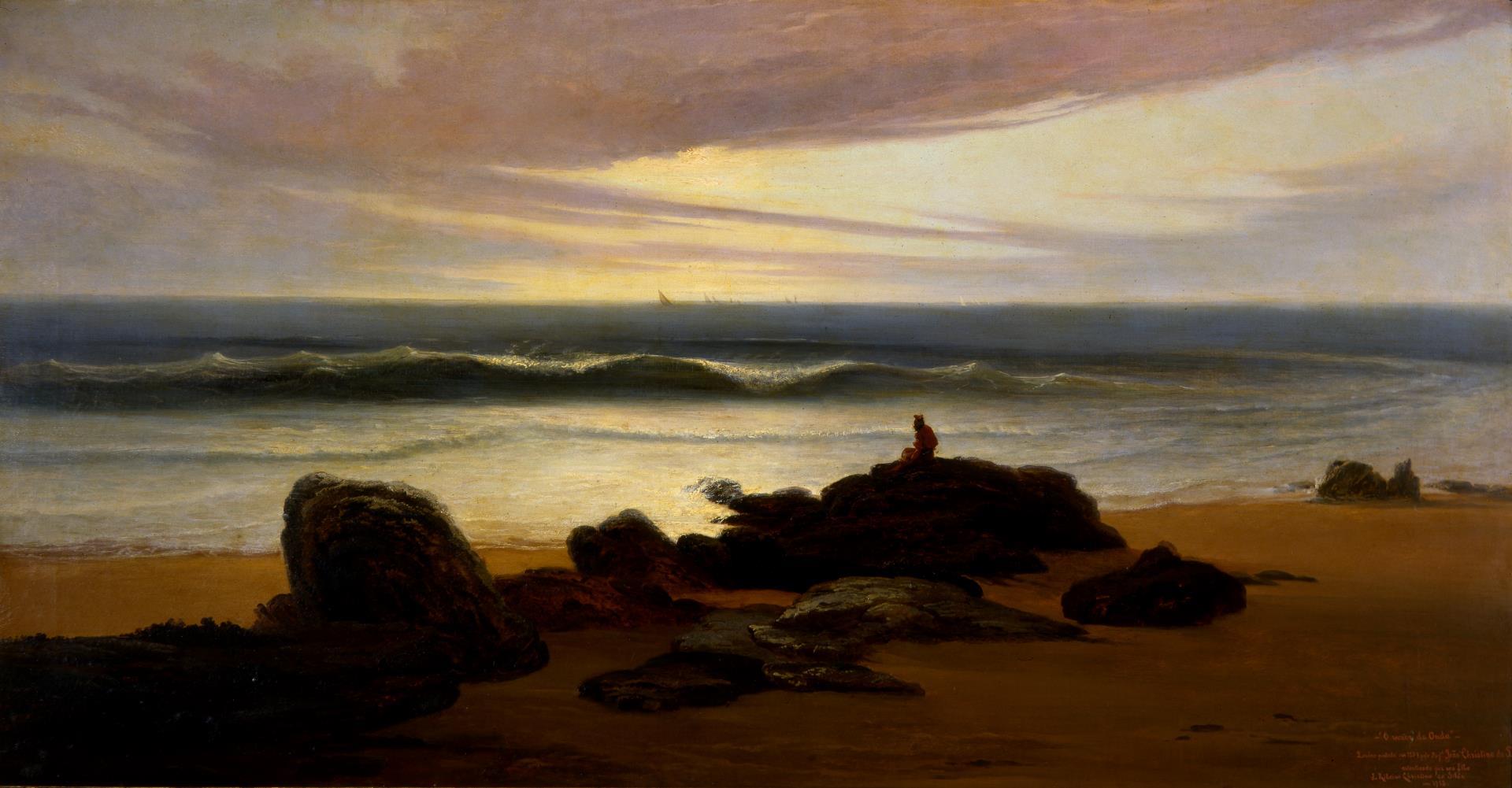
Recuar da onda, Inv. 82P469

Walden, 2014 / Inv. 14P1755

S/ Título, 2005/06 / Inv. 06P1387

Madrid - Vallauris, 1969 / Inv. 83P525

Ombre d'Aralia, Inv. GP2256

Do Subnaturalismo ao Sobrenaturalismo (Pintura Fria), Inv. 88P535

Sem título, Inv. 21P1951

Composition, Inv. 78PE99

Invisíveis Correntes, 2005 / Inv. 17DP4384

Invisíveis Correntes, Inv. 17DP4386

Invisíveis Correntes, 2005 / Inv. 17DP4385

Invisíveis Correntes, 2005 / Inv. 17DP4387

The First Step, 1995 / Inv. 17E1843

"Quadro Muito Doente", 1977 / Inv. 81P612

A Fuga, Inv. 04P1268

S/ Título, 1995 / Inv. 02P1283

S/Título (Pequena figura de esquiador com fundo amarelo), 1999 / Inv. 00P1032

S/Título (Pequena figura sobre fundo verde), 1999 / Inv. 00P1031

H2O, 2004 / Inv. 18IM93

White Star, 2009 / Inv. 18IM97

Path to the stars, Inv. 22IM111

O Ninho, Inv. P1472

S/Título, Setembro/Outubro 1999 / Inv. 99P798

S/Título, Fevereiro 1999 / Inv. 99P796

S/Título, Fevereiro 1999 / Inv. 99P797

S/Título, Setembro/Outubro 1999 / Inv. 99P799

Agrigento, Inv. 22FP757

Tour du Mont Blanc, Inv. 15E1788

UW84DC#14, Inv. EE65

Posta, Inv. 19P1906

Cabo da Roca (6 a.m.), Inv. 96FE56

Cabo Espichel, Inv. 96FE59

Biological Landscape, 1985-1987 / Inv. 90FE25