
Gallery
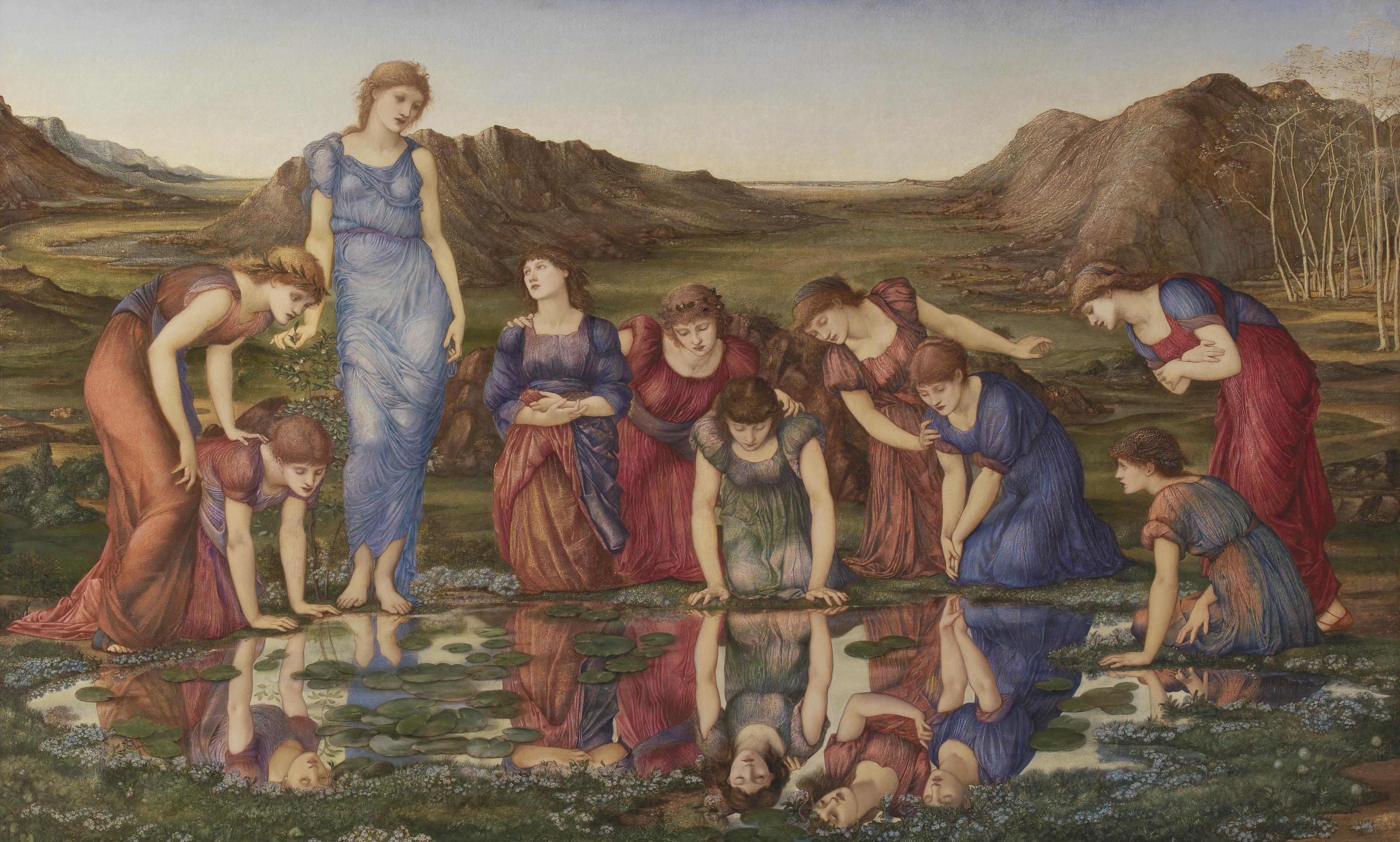
A member of the Pre-Raphaelite movement formed in England in 1848, which promoted the cult of medieval mysticism, Burne-Jones became one of the most well-known figures in the new genre of Aestheticism that appeared in the 1860s. The doctrinal principle of the new aesthetics defended the concept of ‘art for art’s sake’, independent from any moral content.
In this painting, the artist employs a minimal narrative discourse, distributing the poetic and dreamlike figures in a linear fashion, in the manner of a Greek-inspired frieze. More than merely a formal similarity of style, Burne-Jones is seeking a general Renaissance-style ambiance. Clearly suggesting Quattrocento, Botticelli in particular, the painting, an exaltation of ideal beauty, favours the decorative harmony of the whole and deliberately creates a nostalgic evocation of the past.
The composition derives from an illustration intended for The Hill of Venus, featuring in the poem The Earthly Paradise (1868–70), by William Morris, and inspired by the medieval legend of Tannhäuser.
Object details
- Author(s)
- Sir Edward Burne-Jones (1833 – 1898), Painter (artist)
- Title
- The Mirror of Venus
- Origin
- England
- Date
- 1875
- Technique
- Oil on canvas
- Materials
- Canvas; Oil
- Dimensions
- Height 120,00 cm; Width 200,00 cm
- Inventory no.
- 273
Incorporation
- Type
- Purchased
- Place
- London
- Provenance
- Frederick R. Leyland
- Intermediary
- Arthur Ruck
- Date
- 29 Oct 1924