
Octagonal pyx
Gallery
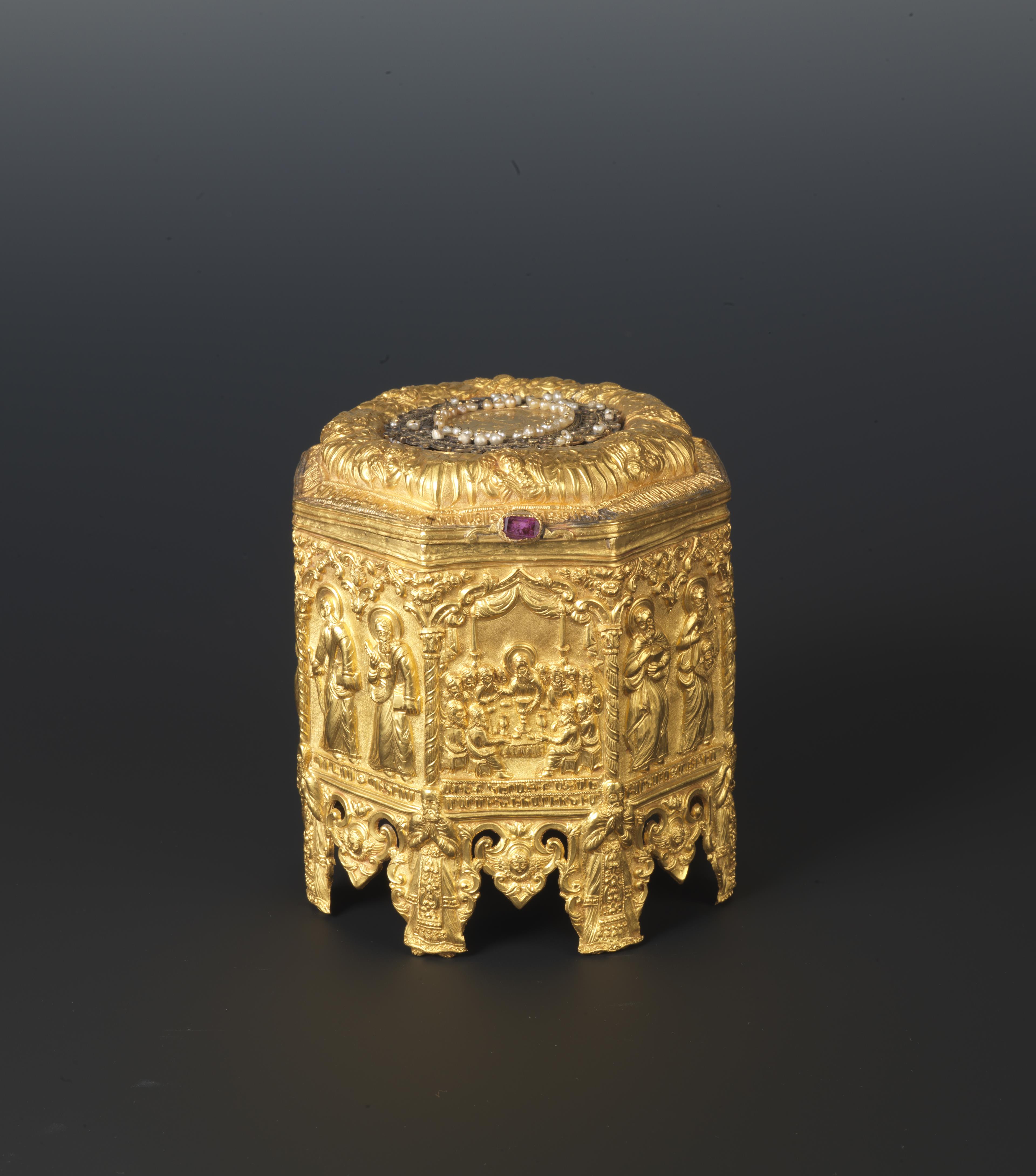
Calouste Gulbenkian (1869–1955) was an Armenian Christian whose paternal ancestors came from Kayseri (Anatolia). After his death, the Calouste Gulbenkian Foundation acquired this octagonal pyxis in his memory, made in Kayseri and signed by an Armenian artisan, named Sedrak. Moreover, an inscription dates its completion to a specific day, the coronation of Sultan Suleyman II, in 1687.
Made of gold, the front panel, carrying a garnet, illustrates the Last Supper, an appropriate scene for a container to hold the Holy Eucharist. On the opposite side, the Coronation of the Virgin appears, mirrored on the lid by an image of the Virgin surrounded by miniature pearls.
The remaining six panels show the Apostles in pairs. One set comprises: Matthias and John the Evangelist; Jude Thaddeus and Simon; James the Lesser and Saint Bartholomew. The other: Philip and Thomas; James the Greater and Saint Andrew; Saint Paul and Saint Peter.
Object details
- Title
- Octagonal pyx
- Origin
- Kayser
- Date
- 1687
- Materials
- Gold
- Dimensions
- Height 11,20 cm; Diameter 10,00 cm
- Inventory no.
- 2920