
'Coromandel' screen
Gallery
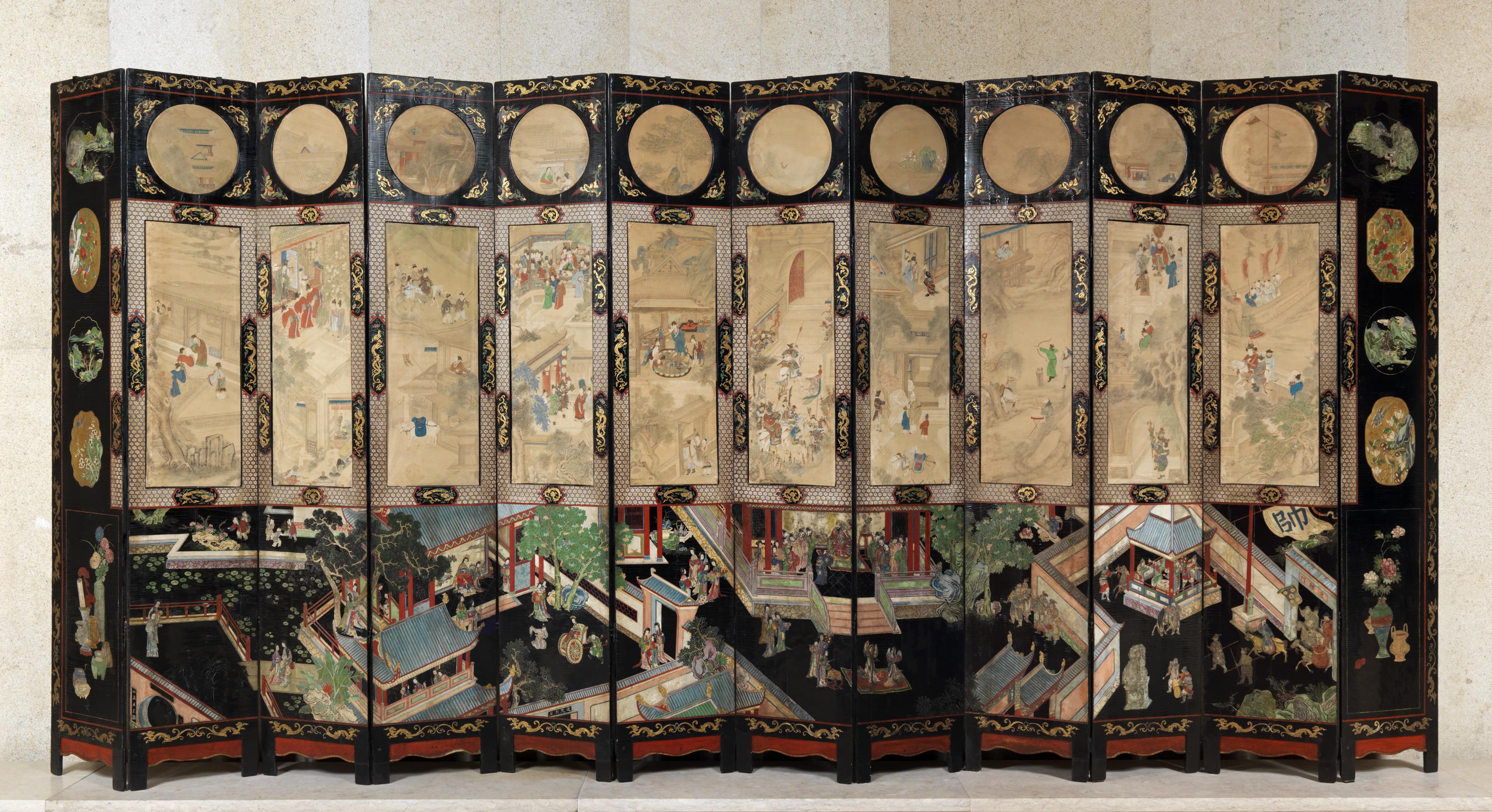
This screen is part of the ‘Coromandel’ type of lacquerware, which is the name given to pieces exported to the West via the Coromandel coast (on the east coast of India).
It has as its main theme episodes from everyday palace life. The piece is made up of 12 independent wooden panels – whose structure is joined by wooden pegs –, connected and fixed with copper alloy fittings. This framing technique is distinctive in that ten of the panels have paper mouldings on the top and calligraphy on the back, which is quite rare in these pieces.
This type of lacquering involved covering the wooden support with a layer of clay on plant fibres (or a piece of hemp), in order to homogenise the surface and prepare the ‘filler’ for the various layers of lacquer. After this preparation – the lacquer was carved [t’ien-ni] into the ‘black’ lacquer [t’ui kuang] with a previous design incised –, and the grooves filled with pigments of various colours [kuan cai].
Object details
- Title
- 'Coromandel' screen
- Origin
- China
- Date
- late 17th century
- Technique
- Urushi-e lacquer
- Materials
- Wood\Pine wood; Lacquer\Urushi lacquer; Paper; Wood\Cryptomeria wood
- Dimensions
- Height 283,50 cm; Width 618,00 cm; Depth 2,50 cm
- Inventory no.
- 1023
Incorporation
- Type
- Purchased
- Place
- London
- Provenance
- Christie's
- Intermediary
- Duveen
- Date
- 9 Dec 1920