
Gallery
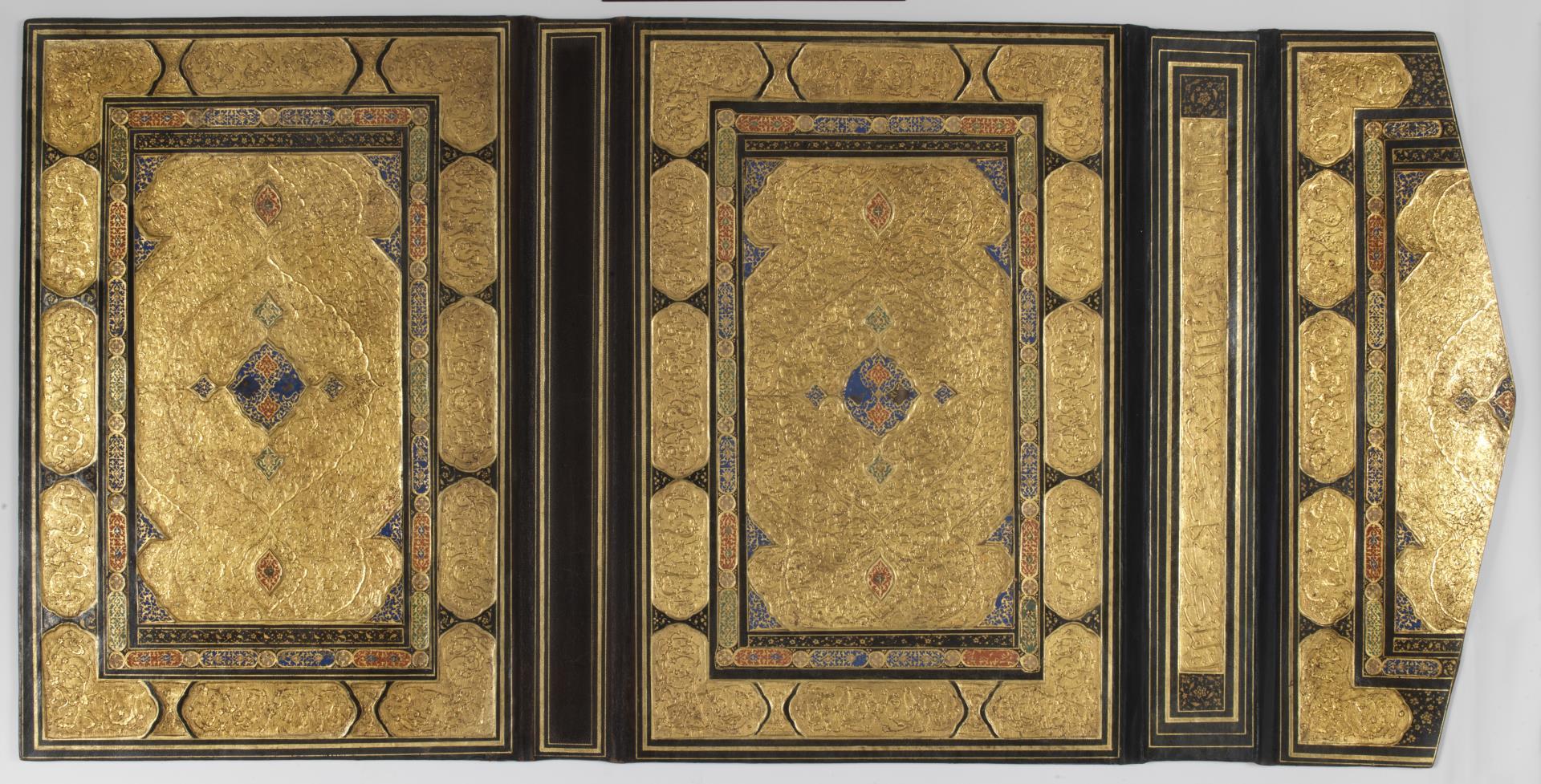
In 1912, Calouste Gulbenkian was invited to participate in the exhibition Miniatures persanes, at the Musée des Arts Décoratifs, Paris, where he presented a prized Safavid book cover of the type seen here.
Once all the folios of a book are complete, they are stitched into a binding. The lower cover typically has an extra flap that folds over the left side, when the book is closed. This ‘envelope flap’ is tucked under the upper cover, creating a sturdy box, and can also be used as a bookmark.
Leather bindings can be decorated in multiple ways. In this example, the exterior was stamped and then the relief surface was gilded. This same technique is used on the interior, but in combination with very fine filigree work, comprising patterns cut from thinly pared leather that is gilded and then laid over coloured grounds, in contrasting orange, green and cobalt blue.
Object details
- Title
- Bookbinding
- Origin
- Iran
- Date
- Safavid period, 16th century
- Technique
- Moulded and gilded leather; Filigrana
- Materials
- Leather; Gold
- Dimensions
- Height 49,50 cm; Width 34,00 cm (closed)
- Inventory no.
- R20