
Gallery
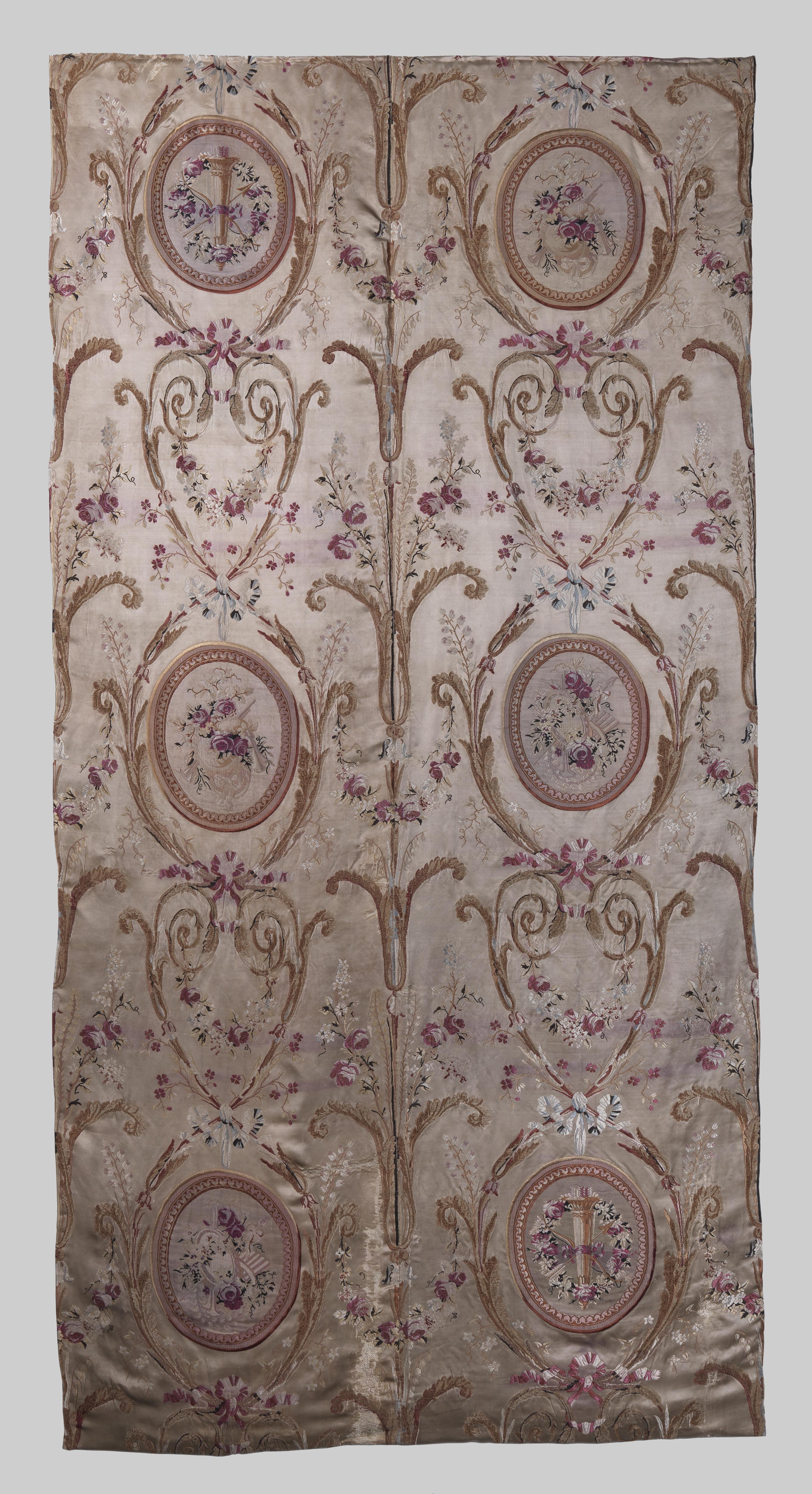
Floral decoration was a dominant feature in the eighteenth century, but from 1760 onwards, the classically influenced arabesque style began to be more commonly used. Jacques Gondoin, the king’s architect, designed this composition of arabesque acanthus scrolls punctuated with appliqué medallions. It was produced by Jean Charton, a master from a renowned family of weavers in Lyon.
Queen Marie Antoinette, for whom this fabric was made, was a great lover of nature, particularly flowers, which were always present in the pieces she commissioned. This fabric was commissioned for her chambers at Versailles and is an example of the finest produced in Lyon at this time.
This fragment was acquired by Calouste Gulbenkian in 1918, along with a considerable amount of the same silk, and lined the walls of a small room in his mansion in Paris.
Object details
- Author(s)
- Jean Charton (1743), Weaver
- Title
- Fabric fragment
- Origin
- Lyon
- Date
- 1779
- Materials
- Silk
- Dimensions
- Height 230,00 cm; Width 46,00 cm
- Inventory no.
- 1401
Incorporation
- Type
- Purchased
- Place
- London
- Provenance
- Coleção Sir John Scott
- Intermediary
- Desmond
- Date
- 14 Nov 1918