
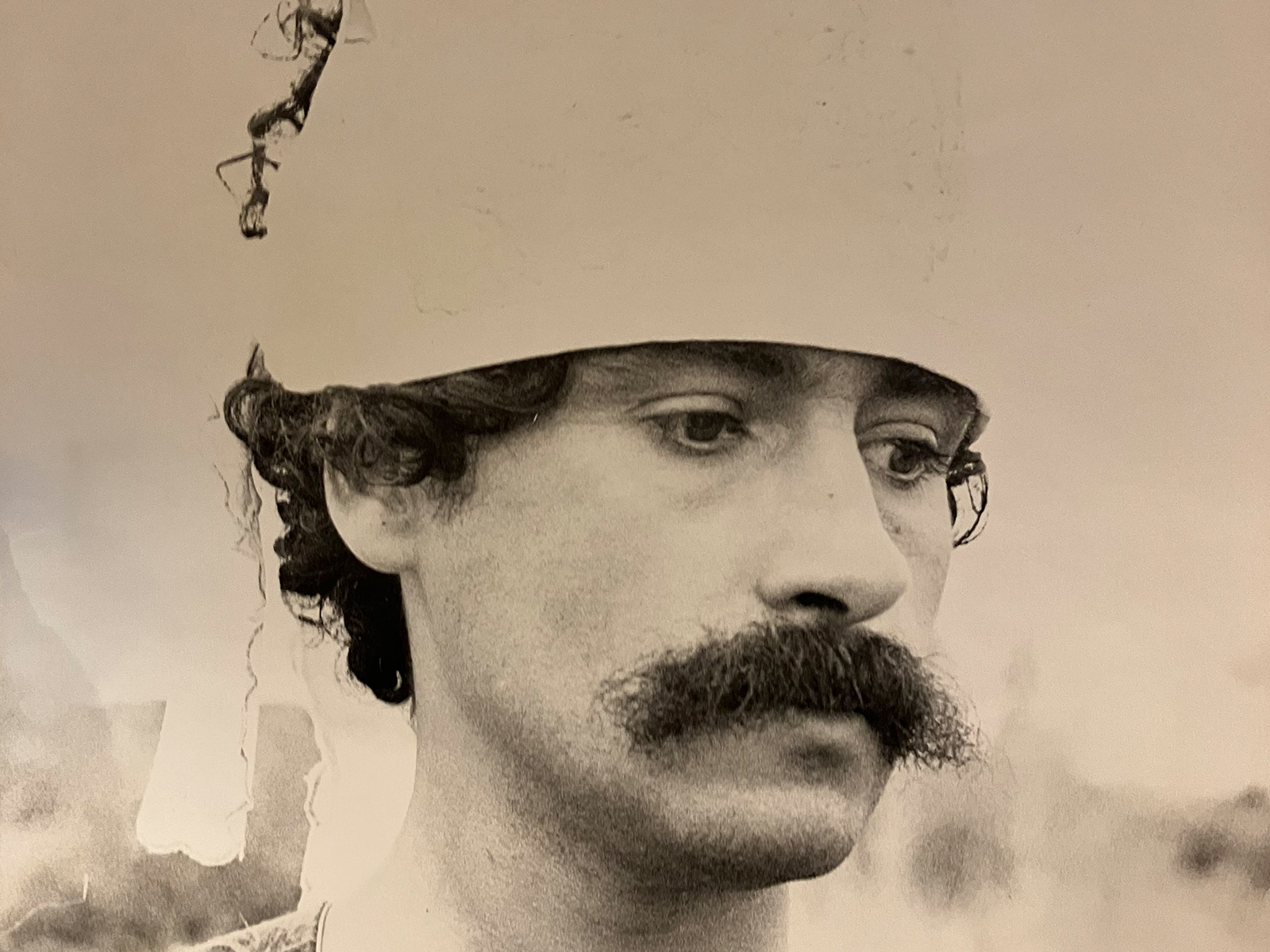
René Bertholo
1935 – 2005
The son of painter Augusto Bértholo, René Bertholo received his early artistic training at the António Arroio School of Decorative Arts (1947-1951). He attended the Lisbon School of Fine Arts until 1957, where he co-edited the student-run magazine Ver (1953-1955).
He began exhibiting in group shows, participating in the VII Exposição Geral de Artes Plásticas (1953), the I Salão de Arte Abstracta (1954), organised by the Galeria de Março, and in exhibitions at the Galeria Pórtico (1955-1957), where he held his first solo exhibition (1956) and which he helped revitalize alongside his colleagues and friends José Escada (1934-1980), Costa Pinheiro (1932-2015), Teresa Sousa (1928-1962), and Lourdes Castro (1930-2022). He shared a studio (1956), located above Café Gelo (in Rossio), with Escada, Gonçalo Duarte (1935-1986), and João Vieira (1934-2009), interacting with members of the so-called “Grupo do Gelo,” which included artists, poets, and writers such as (1923-2006), Herberto Helder (1930-2015), and Mário Henrique Leiria (1923-2008).
Shortly after his marriage to Lourdes Castro (1957), he first moved to Munich, and the couple later settled in Paris (1958). He was accompanied during these stays by his former friends and colleagues from Lisbon School of Fine Arts: Costa Pinheiro, José Escada, João Vieira, and Gonçalo Duarte. There, together with Lourdes Castro, he founded the magazine KWY (1958-1964), which gave origin to the group of the same name, in which everyone – plus the Bulgarian Christo (1935-2020) and the German Jan Voss (b. 1936) – participated.
While in Paris, he received notice that he had been awarded a grant from the Calouste Gulbenkian Foundation (1959 and 1960). During this time abroad, he held group exhibitions (with KWY or with Lourdes Castro) and solo exhibitions in galleries in various cities (Galerie 17, München, 1957; Galerie Soleil dans la Tête, Paris, [1961]; Galerie Dragon, Paris, 1963; 2000 Galleria d’Arte, Bologna, 1962; Galerie Mathias Fels & Cie., Paris, 1965; Galerie Birch, Copenhagen, 1968; Galerie Kückels, Bochum, 1969; Akademie der Künste, Berlin, 1973).
In the late 1960s, René Bertholo began developing and creating small electronically powered objects. This new creative path, combining art with electronics, led him to Berlin, where he attended the Deutscher Akademischer Austauschdienst (1972-1973). Alongside his creation of objects, the artist returned to painting and created works in public spaces (Barreiro Hospital, 1983).
He settled permanently in the Algarve (1982) and, until the 2000s, devoted himself to developing the Makina, a device consisting of a synthesiser and a programmable digital sequencer capable of recording and playing back sounds, thus, in a sense, building on his earlier works.
The Serralves Museum dedicated a retrospective exhibition to him in 2000, and that same year, his works were included in the exhibition Making choices at MoMA. His artwork is represented in various public and private collections in Portugal and abroad, including the Centro de Arte Moderna, the Museu Nacional de Arte Contemporânea, and the Serralves Museum.
René Bertholo passed away on June 10 in Vila Nova de Cacela, where he lived with his second wife, Elna Voss-Hellwig.
Related Resources
- René Bertholo’s Archival Collection in the Art Library catalogue
- Works by René Bertholo in the Art Library catalogue
- Works about René Bertholo in the Art Library catalogue
- Works by René Bertholo in the collection of the Centro de Arte Moderna
- René Bertholo in the History of Gulbenkian art exhibitions