
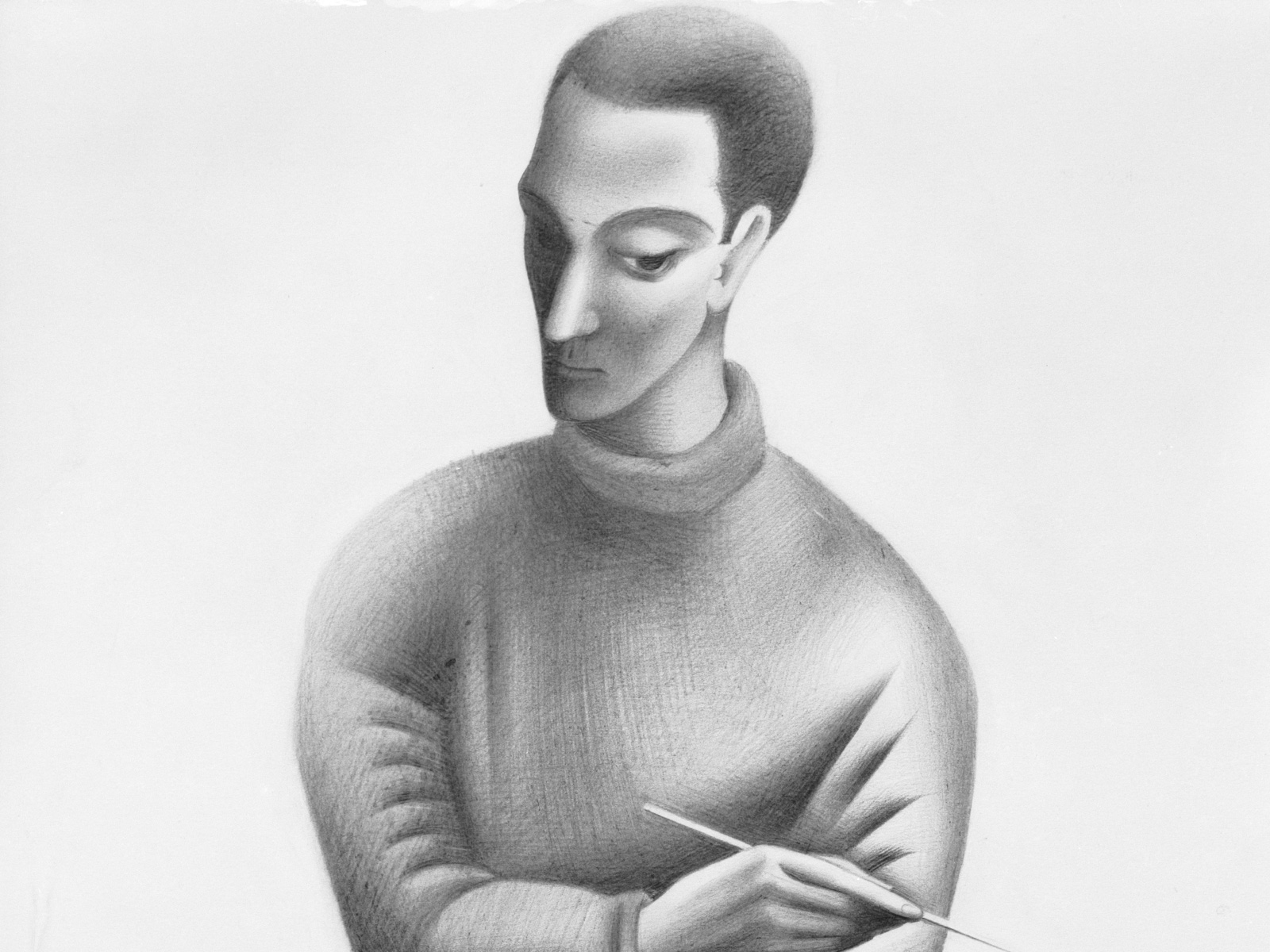
José de Almada Negreiros
1893 – 1970
José de Almada Negreiros was born on the island of São Tomé, where he lived during his early childhood. He lost his mother in 1896 and moved to Lisbon with his brother in 1900, attending the Jesuit College in Campolide as a resident student until it closed in 1910.
His artistic career began in 1911 with the publication of drawings and caricatures in humor magazines and his participation in the I Exhibition of Portuguese Humorists (1912). The following year, Almada held his first solo exhibition, after which he met Fernando Pessoa, and participated in the II Exhibition of Portuguese Humorists.
In 1914, he collaborated as artistic director on the monarchist weekly Papagaio Real, and in 1915 he contributed to the first issue of the magazine Orpheu, wrote A cena do ódio (1915), the Manifesto Anti-Dantas (1915), and Litoral (1916), as well as A engomadeira and K4 O Quadrado Azul (published in 1917).
His second solo exhibition took place in 1916 at the José Pacheco Art Gallery. In 1917, he presented the lecture Futurist Ultimatum to the Portuguese Generations of the 20th Century at the Teatro da República, contributed to the sole issue of the magazine Portugal futurista, and published a manifesto in support of Amadeo de Souza-Cardoso’s first exhibition in Lisbon, calling it “Portugal’s first discovery in Europe in the 20th century”.
In 1919, Almada left for Paris, where he lived until the following year. Upon his return to Lisbon, he held his third solo exhibition at the Teatro Nacional de São Carlos (Lisbon), where he presented drawings, he had made in the French capital and announced the manifesto-poem A invenção do dia claro (published in 1921).
Throughout the 1920s, he wrote and published Pierrot e Arlequim (1924), began writing Nome de Guerra (1925), participated in the Exhibition of the Five Independents (1923) and the First and Second Autumn Salons (1925 and 1926), and was one of the artists whose works were exhibited at Café A Brasileira (1925) and the Bristol Club (1926), both in Lisbon.
From 1927 to 1932, Almada lived in Madrid, participating in the local art and literary scene. Having settled permanently in Lisbon, he married the artist Sara Afonso (1934), published the Sudoeste notebooks, and produced the first studies for the stained-glass windows of the Igreja de Nossa Senhora de Fátima (1934).
Through the late 1930s, he painted, published drawings, illustrations, poetry, essays, and novels; he gave conferences and lectures; and he contributed frescoes and stained-glass windows to various buildings, including the Colonisation Pavilion at the Portuguese World Exhibition (1940) and the “Diário de Notícias” building (1936–1940).
During the 1940s, he created the paintings for Lisbon’s two ferry terminals: Alcântara (1943–1945) and Rocha do Conde de Óbidos (1946–1949). Among his public artworks, the mural decorations at the University City of Lisbon (1957–1961) and the panel Começar, created for the entrance lobby of the Calouste Gulbenkian Foundation’s headquarters (1968–1969), are also noteworthy.
Throughout his career, Almada contributed regularly to magazines and newspapers—including Athena, Contemporânea, Presença (1921–1951), Sempre fixe (1926–1935), and Diário de Lisboa (1921–1935)—with both texts and illustrations.
He researched the panels at São Vicente de Fora, discovering the perspective of the tiles, which led to their new museum display (1926).
His work has been the subject of several solo exhibitions, some of which were retrospective in nature, notably the one held at Galeria Março (1952), at the Secretariat of National Propaganda – Almada. Thirty Years of Drawing (1941) and at the Calouste Gulbenkian Foundation: Almada Negreiros (Centro de Arte Moderna, 1984) and Almada. A Way of Being Modern (2017).
His work is represented in several Portuguese public collections, including those of the Centro de Arte Moderna (CAM), the Armando Martins Museum of Contemporary Art (MACAM), and the National Museum of Contemporary Art (MNAC), and is also represented at the Reina Sofía National Art Center (Spain).
Almada Negreiros was awarded, among others, the Columbano Prize (1942), the Domingos Sequeira Prize (1946), the National Arts Prize (National Information Secretariat, 1959), and the Diário de Notícias Prize (1966). He was also awarded the distinction of Grand Officer of the Military Order of Santiago da Espada (1967).
Ana Barata, João Figueira